
Tags
forgiveness of sins, God, Jesus, mercy of God, Prayer, Psalm 130, Psalms, redemption, the LORD
Psalm 130
A Song of Ascents
Out of the depths I cry out to you, O LORD;
O Lord, hear my voice.
Let your ears be attentive to my cry for mercy.
If you, O LORD, kept a record of sins,
O Lord, who could stand?
But with you there is forgiveness;
therefore you are feared.
I wait for the LORD, my soul waits,
and in his word I put my hope.
My soul waits for the Lord
more than watchmen wait for the morning,
more than watchmen wait for the morning.
O Israel, put your hope in the LORD,
for with the LORD is unfailing love
and with him is full redemption.
He himself will redeem Israel
from all their sins. (NIV)
I have a secret to share. One of the reasons I love the psalms so much is because by reading them I can become a spiritual voyeur. The psalms let me see what most people hide. They take me gently by the hand and lead me into the inner sanctum of the human soul. Here I see men in travail with their God. Here I see the ecstasy of worship—joyous and unrestrained. Here I see everything laid bare before the One who sees all. Here I discover what it means to know God and be fully known by Him.
I come away saying, “So this is what loving God looks like. So, this is what it means to be in a soul-bonding relationship with the Maker of the universe.”
In the psalms we catch a glimpse of these intimate times with God, and we discover how these times can become our own. This is the Bible’s explicit, How-to-Manual for Intimacy with God.
Psalm 130 is a perfect example of a psalm that brings us into the private inner sanctum of communion with God. Here is a portrait of a fallen man—a man on his knees before his Maker, the eternal One. Hear him now as he agonizes in prayer, “Out of the depths I cry out to you, O LORD; O Lord, hear my voice. Let your ears be attentive to my cry for mercy.”

Photo by cottonbro on Pexels.com
The opening lines of this psalm leave little doubt as to what has transpired. The psalmist has failed; he has missed the mark. He has transgressed, yet again. There is an abject poverty of spirit reflected in these words—a poverty that almost makes us cringe.
We do not know what sin, or list of sins has brought the psalmist to this wretched state. The transgression is left unstated. Was it anger, malice, or unbridled lust? Was it pride, greed or wilful dishonesty? Was this a transgression of the mind, of the tongue, of action or inaction? Or was it some combination or permutation of all of these? God knows. We are left guessing.
But a forthright appraisal of my own soul leaves ample latitude for the scope and the severity of sin. I am always somewhat skeptical of those who sanctimoniously claim they could never commit this or that sin. I think we rarely comprehend the depravity of our own hearts. Pushed into wrong circumstances, in the wrong environment, with the wrong peer group, who can plumb the depths to which a man or woman may sink?
I am human, tainted by the fall, by the original transgression. I can identify with the psalmist. I have added my own pile of dung to this world’s heap of moral filth. I too have found myself in the psalmist’s position, sobbing out these words, “Out of the depths I cry out to you, O LORD; O Lord, hear my voice. Let your ears be attentive to my cry for mercy.” 
But … despite my failings, despite my moral poverty, this great God—this God of holiness—is approachable. He is a God of mercy. The psalmist reminds himself and the LORD of His merciful nature.
“If you, O LORD, kept a record of sins, O Lord, who could stand? But with you there is forgiveness; therefore you are feared.”
I need daily reminders of the mercy of God. God the moral accountant is also the Lord of forgiveness. No one does forgiveness better than God. He destroys the record. What accountant does that?
It is income tax time right now, as I complete this manuscript. So, I find myself caught between completing this book and completing my tax return. My accountant always insists that I keep all my receipts, all my records, and every slip of paper. He warns that at some point in the future the revenue department may decide to do an audit of my tax account.
But with God there is no future audit. Every sin I have brought to Him has been erased. It’s been destroyed. The LORD has no record of it. He can’t find it, and He’s not even looking for it. It’s gone. Gone forever!
Wow! What an amazing God! He makes sins disappear. He keeps no records. He is a forgiving God; hence He is feared. The psalmist clearly states, “But with you there is forgiveness; therefore you are feared.”
Now that is a rather curious statement. The forgiveness of God produces in us a reverent fear of the Great Forgiver. We respect, honor, and worship the LORD because He forgives—not because He mocks us for our errors, and slams us into the jail cell of guilt. No, just the opposite is true. God forgives, not once or twice, but repeatedly. He forgives on day one thousand just as freely as He did on day one. He has no remembrance of our first offence. He has no record of it. A purposeful, divine senility has set in. Yet the Ancient of Days is still omniscient; He knows everything. He chooses to forgive me, and to see me as faultless. I have an unblemished record, because there is no record of my wrongs.
Because He forgives, I love Him. Because He forgives, I fear Him, and I will serve Him all the days of my life. He is a shelter for the fallen. He is help for the failing. He is an anchor for the wayward. When I cry out from the depths, He hears. The LORD is there.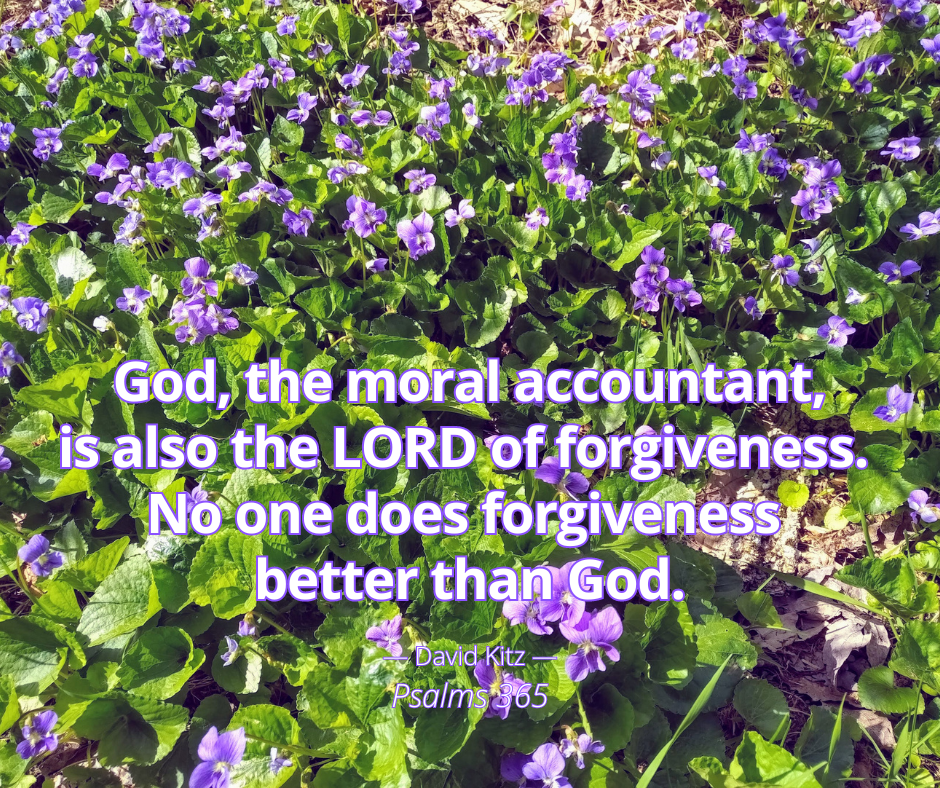
And He is here now. He listens. He is listening to your thoughts. His Holy Spirit convicts us of sin and then wrenches us into alignment with the Almighty. Yes, the gentle Holy Spirit forces us into soul-altering repentance. By forcing us, I mean the Spirit works on our stubborn, hell-bent will until we yield to the will of God. This is the soul-wrenching experience of every God-encountering believer, and we are witnessing such an encounter here within this psalm.
Psalm 130 can be divided into three distinct sections: the confessional approach, the wait, and the LORD’s response. Thus far, we have been looking at the confessional approach. The psalmist comes before his God and pours out his heart. In desperation he pleads for mercy and forgiveness. At the same time, he acknowledges the extreme mercy of God. He knows full well that this God forgives the undeserving.
Now, the psalmist waits.
“I wait for the LORD, my soul waits, and in his word I put my hope. My soul waits for the Lord more than watchmen wait for the morning, more than watchmen wait for the morning.”
This is the step that is most frequently missing in our communion with God. We cannot wait. We rush on. We have things to do, people to see, a life to live. We have no time to wait for the LORD’s response.
But without waiting, we cannot hear the LORD speaking to our hearts. The rush of life takes over. We do not hear Him speak the words of divine pardon. We do not hear the voice of our Saviour. Prayer is reduced to one way communication. We speak into the silence and allow no time for the God of silence to answer back. By our actions we insist that God must respect our timetable.
How many times has the LORD tried to call you and all that He has heard from your end of the line is an annoying busy signal? Will our merciful God continue to call?
What a different response we see from the psalmist. “I wait for the LORD, my soul waits, and in his word I put my hope. My soul waits for the Lord more than watchmen wait for the morning, more than watchmen wait for the morning.”

Misty morning sunrise — Orleans, ON — photo by David Kitz
The repetition of that last line adds a certain gravity to every word. There is resolute determination in these words. I can hear the psalmist saying to himself, “I’m not going anywhere until the LORD answers. I need to hear His voice for myself. I need to hear the pardon from His lips.”
In this time of waiting, the psalmist turns to the written word of God. He states, “In his word I put my hope.”
Where do you turn as you wait for God to answer your prayers?
Turn to God’s word. Read it. Meditate on it. Let it fill your soul. From the pages of His word, God speaks. Put your hope in God’s enduring word.
Now in Psalm 130, we encounter the third transition within the poetic structure of this psalm. There is a one-line break and then the psalmist continues. There is a dramatic change from this point on. Here is the third section—the LORD’s response. The psalmist is no longer addressing the LORD in humble prayer. Now he is addressing us. It is as though the psalmist has heard from God within that blank line on the page. The waiting is over. God has spoken, and now the psalmist rises to his feet. He has a message from the LORD for us—the Israel of God.
“O Israel, put your hope in the LORD, for with the LORD is unfailing love and with him is full redemption.”
For Israel, there was a long wait. The promised Messiah was a long time in coming. The centuries slipped by. Generation after generation passed on, but the word of the LORD stood firm. A redeemer was coming. The ongoing question remained, “Will he come in my day? Will I see his face?”
With an uncanny accuracy the Old Testament prophets foretold the coming of the Christ. Many of those prophesies are found within the Book of Psalms. In Psalm 22, with agonizing detail, David portrayed Christ’s suffering on the cross. Jesus himself drew attention to this prophetic link, as he cried out from the cross, “My God, my God, why have you forsaken me?” (Psalm 22:1; Matthew 27:46).
Now speaking with personal assurance that his sins are forgiven, the psalmist declares, “O Israel, put your hope in the LORD, for with the LORD is unfailing love and with him is full redemption.”
The LORD is our fount of hope. He is love and the source of unfailing love. It is He who will redeem us, body, soul and spirit.
“He himself will redeem Israel from all their sins.”
This is not a job for sacrificial lambs and goats, or the ashes of a heifer. The LORD “himself will redeem Israel from all their sins.”
What a revelation! Redemption in the old covenant involved the shedding of blood. From the time of the first Passover, the firstborn of Israel belonged to the LORD. They were to be redeemed by an animal sacrifice. But here through the voice of the psalmist the LORD makes clear that the old sacrificial system will be superseded. “He himself will redeem Israel from all their sins.”
The God of heaven will come in person—He Himself. He will come in human form and stretch out His hands to draw all humanity to Himself—every infant, every girl and boy, every woman and man—all are included. He will Himself redeem us from our sins. He will take the spikes on our behalf, in our stead. He will bleed for us. The remedy for sin will be found at the foot of the cross.
The psalmist closing words echo Abraham’s words on the way to Mount Moriah, the hill of sacrifice. Abraham told Isaac, “God himself will provide the lamb for the burnt offering, my son” (Genesis 22:8).
God Himself will provide. He will provide Himself. He will provide “the Lamb of God, who takes away the sin of the world” (John 1:29).

Photo by Kat Jayne on Pexels.com
So through the psalms, this spiritual voyeur is brought from beneath the starry hosts to the most intimate place—the place of the cross. There water and blood flowing mingling down. Filthy and naked I come, and there I am washed clean—clean by the blood of the Lamb.
Bringing Life to the Psalms
- In what respect are the psalms a How-to-Manual for Intimacy with God? Do you agree or disagree with this description?
- Take time to consider the three sections of this psalm, the confessional approach, the wait, and the LORD’s response. Can this become a pattern for your own times of prayer?
- There is a prophetic element to this psalm. Where does that prophetic element come from? Does it come from waiting on God? Read Psalm 22 and reflect on the revelation given to David in that psalm.
- Take time to read Genesis 22. Read it from a father’s perspective. Then read it from Isaac’s perspective. Finally try to view this account from our heavenly Father’s perspective. What do you believe was God’s intent in all of this?
- Rejoice. The LORD Himself has stretched out His hands and redeemed you from all your sins.
Today’s post is Chapter 26, the last chapter from the book Psalms Alive! Connecting Heaven & Earth by David Kitz. To find out more or purchase click here.
 I love the Psalms