I will praise Him!

1955 — Children are a heritage from the Lord — photo by Wanda Kitz

22 Sunday Jul 2018
Posted in Bible, God's word, Psalm 127, Psalms
1955 — Children are a heritage from the Lord — photo by Wanda Kitz
21 Saturday Jul 2018
Posted in Bible, God's word, Psalm 126, Psalms

Like streams in the Negev — photo by David Kitz
20 Friday Jul 2018
Posted in Bible, Devotionals, God's word, Psalm 124, Psalms
Reading: Psalm 124
A song of ascents. Of David.
If the LORD had not been on our side—
let Israel say—
if the LORD had not been on our side
when people attacked us,
they would have swallowed us alive
when their anger flared against us;
the flood would have engulfed us,
the torrent would have swept over us,
the raging waters would have swept us away.
Praise be to the LORD,
who has not let us be torn by their teeth.
We have escaped like a bird
from the fowler’s snare;
the snare has been broken,
and we have escaped.
Our help is in the name of the LORD,
the Maker of heaven and earth (NIV).

Petrie Island, Ottawa, Canada — photo by David Kitz
Reflection
We live in a highly competitive world, and I’m not just talking about sports. Businesses compete for customers; advertisers compete for eyeballs; corporations strive for a competitive advantage. Nations jockey for leadership and influence on the world stage.
Now here is a question for you. In all this does the LORD take sides? Is He rooting for my football team—my business—my city—my country? Is He a Blue Jays fan, a Patriots fan, or is He rooting for Real Madrid? Will He be tuned into the big game?
Let’s tackle the easy question first. Yes, the LORD will be tuned into the Super Bowl game, the World Cup final, and the World Series. But He will also be watching a cricket match in Mumbai and a pick-up hockey game at an outdoor rink in Moose Jaw, Saskatchewan. Oh, and let’s not forget that newborn taking its first breath in a tin-roofed shack in Tanzania, or the grandma drawing her last breath in a hospital in Sweden. The LORD will watch it all.
Yes, but whose side will He be on? Actually, according to Psalm 124, that too is an easy answer. The LORD is on our side. If the LORD had not been on our side—let Israel say—if the LORD had not been on our side when people attacked us… the raging waters would have swept us away.
The LORD is always, always, always on our side. He is rooting for you. Three iron nails in a wooden cross drive home that point far better than words on a page or a screen. The real question is, and always has been, whose side are you on? Are you on the LORD’s side? Are you His man? Are you His woman?
Response: LORD God, I am so thankful that you are on my side, on the side of your redeemed people. This is my confession: Our help is in the name of the LORD, the Maker of heaven and earth. Amen.
Your Turn: Are you a sports fan? Are you on the LORD’s side?
19 Thursday Jul 2018
Posted in News Reports, Ottawa Christian Writers
Tags
Athens, David Kilgour, Erdogan, refugees, turkey, Turkish refugees
It’s not often that accidentally dropping your hat at a public event leads to a trip to Athens, Greece. But that’s exactly what happened to award-winning author David Kitz.
![IMG_0901[3555] (3) (1)](https://davidkitz.blog/wp-content/uploads/2018/07/img_09013555-3-1.jpg?w=300&h=225)
David Kitz in front of the Parthenon in Athens
“Suddenly, I felt a light tap on my back as a gentleman handed me my hat,” Kitz recounts.
“You dropped this,” the gentleman offered.
“A discussion followed and I discovered that this man, Omer Livvarcin, had a few months earlier fled Turkey following the coup attempt.”
Livvarcin explained, “I was a high-ranking officer in the Turkish navy, but following the coup everyone in the military was under suspicion. My wife’s private school in Ankara was shut down and all the teachers were dismissed. Life was becoming very difficult for us. Many of our friends were arrested. We were sure we would be next. That’s why we fled to Canada.”
After that chance meeting, Kitz and Livvarcin kept in touch. “I was troubled by the news coming out of Turkey,” Kitz explained.

Human rights advocate — David Kilgour
In early June of this year that interest in Turkish refugees led to a call from former MP and cabinet minister, David Kilgour. Two months earlier Kilgour had been on a fact-finding mission to Athens with US members of Congress. Kilgour described the human rights abuses of the Turkish Erdogan regime as “absolutely deplorable.”
Kilgour was asked to make a return trip to Athens to advocate for the Turkish refugees stranded there, but prior commitments made that trip impossible. That’s when he called on David Kitz to go in his place.
“The four-day trip was a real eye-opener,” Kitz states.
He explains, “The Turkish refugees fell into three broad categories: journalists, teachers and intellectuals.”
“The first interview was with a senior level journalist with Zaman, the biggest daily newspaper in Turkey. In 2013, Zamon reported that truckloads of armaments were crossing from Turkey into Syria in support of ISIS fighters. The Erdogan government’s response was swift. The newspaper’s assets were seized and the journalists were arrested.
“The next day we met with a university professor and engineer, Yunus Karaca. Karaca patented an award-winning system for separating glass, metal and plastics for municipal recycling. Yet despite numerous accolades including from NASA, his career has been stifled. His passport was cancelled by the Turkish authorities, and fearing arrest, he fled with his young daughter to Greece.”

Teachers’ faces hidden for the safety of family members still in Turkey
But the most gripping interviews were with teachers, some of whom were imprisoned for a year or more with as many as 28 men crammed into a cell.
The leader of a teachers’ union told Kitz that the 30,000 members of his union lost their jobs, and then they were systematically arrested and imprisoned for being members of a terrorist group.
Families have been wrenched apart. They live in dread of police arriving at their door. Many are in hiding. To escape they make a dangerous night-time crossing by river into Greece.
Kitz states, “Their stories affected me deeply. I returned to Ottawa with a determination to raise awareness here and across Canada.”

Omer Livvarcin
As for Omer Livvarcin, he is a poster child for what an asylum-seeking refugee can bring to this country. After escaping with his family and little else, he now is a part-time professor at the University of Ottawa’s Telfer School of Management. He heads up two projects doing research on artificial intelligence (AI).
“Canada opened its doors to me. Now I want to give back. By using AI in military procurement I believe we can design a process that can save taxpayers hundreds of millions of dollars.”
His second research project involves using AI to benefit the charitable and non-profit sector.
“Again,” Livvarcin states, “for me this is about gratitude—about giving back.”
You never can tell where unexpected events—like a failed coup or a dropped hat—might take you.
19 Thursday Jul 2018
Posted in Devotionals, God's word, Psalm 123, Psalms
Reading: Psalm 123
A song of ascents.
I lift up my eyes to you,
to you who sit enthroned in heaven.
As the eyes of slaves look to the hand of their master,
as the eyes of a female slave look to the hand of her mistress,
so our eyes look to the LORD our God,
till he shows us his mercy.
Have mercy on us, LORD, have mercy on us,
for we have endured no end of contempt.
We have endured no end
of ridicule from the arrogant,
of contempt from the proud (NIV).

Petrie Island morning — photo by David Kitz
Reflection
Like every parent, I have had moments when I have needed to correct my children. In my professional life as a teacher, correcting a child’s behavior was a daily, sometimes minute-to-minute occurrence. In such situations eye contact is crucial. If the child does not make eye contact with you, you are wasting your breath. Your advice—your admonition—your warning—is going nowhere. You might as well speak to the wind. But in such situations, it is essential that you speak to the heart of the child.
The eyes are the window of the heart. When someone is avoiding eye contact, in reality they are hiding their heart. They are closing their heart to you.
Of course the same principle is true when we consider our relationship with God. We need to make eye contact with the LORD. That’s why there is something truly intimate about this psalm. It’s all about making eye contact with God. It’s about opening your heart to the LORD and exposing what is deep inside you. You are showing when you lift your eyes to Him that you are ready to receive instruction. Yes, and correction too, if that is needed.
So the psalmist speaks these words: I lift up my eyes to you, to you who sit enthroned in heaven. He takes the position and the posture of a slave—a humble servant. He is looking for mercy—hoping for grace and blessing from the hand of His master.
This is perhaps the most intimate of the Songs of Ascent. Having come a great distance, the pilgrim is now in the LORD’s house. He has drawn nigh in the fullest sense. The pilgrim lifts his eyes—not to an idol, but to the LORD—the One who fills all, formed all, and transcends all. With eyes wide open he exposes his heart to God. He waits expectantly for the LORD’s instruction.
Prayer at its best is modelled for us in this psalm. It’s prayer with our eyes wide open to God. We are looking to Him for mercy, comfort, strength and direction.
Response: Father God, I come before you now. I lift up my eyes to you, to you who sit enthroned in heaven. Be merciful to me. Speak to me. Correct me, if I need correction. Give me direction. I am ready to receive instruction from you. I am your servant. Amen.
Your Turn: Are you drawing nigh to God? How do you make eye contact with God?
18 Wednesday Jul 2018
Posted in Devotionals, God's word, Psalm 122, Psalms
Reading: Psalm 122
A song of ascents. Of David.
I rejoiced with those who said to me,
“Let us go to the house of the LORD.”
Our feet are standing in your gates, Jerusalem.
Jerusalem is built like a city
that is closely compacted together.
That is where the tribes go up—
the tribes of the LORD—
to praise the name of the LORD
according to the statute given to Israel.
There stand the thrones for judgment,
the thrones of the house of David.
Pray for the peace of Jerusalem:
“May those who love you be secure.
May there be peace within your walls
and security within your citadels.”
For the sake of my family and friends,
I will say, “Peace be within you.”
For the sake of the house of the LORD our God,
I will seek your prosperity (NIV).

“May those who love you be secure.” — photo by David Kitz
Reflection
This third psalm in the Song of Ascents series is a psalm of arrival. The pilgrims have arrived at Jerusalem the destination of their pilgrimage. The following statement makes it clear that the weary travelers have arrived: Our feet are standing in your gates, Jerusalem. Jerusalem is built like a city that is closely compacted together. That is where the tribes go up—the tribes of the LORD—to praise the name of the LORD according to the statute given to Israel.
It should be noted that this pilgrimage to Jerusalem was not merely an event for the occasional tourist. As the psalmist states, he came to praise the name of the LORD according to the statute given to Israel. In fact, this pilgrimage to the holy city was required according to the Law of Moses. Three times a year all your men are to appear before the Sovereign Lord, the God of Israel. I will drive out nations before you and enlarge your territory, and no one will covet your land when you go up three times each year to appear before the Lord your God (Deuteronomy 34-23-24).
Our Lord and Savior, Jesus Christ, frequently made this journey to fulfill the requirements of the Law. The first reference to this pilgrimage is found in the account of the twelve-year-old Jesus remaining in the city after his parents had left to return to Galilee (Luke 2:41-50). His last pilgrimage to celebrate the Passover ended with his crucifixion and resurrection.
With the psalmist we join in praying for the peace of Jerusalem, and peace within the church of God.
Response: Father God, we pray for your peace—the shalom of God. May your peace come to Jerusalem, and to all of Israel, and especially to all the followers of your dear son, Jesus, the living Christ. Amen.
Your Turn: Do you regularly pray for peace in the house of the LORD our God?
17 Tuesday Jul 2018
Posted in Devotionals, God's word, Psalm 121, Psalms
Tags
hills, Jericho, Jerusalem, pilgrimage, pilgrims, Songs of Ascent, strength
Reading: Psalm 121
A song of ascents.
I lift up my eyes to the mountains—
where does my help come from?
My help comes from the LORD,
the Maker of heaven and earth.
He will not let your foot slip—
he who watches over you will not slumber;
indeed, he who watches over Israel
will neither slumber nor sleep.
The LORD watches over you—
the LORD is your shade at your right hand;
the sun will not harm you by day, nor the moon by night.
The LORD will keep you from all harm—
he will watch over your life;
the LORD will watch over your coming and going
both now and forevermore (NIV).
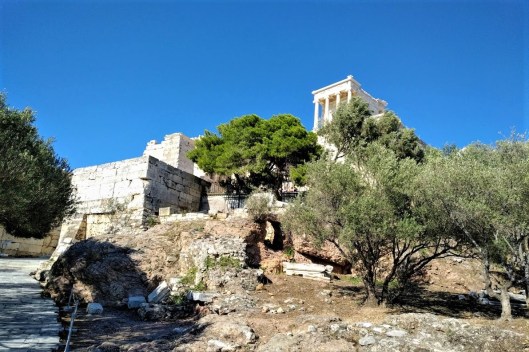
The ascent to the Acropolis, Athens, Greece — photo by David Kitz
Reflection
Psalm 121 is the second Song of Ascents, and as such it was a psalm, which was intended for use by pilgrims as they journeyed to Jerusalem. This particular psalm was most often sung or chanted as the pilgrims set out from Jericho. As they lifted up their eyes, the sharply rising hill country of Judah stretched off into the distance. Hill after hill rose up before them. Jesus often made this journey to Jerusalem from his youth (see Luke 2:41-52) until his final Passover pilgrimage (see Luke 19).
This final portion of the pilgrimage was truly an ascent. From the Dead Sea plain the road to Jerusalem climbs nearly five thousand feet—1600 meters. This is truly an ascent—an ascent from the Dead Sea plain, the lowest point on the earth’s surface, to the heights of Mount Zion.
For the bone-weary pilgrims, who had already walked more than one hundred kilometers (60 miles) from Galilee, the sight of those distant hills must have brought a measure of aching discouragement. Here was a looming challenge. Could they make this final ascent? The opening question of this psalm was not a matter of poetic whimsy. It was spoken in earnest. I lift up my eyes to the mountains—where does my help come from?
The weary pilgrim may well be asking, “Having come this far, can I complete this journey? Do I have enough energy—enough stamina to climb those hills? Will I be able to reach Zion? I am exhausted now—before I even start the ascent. I can’t do this on my own. Where does my help come from?”
The psalmist’s answer resounds off those ancient hills. Even today, it echoes down through the ages and reverberates through the chambers of the heart. My help comes from the LORD, the Maker of heaven and earth.
Response: Father God, I am on a lifelong journey—a pilgrimage to the heavenly Jerusalem. When I become weary, give me strength. I need your help. I know my strength comes from you, LORD. Amen.
Your Turn: Do you need strength? Have you become weary at times in serving the Lord?
16 Monday Jul 2018
Posted in Devotionals, God's word, Psalm 120, Psalms
Tags
lament, Mount Zion, peace, pilgrimage, pilgrims, Songs of Ascent
Reading: Psalm 120
A song of ascents.
I call on the LORD in my distress,
and he answers me.
Save me, LORD, from lying lips
and from deceitful tongues.
What will he do to you,
and what more besides,
you deceitful tongue?
He will punish you with a warrior’s sharp arrows,
with burning coals of the broom bush.
Woe to me that I dwell in Meshek,
that I live among the tents of Kedar!
Too long have I lived
among those who hate peace.
I am for peace;
but when I speak, they are for war (NIV).

What are the Songs of Ascent? Early morning in Grey Nuns Park, Orleans, ON — photo by David Kitz
Reflection
Psalm 120 is the first in a series of fifteen psalms that are called Songs of Ascent. Each psalm begins with this statement or title: A Song of Ascents. Some of the psalms also add this phrase: Of David.
Of course, this title begs the question, what are the Songs of Ascent? And furthermore, to what are we ascending? This compilation of fourteen psalms was composed for the use of pilgrims who were making their way to worship at the temple in Jerusalem. These are psalms of pilgrimage. They are called Songs of Ascent, or Psalms of Ascent, because Jerusalem is built on a high point in the land of Israel. Specifically, the temple compound was constructed at the summit of Mount Zion, so pilgrims were literally and figuratively ascending to worship at the House of God.
This first psalm in the series is really a lament. The psalmist is living in a distant place—a place far from God. All of us begin our pilgrimage—our journey to God—from a distant place. Just like the prodigal we find ourselves in a distant land, a land where there is no peace. Sin has its fleeting pleasures, but it brings no lasting peace, no deep contentment. We have wandered far from the Father’s warm embrace. The psalmist laments, “Woe to me that I dwell in Meshek, that I live among the tents of Kedar!”
The Songs of Ascent are all about drawing near to God. They are about going to the heart of worship and finding peace—true peace in the arms of God. But first we must recognize where we are. We are dwelling in Meshek—in a world far from the LORD. We need to acknowledge our true condition. Change happens when we recognize the truth about ourselves and our need for a Savior. Only then can we begin our journey toward peace.
Have faith in this promise. I call on the LORD in my distress, and he answers me.
Response: Father God, today I am continuing my journey toward you. Lord Jesus, I need you as my Savior. Help me set aside those things that hinder my journey to intimacy with you. Amen.
Your Turn: Are you living in Meshek? Have you begun your pilgrimage to arms of the Father?
15 Sunday Jul 2018
Posted in Bible, God's word, Psalm 125, Psalms
Tags
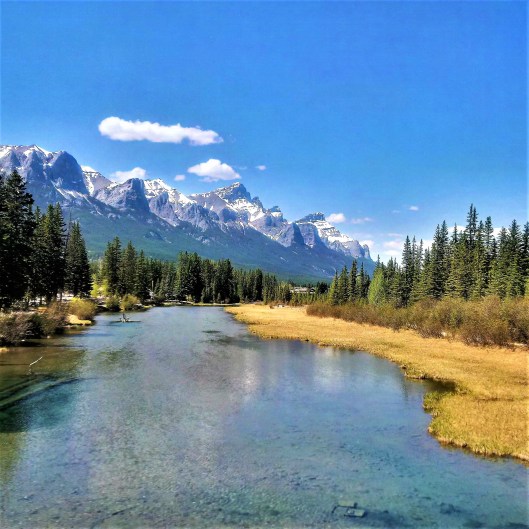
Policeman Creek, Canmore, Alberta, Canada — photo by David Kitz
14 Saturday Jul 2018
Posted in Devotionals, God's word, Psalm 124, Psalms

Mother duck, Nagoya, Japan — photo by David Kitz
 I love the Psalms