
Tags
Bible, David, God, good shepherd, Jesus, Prayer, Psalm 23, Psalms, Righteousness, sheep, shepherd, the LORD
Psalm 23:1-3
A Psalm of David
The LORD is my shepherd,
I shall not be in want.
He makes me lie down in green pastures;
He leads me beside quiet waters.
He restores my soul.
He guides me in paths of righteousness
for his name’s sake.
Yesterday I went for a long walk and pleasant walk through Lincoln Park, which straddles Lake Michigan in Chicago. It was a perfect summer day. Children were playing on the long sandy beach. Waves danced in the sunlight.
From that weekday afternoon stroll, several visual vignettes remain cemented in my mind. There were the four strapping young men caught up in a game of beach volleyball. Another fine-looking young man rolled by me on his bicycle. Later I saw him stretched out on the seawall, stripped to his shorts, perfecting his tan. Down by the marina, two attractive young ladies in bathing suits were in animated conversation as I walked by. One of them even glanced my way. Farther on, sitting on a park bench, a first-time father dandled and bounced his blond two-year-old on his knees. The beaming lad greeted me with a smile that simply invited conversation. Still at the marina, a middle-aged couple parked their Cadillac SUV. Later I saw them sail their yacht out of the bay. It was a perfect day for sailing.
Ah, the good life! There’s nothing like it. People in pursuit of the good life, that’s what I was watching. In fact, that’s what I, myself was enjoying—a slice of the good life.
The truth is all of us want the good life. Is that a wrong desire? Or is it simply the way God made us. We want a life filled with pleasant experiences—a life we can look back on and say, “Now that was a life worth living. That was a good life!
Somehow many of us have developed a rather perverse view of God. Isn’t He that supreme killjoy in the sky? Doesn’t He get His kicks by shutting down anything resembling fun? We have this sense that if we are enjoying ourselves too much, God somehow can’t be in it. Has God become for you a severe, demanding taskmaster?

Gatineau & Ottawa from the Chief William Commanda Bridge — photo by David Kitz
Is that a correct biblical view of God? And what does all this have to do with Psalm twenty-three? Well, if there is a biblical recipe or prescription for the good life, I would say that it can be found in the words of this Psalm. This is a Psalm that drips with satisfaction. It oozes with the very fullness of life; it overflows with a quiet peace. There is a mellow ripeness to these words that runs down your chin, lights a spark in your eye, and puts a spring in your step.
The LORD is my shepherd, I shall not be in want.
The first line is the key to it all. Is the LORD your shepherd? If He is, then all the rest follows. The fullness, the goodness, the love, simply come trailing along behind Him as you follow in His steps. This is so easy, so obvious; you can miss it, because it seems far too simple.
We live in a world that is in feverish pursuit of the good life. The self-centered pursuit of happiness has become the crowning, but ever elusive goal. The word ‘pursuit’ says it all. Apparently, happiness is something we are to chase after. According to this life model, more is always better, to settle for sufficiency is to settle for second best. The race is on. To the winner goes the ever-retreating prize. Oops! There it goes. It just slipped over the next hill.
What a profoundly different model for the good life is found within the words of this Psalm. The good life, which in our hearts we all seek, is anchored in the Good Shepherd. Jesus is that Good Shepherd. Listen to his words, “I am the good shepherd; I know my sheep, and my sheep know me” (John 10:14).

At rest — photo by David Kitz
It is in following Him, rather than following our own desires, that happiness comes. There is an abundance that comes into play the moment we surrender our stubborn will to the Good Shepherd. Now hear the promise in David’s words, “I shall not be in want.”
There is freedom from worry contained in these words. He is the shepherd of ‘more-than-enough.’ One Bible translation puts this promise of sufficiency this way, “I don’t lack a thing.” David sees himself as amply supplied. That is the very nature of the Good Shepherd. He will always make sure his followers have more than enough.
It is worth noting that Jesus first great sermon zeroed right in on this concept of freedom from worry. He wanted his disciples, his followers, to fully understand this, so he teaches that He who clothes the grass of the field will clothe them as well. He who feeds the birds will be sure to provide food for them as well. And this freedom from worry is not rooted in some mindless feel-good sloganeering. No, it is rooted in the sure and dependable promise of God. Hear Jesus as he throws out the challenge to all of us, “Seek first his kingdom and his righteousness, and all these other things will be given to you as well (Matthew 6:33).
The Good Shepherd is still calling his sheep. Those who hear his voice and follow will know the full meaning of these words: I shall not be in want.
To a world caught up in chasing after happiness, the Good Shepherd brings rest.
He makes me lie down in green pastures; he leads me beside quiet waters.
Our God is a God of rest. Rest was his idea. The Almighty was not exhausted by the work of creation. He did not rest on the seventh day because He was plum tuckered out. He rested for our sakes, to teach us a permanent lesson on the value of rest and relaxation. He beckons us to come away to the quiet waters. There is something calming about a body of water. There is a therapy to be found at the water’s edge. Water at rest brings rest to the weary soul. There is a kind of divine magic that quiet water can work upon our frazzled psyche. I dare say all of us have felt its power.
He restores my soul.
O, what promise there is in these words! Can you hear the Good Shepherd calling? Listen to his beckoning call, “Come to me, all you who are weary and burdened, and I will give you rest” (Matthew 11:28).
To the world weary, to the chasers after fleeting pleasure, to those battered by disappointment, to those trapped in the downward spiral of sin, Jesus is calling. To those who hear and follow he brings rest. And with that rest comes restoration.
There is a great redeeming lesson here. We are not saved by our works. A never-ending cycle of human effort will not open heaven’s door. The door is opened when we come to rest—rest in Jesus—rest in the nail scarred hands of the Good Shepherd. He has done the work for you. Now just come and rest. Rest in Him. Your soul’s salvation is a rest. It’s not a work. It’s not achieved by your effort, because salvation’s source is not in you, but in Him.
The Good Shepherd is in the complete restoration business. He restores souls burned out by addiction, brings hope to the depressed, victory to the defeated, imperishable value to those tossed out on the trash heap of society.
He restores my soul. Has he restored your soul? If you put your souls in His hands, Jesus will do the work.
He guides me in paths of righteousness for his name’s sake. Here we see the shepherd in his most visible and obvious role. He is the guide, the leader of the flock. He takes the sheep out to pasture and then back to the sheepfold. Have you surrendered the leadership role in your life to the Good Shepherd? Are your decisions made in full submission to the LORD? Are you the leader, or is He?
This is not a decision that is settled once for all time. On the contrary this is a daily conscious decision to follow where the Good Shepherd leads. Where He leads today, may be totally different from where He leads tomorrow. Are you willing to change course? Are your ears open to hear the shepherd’s call?
David grew up doing the work of a shepherd, so we can assume he knew a great deal about sheep. One of the distinguishing features of sheep is their predisposition to flock together and be followers. Goats on the other hand are a stubborn, ornery and independent lot. They follow no one. They are masters of their own destiny. Are you a goat or a sheep?
Men in particular are raised to be independent, self-directed leaders. Surrendering leadership to someone else runs contrary to our upbringing, what we have been taught at school, how we have been socialized, and our natural disposition. But that is exactly what the LORD asks us to do.
 It is precisely this aspect of Psalm twenty-three, which personally gives me the most trouble. You see, I always think I know what is best for me. Why should I let someone else decide what is best for my life? Yes, in my mind I can tell myself that God is good, and that He will be good to me, but He’s not living in my skin, facing my problems, or confined to the limitations that I encounter.
But wait just a minute. Let’s examine those three objections one by one.
‘He’s not living in my skin.’ That’s an outright lie spawned by the devil. I invited Christ into my heart. He is in residence there. Jesus is in fact living in my skin. He is at work within me, helping me daily to live out His characteristics and attributes. The apostle Paul writes, “Christ lives in me. The life I live in the body, I live by faith in the Son of God, who loved me and gave himself for me” (Galatians 2:20). In effect, what Paul is saying here is that the Good Shepherd laid down his life for me, and now He has taken up residence within me, and as I live by faith, He will pilot me on the right course for my life.
 Now let’s look at the second objection. ‘He’s not facing my problems.’ This can only be true if I have if I have blocked my ears to the Good Shepherd’s call, and if I am hastily trotting off in the opposite direction. Please keep in mind that choosing to cut and run is an option which any believer can choose at any time. You see, when I first surrendered to Christ, a huge vacuum cleaner did not descend from the sky and suck the brains out of my head. My brain was not replaced by a circuit board connected by wireless to the Great Central Control up in the sky. My decision to follow Jesus must be renewed daily. The Good Shepherd leaves my free will intact. I am always free to choose or reject Him and His plan for my life.
If I truly belong to the Good Shepherd, then my problems are His problems. He is my burden bearer. I am yoked with Him. Jesus and I form a two-man team. Listen to His words, “Take my yoke upon you and learn from me, for I am gentle and humble in heart, and you will find rest for your souls. For my yoke is easy and my burden is light” (Matthew 11:29-30).
The Good Shepherd is gentle and humble, not harsh and demanding. As I bring my problems to him, I find they are lighter. He carries the heavy end, while I find the rest that I desperately need.
Now what about that last objection, ‘He’s not confined to the limitations that I encounter?’ This objection presumes that Jesus is unsympathetic about the obstacles and difficulties that I face in life. Over and over again, I am frustrated by my limited resources, lack of time, and an inability to see what the future holds. The truth is this is precisely why I need to submit my life to the Good Shepherd. He knows the future, can supply limitless resources, and can arrange my time for maximum benefit. When I choose to follow Him, He knows exactly what is over the next hill. Furthermore, He has made provision in advance. Why then do I foolishly cling to the mistaken notion that I know what is best, when I am blind to what lies ahead? Pride and a lack of trust are the most likely causes of this spiritual short-sightedness.

Photo by Pixabay on Pexels.com
To experience the good life that the Good Shepherd would lead us into, we must humble ourselves and follow. We must trust that He is truly good all the time, even in times when we do not understand his leading, or why He has us walking on this particular path. I have found that in time as I submit and follow, He makes all things clear. He can be trusted.
Finally, we need to recognize the full truth of these words, “He guides me in paths of righteousness for his name’s sake.“ The paths he chooses for us are paths of righteousness. Righteousness is not always the easiest path. We can be sure it is the best path, but the easiest? We have no guarantee of that. Doing the right thing does not always lead to accolades from our peers or those above us in rank or responsibility. But ultimately our accountability is to a much higher authority. The Good Shepherd reminds us that, “Wide is the gate and broad the road that leads to destruction, and many enter through it. But small is the gate and narrow the road that leads to life, and only a few find it” (Matthew 7:13-14). Jesus is the guide along that narrow road.
Remember Jesus has you walking paths of righteousness for his name’s sake. The good life is about bringing glory and honor to Him. You see it’s not about you or me at all. It’s all about Him. The good life cannot be lived for self. It must be lived for Jesus and others. That’s where the blessing is. The richest lives are the poured-out lives. They overflow with goodness, love and peace because they have tapped into the ocean of God.
Bringing Life to the Psalms
- Consider reading a biography of a person who truly lived the good life. People like Hudson Taylor, Mother Teresa, William Wilberforce, Helen Keller and Martin Luther King spring to my mind. Perhaps you can think of others who heard the Good Shepherd and then followed with all their heart.
- Plan a rest break, preferably beside some quiet water. Use some of that rest time to read, reread and meditate on Psalm twenty-three.
- What objections do you raise rather than following the Good Shepherd? Do they follow a similar pattern to those raised in this chapter? Which one do you use most frequently?
- Have you left the path Jesus has for you? If he is calling you back, make this the day you heed His voice and follow Him anew.
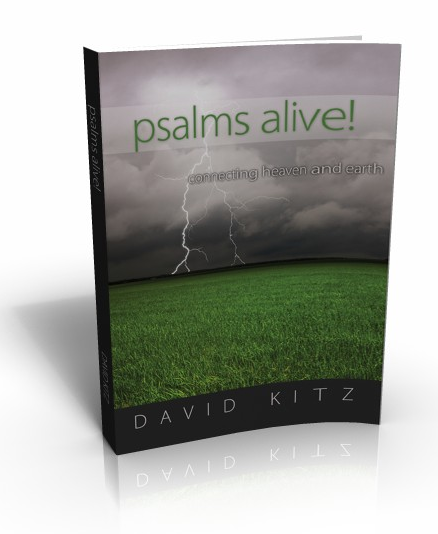
Today’s post is the fourth chapter from the book Psalms Alive! Connecting Heaven & Earth by David Kitz. To find out more or purchase click here.
 I love the Psalms
Thanks for these great insights on Psalm 23—each thought bringing clarity and perspective on this life and our God! Thanks too for your exceptionally helpful Psalms 365 book!
Thanks, Lyle. And thank you Good Shepherd for guiding these two lost sheep into green pastures.