
Tags
altar, church, God, Jesus, King Solomon, Lion of Judah, Prayer, Psalms, temple, the LORD
Of the Sons of Korah
How lovely is your dwelling place, O LORD Almighty!
My soul yearns, even faints, for the courts of the LORD;
my heart and flesh cry out for the living God.
Even the sparrow has found a home,
and the swallow a nest for herself,
where she may have her young—a place near your altar,
O LORD Almighty, my King and my God.
Blessed are those who dwell in your house;
they are ever praising you. (Selah)
Maybe it’s because Canadian Christendom is architecturally challenged, but images of a church do not spring to mind, when I read the opening lines of this psalm. Perhaps if I lived in Europe, the lovely dwelling place of the LORD referred to here would instantly prompt me to imagine one of the grand cathedrals, such as Chartres, Notre Dame in Paris or St. Paul’s in London.
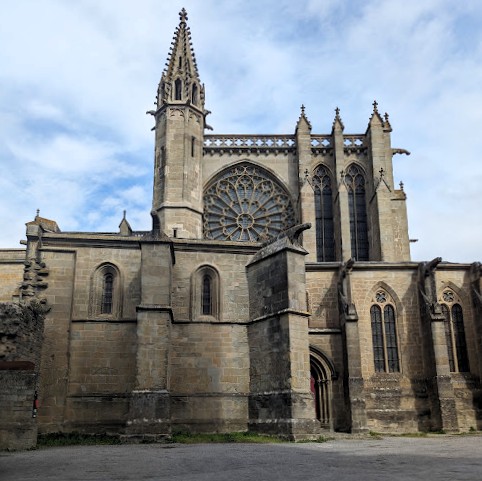
Carcassonne Cathedral, France — photo by David Kitz
Nevertheless, I identify with this psalm. There are times when I am in full agreement with the Psalmist. I echo his thoughts. My soul yearns, even faints, for the courts of the LORD; my heart and flesh cry out for the living God.
I want to be with God. I want to be close to him. I want to be lost in wonder and sense his glory all around me. There are times when I have known that closeness; I have experienced that wonder. Now I long for a return to that closeness. Like a desert wanderer yearns for water, I yearn for God. My heart and flesh cry out for the living God.
Sometimes I have found that closeness to God in a church. For me it comes most frequently during times of corporate worship. As songs of praise and worship reach a crescendo, I sense the LORD’s nearness; his presence is all around me. At such times it is no great stretch to reach out and touch the LORD as he passes by. He is here, in the house of God, and for this time, this precise location is his dwelling place.
There are other times in church when it is the spoken word of God that grabs me. I am under arrest. I have been found by God. I could swear the preacher has been reading my heart and he has been following me around all week. He is describing my life—my hidden thought patterns. I have this uncanny sense that this has all been a huge set up. I have been set up by God. He has brought me to this place, backed me in a corner, and now the loving LORD Almighty is pouncing upon me. The Lion of Judah has found his prey. And when it’s all over, I am so glad he has. His holy word has penetrated my heart, and I am changed. Into my darkness the Light has come. I walk out of that place with new direction and purpose.
I can only say, “How lovely is your dwelling place, O LORD Almighty!”
Despite these wonderful experiences within church buildings, it is not the buildings themselves that attract me, though unlike some people in our society, I certainly have no aversion to church buildings. In the same vein, as someone trained in design, I believe I can truly appreciate beautiful architecture in churches and other public buildings. Yet again, it is not the architecture that attracts me. It is the presence of God that I seek.
Yes, and despite all this, when I read the phrase, “How lovely is your dwelling place, O LORD Almighty!” my mind instantly flashes to pictures of nature. I see God there, in the dazzling sunset, in the mountain grandeur, in the forest depths, in expansive prairie vistas, in the wind whipped ocean breakers, by the sunlit babbling stream. God is there. This is his dwelling place. It is just as David declared, “The earth is the LORD’s, and everything in it, the world, and all who live in it” (Psal 24:1).
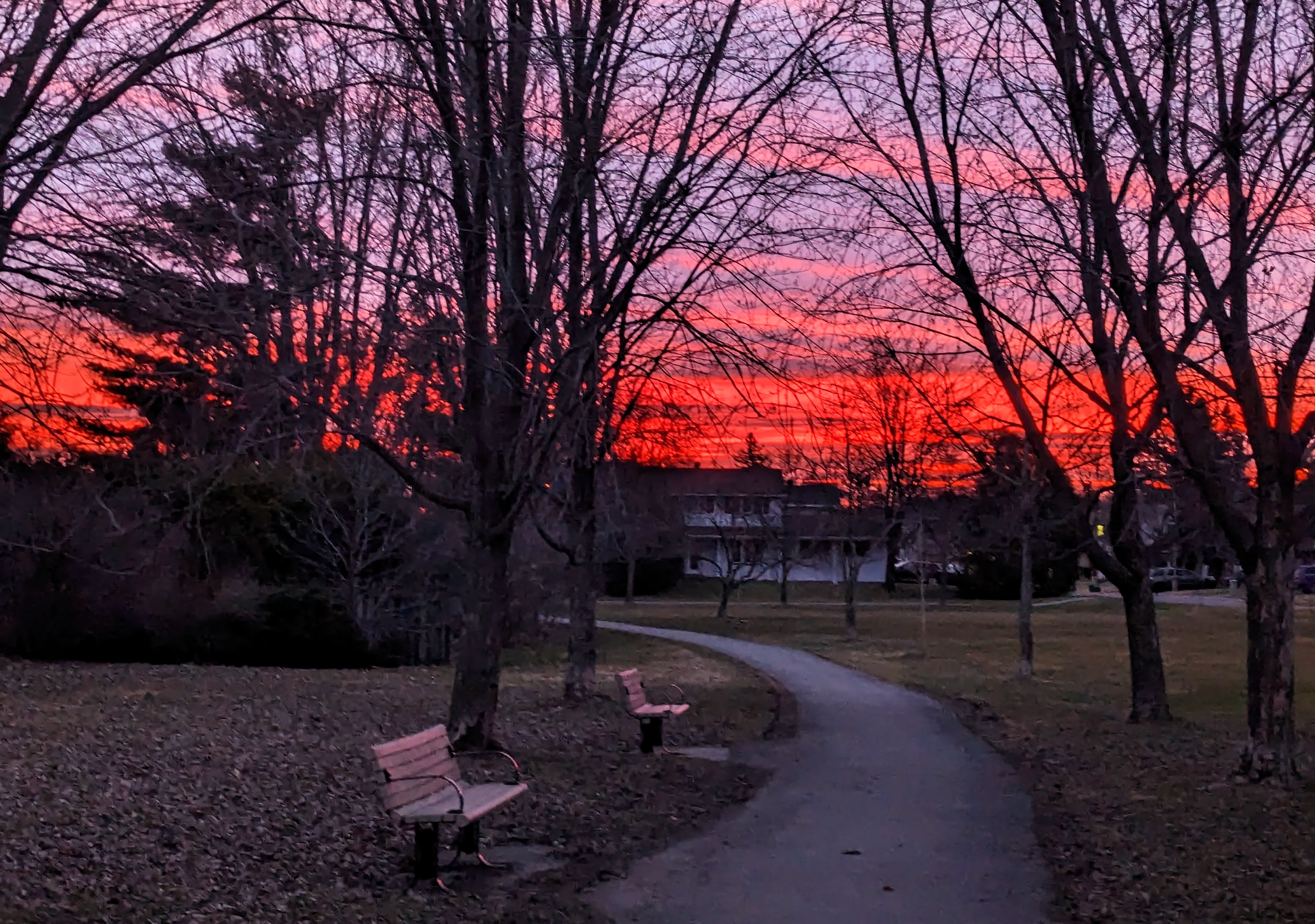
Early April sunrise — photo by David Kitz
Nature is God’s domain. He formed it, planned it, spoke it into existence. It is his dwelling place. Our attempts to create a dwelling place for him are feeble at best. After overseeing the construction of one of the seven wonders of the ancient world, King Solomon, that master temple builder of the Old Testament declared, “There is not enough room in heaven for you, LORD God. How can you possibly live on earth in this temple I have built?” (1 Kings 8:27).
Our God cannot be contained. He is always spilling over the sides, pushing out of our narrow confines, and showing up in unexpected places.
Perhaps this is what the psalmist was referring to here in Psalm 84, when he discovered that nature had invaded the sanctuary of the LORD. Even the sparrow has found a home, and the swallow a nest for herself, where she may have her young—a place near your altar.
The psalmist’s response is very enlightening. He did not see the arrival of these birds in the House of God as something strange or offensive. He did not treat this intrusion of nature as an indignity, ritually prohibited in this, the earthly residence of Deity. His response is in fact, just the opposite. He is delighted by his discovery of nesting birds near the altar of God.
The psalmist views the birds’ presence as an indicative of all of creation’s desire to be close to the Creator. The birds are exactly where the psalmist wants to be—permanently in God’s presence—constantly singing their LORD’s praise. They occupy an envied position. Blessed are those who dwell in your house; they are ever praising you.

Western bluebird — photo by Warwick Burgess
And we should note that these birds are not just visiting; they are not passing through. They have made God’s house their home. This is their nesting place. Here they will raise their family.
How about you? Where are you nesting? Are you nesting in God’s presence? Will you raise your family here, near the altar of God?
In my childhood I recall an occasion when at the close of a church service a barn swallow somehow found its way into our country church. I suppose this bird may have come in through an open front door or possibly through the belfry. Children in the congregation were both excited and amused as this swallow careened about the sanctuary in a display of aerial acrobatics. On the other hand, many of the adults were mortified. After all, this bird might soil the carpet. Quite unexpectedly, nature had invaded the sanctuary of the LORD, and the people of God were not entirely pleased.
In retrospect, and in light of Psalm 84, I believe the LORD may have been as delighted as the young children with the arrival of that swallow. All our formal church-style stuffiness suddenly went right out the window. The outside had come in. Why not enjoy it? Why not swoop and sing God’s praises just like that barn swallow? Why not for a moment be as free as a bird?
Oh, and don’t worry about the carpet. Real life is like that. Accidents happen. Humanity isn’t clean. That’s why there’s an altar.
The truly remarkable thing is that the LORD God Almighty chose, and continues to choose, to live with us. He did not confine himself to the heavens. He chose to swoop down from heaven’s heights and nest among us. Sometimes he even shows up in these barns that we call churches. On the day of dedication, without warning, God showed up in Solomon’s temple as the priests were singing the LORD’s praises.
Suddenly a cloud filled the temple as the priests were leaving the holy place. The LORD’s glory was in that cloud, and the light from it was so bright that the priests could not stay inside to do their work (2 Chronicles 5:13-14).
Why does God choose to do this? Why does he come to live among us? Doesn’t he know that we will soil his carpet? We will mess things up. Doesn’t he know that the lovely dwelling place of the LORD Almighty will only be lovely until the humans show up? Yet in spite of us, and our nest-fouling ways, God chooses to dwell among us.
We can see this clearly in this psalm. Just as the LORD puts up with the nest building birds and their droppings, so the LORD puts up with us. Actually, God goes beyond putting up with us. He welcomes us. Just as the psalmist expresses his delight with the birds, God is delighted that we have come. He is so glad that we have come into his house, his dwelling place. He is not put off or surprised by our mess ups.
What parent throws out their infant on the first occasion when they soil their diapers? Every parent knows that baby messes come with the baby. Changing diapers quickly becomes a part of the family routine. As a father of two infant sons, I had ample opportunity to practise my diaper changing skills. If the need arose at home, most often my wife or I would use a specially designed change table for this job. I would lay the baby on the change table and in a minute or two everything was fixed up—put to right—on that change table.

Photo by Andreas Wohlfahrt on Pexels.com
Every rightly built house of God has a change table. Most often it’s called an altar. God fixes us up there. That altar can look quite different depending on which church tradition you follow. But the purpose for the altar is always the same. It is the place where we are cleaned up. Sin is washed away.
God is intimate with us there. The outward trappings of righteousness are stripped away. He sees us completely. You see there is no place for human pride at the altar of God. Our heavenly Father gently lays us down and does his work on us. There is nothing we can hide. Why would we want to? Let’s deal with all of it.
Cleanse me should be our only cry.
Have you been altered at the altar? Has God changed you there—really changed you in the hidden places?
But isn’t the altar just for babies? LORD, haven’t I grown and matured since my first trip to your altar? I would like to think so. I’m not tripped up by the same things anymore. Surely, I don’t have to humble myself yet again!
If we have outgrown the altar, then we have outgrown God. And that’s preposterous! The LORD God Almighty has not lost any of his awesome power or majesty, simply because we have grown older and supposedly wiser. We are still in need of his correction, his discipline, his mercy and his love. I still need to get onto God’s change table on a regular basis. Moral perfection keeps eluding me. The smugger I feel about my self-deluding, superior spirituality complex, the more I prove that I need to be altered on the altar.
I hear God whispering “Lay down. Lay it all down. I want to change you.”
Over the years I have watched far too many Christians outgrow God. They have become mature in their faith, or so they say, and the altar becomes a place for others to go. The reasoning goes something like this, “It’s a fine place for the wayward and the prodigal, but we are beyond that now.”
In my mind I can hear them say, “Since I came to Christ, I have grown in my understanding. I am sure it won’t be long, and the LORD God Almighty will be calling upon me for advice.”
Of course no one would dare say that. But the attitude is there. That superior older brother attitude comes to dominate. I know it well because I recognize it in myself.
Soon the house of God loses its appeal. Nature calls. “After all, God is present in nature. I can worship him out by the cottage or down by the lake.”

Petrie Island in May — photo by David Kitz
And of course that’s true. God can, and does meet people in all those locations, and ten thousand places in addition to these. But is there an altar there? Does God’s Word wash over you? Remember that that’s where real change happens.
You see Solomon was right. The great God of the heavens was not content to stay there. The heavens could not contain him. He swooped down from there and decided to live among us, to nest with mankind. But God did not stop there. No, the LORD went far beyond that. Through the sacrifice of his Son, he brought us into his nest—into his family.
Wherever I go, I am in his house now. You see, I belong to him. I’m in the family of God. I am nesting in his presence. And right along with the psalmist I can say, “How lovely is your dwelling place, O LORD Almighty! My soul yearns, even faints, for the courts of the LORD; my heart and flesh cry out for the living God.”
And if my heart should stray, “Take me back to your altar, LORD. Cleanse me,” is my only cry.
Bringing Life to the Psalms
- Over a two-week period consider doing a daily reading through, “The Songs of Ascent”—Psalm 120 through to Psalm 134. What insights were you able to glean from these psalms? Can you see how the theme of pilgrimage is integral to these psalms?
- Have you ever undertaken a major endeavour and fallen short of your goal? What did you learn from that experience? Sometimes we learn far more from our failures than from our successes. How have your failures helped to shape your life? Remember that God can turn our failures into stepping stones to success.
- Are you building spiritual muscle or turning into a faithless couch potato? What spiritual disciplines are you exercising on a regular basis? Choose a spiritual discipline to focus on this week. Set an achievable goal, such as ten minutes of daily prayer. If you are in a study group, report back to others on your ability to meet that goal.
- What can church leadership do to increase the sense of group pilgrimage within your congregation? Can you think of ways to build a greater sense connectedness within your faith community? What role might God want you to play in this regard?
Today’s post is Chapter 12 from the book Psalms Alive! Connecting Heaven & Earth by David Kitz. To find out more or purchase click here.
 I love the Psalms