• Home
  • About
  • DavidKitz.ca
  • Youtube Videos
  • Books by David
  • Books on Amazon.com

I love the Psalms

~ Connecting daily with God through the Psalms

I love the Psalms

Tag Archives: temple

James the Apostle to the Jews

21 Sunday Jun 2026

Posted by davidkitz in Books by David Kitz

≈ Leave a comment

Tags

Bible, Christ, Christianity, church, circumcision, faith, Gentile converts, Gentiles, gospel, grace, James, James the brother of Jesus, Jerusalem, Jesus, Judaism, leadership, legalism, Paul, Peter, Scripture, Solomon's Portico, temple, temple worship, uncircumcised

James: the Lynchpin of Our Faith — Chapter 16

Before we transition to an examination of the Epistle of James, it would be appropriate to examine the Jewish roots of the church. No one in the early church embodies the Jewishness of this entity we call the church quite like James. And no event in the history of the early church illustrates Christianity’s link to Judaism quite like James’ decision in Acts 21 that Paul should participate in ritual cleansing at the temple.

Today Christians and Jews see their religions as distinct from each other. The decisions and actions of both James and Paul show that they did not share this view.

James was leading a profoundly Jewish church. He says as much. “You see, brother [Paul], how many thousands of Jews have believed, and all of them are zealous for the law” (Acts 21:20).

These believing Jews were not only zealous for law. They were also zealous for the temple and had not in any way abandoned the practices and ceremonies of temple worship. As James and the elders point out, four of their company—believers in Christ—were fulfilling vows and participating in purification rites. It should be noted that from Pentecost onward, believers were meeting daily in the Temple (Acts 2:46–47), and there are strong indications that this practice continued.

To Christians today, this may seem incomprehensible. We have well-established dividing lines that separate Jews from Christians and Judaism from Christianity. For James no such line existed.

A modern equivalent might be a televangelist having his infant daughter baptized at a cathedral by a Catholic archbishop. Or conversely, the televangelist might do a full immersion baptism of the archbishop. Yet both these examples fall under the broad tent of the Christian faith. But both James and Paul were even more radical. They were comfortable stepping across lines that we have established between two great faiths, Christianity and Judaism.

Some of our difficulties spring from a lack of understanding of this fusion of faith within the early Jewish Christian community. They saw Jesus as their Jewish Messiah, fulfilling all the prophecies of their scriptures. He did not come to do away with their faith or the Law, but to fulfill it—and he said just that.

Do not think that I have come to abolish the Law or the Prophets; I have not come to abolish them but to fulfill them. For truly I tell you, until heaven and earth disappear, not the smallest letter, not the least stroke of a pen, will by any means disappear from the Law until everything is accomplished. Therefore anyone who sets aside one of the least of these commands and teaches others accordingly will be called least in the kingdom of heaven, but whoever practices and teaches these commands will be called great in the kingdom of heaven. For I tell you that unless your righteousness surpasses that of the Pharisees and the teachers of the law, you will certainly not enter the kingdom of heaven. (Matthew 5:17–20)

Also, Jesus in no way encouraged disobedience to the Law. Many Christians have a false impression of Jesus and his teaching. They assume that because he was supremely loving and forgiving, he must have been lax in his application of the Law or easy-going about sin. Just the opposite is true, and his statements recorded in the gospels make this abundantly clear.

Rather than lower the bar in his Sermon on the Mount, Jesus elevates it. The Old Testament law prohibits murder; Jesus prohibits hate (Matthew 5:21–22). The Old Testament law prohibits adultery; Jesus prohibits lust (Matthew 5:27–28). He systematically demands more than the law requires by going to the heart of the issue, rather than simply looking at outward appearance or performance.

While Jesus condemned the hypocrisy and pride of the Pharisees and teachers of the law, he did not quibble with their adherence to it.

Woe to you, teachers of the law and Pharisees, you hypocrites! You give a tenth of your spices—mint, dill and cumin. But you have neglected the more important matters of the law—justice, mercy and faithfulness. You should have practiced the latter, without neglecting the former. You blind guides! You strain out a gnat but swallow a camel. (Matthew 23:23–24)

Similarly, Jesus did not abandon temple worship. If anything, he was an advocate for it. His cleansing of the temple was not an indictment of temple worship, but an attack on the abuse of that sacred space. He viewed the temple grounds as the rightful place for prayer, praise, healing, and the teaching of the word.

Jesus entered the temple courts and drove out all who were buying and selling there. He overturned the tables of the money changers and the benches of those selling doves. “It is written,” he said to them, “‘My house will be called a house of prayer,’ but you are making it ‘a den of robbers.’”

The blind and the lame came to him at the temple, and he healed them. But when the chief priests and the teachers of the law saw the wonderful things he did and the children shouting in the temple courts, “Hosanna to the Son of David,” they were indignant.

“Do you hear what these children are saying?” they asked him.

“Yes,” replied Jesus, “have you never read, ‘From the lips of children and infants you, Lord, have called forth your praise?’” (Matthew 21:12–16)

In the same vein, though Jesus prophesied the destruction of the temple (Matthew 24:1–2), that prophecy should not be viewed as a vindictive declaration, but rather a lament.

As he approached Jerusalem and saw the city, he wept over it and said, “If you, even you, had only known on this day what would bring you peace—but now it is hidden from your eyes. The days will come upon you when your enemies will build an embankment against you and encircle you and hem you in on every side. They will dash you to the ground, you and the children within your walls. They will not leave one stone on another, because you did not recognize the time of God’s coming to you.” (Luke 19:41–44)

The conflict that led to Jesus’ crucifixion can be viewed as a dispute over the proper use of the temple. The high priest and temple authorities were enraged over the eviction of the merchants and money changers because they benefitted from this trade—and it was of course a direct challenge to their authority. In his commentary on this matter, William Barclay makes this assessment on the trade in sacrificial doves:

Clearly he [Jesus] had attacked this abuse. Further, these stalls where the victims were sold were called the Bazaars of Annas, and were the private property of the family of the high priest of that name. (1)

In addition, the high priest and his clan objected to Jesus’ use of the temple as his teaching and healing center.

For Jesus this issue went to the heart of his DNA. It was about being at home in his Father’s house and using it according to His will and purpose. It harkens back to his first recorded words as a twelve-year-old boy, “Didn’t you know I had to be in my Father’s house?” (Luke 2:49)

Furthermore, it was about the fulfilment of his prophetic mandate within this sacred precinct.

“I will send my messenger, who will prepare the way before me. Then suddenly the Lord you are seeking will come to his temple; the messenger of the covenant, whom you desire, will come,” says the LORD Almighty. (Malachi 3:1)

The Messiah had come to his temple, but the Jewish leadership was not prepared for him and refused to recognize him as their Lord.

There are strong indications that the apostles, including James, were fully at one with Jesus’ view of the temple and its proper use and purpose. They saw it as their prayer and worship center and the rightful home of their Messiah.

The apostles did not relinquish the dispute that Jesus had initiated. They were not advocating for the temple’s destruction, though they were accused of this (Acts 6:13-14). Rather, their goal was to turn the entire Jewish nation into believers in Jesus Christ, with the temple being used as their prayer and worship center.

The first physical healing recorded in Acts lends credence to this view. (See Acts 3:1–26.) Peter and John went to the temple at the appointed time for prayer. At the Beautiful Gate, they healed a man who was lame from birth through the power of Jesus’ name. When in amazement a crowd gathered, they preached the gospel message.

Peter and John were doing precisely what Jesus had done in the temple courts before his arrest and crucifixion. They came to pray, they healed the infirm, and they taught the people about Christ. They also got the same response from the authorities. They were arrested just as Jesus had been.

The story of this first miraculous healing of the apostolic age illustrates that rather than separate themselves, Peter and John participated in the rituals and practices of temple worship. They went to the temple at the hour of prayer—the time of the daily sacrifice—the time when Jesus, the pascal lamb, had offered up his life.

Because of persecution and fear, the Jewish church could have withdrawn entirely from the predominant culture—but it did just the opposite. The church inserted itself directly into the fabric of the community by meeting within the temple courts. “The apostles performed many signs and wonders among the people. And all the believers used to meet together in Solomon’s Colonnade.” (Acts 5:12)

Solomon’s Colonnade or Portico was part of the outer court of the temple.(2) Meeting there was an outright challenge to the Jewish religious authorities, and it also served as a bold witness to the believers’ faith in the crucified and risen Christ—the Christ that these same authorities had sent to the cross. Despite arrests and warnings, they filled Jerusalem with their teaching (Acts 5:28).

It is well worth noting that the first public meeting place for the first century church was at the temple. This full, practical integration of Christianity with Judaism seems unnatural or contrary to us at the present. But James and the early believers didn’t want to separate themselves from the Jewish people—they wanted to win over their hearts. In fact, they believed faith in Christ would make them better Jews, since they would be accepting the Messiah sent by the God of Israel.

James was situated at the center of an epic battle for the allegiance of his people. To understand him, we must understand how he viewed his apostolic mission and how he went about pursuing it.

As much as Paul identifies himself as the apostle to the Gentiles, James stands out as the apostle to the Jews. In Paul’s letter to the Galatians, Paul self-identifies in this way, but he identifies Peter as the apostle to the Jews.

For God, who was at work in Peter as an apostle to the circumcised, was also at work in me as an apostle to the Gentiles. James, Cephas [Peter] and John, those esteemed as pillars, gave me and Barnabas the right hand of fellowship when they recognized the grace given to me. They agreed that we should go to the Gentiles, and they to the circumcised. (Galatians 2:8–9)

As time progressed, Peter and John moved on to other fields—fields that included the Gentiles—while James remained rooted in Jerusalem. When we meet James in Acts 21, which may be as much as six years after Paul’s Galatian letter, it is apparent that James has assumed the mantle of the apostle to the Jews.

Perhaps the greatest temptation James faced was the temptation to withdraw from the culture and any involvement with the temple. To do so would be to admit defeat. It would mean ceding the temple to those who sanctioned his brother’s execution. But James steadfastly refused to turn his back on the Father’s house.

The temptation for the church to withdraw from the culture rather than engage with it remains to this day. Self-isolation is safer than being an active and engaged witness to the life-transforming power of Christ.

James’ instructions for Paul to participate in ceremonial cleansing should be viewed as part of a broader strategy to be a potent witness for Christ to the Jewish people. It was a strategy with which Paul agreed because of his desire to see the salvation of his own people.

Brothers and sisters, my heart’s desire and prayer to God for the Israelites is that they may be saved. For I can testify about them that they are zealous for God, but their zeal is not based on knowledge. Since they did not know the righteousness of God and sought to establish their own, they did not submit to God’s righteousness. Christ is the culmination of the law so that there may be righteousness for everyone who believes. (Romans 10:1–4)

Paul views the Jewish fixation on righteousness achieved by the law as a huge impediment to receiving the righteousness of Christ, which comes through faith. James, Paul, and Jesus agree on this point. Salvation for the Jewish people from Abraham onward was always achieved through faith—an active faith—not merely an intellectual acknowledgement.

It would be folly to assume that James and Paul did not discuss these foundational matters of faith on occasions when they met together. The differences they had, which are often projected as irreconcilable, need to be viewed through the lens of their calling. Paul’s apostolic focal point was the Gentiles. James’ apostolic focal point was the Jews.

Salvation for both people groups comes through faith in the atoning sacrifice of Jesus, God’s own Son—the eternal Lamb of God. As we will see, on this point they are in full agreement.

Both James and Paul are determined to let their light shine before men (Matthew 5:16), even in the temple courts—even at the risk of their lives—even to the point of death. The violent zealotry for the law that plays out when Paul is seized, beaten, and arrested in the temple foreshadows what will ultimately happen to James a few years later. In Paul’s case, a Roman commander intervened to save his life.

James was not so fortunate.

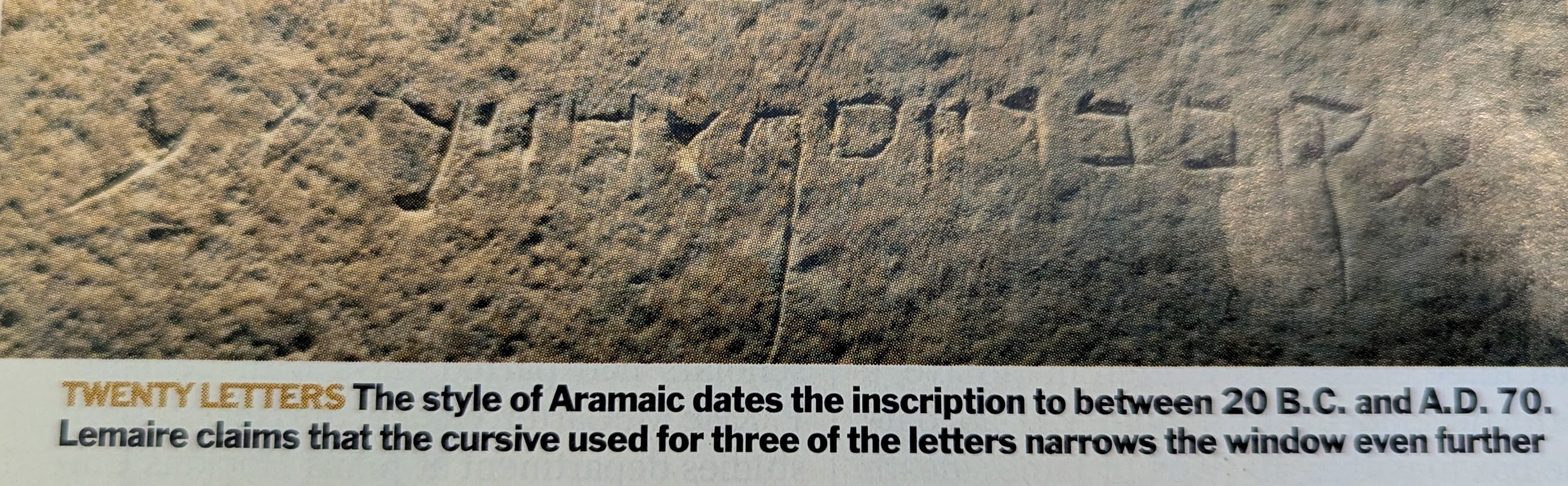
Photo Credit Time Magazine, November 4, 2002 — the inscription on the James Ossuary.

(1) William Barclay, The Gospel of Matthew, Volume Two, Chapters 11–28—The Daily Study Bible (Welch, 1975), p. 246.
(2) “Solomon’s Portico,” by W. F. Stinespring, The Interpreter’s Dictionary of the Bible, Volume 4, Edited by George Arthur Buttrick (Abingdon, 1984), p. 408.

New from David Kitz

James—the brother of Jesus—who was this man? What evidence do we have that this “brother of our Lord” even existed?

David Kitz digs deep into archeology, family dynamics, church history, and the biblical texts. What emerges from his research is a portrait of a decisive, pivotal leader who embodied the will and character of Jesus Christ.

But how did James—James the unbeliever—transform to become a leader who changed the course of world history? In these pages you will uncover the answer and rediscover for yourself the life-changing power of the gospel.

To view further details or purchase directly from the author click here.


No Signs from Our God

12 Friday Jun 2026

Posted by Tim K in Psalms, Psalm 74, Psalm 64

≈ Leave a comment

Tags

Asaph, enemy, God's sanctuary, king, nation, prophets, salvation, signs, signs from God, temple, the Psalms

Today’s Devotion from Psalms 365 by David Kitz

Listen to today’s reading by Jonathan Dent:

https://davidkitz.blog/wp-content/uploads/2026/06/ps-749-17-mixfinal.mp3

Reading: Psalm 74:9-17 (NIV)*

We are given no signs from God;
    no prophets are left,
    and none of us knows how long this will be.
How long will the enemy mock you, God?
    Will the foe revile your name forever?
Why do you hold back your hand, your right hand?
    Take it from the folds of your garment and destroy them!
But God is my King from long ago;
    he brings salvation on the earth.
It was you who split open the sea by your power;
    you broke the heads of the monster in the waters.
It was you who crushed the heads of Leviathan
    and gave it as food to the creatures of the desert.
It was you who opened up springs and streams;
    you dried up the ever-flowing rivers.
The day is yours, and yours also the night;
    you established the sun and moon.
It was you who set all the boundaries of the earth;
    you made both summer and winter
.

Reflection

Do you watch for road signs? I’m inclined to say yes, of course I do. But if I am traveling through a familiar neighborhood or to a familiar location, I pay very little attention to road signs. After all, I know where I am going and how to get there. But put me in unfamiliar territory without a GPS, and the situation changes dramatically. I am hunting for road signs like a sharp-eyed hawk hunts for field mice. Every sign is spotted well in advance; the details are read and repeated to cement them into my memory. Landmarks and the appearance of the terrain are memorized for future reference. I do all this because I don’t like being lost.

In our reading from Psalm 74, the psalmist finds himself in unfamiliar territory. The nation has been invaded and the enemy has desecrated the temple. This is an enormous loss. But beyond the loss, there appears to be no way forward. The psalmist laments, “We are given no signs from God; no prophets are left, and none of us knows how long this will be. How long will the enemy mock you, God?” (v. 9-10).

When I am lost, I watch for signs. But in this situation God gave no signs. After the psalmist pours out his complaint before God, he does not stay there. He goes on to recall the miraculous works of God. He reminds God of His interventions into the affairs of humankind. He makes this bold personal declaration, “But God is my King from long ago; he brings salvation on the earth” (v. 12).

As we pray for our nation, we would do well to pattern our prayers on Psalm 74.

Response

LORD God, you see the sins of our nation. Bring us back to you. You are the Almighty God. You do not change. Bring your salvation on the earth even as you did long ago. You are my King. Amen.

Your Turn

Is it helpful to recall God’s mighty deeds in your life? Will our nation return to God?


Para la publicación de Salmos 365 de hoy en español haga clic aquí.

bgbg_v4.3_1501818
* NEW INTERNATIONAL VERSION, COPYRIGHT ©1973, 1978, 1984, 2011 BY BIBLICA

Pray for peace in Israel, Iran and the Middle East
and continue to pray for peace to return to Ukraine and Russia!

Volume I of Psalms 365: Develop a Life of Worship and Prayer won the Best Book of the Year Award from The Word Guild and Volume II has won the Best Devotional of the Year Award. For those who love God’s word, this three-book series is an ideal way to daily meet with the Lord. To purchase or for a closer look click here.

Conquest of the Heart

20 Wednesday May 2026

Posted by Tim K in Psalm 64, Psalm 68, Psalms

≈ Leave a comment

Tags

citizenship, David, kingdom of heaven, musicians, praise, singers, submission, temple, the LORD, the Psalms, war

Today’s Devotion from Psalms 365 by David Kitz

Listen to today’s reading by Jonathan Dent:

https://davidkitz.blog/wp-content/uploads/2026/05/ps-6824-31-mix-3final.mp3

Reading: Psalm 68:24-31(NIV)*

Your procession, God, has come into view,
    the procession of my God and King into the sanctuary.
In front are the singers, after them the musicians;
    with them are the young women playing the timbrels.
Praise God in the great congregation;
    praise the L
ORD in the assembly of Israel.
There is the little tribe of Benjamin, leading them,
    there the great throng of Judah’s princes,
    and there the princes of Zebulun and of Naphtali.
Summon your power, God;
    show us your strength, our God, as you have done before.
Because of your temple at Jerusalem
    kings will bring you gifts.
Rebuke the beast among the reeds,
    the herd of bulls among the calves of the nations.
Humbled, may the beast bring bars of silver.
    Scatter the nations who delight in war.
Envoys will come from Egypt;
    Cush will submit herself to God.

Reflection

All of Psalm 68 is a hymn of triumph—national triumph. In today’s reading it is apparent this psalm is a triumphant processional song penned by David. The enemies of Israel have been vanquished and God’s army has returned victorious.

 For Christians today, does this psalm hold a deeper significance? Does it signify more than a celebration after a military conquest?

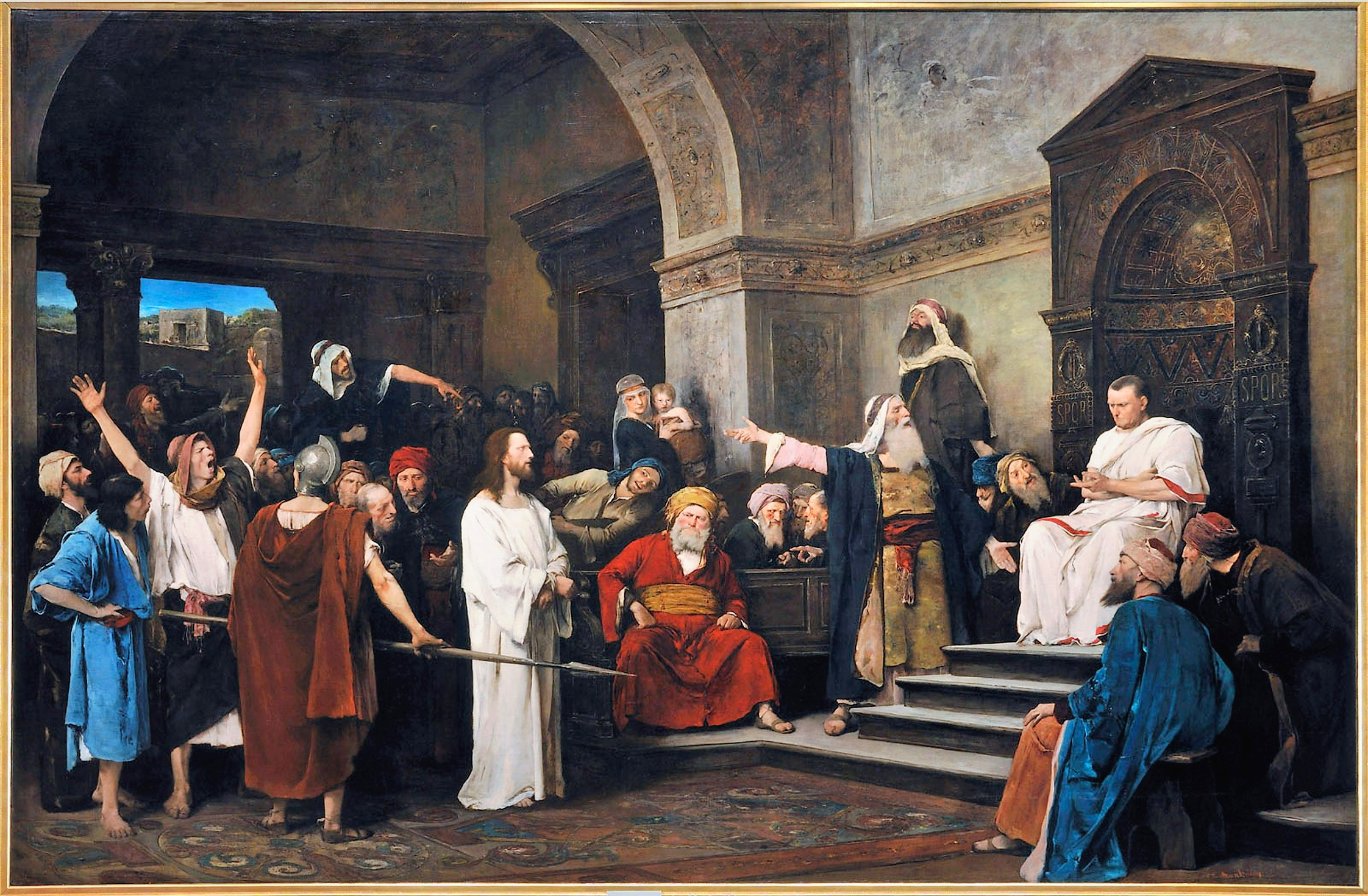
The King we serve—the one born in a stable—didn’t come to establish an earthly kingdom by means of guns and war. In his defence before Pilate Jesus said, “My kingdom is not of this world. If it were, my servants would fight to prevent my arrest by the Jewish leaders. But now my kingdom is from another place” (John 18:36).

Christ before Pilate by Mihály Munkácsy (1881, Wikimedia)

Make no mistake; Jesus calls us to be citizens in his heavenly Kingdom. It is a Kingdom headquartered in heaven, but its address on the earth is the human heart—your heart—my heart. Furthermore, that Kingdom grows in power and influence as we yield our will to God and joyfully become more like His son, Jesus. For followers of Jesus, battles are won as we submit our will to God.

There are nations—Egypt and Cush (the upper Nile region) mentioned in today’s reading. They will submit themselves to God. But for us today, submission must first come from our own stubborn heart.

Response

LORD God, I yield my will to you. Conquer my heart with your love. Through Jesus’ sacrifice on the cross, I am yours. Help me to joyfully live as a productive citizen of your Kingdom on earth. Amen.

Your Turn

Have you been conquered by the love of God? Where is your primary citizenship?


Para la publicación de Salmos 365 de hoy en español haga clic aquí.

bgbg_v4.3_1501818
* NEW INTERNATIONAL VERSION, COPYRIGHT ©1973, 1978, 1984, 2011 BY BIBLICA

Pray for peace in Israel, Iran and the Middle East
and continue to pray for peace to return to Ukraine and Russia!

Volume I of Psalms 365: Develop a Life of Worship and Prayer won the Best Book of the Year Award from The Word Guild and Volume II has won the Best Devotional of the Year Award. For those who love God’s word, this three-book series is an ideal way to daily meet with the Lord. To purchase or for a closer look click here.

Who am I? The Defining Question

01 Sunday Mar 2026

Posted by davidkitz in Books by David Kitz

≈ 2 Comments

Tags

deity of Jesus, God, James, James the brother of Jesus, Jerusalem, Jesus, lukewarm, Mary and Joseph, Passover, Son of God, temple

James: the Lynchpin of Our Faith — Chapter 3

John in the opening chapter to his gospel account makes this observation about Jesus: “He was in the world, and though the world was made through him, the world did not recognize him. He came to that which was his own, but his own did not receive him” (John 1:10–11).

Most commentators on this passage conclude that John, who wrote this gospel in the latter part of the first century, was referring to the rejection of Jesus by the majority of the Jewish nation. To paraphrase: Jesus came to his own people, but they did not recognize him as their Messiah or receive him as such.

Undoubtedly, this is a correct interpretation of this passage. However, I would argue that typically we view and interpret this passage much too broadly. On the macro level this standard view is correct; Jesus was rejected by the Jewish nation. But it is within the microcosm of the family that the truth of this passage truly hits home. Jesus was not only rejected by his nation; he was rejected by his own family. A careful reading of the gospels makes this painful point clear.

The hometown rejection, which we read of in the previous chapter, foreshadows a much more extensive rejection of Jesus that rippled through his family, through the religious establishment and the whole of Jewish society. It culminated in his condemnation by the Sanhedrin and crucifixion at the hands of the Romans. Despite his wise teachings, which were coupled with signs and wonders, most of his contemporaries did not recognize the divinity of Christ. In their eyes, he was just a man—a man dangerously masquerading as so much more. The Gospel accounts make it blatantly clear that this was also the view that James and his brothers held.

But before we delve deeper into Jesus’ rejection by his family, we need to examine the topic of self-recognition. In the quote above, John stated, “He [Jesus] was in the world, and though the world was made through him, the world did not recognize him” (John 1:10).

John sees the problem of Jesus rejection as stemming from a failure of the people to recognize who he was. John clearly saw Jesus as the Creator of the universe; he recognized Jesus as Deity, but by and large Jewish society did not. He was Deity disguised in humanity and for many the disguise was too effective, too confounding. To this day it remains a stumbling block, particularly for those trained in the Jewish faith. God taking on human form is a foreign concept, and it is incomprehensible.

Now imagine for a moment how baffling—how incomprehensible—this concept would be for a twelve-year-old Jewish boy. But somehow at the age of twelve, Jesus grasped it. He recognized his own Deity. He saw himself as the Son of God. How exactly did this come about?

Childhood is all about self-discovery and learning our place in the world. Quite naturally self-discovery begins at home within the context of the family. We learn who we are from our parents and siblings. They define our genetic and cultural heredity. Genetically we are like them, and we become even more like them through our exposure to their loving nurture, interaction and instruction. Our family defines us, particularly at a young age. But for reasons we do not fully understand, Jesus saw himself as radically different. He saw that he did not fit or rightfully belong in his father’s household—in Joseph’s household. Already at age twelve, he recognized that he was not Joseph’s son.

How did this come about? How did Jesus come to see himself as different? Furthermore, it is one thing to conclude that this man you have grown up with is not your true father, but it is a huge leap for a twelve-year-old to conclude that he is some kind of divinely conceived genetic mutant, an offspring of God—a God/Boy. Yet that is how Jesus came to see himself.

The only gospel account of Jesus’ childhood presents a fascinating snapshot of Jesus’ self-perception. In the following account, Jesus reveals how he sees himself; he grasps his true identity:

Every year Jesus’ parents went to Jerusalem for the Festival of the Passover. When he was twelve years old, they went up to the festival, according to the custom. After the festival was over, while his parents were returning home, the boy Jesus stayed behind in Jerusalem, but they were unaware of it. Thinking he was in their company, they traveled on for a day. Then they began looking for him among their relatives and friends. When they did not find him, they went back to Jerusalem to look for him. After three days they found him in the temple courts, sitting among the teachers, listening to them and asking them questions. Everyone who heard him was amazed at his understanding and his answers. When his parents saw him, they were astonished.

His mother said to him, “Son, why have you treated us like this? Your father and I have been anxiously searching for you.”

“Why were you searching for me?” he asked. “Didn’t you know I had to be in my Father’s house?” But they did not understand what he was saying to them.

Then he went down to Nazareth with them and was obedient to them. But his mother treasured all these things in her heart. And Jesus grew in wisdom and stature, and in favor with God and man. (Luke 2:41–52)
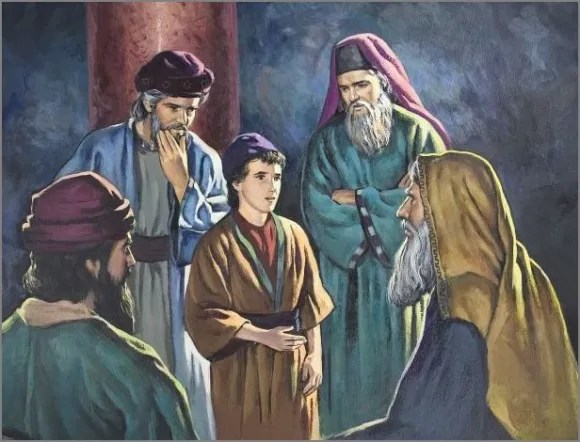
The Boy Jesus in the Temple Courts

Jesus response to Mary’s question speaks volumes about Jesus’ self-perception. “Why were you searching for me? Didn’t you know I had to be in my Father’s house?”

It’s almost as though he is saying to his mother, “I know who I am. I’ve figured it out. Did you forget whose son I really am? God is my Father. All I wanted to do is spend some time with Him.”

“But they did not understand what he was saying to them” (Luke 2:50).

If Mary and Joseph did not understand what Jesus was saying to them, it would seem to indicate that they did not tell him of his divine origin. There was no private conversation where Joseph took Jesus aside and said, “Look son, you’re really not my son. Oh, and by the way, this is how you came about…”

Apparently, Mary did not have this conversation with Jesus either. Think about it. It would be a very difficult conversation to initiate. Explaining the virgin birth would surely stretch the bounds of common logic and would profoundly conflict with the norms of the Jewish faith. Why would the one true God impregnate a Jewish girl by the Spirit? Consider it for a moment. It’s preposterous and intrinsically it runs counter to all we know of Jewish religious dogma.

How do you tell your firstborn that he is the Son of God? Apparently, you don’t. If he truly is the Son of God, you let him figure it out. From this account, it would seem this is the course of inaction that Mary and Joseph took. They let Jesus figure it out. And he did.

That’s what’s truly remarkable about this account. The twelve-year-old figured it out. He discovered his true identity.

The question remains: How did Jesus do it? How did he come to realize his divinity?

Typically, we read this account of the lost twelve-year-old Jesus from the viewpoint of a parent. We identify with the stress of losing a child in a big city. We would title this story, “Mary and Joseph find lost Jesus.” But the story reads quite differently when we view it from the perspective of a child trying to discover who he really is. Viewed from Jesus’ perspective the title of the story might well be, “Lost Boy finds Himself ” or “Lost Boy Discovers His Divinity.”

How did Jesus discover he was God’s son? Some believers might well reason that the answer is obvious. Jesus is God; therefore, he is omniscient. The all-knowing Jesus would surely know that he was God’s son. But many theologians would beg to differ. They view the humanity of Christ as all-pervasive. Jesus was 100% human, and as such he needed to learn and discover his identity, even as any child does. The apostle Paul’s writing lends credence to this perspective. Here is his advice to the believers at Philippi:

In your relationships with one another, have the same mindset as Christ Jesus: Who, being in very nature God, did not consider equality with God something to be used to his own advantage; rather, he made himself nothing by taking the very nature of a servant, being made in human likeness. And being found in appearance as a man, he humbled himself by becoming obedient to death—even death on a cross!

Therefore God exalted him to the highest place and gave him the name that is above every name, that at the name of Jesus every knee should bow, in heaven and on earth and under the earth, and every tongue acknowledge that Jesus Christ is Lord, to the glory of God the Father. (Philippians 2:5–11)

The passage above contrasts the humility and exaltation of Christ. In taking on humanity, Christ emptied himself of Deity. He fully became one of us. He was faced with the same frailties and limitations. In other words, in his humanity, he did not know everything. His feet got tired after a long day, and, yes, they probably stank too. He was fully human. He grew hungry and thirsty, and he was tempted in every way just as we are.

The writer of the Book of Hebrews, when speaking of Jesus tells us that he was

fully human in every way, in order that he [Jesus] might become a merciful and faithful high priest in service to God, and that he might make atonement for the sins of the people. Because he himself suffered when he was tempted, he is able to help those who are being tempted. (Hebrews 2:17–18)

If this is true, then the boy Jesus needed to discover his divine identity. It may have been written into every fibre of his being, but he still needed to discover it, just as any young musical prodigy needs to explore and discover his or her gift. All divine gifts must be discovered and developed to reach their maximum potential.

Luke concludes his boyhood account about Jesus with these words: “Jesus grew in wisdom and stature, and in favor with God and man” (Luke 2:41–52). Evidently, there was a process of learning and growth in Jesus’ development, even as there is in any boy transitioning to manhood. But there was something different about this child. His interests were different from his peers. We are told that he was found in the temple courts, “sitting among the teachers, listening to them and asking them questions. Everyone who heard him was amazed at his understanding and his answers” (Luke 2:46b–47). Clearly, he possessed wisdom and insight beyond his years. His divine DNA was showing. It was written into the very character of his soul, and he was learning to read what was written there.

He was the Son of God.

That is what the boy Jesus saw writ large upon his life. That is what he heard his Father saying to him. If Joseph did not tell the boy Jesus about his divine origin, his heavenly Father certainly did. He was whispering in his ear, “You are my son!”

The teachers were amazed because they were catching glimpses of Deity.

Why did this realization of who he was occur to Jesus at this time?

Developmental psychologists tell us there is something quite significant about the mind of a twelve-year-old. For most children it’s the year of the great leap forward. Mentally there is this massive shift that takes place in brain function. The brain moves from concrete to abstract thought. Ideas take on far greater significance. The mind is less dependent on physical objects as props to thought. Ideas and concepts can be grasped and manipulated in ways that were impossible a few months earlier. In this context, the concept and understanding of self takes on a new significance.

In his twelfth year, for the first time Jesus fully understood who he was.

Jesus was different from his brothers. That was probably the first clue in discovering his true identity. We don’t know what Jesus looked like. First century people didn’t have cameras, and Da Vinci and the European master artists did not have time machines, so we really have no clear idea about Jesus’ appearance.

We do not know what divine DNA looks like when it takes on human form. Did Jesus simply look like a male version of Mary? Or were there other marked differences in appearance coming from the heavenly Father?

We can safely assume that Jesus didn’t look like Joseph, and if he didn’t resemble Joseph, he probably appeared to be different from his half-brothers, James, Joseph, Simon, and Jude. A father’s facial and physical traits are usually very evident in his sons.

A perceptive child would notice the differences. And Jesus was a perceptive child. By age twelve he would recognize that he was the different one, the odd one in the family. Knowing whose child you are cuts to the very core of your identity. Discovering you are not who you think you are is jarring to say the least. Imagine waking up to this totally altered reality. You are not your father’s son. You belong to someone else. You are someone else.

That is the reality that the twelve-year-old Jesus was coming to grips with. His decision to not return to Nazareth with his parents needs to be viewed in this context. Was this a deliberate decision? If Jesus knew he was not Joseph’s son, why return with this man who was not his father? But if he wasn’t Joseph’s son, whose child was he? Did Jesus stay in Jerusalem in an attempt to discover the answer to that question? The twelve- year-old Jesus was coming face to face with an intense identity crisis.

There is a huge level of pathos and emotional freight in this story. Joseph and Mary are frantically worried and searching for their lost son. But on the other side of the equation, we see a lost son—with his whole sense of self in question. Was he searching for and discovering a new identity? But there is a huge leap from recognizing you are different—not fully one of the family—to identifying yourself as the Son of God.

But Jesus made that leap. The New King James Version translates Jesus’ response to Mary’s question in the temple this way. “Why did you seek Me? Did you not know that I must be about My Father’s business?” (Luke 2:49).

Implicit in that response is Jesus’ recognition that he was not the carpenter’s son, but instead God’s son—God’s son ready and willing to take on God’s work.

The easier conclusion a perceptive twelve-year-old might reach is that he was the product of Mary’s union with another man—maybe the result of a teenage fling or indiscretion, or perhaps Mary was raped by a Roman soldier. That would account for Jesus’ apparent differences from the other members in the family. It might also be the reason why these differences were not discussed. His conception was an embarrassing episode prior to marriage. For reasons of family pride, some things were better left unsaid.

But Jesus did not reach this more mundane conclusion. According to the scenario presented here, everything within him told him he was the Son of God. His internal script contained a different code, and there in the temple he had deciphered it. He was God’s son come in the flesh. The lost boy had found Himself. He had found His true identity, not as Joseph’s son, but as God’s Son. (4

Time would tell if this was just the deluded thoughts of a preteen dreamer, or if there was the ring of truth to his self-identification with Deity.

J. W. Shepard in his classic The Christ of the Gospels gives us his take on this account from Luke:

Theologians have speculated as to when Jesus first became conscious of the fact that He was God’s son in a peculiar sense and of his Messianic mission. We turn to these words as the sole clear self-revelation of Jesus in his boyhood years. In them we find his feeling of a distinct disappointment, that his parents did not understand Him better. He reveals in them the consciousness of a unique relationship to His Father. He expressed in them a clear sense of His primary obligations to God, which for the time had so engrossed His attention, that He almost lost sight of time and his human filial relationships. (5

At this point readers may well be questioning how this connects with James. This is supposed to be a book about James after all. But James may well have been present—standing next to Mary and Joseph when Jesus said “Why did you seek Me? Did you not know that I must be about My Father’s business?” (Luke 2:49 NKJV)

There are some sound reasons for believing that this was the case—that young James was present when Jesus identified himself as God’s son. In the previous chapter we clearly established that there were other children born to Mary and Joseph. Luke tells us that… “Every year Jesus’ parents went to Jerusalem for the Festival of the Passover. When he was twelve years old, they went up to the festival, according to the custom” (Luke 2:41–42).

It is logical to assume that this was a pilgrimage that the whole family undertook. Being observant Jews, there are no obvious grounds to assume otherwise. If this is the case, there may well have been as many as five or six children in this family entourage. In this context losing track of one child makes far more sense, given the large size of this family. The oldest boy, Jesus, was more independent, so “Thinking he was in their company, they traveled on for a day. Then they began looking for him among their relatives and friends” (Luke 2:44).

When Joseph and Mary returned to Jerusalem to search for Jesus, James and his brothers and sisters may have come with them. Having just lost one child, Mary and Joseph would want their remaining children close beside them, or safe in the care of the extended family. Hence, it is possible that James was present with his parents when they came upon Jesus in the temple courts.

Via-Dolorosa in Jerusalem — photo courtesy of Lois Morrow

Finally, we need to consider how this story came to be in Luke’s Gospel. In the introduction to his gospel, the good doctor Luke gives us some insight into the sources he drew upon when he wrote his account of Jesus life.

Many have undertaken to draw up an account of the things that have been fulfilled among us, just as they were handed down to us by those who from the first were eyewitnesses and servants of the word. With this in mind, since I myself have carefully investigated everything from the beginning, I too decided to write an orderly account for you, most excellent Theophilus, so that you may know the certainty of the things you have been taught. (Luke 1:1–4)

Luke asserts that he did some careful investigation, and from the above statement it is reasonable to assume that he interviewed eyewitnesses before he sat down to write this portion of his Gospel account. Who were these eyewitnesses?

Luke tells us more about the birth of Jesus and John the Baptistthan any other Gospel writer. He alone describes the stable birth in Bethlehem, the angelic visitation and the adoration of the shepherds. He alone speaks of the encounter with Simeon and the prophetess Anna in the temple courts, where Mary and Joseph hear prophetic words spoken over the baby Jesus. None of the other three Gospel writers make mention of the boyhood of Jesus. Only Luke recounts the twelve-year-old Jesus’ instructional escapade with the teachers of the law in the temple courts.

There is a richness of detail in these stories which strongly suggests that Luke got these accounts from someone who was present when they happened, someone who had an intimate knowledge of the holy family and their history. Two possible sources spring immediately to mind: Mary and James.

Since Joseph died at a relatively young age, Mary would appear to be the obvious choice. But if Luke had an opportunity to speak with her, she would be well-advanced in years. When was Luke’s Gospel written? Could Luke have interviewed Mary or James—or perhaps both—before he penned his Gospel?

Biblical scholars vary widely in their dating of Luke’s Gospel. In his introduction to the Book of Luke, Dr. J. Lyle Story, Associate Professor of Biblical Studies at Regent University, makes the following statement:

Since Luke was in Caesarea during Paul’s two-year incarceration there (Acts 27:1), he would have had ample opportunity during that time to conduct the investigation he mentions in Luke 1:1–4. If this is the case, then Luke’s Gospel may be dated around A.D. 59–60, but as late as A.D. 75. (6

It is by no means unreasonable to picture a seventy-five-year-old Mary in the company of her greying son, James, sitting down over a meal with the good doctor Luke to discuss the events of Jesus’ birth and childhood. It is in fact a thoroughly plausible explanation as to how Luke was able to provide us with such a vivid account of these gospel events. Luke interviewed, probed and questioned the eyewitnesses that were available to him. And who would be better to question about Christ’s birth than Mary, the mother of Jesus?

In summing up Jesus’ birth and the visitation of the shepherds, Luke wrote, “But Mary treasured up all these things and pondered them in her heart” (Luke 2:19). Since these are inner thoughts, how would Luke know that this was so, unless Mary told him?

Some would argue these passages simply came through the divine inspiration that was at work when Luke penned these words—an inspiration that infuses all the holy scriptures. But Luke clearly states that his sources were eyewitnesses. The use of eyewitness accounts does not nullify the concept of divine inspiration. On the contrary, one could argue that it reinforces it.

An early dating of Luke’s Gospel makes a meeting between Mary, James and Luke not only possible, but highly likely. Given James’ preeminent position in the early church,7 it stands to reason that he would be aware of Luke’s intention to write an authoritative gospel account of Jesus life. Luke may in fact, have asked for permission from James and sought his blessing to do so.

We also know that Luke accompanied Paul on his journey to Jerusalem, where together they met with James and the leaders of the church (Acts 21:15–40). Luke would have had an opportunity to discuss and research these matters at that time.

It would also logically follow that both James and Mary would want the events of Jesus annunciation, divine conception, birth and childhood recorded for posterity. Since Mary was already well-advanced in years, this would lend an element of urgency to this project. Full collaboration with Luke is the likely outcome.

Evangelho — Lc 1, 26-38 AI Modified

Historical records indicate that James died a martyr’s death in 64 AD. If Luke’s gospel was completed after 64 AD, then James was not the source of the material found in chapters one and two of Luke’s gospel. But with each succeeding year, the likelihood of Mary being the eyewitness source also diminishes. This makes an early dating of Luke’s gospel eminently plausible.

So, in conclusion, let’s return to that moment the boy Jesus said, “Did you not know that I must be about My Father’s business?” (Luke 2:49 NKJV)

Where was James when Jesus made this declaration? He was likely standing alongside his mother, Mary, and his father, Joseph, as those words were spoken.

Years later, James may also have played a significant role in ensuringthat those words were recorded for all generations.

4) A more commonly accepted scenario for Jesus’ self-identification is presented in the next chapter.

5) J. W. Shepard, The Christ of the Gospels (Eerdmans, 1938), p. 54.

6) J. Lyle Story, “Introduction: The Gospel of Luke,” Spirit Filled Life Bible, New King James Version, General Editor Jack W. Hayford (Thomas Nelson, 1991), p. 1503.

7) For a more thorough discussion of James’ leadership role in the early church, see Chapter 12 of this book.


New from David Kitz

James—the brother of Jesus—who was this man? What evidence do we have that this “brother of our Lord” even existed?

David Kitz digs deep into archeology, family dynamics, church history, and the biblical texts. What emerges from his research is a portrait of a decisive, pivotal leader who embodied the will and character of Jesus Christ.

But how did James—James the unbeliever—transform to become a leader who changed the course of world history? In these pages you will uncover the answer and rediscover for yourself the life-changing power of the gospel.

To view further details or purchase directly from the author click here.



In My Father’s House

31 Wednesday Dec 2025

Posted by davidkitz in Psalm 27, Psalms

≈ 2 Comments

Tags

drawing close to God, Jesus, Nazareth, Prayer, Psalms, temple, the LORD, wisdom

Today’s quote and prayer from
“Psalms 365: Develop a Life of Worship and Prayer

 Today’s Reading: Psalm 27:4-6

Listen to today’s reading by Jonathan Dent:

https://davidkitz.blog/wp-content/uploads/2025/12/ps-274-6-mix1final.mp3


Lord Jesus,
I want to be with you.
I want to live my life close to you now
and close to you forever.
Show me how to do that.
Be near me, Lord Jesus.
I ask you to stay
close by me forever,
and love me I pray.

Amen.

— — — —


The Boy Jesus at the Temple

After the festival was over,
while his parents were returning home,
the boy Jesus stayed behind in Jerusalem,
but they were unaware of it.

Thinking he was in their company,
they traveled on for a day.
Then they began looking for him
among their relatives and friends.

When they did not find him,
they went back to Jerusalem to look for him.

After three days they found him
in the temple courts,
sitting among the teachers,
listening to them and asking them questions.

Everyone who heard him was amazed
at his understanding and his answers.

When his parents saw him,
they were astonished.
His mother said to him,
“Son, why have you treated us like this?
Your father and I
have been anxiously searching for you.”

“Why were you searching for me?”
 he asked.
“Didn’t you know
I had to be in my Father’s house?”
But they did not understand
what he was saying to them.

Then he went down to Nazareth with them
and was obedient to them.
But his mother treasured all these things in her heart.

And Jesus grew in wisdom and stature,
and in favor with God and man.
(Luke 2:43-52 NIV)*

May God bless you in 2026!

Para la publicación de Salmos 365 de hoy en español haga clic aquí.

bgbg_v4.3_1501818
* NEW INTERNATIONAL VERSION, COPYRIGHT ©1973, 1978, 1984, 2011 BY BIBLICA

Pray for enduring peace in Israel and Gaza,
and continue to pray for peace to return to Ukraine and Russia!

Volume I of Psalms 365: Develop a Life of Worship and Prayer won the Best Book of the Year Award from The Word Guild and Volume II has won the Best Devotional of the Year Award. For those who love God’s word, this three-book series is an ideal way to daily meet with the Lord. To purchase or for a closer look click here.

Also available from David KitzIs a return-to-Jesus revival possible in our time?
This book points the way forward.
For details click here.

At Home with the LORD

31 Wednesday Dec 2025

Posted by Tim K in Psalm 27, Psalms

≈ 3 Comments

Tags

David, home, House of God, intimacy with God, presence of God, Psalms, temple, the LORD

Today’s Devotion from Psalms 365 by David Kitz

Reading: Psalm 27:4-6

Listen to today’s reading by Jonathan Dent:

https://davidkitz.blog/wp-content/uploads/2025/12/ps-274-6-mix1final.mp3


One thing I ask of the LORD,
This is what I seek:
That I may dwell in the house of the LORD all the days of my life,
To gaze on the beauty of the LORD
And seek him in his temple.
For in the day of trouble he will keep me safe in his dwelling;
He will hide me in the shelter of his tabernacle
And set me high upon a rock.
Then my head will be exalted above the enemies who surround me;
At his tabernacle will I sacrifice with shouts of joy;
I will sing and make music to the LORD. (NIV)*

Photo by brenoanp on Pexels.com

Reflection
No matter where we travel, or how pleasant the journey, within us all there is a longing to be home. The same longing for the safety and comfort of home can be found in this psalm of David, but for David, being at home meant being in the presence of God. The LORD God was David’s refuge and comfort. To be near the LORD was to be safe, at rest and fully at peace. Nearness to God was the paramount desire of David’s heart.  

Now hear David’s heart cry, “One thing I ask of the LORD, this is what I seek: that I may dwell in the house of the LORD all the days of my life, to gaze on the beauty of the LORD and seek him in his temple.”

David’s statement here delineates a clear priority. For David the house of the LORD was of first importance. But I do not believe it was the physical structure or house that attracted and captivated David. It was the LORD of the house who captured David’s heart. He wanted to be with Him. He longed to see Him and be at home in His house.

Like many preschool children, my youngest son Joshua had some difficulty pronouncing the t-h sound, so in his four-year-old vocabulary the word ‘with’ became ‘whiff’ instead. He would make odd sounding statements such as this, “Daddy, I want to come whiff you,” or “I want to do that whiff you.” Doing something ‘whiff’ someone brings to mind the notion of being so close to them you can smell each other. That’s close—really close; bone of my bone and flesh of my flesh close—father and son close—intimate in a family kind of way.

Something deep and soul changing transpired as David tended that flock of sheep on those Judean hillsides. In his youth David met God. The LORD was ‘whiff David,’ so close they could smell each other. David in his youth tasted and saw that the LORD is good. So even now in his adult years he yearns for that intimacy. He yearns for the house of the LORD. He is filled with a longing for home.

Response:
Lord Jesus, I want to be ‘whiff’ you. I want to live my life close to you now and close to you forever. Show me how to do that. Be near me, Lord Jesus. I ask you to stay close by me forever, and love me I pray. Amen.

Your Turn:
Are you at home with the LORD now? How at home will we feel with Him in eternity, if we aren’t at home with Him now?

May you and your family draw near to God
as we close out 2025.


Para la publicación de Salmos 365 de hoy en español haga clic aquí.

bgbg_v4.3_1501818
* NEW INTERNATIONAL VERSION, COPYRIGHT ©1973, 1978, 1984, 2011 BY BIBLICA

Please pray for peace to return to Israel, Gaza, Russia and Ukraine!

Volume I of Psalms 365: Develop a Life of Worship and Prayer won the Best Book of the Year Award from The Word Guild and Volume II has won the Best Devotional of the Year Award. For those who love God’s word, this three-book series is an ideal way to daily meet with the Lord. To purchase or for a closer look click here.

Volume I of Psalms 365: Develop a Life of Worship and Prayer won the Best Book of the Year Award from The Word Guild and Volume II has won the Best Devotional of the Year Award. For those who love God’s word, this three-book series is an ideal way to daily meet with the Lord. To purchase or for a closer look click here.


New from David Kitz

James—the brother of Jesus—who was this man? What evidence do we have that this “brother of our Lord” even existed?

David Kitz digs deep into archeology, family dynamics, church history, and the biblical texts. What emerges from his research is a portrait of a decisive, pivotal leader who embodied the will and character of Jesus Christ.

But how did James—James the unbeliever—transform to become a leader who changed the course of world history? In these pages you will uncover the answer and rediscover for yourself the life-changing power of the gospel.

To view further details or purchase directly from the author click here.

Looking Forward to the Redemption

29 Monday Dec 2025

Posted by davidkitz in Psalm 26, Psalms

≈ Leave a comment

Tags

congregation, fasting, Jesus, Prayer, praying, presence of God, prophet, Psalms, temple, the LORD, worship

Today’s quote and prayer from
“Psalms 365: Develop a Life of Worship and Prayer

 Today’s Reading: Psalm 26:8-12

Listen to today’s reading by Jonathan Dent:

https://davidkitz.blog/wp-content/uploads/2025/12/ps-268-12-mix2final1.mp3


Come, Lord Jesus,
dwell among.
This is my confession:
“LORD, I love the house where you live,
the place where your glory dwells.”
Lord come and dwell
in my local congregation.
Manifest your presence there,
so many will see it
and be changed by your Spirit.
Amen.

— — — —


Anna’s Testimony

There was also a prophet,
Anna,
the daughter of Penuel,
of the tribe of Asher.
She was very old;
she had lived with her husband
seven years after her marriage,

and then was a widow until she was eighty-four.
She never left the temple
but worshiped night and day,
fasting and praying.

Coming up to them at that very moment,
she gave thanks to God
and spoke about the child [Jesus] to all
who were looking forward to the redemption of Jerusalem.

(Luke 2:36-38 NIV)*

Para la publicación de Salmos 365 de hoy en español haga clic aquí.

bgbg_v4.3_1501818
* NEW INTERNATIONAL VERSION, COPYRIGHT ©1973, 1978, 1984, 2011 BY BIBLICA

Pray for enduring peace in Israel and Gaza,
and continue to pray for peace to return to Ukraine and Russia!

Volume I of Psalms 365: Develop a Life of Worship and Prayer won the Best Book of the Year Award from The Word Guild and Volume II has won the Best Devotional of the Year Award. For those who love God’s word, this three-book series is an ideal way to daily meet with the Lord. To purchase or for a closer look click here.

Also available from David Kitz

Holy Week as seen from a soldier’s perspective

American readers click this link to purchase The Soldier Who Killed a King.

Canadian readers click this link to purchase The Soldier Who Killed a King directly from the author.


My Eyes Have Seen Your Salvation

28 Sunday Dec 2025

Posted by davidkitz in Psalm 25, Psalms

≈ Leave a comment

Tags

Gentiles, Holy Spirit, Israel, Jerusalem, Jesus, Mary, Messiah, praise the LORD, Prayer, Psalms, Simeon, temple, the LORD

I will praise the LORD!

Photo by Laura Garcia on Pexels.com


Reading: Psalm 25:1-7

https://davidkitz.blog/wp-content/uploads/2025/12/psalm-251-7-mix5final.mp3


Jesus Presented in the Temple

Now there was a man in Jerusalem called Simeon,
who was righteous and devout.
He was waiting for the consolation of Israel,
and the Holy Spirit was on him.

It had been revealed to him by the Holy Spirit
that he would not die
before he had seen the Lord’s Messiah.

Moved by the Spirit,
he went into the temple courts.
When the parents brought in the child Jesus
to do for him what the custom of the Law required,

Simeon took him in his arms
and praised God, saying:

   “Sovereign Lord, as you have promised,
you may now dismiss your servant in peace.
For my eyes have seen your salvation,
which you have prepared in the sight of all nations:
a light for revelation to the Gentiles,
and the glory of your people Israel.”

The child’s father and mother marveled
at what was said about him.
 
Then Simeon blessed them
and said to Mary, his mother:
“This child is destined to cause the falling
and rising of many in Israel,
and to be a sign that will be spoken against,

so that the thoughts of many hearts
will be revealed.
And a sword will pierce your own soul too.”
*
(Luke 2:25-35, NIV)

Para la publicación de Salmos 365 de hoy en español haga clic aquí.

bgbg_v4.3_1501818
* NEW INTERNATIONAL VERSION, COPYRIGHT ©1973, 1978, 1984, 2011 BY BIBLICA

Please pray for peace to return to Israel, Gaza, and Ukraine!

Volume I of Psalms 365: Develop a Life of Worship and Prayer won the Best Book of the Year Award from The Word Guild and Volume II has won the Best Devotional of the Year Award. For those who love God’s word, this three-book series is an ideal way to daily meet with the Lord. To purchase or for a closer look click here.

Available now…

James—the brother of Jesus—who was this man? What evidence do we have that this “brother of our Lord” even existed?

David Kitz digs deep into archeology, family dynamics, church history, and the biblical texts. What emerges from his research is a portrait of a decisive, pivotal leader who embodied the will and character of Jesus Christ.

But how did James—James the unbeliever—transform to become a leader who changed the course of world history? In these pages you will uncover the answer and rediscover for yourself the life-changing power of the gospel.

To view further details or purchase directly from the author click here.

His Eyes Examine Them

22 Saturday Nov 2025

Posted by davidkitz in Psalm 11, Psalms

≈ 1 Comment

Tags

foundations, God our refuge, justice, praise the LORD, Psalms, temple, the LORD, the righteous, violence

I will praise the LORD!

Psalm 11

Listen to today’s reading by Jonathan Dent:


https://davidkitz.blog/wp-content/uploads/2025/11/psalm-11-final-mix.mp3

For the director of music. Of David.

In the LORD I take refuge.
    How then can you say to me:
    “Flee like a bird to your mountain.
For look, the wicked bend their bows;
    they set their arrows against the strings
to shoot from the shadows
    at the upright in heart.
When the foundations are being destroyed,
    what can the righteous do?”
The LORD is in his holy temple;
    the LORD is on his heavenly throne.
He observes everyone on earth;
    his eyes examine them.
The LORD examines the righteous,
    but the wicked, those who love violence,
    he hates with a passion.
On the wicked he will rain
    fiery coals and burning sulfur;
    a scorching wind will be their lot.
    For the LORD is righteous,
he loves justice;
the upright will see his face.
 *


Para la publicación de 
Salmos 365 de hoy en español haga clic aquí.

bgbg_v4.3_1501818
* NEW INTERNATIONAL VERSION, COPYRIGHT ©1973, 1978, 1984, 2011 BY BIBLICA

Please pray for peace to return to Israel, Gaza, and Ukraine!

Volume I of Psalms 365: Develop a Life of Worship and Prayer won the Best Book of the Year Award from The Word Guild and Volume II has won the Best Devotional of the Year Award. For those who love God’s word, this three-book series is an ideal way to daily meet with the Lord. To purchase or for a closer look click here.

Available now…

James—the brother of Jesus—who was this man? What evidence do we have that this “brother of our Lord” even existed?

David Kitz digs deep into archeology, family dynamics, church history, and the biblical texts. What emerges from his research is a portrait of a decisive, pivotal leader who embodied the will and character of Jesus Christ.

But how did James—James the unbeliever—transform to become a leader who changed the course of world history? In these pages you will uncover the answer and rediscover for yourself the life-changing power of the gospel.

To view further details or purchase directly from the author click here.

The House Builder

01 Friday Aug 2025

Posted by davidkitz in Psalm 127

≈ 2 Comments

Tags

Bible, builder, children, construction project, devotion, gold, heritage, Prayer, Psalms, Solomon, temple, the LORD, treasure

Today’s Devotion from Psalms 365 by David Kitz

Reading: Psalm 127

A song of ascents. Of Solomon.

Unless the LORD builds the house,
the builders labor in vain.
Unless the L
ORD watches over the city,
the guards stand watch in vain.
In vain you rise early
and stay up late,
toiling for food to eat—
for he grants sleep to those he loves.

Children are a heritage from the LORD,
offspring a reward from him.
Like arrows in the hands of a warrior
are children born in one’s youth.
Blessed is the man
whose quiver is full of them.
They will not be put to shame
when they contend with their opponents in court
(NIV). *

Reflection
There are fifteen Songs of Ascent. Four of them are attributed to David, but only this one is attributed to David’s son, Solomon. It is very fitting that King Solomon should be credited with penning this psalm. The psalm begins with this sentence: Unless the LORD builds the house, the builders labor in vain (v. 1a).

Solomon was the greatest builder of the Old Testament era. He built the magnificent temple of the LORD in Jerusalem. On this project, he spared no expense. Solomon covered the inside of the temple with pure gold, and he extended gold chains across the front of the inner sanctuary, which was overlaid with gold (1 Kings 6:21).

In addition to the temple, Solomon built an enormous palace for himself, as well as stables for his horses and chariots. (See 1 Kings 10:26). Solomon was an expert at construction and on vanity (see the Book of Ecclesiastes) yet he states, “Unless the LORD builds the house, the builders labor in vain. Unless the LORD watches over the city, the guards stand watch in vain” (v. 1).

So then, where is lasting value? There is lasting value in our children. The grand construction project of lasting worth is the life of a child—the soul of a child. Are we pouring a foundation that is built on the solid rock of Christ’s teaching? Are we overlaying the inside of that temple with pure gold? Are we instilling values of honesty, charity, and self-worth? The real treasure is in the heart of a child—a child that will carry those values to the next generation.

Solomon reminds us: Children are a heritage from the LORD, offspring a reward from him (v. 3). They are the arrows that are targeted at the third generation. Now there is a construction project worthy of a king.

Response: Father God, I want to see the true worth of my children. Help me to pass on values and lessons of faith to them. I thank you for them. They are a gift from you of immeasurable worth. Amen.

Your Turn: Are you overlaying the sanctuary of your child’s heart with pure gold? What are you doing to add value to the lives of others?

Para la publicación de Salmos 365 de hoy en español haga clic aquí.

bgbg_v4.3_1501818
* NEW INTERNATIONAL VERSION, COPYRIGHT ©1973, 1978, 1984, 2011 BY BIBLICA

Please pray for peace to return to Israel, Gaza, and Ukraine!

Volume I of Psalms 365: Develop a Life of Worship and Prayer won the Best Book of the Year Award from The Word Guild and Volume II has won the Best Devotional of the Year Award. For those who love God’s word, this three-book series is an ideal way to daily meet with the Lord. To purchase or for a closer look click here.

A gripping read from David Kitz.
Is a return-to-Jesus revival possible in our time?
This book points the way forward.
For details click here.


← Older posts

Psalms 365: Develop a Life of Worship & Prayer

Psalms 365 Volume II

Psalms 365 vol 3
— Psalms 365 Volume III

Now available:

Psalms

Recent posts

  • James the Apostle to the Jews June 21, 2026
  • He Brings Down One, He Exalts Another June 20, 2026
  • Jesus Predicts His Death a Third Time June 19, 2026
  • Miracle-Working Power June 19, 2026
  • The Little Children and Jesus June 18, 2026
  • Dark Days and Songs in the Night June 18, 2026
  • Divorce June 17, 2026

Calendar

June 2026
M T W T F S S
1234567
891011121314
15161718192021
22232425262728
2930  
« May    

Blog Posts

Comments

  • 777joyce on Miracle-Working Power
  • cjsmissionaryminister on Jesus Heals a Demon-Possessed Boy
  • davidkitz on Peter Declares That Jesus Is the Messiah

Blog at WordPress.com.

Privacy & Cookies: This site uses cookies. By continuing to use this website, you agree to their use.
To find out more, including how to control cookies, see here: Cookie Policy
  • Subscribe Subscribed
    • I love the Psalms
    • Join 1,355 other subscribers
    • Already have a WordPress.com account? Log in now.
    • I love the Psalms
    • Subscribe Subscribed
    • Sign up
    • Log in
    • Report this content
    • View site in Reader
    • Manage subscriptions
    • Collapse this bar

Loading Comments...