
Tags
Bible, Christ, Christianity, church, circumcision, faith, Gentiles, gospel, grace, James, James the brother of Jesus, Jerusalem, Jesus, leadership, legalism, Paul, Peter, Scripture
James: the Lynchpin of Our Faith — Chapter 13
As the leader of the church, James finds himself straddling the gulf between two factions: the Judaizers who insist that male Gentile coverts to Christianity be circumcised and follow the Mosaic Law, and a faith-oriented faction led by Paul that believes in the sufficiency of grace, apart from adherence to the Law. The struggle between these opposing positions informs a considerable portion of New Testament scripture. Paul’s letter to the Galatians focuses almost exclusively on this topic, but this issue or doctrine forms an underlying theme throughout Paul’s writing.
At the Jerusalem Council, James comes down decisively on the side of grace and the expansion of the Christian faith into the Gentile world. His ruling clearly endorsed the position taken by Peter and Paul, and he even tempers his remarks by placing some rather minor restrictions on the Gentile converts. Some may view this as a concession to the hardliners in the Jewish faction.
It is my judgment, therefore, that we should not make it difficult for the Gentiles who are turning to God. Instead we should write to them, telling them to abstain from food polluted by idols, from sexual immorality, from the meat of strangled animals and from blood. For the law of Moses has been preached in every city from the earliest times and is read in the synagogues on every Sabbath. (Acts 15:19–21)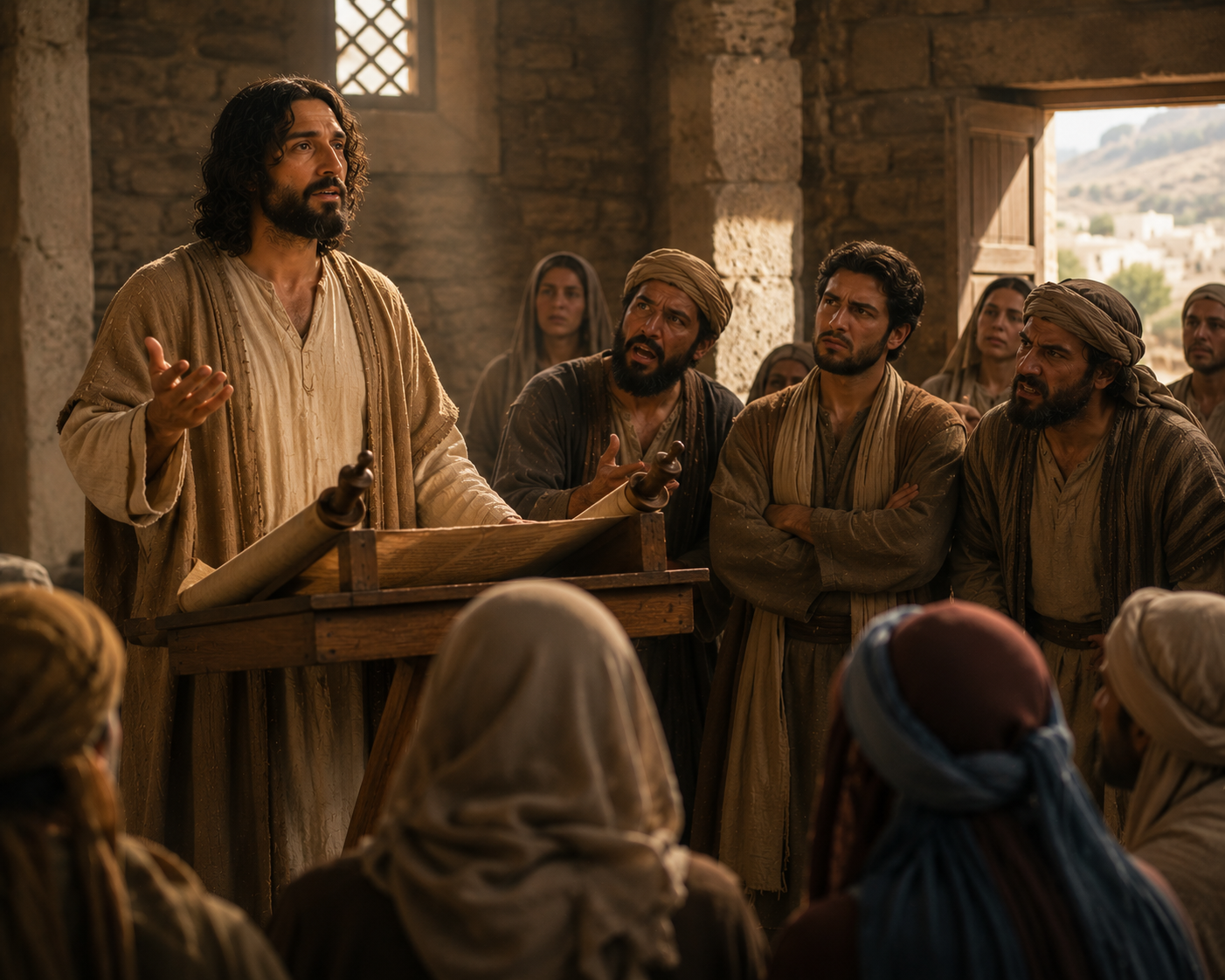
James certainly does not abandon the law entirely. He is not saying, “Believe in Christ and then live as you please.” Neither do any of the apostles. In his letter to the Romans, Paul claims he is falsely accused of promoting this errant doctrine. (See Romans 6:1–3.) Instead, Paul says faith in Christ prompts conformity to the image Christ, who fulfilled the Law (Colossians 3:9–11). Spiritual rebirth initiates and instills life transformation. Believers are changed by their faith in Christ and drawn to obedience to him. Spiritual DNA expresses itself, even as natural DNA does. The child resembles his natural father. Even so, the character and conduct of the born-again believer should increasingly resemble his heavenly Father and his spiritual brother Jesus Christ.
Paul amplifies this thought in his letter to the Romans:
For those God foreknew he also predestined to be conformed to the image of his Son, that he might be the firstborn among many brothers and sisters. (Romans 8:29)
The restrictions or regulations that James places on the Gentile believers appear to be relatively inconsequential, but they had implications for the daily lives of Gentile believers. It was common for meat sold in the Gentile markets to be offered first as an animal sacrifice to idols. This made the Christian consumer of this meat an unwilling participant in pagan idolatry. Clearly this would be offensive to the sensibilities of Jewish believers.

Photo by Sora Shimazaki on Pexels.com
How strictly these regulations were adhered to remains an open question. In the fourteenth chapter of his letter to the Romans Paul discusses this issue of food and abstaining from meat at some length. He also gives these instructions to the believers in Corinth:
Eat anything sold in the meat market without raising questions of conscience, for, “The earth is the Lord’s, and everything in it.”
If an unbeliever invites you to a meal and you want to go, eat whatever is put before you without raising questions of conscience. But if someone says to you, “This has been offered in sacrifice,” then do not eat it, both for the sake of the one who told you and for the sake of conscience. I am referring to the other person’s conscience, not yours. For why is my freedom being judged by another’s conscience? If I take part in the meal with thankfulness, why am I denounced because of something I thank God for?
So whether you eat or drink or whatever you do, do it all for the glory of God. Do not cause anyone to stumble, whether Jews, Greeks or the church of God—even as I try to please everyone in every way. For I am not seeking my own good but the good of many, so that they may be saved. (1 Corinthians 10:25–33)
Similarly, the entire eighth chapter of 1 Corinthians is devoted to this topic. Clearly Paul saw James’ injunction against eating meat offered to idols as an issue of considerable importance, or he would not have addressed this topic in his epistles to the church.
Undoubtedly, the advice cited above was given in keeping with Paul’s understanding of James’ directive in Acts 15. Overall Paul’s concern is chiefly that believers keep their conscience pure. He does not see “food polluted by idols” as a clear black and white issue, but rather as a matter of the heart or the intent of the believer. Paul implies that food is sanctified if it is received with thanksgiving. In so doing, he is providing a practical interpretation of how believers can keep themselves spiritually pure while living in a pagan world.
The injunction against sexual immorality needs little explanation. The Greco-Roman world was awash in sexual immorality, much of it linked to various fertility cults. Abstinence from sexual immorality also involved a rejection of the shrine prostitutes—both male and female—and ritual orgies linked to the worship of these deities. Clearly there was a strong sense that these new Gentile believers must renounce these practices and forms of worship as they embrace a new lifestyle within the body of Christ.
James’ command to abstain “from the meat of strangled animals and from blood” stems directly from Levitical law, where God says:
I will set my face against any Israelite or any foreigner residing among them who eats blood, and I will cut them off from the people. For the life of a creature is in the blood, and I have given it to you to make atonement for yourselves on the altar; it is the blood that makes atonement for one’s life. Therefore I say to the Israelites, “None of you may eat blood, nor may any foreigner residing among you eat blood.” (Leviticus 17:10–12)
This reference to the foreigner, as cited here, has direct relevance as the Jewish believers contemplate welcoming Gentiles into their fellowship. The fellowship meal has particular significance in Middle Eastern culture. For friendship and fellowship to be sealed, the sharing of a meal together was essential. If this overture to the Gentiles was to be significant and meaningful, then Jewish Christian believers and Gentile Christian believers should be able to sit together and eat a fellowship meal together.
But truly the focal point of their fellowship must be Christ—Christ whose redeeming sacrifice was sealed in blood—Christ Jesus who instituted the Eucharist to commemorate the shedding of his blood. By his blood, atonement was made for both Jews and Gentiles. Their fellowship meals included the celebration of the Eucharist. Evidence of this can be found in Paul’s instructions on communion. (See 1 Corinthians 11:17–34.)
Surely the following words had true resonance as James considered the unity of faith between Jews and Gentiles: “it is the blood that makes atonement for one’s life.” His brother’s blood was shed to make that atonement possible. True communion centered around the sacrificial shedding of Jesus’ blood.

Photo by Kaboompics .com on Pexels.com
With James having ruled on this matter, the assembly decided to communicate its decision to those most directly affected—the Gentile churches. Their message also makes it clear that those who caused this doctrinal disturbance were not sent or authorized by the apostolic leadership.
Then the apostles and elders, with the whole church, decided to choose some of their own men and send them to Antioch with Paul and Barnabas. They chose Judas (called Barsabbas) and Silas, men who were leaders among the believers. With them they sent the following letter:
The apostles and elders, your brothers,
To the Gentile believers in Antioch, Syria and Cilicia:
Greetings.
We have heard that some went out from us without our authorization and disturbed you, troubling your minds by what they said. So we all agreed to choose some men and send them to you with our dear friends Barnabas and Paul—men who have risked their lives for the name of our Lord Jesus Christ. Therefore we are sending Judas and Silas to confirm by word of mouth what we are writing. It seemed good to the Holy Spirit and to us not to burden you with anything beyond the following requirements: You are to abstain from food sacrificed to idols, from blood, from the meat of strangled animals and from sexual immorality. You will do well to avoid these things.
Farewell.
So the men were sent off and went down to Antioch, where they gathered the church together and delivered the letter. The people read it and were glad for its encouraging message. (Acts 15:22–31)
James has decisively sided with Peter and Paul on this critical issue. The gospel of grace as opposed to Jewish legalism has triumphed. For the sake of unity, James has added some conditions onto his sweeping welcome of the Gentile believers. Despite this ruling, some Judaizers will persist in trying to force Gentile converts to be circumcised, but they will lack the authority of the church. A certain tension will remain between the proponents of grace and the proponents of legalism. It is a tension that remains in some form between legalistically-inclined and grace-centered believers to this day. Nevertheless, the message is clear: James has ruled in favor of grace.

By welcoming the Gentile believers into the church, James signaled that he fully grasps the significance of the born-again experience. He has come full circle. He has come fully around to his brother’s position, which he so vehemently opposed as a young man—when he gathered the family around him to take charge of Jesus because, by his reasoning, Jesus had gone mad (Mark 3:20–22).
On that occasion with his family waiting at the door, Jesus responded with these words:
“Who are my mother and my brothers?” he asked. Then he looked at those seated in a circle around him and said, “Here are my mother and my brothers! Whoever does God’s will is my brother and sister and mother.” (Mark 3:33–35)
According to Jesus’ reasoning the spiritual family—spiritual genetics—took precedence over the natural family. Though at the time James rejected his brother and his concept of spiritual rebirth, he now finds himself in full agreement with it. His conversion at the appearance of the risen Christ changed everything. (See 1 Corinthians 15:3–9.) What he rejected as heresy before his own rebirth, he now affirms as gospel truth. James now sees the family of believers as his true family—a family that includes even Gentiles.
On a personal level, James was now Jesus’ brother in the Spirit as well as in the flesh.
Furthermore, at the Jerusalem Council, James plays the role his brother would have him play. He institutes his brother’s will by ensuring that the gospel message was available to all throughout the world, regardless of race or gender. James recognizes that those seated before him, eager to hear the gospel message, are his brothers and sisters. He is acting as a doorkeeper to the kingdom of God. In that role, he is guaranteeing that the door is open to all. Anyone can come and enter through repentance and faith in the shed blood of his brother Jesus.
Without question this was a difficult decision to make. By welcoming the Gentiles, James may have sealed the fate of the Jewish church—the church he led. There was a point when it appeared as though Christianity might become the dominant belief system among the Jews. Then severe persecution hindered its advance. Now, with its doors open to the Gentiles, the legalistic members of the Jewish faith could quickly and easily dismiss the Christian faith as an aberrant heresy, unworthy of consideration. As a result, further church growth among the Jewish community was likely stymied.
Did James know that this would be the outcome of his decision to throw the doors open to Gentiles? He probably had some idea of how this would impede the growth of the church among the Jews in their homeland. He knew the ethos of his people. The hardline Pharisaic viewpoint was popular with many Jews, and a fierce, religiously motivated ethnic pride was even more widespread. Generations of religious indoctrination are not easily set aside. Jesus clashed with it; now James does as well.
Despite this, James chose his brother’s will—God’s will—not his own. Perhaps he caught a glimpse of the long view—a view that saw the swift rise to prominence of the church in the Greco-Roman world. Perhaps he simply recognized that this was God’s doing—a work of the Spirit—not simply the work of man. Whatever the reason, James played a pivotal role in promoting the advance of the gospel and in shaping world history for the next two thousand years. Without him Christianity may well have remained an obscure Jewish sect. He was the hinge—the doorkeeper—and he opened the gospel door to the sea of humanity.
But one question remains. How did James come to play such a prominent role in the early church?
New from David Kitz
James—the brother of Jesus—who was this man? What evidence do we have that this “brother of our Lord” even existed?
David Kitz digs deep into archeology, family dynamics, church history, and the biblical texts. What emerges from his research is a portrait of a decisive, pivotal leader who embodied the will and character of Jesus Christ.
But how did James—James the unbeliever—transform to become a leader who changed the course of world history? In these pages you will uncover the answer and rediscover for yourself the life-changing power of the gospel.
To view further details or purchase directly from the author click here.
 I love the Psalms