Tags
Bible, Christ, Christianity, church, circumcision, faith, Gentile converts, Gentiles, gospel, grace, James, James the brother of Jesus, Jerusalem, Jesus, Judaism, leadership, legalism, Paul, Peter, Scripture, Solomon's Portico, temple, temple worship, uncircumcised
James: the Lynchpin of Our Faith — Chapter 16
Before we transition to an examination of the Epistle of James, it would be appropriate to examine the Jewish roots of the church. No one in the early church embodies the Jewishness of this entity we call the church quite like James. And no event in the history of the early church illustrates Christianity’s link to Judaism quite like James’ decision in Acts 21 that Paul should participate in ritual cleansing at the temple.
Today Christians and Jews see their religions as distinct from each other. The decisions and actions of both James and Paul show that they did not share this view.
James was leading a profoundly Jewish church. He says as much. “You see, brother [Paul], how many thousands of Jews have believed, and all of them are zealous for the law” (Acts 21:20).
These believing Jews were not only zealous for law. They were also zealous for the temple and had not in any way abandoned the practices and ceremonies of temple worship. As James and the elders point out, four of their company—believers in Christ—were fulfilling vows and participating in purification rites. It should be noted that from Pentecost onward, believers were meeting daily in the Temple (Acts 2:46–47), and there are strong indications that this practice continued.
To Christians today, this may seem incomprehensible. We have well-established dividing lines that separate Jews from Christians and Judaism from Christianity. For James no such line existed.
A modern equivalent might be a televangelist having his infant daughter baptized at a cathedral by a Catholic archbishop. Or conversely, the televangelist might do a full immersion baptism of the archbishop. Yet both these examples fall under the broad tent of the Christian faith. But both James and Paul were even more radical. They were comfortable stepping across lines that we have established between two great faiths, Christianity and Judaism.
Some of our difficulties spring from a lack of understanding of this fusion of faith within the early Jewish Christian community. They saw Jesus as their Jewish Messiah, fulfilling all the prophecies of their scriptures. He did not come to do away with their faith or the Law, but to fulfill it—and he said just that.
Do not think that I have come to abolish the Law or the Prophets; I have not come to abolish them but to fulfill them. For truly I tell you, until heaven and earth disappear, not the smallest letter, not the least stroke of a pen, will by any means disappear from the Law until everything is accomplished. Therefore anyone who sets aside one of the least of these commands and teaches others accordingly will be called least in the kingdom of heaven, but whoever practices and teaches these commands will be called great in the kingdom of heaven. For I tell you that unless your righteousness surpasses that of the Pharisees and the teachers of the law, you will certainly not enter the kingdom of heaven. (Matthew 5:17–20)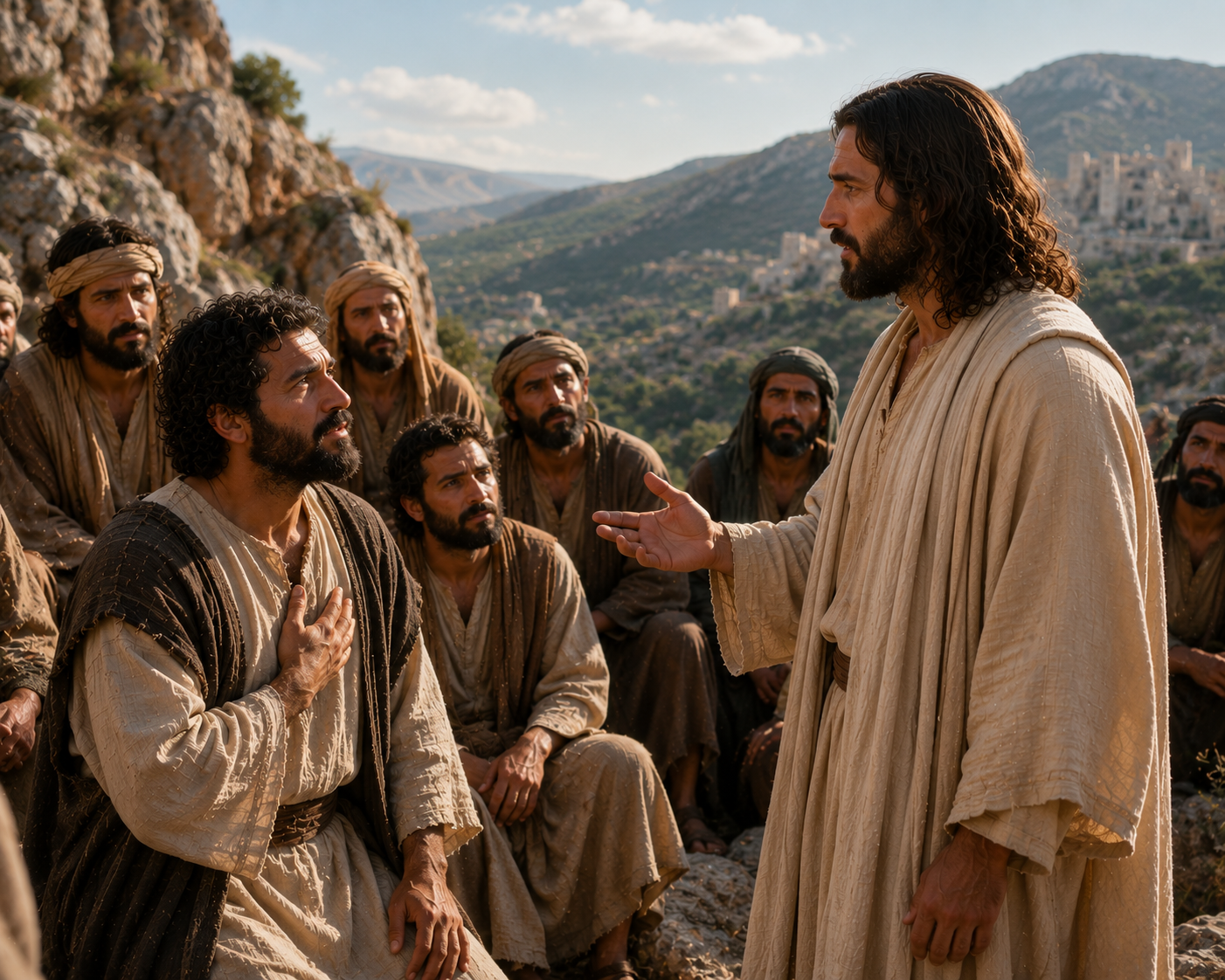
Also, Jesus in no way encouraged disobedience to the Law. Many Christians have a false impression of Jesus and his teaching. They assume that because he was supremely loving and forgiving, he must have been lax in his application of the Law or easy-going about sin. Just the opposite is true, and his statements recorded in the gospels make this abundantly clear.
Rather than lower the bar in his Sermon on the Mount, Jesus elevates it. The Old Testament law prohibits murder; Jesus prohibits hate (Matthew 5:21–22). The Old Testament law prohibits adultery; Jesus prohibits lust (Matthew 5:27–28). He systematically demands more than the law requires by going to the heart of the issue, rather than simply looking at outward appearance or performance.
While Jesus condemned the hypocrisy and pride of the Pharisees and teachers of the law, he did not quibble with their adherence to it.
Woe to you, teachers of the law and Pharisees, you hypocrites! You give a tenth of your spices—mint, dill and cumin. But you have neglected the more important matters of the law—justice, mercy and faithfulness. You should have practiced the latter, without neglecting the former. You blind guides! You strain out a gnat but swallow a camel. (Matthew 23:23–24)
Similarly, Jesus did not abandon temple worship. If anything, he was an advocate for it. His cleansing of the temple was not an indictment of temple worship, but an attack on the abuse of that sacred space. He viewed the temple grounds as the rightful place for prayer, praise, healing, and the teaching of the word.
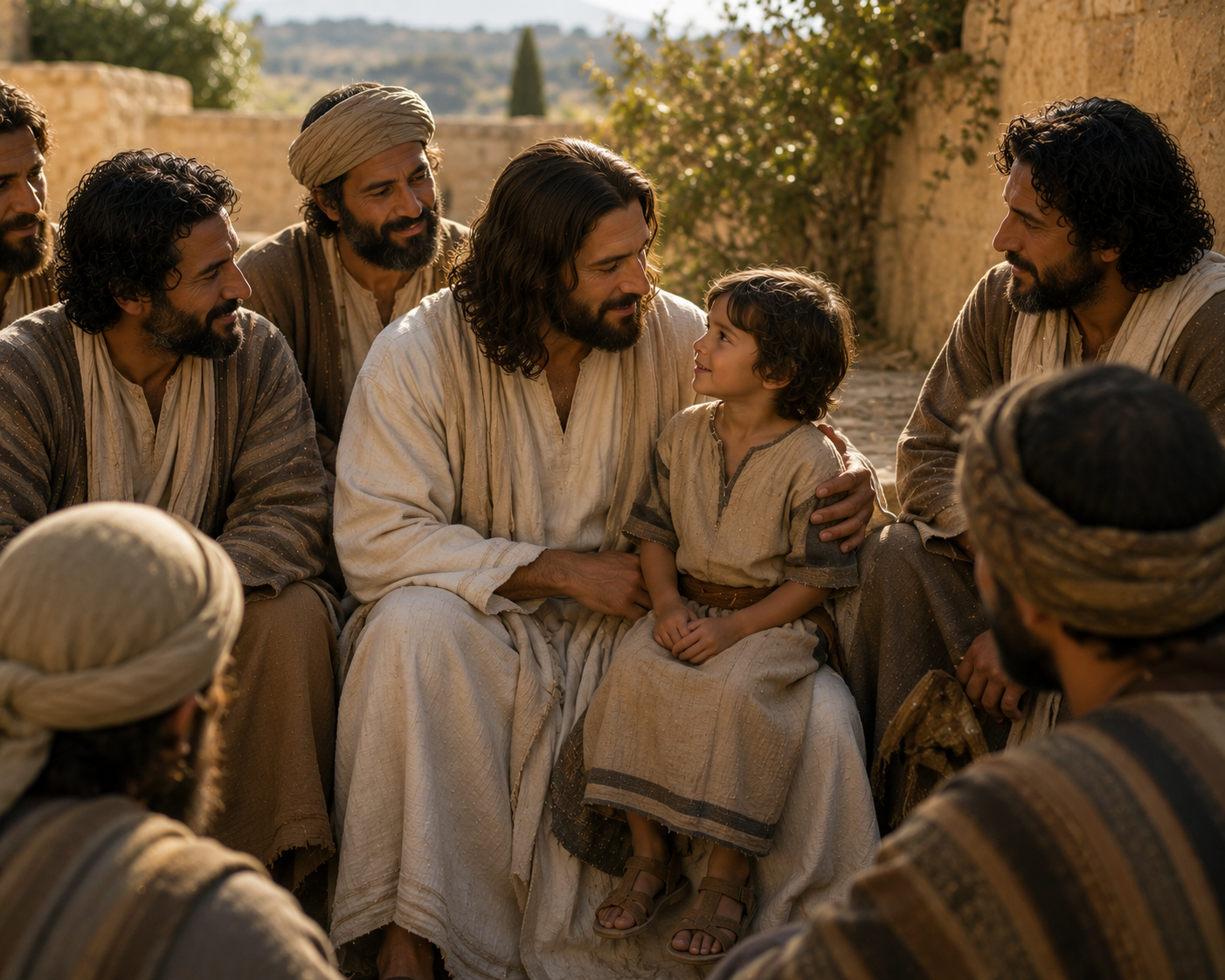
Jesus entered the temple courts and drove out all who were buying and selling there. He overturned the tables of the money changers and the benches of those selling doves. “It is written,” he said to them, “‘My house will be called a house of prayer,’ but you are making it ‘a den of robbers.’”
The blind and the lame came to him at the temple, and he healed them. But when the chief priests and the teachers of the law saw the wonderful things he did and the children shouting in the temple courts, “Hosanna to the Son of David,” they were indignant.
“Do you hear what these children are saying?” they asked him.
“Yes,” replied Jesus, “have you never read, ‘From the lips of children and infants you, Lord, have called forth your praise?’” (Matthew 21:12–16)
In the same vein, though Jesus prophesied the destruction of the temple (Matthew 24:1–2), that prophecy should not be viewed as a vindictive declaration, but rather a lament.
As he approached Jerusalem and saw the city, he wept over it and said, “If you, even you, had only known on this day what would bring you peace—but now it is hidden from your eyes. The days will come upon you when your enemies will build an embankment against you and encircle you and hem you in on every side. They will dash you to the ground, you and the children within your walls. They will not leave one stone on another, because you did not recognize the time of God’s coming to you.” (Luke 19:41–44)
The conflict that led to Jesus’ crucifixion can be viewed as a dispute over the proper use of the temple. The high priest and temple authorities were enraged over the eviction of the merchants and money changers because they benefitted from this trade—and it was of course a direct challenge to their authority. In his commentary on this matter, William Barclay makes this assessment on the trade in sacrificial doves:
Clearly he [Jesus] had attacked this abuse. Further, these stalls where the victims were sold were called the Bazaars of Annas, and were the private property of the family of the high priest of that name. (1)
In addition, the high priest and his clan objected to Jesus’ use of the temple as his teaching and healing center.
For Jesus this issue went to the heart of his DNA. It was about being at home in his Father’s house and using it according to His will and purpose. It harkens back to his first recorded words as a twelve-year-old boy, “Didn’t you know I had to be in my Father’s house?” (Luke 2:49)
Furthermore, it was about the fulfilment of his prophetic mandate within this sacred precinct.
“I will send my messenger, who will prepare the way before me. Then suddenly the Lord you are seeking will come to his temple; the messenger of the covenant, whom you desire, will come,” says the LORD Almighty. (Malachi 3:1)
The Messiah had come to his temple, but the Jewish leadership was not prepared for him and refused to recognize him as their Lord.
There are strong indications that the apostles, including James, were fully at one with Jesus’ view of the temple and its proper use and purpose. They saw it as their prayer and worship center and the rightful home of their Messiah.
The apostles did not relinquish the dispute that Jesus had initiated. They were not advocating for the temple’s destruction, though they were accused of this (Acts 6:13-14). Rather, their goal was to turn the entire Jewish nation into believers in Jesus Christ, with the temple being used as their prayer and worship center.
The first physical healing recorded in Acts lends credence to this view. (See Acts 3:1–26.) Peter and John went to the temple at the appointed time for prayer. At the Beautiful Gate, they healed a man who was lame from birth through the power of Jesus’ name. When in amazement a crowd gathered, they preached the gospel message.
Peter and John were doing precisely what Jesus had done in the temple courts before his arrest and crucifixion. They came to pray, they healed the infirm, and they taught the people about Christ. They also got the same response from the authorities. They were arrested just as Jesus had been.
The story of this first miraculous healing of the apostolic age illustrates that rather than separate themselves, Peter and John participated in the rituals and practices of temple worship. They went to the temple at the hour of prayer—the time of the daily sacrifice—the time when Jesus, the pascal lamb, had offered up his life.
Because of persecution and fear, the Jewish church could have withdrawn entirely from the predominant culture—but it did just the opposite. The church inserted itself directly into the fabric of the community by meeting within the temple courts. “The apostles performed many signs and wonders among the people. And all the believers used to meet together in Solomon’s Colonnade.” (Acts 5:12)
Solomon’s Colonnade or Portico was part of the outer court of the temple.(2) Meeting there was an outright challenge to the Jewish religious authorities, and it also served as a bold witness to the believers’ faith in the crucified and risen Christ—the Christ that these same authorities had sent to the cross. Despite arrests and warnings, they filled Jerusalem with their teaching (Acts 5:28).
It is well worth noting that the first public meeting place for the first century church was at the temple. This full, practical integration of Christianity with Judaism seems unnatural or contrary to us at the present. But James and the early believers didn’t want to separate themselves from the Jewish people—they wanted to win over their hearts. In fact, they believed faith in Christ would make them better Jews, since they would be accepting the Messiah sent by the God of Israel.
 James was situated at the center of an epic battle for the allegiance of his people. To understand him, we must understand how he viewed his apostolic mission and how he went about pursuing it.
As much as Paul identifies himself as the apostle to the Gentiles, James stands out as the apostle to the Jews. In Paul’s letter to the Galatians, Paul self-identifies in this way, but he identifies Peter as the apostle to the Jews.
For God, who was at work in Peter as an apostle to the circumcised, was also at work in me as an apostle to the Gentiles. James, Cephas [Peter] and John, those esteemed as pillars, gave me and Barnabas the right hand of fellowship when they recognized the grace given to me. They agreed that we should go to the Gentiles, and they to the circumcised. (Galatians 2:8–9)
As time progressed, Peter and John moved on to other fields—fields that included the Gentiles—while James remained rooted in Jerusalem. When we meet James in Acts 21, which may be as much as six years after Paul’s Galatian letter, it is apparent that James has assumed the mantle of the apostle to the Jews.
Perhaps the greatest temptation James faced was the temptation to withdraw from the culture and any involvement with the temple. To do so would be to admit defeat. It would mean ceding the temple to those who sanctioned his brother’s execution. But James steadfastly refused to turn his back on the Father’s house.
The temptation for the church to withdraw from the culture rather than engage with it remains to this day. Self-isolation is safer than being an active and engaged witness to the life-transforming power of Christ.
James’ instructions for Paul to participate in ceremonial cleansing should be viewed as part of a broader strategy to be a potent witness for Christ to the Jewish people. It was a strategy with which Paul agreed because of his desire to see the salvation of his own people.
Brothers and sisters, my heart’s desire and prayer to God for the Israelites is that they may be saved. For I can testify about them that they are zealous for God, but their zeal is not based on knowledge. Since they did not know the righteousness of God and sought to establish their own, they did not submit to God’s righteousness. Christ is the culmination of the law so that there may be righteousness for everyone who believes. (Romans 10:1–4)

Paul views the Jewish fixation on righteousness achieved by the law as a huge impediment to receiving the righteousness of Christ, which comes through faith. James, Paul, and Jesus agree on this point. Salvation for the Jewish people from Abraham onward was always achieved through faith—an active faith—not merely an intellectual acknowledgement.
It would be folly to assume that James and Paul did not discuss these foundational matters of faith on occasions when they met together. The differences they had, which are often projected as irreconcilable, need to be viewed through the lens of their calling. Paul’s apostolic focal point was the Gentiles. James’ apostolic focal point was the Jews.
Salvation for both people groups comes through faith in the atoning sacrifice of Jesus, God’s own Son—the eternal Lamb of God. As we will see, on this point they are in full agreement.
Both James and Paul are determined to let their light shine before men (Matthew 5:16), even in the temple courts—even at the risk of their lives—even to the point of death. The violent zealotry for the law that plays out when Paul is seized, beaten, and arrested in the temple foreshadows what will ultimately happen to James a few years later. In Paul’s case, a Roman commander intervened to save his life.
James was not so fortunate.
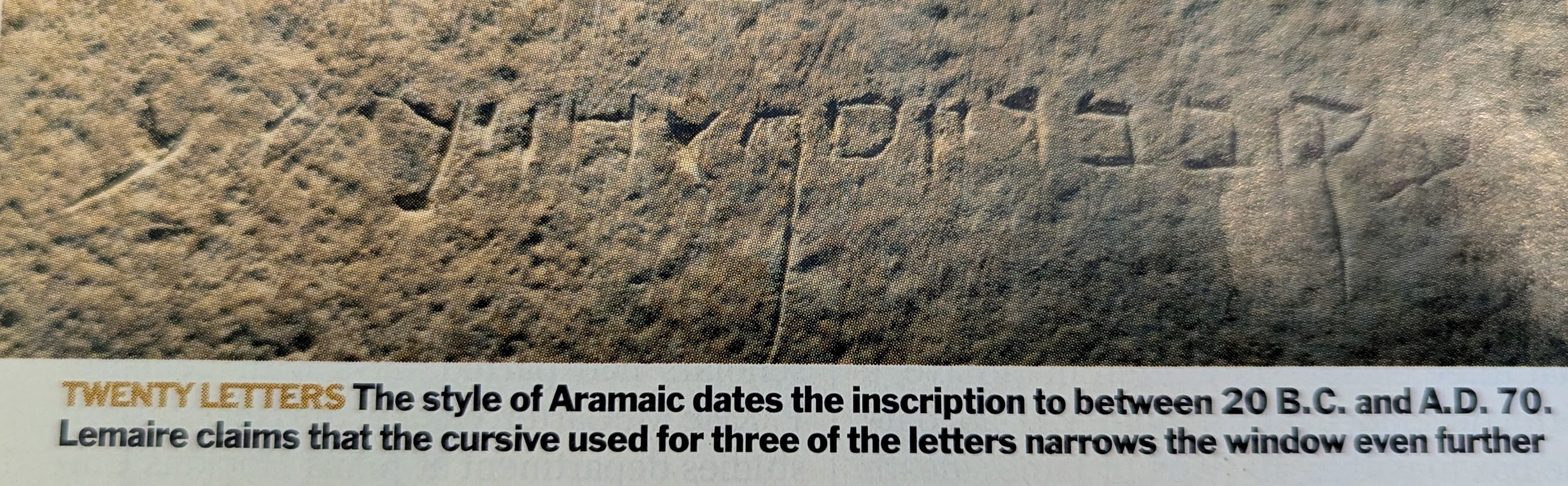
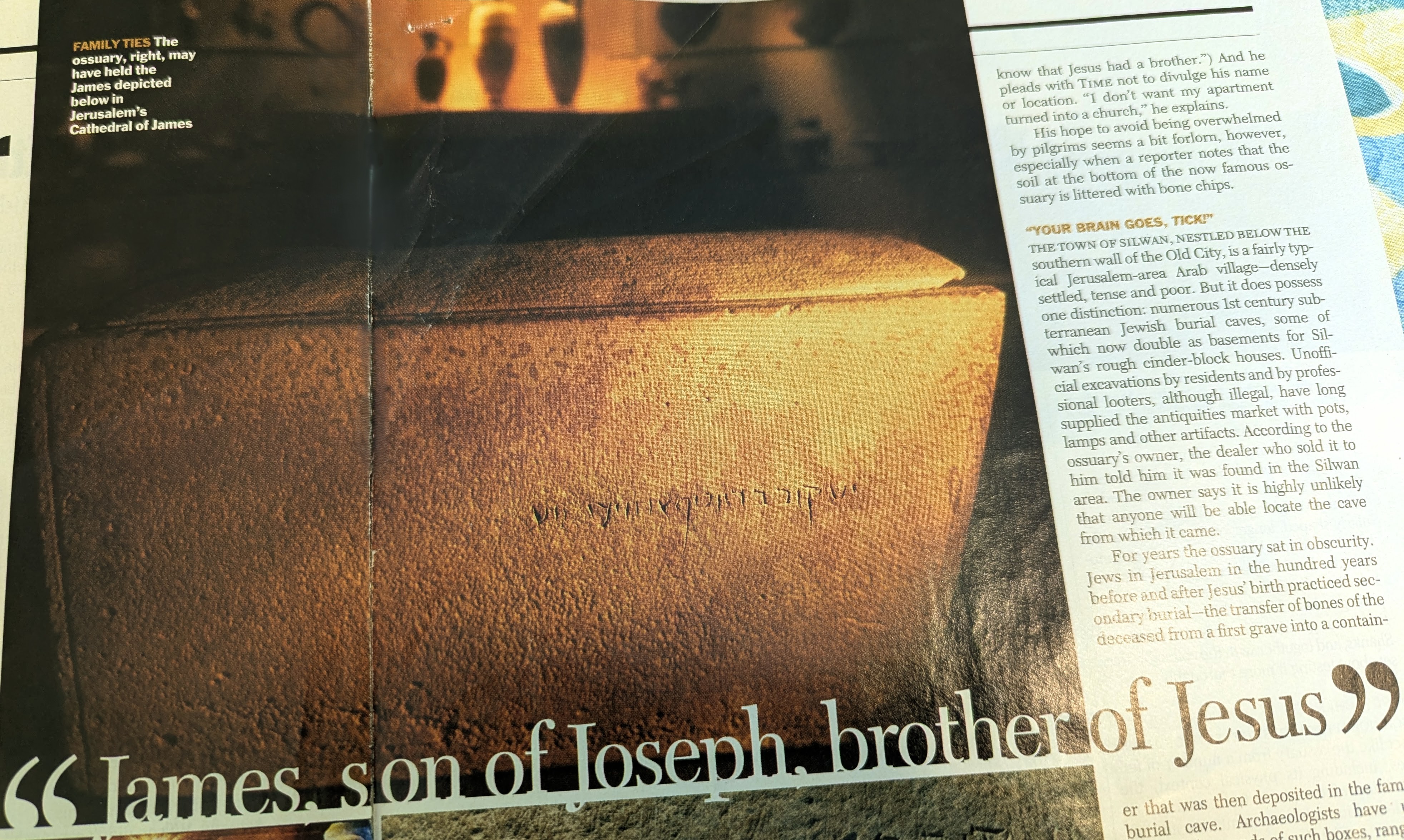
Photo Credit Time Magazine, November 4, 2002 — the inscription on the James Ossuary.
(1) William Barclay, The Gospel of Matthew, Volume Two, Chapters 11–28—The Daily Study Bible (Welch, 1975), p. 246.
(2) “Solomon’s Portico,” by W. F. Stinespring, The Interpreter’s Dictionary of the Bible, Volume 4, Edited by George Arthur Buttrick (Abingdon, 1984), p. 408.
New from David Kitz
James—the brother of Jesus—who was this man? What evidence do we have that this “brother of our Lord” even existed?
David Kitz digs deep into archeology, family dynamics, church history, and the biblical texts. What emerges from his research is a portrait of a decisive, pivotal leader who embodied the will and character of Jesus Christ.
But how did James—James the unbeliever—transform to become a leader who changed the course of world history? In these pages you will uncover the answer and rediscover for yourself the life-changing power of the gospel.
To view further details or purchase directly from the author click here.