• Home
  • About
  • DavidKitz.ca
  • Youtube Videos
  • Books by David
  • Books on Amazon.com

I love the Psalms

~ Connecting daily with God through the Psalms

I love the Psalms

Tag Archives: Gentile converts

To the Twelve Tribes Scattered among the Nations

28 Sunday Jun 2026

Posted by davidkitz in Books by David Kitz

≈ Leave a comment

Tags

Bible, Christ, Christianity, church, faith, Gentile converts, Gentiles, gospel, grace, James, James the brother of Jesus, Jerusalem, Jesus, Judaism, leadership, Messiah, Paul, Peter, Scripture

James the Reflection of Jesus
James through the Lens of his Epistle

James: the Lynchpin of Our Faith — Chapter 17

We can learn a great deal about James through the Gospels, through the Book of Acts, and through Paul’s references to him in his epistles. But ultimately the character of the reborn James is most eloquently revealed through his own writing—through his epistle, the Epistle of James.

Biblical scholars are divided when assigning a date for when the Epistle of James was written. It can be no later than 62 AD, since Josephus indicates that was the year when James was martyred. There is some evidence that it may have been written in the forties, and if true, it would then predate Paul’s letters. William Varner is among the scholars who favor an earlier date. (1) In his notes on James, K. Arthur also situates the epistle “sometime before 50 A.D. or in the early A.D. 50s.” (2) R.V.G Tasker places the most likely date as about AD 60.

In his introduction to the epistle of James, Jon Mark Ruthven states, “We cannot be dogmatic, and can only conclude that the letter was written between AD 48 and 62.” (3)

William Varner’s early date seems improbable, since it comes before the Council of Jerusalem in AD 50 that welcomed the Gentiles into the fellowship of the church. How- ever, a date in the early AD 50s or earlier is intriguing because it raises several questions.

Is the Epistle of James the first epistle in the canon? Did James set the pattern or standard for the other canonical epistle writers? Were Paul, Peter, John, and Jude following the example of James when they picked up the quill pen and wrote their epistles to local churches or more broadly to the universal church? Or alternately was James following the example of Paul when he wrote his epistle?

Due to James’ leadership role in the church, as demonstrated at the Council of Jeru-salem, it is not unreasonable to surmise that he may alsohave led the way in addressing the rapidly growing church through this Holy Spirit inspired literary form.

In fact, James had ample reasons to write an epistle. Having opened the door of the church to uncircumcised believers, he had a responsibility to ensure that these new converts were fully acquainted with the teaching and ethics of their Lord and Savior. Having put their faith in Jesus, how should these new believers live? With his practical, direct approach James answers that question in his epistle.

Furthermore, through his friendship with Paul and by his endorsement of his ministry, James had an envoy through whom he could ensure that his epistle was widely read throughout Paul’s network of churches.

As Ruthven states, we cannot be dogmatic on these points, but through James and Paul’s interaction we can see there is a logical progressionthat can readily explain the development of the epistles as a New Testament form of inter-church communication and teaching. James and his epistle sit at the heart of this first-century inter-church dialogue.

The Epistle of James appears in our bibles as the first of what are commonly called the general epistles. These epistles are called general because they are not addressed to a specific congregation, such as the church in Corinth or Ephesus.

But James does have an audience that he addresses with his greeting:

From James, a servant of God and of our Lord Jesus Christ. Greetings to the twelve tribes scattered all over the world. (James 1:1, CEV)

There is a humility in James’ self-introduction that is worthy of comment. He does not identify himself as the brother of Jesus; to do so would be self-exalting. Instead, he simply identifies as “a servant of God and of our Lord Jesus Christ.”
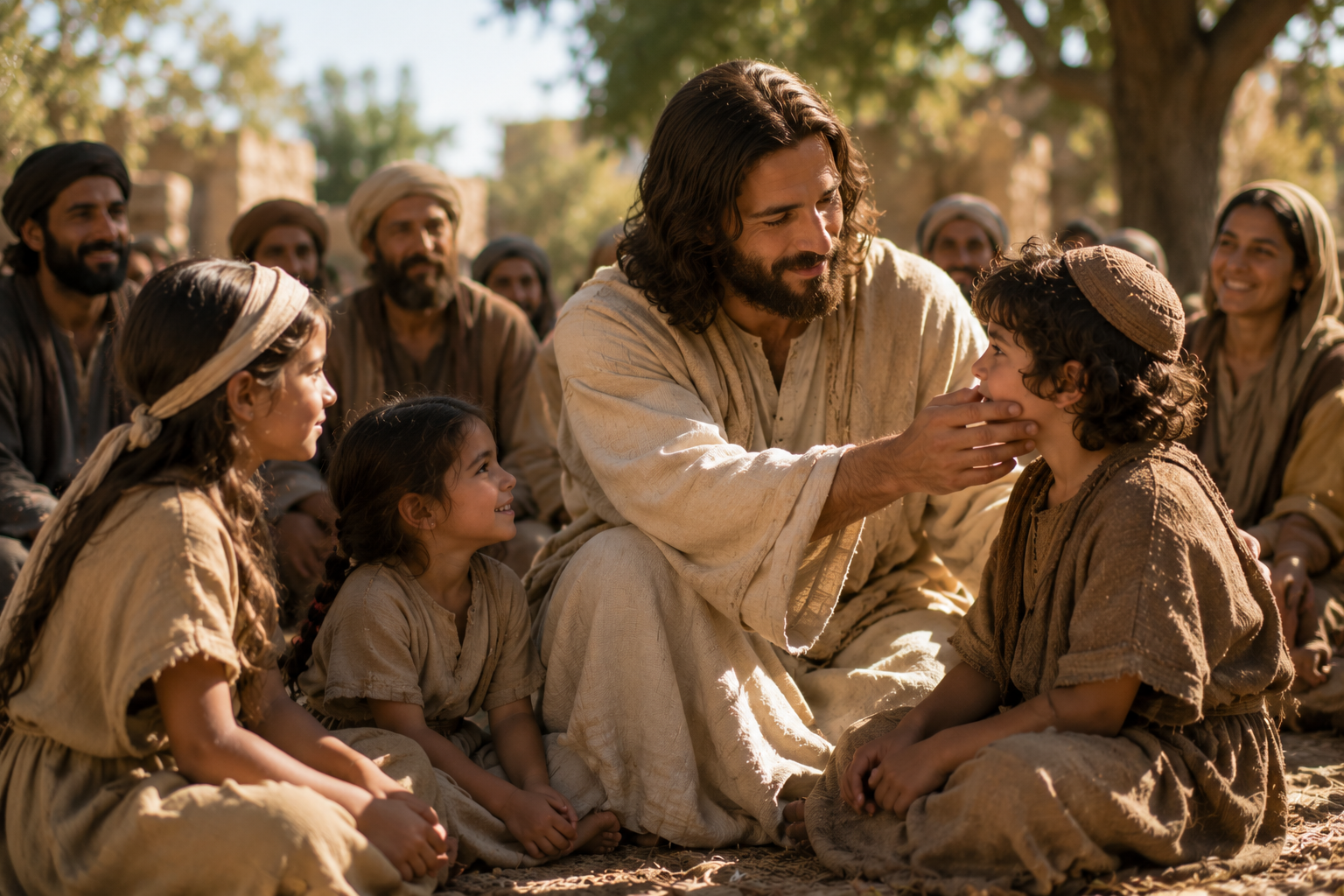
By identifying himself as a servant, James is accurately reflecting the character of his brother, who continually identified himself as a servant. On his final night with his disciples, Jesus assumed a servant’s role as he stooped to wash their feet (John 13:2-17). Now in his role as overseer, James addresses the church of Jesus Christ as the Lord’s
humble servant.

By declining to identify himself as Jesus’ brother, James is following the pattern of humility and self-effacement exemplified by his brother. Though Jesus was the Son of God, he did not refer to himself in those terms. He preferred the term ‘son of man.’ Even in his trial before the Jewish High Council, when he was directly asked if he was the Son of God, he answered, “You say that I am.” (Luke 22:70)

James takes the same approach as his brother. Rather than self-identify as the brother of Jesus, he allows others to identify him as such. He assumes a humble position. James refuses to take the place of honor until he is asked to do so, just as Jesus taught in one of his parables about guests arriving at a banquet (Luke 14:7–11).

James’ letter is addressed to “the twelve tribes scattered all over the world” (CEV) or as the more traditional King James Version reads “to the twelve tribes which are scattered abroad.” At first glance one might assume that this means that James is writing exclusively to the Jewish diaspora.

Some Bible scholars interpret this phrase in this narrow, literal sense. But there is ample evidence to suggest that the phrase “twelve tribes” is in fact inclusive of all Christian believers regardless of race or nationality. Under the new covenant ushered in by Jesus, followers of Christ are the new Israel of God (Galatians 6:14–16).

Tasker sees the phrase “twelve tribes” as a symbolic description of the new Israel.

James is not addressing a single group of Christians with whose circumstances he is familiar, but various congregations of Christians scattered far and wide throughout the Roman world. Together, these groups constitute the people of God who are continuous with the old Israel but consist of all, regardless of nationality, who acknowledge Jesus as God’s Messiah. (4)

The view that the phrase “twelve tribes scattered all over the world” is a description of the church as the new Israel is strengthened by Peter’s use of a similar phrase in 1 Peter 1:1. Peter addresses his letter to “the exiles of the Dispersion” (RSV) or scattering.

In the same way Paul, in his closing remarks to the largely Gentile churches of Galatia, refers to them and the global church as the “Israel of God” (Galatians 6:16). The point being made here is that the apostles saw all those who were redeemed by Christ as heirs of the new kingdom that he was establishing. This new kingdom is the “Israel of God” which James metaphorically calls the “twelve tribes” of the dispersion. According to Paul, the new converts are all the children of Abraham by faith. See Galatians 3:7.  Thus, it includes all the redeemed who have put their faith in Jesus Christ, both Jew and Gentile.

It logically follows that the Epistle of James is addressed to Christian believers every-where and for all time. The scattering or dispersion of believers throughout the world, whether through persecution or missionary endeavor, alludes to Jesus’ teaching about the growth of the kingdom of God as he compares it to yeast in a lump of dough (Matthew 13:33).

In the same vein, in the week prior to his death, Jesus taught via his Parable of the Tenants that a sharp change was coming (Matthew 21:33–46). He spoke this prophetic warning to the chief priests and Pharisees: “Therefore I tell you that the kingdom of God will be taken away from you and given to a people who will produce its fruit” (Matthew21:43).

The kingdom of God was being transferred from the Jewish nation to those who accepted the rulership of Jesus, the Messiah king. Christ’s dire warning had its ful-fillment with the destruction of Jerusalem in 70 AD and the exile of the Jewish population from their homeland. Much of Jesus’ discourse in Matthew 24 predicts and describes this traumatic national event.

Paul points out that by God’s grace and through the message of the gospel, Jews and Gentiles are being drawn together in one body.

In reading this, then, you will be able to understand my insight into the mystery of Christ, which was not made known to people in other generations as it has now been revealed by the Spirit to God’s holy apostles and prophets. This mystery is that through the gospel the Gentiles are heirs together with Israel, members together of one body, and sharers together in the promise in Christ Jesus. (Ephesians 3:4–6)

With the opening salutation of his epistle, then, James was tapping into the great mystery of the gospel, which binds Jews and Gentiles together as one people through faith in Christ Jesus. He was writing to a dispersed and culturally diverse church he had explicitly authorized by his decision at the Council of Jerusalem.

And how did one become a citizen of the kingdom of God and member of the church of Christ? James provides the answer in the first chapter of his epistle.

Don’t be deceived, my dear brothers and sisters. Every good and perfect gift is from above, coming down from the Father of the heavenly lights, who does not change like shifting shadows. He chose to give us birth through the word of truth, that we might be a kind of firstfruits of all he created. (James 1:16–18)

With this brief statement James encapsulates the core gospel message. Salvation is a gift, Ephesians 2:8–9, from our gracious heavenly Father who has chosen us, 1 Peter 1:1–2, and given us new birth into His family through the Word, 1 Peter 1:23, which came to us in human flesh in the person of Jesus, John 1:9–13. In short, we become citizens of the kingdom through rebirth, just as Jesus taught Nicodemus in John 3.

This statement fully aligns with the teaching found throughout the other New Test-ament texts. James and Paul were initially opponents of the ministry of Christ, yet after their conversion they came into agreement on the key elements of the gospel message.

How did that alignment come about? Undoubtedly, it came about as both men met with the apostles who were present during Jesus’ active ministry. The Twelve heard Jesus’ teachings, witnessed his interactions with the crowds, and saw his miraculous powers. One can easily imagine James as an eager new convert meeting with Matthew, Peter, and John, and discussing the key events and the teachings of Jesus’ ministry—events he was not present for.

With the passage of time, it became ever more urgent that these oral accounts be recorded for posterity. In his leadership role, did James by word or by the example provided by his epistle encourage the gospel writers to record the events they witnessed and researched? Possibly. What is clear is that through his epistle, James conveys the ethos, character, and spirit of his brother Jesus.

In summary, James 1:16-18 establishes the apostolic orthodoxy of James’ under-standing of the gospel, and James 1:1 establishes the universality of the audience for his message. Now let’s dig deeper and consider the scope and content of his epistle.

(1) William Varner, James—Evangelical Exegetical Commentary (Lexham, 2014), p.17.
(2) Arthur, The International Inductive Study New Testament, p. 355.
(3) Ruthven, “Introduction: James,” Spirit Filled Life Bible, p. 1893.
(4) R.V.G. Tasker, The General Epistle of James: An Introduction and Commentary—Tyndale New Testament Commentaries (Eerdmans, 1983), p. 39.

New from David Kitz

James—the brother of Jesus—who was this man? What evidence do we have that this “brother of our Lord” even existed?

David Kitz digs deep into archeology, family dynamics, church history, and the biblical texts. What emerges from his research is a portrait of a decisive, pivotal leader who embodied the will and character of Jesus Christ.

But how did James—James the unbeliever—transform to become a leader who changed the course of world history? In these pages you will uncover the answer and rediscover for yourself the life-changing power of the gospel.

To view further details or purchase directly from the author click here.
 

James the Apostle to the Jews

21 Sunday Jun 2026

Posted by davidkitz in Books by David Kitz

≈ Leave a comment

Tags

Bible, Christ, Christianity, church, circumcision, faith, Gentile converts, Gentiles, gospel, grace, James, James the brother of Jesus, Jerusalem, Jesus, Judaism, leadership, legalism, Paul, Peter, Scripture, Solomon's Portico, temple, temple worship, uncircumcised

James: the Lynchpin of Our Faith — Chapter 16

Before we transition to an examination of the Epistle of James, it would be appropriate to examine the Jewish roots of the church. No one in the early church embodies the Jewishness of this entity we call the church quite like James. And no event in the history of the early church illustrates Christianity’s link to Judaism quite like James’ decision in Acts 21 that Paul should participate in ritual cleansing at the temple.

Today Christians and Jews see their religions as distinct from each other. The decisions and actions of both James and Paul show that they did not share this view.

James was leading a profoundly Jewish church. He says as much. “You see, brother [Paul], how many thousands of Jews have believed, and all of them are zealous for the law” (Acts 21:20).

These believing Jews were not only zealous for law. They were also zealous for the temple and had not in any way abandoned the practices and ceremonies of temple worship. As James and the elders point out, four of their company—believers in Christ—were fulfilling vows and participating in purification rites. It should be noted that from Pentecost onward, believers were meeting daily in the Temple (Acts 2:46–47), and there are strong indications that this practice continued.

To Christians today, this may seem incomprehensible. We have well-established dividing lines that separate Jews from Christians and Judaism from Christianity. For James no such line existed.

A modern equivalent might be a televangelist having his infant daughter baptized at a cathedral by a Catholic archbishop. Or conversely, the televangelist might do a full immersion baptism of the archbishop. Yet both these examples fall under the broad tent of the Christian faith. But both James and Paul were even more radical. They were comfortable stepping across lines that we have established between two great faiths, Christianity and Judaism.

Some of our difficulties spring from a lack of understanding of this fusion of faith within the early Jewish Christian community. They saw Jesus as their Jewish Messiah, fulfilling all the prophecies of their scriptures. He did not come to do away with their faith or the Law, but to fulfill it—and he said just that.

Do not think that I have come to abolish the Law or the Prophets; I have not come to abolish them but to fulfill them. For truly I tell you, until heaven and earth disappear, not the smallest letter, not the least stroke of a pen, will by any means disappear from the Law until everything is accomplished. Therefore anyone who sets aside one of the least of these commands and teaches others accordingly will be called least in the kingdom of heaven, but whoever practices and teaches these commands will be called great in the kingdom of heaven. For I tell you that unless your righteousness surpasses that of the Pharisees and the teachers of the law, you will certainly not enter the kingdom of heaven. (Matthew 5:17–20)

Also, Jesus in no way encouraged disobedience to the Law. Many Christians have a false impression of Jesus and his teaching. They assume that because he was supremely loving and forgiving, he must have been lax in his application of the Law or easy-going about sin. Just the opposite is true, and his statements recorded in the gospels make this abundantly clear.

Rather than lower the bar in his Sermon on the Mount, Jesus elevates it. The Old Testament law prohibits murder; Jesus prohibits hate (Matthew 5:21–22). The Old Testament law prohibits adultery; Jesus prohibits lust (Matthew 5:27–28). He systematically demands more than the law requires by going to the heart of the issue, rather than simply looking at outward appearance or performance.

While Jesus condemned the hypocrisy and pride of the Pharisees and teachers of the law, he did not quibble with their adherence to it.

Woe to you, teachers of the law and Pharisees, you hypocrites! You give a tenth of your spices—mint, dill and cumin. But you have neglected the more important matters of the law—justice, mercy and faithfulness. You should have practiced the latter, without neglecting the former. You blind guides! You strain out a gnat but swallow a camel. (Matthew 23:23–24)

Similarly, Jesus did not abandon temple worship. If anything, he was an advocate for it. His cleansing of the temple was not an indictment of temple worship, but an attack on the abuse of that sacred space. He viewed the temple grounds as the rightful place for prayer, praise, healing, and the teaching of the word.

Jesus entered the temple courts and drove out all who were buying and selling there. He overturned the tables of the money changers and the benches of those selling doves. “It is written,” he said to them, “‘My house will be called a house of prayer,’ but you are making it ‘a den of robbers.’”

The blind and the lame came to him at the temple, and he healed them. But when the chief priests and the teachers of the law saw the wonderful things he did and the children shouting in the temple courts, “Hosanna to the Son of David,” they were indignant.

“Do you hear what these children are saying?” they asked him.

“Yes,” replied Jesus, “have you never read, ‘From the lips of children and infants you, Lord, have called forth your praise?’” (Matthew 21:12–16)

In the same vein, though Jesus prophesied the destruction of the temple (Matthew 24:1–2), that prophecy should not be viewed as a vindictive declaration, but rather a lament.

As he approached Jerusalem and saw the city, he wept over it and said, “If you, even you, had only known on this day what would bring you peace—but now it is hidden from your eyes. The days will come upon you when your enemies will build an embankment against you and encircle you and hem you in on every side. They will dash you to the ground, you and the children within your walls. They will not leave one stone on another, because you did not recognize the time of God’s coming to you.” (Luke 19:41–44)

The conflict that led to Jesus’ crucifixion can be viewed as a dispute over the proper use of the temple. The high priest and temple authorities were enraged over the eviction of the merchants and money changers because they benefitted from this trade—and it was of course a direct challenge to their authority. In his commentary on this matter, William Barclay makes this assessment on the trade in sacrificial doves:

Clearly he [Jesus] had attacked this abuse. Further, these stalls where the victims were sold were called the Bazaars of Annas, and were the private property of the family of the high priest of that name. (1)

In addition, the high priest and his clan objected to Jesus’ use of the temple as his teaching and healing center.

For Jesus this issue went to the heart of his DNA. It was about being at home in his Father’s house and using it according to His will and purpose. It harkens back to his first recorded words as a twelve-year-old boy, “Didn’t you know I had to be in my Father’s house?” (Luke 2:49)

Furthermore, it was about the fulfilment of his prophetic mandate within this sacred precinct.

“I will send my messenger, who will prepare the way before me. Then suddenly the Lord you are seeking will come to his temple; the messenger of the covenant, whom you desire, will come,” says the LORD Almighty. (Malachi 3:1)

The Messiah had come to his temple, but the Jewish leadership was not prepared for him and refused to recognize him as their Lord.

There are strong indications that the apostles, including James, were fully at one with Jesus’ view of the temple and its proper use and purpose. They saw it as their prayer and worship center and the rightful home of their Messiah.

The apostles did not relinquish the dispute that Jesus had initiated. They were not advocating for the temple’s destruction, though they were accused of this (Acts 6:13-14). Rather, their goal was to turn the entire Jewish nation into believers in Jesus Christ, with the temple being used as their prayer and worship center.

The first physical healing recorded in Acts lends credence to this view. (See Acts 3:1–26.) Peter and John went to the temple at the appointed time for prayer. At the Beautiful Gate, they healed a man who was lame from birth through the power of Jesus’ name. When in amazement a crowd gathered, they preached the gospel message.

Peter and John were doing precisely what Jesus had done in the temple courts before his arrest and crucifixion. They came to pray, they healed the infirm, and they taught the people about Christ. They also got the same response from the authorities. They were arrested just as Jesus had been.

The story of this first miraculous healing of the apostolic age illustrates that rather than separate themselves, Peter and John participated in the rituals and practices of temple worship. They went to the temple at the hour of prayer—the time of the daily sacrifice—the time when Jesus, the pascal lamb, had offered up his life.

Because of persecution and fear, the Jewish church could have withdrawn entirely from the predominant culture—but it did just the opposite. The church inserted itself directly into the fabric of the community by meeting within the temple courts. “The apostles performed many signs and wonders among the people. And all the believers used to meet together in Solomon’s Colonnade.” (Acts 5:12)

Solomon’s Colonnade or Portico was part of the outer court of the temple.(2) Meeting there was an outright challenge to the Jewish religious authorities, and it also served as a bold witness to the believers’ faith in the crucified and risen Christ—the Christ that these same authorities had sent to the cross. Despite arrests and warnings, they filled Jerusalem with their teaching (Acts 5:28).

It is well worth noting that the first public meeting place for the first century church was at the temple. This full, practical integration of Christianity with Judaism seems unnatural or contrary to us at the present. But James and the early believers didn’t want to separate themselves from the Jewish people—they wanted to win over their hearts. In fact, they believed faith in Christ would make them better Jews, since they would be accepting the Messiah sent by the God of Israel.

James was situated at the center of an epic battle for the allegiance of his people. To understand him, we must understand how he viewed his apostolic mission and how he went about pursuing it.

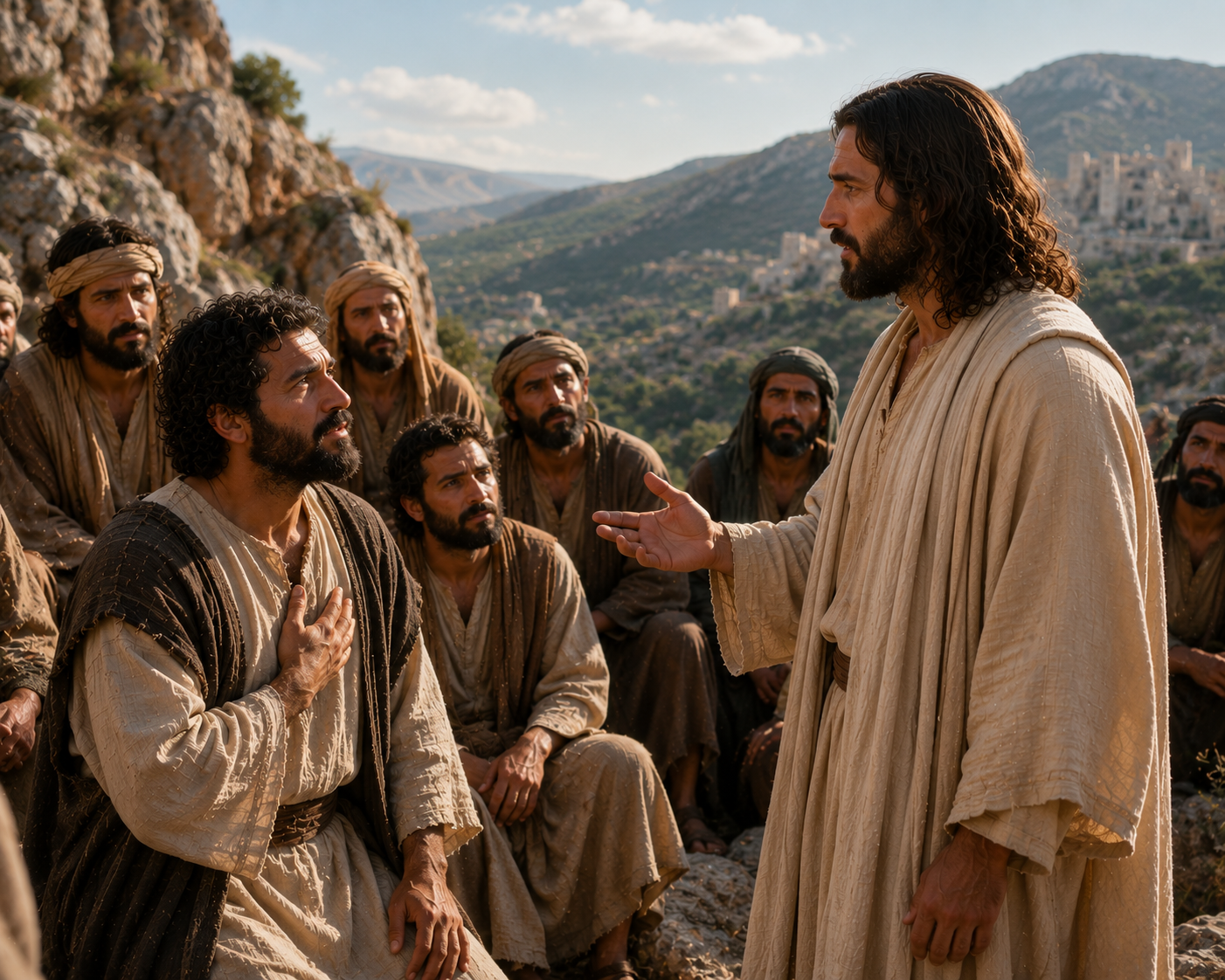
As much as Paul identifies himself as the apostle to the Gentiles, James stands out as the apostle to the Jews. In Paul’s letter to the Galatians, Paul self-identifies in this way, but he identifies Peter as the apostle to the Jews.

For God, who was at work in Peter as an apostle to the circumcised, was also at work in me as an apostle to the Gentiles. James, Cephas [Peter] and John, those esteemed as pillars, gave me and Barnabas the right hand of fellowship when they recognized the grace given to me. They agreed that we should go to the Gentiles, and they to the circumcised. (Galatians 2:8–9)

As time progressed, Peter and John moved on to other fields—fields that included the Gentiles—while James remained rooted in Jerusalem. When we meet James in Acts 21, which may be as much as six years after Paul’s Galatian letter, it is apparent that James has assumed the mantle of the apostle to the Jews.

Perhaps the greatest temptation James faced was the temptation to withdraw from the culture and any involvement with the temple. To do so would be to admit defeat. It would mean ceding the temple to those who sanctioned his brother’s execution. But James steadfastly refused to turn his back on the Father’s house.

The temptation for the church to withdraw from the culture rather than engage with it remains to this day. Self-isolation is safer than being an active and engaged witness to the life-transforming power of Christ.

James’ instructions for Paul to participate in ceremonial cleansing should be viewed as part of a broader strategy to be a potent witness for Christ to the Jewish people. It was a strategy with which Paul agreed because of his desire to see the salvation of his own people.

Brothers and sisters, my heart’s desire and prayer to God for the Israelites is that they may be saved. For I can testify about them that they are zealous for God, but their zeal is not based on knowledge. Since they did not know the righteousness of God and sought to establish their own, they did not submit to God’s righteousness. Christ is the culmination of the law so that there may be righteousness for everyone who believes. (Romans 10:1–4)

Paul views the Jewish fixation on righteousness achieved by the law as a huge impediment to receiving the righteousness of Christ, which comes through faith. James, Paul, and Jesus agree on this point. Salvation for the Jewish people from Abraham onward was always achieved through faith—an active faith—not merely an intellectual acknowledgement.

It would be folly to assume that James and Paul did not discuss these foundational matters of faith on occasions when they met together. The differences they had, which are often projected as irreconcilable, need to be viewed through the lens of their calling. Paul’s apostolic focal point was the Gentiles. James’ apostolic focal point was the Jews.

Salvation for both people groups comes through faith in the atoning sacrifice of Jesus, God’s own Son—the eternal Lamb of God. As we will see, on this point they are in full agreement.

Both James and Paul are determined to let their light shine before men (Matthew 5:16), even in the temple courts—even at the risk of their lives—even to the point of death. The violent zealotry for the law that plays out when Paul is seized, beaten, and arrested in the temple foreshadows what will ultimately happen to James a few years later. In Paul’s case, a Roman commander intervened to save his life.

James was not so fortunate.

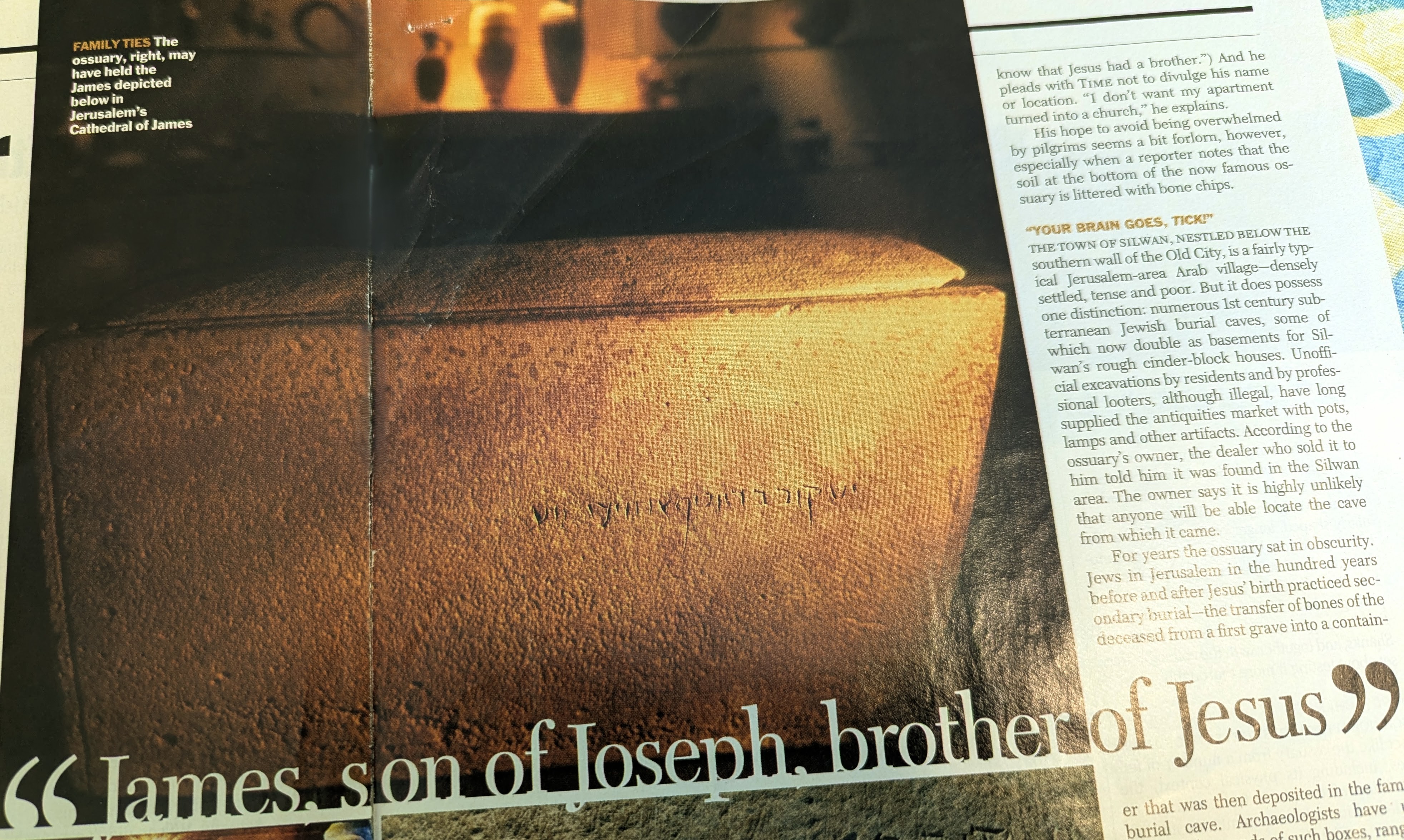
Photo Credit Time Magazine, November 4, 2002 — the inscription on the James Ossuary.

(1) William Barclay, The Gospel of Matthew, Volume Two, Chapters 11–28—The Daily Study Bible (Welch, 1975), p. 246.
(2) “Solomon’s Portico,” by W. F. Stinespring, The Interpreter’s Dictionary of the Bible, Volume 4, Edited by George Arthur Buttrick (Abingdon, 1984), p. 408.

New from David Kitz

James—the brother of Jesus—who was this man? What evidence do we have that this “brother of our Lord” even existed?

David Kitz digs deep into archeology, family dynamics, church history, and the biblical texts. What emerges from his research is a portrait of a decisive, pivotal leader who embodied the will and character of Jesus Christ.

But how did James—James the unbeliever—transform to become a leader who changed the course of world history? In these pages you will uncover the answer and rediscover for yourself the life-changing power of the gospel.

To view further details or purchase directly from the author click here.
 

James Reconciling the Irreconcilable

14 Sunday Jun 2026

Posted by davidkitz in Books by David Kitz

≈ Leave a comment

Tags

Bible, bridge builder, Christ, Christianity, church, circumcision, faith, Gentile converts, Gentiles, gospel, grace, James, James the brother of Jesus, Jerusalem, Jesus, leadership, legalism, Paul, Peter, Scripture, uncircumcised

James: the Lynchpin of Our Faith — Chapter 15

In the scriptural record our next encounter with James is in the twenty-first chapter of Acts. It occurs due to a commitment (cited previously) that the apostle Paul made to James, Peter, and John, regarding help for the poor in Jerusalem:

James, Cephas [Peter] and John, those esteemed as pillars, gave me and Barnabas the right hand of fellowship when they recognized the grace given to me. They agreed that we should go to the Gentiles, and they to the circumcised. All they asked was that we should continue to remember the poor, the very thing I had been eager to do all along. (Galatians 2:9–10)

Apparently, Paul took this commitment seriously. A considerable portion of his ministry involved raising financial support for the poor in the Jerusalem church. He devotes two chapters of his second letter to the Corinthians solely to the topic of collecting an offering for this purpose. He also sent Titus his trusted lieutenant and other brothers ahead to be sure that the church’s offering was ready to be received upon his arrival (2 Corinthians 8:16–9:5). It is evident from these two chapters that this endeavor entailed a great deal of effort and strategic planning. Nor was this an isolated event involving only one church. As Paul travelled through his circuit of church plants, he took up an offering for the destitute believers in Jerusalem in each city. Paul justified his actions with these words:

This service that you perform is not only supplying the needs of the Lord’s people but is also overflowing in many expressions of thanks to God. Because of the service by which you have proved yourselves, others will praise God for the obedience that accompanies your confession of the gospel of Christ, and for your generosity in sharing with them and with everyone else. And in their prayers for you their hearts will go out to you, because of the surpassing grace God has given you. Thanks be to God for his indescribable gift! (2 Corinthians 9:12–15)

It is clear from this statement that Paul saw this offering as a way to build bridges between the Gentile and Jewish Christian communities. Presumably this is part of the reason why James, Peter, and John originally proposed it—that and a genuine concern for the poor. Care for the poor is a prominent teaching in the Epistle of James. (See James 1:9, 2:1–7, 2:15–16.)

Poverty seems to have been common among the Christian believers in Jerusalem and a top-of-mind concern for James. There could be several reasons for this poverty. The early church appears to have attracted a large number of poor. Perhaps this was because Jesus’ personal ministry drew attention to the marginalized, to social outcasts, tax collectors, and sinners. (See Luke 15:1–2, Matthew 9:10–11, Mark 2:15–16, Matthew 21:31–32.) Early on the church in Jerusalem established a charitable ministry to help widows and orphans, and this likely attracted others who were also in need. (See Acts 6:1–7.)

Persecution also ravished the church. From accounts in Acts we know this included death and imprisonment, (Acts 8:3 and 22:4) but it likely also involved a loss of employment or advancement and possibly the destruction or seizure of property. Paul in his earlier life as Saul, the persecutor of the church, had contributed to this impoverishment. This surely was a motivating factor for Paul as he tried to make amends for his former conduct.

Finally, the communal lifestyle that the community adopted likely contributed to the general state of poverty.

All the believers were together and had everything in common. They sold property and possessions to give to anyone who had need. Every day they continued to meet together in the temple courts. They broke bread in their homes and ate together with glad and sincere hearts, praising God and enjoying the favor of all the people. And the Lord added to their number daily those who were being saved. (Acts 2:44–47)

As long as the Christian community was growing, this communal system of care would work well, since there would be a constant supply of fresh funds coming from new converts. But if growth stagnated the result would be mutual poverty. If lands and houses were sold and the capital was used on consumables like food and clothing, long-term sustainability would be in jeopardy.

All the believers were one in heart and mind. No one claimed that any of their possessions was their own, but they shared everything they had. With great power the apostles continued to testify to the resurrection of the Lord Jesus. And God’s grace was so powerfully at work in them all that there were no needy persons among them. For from time to time those who owned land or houses sold them, brought the money from the sales and put it at the apostles’ feet, and it was distributed to anyone who had need. (Acts 4:32–35)

At some point the scenario of general well-being and prosperity described above may have turned to widespread poverty. It seems likely that funds from the burgeoning Gentile church were needed to sustain this early experiment in communal living, hence the request recorded in Galatians that Paul should “remember the poor.”

This is the situation that James, as leader of the Jerusalem church, finds himself in Acts 21. He oversees an established church that appears to have plateaued. Growth has slowed, but the needs of the poor remain constant.

But even before Paul arrives in Jerusalem, he is forewarned that things will not go well for him there.

After we had been there a number of days, a prophet named Agabus came down from Judea. Coming over to us, he took Paul’s belt, tied his own hands and feet with it and said, “The Holy Spirit says, ‘In this way the Jewish leaders in Jerusalem will bind the owner of this belt and will hand him over to the Gentiles.’” (Acts 21:10–11)

But despite this warning, Paul would not turn back, saying he was “willing to die in Jerusalem for the name of the Lord Jesus” (Acts 21:12–14).

Luke’s description of the arrival of Paul’s delegation in Jerusalem gives us considerable insight into James’ position in the church and the state of relations between these two men.

When we arrived at Jerusalem, the brothers and sisters received us warmly. The next day Paul and the rest of us went to see James, and all the elders were present. Paul greeted them and reported in detail what God had done among the Gentiles through his ministry. (Acts
21:17–19)


Did the elders who were present include some of Christ’s original twelve apostles? The text is not clear on this point, since the only apostle named in this circle of leaders is James.

Howard Marshall, in his commentary on this passage, observes that James “by this point had fully assumed the leadership of the church in Jerusalem.” (1)

We are told Paul specifically went to see James.

Firstly, this would indicate that there was an ongoing friendly relationship between James and Paul. This is reinforced by Paul’s statements cited earlier in his letter to the Galatians and by his earlier report to the Council of Jerusalem in the fifteenth chapter of Acts.

Secondly, it implies that Paul considers himself accountable to James. We are told he “reported in detail what God had done among the Gentiles through his ministry.”

One is left with the impression that Paul sees himself as a humble servant of Christ and the church. He has returned to Jerusalem, the home base and headquarters of the church, see Acts 1:8, to present a generous offering for the support of the needy among the believers there.

Moreover, he sees himself as accountable for his actions and ministry to James the head of the church, so he delivers his detailed report before him. In many ways this resembles the procedures of churches or agencies that send missionaries today. The missionary from time to time is expected to report on the successes and challenges of his mission.

Paul’s first mission report was delivered to his sending church, the church in Antioch. (See Acts 14:27–28.) Later, in about 50 AD, he presents a report of pivotal importance to the Council of Jerusalem. (See Acts 15:12.) This then is his third report and his second one before James in Jerusalem.

It should be noted that Paul was accompanied by uncircumcised Gentile converts, Luke the author of Acts being one of them.

Paul’s report draws a rather lengthy response that gives us considerable insight into the mind of James and the state of the church in Jerusalem.

When they heard this, they praised God. Then they said to Paul: “You see, brother, how many thousands of Jews have believed, and all of them are zealous for the law. They have been informed that you teach all the Jews who live among the Gentiles to turn away from Moses, telling them not to circumcise their children or live according to our customs. What shall we do? They will certainly hear that you have come, so do what we tell you. There are four men with us who have made a vow. Take these men, join in their purification rites and pay their expenses, so that they can have their heads shaved. Then everyone will know there is no truth in these reports about you, but that you yourself are living in obedience to the law. As for the Gentile believers, we have written to them our decision that they should abstain from food sacrificed to idols, from blood, from the meat of strangled animals and from sexual immorality.” (Acts 21: 20–25)

Who may stand in his holy place? — photo by David Kitz

Who spoke the words shown within the quotation marks? Luke, the author, attributes these words to “they”—they being “James, and all the elders.” It is implausible that James and the elders spoke these words in unison. Most likely the statement Luke recorded is an accurate summation of their discussion—a discussion over which James presides. It logically follows that this statement provides a glimpse into the mind of James and the elders around him.

First, we are told “they praised God” on hearing Paul’s report of his ministry among the Gentiles. This signals James’ approval of Paul’s ministry and his specific call to reach the Gentiles.

As previously noted, Paul was not alone when he presented his report to James and the elders. He was accompanied by a number of Gentile believers. Luke uses the phrase “Paul and the rest of us” (Acts 21:18), thereby indicating his inclusion in Paul’s delegation during the day’s proceedings.

The presence of these Gentile followers of Christ certainly would have added weight to Paul’s report. These men were living proof of the grace of God being poured out on the Gentiles.

It makes sense that James would draw a good deal of satisfaction from Paul’s report, since it vindicated his previous ruling at the Jerusalem Council to open the door of faith to the Gentiles.

Paul’s report provided ample evidence that God endorsed this radical shift in policy. First, his ministry was accompanied by heaven-sent signs and wonders. Secondly, in quick succession he was establishing local churches in Asia Minor, Macedonia, and Greece. Thirdly, these churches were thriving to the point where they were providing financial support for the church in Jerusalem.

But Paul’s success brought with it a dilemma. In the response to Paul’s report we are told that in Jerusalem “many thousands of Jews have believed, and all of them are zealous for the law.” This zeal for the law presented a problem, since it had the potential of creating a deep cultural rift within the church. To ameliorate this problem, James and the leaders around him propose a bridge building exercise between Paul and these Jewish Christians.

Most often when divisions arise within an organization, misinformation lies at the root. That certainly was the case here. According to the above statement, the believers in Jerusalem “have been informed that you teach all the Jews who live among the Gentiles to turn away from Moses, telling them not to circumcise their children or live according to our customs.”

None of this is true and James knows this, but to set the record straight and prove Paul’s adherence to the law, he is advised to take part in a purification rite with four other men.

Despite Paul’s insistence that Gentile believers need not be circumcised (Galatians 5:2–6), he did not give such advice to Jewish followers of Christ. In fact, he did just the opposite. Timothy, Paul’s personal disciple, is a case in point. Timothy’s mother was Jewish, but his father was Greek. Before setting out on one of his journeys, Paul circumcised him.

Paul wanted to take him [Timothy] along on the journey, so he circumcised him because of the Jews who lived in that area, for they all knew that his father was a Greek. As they traveled from town to town, they delivered the decisions reached by the apostles and elders in Jerusalem for the people to obey. So the churches were strengthened in the faith and grew daily in numbers. (Acts 16:3–5)

What is most remarkable about this example of circumcision is that Paul did this while going about delivering the Jerusalem Council’s ruling that Gentiles need not be circumcised. The reason given for doing this circum-cision reveals a great deal about Paul’s methodology. We are told that this was done “because of the Jews who lived in that area, for they all knew that his father was a Greek.”

Why would the opinion of the Jews in the area matter to Paul? Wasn’t he free from the rule of the law and living under the grace of Christ? By extension, why would Paul submit to participate in purification rites as prescribed by James and the elders in Jerusalem? We can find the answer in Paul’s first letter to the Corinthians.

Though I am free and belong to no one, I have made myself a slave to everyone, to win as many as possible. To the Jews I became like a Jew, to win the Jews. To those under the law I became like one under the law (though I myself am not under the law), so as to win those under the law. To those not having the law I became like one not having the law (though I am not free from God’s law but am under Christ’s law), so as to win those not having the law. To the weak I became weak, to win the weak. I have become all things to all people so that by all possible means I might save some. I do all this for the sake of the gospel, that I may share in its blessings. (1 Corinthians 9:19–23)

Paul’s purpose was evangelism. He wanted to “save some.” He wanted to win the Jews in the vicinity of Tim-othy’s hometown over to faith in Christ. The same motivation would have been at work as Paul returned to Jerusalem. He wanted the gospel presented in the best light possible. If submitting to religious observances helped prepare people’s hearts to hear the gospel message, Paul was willing to oblige.

But this desire that motivated Paul also motivated James. James wanted the entire Jewish nation won over to the gospel. He wanted his people to embrace the message of redemption through the death, burial, and resur-rection of Jesus Christ. This is after all the express mission of the church.

There are theologians who see vastly different motives at work in James and Paul, but a careful reading of the scriptures does not bear this out. There is no indication that Paul chafed at this recommendation to undergo ritual purification. He submitted to it willingly because he wanted to correct the erroneous perception that he had abandoned the law and was encouraging other Jewish converts to do the same.

It should be noted that this erroneous perception existed among Christian Jews who were “zealous for the law.” As we shall see, the perception of unbelieving Jews was that Paul was worthy of death. The first bridge that needed to be built or repaired was between Paul and Jewish believers. Paul would go to great lengths for the sake of cross-cultural Christian unity.

All of this was part of Paul’s grand vision for the church. His great desire was to have Jews and Gentiles united as one under Christ. He gives voice to this thought in his Epistle to the Ephesians.

Therefore, remember that formerly you who are Gentiles by birth and called “uncircumcised” by those who call themselves “the circumcision” (which is done in the body by human hands)—remember that at that time you were separate from Christ, excluded from citizen-ship in Israel and foreigners to the covenants of the promise, without hope and without God in the world. But now in Christ Jesus you who once were far away have been brought near by the blood of Christ.

For he himself is our peace, who has made the two groups one and has destroyed the barrier, the dividing wall of hostility, by setting aside in his flesh the law with its commands and regulations. His purpose was to create in himself one new humanity out of the two, thus making peace, and in one body to reconcile both of them to God through the cross, by which he put to death their hostility. (Ephesians 2:11–16)

Peace begins within — photo by David Kitz

In very practical, tangible terms, Paul is trying to make peace and work at reconciliation between Jews and Gentiles. Paul does this by participating in the prescribed purification rites at the urging of James. These are precisely the laws, commands, and regulations which Christ set aside, according to the statement above.

Typically, these events are viewed from Paul’s perspective, but it is James who sits at the center these two camps—or is it four camps? James is trying to reconcile Paul and his Gentile converts with the Christ following, law-abiding Jews within his flock. James has a measure of sway over these two camps, due to his leadership role and the Spirit of Christ within him.

But beyond these two camps lies the broader Jewish and Gentile world. Both realms are innately hostile to the gospel. Yet as James sees it and Jesus’ Great Commission declares (see Matthew 28:18–20, Mark 16:15–20) the church is charged with reaching both these worlds.

James is fully vested in seeing both worlds reconciled to his brother, the Lord Jesus Christ. That’s why he en-dorsed Paul’s ministry at the Council of Jerusalem. That’s why he set the bar very low for Gentile entry into the church. And that’s why he rejoiced over Paul’s missionary report of rapid church growth among the Gentiles.

The Gentiles were being reconciled to Christ.

Full reconciliation cost Jesus his life. In this situation attempted reconciliation almost cost Paul his life. When hearts become hard, it takes a miracle to reconcile the irreconcilable. In this instance no miracle came. Whereas many hearts in the Gentile world were opening to Christ, in the Jewish world we see hearts are hardening.

When the seven days were nearly over, some Jews from the province of Asia saw Paul at the temple. They stirred up the whole crowd and seized him, shouting, “Fellow Israelites, help us! This is the man who teaches everyone everywhere against our people and our law and this place. And besides, he has brought Greeks into the temple and defiled this holy place.” (They had previously seen Trophimus the Ephesian in the city with Paul and assumed that Paul had brought him into the temple.)

The whole city was aroused, and the people came running from all directions. Seizing Paul, they dragged him from the temple, and immediately the gates were shut. While they were trying to kill him, news reached the commander of the Roman troops that the whole city of Jerusalem was in an uproar. He at once took some officers and soldiers and ran down to the crowd. When the rioters saw the commander and his soldiers, they stopped beating Paul. The commander came up and arrested him and ordered him to be bound with two chains. (Acts 21:27–33a)

There can be no doubt that the intervention of this Gentile commanding officer saved Paul from certain death at the hands of his countrymen.

It was James who sent Paul on this dangerous and futile attempt at cross-cultural bridge building, but there isn’t the slightest hint of anger or regret on Paul’s part during the events that follow. He does not blame James for his subsequent arrest and imprisonment. He sees it as part of the will and purpose of God for his life. He embraces his suffering and makes the most of his opportunities to be a witness for Christ before the Jewish mob, Roman authorities, the Sanhedrin, Governors Felix and Festus, and King Agrippa and Bernice. (See Acts 21:37–26:32.) Ultimately his defence of the gospel will bring him before the emperor in Rome.

Paul sees all this as the fulfilment of his divine mandate received from Christ. Rather than viewing his imprisonment as a hindrance, he sees it as an opportunity.

In light of Paul’s arrest and imprisonment, did James have any regrets for counseling Paul to engage in this ritual purification? There is no indication of that. The apostles wore persecution and suffering for Christ as a badge of honor. (See Acts 5:40–42 and 2 Corinthians 11:16–29.)

James’ advice to Paul while in prison would likely be in line with the opening words of his epistle.

Consider it pure joy, my brothers and sisters, whenever you face trials of many kinds, be-cause you know that the testing of your faith produces perseverance. Let perseverance finish its work so that you may be mature and complete, not lacking anything. (James 1:2–4)

In these matters, James was simply following his brother’s counsel as expressed in the concluding words of the Beatitudes.

Blessed are those who are persecuted because of righteousness, for theirs is the kingdom of heaven.

Blessed are you when people insult you, persecute you and falsely say all kinds of evil against you because of me. Rejoice and be glad, because great is your reward in heaven, for in the same way they persecuted the prophets who were before you. (Matthew 5:10–12)

The interaction between James and Paul in Acts 21 is the last occasion when we meet James within the pages of the Book of Acts. We see an apostle and a leader in his prime. He is exercising his authority over the church—an authority that extends beyond the local church in Jerusalem. The apostle Paul—the leading thinker, evangelist, and author of half the New Testament—reports to James and is accountable to him.

This raises the question: Were the other apostles accountable to James as well?

It could be argued that Paul may have developed a special relationship or bond with James. It may be that Paul saw himself as a disciple of James, and this is why Paul submits to him for counsel and advice.

But at the Council of Jerusalem in Acts 15, both Peter and Paul give reports in a meeting over which James presides. Though not explicitly stated, Luke’s account of the church meetings of Acts 15 and Acts 21 leave the distinct impression that James was functioning as the head of the church.

When we encounter James in Paul’s epistles, we are left with a similar impression. Paul sees Peter as a colleague, but he shows a deference and respect for James that one would expect toward someone in authority. (See 1 Corinthians 15:7, Galatians 1:18–2:16.)

In turn, Peter shows the same collegial respect toward Paul. (See 2 Peter 3:15–16.) The accounts in Acts and Galatians portray James as the overall leader of the church, but this contrasts sharply with the Roman Catholic position that Peter was the designated head of the church. In fact, there is little evidence to support the Catholic position within the Acts account or any of the epistles.

All of this has huge implications for church governance, and it goes to the root of many divisions we see across the church world today.

James lies at the heart of all these issues. But for many, James, the brother of Jesus, remains a great mystery—as enigmatic as the stone box that bears his name.

Time photo of the James Ossuary

(1) Marshall, The Acts of the Apostles, p. 342.

New from David Kitz

James—the brother of Jesus—who was this man? What evidence do we have that this “brother of our Lord” even existed?

David Kitz digs deep into archeology, family dynamics, church history, and the biblical texts. What emerges from his research is a portrait of a decisive, pivotal leader who embodied the will and character of Jesus Christ.

But how did James—James the unbeliever—transform to become a leader who changed the course of world history? In these pages you will uncover the answer and rediscover for yourself the life-changing power of the gospel.

To view further details or purchase directly from the author click here.
 

Psalms 365: Develop a Life of Worship & Prayer

Psalms 365 Volume II

Psalms 365 vol 3
— Psalms 365 Volume III

Now available:

Psalms

Recent posts

  • Is God Leaving? July 4, 2026
  • A Warning Against Hypocrisy July 3, 2026
  • The LORD Looks at the Heart July 3, 2026
  • Paying the Imperial Tax to Caesar July 2, 2026
  • A Nation that Abandons God July 2, 2026
  • The Parable of the Wedding Banquet July 1, 2026
  • God’s Mysterious Choice    July 1, 2026

Calendar

July 2026
M T W T F S S
 12345
6789101112
13141516171819
20212223242526
2728293031  
« Jun    

Blog Posts

Comments

  • Is God Leaving? | Talmidimblogging on Is God Leaving?
  • pastorpete51 on God’s Wrath is Real
  • 777joyce on Miracle-Working Power

Blog at WordPress.com.

Privacy & Cookies: This site uses cookies. By continuing to use this website, you agree to their use.
To find out more, including how to control cookies, see here: Cookie Policy
  • Subscribe Subscribed
    • I love the Psalms
    • Join 1,355 other subscribers
    • Already have a WordPress.com account? Log in now.
    • I love the Psalms
    • Subscribe Subscribed
    • Sign up
    • Log in
    • Report this content
    • View site in Reader
    • Manage subscriptions
    • Collapse this bar

Loading Comments...