• Home
  • About
  • DavidKitz.ca
  • Youtube Videos
  • Books by David
  • Books on Amazon.com

I love the Psalms

~ Connecting daily with God through the Psalms

I love the Psalms

Tag Archives: the cross

Praise the Life-Giving Word

20 Monday Apr 2026

Posted by Tim K in Psalm 56, Psalms

≈ Leave a comment

Tags

David, Psalms, the LORD, word of God, trust, enemies, the cross, God's word, trust in God, praise for God's word

Today’s Devotion from Psalms 365 by David Kitz

Listen to today’s reading by Jonathan Dent:

https://davidkitz.blog/wp-content/uploads/2026/04/psalm-568-13-mixfinal.mp3

Reading: Psalm 56:8-13 (NIV)*

Record my misery;
    list my tears on your scroll—
    are they not in your record?
Then my enemies will turn back
    when I call for help.
    By this I will know that God is for me.
In God, whose word I praise,
    in the L
ORD, whose word I praise—
in God I trust and am not afraid.
    What can man do to me?
 I am under vows to you, my God;
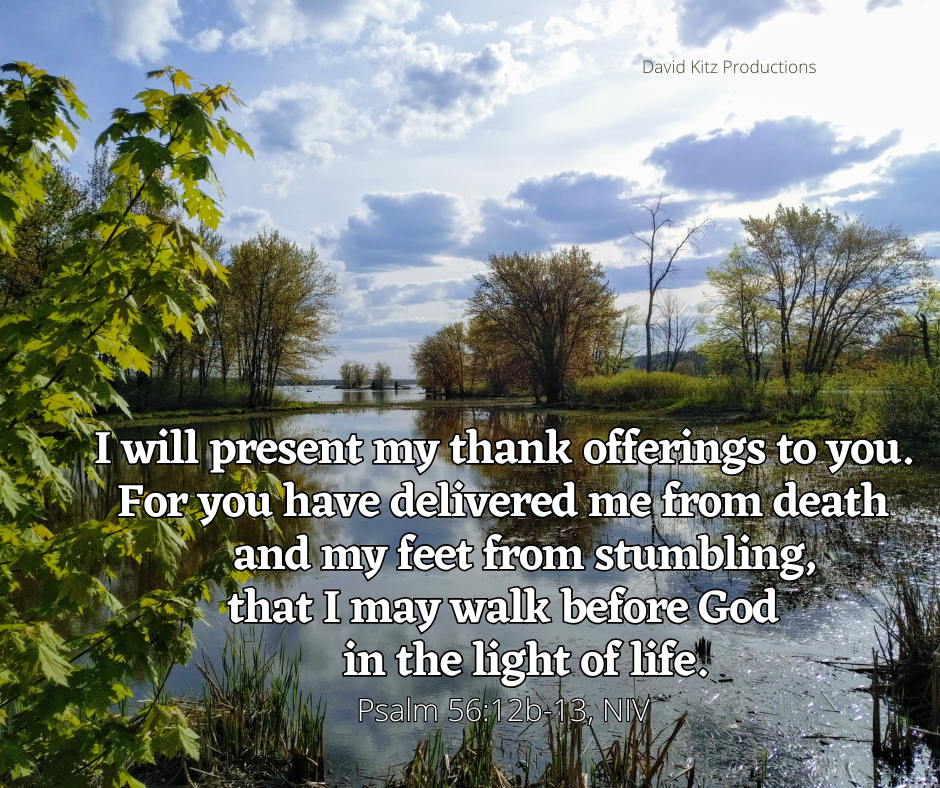
    I will present my thank offerings to you.
For you have delivered me from death
    and my feet from stumbling,
that I may walk before God
    in the light of life.

Reflection

Psalm 56 is a relatively short psalm. Yet in this short psalm, David repeats the phrase ‘whose word I praise’ three times. In today’s reading he states, “In God, whose word I praise, in the LORD, whose word I praise—in God I trust and am not afraid” (v. 10-11).

For me this phrase raises a question. Whose word do I praise? Do I praise God’s word? Do I appreciate and value the written word of God? Have I made it my refuge as it was for David? Is it my sustenance? Do I feed on it daily? While fasting in the wilderness Jesus answered the tempter, “It is written, ‘One does not live by bread alone, but by every word that comes from the mouth of God’” (Matthew 4:4).

Do you trust the living, active word of God to help you today and every day? Trust really is crucial. If I don’t trust God’s word will help, encourage, correct, and sustain me, I won’t bother reading it or meditating on it. I’ll trust in my own abilities or seek direction from other sources.

Trust is crucial in election campaigns. During such campaigns politicians from a variety of parties make their pitch to the electorate. Again, the fundamental question for each voter is whose word, do you trust? Politicians often promise more than they can deliver. Often, I have been let down by a politician who promised to do things differently, but once in office failed to deliver, or became caught up in scandal after scandal. I presume the same disappointment holds true for many voters.

We need to remember salvation won’t ever be achieved at the ballot box. It was achieved at the cross—only at the cross. The remedy for my sin is found there. The living word of God reminds us of that trustworthy, unchanging truth.

Response

LORD God, I put my trust in your word. I praise your life-giving word for it is good and completely trustworthy. Your word is a lamp for my feet, a light on my path (Psalm 119:105). Amen.

Your Turn

Do you make it your habit to read and meditate on the word of God? How can you demonstrate your trust in the living active word of God today and every day?


Para la publicación de Salmos 365 de hoy en español haga clic aquí.

bgbg_v4.3_1501818
* NEW INTERNATIONAL VERSION, COPYRIGHT ©1973, 1978, 1984, 2011 BY BIBLICA

Pray for peace in Israel, Iran and the Middle East
and continue to pray for peace to return to Ukraine and Russia!

Volume I of Psalms 365: Develop a Life of Worship and Prayer won the Best Book of the Year Award from The Word Guild and Volume II has won the Best Devotional of the Year Award. For those who love God’s word, this three-book series is an ideal way to daily meet with the Lord. To purchase or for a closer look click here.

Resurrection Visitation—When and Why

19 Sunday Apr 2026

Posted by davidkitz in Books by David Kitz

≈ Leave a comment

Tags

apostles, Christ, crucifixion, forty days, gospel, James, James the brother of Jesus, Jesus, Jesus' family, Messiah, Paul, Peter, Pilate, proof of the resurrection, resurrection, Scripture, skeptics, the cross, Thomas

James: the Lynchpin of Our Faith — Chapter 9

The cataclysmic events of Good Friday left a shattered, fragmented family in its wake. In the wake of Easter Sunday, Jesus’ post-resurrection visit with James was undoubtedly aimed at restoring a healthy family relationship. There is every indication that this visitation accomplished its purpose.

Because this event is so pivotal in the life of James moving forward, it warrants a closer examination. The New Testament information is indeed scant, but it is possible to propose a sequenced time frame for when this critical meeting of the two brothers took place. First, we need to use Paul the apostle’s statement in 1 Corinthians as a guide. It is repeated here for quick reference:

For what I received I passed on to you as of first importance: that Christ died for our sins according to the Scriptures, that he was buried, that he was raised on the third day according to the Scriptures, and that he appeared to Cephas [Peter], and then to the Twelve. After that, he appeared to more than five hundred of the brothers and sisters at the same time, most of whom are still living, though some have fallen asleep. Then he appeared to James, then to all the apostles, and last of all he appeared to me also, as to one abnormally born. (1 Corinthians 15:3–7)

It should however be noted that Paul’s account of the resurrection appearances of Christ is not comprehensive or complete. It was not intended to be an exhaustive listing of these events. The gospel writers detail other appearances that are not recorded in Paul’s defence of the resurrection. For example, Paul makes no mention of the three women who first reported the resurrection to the apostles on Sunday morning, (Luke 24:1–11, Mark 16:1–8, Matthew 28:1–10) nor does he report the more personal encounter between Jesus and Mary Magdalene (Mark 16:9, John 20:10–18). The gospel writers Luke and Mark report on Jesus’ encounter with two disciples on the road to Emmaus on Sunday afternoon and evening (Mark 16:12–13, Luke 24:13–35). This was followed later that evening by his appearing to the ten in a room with other gathered followers, (Mark 16:14, Luke 24:33–43, John 20:19–23) though apparently Thomas was not present. Eight days later Jesus appeared again among the apostles, and he made a point of convincing Thomas that the story of his resurrection was not a fabrication.

John’s account of this incident bears repeating here, since it may have been similar in some respects to Christ’s encounter with his half-brother James.

Now Thomas (also known as Didymus), one of the Twelve, was not with the disciples when Jesus came. So the other disciples told him, “We have seen the Lord!”

But he said to them, “Unless I see the nail marks in his hands and put my finger where the nails were, and put my hand into his side, I will not believe.”

A week later his disciples were in the house again, and Thomas was with them. Though the doors were locked, Jesus came and stood among them and said, “Peace be with you!” Then he said to Thomas, “Put your finger here; see my hands. Reach out your hand and put it into my side. Stop doubting and believe.”

Thomas said to him, “My Lord and my God!”

Then Jesus told him, “Because you have seen me, you have believed; blessed are those who have not seen and yet have believed.” (John 20:24–29)

Did James need this type of hands-on encounter to convince him that Jesus was alive, was standing before him and had risen from the dead? It certainly seems likely, since the apostle John called him an unbeliever (John 7:5). Did the brothers share a meal together, thus proving that the risen Jesus had fleshly substance and was not merely a ghostly apparition? See Luke 24:36–42.

Sometimes the most difficult people to persuade are the members of our own family. They know us too well and are fully aware of our foibles and shortcomings. After all, familiarity breeds contempt. But another familial phenomenon may be at play here. When we acknowledge the strengths of our sibling, we may feel diminished before them. Having seized the leadership role in the household of Joseph, did James begrudge yielding any authority or praise to the brother whose position he usurped? From James’ perspective, he was not usurping Jesus’ position. He was simply assuming his lawful role as the firstborn heir of Joseph. But acknowledging one’s brother as Messiah and Deity is a steep step down for any man to take. Bending the knee would not come easily.

James was a difficult nut to crack. There was a hard exterior to himm built up over years of rivalry, personal pride, and ambition. Those who have read his New Testament epistle will readily acknowledge that James was a man of rock-solid conviction and impeccable zeal. Some of those characteristics were undoubted evident before his conversion. They were simply oriented in a different direction—a direction that was hostile to Jesus and his mission. In this respect, James was very similar to another New Testament character—Saul who after his encounter with the risen Christ became the zealous apostle Paul.

James the skeptic would certainly need proof of the resurrection. If stunning proof was what he needed, Jesus was willing to provide it.

Luke, the author of the Book of Acts, informs us that there was a forty-day window—from the resurrection to Christ’s ascension—within which the encounter with James must have occurred.

In my former book, Theophilus, I wrote about all that Jesus began to do and to teach until the day he was taken up to heaven, after giving instructions through the Holy Spirit to the apostles he had chosen. After his suffering, he presented himself to them and gave many convincing proofs that he was alive. He appeared to them over a period of forty days and spoke about the kingdom of God. (Acts 2:1–3)

When this passage is compared with Paul’s remarks on the resurrection in 1 Corinthians 15, it becomes clear that Christ’s visitation with James took place near the conclusion of this forty-day period. Jesus saved the encounter with his fiercest skeptic and rival until near the end. Why would this be the case?

One can reasonably assume that there was some logical plan to the appearances that Jesus made. He was providing visible, physical proof of his resurrection. Luke says just that in the Acts passage cited above.

There is also a trainload of significance to the fact that these appearances happened over a period of forty days. Throughout the scriptures the passage of forty days signals a time of testing or proving. The great flood in the days of Noah took place over forty days (Genesis 7:17). Moses spent forty days with God on Mount Sinai receiving the Law (Exodus 34:28). Elijah traveled forty days to Mount Horeb, the mountain of God, on the strength of a single meal (1 Kings 19:7-9). In the same way, Jesus fasted forty days in the wilderness where he was tempted by the devil (Matthew 4:1–11, Mark 1:12–13, Luke 4:1–13). He was severely tested before his public ministry began. During that time of testing, Jesus proved that he was victorious over a triumvirate of evil—the temptations of the flesh, the world and the devil. He proved that he was ready to take on the responsibility of his redemptive mission.

Jesus’ life on planet earth was bookended by another forty days of proving. During this final forty-day interval, he went about proving that he had overcome another triumvirate that rules all humanity—the triumvirate of death, hell and the grave.

Despite repeatedly prophesying this very outcome. See Mark 8:31–33, 9:30–32, 10:32–34. Jesus’ physical resurrection was greeted with profound astonishment and near-universal skepticism. An excerpt from Mark’s gospel account dramatically illustrates this point:

When Jesus rose early on the first day of the week, he appeared first to Mary Magdalene, out of whom he had driven seven demons. She went and told those who had been with him and who were mourning and weeping. When they heard that Jesus was alive and that she had seen him, they did not believe it.

Afterward Jesus appeared in a different form to two of them while they were walking in the country. These returned and reported it to the rest; but they did not believe them either.

Later Jesus appeared to the Eleven as they were eating; he rebuked them for their lack of faith and their stubborn refusal to believe those who had seen him after he had risen (Mark 16:9–14)

One of the strongest arguments for the truth of the four gospel accounts springs from the unbelief of the apostles. When Jesus was raised from the dead, they were completely taken aback. Words such as floored, dumbfounded and thunderstruck spring to mind. And well they should. This is a miracle that defies all the norms of human experience. Their initial unbelief paints a rather unflattering picture of the apostles. This down-to-earth realism, however, lends credibility to the gospel accounts. Who would not be incredulous at reports of someone who was horribly tortured and killed, publicly speared, and drained of his blood (John 19:33–35) suddenly rising from the dead?

Furthermore, anyone who has read the four gospel accounts of the resurrection will discover that there is a certain amount of disorderly chaos in the way the events are reported. They do not match perfectly, and on certain points they seem contradictory. Clearly, no one employed a fact checker before each of the gospels went to press. But rather than sully their credibility, this rather haphazard reporting lends credence tothe truth of the events. The gospel accounts are not carefully crafted documents created by committee and verified in advance by scholarly research. On the contrary, they are independently produced, eyewitness accounts of events that transpired thirty-five or more years prior to the date when they were penned. Some discrepancies can be expected and indeed they are present. But rather than discredit the gospels, these straightforward recollections add to their authenticity and realism.

Present-day eyewitness accounts of the same event usually vary considerably in scope and detail. Witnesses whose stories agree perfectly provide evidence of collusion, nothing more. Discrepancies occur because each witness views the event from a different perspective and with varying degrees of perception. Also, human recall of an event is fallible and can vary over time. This is precisely what we encounter when we read the gospels. When one compares the resurrection accounts in the four gospels, some details appear to be jumbled or missing, but the picture that emerges is strong and clear: To the astonishment of all, Jesus rose from the dead.

Jesus had forty days to prove his resurrection. What logical plan did he follow to convince his followers, and ultimately the world, that he is alive?

Merely appearing before people who do not know him would prove nothing. They were not acquainted with him. Any random stranger could claim to have returned from the dead, but this claim means nothing to the hearer. It seems absurd! They do not know the man and they are unable to verify his claim. Nail scars in hands and feet may be curious features, but they could be self-inflicted wounds. They do not prove that the person thus wounded has risen from the dead.

The point of this argument is this: the people that Jesus must convince are his followers and those who knew him best. They are the only ones who can verify that this man, Jesus, rose from the dead. The general public, despite his fame, cannot verify that the resurrected Jesus is the same person who was put to death. Only those who knew him well can do that. For this reason, Jesus must convince his disciples—specifically the remaining eleven apostles. (Judas had hung himself. See Matthew 27:3–5.) But what is even more important, he must convince his family—his unbelieving brothers. They knew him from his childhood to the point of his death. If he cannot convince them, Jesus has utterly failed in his mission. His resurrection will be deemed a lie nothing more than a fabrication of his deluded followers. This is why police have a family member confirm the identify of an accident or murder victim.

Convincing James is then the ultimate test. Without James and the unbelieving brothers on side, the doctrine of the resurrection is a house of cards. To refute the resurrection claim, the brothers can simply testify that Jesus is dead. It is likely that they too saw him die from a distance. Since his crucifixion was a public event, along a public thoroughfare, it can be said with some accuracy that all Jerusalem witnessed his death.

Furthermore, the brothers can assert that his disciples are babbling idiots. They were already convinced of that before the crucifixion. Now the apostles have removed all doubt by spreading this wild fantasy about Jesus rising from the dead. To convince any thinking person from the public that Jesus is alive, his brothers must first be convinced that he is alive.

James is the linchpin. Unless he is converted, the entire gospel mission is stymied—dead on arrival. James is pivotal to the birth of the church and the advance of the gospel message. At the very core of the gospel message is the death, burial and resurrection of Jesus. For this reason, Jesus must prove to James that he has risen from the dead. He must prove that he is the Son of God. If Jesus is unable to convince the members of his own family, how can the apostles expect to convince the world?

What use or purpose is there in a dead Savior? If he is not alive, the Christian faith is vain and lifeless as a corpse. It is as the apostle Paul says, “And if Christ has not been raised, our preaching is useless and so is your faith” (1 Corinthians 15:14). Only a living Savior can forgive sins and cleanse a guilt-stained heart. Only a living Savior can throw open heaven’s gates. Only the resurrection fixes forever the Father’s seal of approval on the Son. If Jesus remains dead, his death is deserved. If he rises from the dead, his life and his message are vindicated. He is who he said he was—the Son of the Most High. See Matthew 27:63–64, Luke 22:67–71.

Wild flowers — photo by David Kitz

In addition, the gospel message is a message of reconciliation. Humanity is reconciled to God and to one another through the message of the gospel. Again, Paul sheds light on this central tenet of the gospel:

Therefore, if anyone is in Christ, the new creation has come: The old has gone, the new is here! All this is from God, who reconciled us to himself through Christ and gave us the ministry of reconciliation: that God was reconciling the world to himself in Christ, not counting people’s sins against them. And he has committed to us the message of reconciliation. (2 Corinthians5:17–19)

The message of reconciliation rings hollow if Christ cannot be reconciled to his brothers. How can the practitioners of the gospel advocate for reconciliation if the founder of the faith could not be reconciled with the members of his own household? Reconciliation is applied forgiveness. Forgiveness is at the heart of Christ’s teaching, and consequently reconciliation with James is essential. In a post-resurrection world, Jesus and James must be reconciled.

The gospel accounts bear witness to the urgency that Jesus attached to this mission of converting his brothers. On the night of his betrayal, he predicted that his disciples would desert him.

“You will all fall away,” Jesus told them, “for it is written:

“‘I will strike the shepherd, and the sheep will be scattered.’

“But after I have risen, I will go ahead of you into Galilee.” (Mark 14:27–28)

In announcing the resurrection, the angel at the tomb reiterates the same instruction:

“Don’t be alarmed,” he said. “You are looking for Jesus the Nazarene, who was crucified. He has risen! He is not here. See the place where they laid him. But go, tell his disciples and Peter, ‘He is going ahead of you into Galilee. There you will see him, just as he told you.’” (Mark 16:6–7)

Jesus appeared later that day to Mary Magdalene, the tomb-visiting women, to Peter, to two disciples on the road to Emmaus, and finally to the apostles (minus Thomas) at their evening meal in Jerusalem. What urgency was there then in returning to Galilee?

Galilee was the center point of Jesus’ ministry. But, more than that, it was his home. Once again, he would meet with his disciples there. But more importantly, he would return home and meet with his brothers. He says precisely that when he encounters the women near the tomb:

So the women hurried away from the tomb, afraid yet filled with joy, and ran to tell his disciples. Suddenly Jesus met them. “Greetings,” he said. They came to him, clasped his feet and worshiped him. Then Jesus said to them, “Do not be afraid. Go and tell my brothers to go to Galilee; there they will see me.” (Matthew 28:8–10)

The use of the term brothers (adelphos in Greek) is quite curious here. By using this term, Jesus could be broadly referring to his disciples, and most commentators interpret the word in this way. But why would Jesus say this if he was seeing his disciples that evening? Could he also be using the term brothers in the traditional familial sense of the word? Was he instructing these women to tell his unbelieving brothers and related kin to return to Galilee, where he will meet with them again?

His instruction for the brothers to return to Galilee also signals an end to the mourning period. Traditionally, Jewish families are expected to sit for seven days while mourning the loss of their deceased family member. But Jesus was no longer dead, so his announcement to the two Marys (Matthew 28:1-8) was a declaration of an end to the mourning period. Since he was alive, the family members (adelphos) who were in Jerusalem were free to return home to Galilee. The Jewish shiv-ah (mourning period) was over, because the deceased was very much alive.

Typically, the first day of the week, Sunday, was a travel day for the Passover pilgrims. With the end of the Passover week and the final Sabbath, the pilgrims would begin the long journey home. Jesus’ family members in Jerusalem had delayed their departure because of his death. They were observing shiv-ah. Now these two women give the brothers, his mother and other relatives the message that Jesus is alive. He will meet them in Galilee. What a startling turn of events this must have been for James!

The report of Jesus’ words must have cut to the core. “Do not be afraid. Go and tell my brothers to go to Galilee; there they will see me” (Matthew 28:10).

It would seem clear that these words were not intended solely for the eleven apostles. They would see Jesus that evening. They were also intended for his natural adelphos—his brothers according to the flesh.

Did James go to the empty tomb, even as Peter and John did? See John 20:2–10. Did he believe the disciples stole Jesus’ body away? See Matthew 28:11–15. What did he make of the reports of his brother’s resurrection Surely word of it spread like wildfire.

That evening Jesus appeared to his huddled and perplexed disciples. But he did not appear to James, since according to Paul’s defence of the resurrection in 1 Corinthians 15 that meeting was reserved for a later date.

Why was the meeting with James delayed? Paul’s list of resurrection appearances provides us with some clues. It would seem Jesus reserved the hard cases to the end.

Broadly speaking, it would seem that Jesus’ resurrection appearances moved outward in concentric rings from his inner circle, to the outer circle of disciples, to the doubters, and finally the openly hostile. Peter and Mary Magdalene were certainly in the closest inner ring. The Eleven comprise the next circle and then come other disciples beyond the apostolic band. Thomas represents the classic doubter, but there certainly were others, unmentioned by name in the scriptures, who presumably fit in this category. Paul and James fall in the category of the openly hostile—Paul for his persecution of the church, James because of his apparent opposition to Jesus and his gospel message.

Photo by Nacho Juu00e1rez on Pexels.com

As the evidence mounted and testimonials that Jesus was alive kept coming in, it must have produced a great deal of consternation in the hostile, unbelieving James. Since the great rift had opened between them, he had lived his life as a counterpoint to Jesus. These polar opposites did not attract.

In due course, Jesus met with his disciples in Galilee. This included his early morning seaside breakfast meeting with several of them. This occurred after Peter had led the group in a return-to-their-roots fishing expedition. Jesus took this occasion to fully restore his relationship with Peter after his threefold denial on the night of his betrayal. Three times Jesus asked Peter if he loved him, and three times Peter responded in the
affirmative (John 21:1-19).

It seems only fitting that Jesus would do the same work of restoration and reconciliation with James. Did it take only one meeting, or were there several? We do not know. They met at least once accordingto Paul’s testimony. It took several meetings before the relationship with Peter was fully restored. It seems reasonable to postulate that Jesus spent a good deal of time with James and his brothers. Their relationship was in much greater need of repair. They had a great deal to talk about. Ofthose forty post-resurrection days, a good many may have been spent with family, renewing ties that had been damaged and frayed almost beyond repair.

It only seems logical that Jesus returned to Galilee and to his family to rebuild a bridge across a great divide. As we will see, there is ample evidence that he succeeded.


New from David Kitz

James—the brother of Jesus—who was this man? What evidence do we have that this “brother of our Lord” even existed?

David Kitz digs deep into archeology, family dynamics, church history, and the biblical texts. What emerges from his research is a portrait of a decisive, pivotal leader who embodied the will and character of Jesus Christ.

But how did James—James the unbeliever—transform to become a leader who changed the course of world history? In these pages you will uncover the answer and rediscover for yourself the life-changing power of the gospel.

To view further details or purchase directly from the author click here.

 

When you are afraid, who do you turn to?

17 Friday Apr 2026

Posted by Tim K in Psalm 56, Psalms

≈ Leave a comment

Tags

blood of Jesus, David, enemies, fear of God, mercy, Psalms, redemption, the cross, the LORD, trust, trust in God

Today’s Devotion from Psalms 365 by David Kitz

Listen to today’s reading by Jonathan Dent:

https://davidkitz.blog/wp-content/uploads/2026/04/psalm-561-7-mixfinal.mp3

Reading: Psalm 56:1-7 (NIV)*

For the director of music. To the tune of “A Dove on Distant Oaks.” Of David.
A miktam. When the Philistines had seized him in Gath.

Be merciful to me, my God,
    for my enemies are in hot pursuit;
    all day long they press their attack.
My adversaries pursue me all day long;
    in their pride many are attacking me.
When I am afraid, I put my trust in you.
In God, whose word I praise—
in God I trust and am not afraid.
    What can mere mortals do to me?
All day long they twist my words;
    all their schemes are for my ruin.
They conspire, they lurk,
    they watch my steps, hoping to take my life.
Because of their wickedness do not let them escape;
    in your anger, God, bring the nations down.

Reflection

In times of trouble David knew where to turn. With his enemies, the Philistines, surrounding him, he turned to God. Hear his bold confession, “When I am afraid, I put my trust in you. In God, whose word I praise—in God I trust and am not afraid. What can mere mortals do to me?” (vs. 3-4)

David, the obvious answer is, “Mere mortals can torture and kill you.”

Despite this David remained confident. The Philistines could destroy his body, but they could not harm his eternal spirit which was at peace—protected by God. Do you and I have the same confidence? That confidence can be ours if we put our trust in God. 

Jesus warned his disciples, “Do not be afraid of those who kill the body but cannot kill the soul. Rather, be afraid of the One who can destroy both soul and body in hell” (Matthew 10:28). The One we are to fear is God alone. Jesus perfectly demonstrated his trust in God the Father when he went to the cross on our behalf. There he was tortured and killed, but three days later he was vindicated by the Father, who raised him from the dead. Our redemption and salvation come from Jesus.

When we face mortal danger or a deadly prognosis may these words be on our lips and in our heart: When I am afraid, I put my trust in you. In God, whose word I praise—in God I trust and am not afraid. What can mere mortals do to me? (vs. 3-4)

Response

 LORD God, right now I put my faith and trust in you. By the blood of Jesus, you forgive all my sins and have paid the price for my redemption. When I am afraid, I turn to you. I put my trust in you alone.  Amen.

Your Turn

Who do you trust and turn to when bad news comes? Friends and family can provide support, but is your Father—your heavenly Father with you? Are you leaning into Him?


Para la publicación de Salmos 365 de hoy en español haga clic aquí.

bgbg_v4.3_1501818
* NEW INTERNATIONAL VERSION, COPYRIGHT ©1973, 1978, 1984, 2011 BY BIBLICA

Pray for peace in Israel, Iran and the Middle East
and continue to pray for peace to return to Ukraine and Russia!

Volume I of Psalms 365: Develop a Life of Worship and Prayer won the Best Book of the Year Award from The Word Guild and Volume II has won the Best Devotional of the Year Award. For those who love God’s word, this three-book series is an ideal way to daily meet with the Lord. To purchase or for a closer look click here.

The Resurrection Restoration

12 Sunday Apr 2026

Posted by davidkitz in Books by David Kitz

≈ 5 Comments

Tags

blasphemy, Caesar, crucifixion, James, James the brother of Jesus, Jesus, Jesus' family, Messiah, Paul's epistles, Pilate, proof of the resurrection, resurrection, Scripture, scriptures, the cross, treason

James: the Lynchpin of Our Faith — Chapter 8

The cataclysmic events of Good Friday left a shattered, fragmented family in its wake. On one level James must have felt vindicated. He had rightly assessed the pitfalls and dangers in his elder brother’s radical messianic mission. At times, he may have felt a kind of ‘I-told-you-so’ triumphalism. But there was no joy in it. How could there be? His brother was dead, the family lay in ruins, and the family reputation among the elite of Jewish society was in tatters—totally beyond redemption.

Family reputation meant a great deal to James. Saving face and maintaining family honour has always been of primary significance in Middle Eastern culture. How could James show his face back in Nazareth, knowing that his brother had been crucified for blasphemy and treason?

After all, the Sanhedrin had found Jesus guilty of blasphemy. (See Mark 14:61b–64.) From the outset of his ministry Jesus had dared to preach about the emergent kingdom of God (Mark 1:14–15). For the folly of this message he would die. Jesus and his message challenged the authority of Rome. A crown of thorns was Rome’s answer for such audacity. John’s gospel account gives us the clearest picture of how this charge of treason played itself out:

From then on, Pilate tried to set Jesus free, but the Jewish leaders kept shouting, “If you let this man go, you are no friend of Caesar. Anyone who claims to be a king opposes Caesar.”

When Pilate heard this, he brought Jesus out and sat down on the judge’s seat at a place known as the Stone Pavement (which in Aramaic is Gabbatha). It was the day of Preparation of the Passover; it was about noon.

“Here is your king,” Pilate said to the Jews.

But they shouted, “Take him away! Take him away! Crucify him!”

“Shall I crucify your king?” Pilate asked.

“We have no king but Caesar,” the chief priests answered.

Finally Pilate handed him over to them to be crucified. (John 19:12–16)

During the trial Pontius Pilate played his cards shrewdly. In exchange for a guilty verdict, he extracted what he had long wanted from the chief priests: a pledge of fidelity to Rome.

Jesus before Pilate

The humiliation and disgrace of the cross stained a family’s reputation immeasurably. Present day readers may easily underestimate the significance of this humiliation. Crosses adorn churches and are hung on gold chains around our necks. The cross is commonly used as jewelry. For us it has lost its horror. It is a symbol of faith and hope. Not so for the first century citizen of the Roman Empire. For the people of that day, it was viewed with revulsion. They saw it for what it was: a heinous instrument of death.

As the family head, James bore the shame of the cross. His errant bastard brother had brought shame to the family name. Jesus was stripped naked and pinned to a cross along the Roman road into the city. His crime was posted above his head: The King of the Jews. There he hung for all to see—a public spectacle—a living, dying billboard displaying his arrogance and the error of his ways.

It was more than James could bear. Some might understand or sympathize with someone charged with treason against Rome, but blasphemy against God was another matter. It was beyond the pale—an affront to the faith—an affront to the family’s Jewish identity. James could not countenance the thought.

To protect himself and his younger brothers, James took the drastic measure of disowning his mother. The elders in the community of Nazareth already recognized that Mary had conceived Jesus in sin. With Jesus’ trial and crucifixion, the rumours of old gained fresh currency. This child was conceived out of wedlock. He was not the son of Joseph. No son of Joseph would drag the family name through such a slough of infamy. Bad seed brings forth a bad harvest. And this outcome—this public crucifixion—was the ultimate in a bad harvest.

During Jesus’ ministry years, James had done what he could to distance himself from his older brother. Now that Jesus’ renown had turned into shame, he cut the final cord. He repudiated his mother. Surely the synagogue elders in Nazareth would approve of his actions. What else could he do to expunge this stain from the family record?

Three years earlier, after a hostile reception in his hometown, Jesus spoke these words, “A prophet is not without honor except in his own country, among his own relatives, and in his own house” (Mark 6:4, NKJV). Jesus the prophet spoke the truth. His own household rejected him.

As he hung dying, he cried out, “‘Eloi, Eloi, lama sabachthani?’ which is translated, ‘My God, My God, why have You forsaken Me?’” (Mark 15:34b, NKJV)

In his moment of greatest anguish, Jesus was rejected by his earthly family, his disciples had scattered in fear, and apparently even his heavenly Father had abandoned him. The physical torment of the cross was coupled with the torment of utter rejection on every level.

Photo by Pixabay on Pexels.com

James turned his back on his brother—so much for brotherly love. Surely, this was the low point. Between them, things could sink no lower. Does hell have a basement?

And yet… And yet the story does not end there. If we read through the remainder of the New Testament, we discover that James—this same James, the brother of Jesus—becomes a prominent leader in the early church. In fact, he authored a much quoted, canonical book that bears his name. How could this be?

The short answer is because of the resurrection. The resurrection changed everything, including the trajectory of James’ life.

There are certain stories in the New Testament that get a lot of play. By that I mean they are well known. The writer or writers provide the reader with a lot of information. The narrative is rich in detail, and in several instances, particularly in the gospels, we hear the account from various perspectives. The story of Paul’s conversion is told twice in the Book of Acts, for example, and snippets of it can be found in Paul’s epistles.

The conversion of James is not like that. We would know nothing of it except for a cursory mention that appears in Paul’s first letter to the Corinthians. Most casual readers pay little attention to this passing reference. But in accounting for the change in the life of James, this passage has enormous significance.

In Paul’s great defence of the resurrection, he makes this statement:

For what I received I passed on to you as of first importance: that Christ died for our sins according to the Scriptures, that he was buried, that he was raised on the third day according to the Scriptures, and that he appeared to Cephas [Peter], and then to the Twelve. After that, he appeared to more than five hundred of the brothers and sisters at the same time, most of whom are still living, though some have fallen asleep. Then he appeared to James, then to all the apostles, and last of all he appeared to me also, as to one abnormally
born. (1 Corinthians 15:3–7)

The resurrected Christ appeared to James! What an astonishing experience that must have been! It most certainly changed his life—altered his belief system—rattled his cage to the core. James had an encounter with his resurrected brother. For an unbeliever—more than that, an enemy of the gospel message—this can only be a trauma of the highest magnitude.

Imagine the scene for a moment. James is back in Nazareth in his carpentry shop working on some project. Perhaps his head is down, focussed on his work. He looks up and to his astonishment Jesus is there. The brother he believes is dead is standing before him.

Presumably, words are exchanged. What did Jesus say? How did James respond? This side of eternity we will never know the answer, but surely this was the most pivotal event in the life of James. Without question, it was also a pivotal event in the life of the early church.

Did Jesus show James the nail scars in his hands and feet? Did James require visible and tactile proof, as was the case with the apostle Thomas? (See John 20:24–29.) No one knows for sure; the biblical record is silent. What we do know with certainty is that from that moment on James was totally transformed. He was now firmly in the camp of the believers.

In a single encounter, the enmity that tore the family apart was reversed. It takes a miracle to restore a severed relationship. It took a miracle in the order of magnitude of the resurrection to re-establish this poisoned brotherly relationship.

The significance of this turning point should not be underestimated. There is ample evidence to support the concept that the conversion of James shaped not only the history of the early church, but the entire world.


New from David Kitz

James—the brother of Jesus—who was this man? What evidence do we have that this “brother of our Lord” even existed?

David Kitz digs deep into archeology, family dynamics, church history, and the biblical texts. What emerges from his research is a portrait of a decisive, pivotal leader who embodied the will and character of Jesus Christ.

But how did James—James the unbeliever—transform to become a leader who changed the course of world history? In these pages you will uncover the answer and rediscover for yourself the life-changing power of the gospel.

To view further details or purchase directly from the author click here.


A Journey to the Cross and the Empty Tomb

05 Sunday Apr 2026

Posted by davidkitz in Psalms Alive!, The Soldier Who Killed a King

≈ Leave a comment

Tags

Centurion's Report, crucifixion, drama, dramatization, Easter, Jesus, resurrection, Roman centurion, Savior, the cross


This Easter morning, I will be doing a live dramatization of the crucifixion and resurrection before a congregation in Winnipeg, Manitoba, Canada. I have done this Holy Week drama dressed in Roman armor during the Lent/Easter for about thirty years in various locations in Canada and United States. But this is the first time I have done this “Centurion’s Report” presentation in Winnipeg.

Easter Sunday is an ideal time to view this one-man drama since Act 4 concludes with a portrayal of Jesus’ resurrection, and the turmoil and amazement it caused among the Roman soldiers and their centurion commander. See Matthew 27:62-66 and Matthew 28:1-1-15.  This is the same centurion who in Act 3 of this drama confesses at the foot of the cross that Jesus is “the Son of God.” See Matthew 27:54.

To learn more about my dramatization of “The Centurion’s Report” click here.

“The Centurion’s Report” drama became the springboard for my award-winning biblical novel The Soldier Who Killed a King.

This Easter wherever you are take a journey to the cross and the empty tomb.

Marvel and rejoice. Jesus is alive!


Watch the triumphal entry of the donkey-riding king through the eyes of Marcus Longinus, the centurion charged with keeping the streets from erupting into open rebellion.

Look behind the scenes at the political plotting of King Herod, known as the scheming Fox for his ruthless shrewdness.

Get a front-row seat to the confrontation between the Jewish high priest Caiaphas and the Roman governor Pontius Pilate.

Understand as never before the horror of the decision to save a brutal terrorist in order to condemn the peaceful Jew to death.

If you’ve heard the story of Passion Week so often it’s become stale, now is the time to rediscover the terrible events leading from Jesus’s humble ride into the city to his crucifixion. The Soldier Who Killed a King will stun you afresh with how completely Christ’s resurrection changed history, one life at a time.

To view further details or purchase click here.

A Journey through the Psalms to Cross

03 Friday Apr 2026

Posted by davidkitz in Psalms, Psalms Alive!

≈ 1 Comment

Tags

drama, dramatization, Good Friday, Jesus, prophetic, Psakms Alive!, Psalms, Savior, the cross


This evening as this post goes live, I will be doing a live dramatization of fourteen Psalms before an  audience in Winnipeg, Manitoba, Canada. I have done this drama in biblical costume from time to time for about thirty years, but this is the first time I have done this “Psalms Alive!” presentation on Good Friday.

In many respects Good Friday is an ideal time to view this drama since it ends with a portrayal of Jesus’ death on the cross based on the words of Psalm 130.

I am struck by the prophetic links between the Psalms and the life of Jesus our Savior.

To learn more about my dramatization of the Psalms click here.

This Good Friday take a journey to the cross.

The Final Cut

29 Sunday Mar 2026

Posted by davidkitz in Books by David Kitz

≈ Leave a comment

Tags

baptism of Jesus, Bartimaeus, born again, born of God, children of God, communion, God's family, insane, James, James the brother of Jesus, Jesus, Jesus' family, Joseph, Mary and Joseph, Messiah, Passover, Scripture, the cross

James: the Lynchpin of Our Faith — Chapter 7

At this point many readers may feel that this rift in Jesus’ natural family is overstated. Theologians and Bible scholars generally have not raised this matter, and it certainly is not a point of common discussion among believers, or a Sunday sermon topic within churches today. However, when one takes the time to connect the dots—make the links—the biblical record is quite clear. Jesus came from a dysfunctional family. A massive family rift existed between Jesus and his half-brothers, and James was at the crux of this division. No event brings this out more clearly than the crucifixion of Jesus.

But before we connect that final dot, let’s review the evidence of this rift as it has been presented thus far:

• Jesus was rejected by the people of his hometown, Nazareth,
and barely escaped being thrown off the cliff on which the
town was built. (Luke 4:16–30; see also Matthew 13:54–58
and Mark 6:1–6.)

• According to John, the gospel writer, Jesus’ brothers did not
believe in him or his divine mission. See John 7:1–13.

• At a point early in Jesus’ three-year ministry, his brothers and
his mother came to get Jesus because they believed he was out
of his mind. In response, Jesus identified his followers as his
true family. (Luke 4:16–30; see also Matthew 13:54–58 and
Mark 6:1–6.) Jesus taught a counter-cultural gospel of spiritual
rebirth into God’s family. (John 1:11–13 and John 3:1–21.)

• Membership in this new spiritual family required a radical
loyalty to Christ, which superseded the importance of one’s
blood relatives. (Matthew 10:34–39; see also Luke 14:26–27.)

Mackenzie King Estate, Gatineau Park — photo by David Kitz

The picture that emerges is quite clear. Following his baptism by John, Jesus left home and assumed a new identity—his true identity. He no longer identifies as the son of Joseph. He is the Son of God, even as the voice coming from heaven identified him at his baptism. (See Matthew 3:17, Mark 1:11, Luke 3:22.) His birth family, or at least the male members of it, have rejected him as insane or possibly demon possessed. They stand aloof from him, and none of them are numbered among his followers.

Mary finds herself caught in the middle, torn between her faith in and love for her firstborn, and the fierce rejection he has engendered among her other sons. She knows the secret of his divine conception and the prophetic words that were spoken over him. She witnessed the miracles and the angelic confirmation that surrounded the events of his birth. Mary believes—no, she knows—that her son Jesus is the Son of God. At her prompting, he performed his first miracle at Cana (John2:1–12). Yet here she finds herself caught in the middle of this storm of opposition—opposition within her own family. Owing to this opposition, she can only follow Jesus at a distance. She is not numbered among the women who supported and accompanied Jesus and his roving apostolic band as recorded in Luke’s Gospel:

After this, Jesus traveled about from one town and village to another, proclaiming the good news of the kingdom of God. The Twelve were with him, and also some women who had been cured of evil spirits and diseases: Mary (called Magdalene) from whom seven demons had come out; Joanna the wife of Chuza, the manager of Herod’s household; Susanna; and many others. These women were helping to support them out of their own means. (Luke 8:1–3)

Undoubtedly, Mary followed the reports of Jesus’ ministry with great interest. Repeatedly the gospel accounts record how the news of Jesus’ miraculous signs and healings spread throughout the entire region of Galilee and Judea. These reports would spur Mary to even greater faith. Surely the biblical prophecies were coming true. Her son was the long-awaited Messiah. His miraculous powers testified to his divinity. For Mary and thousands of others, hope tingled in the air. Israel’s day of deliverance was drawing nigh.

It is amid this air of expectant hope that Mary set out from Galilee to celebrate the Passover in Jerusalem. This annual pilgrimage was a well-established family tradition (Luke 2:41–42). Undoubtedly, she travelled in the company of one or more of her adult sons: James, Joseph, Simon, or Judas (Jude). No middle-aged woman at that time would undertake such a pilgrimage on her own.

Above all, Passover was and is a family celebration of the deliverance of the firstborn from the angel of death. It is a time for families to gather together. For Mary this journey would have brought back memories of that journey years earlier with her twelve-year-old firstborn, Jesus. Due to the rupture in relations recorded earlier, he was not part of the family gathering now. Jesus was with his new family, his disciples. He was going about “his Father’s business” (Luke 2:49).

But his presence amidst the festive throng stirred their collective faith as never before. They sensed the anticipation. Surely, the long-awaited kingdom of God was at hand. On the final morning of their journey, as they left Jericho for the ascent to Jerusalem, their hopes were confirmed. To the astonishment of all, Jesus performed one of his greatest miracles. Mark’s gospel gives us the most lucid account:

As Jesus and his disciples, together with a large crowd, were leaving the city, a blind man, Bartimaeus (which means “son of Timaeus”), was sitting by the roadside begging.

When he heard that it was Jesus of Nazareth, he began to shout, “Jesus, Son of David, have mercy on me!”

Many rebuked him and told him to be quiet, but he shouted all the more, “Son of David, have mercy on me!”

Jesus stopped and said, “Call him.”

So they called to the blind man, “Cheer up! On your feet! He’s calling you.” Throwing his cloak aside, he jumped to his feet and came to Jesus.

“What do you want me to do for you?” Jesus asked
him.

The blind man said, “Rabbi, I want to see.”

“Go,” said Jesus, “your faith has healed you.” Immediately he received his sight and followed Jesus along the road. (Mark 10:46–52)

The effect that this demonstration of heaven-sent power had upon the crowd cannot be overestimated. This was divine confirmation. The Messiah had come—was walking among them now! Deliverance was at hand. Surely, Jesus was the promised son of David—the anointed one—the Christ.

Wikimediacommons

That morning Jesus did more than open the eyes of a beggar; he opened the eyes of the pilgrims to his divine call and mission. And as they continued their journey, that beggar, Bartimaeus, was walking, talking, living proof of the Messiah’s power. A blind beggar, healed and set free, embodied the Passover pilgrims’ hopes and dreams. They too could be set free from the bondage of Roman rule. Anything was possible. The kingdom of God was among them. The rightful king of the kingdom was walking the dusty road with them.

As they reached the outskirts of Jerusalem, the excitement built to a crescendo. Jesus climbed on the back of a commandeered donkey, and the crowd began to hail him as king. In doing this, he and his followers signaled that he was the coming Messiah-King, the Christ, spoken of in Old Testament prophecy ((Zechariah 9:9).

Many people spread their cloaks on the road, while others spread branches they had cut in the fields. Those who went ahead and those who followed shouted,

“Hosanna!”


“Blessed is he who comes in the name of the
Lord!”

“Blessed is the coming kingdom of our father David!”

“Hosanna in the highest heaven!” (Mark 11:8–10)

Mary’s heart must have swelled with pride as this image unfolded. Her firstborn was being hailed as king! Before her very eyes the words of the angel Gabriel—the words of the annunciation—were coming true.

He will be great and will be called the Son of the Most High. The Lord God will give him the throne of his father David, and he will reign over Jacob’s descendants forever; his kingdom will never end. (Luke 1:32–33)

Only Caiaphas, the high priest, and Pontius Pilate, the Roman governor, stood in the way. All too soon these aspirations of greatness came crashing down. The soft power of a spiritual kingdom collided with the brute force of Rome. Though this grand arrival set all of Jerusalem in a stir, Matthew 21:10–11, the powers that be were not about to surrender authority and control to a so-called prophet from Nazareth.

Upon his arrival Jesus launched a coup. But the coup was not against the Romans. Instead, it was against the temple authorities. Jesus set about cleansing the temple compound of marketers and moneychangers, and then he turned it into his center for healing and teaching. See Matthew 21:12–17. The high priestly clan would countenance none of this. The crafty Caiaphas plotted revenge. See John 11:47–53.

The week that began with a king on a donkey ended with a king on a cross.

For Mary the more ominous words of another prophet were about to come true. At the infant Jesus’ dedication in the temple, the prophet Simeon had said to Mary, “And a sword will pierce your own soul too” (Luke 2:35b). The cruelest cut was yet to come.

Sunday’s elation transitioned to midweek apprehension and finally Friday’s death and despair. An incomprehensible reversal—an unfathomable descent into hell—that’s what Mary experienced.

Her midmorning arrival at the foot of her son’s cross evokes a level of pathos that breaks the bounds of description.

Near the cross of Jesus stood his mother, his mother’s sister, Mary the wife of Clopas, and Mary Magdalene. When Jesus saw his mother there, and the disciple whom he loved standing nearby, he said to her, “Woman, here is your son,” and to the disciple, “Here is your mother.” From that time on, this disciple took her into his home. (John 19:25–27)

Jesus committed his mother into the care of John, his dearest disciple, “the disciple whom he loved.” This was the spoken will of a dying man, and according to the text above, Mary and John carried out Jesus’ will. Mary moved into John’s home.

This event raises a whole series of questions:

• Why would Jesus commit his mother into the care of his
disciple?

• Why would Mary agree to this new living arrangement?

• Where were Jesus’ brothers? Why are they not with their
mother at the foot of the cross?

• What was the motive and basis for this new living arrangement?

None of this makes sense unless there was a deep rift—an estrangement—between Jesus and his brothers. As we have already seen, such an estrangement was evident early on in Jesus’ ministry. His crucifixion brought this rift fully into the open. Here was the climax—the final cut. The family is torn asunder. As for Mary, she has irrevocably aligned herself with Jesus, her firstborn.

But where is James in all this? Where are the other half-brothers? It is unimaginable or highly unlikely that James was not present in Jerusalem for this Passover. The Passover was a family celebration, and with Joseph’s death, and Jesus’ abandonment or abdication of his family responsibilities, James was now the head of the home. Since we know Mary did not come to Jerusalem with Jesus and his apostolic band, we must conclude that she came with James. As the oldest son of Joseph, it was his responsibility to lead the family in the sacred celebration of deliverance from the bondage of Egypt through the blood of the Passover lamb.

It is reasonable to believe that while Jesus was celebrating his last Passover meal and instituting the communion sacrament with his spiritual family—his disciples in Jerusalem—James was leading the Passover celebration with Mary his mother and Jesus’ natural family members at another location in the city. The house of Joseph was divided.

James was not present at the communion table because clearly there was no spiritual union between him and Jesus. By instituting this sacrament Jesus established a link between his imminent death—as the paschal lamb offered up for the sins of the world—and the ancient Jewish Passover ritual. But there is a deeper meaning in this blood sacrifice that warrants further exploration.

Using the emblems of bread and wine, Jesus commanded his disciples to eat his body and drink his blood. Though his words should be interpreted figuratively or spiritually, (John 6:63) they nonetheless represent a drastic departure from orthodox Jewish teaching. Human sacrifice is universally condemned under the Old Covenant, and though the meat of the sacrificial animal or paschal lamb was consumed, by a direct command of God the blood must never be. “And wherever you live, you must not eat the blood of any bird or animal. Anyone who eats blood must be cut off from their people” (Leviticus 7:26–27).

The prohibition is sharp.

According to John’s Gospel, Jesus introduced this teaching about eating his body and drinking his blood in the town of Capernaum in Galilee, prior to instituting the sacrament at his last Passover in Jerusalem. Not surprisingly, his teaching was roundly rejected at that time.

Jesus said to them, “Very truly I tell you, unless you eat the flesh of the Son of Man and drink his blood, you have no life in you. Whoever eats my flesh and drinks my blood has eternal life, and I will raise them up at the last day. For my flesh is real food and my blood is real drink. Whoever eats my flesh and drinks my blood remains in me, and I in them. Just as the living Father sent me and I live because of the Father, so the one who feeds on me will live because of me. This is the bread that came down from heaven. Your ancestors ate manna and died, but whoever feeds on this bread will live forever.” He said this while teaching in the synagogue in Capernaum. (John 6:53–59)

The thought of eating human flesh and drinking human blood is disgusting, repulsive, and strictly forbidden in religious law. The response of the faithful in Capernaum should surprise no one. “On hearing it, many of his disciples said, ‘This is a hard teaching. Who can accept it?’” (John 6:60)

John goes on to report the effect that this teaching had on his followers. “From this time many of his disciples turned back and no longer followed him” (John 6:66).

The question that naturally springs to mind is: Why introduce such a disturbing teaching? Why attempt to overthrow centuries of religious law?

Clearly Jesus must have attached a great deal of significance to this doctrine. It was not peripheral; it was at the core of his teaching. Furthermore, it was at the core of his teaching because it was at the core of his being. It was about his DNA—divine eternal DNA being transferred to his followers. This is why Jesus says, “Whoever eats my flesh and drinks my blood remains in me, and I in them. Just as the living Father sent me and I live because of the Father, so the one who feeds on me will live because of me” (John 6:56–57).

Eternity was written into Christ’s DNA, and to have eternal life, his followers must have eternal DNA. Eternal DNA is found in the blood of Christ. That is why in the sacrament he offers his blood to his followers. In his blood is the life of God. In communion, on a symbolic spiritual level, we become partakers in the DNA of Christ.

To impart eternal life to his disciples, which is only available through his shed blood, Jesus overturns the centuries’ old Levitical prohibition against consuming blood:

For the life of a creature is in the blood, and I have given it to you to make atonement for yourselves on the altar; it is the blood that makes atonement for one’s life. (Leviticus 17:11)

Not only did Jesus’ followers need to partake in his divine DNA, but they also needed to be cleansed by and forgiven through the sacrifice of his body. His shed blood atones for their sins, making them acceptable to God their Father. The writer of the Book of Hebrews makes this concept clear when he states, “In fact, the law requires that nearly everything be cleansed with blood, and without the shedding of blood there is no forgiveness” (Hebrews 9:21–23).

Forgiveness and eternal life are available now through the body and blood of Christ for all who believe. But at this point in our narrative James does not believe. He stands outside the family of God as described by his half-brother, the Lamb of God. James has not experienced a spiritual rebirth. To him this talk of consuming his brother’s flesh and blood is the gibberish of a madman—or worse yet, highhanded blasphemy.

While Jesus instituted the holy sacrament, James, the firstborn son of Joseph, celebrated the Jewish Passover in the traditional way. As a dutiful mother and the family matriarch, Mary would be present with James. But her heart was with Jesus—her firstborn. After all, this memorial celebration was all about the firstborn who was protected from the Angel of Death by the blood of the Passover lamb.

Photo by Kat Smith on Pexels.com

The spiritual family and the natural family of Jesus celebrated the Passover in strikingly different ways. For the most part, this is a difference that continues to this day, as Passover and the celebration of the Eucharist mark the dividing line between the Jewish and Christian faith.

The very next morning, though James was present in the city, he refused to come with his mother to the foot of the cross. As his half-brother Jesus, the Lamb of God, hung dying, James would not climb the hill of Golgotha to bid him farewell. That is how intense the animosity he felt toward Jesus was. James shunned and despised Jesus in the moment of his greatest suffering—in the moment of his death.

Undoubtedly, before Mary arrived at the foot of the cross, there was an intense and heated conversation between her and James. This conversation is not recorded in scripture; it happened off-camera, so to speak. But it’s not difficult to imagine the issues at play.

Mary is caught in the jaws of this horrific turn of events. Mary’s soaring hopes and dreams for her messianic son have come crashing to the ground. Her faith is shattered. Heaven’s promise has turned into hell—an intensely personal hell. In her grief, her only thought is to spend a few final minutes with the child she bore, the child she nursed and loved—the son of her most cherished dreams.

James on the other hand is seized with a mixture of anguish and rage. He sees his brother’s crucifixion as a natural consequence flowing from the words and actions of a dangerously deluded mind. He had tried to put an end to this messianic delusion—to take charge of his brother early in his ministry—all to no avail (Mark 3:20–35). Now his worst nightmare has come to pass. And what had all this talk of the kingdom of God accomplished? It led directly to death on a Roman cross—an outcome that was entirely predictable. Wasn’t this the reason he tried to take charge of Jesus? But the deluded fool would have none of it. He refused to listen to his family and the voice of reason.

As seen through the eyes of James, the sins of Jesus were numerous and stunningly heinous. He abandoned his family responsibilities. He rejected the wise counsel of his family members; in fact, he rejected his entire family (Mark 3:33–35). From the earliest days of his ministry, Jesus was a deranged rebel, who opposed the highest religious authorities in the land (Mark 3:22). Furthermore, he had the audacity to take his opposition to authority to the highest level. He denounced the strict and pious Pharisees, men whose legal scruples James admired. But not content with mocking the religious establishment from the sidelines, Jesus invaded the temple courts with his deluded hordes and challenged the authority of the high priest in his own precinct. Is it any wonder that Caiaphas reacted as he did?

But here is the most grievous of all his transgressions. Jesus had delusions of grandeur—of Deity. How could James’ brother—his flesh and blood brother—be God? Deity come in the flesh? Preposterous! Such an idea was beyond scandalous. It was the height of blasphemy. And James was proven right in this assessment when the Jewish high council, the Sanhedrin, reached its verdict in Jesus’ trial (Mark 14:61b–64).

What might James have thought at this moment? Death on a cross was too kind an outcome for such a fool—such a bastard!

And now Mary, the mother of this bastard—yes, and his own mother too—wants to say farewell to her bastard. Well, let her go. She was the mother of this bastard, and for reasons that totally confounded James, she had urged Jesus on in this course of action—this blasphemous folly to the shame and disgrace of the entire family.

Let her go. Let her go crying to her humiliated, bastard son. Wasn’t she the mother of this catastrophe—this affront to the Jewish faith? She was the source and the root cause of all the dissension in the family. From the moment of Jesus’ conception to this very instant, Mary had brought disrepute and an immeasurable dishonour to the house of Joseph.

Let the b*tch go to her bastard now, he must have thought. (I derive no pleasure in using these derogatory terms. Strong, insulting language is used here to signal the complete breakdown of the family relationship.) But in all likelihood, James also let Mary know that if she went to see Jesus, she was unwelcome in his home. If she went crying to him—if she sided with him—she too was an outcast.

This is a look into the mind of James on the day Jesus died.

Photo by Pixabay on Pexels.com

Well, Mary made her decision. She walked to the foot of the cross. But she did not come forward alone. She came with other believers, her sister, “Mary the wife of Clopas, and Mary Magdalene.” See John 19:25. At last Mary has fully entered the circle of Jesus followers. She made a courageous and conscientious decision to associate herself with the family of God. She aligned herself with her firstborn.

Why did Jesus commit his mother into John’s care? Without this background, this decision makes no sense because Mary has four remaining sons—and daughters, as well. According to rabbinical law and practice, the oldest son was required to be her provider in her declining years as a widow. The decision to commit Mary to John’s care only makes sense in view of the scenario that has just been described. Mary needs a new home and a new family because she has been rejected by her remaining children, her own flesh and blood.

Mary stood before Jesus as a homeless widow without a family. She is not an orphan in the traditional sense of the word, but with the death of Jesus, she will become an orphan from her natural family. Therefore, Jesus entrusts her into John’s care.

With her arrival at the cross, Mary has taken on a new identity in the fullest sense imaginable, even as Jesus did when he was baptized. She has left the household of Joseph and joined the household of God. She will be forever known as the mother of the Son of God.

Jesus would not leave his mother in the care of an unbeliever, so he entrusted her to John, his dearest disciple.

There is a profound spiritual dynamic at work here. Jesus is signaling to all that spiritual birth takes precedence over natural birth. In his eternal kingdom, the spiritual family and spiritual DNA trump the natural family and natural DNA.

For Mary this was the final cut. She was cut off from her natural family and grafted into the family tree of God.


New from David Kitz

James—the brother of Jesus—who was this man? What evidence do we have that this “brother of our Lord” even existed?

David Kitz digs deep into archeology, family dynamics, church history, and the biblical texts. What emerges from his research is a portrait of a decisive, pivotal leader who embodied the will and character of Jesus Christ.

But how did James—James the unbeliever—transform to become a leader who changed the course of world history? In these pages you will uncover the answer and rediscover for yourself the life-changing power of the gospel.

To view further details or purchase directly from the author click here.


Judas Comes to the Garden

25 Wednesday Mar 2026

Posted by davidkitz in Psalms

≈ Leave a comment

Tags

betrayed, disciples, Jesus, Jesus' sacrifice, Judas, Lent, love of Jesus, Prayer, praying, Psalms, sacrifice, Savior, strength, the cross, trust in God

Today’s quote and prayer from
“Psalms 365: Develop a Life of Worship and Prayer


Today’s Reading: Psalm 47

Listen to today’s reading by Jonathan Dent:
https://davidkitz.blog/wp-content/uploads/2026/03/psalm-47-mix2final.mp3

LORD God,
I put my trust in you.
In times of trouble,
you have been my help
and my strength.
I turn to you in confidence
because you are with me.
You are my Savior and my God.
Amen.

     — — — —


Lent Reading:
Judas Comes to the Garden

When he had finished praying,
Jesus left with his disciples
and crossed the Kidron Valley.
On the other side there was a garden,
and he and his disciples went into it.

Now Judas, who betrayed him,
knew the place,
because Jesus had often met there with his disciples.

So Judas came to the garden,
guiding a detachment of soldiers and some officials
from the chief priests and the Pharisees.
They were carrying torches, lanterns and weapons.

(John 18:1-3).

* * *

This is love:
not that we loved God,
but that he loved us and sent his Son
as an atoning sacrifice for our sins.
(1 John 4:10 NIV)

Para la publicación de Salmos 365 de hoy en español haga clic aquí.

bgbg_v4.3_1501818
* NEW INTERNATIONAL VERSION, COPYRIGHT ©1973, 1978, 1984, 2011 BY BIBLICA

Pray for peace in Israel, Iran and the Middle East
and continue to pray for peace to return to Ukraine and Russia!

Volume I of Psalms 365: Develop a Life of Worship and Prayer won the Best Book of the Year Award from The Word Guild and Volume II has won the Best Devotional of the Year Award. For those who love God’s word, this three-book series is an ideal way to daily meet with the Lord. To purchase or for a closer look click here.

Ideal for the Season of Lent


Watch the triumphal entry of the donkey-riding king through the eyes of Marcus Longinus, the centurion charged with keeping the streets from erupting into open rebellion.

Look behind the scenes at the political plotting of King Herod, known as the scheming Fox for his ruthless shrewdness.

Get a front-row seat to the confrontation between the Jewish high priest Caiaphas and the Roman governor Pontius Pilate.

Understand as never before the horror of the decision to save a brutal terrorist in order to condemn the peaceful Jew to death.

If you’ve heard the story of Passion Week so often it’s become stale, now is the time to rediscover the terrible events leading from Jesus’s humble ride into the city to his crucifixion. The Soldier Who Killed a King will stun you afresh with how completely Christ’s resurrection changed history, one life at a time.

To view further details or purchase click here.

Jesus Prays for His Followers

24 Tuesday Mar 2026

Posted by davidkitz in Psalm 46, Psalms

≈ 2 Comments

Tags

attitude, Jesus, Jesus' sacrifice, Lent, love of Jesus, Prayer, prayer for believers, Psalms, sacrifice, strength, the cross, trust in God

Today’s quote and prayer from
“Psalms 365: Develop a Life of Worship and Prayer


Today’s Reading: Psalm 46:8-11

Listen to today’s reading by Jonathan Dent:
https://davidkitz.blog/wp-content/uploads/2026/03/ps-468-11-mix1final.mp3

LORD God,
alter me at the foot of the cross.
I need you to change my heart,
my life, my attitude.
Help me be still before you
as I contemplate your love—
love I don’t deserve—
that I have not earned.
But Jesus,
you offered yourself freely.
Thank you.
Amen.

     — — — —


Lent Reading:
Jesus Prays for His Followers

“Righteous Father,
though the world does not know you,
I know you,
and they know that you have sent me.

I have made you known to them,
and will continue to make you known
in order that the love you have for me
may be in them
and that I myself may be in them.”
(John 17:25-26).

* * *

This is love:
not that we loved God,
but that he loved us and sent his Son
as an atoning sacrifice for our sins.
(1 John 4:10 NIV)

Para la publicación de Salmos 365 de hoy en español haga clic aquí.

bgbg_v4.3_1501818
* NEW INTERNATIONAL VERSION, COPYRIGHT ©1973, 1978, 1984, 2011 BY BIBLICA

Pray for peace in Israel, Iran and the Middle East
and continue to pray for peace to return to Ukraine and Russia!

Volume I of Psalms 365: Develop a Life of Worship and Prayer won the Best Book of the Year Award from The Word Guild and Volume II has won the Best Devotional of the Year Award. For those who love God’s word, this three-book series is an ideal way to daily meet with the Lord. To purchase or for a closer look click here.

Ideal for the Season of Lent


Watch the triumphal entry of the donkey-riding king through the eyes of Marcus Longinus, the centurion charged with keeping the streets from erupting into open rebellion.

Look behind the scenes at the political plotting of King Herod, known as the scheming Fox for his ruthless shrewdness.

Get a front-row seat to the confrontation between the Jewish high priest Caiaphas and the Roman governor Pontius Pilate.

Understand as never before the horror of the decision to save a brutal terrorist in order to condemn the peaceful Jew to death.

If you’ve heard the story of Passion Week so often it’s become stale, now is the time to rediscover the terrible events leading from Jesus’s humble ride into the city to his crucifixion. The Soldier Who Killed a King will stun you afresh with how completely Christ’s resurrection changed history, one life at a time.

To view further details or purchase click here.

Be Still Today

24 Tuesday Mar 2026

Posted by Tim K in Psalm 46, Psalms

≈ Leave a comment

Tags

Adam and Eve, be still, blood of Christ, contemplation, Good Friday, Holy Week, Psalms, the cross, trust in God

Today’s Devotion from Psalms 365 by David Kitz

Reading: Psalm 46:8-11

Listen to today’s reading by Jonathan Dent:
https://davidkitz.blog/wp-content/uploads/2026/03/ps-468-11-mix1final.mp3

Come and see what the LORD has done,
    the desolations he has brought on the earth.
He makes wars cease
    to the ends of the earth.
He breaks the bow and shatters the spear;
    he burns the shields with fire.
He says, “Be still, and know that I am God;
    I will be exalted among the nations,
    I will be exalted in the earth.”
The LORD Almighty is with us;
    the God of Jacob is our fortress.
(NIV)*

Reflection
As I sit to write this it’s Holy Week—a week of contemplation leading to Good Friday—leading to our Saviour’s death on the cross. The opening line of this reading from Psalm 46 grabs me: Come and see what the LORD has done.

Yes. Come and see what the LORD has done! Come and see what has happened to God’s son. Come and see the desolations he has brought on the earth—the desolations He has brought on the dust-formed bundle of flesh that at birth was laid in a manager. Now he is laid on a cross. He is not wrapped in swaddling clothes. He is stripped naked; arms pried wide open and nailed to a cross.

Come and see what has happened to him. This is the LORD’s doing. This is the Father’s will. This is the Son’s willing obedience. Now hear the Spirit’s beckoning call, “Come and see what the LORD has done!”

 This is what love looks like—not our love for God, but God’s love for man. Love looks like Jesus on the cross. Love looks like a bloody sacrifice, engineered by God, inflicted on God, God come-in-the-flesh. Love looks painful. It looks painful because it gives to the last drop. It calls us near to the last breath. “Come and see what the LORD has done!”

 And when you come be still. He says, “Be still, and know that I am God.”

 This is not the time to rush on by. Eve reached for the forbidden fruit. Adam rushed after her. Rushing has brought us this mess—this messed up world—this mess on the cross. Self-centered rushing hurtles us into sin with no thought for tomorrow—no thought for the man on a cross. Instead, today, “Be still, and know that I am God; I will be exalted among the nations, I will be exalted in the earth.”

Be still. Be still before the cross. He is God. The man on the cross is God. Love has a price, always has a price. It’s written in blood—the Savior’s blood.

Response
LORD God, alter me at the foot of the cross. I need you to change my heart, my life, my attitude. Help me be still before you as I contemplate your love—love I don’t deserve—that I have not earned. But Jesus, you offered yourself freely. Thank you. Amen.

Your Turn
Has your life been altered by the cross? How has a journey to the cross changed how you live your daily life?


Para la publicación de Salmos 365 de hoy en español haga clic aquí.

bgbg_v4.3_1501818
* NEW INTERNATIONAL VERSION, COPYRIGHT ©1973, 1978, 1984, 2011 BY BIBLICA

Pray for peace in Israel, Iran and the Middle East
and continue to pray for peace to return to Ukraine and Russia!

Volume I of Psalms 365: Develop a Life of Worship and Prayer won the Best Book of the Year Award from The Word Guild and Volume II has won the Best Devotional of the Year Award. For those who love God’s word, this three-book series is an ideal way to daily meet with the Lord. To purchase or for a closer look click here.


Ideal for the Season of Lent

A stunning story of Holy Week through the eyes of a Roman centurion.

Watch the triumphal entry of the donkey-riding king through the eyes of Marcus Longinus, the centurion charged with keeping the streets from erupting into open rebellion.

Look behind the scenes at the political plotting of King Herod, known as the scheming Fox for his ruthless shrewdness.

Get a front-row seat to the confrontation between the Jewish high priest Caiaphas and the Roman governor Pontius Pilate.

Understand as never before the horror of the decision to save a brutal terrorist in order to condemn the peaceful Jew to death.

If you’ve heard the story of Passion Week so often it’s become stale, now is the time to rediscover the terrible events leading from Jesus’s humble ride into the city to his crucifixion. The Soldier Who Killed a King will stun you afresh with how completely Christ’s resurrection changed history, one life at a time.

To view further details or purchase click here.

← Older posts

Psalms 365: Develop a Life of Worship & Prayer

Psalms 365 Volume II

Psalms 365 vol 3
— Psalms 365 Volume III

Now available:

Psalms

Recent posts

  • Awake My Soul! April 25, 2026
  • The Narrow Gate April 24, 2026
  • My Secure Fortress April 24, 2026
  • The Sum of the Law and the Prophets April 23, 2026
  • Godly Anger April 23, 2026
  • Asking, Seeking, Knocking April 22, 2026
  • Awake, O My Soul! April 22, 2026

Calendar

April 2026
M T W T F S S
 12345
6789101112
13141516171819
20212223242526
27282930  
« Mar    

Blog Posts

Comments

  • Signora Sheila on Molly Jaber’s Review
  • Asking, Seeking, Knocking – QuietMomentsWithGod on Asking, Seeking, Knocking
  • davidkitz on My Secure Fortress

Blog at WordPress.com.

Privacy & Cookies: This site uses cookies. By continuing to use this website, you agree to their use.
To find out more, including how to control cookies, see here: Cookie Policy
  • Subscribe Subscribed
    • I love the Psalms
    • Join 1,344 other subscribers
    • Already have a WordPress.com account? Log in now.
    • I love the Psalms
    • Subscribe Subscribed
    • Sign up
    • Log in
    • Report this content
    • View site in Reader
    • Manage subscriptions
    • Collapse this bar
 

Loading Comments...