Tags
apostles, Christ, crucifixion, forty days, gospel, James, James the brother of Jesus, Jesus, Jesus' family, Messiah, Paul, Peter, Pilate, proof of the resurrection, resurrection, Scripture, skeptics, the cross, Thomas
James: the Lynchpin of Our Faith — Chapter 9
The cataclysmic events of Good Friday left a shattered, fragmented family in its wake. In the wake of Easter Sunday, Jesus’ post-resurrection visit with James was undoubtedly aimed at restoring a healthy family relationship. There is every indication that this visitation accomplished its purpose.
Because this event is so pivotal in the life of James moving forward, it warrants a closer examination. The New Testament information is indeed scant, but it is possible to propose a sequenced time frame for when this critical meeting of the two brothers took place. First, we need to use Paul the apostle’s statement in 1 Corinthians as a guide. It is repeated here for quick reference:
For what I received I passed on to you as of first importance: that Christ died for our sins according to the Scriptures, that he was buried, that he was raised on the third day according to the Scriptures, and that he appeared to Cephas [Peter], and then to the Twelve. After that, he appeared to more than five hundred of the brothers and sisters at the same time, most of whom are still living, though some have fallen asleep. Then he appeared to James, then to all the apostles, and last of all he appeared to me also, as to one abnormally born. (1 Corinthians 15:3–7)
It should however be noted that Paul’s account of the resurrection appearances of Christ is not comprehensive or complete. It was not intended to be an exhaustive listing of these events. The gospel writers detail other appearances that are not recorded in Paul’s defence of the resurrection. For example, Paul makes no mention of the three women who first reported the resurrection to the apostles on Sunday morning, (Luke 24:1–11, Mark 16:1–8, Matthew 28:1–10) nor does he report the more personal encounter between Jesus and Mary Magdalene (Mark 16:9, John 20:10–18). The gospel writers Luke and Mark report on Jesus’ encounter with two disciples on the road to Emmaus on Sunday afternoon and evening (Mark 16:12–13, Luke 24:13–35). This was followed later that evening by his appearing to the ten in a room with other gathered followers, (Mark 16:14, Luke 24:33–43, John 20:19–23) though apparently Thomas was not present. Eight days later Jesus appeared again among the apostles, and he made a point of convincing Thomas that the story of his resurrection was not a fabrication.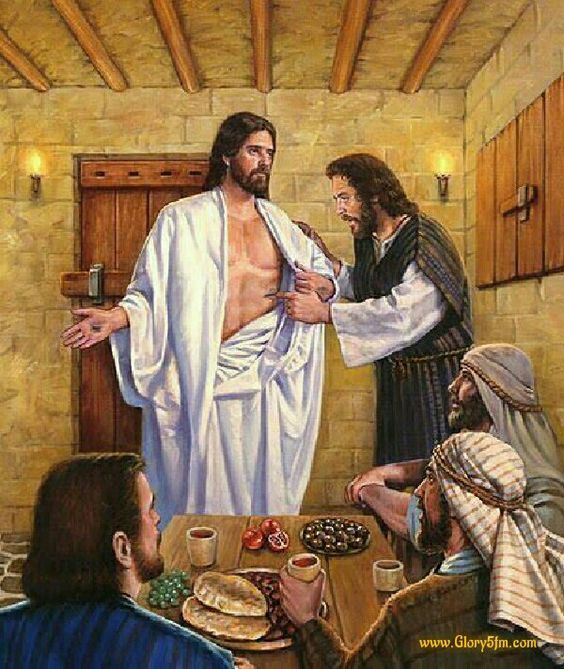
John’s account of this incident bears repeating here, since it may have been similar in some respects to Christ’s encounter with his half-brother James.
Now Thomas (also known as Didymus), one of the Twelve, was not with the disciples when Jesus came. So the other disciples told him, “We have seen the Lord!”
But he said to them, “Unless I see the nail marks in his hands and put my finger where the nails were, and put my hand into his side, I will not believe.”
A week later his disciples were in the house again, and Thomas was with them. Though the doors were locked, Jesus came and stood among them and said, “Peace be with you!” Then he said to Thomas, “Put your finger here; see my hands. Reach out your hand and put it into my side. Stop doubting and believe.”
Thomas said to him, “My Lord and my God!”
Then Jesus told him, “Because you have seen me, you have believed; blessed are those who have not seen and yet have believed.” (John 20:24–29)
Did James need this type of hands-on encounter to convince him that Jesus was alive, was standing before him and had risen from the dead? It certainly seems likely, since the apostle John called him an unbeliever (John 7:5). Did the brothers share a meal together, thus proving that the risen Jesus had fleshly substance and was not merely a ghostly apparition? See Luke 24:36–42.
Sometimes the most difficult people to persuade are the members of our own family. They know us too well and are fully aware of our foibles and shortcomings. After all, familiarity breeds contempt. But another familial phenomenon may be at play here. When we acknowledge the strengths of our sibling, we may feel diminished before them. Having seized the leadership role in the household of Joseph, did James begrudge yielding any authority or praise to the brother whose position he usurped? From James’ perspective, he was not usurping Jesus’ position. He was simply assuming his lawful role as the firstborn heir of Joseph. But acknowledging one’s brother as Messiah and Deity is a steep step down for any man to take. Bending the knee would not come easily.
James was a difficult nut to crack. There was a hard exterior to himm built up over years of rivalry, personal pride, and ambition. Those who have read his New Testament epistle will readily acknowledge that James was a man of rock-solid conviction and impeccable zeal. Some of those characteristics were undoubted evident before his conversion. They were simply oriented in a different direction—a direction that was hostile to Jesus and his mission. In this respect, James was very similar to another New Testament character—Saul who after his encounter with the risen Christ became the zealous apostle Paul.
James the skeptic would certainly need proof of the resurrection. If stunning proof was what he needed, Jesus was willing to provide it.
Luke, the author of the Book of Acts, informs us that there was a forty-day window—from the resurrection to Christ’s ascension—within which the encounter with James must have occurred.
In my former book, Theophilus, I wrote about all that Jesus began to do and to teach until the day he was taken up to heaven, after giving instructions through the Holy Spirit to the apostles he had chosen. After his suffering, he presented himself to them and gave many convincing proofs that he was alive. He appeared to them over a period of forty days and spoke about the kingdom of God. (Acts 2:1–3)
When this passage is compared with Paul’s remarks on the resurrection in 1 Corinthians 15, it becomes clear that Christ’s visitation with James took place near the conclusion of this forty-day period. Jesus saved the encounter with his fiercest skeptic and rival until near the end. Why would this be the case?
One can reasonably assume that there was some logical plan to the appearances that Jesus made. He was providing visible, physical proof of his resurrection. Luke says just that in the Acts passage cited above.
There is also a trainload of significance to the fact that these appearances happened over a period of forty days. Throughout the scriptures the passage of forty days signals a time of testing or proving. The great flood in the days of Noah took place over forty days (Genesis 7:17). Moses spent forty days with God on Mount Sinai receiving the Law (Exodus 34:28). Elijah traveled forty days to Mount Horeb, the mountain of God, on the strength of a single meal (1 Kings 19:7-9). In the same way, Jesus fasted forty days in the wilderness where he was tempted by the devil (Matthew 4:1–11, Mark 1:12–13, Luke 4:1–13). He was severely tested before his public ministry began. During that time of testing, Jesus proved that he was victorious over a triumvirate of evil—the temptations of the flesh, the world and the devil. He proved that he was ready to take on the responsibility of his redemptive mission.
Jesus’ life on planet earth was bookended by another forty days of proving. During this final forty-day interval, he went about proving that he had overcome another triumvirate that rules all humanity—the triumvirate of death, hell and the grave.
Despite repeatedly prophesying this very outcome. See Mark 8:31–33, 9:30–32, 10:32–34. Jesus’ physical resurrection was greeted with profound astonishment and near-universal skepticism. An excerpt from Mark’s gospel account dramatically illustrates this point:
When Jesus rose early on the first day of the week, he appeared first to Mary Magdalene, out of whom he had driven seven demons. She went and told those who had been with him and who were mourning and weeping. When they heard that Jesus was alive and that she had seen him, they did not believe it.
Afterward Jesus appeared in a different form to two of them while they were walking in the country. These returned and reported it to the rest; but they did not believe them either.
Later Jesus appeared to the Eleven as they were eating; he rebuked them for their lack of faith and their stubborn refusal to believe those who had seen him after he had risen (Mark 16:9–14)
One of the strongest arguments for the truth of the four gospel accounts springs from the unbelief of the apostles. When Jesus was raised from the dead, they were completely taken aback. Words such as floored, dumbfounded and thunderstruck spring to mind. And well they should. This is a miracle that defies all the norms of human experience. Their initial unbelief paints a rather unflattering picture of the apostles. This down-to-earth realism, however, lends credibility to the gospel accounts. Who would not be incredulous at reports of someone who was horribly tortured and killed, publicly speared, and drained of his blood (John 19:33–35) suddenly rising from the dead?
Furthermore, anyone who has read the four gospel accounts of the resurrection will discover that there is a certain amount of disorderly chaos in the way the events are reported. They do not match perfectly, and on certain points they seem contradictory. Clearly, no one employed a fact checker before each of the gospels went to press. But rather than sully their credibility, this rather haphazard reporting lends credence tothe truth of the events. The gospel accounts are not carefully crafted documents created by committee and verified in advance by scholarly research. On the contrary, they are independently produced, eyewitness accounts of events that transpired thirty-five or more years prior to the date when they were penned. Some discrepancies can be expected and indeed they are present. But rather than discredit the gospels, these straightforward recollections add to their authenticity and realism.
Present-day eyewitness accounts of the same event usually vary considerably in scope and detail. Witnesses whose stories agree perfectly provide evidence of collusion, nothing more. Discrepancies occur because each witness views the event from a different perspective and with varying degrees of perception. Also, human recall of an event is fallible and can vary over time. This is precisely what we encounter when we read the gospels. When one compares the resurrection accounts in the four gospels, some details appear to be jumbled or missing, but the picture that emerges is strong and clear: To the astonishment of all, Jesus rose from the dead.
Jesus had forty days to prove his resurrection. What logical plan did he follow to convince his followers, and ultimately the world, that he is alive?
Merely appearing before people who do not know him would prove nothing. They were not acquainted with him. Any random stranger could claim to have returned from the dead, but this claim means nothing to the hearer. It seems absurd! They do not know the man and they are unable to verify his claim. Nail scars in hands and feet may be curious features, but they could be self-inflicted wounds. They do not prove that the person thus wounded has risen from the dead.
The point of this argument is this: the people that Jesus must convince are his followers and those who knew him best. They are the only ones who can verify that this man, Jesus, rose from the dead. The general public, despite his fame, cannot verify that the resurrected Jesus is the same person who was put to death. Only those who knew him well can do that. For this reason, Jesus must convince his disciples—specifically the remaining eleven apostles. (Judas had hung himself. See Matthew 27:3–5.) But what is even more important, he must convince his family—his unbelieving brothers. They knew him from his childhood to the point of his death. If he cannot convince them, Jesus has utterly failed in his mission. His resurrection will be deemed a lie nothing more than a fabrication of his deluded followers. This is why police have a family member confirm the identify of an accident or murder victim.
Convincing James is then the ultimate test. Without James and the unbelieving brothers on side, the doctrine of the resurrection is a house of cards. To refute the resurrection claim, the brothers can simply testify that Jesus is dead. It is likely that they too saw him die from a distance. Since his crucifixion was a public event, along a public thoroughfare, it can be said with some accuracy that all Jerusalem witnessed his death.
Furthermore, the brothers can assert that his disciples are babbling idiots. They were already convinced of that before the crucifixion. Now the apostles have removed all doubt by spreading this wild fantasy about Jesus rising from the dead. To convince any thinking person from the public that Jesus is alive, his brothers must first be convinced that he is alive.
James is the linchpin. Unless he is converted, the entire gospel mission is stymied—dead on arrival. James is pivotal to the birth of the church and the advance of the gospel message. At the very core of the gospel message is the death, burial and resurrection of Jesus. For this reason, Jesus must prove to James that he has risen from the dead. He must prove that he is the Son of God. If Jesus is unable to convince the members of his own family, how can the apostles expect to convince the world?
What use or purpose is there in a dead Savior? If he is not alive, the Christian faith is vain and lifeless as a corpse. It is as the apostle Paul says, “And if Christ has not been raised, our preaching is useless and so is your faith” (1 Corinthians 15:14). Only a living Savior can forgive sins and cleanse a guilt-stained heart. Only a living Savior can throw open heaven’s gates. Only the resurrection fixes forever the Father’s seal of approval on the Son. If Jesus remains dead, his death is deserved. If he rises from the dead, his life and his message are vindicated. He is who he said he was—the Son of the Most High. See Matthew 27:63–64, Luke 22:67–71.

Wild flowers — photo by David Kitz
In addition, the gospel message is a message of reconciliation. Humanity is reconciled to God and to one another through the message of the gospel. Again, Paul sheds light on this central tenet of the gospel:
Therefore, if anyone is in Christ, the new creation has come: The old has gone, the new is here! All this is from God, who reconciled us to himself through Christ and gave us the ministry of reconciliation: that God was reconciling the world to himself in Christ, not counting people’s sins against them. And he has committed to us the message of reconciliation. (2 Corinthians5:17–19)
The message of reconciliation rings hollow if Christ cannot be reconciled to his brothers. How can the practitioners of the gospel advocate for reconciliation if the founder of the faith could not be reconciled with the members of his own household? Reconciliation is applied forgiveness. Forgiveness is at the heart of Christ’s teaching, and consequently reconciliation with James is essential. In a post-resurrection world, Jesus and James must be reconciled.
The gospel accounts bear witness to the urgency that Jesus attached to this mission of converting his brothers. On the night of his betrayal, he predicted that his disciples would desert him.
“You will all fall away,” Jesus told them, “for it is written:
“‘I will strike the shepherd, and the sheep will be scattered.’
“But after I have risen, I will go ahead of you into Galilee.” (Mark 14:27–28)
In announcing the resurrection, the angel at the tomb reiterates the same instruction:
“Don’t be alarmed,” he said. “You are looking for Jesus the Nazarene, who was crucified. He has risen! He is not here. See the place where they laid him. But go, tell his disciples and Peter, ‘He is going ahead of you into Galilee. There you will see him, just as he told you.’” (Mark 16:6–7)
Jesus appeared later that day to Mary Magdalene, the tomb-visiting women, to Peter, to two disciples on the road to Emmaus, and finally to the apostles (minus Thomas) at their evening meal in Jerusalem. What urgency was there then in returning to Galilee?
Galilee was the center point of Jesus’ ministry. But, more than that, it was his home. Once again, he would meet with his disciples there. But more importantly, he would return home and meet with his brothers. He says precisely that when he encounters the women near the tomb:
So the women hurried away from the tomb, afraid yet filled with joy, and ran to tell his disciples. Suddenly Jesus met them. “Greetings,” he said. They came to him, clasped his feet and worshiped him. Then Jesus said to them, “Do not be afraid. Go and tell my brothers to go to Galilee; there they will see me.” (Matthew 28:8–10)
The use of the term brothers (adelphos in Greek) is quite curious here. By using this term, Jesus could be broadly referring to his disciples, and most commentators interpret the word in this way. But why would Jesus say this if he was seeing his disciples that evening? Could he also be using the term brothers in the traditional familial sense of the word? Was he instructing these women to tell his unbelieving brothers and related kin to return to Galilee, where he will meet with them again?
His instruction for the brothers to return to Galilee also signals an end to the mourning period. Traditionally, Jewish families are expected to sit for seven days while mourning the loss of their deceased family member. But Jesus was no longer dead, so his announcement to the two Marys (Matthew 28:1-8) was a declaration of an end to the mourning period. Since he was alive, the family members (adelphos) who were in Jerusalem were free to return home to Galilee. The Jewish shiv-ah (mourning period) was over, because the deceased was very much alive.
Typically, the first day of the week, Sunday, was a travel day for the Passover pilgrims. With the end of the Passover week and the final Sabbath, the pilgrims would begin the long journey home. Jesus’ family members in Jerusalem had delayed their departure because of his death. They were observing shiv-ah. Now these two women give the brothers, his mother and other relatives the message that Jesus is alive. He will meet them in Galilee. What a startling turn of events this must have been for James!
The report of Jesus’ words must have cut to the core. “Do not be afraid. Go and tell my brothers to go to Galilee; there they will see me” (Matthew 28:10).
It would seem clear that these words were not intended solely for the eleven apostles. They would see Jesus that evening. They were also intended for his natural adelphos—his brothers according to the flesh.
Did James go to the empty tomb, even as Peter and John did? See John 20:2–10. Did he believe the disciples stole Jesus’ body away? See Matthew 28:11–15. What did he make of the reports of his brother’s resurrection Surely word of it spread like wildfire.
That evening Jesus appeared to his huddled and perplexed disciples. But he did not appear to James, since according to Paul’s defence of the resurrection in 1 Corinthians 15 that meeting was reserved for a later date.
Why was the meeting with James delayed? Paul’s list of resurrection appearances provides us with some clues. It would seem Jesus reserved the hard cases to the end.
Broadly speaking, it would seem that Jesus’ resurrection appearances moved outward in concentric rings from his inner circle, to the outer circle of disciples, to the doubters, and finally the openly hostile. Peter and Mary Magdalene were certainly in the closest inner ring. The Eleven comprise the next circle and then come other disciples beyond the apostolic band. Thomas represents the classic doubter, but there certainly were others, unmentioned by name in the scriptures, who presumably fit in this category. Paul and James fall in the category of the openly hostile—Paul for his persecution of the church, James because of his apparent opposition to Jesus and his gospel message.

Photo by Nacho Juu00e1rez on Pexels.com
As the evidence mounted and testimonials that Jesus was alive kept coming in, it must have produced a great deal of consternation in the hostile, unbelieving James. Since the great rift had opened between them, he had lived his life as a counterpoint to Jesus. These polar opposites did not attract.
In due course, Jesus met with his disciples in Galilee. This included his early morning seaside breakfast meeting with several of them. This occurred after Peter had led the group in a return-to-their-roots fishing expedition. Jesus took this occasion to fully restore his relationship with Peter after his threefold denial on the night of his betrayal. Three times Jesus asked Peter if he loved him, and three times Peter responded in the
affirmative (John 21:1-19).
It seems only fitting that Jesus would do the same work of restoration and reconciliation with James. Did it take only one meeting, or were there several? We do not know. They met at least once accordingto Paul’s testimony. It took several meetings before the relationship with Peter was fully restored. It seems reasonable to postulate that Jesus spent a good deal of time with James and his brothers. Their relationship was in much greater need of repair. They had a great deal to talk about. Ofthose forty post-resurrection days, a good many may have been spent with family, renewing ties that had been damaged and frayed almost beyond repair.
It only seems logical that Jesus returned to Galilee and to his family to rebuild a bridge across a great divide. As we will see, there is ample evidence that he succeeded.
New from David Kitz
James—the brother of Jesus—who was this man? What evidence do we have that this “brother of our Lord” even existed?
David Kitz digs deep into archeology, family dynamics, church history, and the biblical texts. What emerges from his research is a portrait of a decisive, pivotal leader who embodied the will and character of Jesus Christ.
But how did James—James the unbeliever—transform to become a leader who changed the course of world history? In these pages you will uncover the answer and rediscover for yourself the life-changing power of the gospel.
To view further details or purchase directly from the author click here.