• Home
  • About
  • DavidKitz.ca
  • Youtube Videos
  • Books by David
  • Books on Amazon.com

I love the Psalms

~ Connecting daily with God through the Psalms

I love the Psalms

Tag Archives: Pentecost

The Door of Faith Blows Open

03 Sunday May 2026

Posted by davidkitz in Books by David Kitz

≈ Leave a comment

Tags

apostles, Bible, birth of the church, Book of Acts, Christ, Gentiles, gospel, James, James the brother of Jesus, Jerusalem, Jesus, Jesus' family, leadership, Messiah, Paul, Pentecost, Peter, resurrection, Scripture, speaking in tongues, the cross

James: the Lynchpin of Our Faith — Chapter 11

The persecution of the early Christians initiated by Saul (Paul) after the martyrdom of Stephen (Acts 7:54–60) had an unintended effect. As believers fled for their lives, the gospel message spread out from Jerusalem.

On that day a great persecution broke out against the church in Jerusalem, and all except the apostles were scattered throughout Judea and Samaria. Godly men buried Stephen and mourned deeply for him. But Saul began to destroy the church. Going from house to house, he dragged off both men and women and put them in prison.

Those who had been scattered preached the word wherever they went. (Acts 8:1b–4)

Acts chapter eight describes the conversion of the Samaritans through the ministry of Philip the evangelist. This brought the Christian message beyond the tight bounds of Jewish faith and lineage. The Samaritans were considered outsiders to the Abrahamic covenant, though some might legitimately claim a partial Jewish heritage as W. Haskell describes.

The Samaritans were a mixed race with a heathen core (Ezra 4:2). Their blood would become more and more Hebraized by the addition of renegade Jews and by the intermarriage with surrounding Israelites, who would find among them the familiar worship of former times. (1)

It should be noted that the Samaritans were monotheists. They had their own version of the Pentateuch and believed that Mount Gizrim rather than Jerusalem was the holy place chosen by God. For the purists among the Jewish Christians, the inclusion of Samaritan believers undoubtedly challenged long-held perspectives and conventions. However, the apostles appeared to welcome the news of Samaria’s turn toward faith in Jesus Christ.

When the apostles in Jerusalem heard that Samaria had accepted the word of God, they sent Peter and John to Samaria. When they arrived, they prayed for the new believers there that they might receive the Holy Spirit, because the Holy Spirit had not yet come on any of them; they had simply been baptized in the name of the Lord Jesus. Then Peter and John placed their hands on them, and they received the Holy Spirit. (Acts 8:14–17)

If there were any misgivings about welcoming the Samaritans into the Christian fold, they are not recorded in this account. Undoubtedly, Peter and John recognized that this spiritual harvest among the Samaritans was a sovereign work of the Holy Spirit. In all likelihood, they also recalled Jesus’ ministry among the Samaritans was marked by kindness and sympathy rather than by the shunning and hostility, which was the societal norm during this time. See Luke 10:25–37, Luke 17:11–19, John 4:4–42. Nonetheless, it must be noted that with the conversion of the Samaritans, the gospel message had leaped across a significant religious and social barrier. But there was more to come.

Acts chapter eight concludes with the conversion of an Ethiopian eunuch, “an important official in charge of all the treasury of the Kandake (which means “queen of the Ethiopians”)” (Acts 8:27). This eunuch appears to have been either a convert to Judaism or perhaps a member of the Jewish faith who could trace his lineage back to the time of Solomon. In either case he is identified as an Ethiopian, a man coming from the upper Nile region, possibly Nubia.

Though not explicitly stated, the eunuch was a man of a different race. Apparently Luke, the Gentile author of the Book of Acts, included this account of the Ethiopian’s conversion to signal the gospel’s leap across a racial barrier. It is well worth noting that the Coptic Church in Ethiopia traces its origin to this account in Acts chapter eight.

The spread of the Christian faith beyond Jerusalem drew a vicious response from Saul (Paul). He was not content to lay waste to the church in Jerusalem. He intended to wipe out the Christian faith wherever he found it.

Meanwhile, Saul was still breathing out murderous threats against the Lord’s disciples. He went to the high priest and asked him for letters to the synagogues in Damascus, so that if he found any there who belonged to the Way, whether men or women, he might take them as prisoners to Jerusalem. As he neared Damascus on his journey, suddenly a light from heaven flashed around him. He fell to the ground and heard a voice say to him, “Saul, Saul, why do you persecute me?”

“Who are you, Lord?” Saul asked.

“I am Jesus, whom you are persecuting,” he replied. “Now get up and go into the city, and you will be told what you must do.” (Acts 9:1–6)
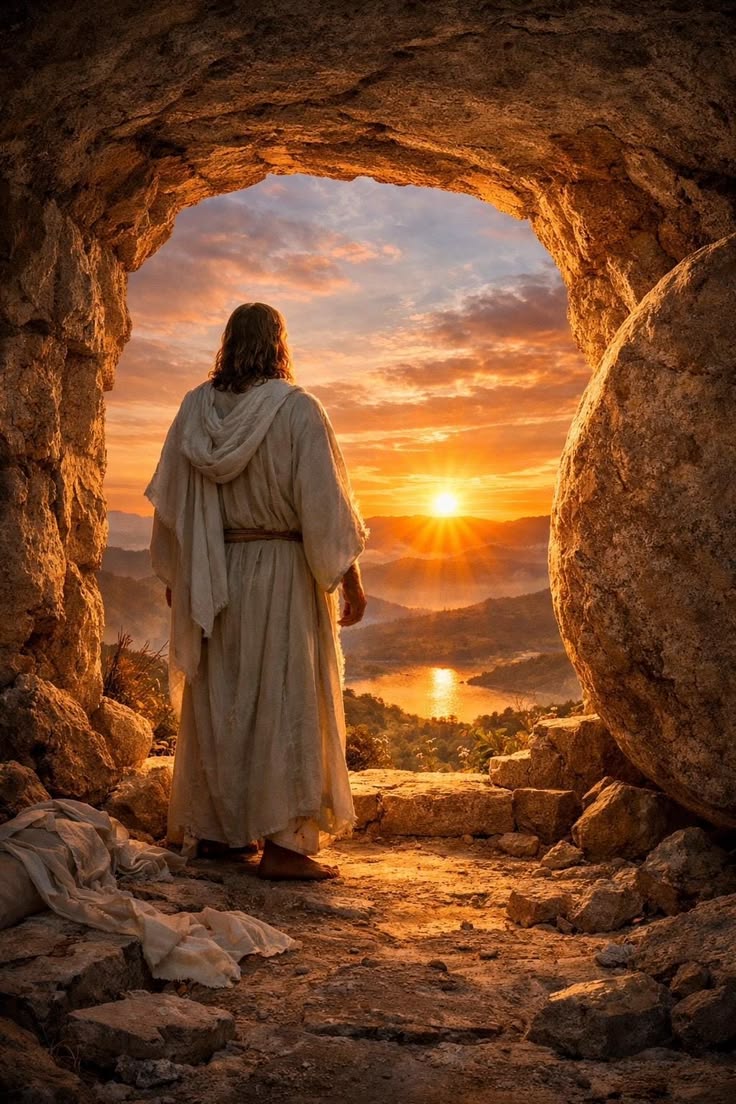
Saul’s miraculous conversion set the early church on a radically different trajectory. Many theologians and biblical scholars see the conversion of Saul of Tarsus as the starting point for the Gentile tidal wave that would flood into the church. They see Saul, who is renamed Paul, as the prima facia cause for the rapid growth of the Christian faith in the Gentile world. However, a closer examination of the Acts narrative and church history reveals that Paul was part of a much larger movement—a Holy Spirit directed movement that propelled the
growing church from its cradle in Jerusalem to the ends of the earth. This movement began with Peter not Paul, and it was validated by James.

Acts chapter ten is of pivotal significance in this regard. With Saul’s fierce persecution brought to a sudden end by his conversion, we are told that:

Then the church throughout Judea, Galilee and Samaria enjoyed a time of peace and was strengthened. Living in the fear of the Lord and encouraged by the Holy Spirit, it increased in numbers. (Acts 9:31)

However, this increase was confined to Jewish and Samaritan converts to the faith. But as Peter toured through this region performing at least two miraculous signs, (see Acts 9:32–42) he eventually came to sojourn in Joppa at the home of a tanner named Simon. At Joppa the gospel message made a startling leap across the barrier between Jews and uncircumcised Gentiles.

An angel was sent to the household of Cornelius, a Roman centurion.

One day at about three in the afternoon he had a vision. He distinctly saw an angel of God, who came to him and said, “Cornelius!”

Cornelius stared at him in fear. “What is it, Lord?” he asked.

The angel answered, “Your prayers and gifts to the poor have come up as a memorial offering before God. Now send men to Joppa to bring back a man named Simon who is called Peter. He is staying with Simon the tanner, whose house is by the sea.” (Acts 10:3–6)

The next day as Peter was waiting for his noonday meal to be prepared, he fell into trance in which he saw a sheet lowered from heaven containing all manner of animals, birds, and reptiles.

Then a voice told him, “Get up, Peter. Kill and eat.”

“Surely not, Lord!” Peter replied. “I have never eaten anything impure or unclean.”

The voice spoke to him a second time, “Do not call anything impure that God has made clean.”

This happened three times, and immediately the sheet was taken back to heaven. (Acts 10:13–16)

More than watchmen wait for the morning — photo by David Kitz

While Peter was still wondering about the meaning of this vision,three messengers from Cornelius arrived at the door. Peter, who was keenly attuned to the voice of the Lord, heard the Holy Spirit say, “Simon, three men are looking for you. So get up and go downstairs. Do not hesitate to go with them, for I have sent them.” (Acts 10:19–20)

These events were preparing Peter’s heart and mind for the dramatic shift in direction that the proclamation of the gospel was about to take. Peter was being sent by the Spirit to a different audience—a Gentile audience outside the covenantal laws of the Jewish people.

In this regard, even Peter’s sojourn in the home of Simon the tanner can be viewed as a preparatory step. Because leather tanners were required to work with the carcasses of animals their work was considered unclean by many in the Jewish community. As I. Howard Marshall writes, “Commentators have noted that the tanner’s occupation was an unclean one, and that a person with Pharisaic scruples would avoid contact with such a man.” (2)

One could assume that Peter’s scruples regarding what was ceremonially clean and unclean were in a state of transition. He certainly did not adhere strictly to the Pharisaic scruples, which went beyond the law and were admired by some first-century Jews.

In this respect he was following the example of his master Jesus, who frequently came into conflict with the Pharisees on such matters. See Matthew 23, Mark 3:23–28, Mark 7:1–23.

But stepping into a Gentile’s home was a line few observant Jews would deign to cross. Therefore, on the following day when Peter enters Cornelius’s home, he offers the following explanation:

While talking with him [Cornelius], Peter went inside and found a large gathering of people. He said to them: “You are well aware that it is against our law for a Jew to associate with or visit a Gentile. But God has shown me that I should not call anyone impure or unclean. So when I was sent for, I came without raising any objection. May I ask why you sent for me?” (Acts 10:27–29)

In response Cornelius recounts the visitation of the angel, and how he was instructed to send for Peter. The assembled listeners are eager to hear what Peter has to tell them. Of course, Peter uses this heaven-sent opportunity to preach the good news about the ministry of Jesus Christ and his death, burial, and resurrection. He prefaces his message with these words of self-reflection: “I now realize how true it is that God does not show favoritism but accepts from every nation the one who fears him and does what is right” (Acts 10:34–35).

It is evident from Peter’s remarks that he did not cross this cultural barrier without due consideration and soul searching. Undoubtedly, he knew he would face criticism from fellow Jewish Christians. They would certainly question his decision to enter a Gentile’s home. In this single act of hospitality, centuries of rabbinical teaching and practice were being set aside. Many would see this as a grave offence, especially since
Peter was a leader in the church.

But this exercise in cross-cultural outreach was not initiated by Peter, Cornelius, or any other man. It was initiated by God. The proof of this can be seen in the response to Peter’s message. The Holy Spirit intervened while he is still presenting the message. Peter said:

“All the prophets testify about him [Jesus] that everyone who believes in him receives forgiveness of sins through his name.”

While Peter was still speaking these words, the Holy Spirit came on all who heard the message. The circumcised believers who had come with Peter were astonished that the gift of the Holy Spirit had been poured out even on Gentiles. For they heard them speaking in tongues and praising God.

Then Peter said, “Surely no one can stand in the way of their being baptized with water. They have received the Holy Spirit just as we have.” So he ordered that they be baptized in the name of Jesus Christ. Then they asked Peter to stay with them for a few days. (Acts 10:43–48)

They were all baptized into Moses in the cloud and in the sea (1 Corinthians 10:2). Photo by David Kitz

This event at the home of a Roman centurion in Caesarea has enormous historic significance. It represents the first penetration of the gospel message into the Roman world. Rome was the dominant political and cultural power at that time. This humble home meeting represents the beachhead from which the gospel would spread across Rome’s farflung empire. This was the birthplace of the Gentile church, and Peter played the role of attendant physician to this miraculous birth.

But it was not a birth without controversy. Peter was called to account for his actions that day in Caesarea.

The apostles and the believers throughout Judea heard that the Gentiles also had received the word of God. So when Peter went up to Jerusalem, the circumcised believers criticized him and said, “You went into the house of uncircumcised men and ate with them.” (Acts 11:1–3)

Evidently, many Jewish believers found Peter’s actions offensive. They certainly were contrary to the norms proscribed by the teachings of rabbinic Judaism. They felt this breech of the Talmudic law needed to be repaired. Peter must be confronted about his transgression. In response, Peter provides a full recount of the events leading to his visit to the centurion’s home and the subsequent conversion of all who were gathered there. In his justification for his action, he points the finger directly at the Holy Spirit.

“As I began to speak, the Holy Spirit came on them as he had come on us at the beginning. Then I remembered what the Lord had said: ‘John baptized with water, but you will be baptized with the Holy Spirit.’ So if God gave them the same gift he gave us who believed in the Lord Jesus Christ, who was I to think that I could stand in God’s way?” (Acts 11:15-17)

What was this “same gift” to which Peter refers? Of course, he is referring to speaking in tongues, as happened initially on the day of Pentecost about eleven years prior to Peter’s meeting at the home of Cornelius.(3) Peter was struck that without specific instruction on this matter, the same phenomena manifested among these Gentile listeners. While listening to Peter’s message, these Gentile hearers became Gentile believers, and the Holy Spirit confirmed their faith by granting them the same gift that the apostles received at Pentecost.

To the consternation of many, the Holy Spirit was making no distinction between Jews and Gentiles. Nonetheless, Peter’s explanation appeared to satisfy those who raised objections.

When they heard this, they had no further objections and praised God, saying, “So then, even to Gentiles God has granted repentance that leads to life.” (Acts 11:18)

Where was James in this debate? Was he presiding over this interrogation? Luke’s account gives us no indication, but it’s not difficult to imagine James as one of the first to raise objections to Peter’s conduct. Due to his prominent role in the early church, he likely was present to hear Peter’s defence. In his epistle penned many years later, James appears to be a rigorous defender of doing things right—correct and by the book. One can easily see how crossing the line into forbidden territory, as Peter had done, would not sit well with James. Nevertheless, Peter was not sanctioned for his conduct. On the contrary, his testimony on this matter led to rejoicing.

One should not assume that the inclusion of Gentile believers within the church proceeded without tension. Centuries of belief, practice, and prejudice are not easily set aside. While many Jewish followers of Christ embraced the message of his sacrificial death and resurrection, it does not logically follow that they would set aside all aspects of their Jewish heritage. They quite rightly saw Jesus as their promised Messiah, but it does not necessarily follow that they saw Jesus as the Savior of the whole world—the Gentile world.

There are an abundance of Old Testament scriptures that point to the salvation of the Gentiles.(4) One can rightly argue, as Paul does, that the salvation of the Gentiles is an integral part of the Abrahamic covenant.
(See Ephesians 3:6 and Genesis 22:18.) But it’s one thing to read these prophecies and give mental assent; it’s quite a different matter when one sees these things being fulfilled before one’s eyes. A complete paradigm shift is required. Undoubtedly some readily embraced this change, while other Jewish believers in Jesus found it difficult or impossible.

Jesus alluded to this in one of his teachings:

“No one sews a patch of unshrunk cloth on an old garment. Otherwise, the new piece will pull away from the old, making the tear worse. And no one pours new wine into old wineskins. Otherwise, the wine will burst the skins, and both the wine and the wineskins will be ruined. No, they pour new wine into new wineskins.” (Mark 2:21–22)

New truths are most easily adopted by those who are new to the gospel message. Those trained and hardened in traditional teachings often find it difficult or impossible to embrace radically different ideas or new concepts. Their wineskins have hardened. Accepting Gentiles into the faith required a radical shift in thinking for many Jewish followers of Christ, including the Lord’s own disciples. This was true despite his explicit teaching that the gospel was for all—for the whole world.(5)

The acceptance of Cornelius and the converts at his home into the church signals the tacit acceptance that their conversion was the fulfillment of the words of the prophets. However, this welcome into the fold does not answer the question of how these new converts should live. Should they be required to adhere to all the rigours of Judaic law? In their daily lives are they to live as Jews, as Gentile believers in the Jewish Christ, or some blend of the two? Should their males be circumcised? Should they celebrate the Sabbath? Which day should be set aside for worship?

These matters would come to the fore later in the Book of Acts. To some extent, these questions are matters of debate, and even some contention in the broader church today. For example, how should Christians apply Old Testament teachings today? What eventually pushed these questions to the fore in the first century was the robust growth of the church among the Gentiles. We read of this expansion later in the same chapter of Acts:

Now those who had been scattered by the persecution that broke out when Stephen was killed traveled as far as Phoenicia, Cyprus and Antioch, spreading the word only among Jews. Some of them, however, men from Cyprus and Cyrene, went to Antioch and began to speak to Greeks also, telling them the good news about the Lord Jesus. The Lord’s hand was with them, and a great number of people believed and turned to the Lord. (Acts 11:19–21)


This great ingathering resulted in an equally great need for sound teaching in the faith, as well as apostolic oversight. Therefore, the church in Jerusalem responded.

News of this reached the church in Jerusalem, and they sent Barnabas to Antioch. When he arrived and saw what the grace of God had done, he was glad and encouraged them all to remain true to the Lord with all their hearts. He was a good man, full of the Holy Spirit and faith, and a great number of people were brought to the Lord.

Then Barnabas went to Tarsus to look for Saul, and when he found him, he brought him to Antioch. So for a whole year Barnabas and Saul met with the church and taught great numbers of people. The disciples were called Christians first at Antioch. (Acts 11:22–26)

Why was Barnabas chosen to head this mission to Antioch? When Samaria turned to the Lord in Acts chapter eight, it was Peter and John who were sent to investigate and provide further instruction. (See Acts 8:14–25.) Why were they not sent to Antioch, since previously they had been engaged in a similar assignment? Luke’s account in the Book of Acts provides us with no further details. Perhaps they were fully engaged in other matters of ministry. It is worth noting however that Barnabas was originally from Cyprus (Acts 4:36), and it was men from Cyprus who first brought the gospel to Antioch. For cultural reasons Barnabas may have been a natural choice. He may also have been personally acquainted with these men from Cyprus, thus adding to his appeal as a candidate for this assignment.

Finally, it appears that this was a group decision. We read “they sent Barnabas to Antioch.” The Greek used here is plural. It appears that the apostolic leadership within the church decided the matter. It was not decided by one man alone. Was James a part of the decision-making process? From later references in Acts chapter twelve and fifteen, it would seem logical to believe so, though in this instance nothing is stated definitively.

(1) W. Haskell, Unger’s Bible Dictionary, Editor Merrill F. Unger (Moody, 1972), p. 958.
(2) I. Howard Marshall, The Acts of the Apostles—Tyndale New Testament Commentaries (Eerdmans, 1980), p. 180.
(3) The scholars associated with The International Inductive Study New Testament situate the Acts 2 day of Pentecost as occurring in 30 AD and the incident at the home of Cornelius as happening in 41 AD. From K. Arthur, The International Inductive Study New Testament (Harvest House, 1993), pp. 167, 168, 181.
(4) See Psalm 22:27, Psalm 86:9, Isaiah 9:2, Isaiah 49:6, Isaiah 60:3, Daniel 7:4, Hosea 2:23.
(5) See Matthew 24:14, Matthew 28:19, Mark 13:10, Mark 16:15, Luke 24:47, Acts 1:8.


New from David Kitz

James—the brother of Jesus—who was this man? What evidence do we have that this “brother of our Lord” even existed?

David Kitz digs deep into archeology, family dynamics, church history, and the biblical texts. What emerges from his research is a portrait of a decisive, pivotal leader who embodied the will and character of Jesus Christ.

But how did James—James the unbeliever—transform to become a leader who changed the course of world history? In these pages you will uncover the answer and rediscover for yourself the life-changing power of the gospel.

To view further details or purchase directly from the author click here.

 

Out of the Shadows a Leader Emerges

26 Sunday Apr 2026

Posted by davidkitz in Books by David Kitz

≈ 4 Comments

Tags

apostles, ascension of Christ, Bible, birth of the church, Book of Acts, Christ, crucifixion, gospel, James, James the brother of Jesus, Jerusalem, Jesus, Jesus' family, leadership, Messiah, Paul, Pentecost, Peter, resurrection, Scripture, speaking in tongues, the cross

———— Part Two ————
James the Leader
James through the Lens of the Book of Acts

James: the Lynchpin of Our Faith — Chapter 10

The most reliable account that we have of the early days of the church is Luke’s New Testament book known as The Acts of the Apostles (commonly abbreviated to Acts). It is the primary source through which we discover James’ spectacular rise to prominence in the church at Jerusalem.

Acts gives us a well-researched depiction of the explosive growth of the infant church. In his last meeting with the apostles just before his bodily ascension into heaven, Jesus predicts how the gospel message will ripple out from Jerusalem in concentric circles like waves in a pond after a rock has dropped into it.

Then they [the apostles] gathered around him and asked him, “Lord, are you at this time going to restore the kingdom to Israel?”

He [Jesus] said to them: “It is not for you to know the times or dates the Father has set by his own authority. But you will receive power when the Holy Spirit comes on you; and you will be my witnesses in Jerusalem, and in all Judea and Samaria, and to the ends of the earth.” (Acts 1:6–8)

Essentially, the above statement is a quick outline of the Book of Acts. Through the chronological progression of twenty-eight chapters, Luke describes the advance of the gospel message from Jerusalem, through Judea, to Samaria, and finally, through the ministry of the apostle Paul, to the ends of the earth. The book ends with Paul the apostle boldly preaching the message of Christ—his life, death, burial, and resurrection—while awaiting his own trial before Caesar in Rome.

For two whole years Paul stayed there in his own rented house and welcomed all who came to see him. He proclaimed the kingdom of God and taught about the Lord Jesus Christ—with all boldness and without hindrance! (Acts 28:30–31)

In one sense, the Book of Acts has no end because the proclamation of the gospel continues to this day. The concentric ripples continue to expand out into the world.

It is not clear from the description found in Luke’s text in Acts 1 if James was present at the ascension. There are contextual grounds to believe that he was. But it is well worth noting that James certainly was present with the apostles as they awaited the coming of the promised Holy Spirit.

Photo by 4FLY RJ on Pexels.com

Then the apostles returned to Jerusalem from the hill called the Mount of Olives, a Sabbath day’s walk from the city. When they arrived, they went upstairs to the room where they were staying. Those present were Peter, John, James and Andrew; Philip and Thomas, Bartholomew and Matthew; James son of Alphaeus and Simon the Zealot, and Judas son of James. They all joined together constantly in prayer, along with the women and Mary the mother of Jesus, and with his brothers. (Acts 1:12–14)

Essentially, the above statement is a quick outline of the Book of Acts. Through the chronological progression of twenty-eight chapters, Luke describes the advance of the gospel message from Jerusalem, through Judea, to Samaria, and finally, through the ministry of the apostle Paul, to the ends of the earth. The book ends with Paul the apostle boldly preaching the message of Christ—his life, death, burial, and resurrection—while awaiting his own trial before Caesar in Rome.

For two whole years Paul stayed there in his own rented house and welcomed all who came to see him. He proclaimed the kingdom of God and taught about the Lord Jesus Christ—with all boldness and without hindrance! (Acts 28:30–31)

In one sense, the storyline of the Book of Acts has no end because the proclamation of the gospel continues to this day. The concentric ripples continue to expand out into the world.

It is not clear from the description found in Luke’s text in Acts 1 if James was present at the ascension. There are contextual grounds to believe that he was. But it is well worth noting that James certainly was present with the apostles as they awaited the coming of the promised Holy Spirit.

Then the apostles returned to Jerusalem from the hill called the Mount of Olives, a Sabbath day’s walk from the city. When they arrived, they went upstairs to the room where they were staying. Those present were Peter, John, James and Andrew; Philip and Thomas, Bartholomew and Matthew; James son of Alphaeus and Simon the Zealot, and Judas son of James. They all joined together constantly in prayer, along with the women and Mary the mother of Jesus, and with his brothers. (Acts 1:12–14)

The phrase, “Mary the mother of Jesus, and with his brothers” must refer to the same brothers that are listed in the gospels, namely, James, Joseph, Judas (Jude), and Simon. See Matthew 13:55, Mark 6:3. Regent University Professor Jon Mark Ruthven in his introduction to the Epistle of James fully supports this view:

James apparently was an unbeliever during the ministry of Jesus (John 7:3–5). A post-resurrection appearance of Christ to him (1 Corinthians 15:7) probably led to his conversion, for he is numbered with the believers in Acts 1:14. (1)

The family reconciliation that Jesus undertook following his resurrection must have borne fruit. The unbelieving brothers are now numbered among the believers, and the divided family is now reunited. At last, the house of Joseph has rallied round Mary’s firstborn son. The occurrence of such a profound reversal lends credibility to the resurrection. It would take a miracle to change the hard-headed James—and a miracle of the highest order is precisely what occurred. The resurrection changed everything.

In the wake of the resurrection, there are two pivotal events in the Book of Acts. The first is the coming of the Holy Spirit on the day of Pentecost. The second is the breakthrough of the gospel messages into the Gentile world. Both events are totally transformational and continue to have a momentous impact right up to the present day.

The first event prefigures and is predictive of the second event. On the day of Pentecost, the Holy Spirit descended upon 120 believers gathered in an upper room in Jerusalem. The primary evidence of the Spirit’s arrival was a phenomenon commonly called speaking in tongues.

When the day of Pentecost came, they were all together in one place. Suddenly a Resound like the blowing of a violent wind came from heaven and filled the whole house where they were sitting. They saw what seemed to be tongues of fire that separated and came to rest on each of them. All of them were filled with the Holy Spirit and began to speak in other tongues as the Spirit enabled them.

Now there were staying in Jerusalem God-fearing Jews from every nation under heaven. When they heard this sound, a crowd came together in bewilderment, because each one heard their own language being spoken. Utterly amazed, they asked: “Aren’t all these who are speaking Galileans? Then how is it that each of us hears them in our native language Parthians, Medes and Elamites; residents of Mesopotamia, Judea and Cappadocia, Pontus and Asia, Phrygia and Pamphylia, Egypt and the parts of Libya near Cyrene; visitors from Rome (both Jews and converts to Judaism); Cretans and Arabs—we hear them declaring the wonders of God in our own tongues!” Amazed and perplexed, they asked one another, “What does this mean?”

Some, however, made fun of them and said, “They have had too much wine.” (Acts 2:1–13)

Though not all utterances in tongues are understood by those of foreign tongue, in this instance they were. To their astonishment, the pilgrims who arrived in Jerusalem for this Jewish festival heard these Galilean followers of Christ speaking in their native language. The significance of this linguistic breakthrough had them all perplexed, hence the question, “What does this mean?”

The apostle Peter stepped forward to address this question. What followed was a succinct explanation of this spiritual phenomenon, which links the Holy Spirit’s coming with the ancient prophecy of Joel. According to Peter, in these last days, God’s Spirit was being poured out on all people, “And everyone who calls on the name of the Lord will be saved” (Acts 2:21).

Peter goes on to explain that this salvation was available through faith in Jesus, who had been crucified, but had risen from the dead. Peter and those assembled with him were witnesses of these things. Furthermore, God signaled his approval of Christ’s bodily sacrifice by raising him from the dead and then pouring out the Holy Spirit on his followers.

“Therefore let all Israel be assured of this: God has made this Jesus, whom you crucified, both Lord and Messiah.”

When the people heard this, they were cut to the heart and said to Peter and the other apostles, “Brothers, what shall we do?”

Peter replied, “Repent and be baptized, every one of you, in the name of Jesus Christ for the forgiveness of your sins. And you will receive the gift of the Holy Spirit. The promise is for you and your children and for all who are far off—for all whom the Lord our God will call.”

With many other words he warned them; and he pleaded with them, “Save yourselves from this corrupt generation.” Those who accepted his message were baptized, and about three thousand were added to their number that day. (Acts 2:36–41)

What we have described here is the birth of the church. On her birthday she grew from one hundred twenty souls to three thousand souls. God was at work among his people.

It should be noted that these new believers were Jewish converts to what is now called Christianity. The term ‘Christianity’ had not yet been invented. But, already, there was a distinct foreshadowing about what was about to come. The assembled believers spoke in tongues—tongues that were understood by foreigners. Surely this was a portent—a sign that the gospel message was poised to break through into the Gentile world.

In the spirit realm a door had opened to the Gentile world—and it just so happened that James, the brother of Jesus, was the hinge on which this door would swing wide. He would play the pivotal role in the opening of the church to the world.

However, at this early juncture in the Book of Acts and the birth of the church, there is no indication that James would play a leadership role. Why would he? He had not been a follower of the Lord during his earthly ministry. The leadership within Christ’s apostolic band had been forged during three and a half years of miracle-filled itinerant ministry. Jesus’ inner circle consisted of three men: Peter and the brothers James and John, the sons of Zebedee, whom Jesus nicknamed “the sons of thunder” (Mark 3:17). Peter was clearly preeminent among the Twelve and acted as the spokesman for the group, even as he did on the day of Pentecost. James the son of Joseph was a complete outsider to this apostolic group.

But Acts gives us some strong indications that James soon rose to prominence in the church. The narrative structure of Acts records the gospel message spiraling out from Jerusalem to the world. The two central players in the drama that unfolds are first Peter and later Paul, but throughout the book James plays an important background role. He is the éminence grise in the story—a respected authority figure to whom others are accountable.

The first indication of this prominent role can be found in the account of Peter’s imprisonment in Acts chapter twelve. At this juncture, the persecution of the fledgling church by the Jewish authorities has been sharply intensified. After the martyrdom of Stephen in chapter seven, Saul (Paul) unleashes a round of murderous persecution that sends most of the believers fleeing from the city. (See Acts 8:1.) A second round of persecution is described in Acts chapter twelve.

It was about this time that King Herod arrested some who belonged to the church, intending to persecutethem. He had James, the brother of John, put to death with the sword. When he saw that this met with approval among the Jews, he proceeded to seize Peter also. This happened during the Festival of Unleavened Bread. After arresting him, he put him in prison, handing him over to be guarded by four squads of four soldiers each. Herod intended to bring him out for public trial after the Passover.

So Peter was kept in prison, but the church was earnestly praying to God for him. (Acts 12:1–5)

Peter is miraculously freed by an angel who wakes him in the middle of the night and escorts him past the sleeping guards and out through the prison gate, which opens of its own accord. He disrupts the prayer meeting that has been summoned to pray for his release.

But Peter kept on knocking, and when they opened the door and saw him, they were astonished. Petermotioned with his hand for them to be quiet and described how the Lord had brought him out of prison. “Tell James and the other brothers and sisters about this,” he said, and then he left for another place. (Acts12:16–17)

Without doubt, the James that Peter speaks of here is James, the half-brother of Jesus. Bible commentators agree on the identity of the James referred to here. But why would James be accorded this level of respect by Peter? Peter’s request implies a degree of accountability to James, as though James held a leadership role. At the very least, Peter sees James as a respected friend and brother in the faith.

I. Howard Marshall in his commentary on this passage states the following:

The James mentioned here is the brother of Jesus (Mk. 6:3) who later figured as the leader of the church in Jerusalem (Acts 15:13, 21:18); Paul regarded him, along with Peter and John, as one of the three ‘pillars of the church’ (Gal. 2:9). He had been a witness of a resurrection appearance of Jesus (1Cor. 15:7), and hence Paul recognized him as an apostle (Gal. 1:19). It seems probable that from an early stage he was one of the leaders in the church, and at some point he took Peter’s place as the recognized leader. The present passage [Acts 12:16–17] need not express more than that he was Peter’s deputy at this stage. (2)

Other commentators see James in a leadership role over Peter. George E. Ladd is among the theologians who hold this view. In his comments on Acts 12:16–17, he states the following:

James, the brother of Jesus, had become the acting head of the Jerusalem church, but he was not with the assembled church at this time. The brethren [other brothers and sisters] may be the elders of [Acts] 11:30 who shared the rule of the church with James. (3)

At this point in the Acts narrative, it may be unclear whether James was Peter’s deputy, a coequal or Peter’s superior; however, three chapters later it becomes obvious who has the greater authority. In Acts chapter fifteen it becomes apparent that James, the brother of Jesus, is the chief executive officer of the first century church. He makes what is arguably one of the most pivotal decisions in human history—a decision that has profound ramifications even today. He decides that his brother’s gospel message will not be confined to Jewry but will spread to the entire world.

(1) John Mark Ruthven, “Introduction: The Epistle of James,” Spirit Filled Life Bible, New King James Version, General Editor Jack W. Hayford, (Thomas Nelson, 1991), p. 1893.

(2) I. Howard Marshall, The Acts of the Apostles—Tyndale New Testament Commentaries (Eerdmans, 1980), pp. 210–211.

(3) George E. Ladd, The Wycliffe Bible Commentary, Editors Charles F. Pfeiffer and Everett F. Harrison (Moody, 1972), p. 1146.


New from David Kitz

James—the brother of Jesus—who was this man? What evidence do we have that this “brother of our Lord” even existed?

David Kitz digs deep into archeology, family dynamics, church history, and the biblical texts. What emerges from his research is a portrait of a decisive, pivotal leader who embodied the will and character of Jesus Christ.

But how did James—James the unbeliever—transform to become a leader who changed the course of world history? In these pages you will uncover the answer and rediscover for yourself the life-changing power of the gospel.

To view further details or purchase directly from the author click here.
 

Christian Writers Gather in a Spirit of Unity

27 Saturday May 2023

Posted by davidkitz in News Reports

≈ 2 Comments

Tags

art, authors, creative, Creator, faith, Pentecost, writing conference

By David Kitz

I am writing this report just before Pentecost Sunday, so when reflecting on the May 5th Christian writers’ conference in Surrey, BC, this scripture readily comes to mind: “When the Day of Pentecost had fully come, they were all with one accord in one place” (Acts 2:1, NKJV).

Yes, we gathered in one accord in one place. And yes, in various ways, I believe all the conference participants sensed the Holy Spirit, and the spirit of unity, as we came together for an afternoon and evening of teaching, inspiration, music, drama, art, and sweet fellowship at Peace Portal Alliance Church.

The conference began with a brief land acknowledgement statement that ended with this sentence: “With our First Nations brothers and sisters, we celebrate the manifold gifts of our Creator, land, sea, air, and life in all its rich and varied forms.”

Carolyn Arends 6gfxvfIQ

Carolyn Arends has released 14 albums and is the author of 3 critically-acclaimed books.

The evening ended with a keynote address by award-winning songwriter and recording artist Carolyn Arends. Arends sprinkled her presentation with songs that illustrated her love for her Creator and her engagement with the creative writing process. From start to finish, the conference truly was a celebration of the Creator and the creative process across the broad spectrum of the arts.

In the afternoon, a total of eight workshops were on offer in three distinct time sessions. The workshops built on the theme of faith igniting creativity. Each workshops featured some aspect of creativity in the writing, marketing, and platform building process. One of the most intriguing workshops included an “ask me anything” session where attendees were encouraged to build community as they posed writing related questions to experienced authors.

Perhaps the most appreciated feature of the conference was the visual art display in the conference area foyer organized by artist and writer Violet Nesdoly. Writers were encouraged to jot down their musings on the art on offer, then some of these thoughts were read out following the evening banquet. Also, there was a draw for a large painting that was graciously donated for the conference.

The Surrey Christian Writer’s Conference came together as a collaborative effort between The Word Guild and Inscribe Christian Writers’ Fellowship. The event beautifully illustrated this slightly modified rendering of Psalm 133:1. “How good and pleasant it is when God’s people live [and work] together in unity!”

That’s where our Creator LORD bestows His blessing.

Resurrection Hope

27 Wednesday Dec 2017

Posted by davidkitz in Bible, Devotionals, Psalm 71, Psalms

≈ 7 Comments

Tags

Christ, Christians, faithfulness, hope, Jesus, New Testament, Old Testament, Pentecost, promise, prophetic, psalmist, redemption, resurrection

Reading:                                      Psalm 71

(Verses 19-24)
Your righteousness, God, reaches to the heavens,
you who have done great things.
Who is like you, God?
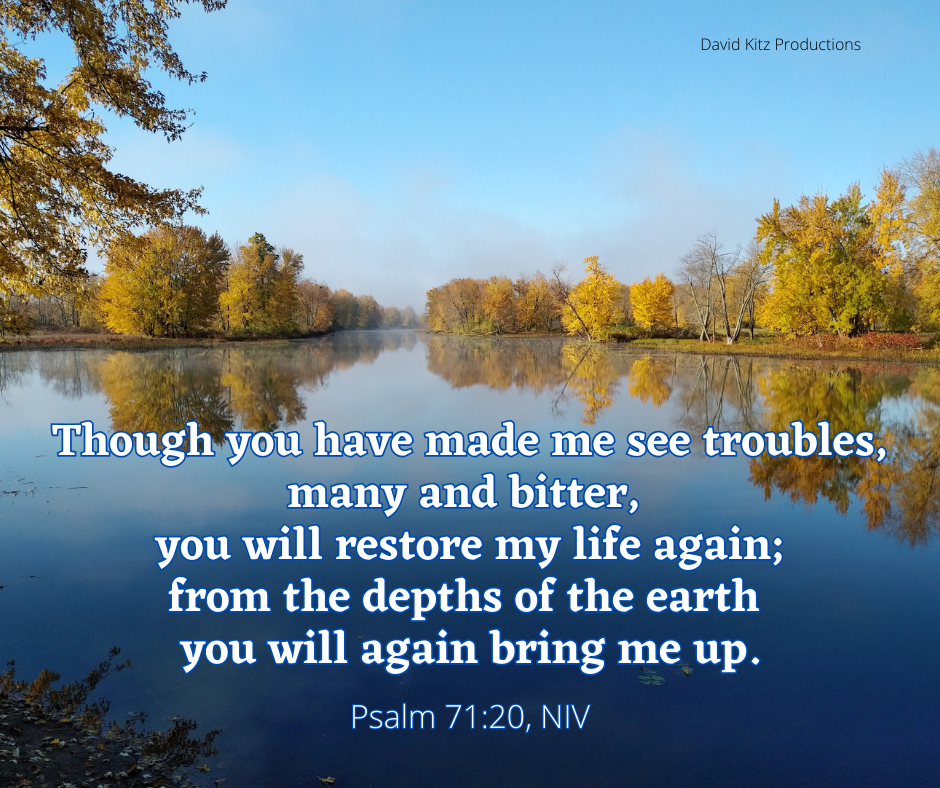
Though you have made me see troubles,
many and bitter, you will restore my life again;
from the depths of the earth
you will again bring me up.
You will increase my honor
and comfort me once more.
I will praise you with the harp
for your faithfulness, my God;
I will sing praise to you with the lyre,
Holy One of Israel.
My lips will shout for joy when I sing praise to you—
I whom you have delivered.
My tongue will tell of your righteous acts all day long,
for those who wanted to harm me
have been put to shame and confusion
(NIV).

Reflection
Typically Christians view resurrection as a New Testament concept, but here in the conclusion to Psalm 71, we can see that the Old Testament psalmist had a solid grasp of resurrection truths. Consider his words. Though you have made me see troubles, many and bitter, you will restore my life again; from the depths of the earth you will again bring me up.

img_20170209_162239

Icy sunset, Grey Nuns Park, Ottawa, ON — photo by David Kitz

That sounds like resurrection to me. Jesus fulfilled the prophetic words of the psalmist when he stepped out of the tomb on resurrection morning. Elsewhere David spoke prophetically of Christ and his resurrection when he wrote, “I am your chosen one. You won’t leave me in the grave or let my body decay” (Psalm 16:10).

Peter sited this verse as proof of Jesus’ resurrection when he preached to the crowd that gathered on the Day of Pentecost. See Acts 2:22-36.

The promise of the resurrection filled the psalmist with hope and it should do the same for us. Because Jesus is alive now, we too will be raised to life. That thought should buoy us on tough days. When we lose a loved one, whose faith was rooted in God’s redeeming love, we can rest assured that our farewell is not forever. We will see them again at the resurrection. On that great day we can join with the psalmist and declare, “My lips will shout for joy when I sing praise to you—I whom you have delivered.”

Response: LORD God, thank you for the promise of resurrection. Thank you for the hope we have in Jesus. Through Jesus’ shed blood we have redemption, and the forgiveness that makes resurrection possible. Hallelujah! Amen.

Your Turn: Why is the resurrection meaningful to you?

Psalms 365: Develop a Life of Worship & Prayer

Psalms 365 Volume II

Psalms 365 vol 3
— Psalms 365 Volume III

Now available:

Psalms

Recent posts

  • Woe on Unrepentant Towns May 14, 2026
  • A Hymn of Triumph May 14, 2026
  • The Workers Are Few May 13, 2026
  • Blessing so we might bless May 13, 2026
  • Jesus Raises a Dead Girl and Heals a Sick Woman May 12, 2026
  • Praying from the Heart May 12, 2026
  • Jesus Questioned About Fasting May 11, 2026

Calendar

May 2026
M T W T F S S
 123
45678910
11121314151617
18192021222324
25262728293031
« Apr    

Blog Posts

Comments

  • davidkitz on A Hymn of Triumph
  • pastorpete51 on A Hymn of Triumph
  • davidkitz on Praying from the Heart

Blog at WordPress.com.

Privacy & Cookies: This site uses cookies. By continuing to use this website, you agree to their use.
To find out more, including how to control cookies, see here: Cookie Policy
  • Subscribe Subscribed
    • I love the Psalms
    • Join 1,349 other subscribers
    • Already have a WordPress.com account? Log in now.
    • I love the Psalms
    • Subscribe Subscribed
    • Sign up
    • Log in
    • Report this content
    • View site in Reader
    • Manage subscriptions
    • Collapse this bar

Loading Comments...