• Home
  • About
  • DavidKitz.ca
  • Youtube Videos
  • Books by David
  • Books on Amazon.com

I love the Psalms

~ Connecting daily with God through the Psalms

I love the Psalms

Tag Archives: Holy Spirit

James the Door Hinge for the Gentile World

17 Sunday May 2026

Posted by Victor Uduh in Books by David Kitz

≈ Leave a comment

Tags

Bible, Christ, church, circumcision, faith, Gentiles, gospel, Holy Spirit, James, James the brother of Jesus, Jerusalem, Jesus, leadership, Paul, Pentecost, Peter, Scripture, speaking in tongues

James: the Lynchpin of Our Faith — Chapter 12 — Part I

At this early point in the history of the church, the city of Antioch served as home base for the Christian faith in the Gentile world. Luke records that “the disciples were called Christians first at Antioch” (Acts 11:26). From here through Paul’s ministry, the gospel spread like wildfire. Antioch was the principal cultural and commercial center in the eastern Mediterranean region. The biblical scholar G. Downey describes Syrian Antioch in these terms:

A Hellenistic city in NW Syria (modern Antakya, Turkey), ranking with Rome and Alexandria as one of the three greatest cities of the Greco-Roman world, and an early center of Christian expansion. (1)

In this great center, Christianity flourished. But the greatest challenge to further growth came from within the Christian community.

Certain people came down from Judea to Antioch and were teaching the believers: “Unless you are circumcised, according to the custom taught by Moses, you cannot be saved.” This brought Paul and Barnabas into sharp dispute and debate with them. So Paul and Barnabas were appointed, along with some other believers, to go up to Jerusalem to see the apostles and elders about this question. (Acts 15:1–2)

This question had enormous ramifications. Were the new Gentile convertsmto the faith required to live in accordance with laws of Moses in order to be saved? Must they be circumcised? In essence, must they become Jews in order to live as Christians? Was faith in Christ’s finished work on the cross sufficient for salvation or were there additional requirements?

Quite rightly, Paul and Barnabas saw this requirement to be circumcised as a direct challenge to their calling and mission, and a threat to the Gentile church. More fundamentally, it undermined the sufficiency of grace, the redemptive power of the cross and the sacrificial atonement through the blood of Jesus. If one is saved through the observance of the law, rather than through faith, why is there any need for Christ’s death on the cross? The cross is stripped of its meaning and power.

Later in his letter to the Galatian church, Paul forcefully argues this very point:

Mark my words! I, Paul, tell you that if you let yourselves be circumcised, Christ will be of no value to you at all. Again I declare to every man who lets himself be circumcised that he is obligated to obey the whole law. You who are trying to be justified by the law have been alienated from Christ; you have fallen away from grace. For through the Spirit we eagerly await by faith the righteousness for which we hope. For in Christ Jesus neither circumcision nor uncircumcision has any value. The only thing that counts is faith expressing itself through love. (Galatians 5:2–6)

Ultimately, this was a question about DNA. The Gentile believers had the wrong DNA. They were not of Abrahamic lineage; therefore, they were outside the divine covenant and by reason of birth alienated from the blessing of God. Circumcision was the means by which believing Gentiles might be incorporated into the family of God. But Paul correctly argues that those who are circumcised are then required to obey the whole Law of Moses. Relying on human effort and obedience to the law nullifies entirely the concept of spiritual rebirth, which comes by faith.

Jesus taught, “You must be born again” (John 3:3–21). This requirement of rebirth applied universally to Jews and Gentiles. Furthermore, rebirth is a work of the Holy Spirit not human effort. Rebirth is experienced through faith. It is a gift from God. (See Ephesians 2:8–9.) Through the miracle of the born-again experience, believers are recipients of divine DNA—eternal DNA—indestructible DNA. Why settle for Abrahamic DNA, when through God’s son we can become transformed repositories of divine DNA—children of the eternal, living God?

At this early stage in the churches’ development, these doctrines maynot have been fully formulated, universally accepted, or understood. But rebirth was certainly occurring as demonstrated by the work of the Holy Spirit. One can study the concept of rebirth at great length, but it can remain nothing more than an academic exercise. A transformed life, and the joy, and peace of the Holy Spirit are true marks of rebirth. In the ministry of Paul and the other apostles, there was ample evidence of changed lives as new believers flooded into the church.

But where was James amid this controversy? Some scholars would have us believe that James was in agreement with the teachers who had arrived in Antioch and were urging the believers to be circumcised. Perhaps, they reason, he had sent them, since Paul’s letter to the Galatians gives credence to this perspective. (See Galatians 2:12.) Those who take this view do so because they see James as a Jewish legalist insisting on conformance to the Laws of Moses. In addition, they see an enormous rift between Paul and James. However, the text of Acts chapter fifteen does not support this view.

What becomes plainly evident in Acts 15 is that James is seen as the leader of the church. One cannot read this chapter without concluding just that. Three observations can be made, which prove this point:

• James provides oversight to the church, the body of Christ.
• The leaders in the church are accountable to him.
• He is the one who renders judgement on this issue of paramount
importance.

On the first point, it is significant that this synod—or council, as it is often called—took place in Jerusalem. New Testament scholars are generally in agreement that this council took place in about 50 AD. (2) Jerusalem would seem like the logical choice since it was the birthplace of the church, and it certainly flourished there in the early years. But the church had grown and spread out geographically from this home base. Some of this dispersion was due to severe persecution in Jerusalem. Peter fled the city for this very reason; however, James remained. (See Acts 12:16–17.)

There is no indication in scripture that Peter returned to reside in Jerusalem. He began what can be described as an itinerant ministry, following in the footsteps of his Lord and Master. Some of that ministry is detailed in the earlier chapters of Acts and from Paul’s letter to the Galatians we also know he traveled to Antioch.

On the other hand, it appears that James’ ministry was centered in Jerusalem. In the writings of several early church fathers, James is identified as the first Bishop of Jerusalem. (3) Similarly, the Eastern Orthodox Church recognizes James as the first Bishop of Jerusalem.

The Clementine Homilies and Clementine Recognitions, which are romances about the life of Clementine (4) dating from the fourth century but partly based on Jewish Christian sources of an earlier time, call James “bishop of bishops.” In these writings Peter and the other apostles are accredited by James. (5)

If James was functioning in his role as bishop, was he providing oversight only to the church in Jerusalem or was he providing general oversight to the whole church? This is a question of considerable importance as we examine Acts chapter fifteen.

If Peter was providing general oversight to the church, then it might logically follow that the church leadership would gather to discuss this important matter at Peter’s current place of ministry, but this is not the case. Peter appears and testifies at the Jerusalem Council as a delegate—a trusted apostolic delegate. He does not have the final say in the matter being discussed. The final decision is left to James.

Though Luke never personally interjects himself into the Acts account, the way in which he frames the events of chapter fifteen leaves the reader with the impression that he may have accompanied Paul and Barnabas on this journey from Antioch to Jerusalem. It certainly is possible that he was appointed as one of the believers sent as delegates to the council. (See Acts 15:3.) Since Doctor Luke was a Gentile, this matter certainly would have a huge bearing on his life and faith, and he records the events in some detail. A close examination of his account is warranted.

The church sent them [Paul, Barnabas and ‘some believers’] on their way, and as they traveled through Phoenicia and Samaria, they told how the Gentiles had been converted. This news made all the believers very glad. When they came to Jerusalem, they were welcomed by the church and the apostles and elders, to whom they reported everything God had done through them. (Acts 15:3–4)

Photo by Sharefaith on Pexels.com

Luke then goes on to clearly delineate the question that the council must decide:

Then some of the believers who belonged to the party of the Pharisees stood up and said, “The Gentiles must be circumcised and required to keep the law of Moses.” The apostles and elders met to consider this question. (Acts15:5–6)

Apparently, some Pharisees had come to faith in Christ despite the frequent clashes that had occurred between them during his earthly ministry. Quite naturally some of these Pharisees continued with their hardline requirements of obedience to every jot and tittle of the Law of Moses. At least on the surface, it appears that their adherence to Mosaic Law took precedence over their allegiance to the law of love introduced by Christ. (See John 13:34–35.)

We are told that after much discussion, Peter addressed the assembled leaders. Undoubtedly, there was rigorous debate on this topic, since it had profound doctrinal implications and had a direct bearing on the outreach mission of the church. Was obedience to the Mosaic Law a requirement for salvation? Was salvation a gift from God received by faith or was it merited through works and religious observances such as circumcision and adherence to sabbath requirements? Were the new Gentile converts genuinely welcome in the church? Was Paul’s mission to the Gentile’s a valid extension of the ongoing mission of Christ on the earth? All these questions were in play as Peter addressed the synod.

“Brothers, you know that some time ago God made a choice among you that the Gentiles might hear from my lips the message of the gospel and believe. God, who knows the heart, showed that he accepted them by giving the Holy Spirit to them, just as he did to us. He did not discriminate between us and them, for he purified their hearts by faith. Now then, why do you try to test God by putting on the necks of Gentiles a yoke that neither we nor our ancestors have been able to bear? No! We believe it is through the grace of our Lord Jesus that we are saved, just as they are.” (Acts 15:7–11)

Peter’s response on this matter is clear and unequivocal. Peter points out that this matter has already been decided—not by man—but by God. God chose to have the message of the gospel preached to the Gentiles. He did so by sending an angel to the home of a Roman centurion named Cornelius. The angel’s instructions were to send for Simon Peter, whose heart was prepared in advance through a vision. The gospel message was proclaimed to the Gentiles because God wanted it preached to the Gentiles. He initiated this whole matter.

Moreover, the Gentiles at Cornelius’ home responded in faith. They believed the message of the gospel. Peter points out that God “purified their hearts by faith” (Acts 15:9). Works or merit based on obedience to the law did not enter into the picture.

Furthermore, God demonstrated that the Gentiles were accepted “by giving the Holy Spirit to them” (Acts 15:8). This was apparent “for they heard them speaking in tongues and praising God” (Acts 10:46). The Pentecostal experience was visited upon these Gentile believers even as it had initially come to the apostles and the hundred and twenty. God revealed that He had accepted the Gentiles into the household of faith without any preconditions. He made no distinction whatsoever between Jews and Gentiles.

In short, Peter was saying that this was entirely God’s doing. God initiated the whole process of bringing the Gentiles into the church, and it was perilous for the church to now place restrictions on the people whom God had so freely and graciously welcomed into the family. Peter calls this testing God. His words bear repeating:

Now then, why do you try to test God by putting on the necks of Gentiles a yoke that neither we nor our ancestors have been able to bear? No! We believe it is through the grace of our Lord Jesus that we are saved, just as they are. (Acts 15:10–11)

With these words Peter echoes the thoughts and sentiments of Jesus—who, during the week of his arrest, excoriated the Pharisees and teachers of the law.

The teachers of the law and the Pharisees sit in Moses’ seat. So you must be careful to do everything they tell you. But do not do what they do, for they do not practice what they preach. They tie up heavy, cumbersome loads and put them on other people’s shoulders, but
they themselves are not willing to lift a finger to move them. (Matthew 23:2–4)

Quite rightly Peter was unwilling to impose a burden on the Gentiles that Jesus had spoken against. (See Luke 11:37–54.) Instead, Peter embraced the grace of God. By doing this he placed Jews and Gentiles on the same footing. Both are saved by the grace of Jesus Christ and not by works of the law.

In his statement before the Jerusalem Council, Peter encapsulates the great truths of the gospel and points the way forward for the church. Decades later, Paul in his Epistle to the Romans expounds at great length on the truths that Peter has succinctly stated here. Peter simply directs the council’s attention to the choices that God has already made. God chose to save both Jews and Gentiles by grace through faith and to pour out His Spirit on them. This was and to this day continues to be His doing and not the work of human effort.

(1) G. Downey, “Antioch (Syrian),” The Interpreter’s Dictionary of the Bible, Volume 1, Edited by George Arthur Buttrick (Abingdon, 1984), p. 145.
(2) Arthur, The International Inductive Study New Testament, p.186.
(3) In the late 2nd century, Clement of Alexandria recorded the following: “For they say that Peter and James and John, after the ascension of our savior, as if also preferred by our Lord, strove not after honor, but chose James the Just as bishop of Jerusalem.” From Eusebius’ Church History, Book 2:1, quoting Clement of Alexandria’s Sixth Hypotyposes, Translated by Arthur Cushman McGiffert. From Nicene and Post-Nicene Fathers, Second Series, Vol. 1, Edited by Philip Schaff and Henry Wace (Christian Literature, 1890), Revised and edited for New Advent by Kevin Knight, www.newadvent.org/fathers/250102.htm.
(4) Clementine of Rome died around 100 AD and is believed to be the second or third bishop of Rome.
(5) W. A. Beardslee, “James,” The Interpreter’s Dictionary of the Bible, Volume 2, Edited by George Arthur Buttrick (Abingdon, 1984), p. 793.


New from David Kitz

James—the brother of Jesus—who was this man? What evidence do we have that this “brother of our Lord” even existed?

David Kitz digs deep into archeology, family dynamics, church history, and the biblical texts. What emerges from his research is a portrait of a decisive, pivotal leader who embodied the will and character of Jesus Christ.

But how did James—James the unbeliever—transform to become a leader who changed the course of world history? In these pages you will uncover the answer and rediscover for yourself the life-changing power of the gospel.

To view further details or purchase directly from the author click here.


Jesus Heals a Leper

30 Thursday Apr 2026

Posted by davidkitz in Psalm 62, Psalms

≈ 1 Comment

Tags

foundation, Holy Spirit, Jesus, Jesus Christ, leprosy, Prayer, Psalms, rest in God, rock of refuge, testimony, the rock

Today’s quote and prayer from
“Psalms 365: Develop a Life of Worship and Prayer
”

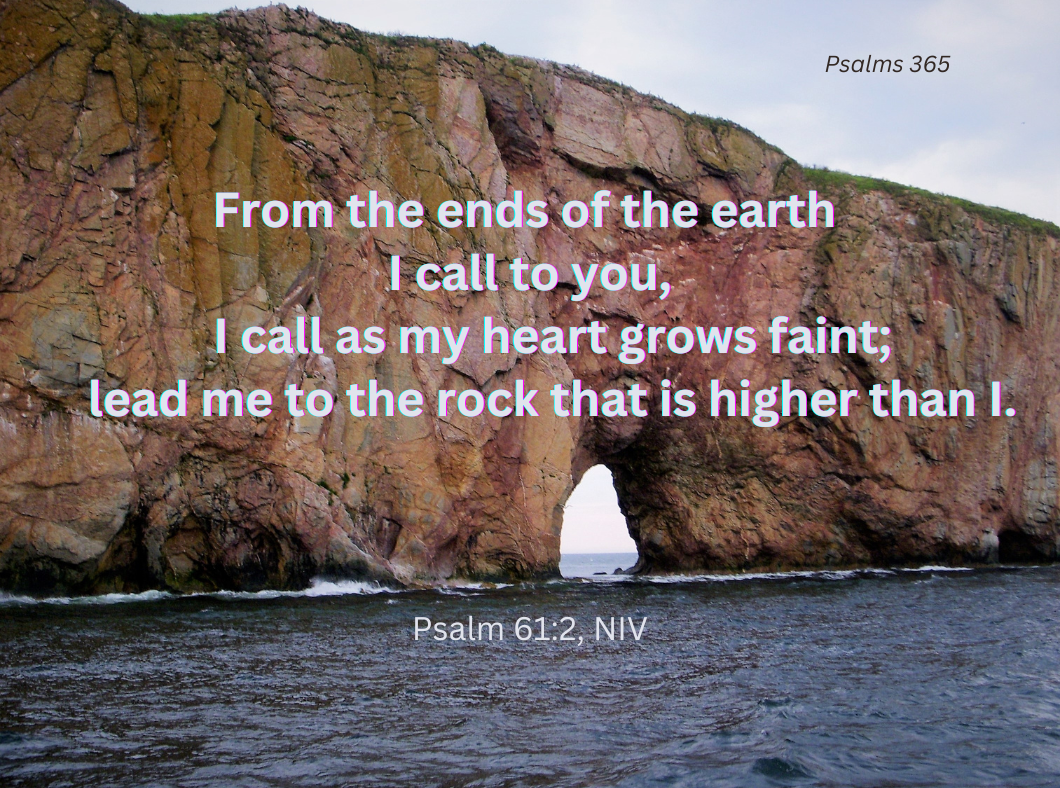
Christ is our living Rock — photo by David Kitz


Today’s
Reading:
Psalm 62:1-8 (NIV)*

Listen to today’s reading by Jonathan Dent:

https://davidkitz.blog/wp-content/uploads/2026/04/ps-621-8-mixfinal2.mp3

LORD God,
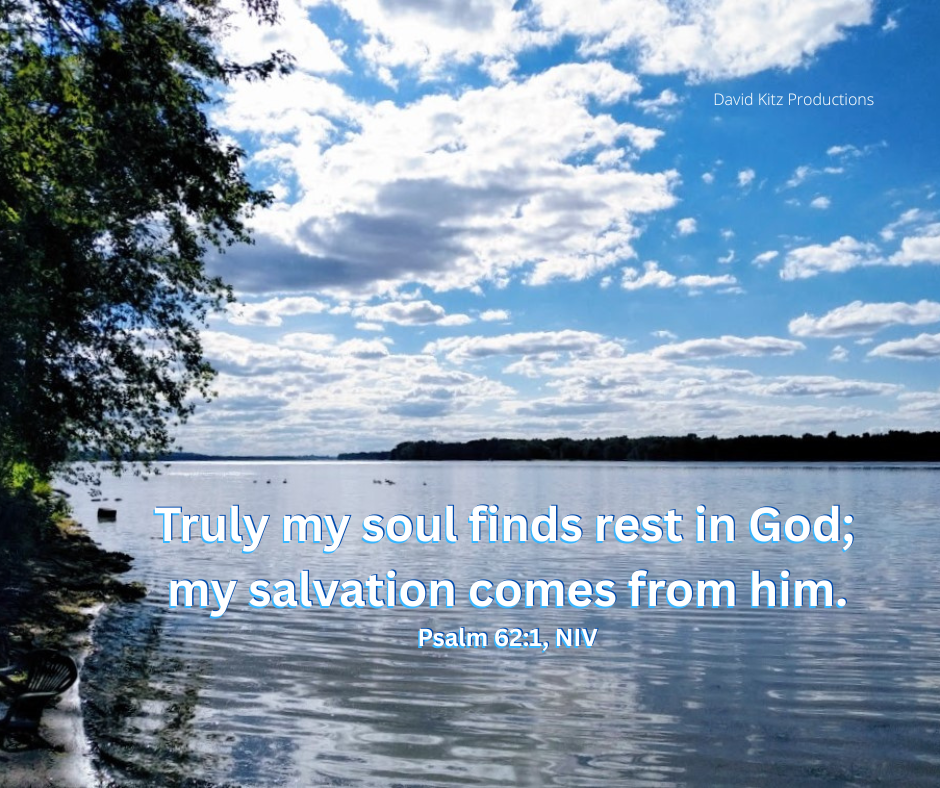
you are my mighty rock, my refuge.
In a troubled world
you are a sure foundation.
My soul finds rest in you.
Help me put into practice the words of life—
the words of Jesus. 
Amen.

  — — — —

Gospel Reading:
Jesus Heals a Leper

When Jesus came down from the mountainside,
large crowds followed him.

A man with leprosy came
and knelt before him and said,
“Lord, if you are willing, you can make me clean.”


Jesus reached out his hand
and touched the man.
“I am willing,” he said. 
“Be clean!” 
Immediately he was cleansed of his leprosy.

Then Jesus said to him,
 “See that you don’t tell anyone.
 But go, show yourself to the priest
 and offer the gift Moses commanded,
 as a testimony to them.”

(Matthew 8:1-4).

* * *

This is how we know what love is:
Jesus Christ laid down his life for us.
And we ought to lay down our lives
for our brothers and sisters.
(1 John 3:16 NIV)

Para la publicación de Salmos 365 de hoy en español haga clic aquí.

bgbg_v4.3_1501818
* NEW INTERNATIONAL VERSION, COPYRIGHT ©1973, 1978, 1984, 2011 BY BIBLICA

Pray for peace in Israel, Iran and the Middle East
and continue to pray for peace to return
to Ukraine and Russia!

Volume I of Psalms 365: Develop a Life of Worship and Prayer won the Best Book of the Year Award from The Word Guild and Volume II has won the Best Devotional of the Year Award. For those who love God’s word, this three-book series is an ideal way to daily meet with the Lord. To purchase or for a closer look click here.

Take a Journey to the Cross and the Empty Tomb.

To view further details or purchase click here.

Wise and Foolish Builders

29 Wednesday Apr 2026

Posted by davidkitz in Psalm 61, Psalms

≈ 1 Comment

Tags

builders, built on sand, floods, foolish, foundation, Holy Spirit, house, Jesus Christ, Prayer, Psalms, the rock, wise

Today’s quote and prayer from
“Psalms 365: Develop a Life of Worship and Prayer
”


Today’s
Reading:
Psalm 61 (NIV)*

Listen to today’s reading by Jonathan Dent:

https://davidkitz.blog/wp-content/uploads/2026/04/psalm-61-mixfinal-1.mp3

LORD God,
help me to draw near to you.
Thank you for the indwelling Holy Spirit.
You have been my refuge,
 a strong tower against the foe.

Amen.

  — — — —

Canada’s Parliament Buildings as seen from the National Gallery — photo by David Kitz

Gospel Reading:
Wise and Foolish Builders

“Therefore everyone who hears these words of mine
and puts them into practice
is like a wise man who built his house on the rock.

The rain came down, the streams rose,
and the winds blew and beat against that house;
yet it did not fall,
because it had its foundation on the rock.

But everyone who hears these words of mine
and does not put them into practice
is like a foolish man who built his house on sand.

The rain came down, the streams rose,
and the winds blew and beat against that house,
and it fell with a great crash.”

(Matthew 7:24-27).

* * *

This is how we know what love is:
Jesus Christ laid down his life for us.
And we ought to lay down our lives
for our brothers and sisters.
(1 John 3:16 NIV)

Para la publicación de Salmos 365 de hoy en español haga clic aquí.

bgbg_v4.3_1501818
* NEW INTERNATIONAL VERSION, COPYRIGHT ©1973, 1978, 1984, 2011 BY BIBLICA

Pray for peace in Israel, Iran and the Middle East
and continue to pray for peace to return
to Ukraine and Russia!

Volume I of Psalms 365: Develop a Life of Worship and Prayer won the Best Book of the Year Award from The Word Guild and Volume II has won the Best Devotional of the Year Award. For those who love God’s word, this three-book series is an ideal way to daily meet with the Lord. To purchase or for a closer look click here.

Take a Journey to the Cross and the Empty Tomb.

To view further details or purchase click here.

David’s Confession Part II

18 Saturday Apr 2026

Posted by davidkitz in Psalm 51, Psalms

≈ 3 Comments

Tags

confession of sin, David, Holy Spirit, Prayer, Psalms, repentance, restoration, Righteousness, salvation, scriptures, sins, transgressions

Listen to Psalm 51:10-19 read by Jonathan Dent

https://davidkitz.blog/wp-content/uploads/2026/04/ps-5110-19-mixfinal.mp3

Reading:Psalm 51:10-19 (NIV)*

Create in me a pure heart, O God,
    and renew a steadfast spirit within me.
Do not cast me from your presence
    or take your Holy Spirit from me.
Restore to me the joy of your salvation
    and grant me a willing spirit, to sustain me.

Then I will teach transgressors your ways,
    so that sinners will turn back to you.
Deliver me from the guilt of bloodshed, O God,
    you who are God my Savior,
    and my tongue will sing of your righteousness.
Open my lips, Lord,
    and my mouth will declare your praise.
You do not delight in sacrifice, or I would bring it;
    you do not take pleasure in burnt offerings.
My sacrifice, O God, is a broken spirit;
    a broken and contrite heart
    you, God, will not despise.
May it please you to prosper Zion,
    to build up the walls of Jerusalem.
Then you will delight in the sacrifices of the righteous,
    in burnt offerings offered whole;
    then bulls will be offered on your altar.
(NIV)*

Reflection
Psalm 51 is the great repentance psalm. This final portion of the psalm is David’s plea for restoration. When we fail our Savior hears our confession and welcomes us once again.

Para la publicación de Salmos 365 de hoy en español haga clic aquí.

bgbg_v4.3_1501818
* NEW INTERNATIONAL VERSION, COPYRIGHT ©1973, 1978, 1984, 2011 BY BIBLICA

Pray for peace in Israel, Iran and the Middle East
and continue to pray for peace to return to Ukraine and Russia!

Volume I of Psalms 365: Develop a Life of Worship and Prayer won the Best Book of the Year Award from The Word Guild and Volume II has won the Best Devotional of the Year Award. For those who love God’s word, this three-book series is an ideal way to daily meet with the Lord. To purchase or for a closer look click here.


Ideal for the Season of Lent

A stunning story of Holy Week through the eyes of a Roman centurion.

Watch the triumphal entry of the donkey-riding king through the eyes of Marcus Longinus, the centurion charged with keeping the streets from erupting into open rebellion.

Look behind the scenes at the political plotting of King Herod, known as the scheming Fox for his ruthless shrewdness.

Get a front-row seat to the confrontation between the Jewish high priest Caiaphas and the Roman governor Pontius Pilate.

Understand as never before the horror of the decision to save a brutal terrorist in order to condemn the peaceful Jew to death.

If you’ve heard the story of Passion Week so often it’s become stale, now is the time to rediscover the terrible events leading from Jesus’s humble ride into the city to his crucifixion. The Soldier Who Killed a King will stun you afresh with how completely Christ’s resurrection changed history, one life at a time.

To view further details or purchase click here.


* New International Version, Copyright ©1973, 1978, 1984, 2011 by Biblica

Peace Be with You!

14 Tuesday Apr 2026

Posted by davidkitz in Psalm 55, Psalms

≈ 1 Comment

Tags

disciples, forgiveness of sins, friend, Holy Spirit, Jesus, Jesus Christ, Prayer, Psalms, repentance, resurrection, Scripture, seeing God, the peace of Christ, troubles

Today’s quote and prayer from
“Psalms 365: Develop a Life of Worship and Prayer


Today’s Reading: Psalm 55:1-8 (NIV)*

Listen to today’s reading by Jonathan Dent:

https://davidkitz.blog/wp-content/uploads/2026/04/psalm-551-8-mix-4final.mp3

LORD God
help me remember
I have a friend in Jesus.
I can bring my troubles,
sorrows, and losses to Him.
I offer you my thanks, Lord Jesus.
You hear me when I call.
Amen.

     — — — —


Post Resurrection Reading:
Receive His Peace

On the evening of that first day of the week,
when the disciples were together,
with the doors locked for fear of the Jewish leaders,
Jesus came and stood among them and said,
“Peace be with you!”

After he said this,
he showed them his hands and side.
The disciples were overjoyed
when they saw the Lord.

Again Jesus said,
“Peace be with you!
As the Father has sent me,
I am sending you.”

And with that he breathed on them and said,
“Receive the Holy Spirit.

If you forgive anyone’s sins,
their sins are forgiven;
if you do not forgive them,
they are not forgiven.”

(John 20:19-23).

* * *

This is how we know what love is:
Jesus Christ laid down his life for us.
And we ought to lay down our lives
for our brothers and sisters.
(1 John 3:16 NIV)

Para la publicación de Salmos 365 de hoy en español haga clic aquí.

bgbg_v4.3_1501818
* NEW INTERNATIONAL VERSION, COPYRIGHT ©1973, 1978, 1984, 2011 BY BIBLICA

Pray for peace in Israel, Iran and the Middle East
and continue to pray for peace to return to Ukraine and Russia!

Volume I of Psalms 365: Develop a Life of Worship and Prayer won the Best Book of the Year Award from The Word Guild and Volume II has won the Best Devotional of the Year Award. For those who love God’s word, this three-book series is an ideal way to daily meet with the Lord. To purchase or for a closer look click here.

Ideal for the Season of Lent


Watch the triumphal entry of the donkey-riding king through the eyes of Marcus Longinus, the centurion charged with keeping the streets from erupting into open rebellion.

Look behind the scenes at the political plotting of King Herod, known as the scheming Fox for his ruthless shrewdness.

Get a front-row seat to the confrontation between the Jewish high priest Caiaphas and the Roman governor Pontius Pilate.

Understand as never before the horror of the decision to save a brutal terrorist in order to condemn the peaceful Jew to death.

If you’ve heard the story of Passion Week so often it’s become stale, now is the time to rediscover the terrible events leading from Jesus’s humble ride into the city to his crucifixion. The Soldier Who Killed a King will stun you afresh with how completely Christ’s resurrection changed history, one life at a time.

To view further details or purchase click here.

What About Spiritual Hygiene?

08 Wednesday Apr 2026

Posted by Tim K in Psalm 51, Psalms

≈ Leave a comment

Tags

Christ's love, David, forgiveness, Holy Spirit, Jerusalem, Psalms, pure heart, sacrifice, Savior, sin, sinners, spiritual hygiene, the LORD, Zion

Today’s Devotion from Psalms 365 by David Kitz

Reading: Psalm 51:10-19

Listen to today’s reading by Jonathan Dent:
https://davidkitz.blog/wp-content/uploads/2026/04/ps-5110-19-mixfinal.mp3

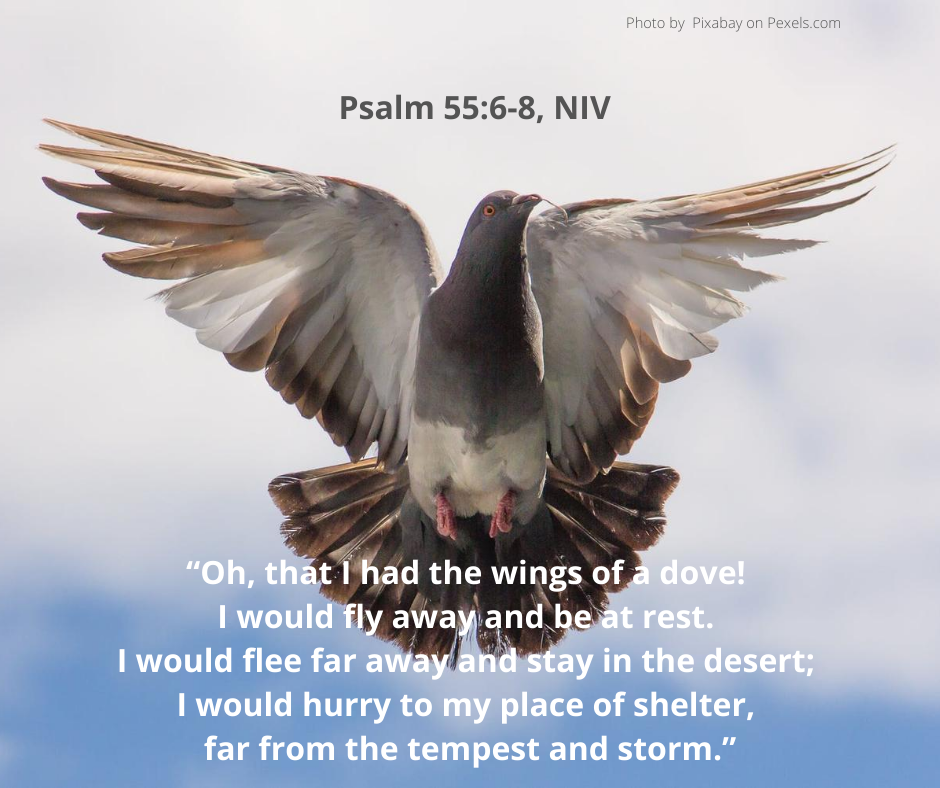
Create in me a pure heart, O God,
    and renew a steadfast spirit within me.
Do not cast me from your presence
    or take your Holy Spirit from me.
Restore to me the joy of your salvation
    and grant me a willing spirit, to sustain me.
Then I will teach transgressors your ways,
    so that sinners will turn back to you.
Deliver me from the guilt of bloodshed, O God,
    you who are God my Savior,
and my tongue will sing of your righteousness.
Open my lips, Lord, and my mouth will declare your praise.
You do not delight in sacrifice, or I would bring it;
    you do not take pleasure in burnt offerings.
My sacrifice, O God, is a broken spirit;
    a broken and contrite heart you, God, will not despise.
May it please you to prosper Zion,
    to build up the walls of Jerusalem.
Then you will delight in the sacrifices of the righteous,
    in burnt offerings offered whole;
    then bulls will be offered on your altar.
(NIV)*

Reflection
I just had my morning shower. Nothing special about that—daily showers are the social norm. But they haven’t always been the norm. Step back a century and the weekly bath was the norm. Step back a thousand years and a bath was an annual event. With this lack of personal hygiene, is it any wonder epidemics ran rampant through the medieval population, and diseases like smallpox and the bubonic plague killed millions in Europe?

As a society we have embraced the concept and practice of personal hygiene. But what about spiritual hygiene? Have we embraced that as well? I fear the opposite is true. Are we routinely plunging into the deep end of a cesspool of sin? Do we mistakenly believe there are no consequences? A filthy spirit can be as deadly as bubonic plague. A host of mental, emotional, and social problems are a direct result of poor spiritual hygiene. Cleanse your heart and mind and you will walk in spiritual health.

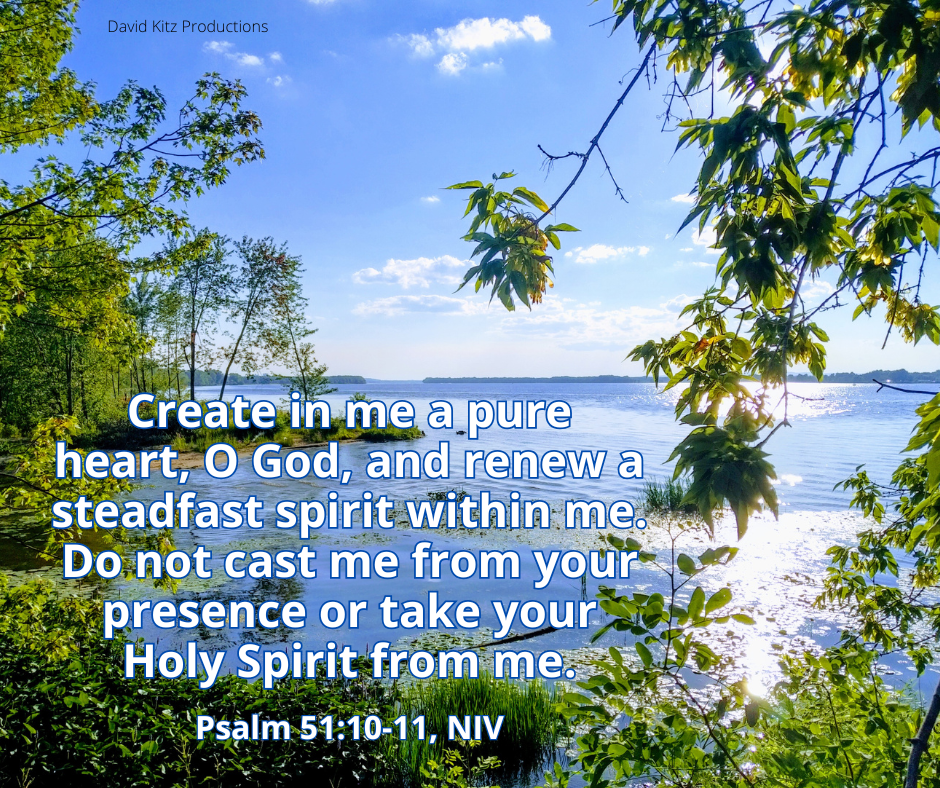
From his own cesspool of sin David cried out: Create in me a pure heart, O God, and renew a steadfast spirit within me. Do not cast me from your presence or take your Holy Spirit from me. Restore to me the joy of your salvation and grant me a willing spirit, to sustain me.

I don’t know about you, but daily I need to bathe in Christ’s love and forgiveness. He cleans me up.

Response
LORD God, thank you for the forgiveness you purchased for me through the shed blood of Jesus your son. I acknowledge my need for your cleansing power. Amen.

Your Turn
How is your spiritual hygiene today? How do you keep your spirit clean?


Para la publicación de Salmos 365 de hoy en español haga clic aquí.

bgbg_v4.3_1501818
* NEW INTERNATIONAL VERSION, COPYRIGHT ©1973, 1978, 1984, 2011 BY BIBLICA

Pray for peace in Israel, Iran and the Middle East
and continue to pray for peace to return to Ukraine and Russia!

Volume I of Psalms 365: Develop a Life of Worship and Prayer won the Best Book of the Year Award from The Word Guild and Volume II has won the Best Devotional of the Year Award. For those who love God’s word, this three-book series is an ideal way to daily meet with the Lord. To purchase or for a closer look click here.


Ideal for the Season of Lent

A stunning story of Holy Week through the eyes of a Roman centurion.

Watch the triumphal entry of the donkey-riding king through the eyes of Marcus Longinus, the centurion charged with keeping the streets from erupting into open rebellion.

Look behind the scenes at the political plotting of King Herod, known as the scheming Fox for his ruthless shrewdness.

Get a front-row seat to the confrontation between the Jewish high priest Caiaphas and the Roman governor Pontius Pilate.

Understand as never before the horror of the decision to save a brutal terrorist in order to condemn the peaceful Jew to death.

If you’ve heard the story of Passion Week so often it’s become stale, now is the time to rediscover the terrible events leading from Jesus’s humble ride into the city to his crucifixion. The Soldier Who Killed a King will stun you afresh with how completely Christ’s resurrection changed history, one life at a time.

To view further details or purchase click here.

Jesus Arrested

26 Thursday Mar 2026

Posted by davidkitz in Psalm 48, Psalms

≈ Leave a comment

Tags

Caiaphas, community, disciples, Holy Spirit, Jesus, Jesus arrested, Jesus' sacrifice, Lent, love of Jesus, Peter, Prayer, praying, Psalms, sacrifice

Today’s quote and prayer from
“Psalms 365: Develop a Life of Worship and Prayer


Today’s Reading: Psalm 48:1-8

Listen to today’s reading by Jonathan Dent:
https://davidkitz.blog/wp-content/uploads/2026/03/psalm-481-8-mix2final.mp3

LORD God,
I thank you
because you live within us!
Help me to let my light shine
in my city or community,
whether it is large or small, urban or rural.
Your Holy Spirit has come
to live within your people.
Amen.

     — — — —

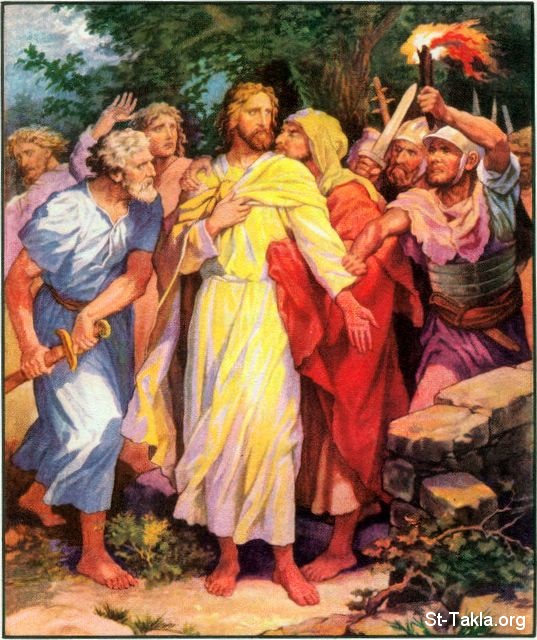
St-Takla.org –Jesus Arrested


Lent Reading:
Jesus Arrested

Then Simon Peter,
who had a sword,
drew it and struck the high priest’s servant,
cutting off his right ear.
(The servant’s name was Malchus.)

Jesus commanded Peter,
“Put your sword away!
Shall I not drink the cup
the Father has given me?”

Then the detachment of soldiers with its commander
and the Jewish officials arrested Jesus.
They bound him
 
and brought him first to Annas,
who was the father-in-law of Caiaphas,
the high priest that year.
 
Caiaphas was the one
who had advised the Jewish leaders
that it would be good if one man died for the people.
(John 18:10-14).

* * *

This is love:
not that we loved God,
but that he loved us and sent his Son
as an atoning sacrifice for our sins.
(1 John 4:10 NIV)

Para la publicación de Salmos 365 de hoy en español haga clic aquí.

bgbg_v4.3_1501818
* NEW INTERNATIONAL VERSION, COPYRIGHT ©1973, 1978, 1984, 2011 BY BIBLICA

Pray for peace in Israel, Iran and the Middle East
and continue to pray for peace to return to Ukraine and Russia!

Volume I of Psalms 365: Develop a Life of Worship and Prayer won the Best Book of the Year Award from The Word Guild and Volume II has won the Best Devotional of the Year Award. For those who love God’s word, this three-book series is an ideal way to daily meet with the Lord. To purchase or for a closer look click here.

Ideal for the Season of Lent


Watch the triumphal entry of the donkey-riding king through the eyes of Marcus Longinus, the centurion charged with keeping the streets from erupting into open rebellion.

Look behind the scenes at the political plotting of King Herod, known as the scheming Fox for his ruthless shrewdness.

Get a front-row seat to the confrontation between the Jewish high priest Caiaphas and the Roman governor Pontius Pilate.

Understand as never before the horror of the decision to save a brutal terrorist in order to condemn the peaceful Jew to death.

If you’ve heard the story of Passion Week so often it’s become stale, now is the time to rediscover the terrible events leading from Jesus’s humble ride into the city to his crucifixion. The Soldier Who Killed a King will stun you afresh with how completely Christ’s resurrection changed history, one life at a time.

To view further details or purchase click here.

It’s all about DNA

15 Sunday Feb 2026

Posted by davidkitz in Books by David Kitz

≈ 3 Comments

Tags

angel Gabriel, Christians, David, DNA, Holy Spirit, James the brother of Jesus, Jesus, Joseph, king, King Herod, Mary, Messiah

James: the Lynchpin of Our Faith — Chapter 1

Have you ever wondered what your life would be like, if you grew up in a different family? I think we all have considered that thought. Maybe it occurred to you the first time you slept over at a friend’s house. You thought, what would it be like to grow up in this house, with this family? Would you be where you are today? Now stretch that thought a bit. What if you were born into a different nation, culture or religious tradition? Would you still be the same person? What would you be like, if you were raised by a low-caste family in southern India, or by Masai warriors in Kenya? We all know that our home and upbringing influence our adult life in a thousand different ways.

Photo by samer daboul on Pexels.com

Then there is the question of DNA. We also know that our genetic make-up impacts everything about us. Every cell and fiber in our body is programmed according to the genetic code inherited from our parents. That code determines more than just our eye colour and shoe size. It shapes facets of personality, disposition, and even subtleties such as our posture, the way we move, and the gestures we use. Of course the influences of nature and nurture, DNA, and upbringing were just as important in biblical times as they are today. We are who we are because of the complex interactions of heredity, family, and social influences. These same influences were at play in shaping the life of James

It is only natural that, following in this vein, the New Testament begins by highlighting heredity. The Gospel of Matthew starts with a recitation of the lineage of Jesus. Incidentally, since they were half-brothers by blood, this also would be the lineage of James. And to truly under stand James—to paint a portrait of him—we need to grasp the paramount role that his older brother played. With this purpose in mind, let’s examine Matthew’s account.

This is the genealogy of Jesus the Messiah the son of David, the son of Abraham:
Abraham was the father of Isaac,
Isaac the father of Jacob,
Jacob the father of Judah and his brothers,
Judah the father of Perez and Zerah, whose mother
was Tamar,
Perez the father of Hezron,
Hezron the father of Ram,
Ram the father of Amminadab,
Amminadab the father of Nahshon,
Nahshon the father of Salmon,
Salmon the father of Boaz, whose mother was Rahab,
Boaz the father of Obed, whose mother was Ruth,
Obed the father of Jesse,
and Jesse the father of King David. (Matthew 1:1–5)

The gospel writer’s purpose here is to establish the quintessential Jewishness of Jesus. He does this in the most organic way possible, by linking him back to the father of the Jewish nation, Abraham. Matthew’s
gospel is written to a Jewish audience and so by doing this, Matthew is saying to his fellow Jews, “Look folks, Jesus, the Messiah is one of us. Just like you, he can trace back his bloodline right to Abraham. We have
a common heritage and here it is spelled out in black and white.” With the next portion of the genealogy Matthew takes this message a step further:

David was the father of Solomon, whose mother had been Uriah’s wife,
Solomon the father of Rehoboam,
Rehoboam the father of Abijah,
Abijah the father of Asa,
Asa the father of Jehoshaphat,
Jehoshaphat the father of Jehoram,
Jehoram the father of Uzziah,
Uzziah the father of Jotham,
Jotham the father of Ahaz,
Ahaz the father of Hezekiah,
Hezekiah the father of Manasseh,
Manasseh the father of Amon,
Amon the father of Josiah,
and Josiah the father of Jeconiah and his brothers
at the time of the exile to Babylon. (Matthew 1:6b–11)

To the casual present-day reader, this list of names means next to nothing, but in Matthew’s time every educated Jewish boy or girl would recognize that this is the full pantheon of Jewish kings. Here are the great and not so great leaders of the Jewish nation—royal heroes and scoundrels all. By providing this list Matthew has just upped the ante. He is telling his Jewish readers, “Have a look at this. Jesus is a royal descendant from the line of David. He is no ordinary Jew. Surely, he is marked for a higher calling.”

Matthew continues:

After the exile to Babylon:
Jeconiah was the father of Shealtiel,
Shealtiel the father of Zerubbabel,
Zerubbabel the father of Abihud,
Abihud the father of Eliakim,
Eliakim the father of Azor,
Azor the father of Zadok,
Zadok the father of Akim,
Akim the father of Elihud,
Elihud the father of Eleazar,
Eleazar the father of Matthan,
Matthan the father of Jacob,
and Jacob the father of Joseph, the husband of Mary,
and Mary was the mother of Jesus who is called
the Messiah. (Matthew 1:12–16)

Matthew has laid out this catalog of patriarchs to establish Jesus’ provenance. This is his royal heritage. To his Jewish audience he is saying, “We all know that the coming Messiah—the promised one—is a descendant of David. Well, here is Jesus’ family tree. He springs from the right stock. He’s got the bona fides.”

But did you notice that surprising little twist at the end? We are introduced to “Joseph, the husband of Mary, and Mary was the mother of Jesus who is called the Messiah” (Matthew 1:16). That’s right! After that great, long, monotonous list of was the-father-of’s, there’s an abrupt change. Joseph was not the father of Jesus. The genetic link breaks down. “Mary was the mother of Jesus who is called the Messiah” (Matthew 1:16).

Matthew goes on to explain:

This is how the birth of Jesus the Messiah came about:
His mother Mary was pledged to be married to Joseph,
but before they came together, she was found to be
pregnant through the Holy Spirit. (Matthew 1:18)


It’s as though God is saying through Matthew that royal heritage is significant, but it isn’t good enough; the best human DNA isn’t good enough. It’s only human after all. For the Messiah we must look to a higher source—a divine source. “But before they came together, she was found to be pregnant through the Holy Spirit” (Matthew 1:18).

God intervened. God put some skin in the game. If the redemption of mankind was a rescue mission, then the Maker of the universe just got seriously committed. He inserted Himself into the human genome.

Divine DNA—Holy Spirit DNA. Think of that for a minute. Divine DNA, the very nature of God, is linked with human DNA in theperson of Jesus. “She [Mary] was found to be pregnant through the HolySpirit” (Matthew 1:18). If you find it difficult to wrap your mind aroundthat statement, you are not alone. Joseph had some difficulty with it too. In fact, he needed a bit of angelic dream therapy to convince him of the heavenly origin this pregnancy. Let’s return to Matthew’s account:

This is how the birth of Jesus the Messiah came about:
His mother Mary was pledged to be married to Joseph,
but before they came together, she was found to be
pregnant through the Holy Spirit. Because Joseph her
husband was faithful to the law, and yet did not want
to expose her to public disgrace, he had in mind to
divorce her quietly.

But after he had considered this, an angel of the
Lord appeared to him in a dream and said, “Joseph son
of David, do not be afraid to take Mary home as your
wife, because what is conceived in her is from the Holy
Spirit. She will give birth to a son, and you are to give
him the name Jesus, because he will save his people
from their sins.”

All this took place to fulfill what the Lord had said
through the prophet: “The virgin will conceive and
give birth to a son, and they will call him Immanuel”
(which means “God with us”).

When Joseph woke up, he did what the angel of
the Lord had commanded him and took Mary home
as his wife. But he did not consummate their marriage
until she gave birth to a son. And he gave him the
name Jesus. (Matthew 1:18–24)

In a normal human pregnancy, the father’s sperm, containing his DNA, unites with the mother’s DNA in the egg to form a new child (zygote). In Mary’s case, the Holy Spirit supplied the required male DNA, or its spiritual equivalent, to set the growth of the zygote (child) into motion.

Theologians have pondered and debated the topic of the virgin birth from the very foundation of the Christian faith. For unbelievers it is a huge stumbling block. How could this come about? It should not surprise us that those most intimately involved with this miracle—Mary and Joseph— would also have doubts and questions. They needed divine assurance and convincing proofs, even as many believers do today.

It’s easy for us who live in a postmodern world to assume that the ancients of biblical times lived in an age of faith where everyone was quick to believe in miracles and the supernatural intervention of God. But a careful reading of the New Testament tells quite a different story. Many struggled with their faith. There are skeptics who demand proof in every age. But how glorious it is when the skeptic has his questions answered, his doubts stripped away, and he finds himself confronted by the living God. This was the case with both Mary and Joseph.

In Luke’s gospel account, Mary’s encounter with the angel Gabriel quite logically sets off some serious questions and doubts. We are told that “Mary was greatly troubled at his [Gabriel’s] words and wondered
what kind of greeting this might be” (Luke 1:29).

Mary had just heard that she “is highly favoured,” and “the Lord is with her.” If she found that angelic greeting disturbing, or as some translations say “confusing,” I am sure she found Gabriel’s announcement
which followed even more troubling.

“Do not be afraid, Mary; you have found favor with
God. You will conceive and give birth to a son, and you
are to call him Jesus. He will be great and will be called
the Son of the Most High. The Lord God will give him
the throne of his father David, and he will reign over
Jacob’s descendants forever; his kingdom will never
end.”
“How will this be,” Mary asked the angel, “since

I am a virgin?” (Luke 1:30b–34)
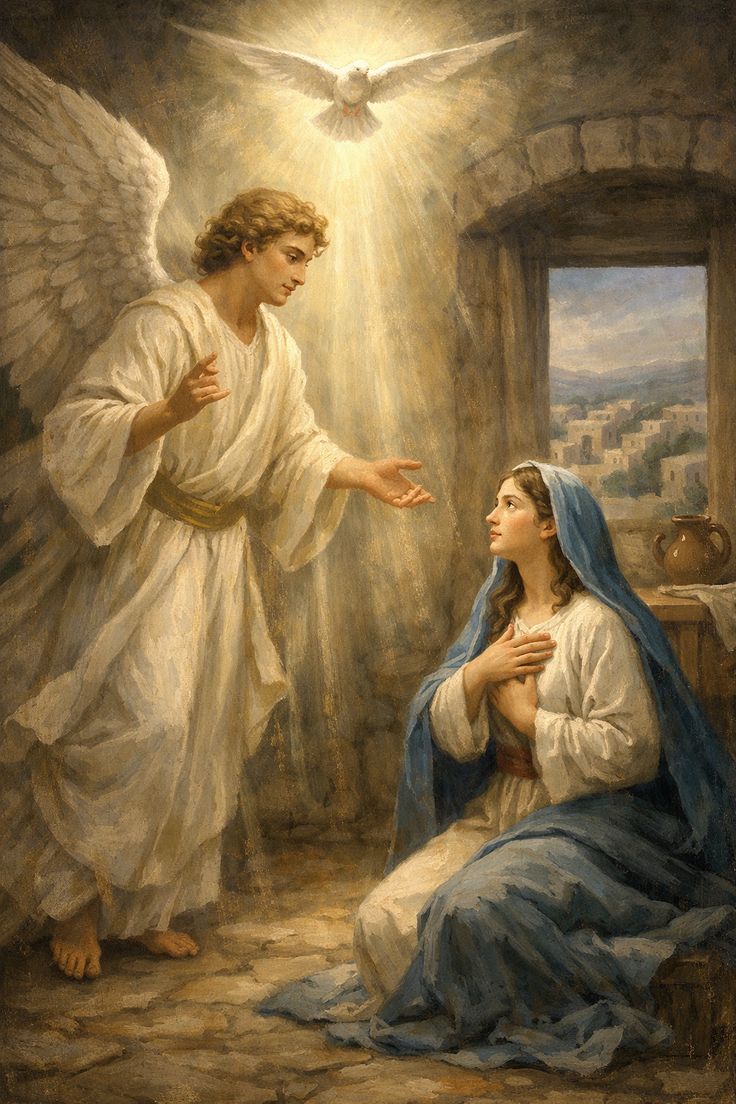
 

Evangelho — Lc 1, 26-38 AI Modified

Mary’s uncertainty is evident through her question. This girl without doubt knew about the birds and the bees and the normal ways and means that produce a pregnancy. Her question flowed logically from everything she knew about human reproduction. Would this promised-child come from her union with Joseph? That would certainly be the natural, predictable course of events, since she was already pledged in marriage to him. Can you imagine her surprise when she heard the angel’s response to her question?

The angel answered, “The Holy Spirit will come on
you, and the power of the Most High will overshadow
you. So the holy one to be born will be called the Son
of God. Even Elizabeth your relative is going to have a
child in her old age, and she who was said to be unable
to conceive is in her sixth month. For no word from
God will ever fail.” (Luke 1:35-37)

Mary is unequivocally told that God would be the father of this child, “so the holy one to be born will be called the Son of God.” This echoes what she had been told before she questioned Gabriel. Mary was told, “He will be great and will be called the Son of the Most High.” Undoubtedly, it takes time and repetition to fully grasp the implications of such statements. In Mary’s case it would take a lifetime. After all, this angelic announcement confounded her Jewish theology. How could God take on human flesh? It defied logic and the norms of human experience. While a Jewish Messiah was hoped for, even expected, who knew that it would come this way? From her own body no less?

To reassure Mary, Gabriel adds the news about Elizabeth’s pregnancy. This aged, barren woman was the last woman among her relatives that Mary would expect to be pregnant. If the miraculous pregnancy of Elizabeth was possible, then perhaps this divine conception via a virgin was possible too.

Mary’s response indicates the spark of faith was alive within her.

“I am the Lord’s servant,” Mary answered. “May your word to me be fulfilled.” Then the angel left her. (Luke 1:38)

Following this angelic visitation, Mary did not remain in her hometown, Nazareth, for long. Luke goes on to tell us that she went down to Zachariah and Elizabeth’s house in Judea. We are not told why she made this journey, but Mary probably hoped for confirmation that Gabriel’s words were true—that Elizabeth was indeed pregnant. If it was confirmation that she sought, it came upon her arrival.

When Elizabeth heard Mary’s greeting, the baby leaped in her womb, and Elizabeth was filled with the Holy Spirit. In a loud voice she exclaimed: “Blessed are you among women, and blessed is the child you will bear! But why am I so favored, that the mother of my Lord should come to me? As soon as the sound of your greeting reached my ears, the baby in my womb leaped for joy. Blessed is she who has believed that the Lord would fulfill his promises to her!” (Luke 1:41–45)

Elizabeth’s words confirm that the spark of faith in Mary was sufficient. She had believed the angel’s words—the Lord’s promise to her via Gabriel—and as a result conception had become reality. As the gospel writer John puts it, “The Word [Jesus] became flesh and made his dwelling among us” (John 1:14). In the coming days, God would become flesh within the womb of Mary.

Later, we see that this concept of power residing in spoken words becomes a prominent theme in Jesus’ ministry. When mixed with faith, the spoken word releases transformation, healing and the miraculous. Jesus speaks to the wind and the waves, and they obeyed him. With a simple spoken word, he heals the sick, restores sight to the blind and casts out demons. Time and again we hear him say, “Your faith has healed you,” as the afflicted walk away in perfect health (Matthew 9:22, Mark5:34, Mark 10:52, Luke 8:48, Luke18:42).

It is this potent mix of the spoken word and faith in the heart of the listener that brings forth amazing transformation. As it was at conception, so it continued through Jesus’ life—words and faith formed an astonishing blend. His words brought life; God’s word brings life.

Later we will see that James, the brother of Jesus, fully grasps this concept of power residing in the spoken word. It is a major theme in his writing, and he hammers it home like no other New Testament writer.

Is it legitimate to speak of divine DNA linking with human DNA to produce the God/man Jesus Christ? Deoxyribonucleic acid or DNA is a physical molecular structure after all, but the Bible asserts that God is a spirit. How could God, who is a spirit, have a physical component or discernible material structure?

If this question seems baffling, then consider this. For the last 50 years nuclear physicists have been trying to find the Higgs boson or ‘God particle’—that elusive element that gives everything in the universe its mass. After spending billions of dollars on the Large Hadron Collider near Geneva, Switzerland, and then creating millions of subatomic particle collisions, scientists have concluded that what we call nothing (totally empty space) is actually something. The God particle discovery announced on July 4th, 2012, is the theological equivalent of saying that God has substance.

For more than two thousand years, Christians have been arguing that God has substance. He took on substance at the conception of Christ in Mary’s womb. In an instant God took on human form. Godly characteristics found their full expression in a human form—first as a zygote, then a fetus, an infant, a child, an adolescent, and a man named Jesus. At every stage of development, he was both God and man. The essence and nature of God took on substance—a material form—and became incarnate. God was no longer only a spirit. He had a physical structure—a human form through which the world could see the express nature and character of God. As a human father expresses his nature and characteristics genetically through his offspring, so too the heavenly Father’s spiritual code was written into every molecule and fiber of Jesus’ being.

Furthermore, it bears noting that this God/man, Jesus Christ, was not a demigod in the Greek and Roman religious tradition of that period. He was simultaneously fully God and fully man, according to sound biblical interpretation and the earliest Christian conventions.

From a biblical perspective the divine nature of the child Jesus is undeniable. Jesus’ biological father was God, as clearly stated in Matthew and Luke’s gospel accounts. But why does Matthew bother listing his earthly, adoptive father’s genealogy if, as stated, Joseph had no DNA in the mix?

The answer appears to be threefold. First, nurture matters. An all-knowing God recognized that Joseph would act as an ideal father to the boy Jesus. Joseph would raise Jesus in the faith. He would love and discipline him in a godly way and educate him in what it means to be a man in Jewish society. Everything we know about child rearing points to the importance of the father figure in the home. This is especially true in the case of boys. Joseph played a very significant role in the life of Jesus. But Joseph played a crucial role in the life of James—crucial because he was the biological father of James. As the lives of these two boys develop, we will see the pivotal role this difference in DNA played.

Secondly, family lineage matters. In Western society we downplay the importance of family heritage. Rugged individualism is highly valued. But even today in Middle Eastern culture, a person’s family name and lineage are of great importance, even paramount. An individual’s life is always viewed in the context of family and family heritage. This is why such a high premium is placed on family honor. It is also why blood feuds go on for multiple generations, as families are locked into past modes of behavior and interaction. To fully introduce a person within such a society, one needs to provide their lineage. Matthew does just that by delineating Jesus’ heritage at the outset of his gospel account.

Finally, royalty matters. The long-awaited, promised Messiah was to come from the royal line of David. This was common knowledge to all Jews of this period. Hence, Matthew begins his gospel with these words: “This is the genealogy of Jesus the Messiah, the son of David, the son of Abraham” (Matthew 1:1). Similarly, in Joseph’s dream, recorded inthe first chapter, the angel does not address Joseph as the son of Jacob, Jacob being his immediate father, but rather as, “Joseph, son of David” (Matthew 1:29). Why jump fourteen generations back? Simply put, it’s because royalty matters.

Because royalty matters, it is the opening theme of Matthew’s first gospel narrative:

After Jesus was born in Bethlehem in Judea, during the
time of King Herod, Magi from the east came to Jerusalem
and asked, “Where is the one who has been born king of the Jews?
We saw his star when it rose and have come to worship him.”

When King Herod heard this he was disturbed,
and all Jerusalem with him. When he had called to
gether all the people’s chief priests and teachers of the
law, he asked them where the Messiah was to be born.
“In Bethlehem in Judea,” they replied, “for this is what
the prophet has written:

“‘But you, Bethlehem, in the land of Judah,
are by no means least among the rulers of Judah;
for out of you will come a ruler who will shepherd
my people Israel.’” (Matthew 2:1–6)

Because royalty matters, jealous King Herod had all the male infants under the age of two put to death in Bethlehem and its environs. Clearly this newborn king had the endorsement of heaven, since the appearance of a star marked his birth. Furthermore, the scriptures predicted his birth. The crafty Herod immediately sensed the threat to his dynastic rule.

In Luke’s gospel account we see that being a descendant of royalty mattered to Joseph. Why else would a resident of Nazareth make the long journey to Bethlehem for the sake of an imperial census, especially since his wife was in the final stages of pregnancy?

So Joseph also went up from the town of Nazareth in Galilee to Judea, to Bethlehem the town of David, because he belonged to the house and line of David. He went there to register with Mary, who was pledged to be married to him and was expecting a child. (Luke 2:4–5)

As you can see, it’s all about DNA—royal DNA—messianic DNA. It’s all about being from the right family, the right clan, and being born in the right place at the right time as a fulfillment of ancient biblical prophecy. It’s about divine DNA or its spiritual equivalent touching the right human DNA to trigger the birth of the Messiah—the God-man who came into the world.
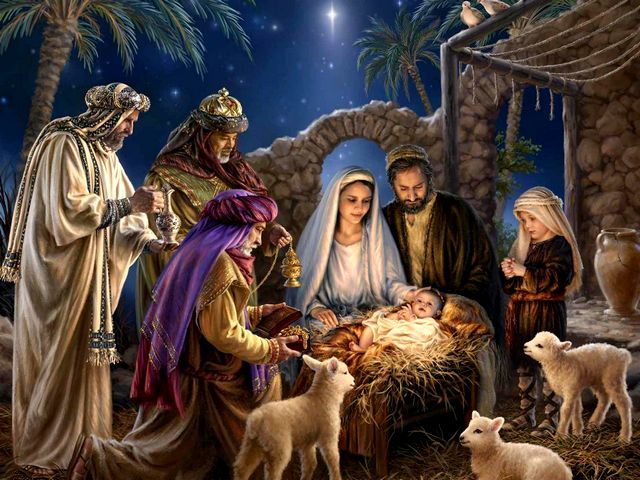
But the DNA that the Holy Spirit touched to trigger conception was Mary’s DNA. Luke provides us with a different genealogical list than Matthew as he traces back Jesus’ ancestors all the way to Adam and finally to God. (See Luke 3:23–38.) He does this because unlike Matthew, who is writing to a Jewish audience, Luke is writing to a Gentile audience. Luke wants his readers to understand that this Jewish Messiah is not just the Savior for Jews, but for all humankind. Of course, Luke goes on to describe the stable birth, the shepherd’s visit and the heavenly, angelic light and sound show that heralded the nativity of the Son of God.

Many Bible scholars believe that the differences between Matthew’s genealogical list and Luke’s list are due to Luke following Mary’s line of descent, while Matthew follows Joseph’s line. What is abundantly clear from both lists is that we are tracing the royal line of David, since at some point the lists merge and are identical.

Implicitly what both authors are saying by providing these lineages is that Jesus is the rightful heir of the Jewish throne. He is the long-awaited Messiah and the fulfillment of prophecy. His birth and arrival on the
scene mark a turning point in world history. God has stepped into human flesh and has come to live among us.

The gospel writer John puts it this way:

The Word became flesh and made his dwelling among us. We have seen his glory, the glory of the one and only Son, who came from the Father, full of grace and truth. (John 1:14)

James was born into this family, with this heritage, with this more-than-preeminent older brother. Talk about being overshadowed by an older brother! Like no one else on this planet James had the blessing, the challenge, and the curse of being overshadowed by the Almighty. And in human form, this Almighty was none other than his living, breathing, flesh, and blood older brother.


New from David Kitz

James—the brother of Jesus—who was this man? What evidence do we have that this “brother of our Lord” even existed?

David Kitz digs deep into archeology, family dynamics, church history, and the biblical texts. What emerges from his research is a portrait of a decisive, pivotal leader who embodied the will and character of Jesus Christ.

But how did James—James the unbeliever—transform to become a leader who changed the course of world history? In these pages you will uncover the answer and rediscover for yourself the life-changing power of the gospel.

To view further details or purchase directly from the author click here.

Because of His Mercy

13 Friday Feb 2026

Posted by davidkitz in Psalms

≈ Leave a comment

Tags

Jesus, Psalms, Prayer, the LORD, Savior, Holy Spirit, salvation, mercy of God, justified, justified by grace

Today’s quote and prayer from
“Psalms 365: Develop a Life of Worship and Prayer


Today’s Reading: Psalm 36:10-12

Listen to today’s reading by Jonathan Dent:

https://davidkitz.blog/wp-content/uploads/2026/02/ps-3610-12-mixfinal.mp3

LORD God,
give me a humble heart
that seeks after you.
Show me your ways, O Lord.
Give me a hunger for your word.
I want to know you more and more.
Help me to do the Father’s will today.
In Jesus’ name, I pray.
Amen.

     — — — —

Photo by David Kitz


Because of His Mercy

At one time we too were foolish,
disobedient, deceived and enslaved
by all kinds of passions and pleasures.
We lived in malice and envy,
being hated and hating one another.

But when the kindness and love of God our Savior appeared,
he saved us,
not because of righteous things we had done,
but because of his mercy.
He saved us through the washing of rebirth
and renewal by the Holy Spirit,

whom he poured out on us generously
through Jesus Christ our Savior,

so that, having been justified by his grace,
we might become heirs having the hope of eternal life.
(Titus 3:3-7 NIV)*


Whoever does not love does not know God,
because God is love (1 John 4:8 NIV)

Para la publicación de Salmos 365 de hoy en español haga clic aquí.

bgbg_v4.3_1501818
* NEW INTERNATIONAL VERSION, COPYRIGHT ©1973, 1978, 1984, 2011 BY BIBLICA

Pray for enduring peace in Israel and Gaza,
and continue to pray for peace to return to Ukraine and Russia!

Volume I of Psalms 365: Develop a Life of Worship and Prayer won the Best Book of the Year Award from The Word Guild and Volume II has won the Best Devotional of the Year Award. For those who love God’s word, this three-book series is an ideal way to daily meet with the Lord. To purchase or for a closer look click here.

Also available from David KitzIs a return-to-Jesus revival possible in our time?
This book points the way forward.
For details click here.

The Conclusion of “The Elisha Code & the Coming Revival”

25 Sunday Jan 2026

Posted by davidkitz in The Elisha Code

≈ 4 Comments

Tags

courage, Elijah, Elisha, faith, Holy Spirit, Jesus, John the Baptist, miracles, revival, spiritual renewal

A code must be recognized, interpreted, and applied for it to be useful, and for it to effect meaningful change. Codes are recognized by the appearance of repetitive patterns. Through our examination of the lives and ministries of the Old Testament duo of Elijah and Elisha, and the New Testament duo of John the Baptist and Jesus, we can clearly see a pattern—a pattern of ever-increasing power and revelation.

In considerable detail, we have outlined how Elijah and John the Baptist are linked in terms of personality and the scope of their ministry. In the same way we have detailed how the miracles and ministry of Jesus runs parallel to the ministry of the prophet Elisha. The pattern is there for all to see.

What are the implications for Christians today? If we recognize this coded message in the Scriptures, how can it impact our lives in the twenty-first century?

Above all, The Elisha Code is a call to action. Yes, we can learn a great deal about the links between Elijah and John the Baptist and the links between Elisha and Jesus. But of first importance, we need the empowerment of the Holy Spirit to work within us and to transform our churches and society today.

The dynamic duos of this book were the greatest revivalists of their time. Elijah and Elisha brought about transformative change in Old Testament Israel. John the Baptist and Jesus set in motion the greatest spiritual transformation the world has ever seen—a transformation that continues to this day.

Here then are some key takeaways from studying the lives of these biblical dynamic duos and other revivalists and key figures in church history:

  • Revivals/spiritual renewals have been an integral part of our faith from the time of ancient Israel to the present.
  • The age of miracles has not ended. We have Jesus’ promise that believers will do even greater things (John 14:12).
  • Genuine revivals are initiated by the Holy Spirit through fallible, imperfect human vessels (2 Timothy 2:20-22).
  • Literary prophets have played, and will continue to play, an important role in fomenting revival and bringing about social and spiritual change.
  • We need leaders with prophetic hindsight, insight, and foresight for the church to reach its full potential.
  • Humility and selfless service are foundational in initiating and sustaining revival. The Spirit of God is quenched and grieved when pride, sin, or selfishness enter in (1 Thessalonians 5:19).
  • Life-changing repentance is at the core of any authentic revival (Mark 1:15, Acts 2:38).
  • The gospel message according to Jesus is all about regime change on a personal level. It’s about letting King Jesus rule our hearts and minds (Colossians 1:13-14).
  • True spiritual awakenings leap across religious, denominational, racial, and cultural barriers (Acts 10). The most effective revivalists build bridges rather than walls.
  • The church must remain focused on the core of the gospel message, rather than become swallowed by political agendas and yield to the third temptation of Christ (Matthew 4:8-11).
  • We are called to live a crucified life that elevates Christ and others by the power of relentless love and forgiveness (Galatians 2:20).
  • God uses broken people who are yielded to his will (John 21:15-19).
  • Hungry humble prayer prepares a runway for the Holy Spirit to land just as it did on the day of Pentecost (Acts 1:14, 2:1-4).
  • Frequently, revivals begin where and when we least expect them, and they are often spearheaded by the young.
  • Our goal should be to finish well. Our service to the Lord may involve many transitions, but his calling on our lives remains till we take our last breath (Romans 11:29).

Finally, the Elisha code is a call to courageous and audacious faith.

Courage is a matter of the heart. The word courage is derived from the Latin word for heart. We must put our heart into our faith. Courageous faith flows from a heart that has been captured by the love of Jesus.

Let this be our prayer. Lord, give us courageous faith.

Audacious faith refuses to remain silent. It speaks out. It must speak.

After Elijah was swept up to heaven in a chariot of fire, Elisha did not remain silent. He spoke up with audacious faith.

Then he took the mantle of Elijah that had fallen from him, and struck the water, and said, “Where is the LORD God of Elijah?” And when he also had struck the water, it was divided this way and that; and Elisha crossed over. (2 Kings 2:14, NKJV)

Audacious faith is bold—bold like Elisha. The word audacious is derived from the same Latin root as audio. Audacious faith makes noise. It must be heard. Is your faith loud enough to be heard by others? Is it being heard by God?

Jesus, whose New Testament miracles are patterned after Elisha’s miracles, frequently chided his disciples for their lack of faith (Matthew 17:17-20).

Let this be our prayer. Lord Jesus, grant us a mustard seed of your audacious faith—mountain moving faith, and as we walk this road with you, light your fire in our hearts.

This is the final excerpt from the award-winning book 
The Elisha Code & the Coming Revival

Is a return-to-Jesus revival possible in our time?
This book points the way forward.
For details click here.


← Older posts

Psalms 365: Develop a Life of Worship & Prayer

Psalms 365 Volume II

Psalms 365 vol 3
— Psalms 365 Volume III

Now available:

Psalms

Recent posts

  • The Conclusion of King Solomon’s Prayer June 5, 2026
  • Peter Declares That Jesus Is the Messiah June 4, 2026
  • King Solomon’s Prayer June 4, 2026
  • The Yeast of the Pharisees and Sadducees June 3, 2026
  • Resurrection Truths June 3, 2026
  • The Demand for a Sign June 2, 2026
  • The Elder’s Prayer June 2, 2026

Calendar

June 2026
M T W T F S S
1234567
891011121314
15161718192021
22232425262728
2930  
« May    

Blog Posts

Comments

  • Resurrection Truths | Talmidimblogging on Resurrection Truths
  • atimetoshare.me on Rock of refuge in a changing world
  • davidkitz on Rock of refuge in a changing world

Blog at WordPress.com.

Privacy & Cookies: This site uses cookies. By continuing to use this website, you agree to their use.
To find out more, including how to control cookies, see here: Cookie Policy
  • Subscribe Subscribed
    • I love the Psalms
    • Join 1,354 other subscribers
    • Already have a WordPress.com account? Log in now.
    • I love the Psalms
    • Subscribe Subscribed
    • Sign up
    • Log in
    • Report this content
    • View site in Reader
    • Manage subscriptions
    • Collapse this bar

Loading Comments...