The Cornerstone

Tags

, , , ,

Reading: Psalm 118
(Verses 22-29)
The stone the builders rejected
has become the cornerstone;
the L
ORD has done this,
and it is marvelous in our eyes.
 The L
ORD has done it this very day;
let us rejoice today and be glad.
LORD, save us! LORD, grant us success!
Blessed is he who comes in the name of the LORD.
From the house of the L
ORD we bless you.
The L
ORD is God,
and he has made his light shine on us.
With boughs in hand, join in the festal procession
up to the horns of the altar.
You are my God, and I will praise you;
you are my God, and I will exalt you.
Give thanks to the LORD, for he is good;
his love endures forever
(NIV).

img_20181019_0922528

Rejoice today and be glad — photo by David Kitz

Reflection
This final reading from Psalm 118 contains one of the most profound messianic prophecies of the Old Testament. The opening sentence carries great significance: The stone the builders rejected has become the cornerstone; the LORD has done this, and it is marvelous in our eyes.

The apostle Peter identifies Jesus as the stone the builders rejected. He adds that this rejection was due to disobedience and unbelief and he quotes Isaiah 8:14 to prove his point. “[Jesus is] A stone that causes people to stumble and a rock that makes them fall.” They stumble because they disobey the message—which is also what they were destined for. But you are a chosen people, a royal priesthood, a holy nation, God’s special possession, that you may declare the praises of him who called you out of darkness into his wonderful light (1 Peter 2:8-9).

In reality our reading from Psalm 118 paints a metaphoric picture of Christ’s Passion Week. When Jesus arrived triumphant in Jerusalem on Palm Sunday he was greeted by the crowds chanting this line from Psalm 118: “Blessed is he who comes in the name of the Lord!” (Matthew 21:9). But later, Jesus, the rock of our salvation, was rejected by the religious leadership. Metaphorically, he was taken up to the horns of the altar and there on a cruel wooden cross, the Lamb of God became our sacrificial offering.

But… but praise be to God! The stone the builders rejected has become the cornerstone. This same Jesus was raised from the dead on the third day, and now he offers forgiveness and salvation for all those who put their faith in him. He is our living rock—the rock that accompanied Israel through the wilderness. See 1 Corinthians 10:1-5. Jesus is the rock on which you can build your life—your cornerstone. 

Response: Father God, I thank you for your prophetic word because it points to Jesus. Lord Jesus, you are the rock solid foundation of my life. I give thanks to the LORD, for he is good! Amen.

Your Turn: Are you building on the Rock, which is Christ?

A Right-handed Cultural Perspective

Tags

, , ,

Reading: Psalm 118
(Verses 15-21)
Shouts of joy and victory
resound in the tents of the righteous:
“The L
ORD’s right hand has done mighty things!
The L
ORD’s right hand is lifted high;
the L
ORD’s right hand has done mighty things!”
I will not die but live,
and will proclaim what the L
ORD has done.
The L
ORD has chastened me severely,
but he has not given me over to death.
Open for me the gates of the righteous;
I will enter and give thanks to the L
ORD.
This is the gate of the L
ORD
through which the righteous may enter.
I will give you thanks, for you answered me;
you have become my salvation
(NIV).

img_20191008_0656337-1

MacNutt, Saskatchewan at sunrise — photo by David Kitz

Reflection
Are you left handed? Today in western cultures being left handed presents some challenges since many devices are designed with right-handed people in mind. Try finding left-handed scissors next time you’re at a store. Good luck with that! Oh, and if you find them, expect to pay three times the price of a right-handed model. Often lefties don’t have it so good.

Even today in Middle Eastern cultures being born left handed presents an enormous challenge. The right hand is used for eating food; the left hand is used for personal hygiene—bottom wiping. You dare not reverse that assigned role. Toddlers are strictly trained in this cultural practice. Usually left-handed children are forced to switch so they conform to the social norm. Making this switch plays havoc with the developing brain and often results in speech impediments such as stuttering, since this transition requires a complete rewiring of the child’s brain.

The Bible was written by Holy Spirit inspired authors, but like authors today they were not blank slates. They wrote from their cultural perspective to the people of their time. As a result, readers today can easily miss or misunderstand concepts that were readily understood in their original context.

The significance of the right hand is one of those culturally important concepts that we often pass over with little thought. The Bible is replete with references to the right hand or specifically God’s right hand. So what’s the big deal, we think to ourselves. But in Middle Eastern culture the right hand holds great significance. This is the hand of righteousness, honor and blessing. Thus, there is immense significance in this statement: “The LORD’s right hand has done mighty things! The LORD’s right hand is lifted high; the LORD’s right hand has done mighty things!”

Response: Father God, extend your right hand of blessing over me. Work on my behalf. Show me your mercy, your power and glory. Again and again I will give you thanks, for you answered me. Amen.

Your Turn: Are you like the psalmist? Has the LORD spared your life for a purpose? Has God lifted His right hand to save and bless you?

The Words of a Warrior

Tags

, , , ,

Reading: Psalm 118
(Verses 8-14)
It is better to take refuge in the LORD
than to trust in humans.
It is better to take refuge in the L
ORD
than to trust in princes.
All the nations surrounded me,
but in the name of the L
ORD I cut them down.
They surrounded me on every side,
but in the name of the L
ORD I cut them down.
They swarmed around me like bees,
but they were consumed as quickly as burning thorns;
in the name of the L
ORD I cut them down.
I was pushed back and about to fall,
but the L
ORD helped me.
The L
ORD is my strength and my defense;
he has become my salvation
(NIV).

IMG_20180629_1825564-ANIMATION (2)

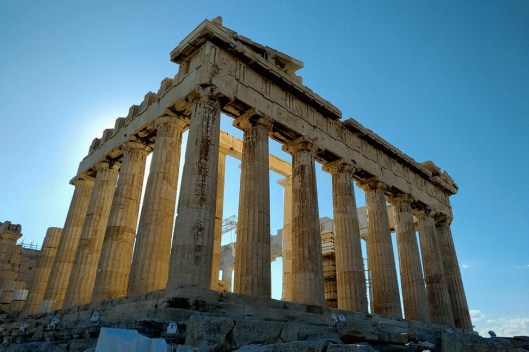
The Parthenon, Athens, Greece — photo by David Kitz

Reflection
Psalm 118 is perhaps the most militant psalm in the Bible. The psalmist assumes a combative stance. He is ready to take on the world and everything his adversaries can toss at him. These are the words of a fighter—a courageous warrior: All the nations surrounded me, but in the name of the LORD I cut them down. They surrounded me on every side, but in the name of the LORD I cut them down.

Some may find the aggressive words of this psalm offensive. To be frank, I prefer the more passive psalms that speak of quiet waters, grassy hills and star-filled night skies, but life is more than tranquil repose. It also includes moments of conflict and combat. As the author of Ecclesiastes reminds us, “There is a time for everything, and a season for every activity under the heavens: a time to love and a time to hate, a time for war and a time for peace” (Ecclesiastes 3:1, 9). There is a time to be conciliatory, but there also are times when we need to stand our ground and defend our faith and our way of life.

Joshua is a Bible character who exemplifies the attitude and intent of this psalm. He was a man on a mission. His mission, assigned to him by God, was the conquest of Canaan. If you read the Book of Joshua, you will discover that he pursued his mission with a ruthless passion that ultimately brought victory and success. In his farewell speech to the nation, Joshua had these words of advice: “The LORD has driven out before you great and powerful nations; to this day no one has been able to withstand you. One of you routs a thousand, because the LORD your God fights for you, just as he promised. So be very careful to love the LORD your God” (Joshua 23:9-11).

The God of peace is also the God who fights for you. Very little in this life is accomplished without rugged determination and a fighting spirit. Joshua proved that great nation-changing things are possible when we move forward with courage and tap into the power of God.

Response: Father God, there are battles that you want me to fight. Help me to personally tap into your power. Give me courage to stand for you and your truth though a thousand oppose me. Amen.

Your Turn: Are there great things that God has called you to accomplish? Is He fighting for you?

The Strength of His People

Tags

, , ,

I will praise Him!

img_20191007_1017596

Autumn glory near MacNutt, Saskatchewan — photo by David Kitz

Praise be to the LORD,
    for he has heard my cry for mercy.
The LORD is my strength and my shield;
    my heart trusts in him, and he helps me.
My heart leaps for joy,
    and with my song I praise him.

The LORD is the strength of his people,
    a fortress of salvation for his anointed one.
Save your people and bless your inheritance;
    be their shepherd and carry them forever.

  (Psalm 28:6-9, NIV)

If You Remain Silent

Tags

, ,

I will praise Him!

img_20191005_1645383-effects

Autumn sunflowers, Churchbridge, SK — photo by David Kitz

Of David.

To you, LORD, I call;
    you are my Rock,
    do not turn a deaf ear to me.
For if you remain silent,
    I will be like those who go down to the pit.
Hear my cry for mercy
    as I call to you for help,
as I lift up my hands
    toward your Most Holy Place.

  (Psalm 28:1-2, NIV)

He Brought me into a Spacious Place

Tags

, , ,

Reading: Psalm 118
(Verses 1-7)
Give thanks to the LORD, for he is good;
his love endures forever.
Let Israel say:
“His love endures forever.”
Let the house of Aaron say:
“His love endures forever.”
Let those who fear the L
ORD say:
“His love endures forever.”
When hard pressed, I cried to the LORD;
he brought me into a spacious place.
The L
ORD is with me; I will not be afraid.
What can mere mortals do to me?
The L
ORD is with me; he is my helper.
I look in triumph on my enemies
(NIV).

img_20191003_1227175

Northern Ontario roadside vista — photo by David Kitz

Reflection
Psalm 118 is a psalm of thanksgiving and triumph, over adversaries and adversity. Many of the enemies we encounter have no human face; instead they are life circumstances, worldly thinking, or schemes hatched in hell. We all have struggles and obstacles that we must overcome. The good news found in this psalm is that God is on our side. When we surrender to the LORD, we join the winning side. Then we can join the psalmist in this declaration: The LORD is with me; he is my helper.

This psalm begins and ends with this statement: Give thanks to the LORD, for he is good; his love endures forever. From ancient times this psalm was likely used in public worship. It may well have been used in a kind of call and response with the priest or worship leader calling or singing out, “Give thanks to the LORD, for he is good,” while the congregation answers back, “his love endures forever.” 

I think at various times we all have experienced the truth of the following words: When hard pressed, I cried to the LORD. If you have prepared for a semester-ending-round-of-exams, you know all about being hard pressed. If you have a crucial work deadline, you know all about being hard pressed. If you have spent countless days and hours preparing for a special event, you know all about being hard pressed. Life is full of hard-pressed moments. How we respond in those stressful situations is crucial to our development as citizens of earth and heaven.

In those high pressure moments have you learned to cry out to the LORD? Have you experienced His help? Have you come out the other side as a stronger, more courageous person because you faced your fears? When you called out to God did He bring you through to victory? If the answer is yes, let these words become your response: He brought me into a spacious place. The LORD is with me; I will not be afraid. What can mere mortals do to me?

Response: Father God, I am facing some deadlines and difficulties. But you are my helper, LORD. I call out to you. I want to triumph over the obstacles I face. I thank you in advance for the victory that you have instore for me. Amen.

Your Turn: Has God helped you in a high pressure situation? I would love to hear about your victory.

Enough Truth to Set the World on Fire

Tags

, , , ,

Reading: Psalm 117
Praise the LORD, all you nations;
extol him, all you peoples.
For great is his love toward us,
and the faithfulness of the L
ORD endures forever.
Praise the LORD (NIV).

img_20190929_0716289

Reflections on the shortest Psalm — photo by David Kitz

Reflection
Psalm 17 is the shortest of all the psalms. It reminds me of tabasco sauce. It’s concentrated; you don’t need much to set your mouth on fire.

What’s so great—so powerful—about Psalm 117 you ask? Well in 29 short words, it sums up the call and global appeal of the entire Bible.

Let’s consider this opening sentence: Praise the LORD, all you nations; extol him, all you peoples. This call to worship is for all people; it’s universal. The message of the Bible is for all people. It’s not limited to a single nation, race or people group.

This call for universal praise is unusual because it draws all humanity into a common faith in the LORD. The Jewish faith was and is a very exclusive religion. This is the faith of the chosen people—God’s chosen people. They did not choose Him, but rather they were uniquely selected by God to bear His name before the nations of the world. Throughout the Old Testament we have a clear sense that God was dealing with his own special people, and they were to walk separate from the nations. They received God’s laws and were the guardians of His word. They were instructed not to intermarry with other nations, nor be polluted by them and their idol worship. The worshippers of Yahweh were an exclusive group, a unique people, but they were not evangelistic. They kept the message to themselves.

But here in Psalm 117 the constricted, exclusive God of the Old Testament appears to break out of His narrow nationalist cocoon. We see that He is in reality a God for all nations, not just for the descendants of Abraham. Here we catch a glimpse of the big picture—the global perspective. All the nations of the earth are to praise Him. The longstanding intent of the God Israel is that every people group should know his ways and experience His salvation.

But why should all nations praise the LORD? The second verse of this miniature psalm provides the answer. For great is his love toward us, and the faithfulness of the LORD endures forever. Where did the LORD demonstrate His great love for us? We see God’s love most vividly on the cross. There the Son of God poured out His blood to redeem men and women, boys and girls, from every nation under heaven. There love flowed down in a crimson stream. There God fulfilled His Abrahamic promise. “God himself will provide the lamb for the burnt offering, my son” (Genesis 22:8). There the prophecy of John the Baptist was achieved. “Look, the Lamb of God, who takes away the sin of the world!” (John 1:29).   

Concentrated within the shortest Psalm is enough truth to set the world on fire. 

Response: Father God, I just want to praise you. Thank you for your great love and faithfulness as revealed by Jesus on the cross. I love you, Lord Jesus. I am grateful that you love encompasses all. Amen.

Your Turn: Why is racism run contrary to anyone who claims to love God?

Death and Service

Tags

, , , ,

Reading: Psalm 116
(Verses 15-19)
Precious in the sight of the LORD
is the death of his faithful servants.
Truly I am your servant, L
ORD;
I serve you just as my mother did;
you have freed me from my chains.
I will sacrifice a thank offering to you
and call on the name of the L
ORD.
 I will fulfill my vows to the L
ORD
in the presence of all his people,
in the courts of the house of the LORD
in your midst, Jerusalem.
Praise the LORD (NIV).

img_20191007_1029210

Country road home — photo by David Kitz

Reflection
Funerals are fascinating occasions for a whole variety of reasons. Recently I have had an opportunity to attend a number of these end-of-life events. There is something bittersweet about most funerals—bitter due to the loss of a loved one—sweet because often fond memories are recalled.

The end of a life here on earth gives us an opportunity to reflect on the values that the deceased portrayed, and by extension it allows us to examine the values and qualities that shape our own lives. Our lives paint a portrait. What sort of portrait will it be?

Apparently the LORD takes note when one of His own passes on from this life. Precious in the sight of the LORD is the death of his faithful servants. Truly I am your servant, LORD; I serve you just as my mother did; you have freed me from my chains. 

The word servant is significant in the passage above. It is repeated twice along with its verb form serve. Now here is a question for you. Who are you serving? Are you a servant of the LORD or are you serving only yourself?

Those who serve only themselves should expect few at their bedside as they draw their last breath. All too often their last days are spent in loneliness and bitter resentment—not so for those who spent their lives in the service of others and the LORD. They can expect to be surrounded by family and friends because they have poured out their lives in service. We reap what we sow, and when the Grim Reaper comes, those who have sown generously will be rewarded generously. God, Himself will be present!

Now we should note that genuine service to others is service to the Lord. In essence, Jesus said just that when in his parable of the final judgment he declared, “Truly I tell you, whatever you did for one of the least of these brothers and sisters of mine, you did for me” (Matthew 25:40).

Response: LORD, I want to serve you. Today please show me how I can be the best possible servant to you and those around me. Open my eyes to the needs of others. I want to serve with a heart filled with gratitude and joy. Amen.

Your Turn: Are you living a life of service? What does serving God mean for you?

Lift up the Cup of Salvation

Tags

, , ,

Reading: Psalm 116
(Verses 10-14)
I trusted in the LORD when I said,
    “I am greatly afflicted”;
in my alarm I said, “Everyone is a liar.”
What shall I return to the LORD
for all his goodness to me?
I will lift up the cup of salvation
  and call on the name of the LORD.
I will fulfill my vows to the LORD
    in the presence of all his people (NIV).

img_20191008_0750318-effects

Prairie sunrise — photo by David Kitz

Reflection
Today started a bit different. Rather than beginning my day with a hot cup of coffee, I had a few sips of water and then headed off for some blood tests. I missed that cup of coffee, but in reality going without it was no great hardship. Some view their morning shot of caffeine like a cup of salvation—early morning salvation. Today’s reading from Psalm 116 speaks of the cup of salvation. I’m sure the psalmist wasn’t speaking of his morning cup of java. What was he speaking of?

The psalmist lifts up the cup of salvation and calls on the name of the LORD in response to this question: What shall I return to the LORD for all his goodness to me? The psalmist lifts up his cup as an expression of thanksgiving to the LORD for the salvation he has received from God.

But salvation came at a price. To purchase our salvation, Jesus lifted up a cup and brought it to his lips. It was a cup of unimaginable suffering. In the Garden of Gethsemane he prayed, “Father, if you are willing, take this cup from me; yet not my will, but yours be done” (Luke 22:42). He was referring to the anguish he would endure. In the hours that followed, Jesus drained that cup of suffering dry, even as his body was drained of blood on a cruel Roman cross.

In the great plan of redemption, Jesus’ cup of suffering became for us a cup of salvation. He drank it down to save us from the cruel consequences of our sin. Jesus assumed the full penalty of our disobedience, rebellion and devious ways. But now by faith, we can become active recipients of the salvation that he won on our behalf.

The next time you bring the communion cup to your lips you are remembering—acknowledging in a tangible way—that Jesus’ blood was shed for you. Salvation came through a cup of suffering. We can rejoice in that truth because early on a Sunday morning Jesus’ dead body was jolted back to life. He was resurrected by the power of the Father, and one day the body of every believer will be resurrected too. In that moment we will experience the fullness of our salvation.

Tomorrow morning, I’ll return to my usual routine and I’ll enjoy my hot cup of coffee. But the cup I savour most is the cup the Lord provides—the cup of salvation.

Response: Lord Jesus, I thank you for your sacrifice. You gave yourself fully for me. On a crude wooden cross you purchased my salvation. Today, help me fulfill my vows to the LORD. Amen.

Your Turn: Which cup do you appreciate most? How can you show your appreciation?

Delivered from Tears

Tags

, ,

Reading: Psalm 116
(Verses 1-9)
I love the LORD, for he heard my voice;
he heard my cry for mercy.
Because he turned his ear to me,
I will call on him as long as I live.
The cords of death entangled me,
the anguish of the grave came over me;
I was overcome by distress and sorrow.
Then I called on the name of the L
ORD:
“L
ORD, save me!”
The LORD is gracious and righteous;
our God is full of compassion.
The L
ORD protects the unwary;
when I was brought low, he saved me.
Return to your rest, my soul,
for the L
ORD has been good to you.
For you, LORD, have delivered me from death,
my eyes from tears, my feet from stumbling,
that I may walk before the L
ORD
in the land of the living
(NIV).

img_20191007_1027157-effects

While on a morning walk on my brother’s farm near MacNutt, SK — photo by David Kitz

Reflection
Three years ago this month, on a family level I experienced the power and truth of the following words: For you, LORD, have delivered me from death, my eyes from tears, my feet from stumbling, that I may walk before the LORD in the land of the living.

Some time ago on a Saturday evening, I got a call from my brother. My alert and active, ninety-three-year-old mother had suffered a stroke. Fortunately, this happened while in hospital, as she was in recovery from having a heart pacemaker implanted. Clot dissolving drugs could be administered. But…

But my mother is a hemophiliac—a bleeder. In her case, the clot dissolvers could easily result in a brain hemorrhage leading to death. The doctors needed us to decide on a course of action. The choice was between taking no action and having my mother permanently disabled by the stroke, or administering a remedy that could kill her. This is the dilemma we faced.

We decided to have the doctors proceed with the clot dissolving drugs. We resolved to pray and trust God for the best outcome. And God answered by bringing my mother through with no symptoms of a stroke whatsoever. Zero. Two weeks later she was standing in front of her church, proudly displaying a quilt she had made to mark the 70th anniversary of the congregation. Yes, and just to remind us that this recovery was God’s doing, she had a significant bleeding incident earlier that week from her pacemaker incision. You, LORD, have delivered me from death, my eyes from tears, my feet from stumbling.

Response: Father God, I love you LORD, for you heard my voice. Over and over you have answered my prayers. You are a very merciful God. Thank you. Amen.

Your Turn: Has God helped you? Has He answered your prayers? Take a moment to testify.