
Tags
Harvard, Jesus, prophecy, prophetic, prophets, repent, Russia, Solzhenitsyn, spiritual wealth, Stalin, the cross, wealth
Now in the church at Antioch
there were prophets and teachers:
Barnabas, Simeon called Niger, Lucius of Cyrene, Manaen
(who had been brought up with Herod the tetrarch) and Saul.
(Acts 13:1, NIV)
Are there modern-day prophets, or did that all cease when the Bible was completed? Prophecy will cease one day when Jesus the perfect one returns to take us home (1st Corinthians 13:10). But clearly Paul saw a vital role for prophets in the New Testament church. He and Barnabas were sent out on their first missionary journey by the prophets and teachers in Antioch.[i] Paul saw prophets as Christ appointed and ordained.
So Christ himself gave the apostles, the prophets, the evangelists, the pastors and teachers, to equip his people for works of service, so that the body of Christ may be built up until we all reach unity in the faith and in the knowledge of the Son of God and become mature, attaining to the whole measure of the fullness of Christ. (Ephesians 4:12-13, NIV)
In our time, we have seen evidence of prophets among us. Sometimes, those prophets emerge from unlikely place—from the wilderness—even the Siberian wilderness. A key example is Alexander Solzhenitsyn who challenged both eastern and western regimes and politicians. As Solzhenitsyn became world-renowned, he was being ‘played’ by the politicians and other writers, just like Jesus was tempted in the wilderness. Everyone wanted to claim him as their own, without really hearing his prophetic challenge.
Solzhenitsyn was sent to a Siberian prison for ten years, because he dared to question Joseph Stalin in a private letter to a friend. While in prison, he wrote the first book to be published about the communist Siberian prisons: One Day in the Life of Ivan Denisovich. Not allowed to write due to extreme censorship, he had to store the book in his brain, and only recorded it on paper much later.
The Soviet leader Nikolai Khruschev, who resented Stalin’s abuses, publicly criticized Stalin, and then welcomed Solzhenitsyn’s book since it supported his new stance. His official authorization of this book was mind boggling for the Russians. This was the initial crack in the formidable Iron Curtain.
After Khrushchev was deposed, however, the repression came back, and Solzhenitsyn was shut down again. He had to write in secret, hiding his writings in bottles, buried in the ground. He was in real trouble with the Soviets over the publication of his book Cancer Ward, after he survived terminal cancer. In Russia, everything was supposed to be wonderful. How dare he criticize the perfect socialist society? The KGB poisoned him in 1971, but he miraculously survived it.
When he wrote two copies of The Gulag Archipelago, the KGB stole one of the copies, hidden by a friend. After they tortured her and she gave it up, she hung herself. With the other copy, he could wait no longer, so in 1973, he sent it to be published in the West.
Often the finest gold is refined in the furnace of affliction, and the Siberian gulag was certainly a furnace of affliction.[ii]
Solzhenitsyn was treated as a traitor in Russia. But West Germany accepted him, after he was thrown out of the Soviet Union.
When Solzhenitsyn moved to Vermont, USA, to write in seclusion, the media showered him with unrelenting adulation. The peak of this attention was his speaking at a 1978 commencement event to 20,000 people outside in the rain at Harvard University. It was the largest gathering at Harvard in known history.
The crowd expected that he would give a pleasant talk criticizing Russia and complimenting the West over its stand for freedom. Instead, he spoke about Harvard’s motto Veritas, affirming objective, knowable truth. In his talk, he prophetically critiqued Western culture and the USA for its softness and lack of courage. He shocked them by saying that he could not commend the West to Russia because of its self-indulgence.
He said that because the Russian Christians suffered so deeply under communism, they developed more spiritually. In contrast, the West has worshipped material success, but often ignored its spiritual development. From that point on, the media treated Solzhenitsyn as a non-person, removing any significant media coverage. What was his offence? He failed to endorse the Cold War political narrative, instead he addressed the spiritual poverty in America.
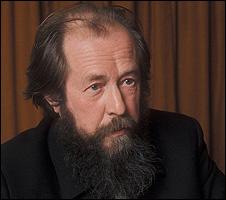
Photo credit: www. billmuehlenberg.com
Solzhenitsyn challenged us prophetically to embrace the cross, rather than western material success. Have we heeded his call? No, individually and as a society we have continued to plunge headlong into a pursuit of happiness through material wealth. Surely the next raise, the next trinket, the next high-tech gadget will bring us happiness.
Often, the church has simply mimicked our society’s worldly pursuit of prosperity. Of course, we have sanctified the language of greed by calling it God’s blessing. But true spiritual wealth is not measured by our bank account, or a nation’s GDP. Spiritual wealth is measured on the scales of eternity by our adherence to God’s truth and God’s will.
The words of Jesus to the church of Laodicea ring true for us today:
You say, ‘I am rich; I have acquired wealth and do not need a thing.’ But you do not realize that you are wretched, pitiful, poor, blind and naked. I counsel you to buy from me gold refined in the fire, so you can become rich; and white clothes to wear, so you can cover your shameful nakedness; and salve to put on your eyes, so you can see.
Those whom I love I rebuke and discipline. So be earnest and repent. (Revelation 3:17-19, NIV)
Frequently, throughout history the true prophets have been rejected. Consider the life and ministry of Jeremiah for example.[iii] The true prophet does not tell us what we want to hear, rather he tells us what we need to hear.
Elijah and Elisha called the people of Israel to repent. At the start of the New Testament era, John the Baptist and Jesus did the same.
Are we ready and willing to heed their call to repent? Will we heed the prophets of our time who challenge us to humble ourselves and return to the Lord?
This is the sixteenth weekly excerpt from the award-winning book
The Elisha Code & the Coming Revival
A soul-gripping read.
 Is a return-to-Jesus revival possible in our time?
This book points the way forward.
For details click here.
 I love the Psalms