Tags
faithfulness, heavens, love, mountains, Righteousness, skies, the LORD
I will praise Him!

On the shore of the Ottawa River — photo by David Kitz

29 Saturday Oct 2016
Posted in Psalms, Saturday's Psalm
Tags
faithfulness, heavens, love, mountains, Righteousness, skies, the LORD
On the shore of the Ottawa River — photo by David Kitz
25 Tuesday Oct 2016
Reading: Psalm 103
(Verses 19-22)
The LORD has established his throne in heaven,
and his kingdom rules over all.
Praise the LORD, you his angels,
you mighty ones who do his bidding,
who obey his word.
Praise the LORD, all his heavenly hosts,
you his servants who do his will.
Praise the LORD, all his works
everywhere in his dominion.
Praise the LORD, my soul (NIV).
Reflection
Have you ever found yourself in a chaotic situation where you immediately ask this question, “Who’s in charge here?” Sometimes I have walked into an unruly classroom where that question is very pertinent. The teacher may be nowhere in sight, or is absorbed with one or two students while bedlam reigns all around. It takes very little to lose control of thirty twelve-year-olds. Trust me on this point: It takes a range of skills to get a class of youngsters motivated and moving in the same direction.

Petrie Island, glory — photo by David Kitz
Today’s reading from the psalms gives us an answer to that age old question, “Who’s in charge here?” The LORD has established his throne in heaven, and his kingdom rules over all.
So there is your answer. The LORD is in charge here. He’s in charge of everything—the orderly and the controlled, and the seemingly random. Above this world and its mixture of order, routine, bedlam and chaos, the LORD sits enthroned as ruler over all.
Often the LORD is blamed for the bedlam and the chaos, but is that a fair assessment? Yes, He could control everything—every detail, but then there would be no humans on this planet—no free moral agents. To be human is to have the ability to choose both good and evil. If God sovereignly decided that we could only do good, then we would be robotic humanoids—not true humans at all.
Can there be true love, if love is enforced from on high rather than freely chosen? Can there be genuine worship, if this divine privilege is induced by the Creator rather than willingly offered by the created? No, the LORD calls for our worship, but He forces it on no one. The God I serve is not a rapist; He is a true lover.
So I will freely join with all creation to praise Him. I will join the angels, the heavenly hosts and all his works everywhere in his dominion. I will join in praising my Creator and my Redeemer, who was born in a stable and raised high to suffer on a cross, but now His throne is established in heaven and His kingdom rules over all. He is the One I will praise. How about you?
Response: Father God, I appreciate the free will that you have given me. I choose to worship you. You are the lover of my soul. Thank you for all you have done. I owe my life to Jesus. Amen.
Your Turn: Do we choose God or does He choose us, or are both answers correct?
24 Monday Oct 2016
Tags
astronomy, compassion, dust, eternal, galaxies, Landestreu, love, Milky Way, stars, stars in the universe, the LORD
Reading: Psalm 103 (Verses 13-18)
As a father has compassion on his children,
so the LORD has compassion on those who fear him;
for he knows how we are formed,
he remembers that we are dust.
The life of mortals is like grass,
they flourish like a flower of the field;
the wind blows over it and it is gone,
and its place remembers it no more.
But from everlasting to everlasting
the LORD’s love is with those who fear him, and his righteousness with their children’s children—
with those who keep his covenant
and remember to obey his precepts (NIV).
Reflection
Last week I heard a news report that stated that new research has led astronomers to realize that there are ten times more stars in the universe than they previously estimated. A minor miscalculation you may assume. Not really!

Beyond the moon, Landestreu Church, SK — photo courtesy of Donald Adam.
Our own Milky Way galaxy contains about 400 billion stars of varying sizes. The most recent astronomical estimate counts 170 billion galaxies in the observable universe. To do a rough calculation of the total number of stars in the universe, you multiply 400 billion stars X 170 billion galaxies and get a number with twenty-five zeroes tacked on the end. Now that’s astronomical!
So how does that ginormous number connect with today’s reading from Psalm 103? It tells us the LORD’s concern and care for us are nothing short of astounding. The God who created all that vast array of stars cares even for you and me. As a father has compassion on his children, so the LORD has compassion on those who fear him; for he knows how we are formed, he remembers that we are dust.
Dust… We are nothing more than dust. From dust we were formed and to dust we will return. (See Genesis 3:19.) Yet despite our humble origin and our body’s grave fate, we have a God who has the compassion of a father for his children. Furthermore, this care and compassion is not fleeting; it’s eternal. Our time on earth may be transitory, but God’s love for us persists. But from everlasting to everlasting the LORD’s love is with those who fear him, and his righteousness with their children’s children—with those who keep his covenant and remember to obey his precepts.
Why would a God of such infinite capacity commit Himself to a creature of such miniscule significance? The LORD is mind-boggling; God is completely mind-boggling! You can see it in the stars. You can count it in the grains of dust—dust that the LORD loves!
Response: Father God, you are matchless. There is none like you. Your compassion is astonishing. Your grandeur is beyond my ability to even imagine. I love you, LORD. I bow in awe. Amen.
Your Turn: How big is your God? How tiny are you before this awesome God?
21 Friday Oct 2016
Tags
Arboretum, compassion, forgiveness, God, love, nature of God, Ottawa ON, patience
Reading: Psalm 103
(Verses 7-12)
He made known his ways to Moses,
his deeds to the people of Israel:
The LORD is compassionate and gracious,
slow to anger, abounding in love.
He will not always accuse,
nor will he harbor his anger forever;
he does not treat us as our sins deserve
or repay us according to our iniquities.
For as high as the heavens are above the earth,
so great is his love for those who fear him;
as far as the east is from the west,
so far has he removed our transgressions from us (NIV).
Reflection
Here is a little secret that will be a secret no longer: Of all the psalms, Psalm 103 is my favorite.
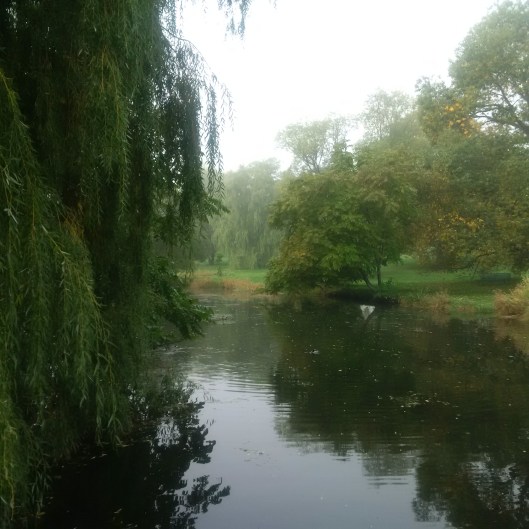
Misty morning at the Arboretum, Ottawa, ON, — photo by David Kitz
Why do I have such a deep love for this psalm? The answer lies in what the psalm tells us about God. The LORD is compassionate and gracious, slow to anger, abounding in love.
That sentence should be etched on our hearts and minds. The character of God is revealed in these traits. I stand in need of a God who has these qualities because by nature I am the polar opposite. In various situations I have lacked compassion. I have reasoned that those who suffer are getting what they deserve. Rather than extent grace, I have a tendency to be judgmental. When things don’t go my way, I can be quick tempered rather than slow to anger. I like to think I am loving, but I’m not sure others would always agree.
The amazing truth is that despite all our shortcomings God still loves you and me. He [the LORD] will not always accuse, nor will he harbor his anger forever; he does not treat us as our sins deserve or repay us according to our iniquities.
Satan is the accuser; God is the merciful forgiver. Sometimes I think in our minds we have reversed those roles. That’s why this psalm acts as such a powerful antidote to wrong thinking. Do you think God cannot forgive you because of some past transgression? Think again. Psalm 103 tells us to view God differently. He is more compassionate than we can imagine, more loving than we can fathom, more patient than we can comprehend.
For as high as the heavens are above the earth, so great is his love for those who fear him; as far as the east is from the west, so far has he removed our transgressions from us.
Infinite—our God’s love and compassion are infinite. Enough said.
Response: Father God, because of your love, mercy and grace I want to serve you. Please accept my feeble attempts at loving you back. Your forgiveness leaves me with a debt of love I cannot pay. Amen.
Your Turn: What is your favorite psalm? Why?
12 Wednesday Oct 2016
Tags
blameless, goal setting, goals, holiness, justice, legalism, love, personal standards, the LORD
Reading: Psalm 101
Of David. A psalm.
(Verses 1-4)
I will sing of your love and justice;
to you, LORD, I will sing praise.
I will be careful to lead a blameless life—
when will you come to me?
I will conduct the affairs of my house
with a blameless heart.
I will not look with approval
on anything that is vile.
I hate what faithless people do;
I will have no part in it.
The perverse of heart shall be far from me;
I will have nothing to do with what is evil (NIV).
Reflection
Psalm 101 is a call to action or commitment. David, the author of this psalm, commits himself to a course of action. In this short opening portion of the psalm, David makes seven ‘I will’ statements. Each commitment is life altering in some way.

Reflection — photo by Donald Adam
The first commitment David makes is to sing of the LORD’s justice and love. He is determined to praise his God with a full, joyous awareness of the LORD’s character. This is the true starting point of any sustained relationship with God. The LORD is both loving and just. If we emphasize aspects of God’s justice too much, we risk becoming legalistic. If we focus only on the love of God, His holiness is ignored resulting in a break down in personal responsibility. Within the Godhead there exists a perfect tension between His justice and His love. As God’s servants, we do well when we recognize and maintain that tension.
Twice David uses the word blameless. I will be careful to lead a blameless life—when will you come to me? I will conduct the affairs of my house with a blameless heart. With these words, David has set for himself a high standard—an impossible standard. Did David succeed in reaching his lofty goal? The biblical record leaves no room for doubt. He failed miserably. In his affair with Bathsheba, King David was guilty of both adultery and murder.
Well, what good is there then in setting lofty goals? Why make any ‘I will’ statements, if I am doomed to fail? Why not freely look on the vile and indulge in it?
Actually, despite David’s stunning failures, there are many sound reasons for calling ourselves to a high standard. To put it bluntly, God expects it of us. He demands holiness from us—always has—always will. Will we succeed? Of course not. That’s why there’s the gift of repentance. That’s why there’s a Savior named Jesus. He’s the blameless one. I need his sinless record applied to my account.
Response: Dear God, I want my will to be conformed to your will. I want to lead a blameless life. By Jesus’ blood, grant me a blameless heart that is determined to love and serve you for all my days. Amen.
Your Turn: Should we set goals for ourselves? How do you measure the progress in your love for God?
03 Monday Oct 2016
Reading: Psalm 97
Verses 8-12
Zion hears and rejoices
and the villages of Judah are glad
because of your judgments, LORD.
For you, LORD, are the Most High over all the earth;
you are exalted far above all gods.
Let those who love the LORD hate evil,
for he guards the lives of his faithful ones
and delivers them from the hand of the wicked.
Light shines on the righteous
and joy on the upright in heart.
Rejoice in the LORD, you who are righteous,
and praise his holy name (NIV).
Reflection
Love and hate are two extremes—two opposites. Almost always we see love as a good thing, something to be encouraged or applauded, while hate is regarded as a universally negative emotion. But is this a correct view of love and hate?

Light shines on the path of life — photo by David Kitz
The addict may love his crack cocaine pipe, but is that a good or wholesome kind of love? Strange as it may seem, the battered wife may love her abusive husband and yet feel locked into that relationship despite its toxic or even deadly consequences. Is that a healthy kind of love? Of course not, but the addict and the abused partner both use the term love when they describe the object of their affection.
Similarly hate—that polar opposite emotion—is universally viewed as negative. Is it wrong to hate injustice, murder or pedophilia? Of course not. Hate is the right emotional response when we see these things taking place. The devastating consequences of sin and criminal wrongdoing are repulsive. Seeing such harmful conduct should prompt us to hate those actions.
In today’s reading from Psalm 97, we see a different perspective on love and hate. Let those who love the LORD hate evil, for he guards the lives of his faithful ones and delivers them from the hand of the wicked.
Are you loving God and hating evil? All too often we see there are those in this world who love evil and hate God. Why do they hate God? Could it be because the LORD expects—no requires—better from them, and they thinking they know better, have gone their own selfish way?
Note that we are commanded to hate evil. We are not commanded to hate evildoers. God in His great mercy may yet redeem the evildoer. It is by God’s grace that we ourselves are not caught up in evil, so wisdom urges us not to be haughty. We do well if we focus on loving the LORD. We can draw encouragement from these words: Light shines on the righteous and joy on the upright in heart.
Response: LORD God, teach me to identify and hate evil when I see it. I want your light to shine on me, so I can walk in the path you have set out for me. Let my love for you grow day by day. Amen.
Your Turn: Are you loving the LORD and hating evil? Do you get caught up in hating the evildoer?
01 Saturday Oct 2016
Posted in Psalms, Saturday's Psalm

Bilberry Creek, Orleans, ON — photo by David Kitz
26 Monday Sep 2016
Reading: Psalm 95
Verses 1-7
Come, let us sing for joy to the LORD;
let us shout aloud to the Rock of our salvation.
Let us come before him with thanksgiving
and extol him with music and song.
For the LORD is the great God,
the great King above all gods.
In his hand are the depths of the earth,
and the mountain peaks belong to him.
The sea is his, for he made it,
and his hands formed the dry land.
Come, let us bow down in worship,
let us kneel before the LORD our Maker;
for he is our God
and we are the people of his pasture,
the flock under his care (NIV).
Reflection
I can’t read this opening portion of Psalm 95 without the folk spiritual “He’s Got the Whole World in His Hands” springing to mind. The psalmist makes this declaration: In his hand are the depths of the earth, and the mountain peaks belong to him. The sea is his, for he made it, and his hands formed the dry land. In other words, He’s got the whole world in His hands.

Sunset across the Ottawa River — photo by David Kitz
There is something deeply reassuring about that thought. The great loving God, the Creator of the universe, has the whole world in His hands. But more specifically, our heavenly Father has you and me in His hands. If we grasp this biblical truth, it has broad personal implications.
Early this morning I met with a weekly gathering of men to pray and study God’s word. One of the co-leaders of the group is going through a great personal tragedy. His young, vibrant wife is dying of pancreatic cancer. Unless the Lord miraculously intervenes, his school-age son and daughter will soon be without a mother. At the close of our meeting we placed our hands on this husband and father and prayed. The LORD has the whole world in his hands including this young family.
Do we understand the LORD’s purposes in all this? No. We would be fools to think we do. We can content ourselves in knowing that these great matters—these matters of life and death are in God’s hands. They are loving hands—hands that in the person of Jesus were scarred and pierced by nails. I’ll be content to be held in those hands.
Knowing this, let’s heed the psalmist’s call. Come, let us bow down in worship, let us kneel before the LORD our Maker; for he is our God and we are the people of his pasture, the flock under his care.
Response: LORD God, you know all things. We were created for your purpose. Help us to live our lives in service to you. We are the flock under your care. Please extend your hand of mercy and blessing. Amen.
Your Turn: Does knowing your life is in God’s hands bring you reassurance?
16 Friday Sep 2016
Reading: Psalm 92
A psalm. A song. For the Sabbath day.
Verses 1-8
It is good to praise the LORD
and make music to your name, O Most High,
proclaiming your love in the morning
and your faithfulness at night,
to the music of the ten-stringed lyre
and the melody of the harp.
For you make me glad by your deeds, LORD;
I sing for joy at what your hands have done.
How great are your works, LORD,
how profound your thoughts!
Senseless people do not know,
fools do not understand,
that though the wicked spring up like grass
and all evildoers flourish,
they will be destroyed forever.
But you, LORD, are forever exalted (NIV).
Reflection
Why is music such a central part of the Christian worship experience? For the answer to that question we need to look no further than the opening lines of Psalm 92. It is good to praise the LORD and make music to your name, O Most High, proclaiming your love in the morning and your faithfulness at night, to the music of the ten-stringed lyre and the melody of the harp.

I sing for joy at what your hands have done — photo by David Kitz
To put it simply, praising the LORD is a good thing. Making music to honor the name of the Most High is a wholesome expression of our love for God. Furthermore, the LORD approves the use of musical instruments. The harp and the lyre are mentioned here, but there is no scriptural reason to limit the use of instruments.
Why do men sing love songs? Because they love the woman of their dreams—the object of their affection. The same holds true when we fall in love with God. The LORD becomes the object of our deepest affection. He is worthy of our praise.
Do you need some reasons to praise God? The psalmist provides us with some sound reasons: For you make me glad by your deeds, LORD; I sing for joy at what your hands have done. How great are your works, LORD, how profound your thoughts!
If the marvels of creation are insufficient to prompt us to praise, then consider for a moment the wonders of redemption. God sent His only begotten Son to suffer and die on our behalf. He purchased our eternal redemption with the shed blood of Jesus. Oh what love! What wondrous love! It makes me want to break out in song.
Response: LORD God, every morning I want to praise you. Thank you for the gift of music. Help me use my voice and every talent you have given me to express my praise to you. Amen.
Your Turn: Do you enjoy praising God? Do you save your praise for Sundays or is it expressed daily?
05 Monday Sep 2016
Tags
authority, faithfulness, God, God's throne, Grey Nuns Park, justice, love, Righteousness, the LORD
Reading: Psalm 89
Verses 14-18
Righteousness and justice are the foundation of your throne;
love and faithfulness go before you.
Blessed are those who have learned to acclaim you,
who walk in the light of your presence, LORD.
They rejoice in your name all day long;
they celebrate your righteousness.
For you are their glory and strength,
and by your favor you exalt our horn.
Indeed, our shield belongs to the LORD,
our king to the Holy One of Israel (NIV).
Reflection
Yesterday afternoon at about 4:30 my wife and I got a call from my son. He found himself in a difficult spot. He and his wife had just bought two swivel chairs. He had wrongly assumed that both would fit into the trunk of his car. Despite his best efforts the second chair would not fit. Could I come, pick up and deliver the second chair to their home?
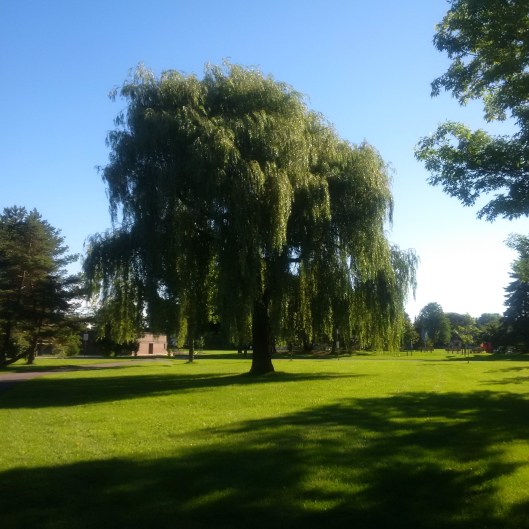
Weeping willow, Grey Nuns Park, Orleans, ON — photo by David Kitz
My wife had a batch of homemade buns rising in the oven, so she was not available. The delivery task fell to me. So off I drove in a torrential downpour through heavy rush-hour traffic to pick up this chair. Did I resent this interruption in my schedule? Did I get all steamed up about the inconvenience? Was I upset that I was a few minutes late for dinner? No. In all seriousness, none of this bothered me because I love my son and his wife. I was glad to help. I even took a minute or two to sit in that comfy chair and appreciate their new purchase.
Today’s reading from Psalm 89 is all about a chair—a special chair. It’s called the throne of God. Unlike the rollers on the bottom of the chair that my son purchased, this chair has a foundation. It’s immovable. The psalmist makes this statement. Righteousness and justice are the foundation of your throne; love and faithfulness go before you.
The throne of God speaks of His authority. God’s authority rests squarely on His righteousness and justice. This has always been so and will be so forever. Righteousness and justice are foundational to all authority. When authorities in this world go astray and engage in unjust and immoral behavior, we find this abhorrent. We question the legitimacy of such authorities. We say they have lost the moral authority to govern.
But God does more than just sit on His throne and govern. He moves out from that throne. Again the psalmist states, “Love and faithfulness go before you.” God is active in this world. Daily the LORD demonstrates His love and faithfulness to His people and also to those who do not call on His name. He causes his sun to rise on the evil and the good, and sends rain on the righteous and the unrighteous (Matthew 5:45). Furthermore, our heavenly Father is eager to do these things because He loves us.
Response: Heavenly Father, you are good and kind to all. I thank you for your love and faithfulness. Today, I want to walk in the light of your presence, LORD, and rejoice in your name all day long. Amen.
Your Turn: Can you testify that on various occasions God’s love and faithfulness have gone before you?
 I love the Psalms