Tags
forever, God's house, hope, love, olive tree, praise, tree, unfailing love
I will praise Him!
-
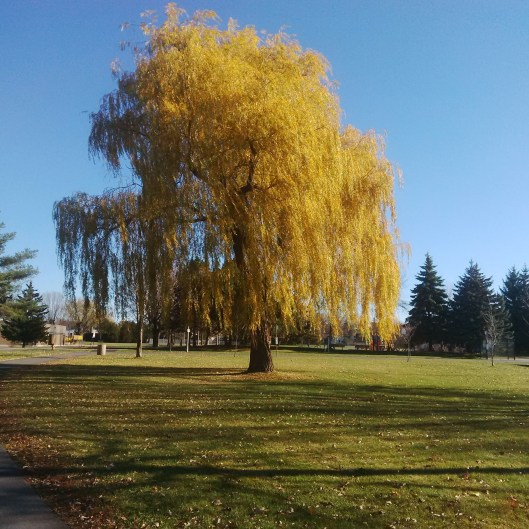
Flourishing in God’s House, Grey Nuns Park — photo by David Kitz

19 Sunday Mar 2017
Posted in Psalms, Sunday's Psalm
Tags
forever, God's house, hope, love, olive tree, praise, tree, unfailing love
Flourishing in God’s House, Grey Nuns Park — photo by David Kitz
13 Monday Mar 2017
Reading: Psalm 136
(Verses 17-26)
to him who struck down great kings,
His love endures forever.
and killed mighty kings—
His love endures forever.
Sihon king of the Amorites
His love endures forever.
and Og king of Bashan—
His love endures forever.
and gave their land as an inheritance,
His love endures forever.
an inheritance to his servant Israel.
His love endures forever.
He remembered us in our low estate
His love endures forever.
and freed us from our enemies.
His love endures forever.
He gives food to every creature.
His love endures forever.
Give thanks to the God of heaven.
His love endures forever (NIV).
Reflection
In recent months I have transitioned from attending an established church to involvement in a new church plant. In many respects the change has been refreshing. This new church has a clear focus on reaching the lost in our city, specifically those who are trapped in addictions. Almost weekly new converts are coming forward to put their trust in Christ. The church itself is a place of transition, as deadly habits are broken, and the healing power of Jesus is applied to long festering inner wounds.

Jesus said, “I am the gate” (John 10:9) — photo by David Kitz
So how does this connect with our reading from Psalm 136? In his description of Israel, the psalmist makes this statement: He remembered us in our low estate… and freed us from our enemies.
We serve a God who rescues us at our lowest point, in our low estate. In our foolish pride, we would never turn to God. But when we hit bottom—when there is no way forward, put up—then we turn to the Lord. You see, Christ has been patiently waiting for us to acknowledge our need. But Jesus doesn’t rescue the proud. He doesn’t save those who see no need for salvation. He only comes to the humble—those who admit they need a lift from the hole they find themselves in.
Sadly, there are many who sit in fine churches that have never discovered their low estate. Actually, they have become experts at hiding it. We all have a secret addiction to sin. Even St. Paul wrote, “For I do not do the good I want to do, but the evil I do not want to do—this I keep on doing” (Romans 7:19). The only one who can turn us around is Jesus, our Savior. See Romans 7:25.
Response: Father God, I admit my need for Jesus, my Savior. His love endures forever. Amen.
Your Turn: Why do we hide our sins rather than confess them? Does pride hold us back?
09 Thursday Mar 2017
Tags
creation, Creator, environment, gardening, God, love, nature, seasons, the LORD, wildlife, winter, worship
Reading: Psalm 136
(Verses 1-9)
Give thanks to the LORD, for he is good.
His love endures forever.
Give thanks to the God of gods.
His love endures forever.
Give thanks to the Lord of lords:
His love endures forever.
to him who alone does great wonders,
His love endures forever.
who by his understanding made the heavens,
His love endures forever.
who spread out the earth upon the waters,
His love endures forever.
who made the great lights—
His love endures forever.
the sun to govern the day,
His love endures forever.
the moon and stars to govern the night;
His love endures forever (NIV).
Reflection
Here are some straightforward facts about me. I love nature. I enjoy all four seasons. I love getting out of the house and hiking through the woods or riding my bicycle along nature trails. I am fascinated by the wildlife I encounter on these excursions. I like planting a backyard garden in spring, and harvesting the produce from it through the summer and fall. I feel knitted to the land and its seasons.
![IMG_20170308_090816[91]](https://davidkitz.blog/wp-content/uploads/2017/03/img_20170308_09081691.jpg?w=529)
A winter walk in God’s creation — photo by David Kitz
Psalm 136 extols the virtues of this awesome limitless God. His love endures forever. For a total of twenty-six verses the psalmist expounds on the goodness of the LORD. In response His people reply, “His love endures forever.”
Today’s reading lays the foundation for our worship. That foundation rests on the wonder of God’s creation. We are to give thanks to God because He alone does great wonders. By his understanding, [He] made the heavens, and spread out the earth upon the waters.
As you go through your day do you find moments where you give God thanks for the wonders of His creation? In an urban, man-made environment we can easily lose touch with nature and our Creator. We lose something precious—something fundamental to our well-being—when that happens.
Response: LORD God, help me to appreciate the wonder of your creation every day. Give me opportunities to see the beauty in it, because it’s a reflection of your magnificent character. Amen.
Your Turn: Do you enjoy nature? Does that appreciation of nature translate into love for God?
26 Sunday Feb 2017
Posted in Psalms, Sunday's Psalm

Prairie sunset near MacNutt, Saskatchewan — photo by David Kitz
24 Friday Feb 2017
Posted in Friday's Focus, Psalms

Skaters on the Rideau Canal beneath the Highway 417 bridge, Ottawa, ON, 02-18-2017, photo by David Kitz
21 Tuesday Feb 2017
Reading: Psalm 133
A song of ascents. Of David.
How good and pleasant it is
when God’s people live together in unity!
It is like precious oil poured on the head,
running down on the beard,
running down on Aaron’s beard,
down on the collar of his robe.
It is as if the dew of Hermon
were falling on Mount Zion.
For there the LORD bestows his blessing,
even life forevermore (NIV).
Reflection
Short, but powerful and evocative—that’s my description of Psalm 133. I might also add, easily read, but difficult to put into practice. Unity among the people of God is that great allusive goal that seems to always disappear around the next bend in the road just as we approach it. But there God has commanded His blessing, if we could only reach that blessed state.

Good and pleasant on the shore of the Ottawa River — photo by David Kitz
The psalmist uses two metaphors to portray this good and pleasant state of affairs. The first may appear to be rather messy and wasteful. Who wants oil running down their beard and onto their clothing? But in the Old Testament, prophets, priests and kings were anointed in just this way. It symbolized the release of divine authority and power into an individual’s life. The Spirit of God was coming upon them for public service. This concept forms an effective bridge to the coming of the Holy Spirit in the Book of Acts. When the waiting disciples were of one accord, the Holy Spirit was poured upon them; the anointing came. See Acts 2.
The second metaphor signifies rejuvenation. The dew of the morning is new each day. It refreshes and revives. When our social interactions are positive and enriching, the outcome is spiritual renewal and a deep sense of belonging. Recent studies have shown that social isolation may be a greater risk factor among the elderly than smoking or heart disease. Lack of meaningful interaction with others also has a negative impact on mental health.
The person who continually self-isolates is committing a slow form of suicide, both physically and spiritually. Satan loves the isolated believer—feasts on the mind of the isolated believer.
Simply put, we need each other. We need to be surrounded by loving caring relationships, at home, at work and in the church. On every level, unity of purpose coupled with unselfish love, refreshes and revives the weary soul. We all want God’s blessing. Well, here’s the key to God’s blessing. The LORD commands a blessing when God’s people live together in unity!
Response: Father God, help me sow words of love and unity. Open my eyes to see where I can bring a word of encouragement and affirmation to those around me. Make me an instrument of peace, love and unity today. Amen.
Your Turn: How can you avoid sowing seeds of discord? What can you do today to build unity?
09 Thursday Feb 2017
Tags
blessing, blessings of children, children, family, fearing God, holidays, holy days, love, olive shoots, parents, pilgrims, unity
Reading: Psalm 128
A song of ascents.
Blessed are all who fear the LORD,
who walk in obedience to him.
You will eat the fruit of your labor;
blessings and prosperity will be yours.
Your wife will be like a fruitful vine
within your house;
your children will be like olive shoots
around your table.
Yes, this will be the blessing
for the man who fears the LORD.
May the LORD bless you from Zion;
may you see the prosperity of Jerusalem
all the days of your life.
May you live to see your children’s children—
peace be on Israel (NIV).
Reflection
I got an unexpected call from my son this morning. “Can we have lunch together today?” he asked.

Enjoying the blessings of family in northern Vermont — photo courtesy of Chris Kennedy.
“Sure,” I responded without hesitation. Who can say no to such a request? We went out to a pizza place for their buffet lunch. We enjoyed a leisurely conversation. There was no urgency to our discussion. He shared a few minor work frustrations, while I did the same. This was simply a father and son enjoying each other’s company, talking a little sports and discussing whatever came to mind.
According to Psalm 128, I was appreciating one of the olive shoots around my table. Now that’s a unique way to view your son or daughter. Children are a blessing, and when adult children enjoy spending time with their parents that’s a double blessing. At a time when many adult children are estranged from their parents or separated by long distances, the opportunity to spend time together at the drop of a hat is a real blessing. As a parent you are enjoying the fruit of your labor. You are reaping the rewards from years spent pouring into the lives of your children.
This is the ninth psalm of the series of psalms known as Songs of Ascent or Psalms of Ascent. These were psalms used by pilgrims as they made the annual trek to Jerusalem for celebrations such as the Feast of Tabernacles or the Passover. In some respects, these ancient holy days correspond to our present day holidays such as Thanksgiving or Christmas. Families today often make long journeys to celebrate together what at their core are religious holidays. Family togetherness is a central feature of such events. We should not be surprised then that this entire psalm highlights the blessings of family unity.
It should be noted that the blessings of family begin with obedience and the fear of the LORD.
Response: Father God, I love my family. I am so blessed to have children who love you, Lord. Watch over them, I pray. Keep their hearts tender before you. Help them to daily hear your voice. Amen.
Your Turn: Are you estranged from family members? Can you build a bridge back to that loved one?
28 Saturday Jan 2017
Posted in Psalms, Saturday's Psalm
15 Thursday Dec 2016
Tags
Bible, faithfulness, fire, Jewish faith, Lamb of God, love, Old Testament, racism, shortest Psalm, tabasco sauce, the LORD
Reading: Psalm 117
Praise the LORD, all you nations;
extol him, all you peoples.
For great is his love toward us,
and the faithfulness of the LORD endures forever.
Praise the LORD (NIV).
Reflection
Psalm 17 is the shortest of all the psalms. It reminds me of tabasco sauce. It’s concentrated; you don’t need much to set your mouth on fire.

Seasons change but God’s faithfulness endures forever — photo by David Kitz
What’s so great—so powerful—about Psalm 117 you ask? Well in 29 short words, it sums up the call and global appeal of the entire Bible.
Let’s consider this opening sentence: Praise the LORD, all you nations; extol him, all you peoples. This call to worship is for all people; it’s universal. The message of the Bible is for all people. It’s not limited to a single nation, race or people group.
This call for universal praise is unusual because it draws all humanity into a common faith in the LORD. The Jewish faith was and is a very exclusive religion. This is the faith of the chosen people—God’s chosen people. They did not choose Him, but rather they were uniquely selected by God to bear His name before the nations of the world. Throughout the Old Testament we have a clear sense that God was dealing with his own special people, and they were to walk separate from the nations. They received God’s laws and were the guardians of His word. They were instructed not to intermarry with other nations, nor be polluted by them and their idol worship. The worshippers of Yahweh were an exclusive group, a unique people, but they were not evangelistic. They kept the message to themselves.
But here in Psalm 117 the constricted, exclusive God of the Old Testament appears to break out of His narrow nationalist cocoon. We see that He is in reality a God for all nations, not just for the descendants of Abraham. Here we catch a glimpse of the big picture—the global perspective. All the nations of the earth are to praise Him. The longstanding intent of the God Israel is that every people group should know his ways and experience His salvation.
But why should all nations praise the LORD? The second verse of this miniature psalm provides the answer. For great is his love toward us, and the faithfulness of the LORD endures forever. Where did the LORD demonstrate His great love for us? We see God’s love most vividly on the cross. There the Son of God poured out His blood to redeem men and women, boys and girls, from every nation under heaven. There love flowed down in a crimson stream. There God fulfilled His Abrahamic promise. “God himself will provide the lamb for the burnt offering, my son” (Genesis 22:8). There the prophecy of John the Baptist was achieved. “Look, the Lamb of God, who takes away the sin of the world!” (John 1:29).
Concentrated within the shortest Psalm is enough truth to set the world on fire.
Response: Father God, I just want to praise you. Thank you for your great love and faithfulness as revealed by Jesus on the cross. I love you, Lord Jesus. Amen.
Your Turn: Why is racism run contrary to anyone who claims to love God?
12 Monday Dec 2016
Tags
answered prayer, Churchridge SK, death, love, love for God, Prayer, testimony, Trinity Lutheran Church
Reading: Psalm 116
(Verses 1-9)
I love the LORD, for he heard my voice;
he heard my cry for mercy.
Because he turned his ear to me,
I will call on him as long as I live.
The cords of death entangled me,
the anguish of the grave came over me;
I was overcome by distress and sorrow.
Then I called on the name of the LORD:
“LORD, save me!”
The LORD is gracious and righteous;
our God is full of compassion.
The LORD protects the unwary;
when I was brought low, he saved me.
Return to your rest, my soul,
for the LORD has been good to you.
For you, LORD, have delivered me from death,
my eyes from tears, my feet from stumbling,
that I may walk before the LORD
in the land of the living (NIV).
Reflection
Recently, on a family level I experienced the power and truth of these words: For you, LORD, have delivered me from death, my eyes from tears, my feet from stumbling, that I may walk before the LORD in the land of the living.
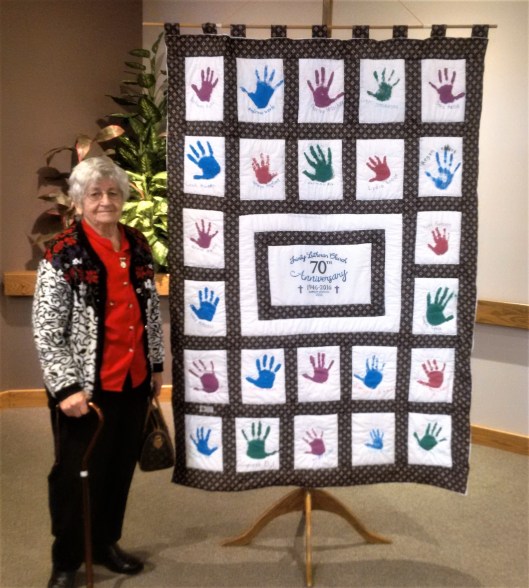
My mother with her commemorative quilt, Trinity Church, Churchbridge, SK — photo by David Kitz
About six weeks ago on a Saturday evening, I got a call from my brother. My alert and active, ninety-three-year-old mother had suffered a stroke. Fortunately, this happened while in hospital, as she was in recovery from having a heart pacemaker implanted. Clot dissolving drugs could be administered. But…
But my mother is a hemophiliac—a bleeder. In her case, the clot dissolvers could easily result in a brain hemorrhage leading to death. The doctors needed us to decide on a course of action. The choice was between taking no action, and having my mother permanently disabled by the stroke, or administering a remedy that could kill her. This is the dilemma we faced.
We decided to have the doctors proceed with the clot dissolving drugs. We resolved to pray and trust God for the best outcome. And God answered by bringing my mother through with no symptoms of a stroke whatsoever. Zero. Two weeks later she was standing in front of her church, proudly displaying a quilt she had made to mark the 70th anniversary of the congregation. Yes, and just to remind us that this recovery was God’s doing, she had a significant bleeding incident earlier that week from her pacemaker incision. You, LORD, have delivered me from death, my eyes from tears, my feet from stumbling.
Response: Father God, I love you LORD, for you heard my voice. Over and over you have answered my prayers. You are a very merciful God. Amen.
Your Turn: Has God helped you? Has He answered your prayers? Take a moment to testify.