PSALM 19:1-6
For the director of music. A psalm of David.
The heavens declare the glory of God;
the skies proclaim the work of his hands.
Day after day they pour forth speech;
night after night they display knowledge.
There is no speech or language where their voice is not heard.
Their voice goes out into all the earth,
their words to the ends of the world.
In the heavens he has pitched a tent for the sun,
which is like a bride groom coming forth from his pavilion,
like a champion rejoicing to run its course.
It rises at one end of the heavens and makes its circuit to the other;
nothing is hidden from its heat. (NIV)
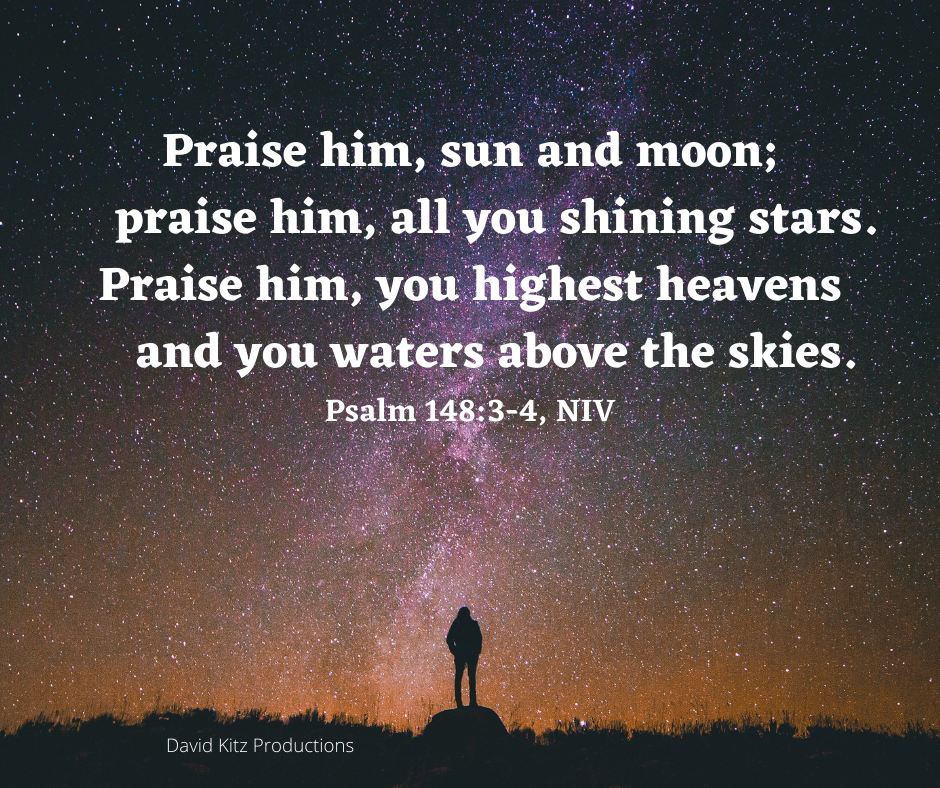
When was the last time you went for a walk beneath a canopy of stars? Now, I’m not talking about catching a fleeting glimpse of a dozen or so stars, obscured by the incessant glare of city streetlights. I’m talking about walking beneath a canopy of stars, visible in their myriads, stretching from horizon to horizon. Now that’s a truly awe-inspiring experience!
That’s where David begins this Psalm. He begins it beneath the stars. He begins it beneath a sky so big it reduces any who behold it to a mere speck of insignificance—a speck below the glorious vastness above. Can you see him standing there—the youthful shepherd, on the Judean hillside, gazing into the face of eternity?
And eternity is talking. The sky is talking to him.
What is it saying? Can you hear its words?
David can. He hears it pouring forth speech. And it’s not just the night sky that’s talking to him. The heavens are speaking continually, day and night. This is an endless conversation heard around the world.
You see the sky speaks in a language understood by all. Who has not stopped and stood in wonder at the sight of a dazzling sunset, marvelled at the shafts of light beaming down from behind a thunder head, been amazed by the appearance of a rainbow, or perhaps you have seen the aurora whirl and dance across the northern sky?
These experiences are universal. They are available to all, on every continent, in every nation, to every language and people group.
The sky is talking. Are you listening? Do you understand the words?
“I am the Creator. I am the maker of the heavens and the earth. I am the author of beauty, the fount of life, the giver of knowledge, the ageless one. I am food for the hungry, water of life for the thirsty, wisdom for the seeking soul. I am bigger than your problems, more vast than the oceans, deeper than the abyss, higher than the sky.
I am eternal.
I am here.
I am.”
I am is speaking.
Is he speaking to you?
Theologians call these words spoken from the sky, the testimony of nature. It is considered by many to be one of the primary or foremost arguments for the existence of God. Now in a court of law it is essential that any witness who is called to the stand speak audibly, so their testimony can be heard by all.
In this Psalm we hear David’s implied question to us, “Have you heard the sky speaking? Do you hear the testimony—the words heaven is proclaiming to your heart?”
We are all summoned to this cosmic courtroom. All of the humanity is there. We may all listen to the testimony of this witness. Everyone under the sun can hear these words. They are as loud as the blaring brilliance of the sun at high noon, or as soft as the glow of the most distant star.
Are you listening? Can you hear it now—these words that the sky above declares?
Some nine hundred years after David penned Psalm 19, the apostle Paul wrote these words about humankind:
“What may be known about God is plain to them, because God has made it plain to them. For since the creation of the world God’s invisible qualities—his eternal power and divine nature—have been clearly seen, being understood from what has been made, so that men are without excuse” (Romans 1:19-20).
In effect, Paul is saying the sky has been talking all this time. In fact, the entirety of nature has been declaring the power and character of this awesome Creator God. Have you not heard him in the thundering waterfall, caught a glimpse of his reflection in the azure mountain lake, picked up his whisper beneath the ocean breakers’ roar? Have you not heard nature testifying to the grandeur and majesty of the Creator?

Are you deaf or have you chosen not to hear?
Romans chapter one is in fact a ringing indictment against humankind. Beneath the sky that covers us all, we have been summoned. We have come to the court of the universe. Heaven’s witnesses have spoken, and they are a multitude beyond number. They have addressed us. And we have stopped our ears. We have refused to listen.
Surely, God’s judgment on us will follow.
But here in Psalm 19, we see a man with a different heart—a man whose heart is tuned to God—a man who hears the heavens speaking. This is in fact David’s distinguishing characteristic. He is a man after God’s own heart.
In 1 Samuel 13:14, we see that David was chosen to be king over Israel because of this singular trait. Saul was rejected as king because of his refusal to hear and obey the voice of God. In this one sentence of scripture, spoken by Samuel the prophet, we hear the LORD’s indictment against Saul, and we also hear the LORD’s reason for choosing David to replace him.
“But now your kingdom will not endure; the LORD has sought out a man after his own heart and appointed him leader of his people, because you have not kept the LORD’s command” (1 Samuel 13:14).
Where did David develop that heart that seeks after God? Could it be that it all began on a starry night as he stood alone on that Judean hillside—a mere speck below the glorious vastness above?
If we cannot hear God in the silence, will we be able to hear him at all? Unless we cultivate a listening heart, how can we hope to hear him in the din of life, amid the hectic charge?
I began this chapter with a question, “When was the last time you went for a walk beneath a canopy of stars?”
I must confess that for me it’s been years. You see, I am a city dweller, and though I often go for nighttime walks through the park by my home, even on the clearest night only a few of the brightest stars are visible.
We have blocked them out. We have made our own lights. Now if we choose to walk at night, we walk by our own light. That age old communion between humanity and the night sky has been broken. And we are the poorer for it.

Edison’s fine invention has robbed me of this opportunity to gaze into the face of eternity.
In 2006 the world’s population reached a significant milestone. More than 50 per cent of the earth’s people now live in an urban environment. The inhabitants of this increasingly urbanized planet are becoming ever more disconnected from the nightly conversation of the heavens—this conversation of which David wrote so many centuries ago. In fact a kind of cosmic reversal has taken place. Now the darkened planet beams light up into the night sky. Have you seen the satellite photos of North America at night? They show a constellation of cities twinkling along the eastern and western seaboard. Vast agglomerations of light are camped along the Great Lakes. We have developed our own Milky Way.
Astronomers lament this light pollution. They must move their star gazing equipment to ever more remote locations.
But what about the common man or woman, the girl or boy who grows up without engaging in this heavenly conversation—a conversation that was so common, so universal a century ago? They have lost an opportunity to marvel, to stand in awe beneath the transcendent One. And this is no minor loss.
What have we engaged in instead? What are we caught up in? Humanity is caught up in a fascination with gadgetry. Techno-wizardry enthrals us. Computers beckon for our time. Radios blare. Televisions drone on. The advertisers flash their images upon our naked brain. And we sit transfixed; entertained, but rarely enlightened; occupied, but rarely enthralled; impressed only with ourselves, but seldom challenged.
This is a world turned in on itself, self-absorbed, playing with its own toys. Its back is turned away from God. The heavens flash their message. The skies call out but no one is listening.
Have we forgotten how to stand in awe?
How can we hear God if we have drowned out the stars and the message that they bring? If the astronomers are in lamentation, then the theologians, the God-seekers on this earth should be on their knees in sackcloth and ashes.
We have silenced the myriads. Within our urban environments, their message has been blocked, drowned out by the light our own creation. Their testimony to the majesty of God has been nullified. Three billion people can no longer hear this witness on a regular nightly basis.
Is it any wonder that faith in the all wise creator God is in decline? And nowhere is this decline more evident than in urban centers.

Extol Him — photo by David Kitz
In cities even the view of the daytime sky is obstructed. Broad open vistas are blocked by buildings. All too often daylight working hours are spent in windowless buildings. Increasingly smog hinders our view. The testimony of the sky is impeded.
Nevertheless, David’s words in this Psalm haunt us. The glory of God remains. We may have sullied the skies, but the skies remain. Our view of the sun maybe clouded by pollutants, but the sun remains. Our view of the stars may be dimmed by our own light, but the stars remain. They sing out His glory.
God remains. The unchanging, unfathomable, ageless Creator remains. His desire to communicate with us remains. His voice has not been silenced. He still beckons us out from our self-obsessed focus to seek after Him, to discover His heart.
On that Judean hillside, among those few sheep, little David found himself. He found himself small beneath the hand of the Almighty God. He discovered his smallness—his insignificance beneath the all surpassing vastness of God.
Have you discovered your smallness?
Unless we catch a glimpse of God, we are doomed to walk this planet like self-inflated titans, puffed up large in our own eyes, but void of all meaning. The world is filled with men who strut about in this fashion. King Saul had become such a man.
So God sought a man after his own heart. In David he found the right heart—a heart that had been touched by the greatness of God—not the greatness of self. If there is a theme throughout the Psalms, surely this is it. The Psalms are all about the greatness of God.
In a few short weeks I hope to return to my childhood home. There on the prairies unobstructed by city lights, I can behold the same stars David saw nearly three thousand years ago. They can begin their magical chant. Again, I can hear the words they proclaimed to me as a young farm boy so many years ago. Perhaps they are the same words David heard. They dare not speak of themselves. They speak only of the source of all light.
Can you hear them?
“I am the Creator. I am the maker of the heavens and the earth. I am the author of beauty, the fount of life, the giver of knowledge, the ageless one. I am food for the hungry, water of life for the thirsty, wisdom for the seeking soul. I am bigger than your problems, more vast than the oceans, deeper than the abyss, higher than the sky.
I am eternal.
I am here.
I am.”
I am is speaking.
Is he speaking to you?

Sunset on the Ottawa River — photo by David Kitz
Bringing Life to the Psalms
- Plan a personal evening beneath the stars outside the city. Make it a time of listening for God’s voice.
- Have you encountered God in nature? Take a few moments to reflect on that experience. How did you respond as you sensed his presence?
- Take a daily nature break. Even five minutes spent in a park or garden can rejuvenate the human spirit and bring us more in tune with God.
- Take time to be alone. Turn off the noise box and listen. Heed the psalmist’s admonition, “Be still and know that I am God” (Psalm 46:10). Without a doubt, the Maker of the universe is still speaking. He longs to speak to you.
- Religious surveys indicate there is a high percentage of atheists and agnostics in the faculties of most secular universities. However, astronomy departments are largely peopled by men and women of who have faith in God. How do you account for this discrepancy?
Today’s post is the first chapter from the book Psalms Alive! Connecting Heaven & Earth by David Kitz. To view or purchase click here.







![BGBG_v4.3_150[1818]](https://davidkitz.blog/wp-content/uploads/2021/07/bgbg_v4.3_1501818.jpg)



 I love the Psalms