• Home
  • About
  • DavidKitz.ca
  • Youtube Videos
  • Books by David
  • Books on Amazon.com

I love the Psalms

~ Connecting daily with God through the Psalms

I love the Psalms

Monthly Archives: March 2018

Excerpt 22 for Lent from The Soldier Who Killed a King

20 Tuesday Mar 2018

Posted by davidkitz in Books by David Kitz, Christ's Passion, Good Friday, Lent

≈ 1 Comment

Tags

Annas, Caiaphas, high priest, Jesus of Nazareth, judge, Pontius Pilate, The Soldier Who Killed a King, trial, trial of Jesus

A journey to the cross is a journey to repentance. It’s a journey to deep personal change. Will you take this journey with me?

Date: Six thirty in the morning, Friday, April 7 A.D.
Jesus trial before Pontius Pilate begins.

The governor peered over the heads of the men directly in front of him. He scanned the assemblage on the street, took in the significance of it all, and then cleared his throat. “Where is the man?”
Jonathon turned quickly. On reaching the first step, he beckoned beyond our pikemen to three of his own temple guards, who then advanced with their prisoner—Jesus of Nazareth.
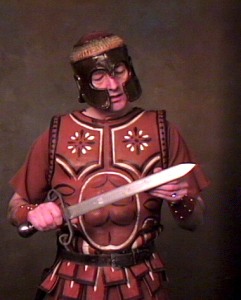
Picture Cent-helmetHe was a mess, almost unrecognizable. His hair was matted. He had been spat upon. The spittle was drying in his beard. There were red welts on his face and neck, a blood- oozing gash above his left eye, a discernable limp to his gait.
It was apparent that during the night they’d had their way with him.
He was escorted to a position directly before me. Intuitively I knew he was my man now, my charge.
A twitch of Pilate’s eyebrow hinted his surprise at the condition of the man.
“Loose him,” he directed with a slight wave of his hand.
Two temple guards hastened to unfasten the leather strap binding Jesus’s arms to his torso. The third man freed the prisoner’s hands. With a second wave of his hand, Pilate dismissed the temple guards, who repositioned themselves on the first step and stood facing the proceedings.
Pilate took a seat on the throne of judgment, which had been brought out for him by two attendants. Raising the scroll in his left hand, he asked, “What charges are you bringing against this man?”
It was clear from this gesture that he was referring to the charges written on the scroll he now clutched in his hand. Undoubtedly he had read these charges himself, and in all likelihood had discussed them
with the assessor standing to his right. But he wanted the high priest to articulate them. “If he were not a criminal, we would not have handed him over to you,” Caiaphas said with a huff.
A rather cheeky response, I thought.
“Take him yourselves and judge him by your own law,” Pilate answered.
Here Annas interjected, “But we have no right to execute anyone.”
A devious response if there ever was one. The temple, in fact, routinely acted as bothbiblical-fiction-award-2017_orig judge and executioner in religious matters and had been granted full authority to do so. Death by stoning was commonplace. I had witnessed Annas himself cast the first stone at some hapless adulteress within the first week of my arrival here ten years ago. No, the temple had the right to execute, and these crafty fellows could surely find grounds to execute this man. They just didn’t want the blood on their hands. They did not want to be blamed for the death of this rabbi. For many he had become the hope of the nation. No, they wanted us to do the job, to act as their executioners. They wanted him judged and executed under Roman law. What Caiaphas said next made this abundantly clear.

“We have found this man”—he aimed a bony finger at Jesus—“subverting our nation. He opposes payment of taxes to Caesar and claims to be Messiah, a king.”
Now here was a capital offense—a capital offense under Roman law.
The Weasel had backed the Badger into a corner, and he was relishing the moment. These charges would need further examination. But Pilate would not proceed in full view of a gloating high priest, urged on by his consorts and a handpicked audience. He retreated.
He abruptly arose from his throne, fixed his eyes on me, and said, “Bring the man.” He motioned with a jerk of his head toward the great doors behind us and then marched off into his residence.
I stepped down to escort Jesus, but he was already in motion. It became clear that the steps were painful for him. I put my hand to his elbow.

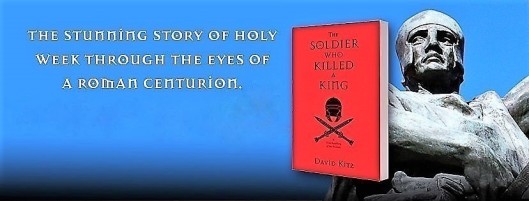
American readers click this link to purchase The Soldier Who Killed a King.

Canadian readers click this link to purchase The Soldier Who Killed a King directly from the author.

When Anxiety was Great

20 Tuesday Mar 2018

Posted by davidkitz in Bible, Devotionals, Psalm 94, Psalms

≈ 1 Comment

Tags

anxiety, cares, corruption, election, joy, king, misery, nation, political, problems, Righteousness, Suffering, the LORD, trouble, truth, unfailing love, wisdom

Reading:                                     Psalm 94

(Verses 16-23)
Who will rise up for me against the wicked?
Who will take a stand for me against evildoers?
Unless the L
ORD had given me help,
I would soon have dwelt in the silence of death.
When I said, “My foot is slipping,”
your unfailing love, L
ORD, supported me.
When anxiety was great within me,
your consolation brought me joy.
Can a corrupt throne be allied with you—
a throne that brings on misery by its decrees?
The wicked band together against the righteous
and condemn the innocent to death.
But the L
ORD has become my fortress,
and my God the rock in whom I take refuge.
He will repay them for their sins
and destroy them for their wickedness;
the L
ORD our God will destroy them (NIV).

Reflection
Here is a question that is well worth asking at election time, or really at any time during the life of a nation: Can a corrupt throne be allied with you—a throne that brings on misery by its decrees?

2018-03-09

Late winter snowfall — photo by David Kitz

Whatever your political persuasion, this is a question that has relevance. Corruption isn’t a problem that is unique to just one party. It transcends the political spectrum. Corruption and poorly designed laws or decrees can bring misery to millions. According to the psalmist, it has happened in the past and as long as we live in a fallen world, it will continue into the future.

If we fix our eyes on the problems of this world, we can soon find ourselves in despair. Like the psalmist, in times of worry, we need to turn to the LORD. When I said, “My foot is slipping,” your unfailing love, LORD, supported me. When anxiety was great within me, your consolation brought me joy.

That’s the good news of the gospel. In times of anxiety we have someone to turn to. His name is Jesus. He was familiar with suffering and adversity. In Psalm 55 we read, “Cast your cares on the LORD and he will sustain you; he will never let the righteous be shaken” (Psalm 55:22). The apostle Peter reiterates the same thought: Cast all your anxiety on him [God] because he cares for you (1 Peter 5:7).

In times of trouble the unfailing love of the LORD will sustain you. In times of loss His consolation will bring you joy. That’s the promise of Psalm 94. It’s a promise that’s worth clinging to in good times and bad, and yes, even in election years.

Response: LORD God, I am so glad that first and foremost I live under your Kingdom rule. You are my King. I find unfailing love and consolation in knowing you. Guide the leaders of our land into paths of righteousness, wisdom and truth. Amen.

Your Turn: Are you facing adversity now? How can I pray for you?

Excerpt 21 for Lent from The Soldier Who Killed a King

19 Monday Mar 2018

Posted by davidkitz in Books by David Kitz, Christ's Passion, Good Friday, Lent

≈ 1 Comment

Tags

arrested, Caiaphas, centurion, high priest, Jerusalem, Jesus of Nazareth, Lent, Longinus, Marcus, Pontius Pilate, repentance, The Soldier Who Killed a King

A journey to the cross is a journey to repentance. It’s a journey to deep personal change. Will you take this journey with me?

Date: Five forty-five in the morning, Friday, April 7 A.D.
In today’s reading, a messenger from Pontius Pilate arrives at the home of Marcus Longinus, the Roman centurion, with the news that Jesus has been arrested.

“Sir, I have just come from the governor. You are to report to the Praetorium immediately. Jesus of Nazareth has been arrested. The high priest has brought him before the governor for judgment.”
“Is that so?” I said in a state of consternation. “Who sent you?”
“The governor himself. He said you were familiar with the Galilean.”
I blew a short puff of air through my nostrils. All of Jerusalem was somewhat familiar with the Galilean.
“So he wants me there immediately?”
“Immediately, sir.” He shifted from one foot to the other and then, as if to justify thisCentur. Sw response, he added, “The high priest and a big delegation, maybe three hundred men, maybe more, arrived at the palace door at first light. They had the prisoner—Jesus—with them.”
“Tell the governor I’m on my way.”
With a quick nod of my head, I dismissed the messenger. Instantly he turned and began his run back to the governor’s residence. I took one step back inside the gate and began barking orders.
“You, you, and you!” I stabbed my index finger in the direction of the most dressed and prepared-looking soldiers. “Strap on your swords and follow me. Now!”
Then, addressing the other soldiers, I announced, “The rest of you, meet me at the Praetorium as soon as you are ready.”
“Claudius”—I nodded in his direction—“you are in charge. I’ll give everyone their assignment for the day when they get there.”
I stepped back through the gate and began covering the ground with long, quick strides. My three recruits had to run to catch up. With each stride a new thought came jogging into my head. Stupid Arius! Why didn’t he tell me the messenger was from Pilate? I would have moved a good deal faster.
Obviously my concerns about the prophet had moved up the chain of command. Flavio must have informed Pilate about my worries and the actions I had taken, hence this unusual move—a direct summons by the governor. I harbored the hope that he would consult directly with me on the matter. Three hundred men! Three hundred men at first light? The Weasel must have had a busy night. It takes a good deal of effort to set your troops in array. Caiaphas must have been hatching this plot for a good long while. 4485 TWITTER
But the Weasel caught his prey! What a sweet bit of treachery that must have been. I wondered how he pulled that off. Now the high priest would move in for the kill. We would see if he could slaughter his own Passover lamb. The people! If the pilgrims, especially the Galilean pilgrims, knew their Messiah had been seized, there could be a mass revolt. That must be why the Weasel had done his dirty work in the dark of the night. And furthermore, he had played out this drama at the zenith of the festival, while minds and hearts were on faith, home, and family. Here was a cunning scheme worthy of the Fox, played out by the Weasel.
Undoubtedly most of the population would still be unaware of these developments, even as I had been caught off guard. Off guard but not surprised. I could smell this coming.
My conversation with Renaldo at the bathhouse came echoing back. It gave me an eerie feeling knowing I had spoken like some prophetic oracle. It made me wonder from where that insight had really come.
“By Jupiter! I forgot the spikes.” I wheeled around while reaching out my hand to halt the soldier at my side. Addressing him directly, I said, “I forgot them—the spikes. They’re in a pouch hanging on a peg in my bedchamber. My wife, she’ll know where they are. Ask her to get the pouch for you. Then bring it to me at the Praetorium. Oh, and tell the other men to hurry. This is urgent.” I fixed my eyes on him to stress the importance of this last statement and then added, “Now run.”

American readers click this link to purchase The Soldier Who Killed a King.

Canadian readers click this link to purchase The Soldier Who Killed a King directly from the author.
Blessed is the One You Discipline

19 Monday Mar 2018

Posted by davidkitz in Bible, Devotionals, Psalm 94, Psalms

≈ 8 Comments

Tags

character, discipline, dividend, fortunes, Jesus, nations, obedience, self-denial, self-discipline, sinful nature, Suffering, the LORD

Reading:                                      Psalm 94

(Verses 8-15)
Take notice, you senseless ones among the people;
you fools, when will you become wise?
Does he who fashioned the ear not hear?
Does he who formed the eye not see?
Does he who disciplines nations not punish?
Does he who teaches mankind lack knowledge?
 The L
ORD knows all human plans;
he knows that they are futile.
Blessed is the one you discipline, LORD,
the one you teach from your law;
you grant them relief from days of trouble,
till a pit is dug for the wicked.
For the L
ORD will not reject his people;
he will never forsake his inheritance.
Judgment will again be founded on righteousness,
and all the upright in heart will follow it
(NIV).

Reflection
Do I like discipline? Hardly. Do I like self-discipline? Not really. Discipline sounds difficult or unpleasant. Self-discipline and self-denial are twin brothers. I don’t like either of them. They are two tough customers that demand that I change, but I don’t like change. My flesh—my stubborn sinful nature—resists change.

2017-09-02

Splendor and majesty are before Him — photo by David Kitz

On the other hand, do I like the fruits of self-discipline? Absolutely. Self-discipline pays huge dividends. In any field of endeavor, in due time self-discipline will bring rewards. Athletes succeed because of self-discipline. Fortunes are accumulated through self-discipline. But those same fortunes can be frittered away through a lack of discipline. Strength of character does not develop naturally; it develops through adversity and self-discipline.

Discipline comes in two forms, internally or externally. Both are needed if we are to become people of the cross.  Son though he was, he [Jesus] learned obedience from what he suffered and, once made perfect, he became the source of eternal salvation for all who obey him (Hebrews 5:8-9). If Jesus learned obedience through the discipline of suffering, should we not expect to experience the same?

Here in Psalm 94 we learn that the LORD disciplines nations. The following admonition reminds us of the vital role that discipline plays in the life of the believer: “My son, do not make light of the Lord’s discipline, and do not lose heart when he rebukes you, because the Lord disciplines the one he loves, and he chastens everyone he accepts as his son.” Endure hardship as discipline; God is treating you as his children. For what children are not disciplined by their father? If you are not disciplined—and everyone undergoes discipline—then you are not legitimate, not true sons and daughters at all (Hebrews 12:5-8).

Response: LORD God, I confess that I need your discipline. I want to become like your Son, Jesus. Help me to learn from the difficult experiences of life. I want to live my life as your obedient child. Amen.

Your Turn: Do you appreciate God’s discipline? Are you enjoying the fruit of self-discipline?

Great Is His Love Toward Us

18 Sunday Mar 2018

Posted by davidkitz in Bible, Psalm 117, Psalms

≈ 4 Comments

Tags

faithfulness, love, love of God, nations, praise, Saskatchewan, the LORD

I will praise Him!

IMG_1736 D Adam

Saskatchewan sunrise — photo by Donald Adam

Praise the LORD, all you nations;
    extol him, all you peoples.
For great is his love toward us,
    and the faithfulness of the LORD endures forever.

Praise the LORD.

(Psalm 117:1-2, NIV)

A Thank Offering

17 Saturday Mar 2018

Posted by davidkitz in Bible, Psalm 116, Psalms

≈ 1 Comment

Tags

death, Jerusalem, praise, sacrifice, servant, the LORD, the name of the LORD, vows

I will praise Him!

2018-03-09b

Light dawns on a snowy morning — photo by David Kitz

Precious in the sight of the LORD
    is the death of his faithful servants.
Truly I am your servant, LORD;
    I serve you just as my mother did;
    you have freed me from my chains.

I will sacrifice a thank offering to you
    and call on the name of the LORD.
I will fulfill my vows to the LORD
    in the presence of all his people,
in the courts of the house of the LORD—
    in your midst, Jerusalem.

Praise the LORD.

(Psalm 116:15-19, NIV)

Excerpt 20 for Lent from The Soldier Who Killed a King

16 Friday Mar 2018

Posted by davidkitz in Books by David Kitz, Christ's Passion, Friday's Focus, Lent, The Soldier Who Killed a King

≈ 1 Comment

Tags

Caesar Augustus, Caiaphas, Galilee, Herod Antipas, Herod the Great, Herodias, kings, Messiah, Pontius Pilate, power, repentance

A journey to the cross is a journey to repentance. It’s a journey to deep personal change. Will you take this journey with me?

Date: Mid afternoon on Thursday, April 6th, 30 A.D.
In today’s reading, Governor Pontius Pilate gives a brief speech formally welcoming Herod the tetrarch to Jerusalem.

At last the two mounted commanders arrived before Pilate’s chariot. They were motioned to take their position on either side. After a brief confusion of feet, the royal litter managed to turn sideways so the royal couple could face the governor as he stood upon his imperial chariot. The trumpeters sounded the fanfare. When the last note had echoed off the marble wall, Pilate unrolled the parchment handed to him by an attendant. He cleared his throat and began his oration.
Free WW-e FACEBOOK-2 (2)
“It was under the rule of the great and wise Emperor Caesar Augustus that this magnificent temple behind us began to take shape. He recognized the desire of the Jewish people for a central place to worship. It was Herod the great Idumean king who oversaw the construction of this masterpiece of the empire, and today it stands as a symbol of Roman respect for the unity and diversity of all the peoples of the empire. It is only fitting today that I, as the emperor’s representative, welcome the son of this master builder, Herod Antipas, the tetrarch of Galilee and Perea.”
With a wave of his hand, Pilate signaled the sounding of a second trumpet fanfare. As the first note was sounded, he stepped off the chariot and then graciously lent a hand to his wife. Thus accompanied by his mate, he swaggered over to the royal litter to personally greet Herod and Herodias, who both stood to meet them.
Greetings were exchanged, none of which I could discern from a distance. After a brief discussion Claudia joined Herodias in the royal litter. Herod barked out some orders. The litter bearers stood to their feet and headed off in the direction of the governor’s residence. Apparently the ladies would have their own time together.
At a leisurely pace Pilate escorted Herod over to where the priestly delegation waited.Soldier book
It was an unusual sight, these three hostile, inflated men exchanging greetings and meaningless pleasantries. Herod Antipas, Pontius Pilate, and Joseph Caiaphas; the Fox, the Badger, and the Weasel. All three were kings in their own right, within their own jurisdiction. All three craved more power, absolute power, while fiercely holding one another in check.
Pilate turned to me and gave a quick, tight nod. I signaled up to Claudius, and the great Golden Gate, the Messiah Gate, was hoisted, granting entrance to the three competing kings.
Only the fourth king, the people’s king—the donkey king—only he was absent.

American readers click this link to purchase The Soldier Who Killed a King.

Canadian readers click this link to purchase The Soldier Who Killed a King directly from the author.


Rise up, Judge of the Earth

16 Friday Mar 2018

Posted by davidkitz in Bible, Devotionals, Psalm 94, Psalms

≈ 2 Comments

Tags

aid convoys, bombs, emergency aid, evil, God of Jacob, good Samaritans, judge, mercy, murder, peace, pray, prosperity, Syria, Syrian conflict, the LORD, war

Reading:                                      Psalm 94

(Verses 1-7)
The LORD is a God who avenges.
O God who avenges, shine forth.
Rise up, Judge of the earth;
pay back to the proud what they deserve.
How long, L
ORD, will the wicked,
how long will the wicked be jubilant?
They pour out arrogant words;
all the evildoers are full of boasting.
They crush your people, L
ORD;
they oppress your inheritance.
They slay the widow and the foreigner;
they murder the fatherless.
They say, “The L
ORD does not see;
the God of Jacob takes no notice”
(NIV).

Reflection
As I gather my thoughts to write this post there are fresh reports that a ceasefire in the Syrian conflict has come to an end. Aid convoys have been bombed. Recriminations fly back and forth between the warring parties; each blames the other. Meanwhile, war rages on. People starve. Refugees flee. Bombs fall from the sky and children are killed and injured. 

IMG_1733[2743]

Saskatchewan sunrise — photo courtesy of Donald Adam

There is a present-day relevance to Psalm 94. Its words are an ongoing reality in war-torn Syria. How long, LORD, will the wicked, how long will the wicked be jubilant? They pour out arrogant words; all the evildoers are full of boasting. They crush your people, LORD; they oppress your inheritance. They slay the widow and the foreigner; they murder the fatherless. 

The Syrian conflict is now into its seventh year with no end in sight and many people are asking, “How long, LORD?”

There is so much evil in the world. Evil expresses itself most graphically during war. There are those who would like to blame God for war, but that makes no sense. Human pride, greed and cunning lead to war. Human intransigence keeps it going. We can and should pray for God to show mercy and bring peace, but ultimately human hearts must change to bring an end to war.

We are right to pray for an end to murderous regimes. Essentially that is what the psalmist is praying. Is there more we can do? Emergency aid to war-torn regions is always needed. We can open our hearts and our wallets to provide some help. When an entire nation falls into the hands of murderous thieves are there a few good Samaritans who are willing to help?

Sometimes there are no easy answers in this difficult world. Rise up, Judge of the earth!
O God who avenges, shine forth.

Response: LORD God, thank you for the peace and security I enjoy. I don’t want to take my peace and prosperity for granted. Show me how I can be of help in this troubled world. Amen.

Your Turn: Should we be concerned about foreign conflicts or only pay attention to things at home?

Excerpt 19 for Lent from The Soldier Who Killed a King

15 Thursday Mar 2018

Posted by davidkitz in Books by David Kitz, Christ's Passion, Lent, The Soldier Who Killed a King

≈ 1 Comment

Tags

Caiaphas, centurion, Claudia Procula, governor, Herod, Herod the tetrarch, high priest, King Herod, Pontius Pilate, repentance, Savior

A journey to the cross is a journey to repentance. It’s a journey to deep personal change. Will you take this journey with me?

In today’s reading, the rivalry and tension between the Governor Pontius Pilate, and Joseph Caiaphas, the high priest are on full display. The two leaders are waiting for the official arrival of Herod the tetrarch. Date: Mid afternoon on Thursday, April 6th, 30 A.D.

When all were in position, I called for the lowering of the heavy, grated iron gate. From now on, the Passover celebrants would be forced to use an alternate entrance or exit.
In short order the toga-clad governor, Pontius Pilate, arrived on his gold-ornamented chariot. The gate was raised. By the governor’s side stood Claudia Procula lavishly dressed in full-length scarlet. Her bejeweled opulence contrasted sharply with the poverty common to most women of this province. The chariot took a position allowing the ruling couple to look out to the Mount of Olives, in readiness for the approaching king.
The only missing player was Caiaphas. In due time his delegation arrived, and the enormous gate was hauled up once more on creaking chains, only to be lowered again when the priestly party had exited.
4485 TWITTER
Pilate had been gazing down the road stretched out before him when Caiaphas arrived, and it was only the coarse rattle coming from the gate chains behind him that alerted him to the approach of the high priest and his delegation. He turned, stepped down from the chariot, and briskly strode over to the dumbfounded cleric. The expression on Caiaphas’s face said it all. He clearly did not expect to see Pilate here. He had intended this to be a discreet, private tour and consultation.
“You’re expecting someone?” Pilate brusquely inquired.
An uncomfortable pause followed. Caiaphas cast a hasty glance at those accompanying him, adjusted the folds in his robe, cleared his rusty throat, and replied, “Yes, King Herod requested a tour of the great temple.”
“Did he now?” There was a coldness in Pilate’s voice that betrayed the utter contempt he felt toward this Jewish leader. “Ahh!” He gestured grandly. “There is no king in these parts. I know of no king.” Then spotting me on horseback nearby, the governor turned and in mock sincerity called out, “Centurion. Is there a king around here?”
“We have no king here but Caesar,” I answered, joining in the sport.
“The centurion says there is no king but Caesar. Do you have some other king I’m unaware of? Perhaps I should meet this king.”
By now the high priest was well beyond flustered. He had stepped into a trap. Surrounded by Roman troops and cut off from the safety of the temple’s hallowed sanctum, he was now being hectored by his chief political rival. It seemed more than he could endure. He began to tremble uncontrollably, whether from fear or anger I could not tell.
“Your Excellency”—he swallowed hard—“I was referring to the . . . te-tetrarch of Galilee.” 
“The te-tetrarch?” Pilate mimicked not only the high priest’s tremulous stammer, but also the rusty-gate scratch of his voice. “Is that so? Well, the tetrarch is no king. And he certainly isn’t your king.” Then with slow, icy deliberation, Pilate said, “There is no king here but Caesar. Did you hear that?”
This was no rhetorical question. “Yes, Your Excellency. I heard.”Biblical fiction winner 2017
“Do you, any of you”—he scanned the delegation—“have any other king?”
The cowering dogs dutifully answered, “No, we have no other king.”
Caiaphas, however, was silent. A fact well noted by the governor.
Then Pilate took a step closer to the trembling priest, pointed a bony finger in his face, and hissed, “Now don’t forget that, you old goat, or your blood will be running down the Kidron! Did you hear that?”
“I . . . I am your servant, Your Excellency,” Caiaphas rasped.
“Ha!” Pilate laughed an icy laugh in a show of disdain for that remark. Then he turned on his heels and marched back to his chariot, where once more he joined his wife.
For a full minute there was stunned silence from the religious delegation, and then suddenly they all began to speak at once in a huddle of hushed tones like schoolboys after a tongue-lashing from the headmaster.
But there was murder in the high priest’s eye. Nothing childish there. From my vantage point I could see that. He didn’t have the means, but he most certainly had the intent.
I am sure that if the gate had been open, the delegation would have returned to the safety of the sanctuary to plot their revenge, but that option was not open to them. They were trapped in this pocket, surrounded by hated foreign troops, subject to the whim and ridicule of their enemy, awaiting the arrival of their pretentious savior king.
Long, awkward moments passed. But they were saved from this interminable purgatory by Herod’s arrival.

American readers click this link to purchase The Soldier Who Killed a King.

Canadian readers click this link to purchase The Soldier Who Killed a King directly from the author.

Majesty!

15 Thursday Mar 2018

Posted by davidkitz in Bible, Devotionals, Psalm 93, Psalms

≈ 1 Comment

Tags

absolutes, Almighty, glory, holiness, majestic, majesty, mighty, moral absolutes, moral law, moral relativism, psalmist, the LORD, unchanging

Reading:                                     Psalm 93

The LORD reigns, he is robed in majesty;
the L
ORD is robed in majesty and armed with strength;
indeed, the world is established, firm and secure.
Your throne was established long ago;
you are from all eternity.
The seas have lifted up, LORD,
the seas have lifted up their voice;
the seas have lifted up their pounding waves.
Mightier than the thunder of the great waters,
mightier than the breakers of the sea—
the L
ORD on high is mighty.
Your statutes, LORD, stand firm;
holiness adorns your house
for endless days
(NIV).

Reflection
What things in this world are majestic? As I write this post, I’m looking out across my front lawn where a squirrel is cavorting about. Are squirrels majestic? Certainly not in my opinion. In the animal kingdom perhaps lions or stallions are majestic in their bearing. Snow-covered mountain peaks may be majestic, but squirrels not so much.

2017-06-10jpg

Sunset photo courtesy of Liz Kranz

 Here in Psalm 93 the psalmist is trying to capture in words the might and majesty of the LORD. Surely, this is an impossible task, but the psalmist makes a valiant effort. His thoughts turn to the vast power of the sea. Mightier than the thunder of the great waters, mightier than the breakers of the sea—the LORD on high is mighty. 

Of course the might of the LORD is incomparable. How can the power of the sea be compared to the power of the One who created the sea? The comparison breaks down; it is not valid. We grasp at straws when we try to capture the majesty and glory of the LORD.

According to the psalmist two things stand firm and secure, the world and the statutes of the LORD. How firm are the laws of the LORD established in your mind? In a world where moral relativism rules the day, absolutes are shunned. What may be deemed right and good today may be judged as unacceptable or reprehensible tomorrow. In our society it seems the opinion of the fickle masses determines what is good. God’s opinion—His statutes matter little.

But in reality—in this thing called eternity—there are things that never change. There are absolutes. On the day we die, ready or not, we will know and experience the absolutes of God. The unchanging God has not thrown out His moral law with yesterday’s garbage. The psalmist declares, “Your statutes, LORD, stand firm; holiness adorns your house for endless days.”

Response: LORD God, I want your holiness to adorn my house and my heart. Help me to conform to your will and your ways, rather than the other way around. You are my Lord. Reign on sovereign LORD. Reign in glorious majesty. Amen.

Your Turn: What does God’s majesty mean to you?

← Older posts
Newer posts →

Psalms 365: Develop a Life of Worship and Prayer

Psalms 365 Volume II

Psalms 365 vol 3
— Psalms 365 Volume III

Psalms

Recent posts

  • Redeeming Shame December 22, 2025
  • He Refreshes My Soul December 21, 2025
  • The Church and the Third Temptation of Christ December 21, 2025
  • May the LORD Grant All Your Requests December 20, 2025
  • A Horn of Salvation December 19, 2025
  • Ready for the King of Glory December 19, 2025
  • My Spirit Rejoices in God My Savior December 18, 2025

Calendar

March 2018
M T W T F S S
 1234
567891011
12131415161718
19202122232425
262728293031  
« Feb   Apr »

Blog Posts

Enter your email address to follow this blog and receive notifications of new posts by email.

Comments

  • davidkitz on The Church and the Third Temptation of Christ
  • My Life in Our Father's World on The Church and the Third Temptation of Christ
  • davidkitz on My Spirit Rejoices in God My Savior

Blog at WordPress.com.

Privacy & Cookies: This site uses cookies. By continuing to use this website, you agree to their use.
To find out more, including how to control cookies, see here: Cookie Policy
  • Subscribe Subscribed
    • I love the Psalms
    • Join 1,377 other subscribers
    • Already have a WordPress.com account? Log in now.
    • I love the Psalms
    • Subscribe Subscribed
    • Sign up
    • Log in
    • Report this content
    • View site in Reader
    • Manage subscriptions
    • Collapse this bar
 

Loading Comments...