I will praise Him!

He brought me out into a spacious place — photo by David Kitz

13 Saturday Oct 2018
Posted in Bible, God's word, Psalm 18, Psalms
He brought me out into a spacious place — photo by David Kitz
12 Friday Oct 2018
Posted in Bible, Devotionals, Psalms
Tags

Quiet beauty, Round Lake, Ontario — photo courtesy of Liz Kranz
Yesterday’s Psalm 150 post signals the end of the Book of Psalms. But is it really the end? Technically, Psalm 150 is the last of the biblical psalms, but God’s people have not stopped writing psalms. Down through the ages, God’s spirit has continued to move on people’s hearts, and in response they have written psalms and hymns and spiritual songs.
Paul, the apostle, gave this advice to the Ephesian church: Do not get drunk on wine, which leads to debauchery. Instead, be filled with the Spirit, speaking to one another with psalms, hymns, and songs from the Spirit. Sing and make music from your heart to the Lord, always giving thanks to God the Father for everything, in the name of our Lord Jesus Christ (Ephesians 5:18-20).
Psalm writing and singing have never ended, just as worship has never ended. It will continue through all eternity.
Those who have faithfully followed this post have journeyed through the entire Book of Psalms—from Psalm 1 to Psalm 150. In total I have written 365 devotional posts on the Psalms; a devotional post for every day of the year. At some point I hope to have these posts published in book form. If you think this is a good idea, please let me know in a comment below.
Is this really the end of my daily posts?
No. On Monday I will start the sequence once more beginning at Psalm 1. I hope you will continue the journey. Each time through we can gain new insights.
Response: LORD God, thank you for your holy word. Help me to read, study and apply it to my daily life. Amen.
Your Turn: Have you enjoyed this journey through the Psalms? Is there some aspect of these posts that you have particularly appreciated?
11 Thursday Oct 2018
Posted in Books by David Kitz, Little Froggy, Psalms
Not very far from here,
there is a little pond,
and in the pond,
there’s a little frog.
Now he’s really a little frog.
As a matter of fact
he has just become a frog.
He used to be a tadpole.
But now that he has legs,
He thinks it’s time to explore
the BIG WORLD.
So off he swam,
swish, swish, swish,
to talk to PAPA Bullfrog.
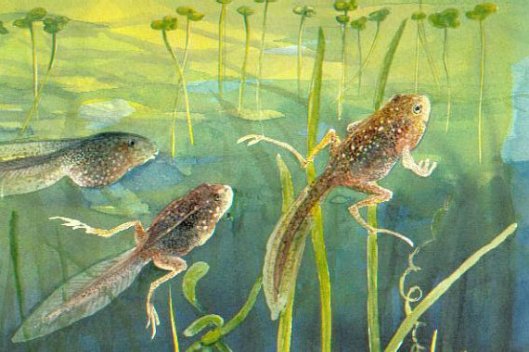
The beginning of life in the pond — artwork by Mircea Gabor
PAPA Bullfrog sat on a big log
in the middle of the pond.
Swish, swish, plop!
Out hopped the little frog
on to the log.
Plop, plop, plop,
He hopped over to PAPA Bullfrog
And said,
To discover the next stage of Little Froggy’s adventure visit and click on the Little Froggy YouTube link found here. https://davidkitz.ca/froggy.php
For direct purchase from the author visit
https://www.davidkitz.ca/bookcart/index.php?route=product/product&path=59&product_id=53
11 Thursday Oct 2018
Posted in Bible, Devotionals, Psalm 150, Psalms
Tags
breath, Creator, Holy Spirit, Jesus, Maker, praise, praise the LORD
Reading: Psalm 150
Praise the LORD.
Praise God in his sanctuary;
praise him in his mighty heavens.
Praise him for his acts of power;
praise him for his surpassing greatness.
Praise him with the sounding of the trumpet,
praise him with the harp and lyre,
praise him with timbrel and dancing,
praise him with the strings and pipe,
praise him with the clash of cymbals,
praise him with resounding cymbals.
Let everything that has breath praise the LORD.
Praise the LORD (NIV).

Let everything that has breath praise the LORD! — photo by David Kitz
Reflection
We have reached the crescendo—the conclusion and the high point of the Book of Psalms. Hallelujah and praise the LORD!
The word praise appears thirteen times in this final psalm. The number thirteen is suggestive of Jesus and his apostles. He is at the core—the very center of God ordained worship.
Eight forms or instruments of praise are listed in this psalm. Eight is the number of new beginnings. Seven suggests completeness, so we see that God rested on the seventh day. But eight signals a new start. In the same way, these eight means or instruments of praise do not represent a complete list. They simply suggest the varied ways in which we can express our praise to the LORD. We have only just begun to discover and explore the many ways in which we can show our gratitude to our Creator.
No one—no living being—is excluded from this call to praise. Let everything that has breath praise the LORD.
This call for all the breathing to praise the LORD is truly fitting. We received our original breath from the LORD. Then the LORD God formed a man from the dust of the ground and breathed into his nostrils the breath of life, and the man became a living being (Genesis 2:7). Now with our breath—our God-given breath—let us praise our Maker.
In the same way after his resurrection Jesus breathed on his disciples. Again Jesus said, “Peace be with you! As the Father has sent me, I am sending you.” And with that he breathed on them and said, “Receive the Holy Spirit” (John 20:21-22).
We need the breath of God in us—the breath of the Holy Spirit in us to live—to truly live in the overcoming power and joy of the psalms. For the Holy Spirit’s presence I will praise the LORD!
Response: LORD God, I praise you. You are my strength and my song. Help me to discover new ways to praise you because you are good. Let my entire life reflect your redemptive presence in me. Amen.
Your Turn: Why are you breathing? Is praising God an integral part of your purpose?
10 Wednesday Oct 2018
Posted in Bible, Devotionals, Psalm 149, Psalms
Reading: Psalm 149
(Verses 6-9)
May the praise of God be in their mouths
and a double-edged sword in their hands,
to inflict vengeance on the nations
and punishment on the peoples,
to bind their kings with fetters,
their nobles with shackles of iron,
to carry out the sentence written against them—
this is the glory of all his faithful people.
Praise the LORD (NIV).
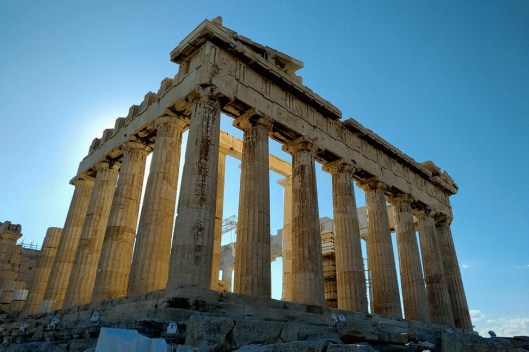
The Parthenon, Athens, Greece — photo by David Kitz
Reflection
In society today there are moves afoot to rewrite history. Old monuments are being torn down or neglected. Places and buildings are being renamed because past victories or policies are now seen as oppressive or unjust. Many of the heroes of the past have lost their luster. In many cases there is sound reasoning that goes into justifying this change. Let’s face it; not every conquest was undertaken with pure motives. Not every government policy in the past was without racial or gender bias.
But are we wise when we judge people from a different era with the moral positions and perspectives of today? Do we carry our own set of biases that color our view of history? Of course we do.
We encounter the same issues when we look back at Old Testament history. It’s difficult for New Testament believers to justify Old Testament vengeance, genocide and slaughter. And yes, there’s plenty of that recorded in our Bibles. Today’s reading from Psalm 149 touches on this very point. The psalmist urges the infliction of vengeance on the nations and punishment on the peoples, to bind their kings with fetters, their nobles with shackles of iron. As followers of a gentle Jesus, who taught us to love our enemies, how are we to interpret and apply this call to action?
First, let’s realize that we are living under a new and better covenant with Jesus as our Lord and Savior. When he was arrested, Jesus told Peter to put away his sword. We do well when we heed that advice. The eager warmongers among us often need to take a chill pill. Jesus showed no tendencies to war, or armed revolt against the oppression of the Roman Empire.
But we do have a battle to fight, and we urgently need a double-edged sword. St. Paul calls it the sword of the Spirit, which is the word of God (Ephesians 6:17b). How effective are you in handling the word of God? How effective are you in battling the spiritual forces and daily temptations that are arrayed against you? With the praises of God in your mouth, and the sword of the Spirit in your hand, are you propelling your way to victory in the daily grind of life? Are the joy and peace of God reigning in your life?
Blessed is the one who perseveres under trial because, having stood the test, that person will receive the crown of life that the Lord has promised to those who love him (James 1:12).
Response: LORD God, I want to grow in my love for your word. Help me to use it wisely and deftly to the advance of your Kingdom. Lord Jesus, help me gain victory over spiritual forces that oppose me. Amen.
Your Turn: Are you developing competence in using the sword of the Spirit, which is the word of God?
09 Tuesday Oct 2018
Posted in Bible, Devotionals, God's word, Psalm 149, Psalms
Reading: Psalm 149
(Verses 1-5)
Praise the LORD.
Sing to the LORD a new song,
his praise in the assembly of his faithful people.
Let Israel rejoice in their Maker;
let the people of Zion be glad in their King.
Let them praise his name with dancing
and make music to him with timbrel and harp.
For the LORD takes delight in his people;
he crowns the humble with victory.
Let his faithful people rejoice in this honor
and sing for joy on their beds (NIV).

Nature’s exuberance for praise — wild roses, Edmonton, Alberta — photo by David Kitz
Reflection
I previously wrote that as we draw to the end of the Book of Psalms, we are slowly building to a crescendo of praise to the LORD. Today’s reading from Psalm 149 expands and amps up the level of praise.
For some praise to the LORD is one dimensional. It involves singing a hymn or worship chorus to the LORD in a place of worship at a designated time. Usually this simply means in church on a Sunday morning. But praise that is birthed by the Spirit of God can be much more than just that. Psalm 149 calls for a wide range of praise. It begins by calling for a new song. Sing to the LORD a new song, his praise in the assembly of his faithful people.
It would seem that the Creator would like to hear something fresh and creative. That’s so much like Him. After all, His mercies are new every morning. See Lamentations 3:22-23. Now don’t get me wrong. There is a place for the tried and true, and the old and familiar. But genuine praise is like fresh homemade bread. It’s best served warm from the oven. Stale worship invigorates no one.
Secondly, our praise for the LORD can take a variety of forms. Let Israel rejoice in their Maker; let the people of Zion be glad in their King. Let them praise his name with dancing and make music to him with timbrel and harp.
Just yesterday I watched a couple do a beautiful dance to a popular worship chorus. The words, the music, and their expressive movements, added heartfelt meaning to their praise. God was glorified in their dance. We were created to move and our posture and movements can reflect an expressive exuberance for God.
Finally, Spirit initiated praise knows no bounds. It refuses to be confined to a church building. It is after all an outward expression of a thankful heart. There is a place for praise, wherever we find ourselves, whether it’s on a park bench, a subway car, or as we stroll down the grocery aisle. Praise the LORD!
Response: LORD God, renew in me a heart of praise. I want to lose my self-consciousness as I praise you. This is all about you. True worship is not about me. I want to praise you with my whole being. Amen.
Your Turn: Is it possible to be God focussed when we are self-focussed or self-conscious?
08 Monday Oct 2018
Posted in Bible, Devotionals, Psalm 148, Psalms
Reading: Psalm 148
(Verses 13-14)
Let them praise the name of the LORD,
for his name alone is exalted;
his splendor is above the earth and the heavens.
And he has raised up for his people a horn,
the praise of all his faithful servants,
of Israel, the people close to his heart.
Praise the LORD (NIV).

Rock strewn stream, Gatineau Park, Quebec — photo by David Kitz
Reflection
Broadly speaking I like modern translations of the Bible over the traditional King James Version, but… But sometimes the old King James just sounds better, or more familiar. Here at the close of Psalm 148 we have a case in point.
The New International Version ends the psalm with these words: Praise the LORD. The King James Version ends the psalm with Praise ye the LORD. But a more literal translation or transliteration of this final phrase is Hallelujah! The footnotes to the New American Standard Bible point out that Hallelu means praise, while JAH is the abbreviated Hebrew name for God, which is often translated Jehovah or more accurately Yahweh.
Whenever you see the phrase praise the LORD, you are actually looking at a translation of the Hebrew word hallelujah!
Hallelujah is entirely absent from the New International Version of the Bible. It has also been scrubbed from most of the other modern translations. To put it bluntly, I miss hallelujah. It has an uplifting ring to it. Hallelujah skips off the tongue like a shooting star. It bursts forth from a thankful heart like fireworks on a summer night.
For the Christian believer Christmas is the great Hallelujah! God has come to the earth and been born as a baby like you and me. This is the beginning of the great redemption story.
The resurrection is the second great Hallelujah! The Son of God was vindicated. His death was not in vain. He conquered death, our greatest foe, and now Jesus reigns on high forever. That calls for a hallelujah! And for good measure, let’s add praise the LORD too!
The one who at his birth was laid in a manger is the King of kings and the Lord of lords. As Handel’s Messiah proclaims, “He shall reign forever and ever. Hallelujah!” Let the hallelujahs resound from the earth to the heavens as we join in the song of the angels—the song of the ages.
Let them praise the name of the LORD, for his name alone is exalted; his splendor is above the earth and the heavens.
Response: LORD God, I praise you for sending Jesus. I praise you for your great plan of redemption. Jesus, I thank you for carrying my sins to Calvary. I rejoice in your resurrection victory. Hallelujah! Amen.
Your Turn: Do you enjoy Handel’s Hallelujah Chorus? What is your favorite expression of praise to God?
Finally, for all my fellow Canadians, I wish you a wonderful Thanksgiving Day. We have so much to be thankful for! Hallelujah!
07 Sunday Oct 2018
Posted in Bible, God's word, Psalm 18, Psalms

Crashing waves, Lake Ontario – photo courtesy of Eric E. Wright
06 Saturday Oct 2018
Posted in Bible, God's word, Psalm 18, Psalms
Tags
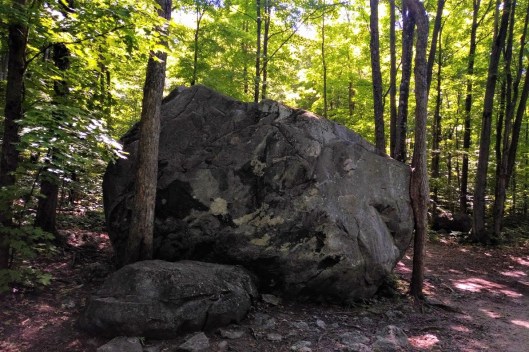
The LORD is my rock — photo by David Kitz
05 Friday Oct 2018
Posted in Psalms
Reading: Psalm 148
(Verses 7-12)
Praise the LORD from the earth,
you great sea creatures and all ocean depths,
lightning and hail, snow and clouds,
stormy winds that do his bidding,
you mountains and all hills,
fruit trees and all cedars,
wild animals and all cattle,
small creatures and flying birds,
kings of the earth and all nations,
you princes and all rulers on earth,
young men and women,
old men and children (NIV).

Sunrise in Grey Nuns Park, Orleans, ON — photo by David Kitz
Reflection
Psalm 148 began with a call for praise for the LORD from the angels, who are heaven’s messengers, from the heavenly hosts and all the heavenly bodies. In today’s reading, the psalmist expands this call for praise to all the creatures of the earth, the elements of nature, wind, cloud and ocean depths, and finally to all humanity.
There is a logical progression in this call for thunderous praise. The call begins with what is distant, the galaxies and the heavenly beings, and then it descends to the earth, and finally it touches humanity. It becomes personal. We are called to praise God. Will you join the swelling chorus?
John, the beloved, gives us a picture of what heaven’s praise party looks like.
Then I looked and heard the voice of many angels, numbering thousands upon thousands, and ten thousand times ten thousand. They encircled the throne and the living creatures and the elders. In a loud voice they were saying:
“Worthy is the Lamb, who was slain,
to receive power and wealth and wisdom and strength
and honor and glory and praise!” (Revelation 5:11-12).
Our Lord taught us to pray, “Our Father in heaven, hallowed be your name, your kingdom come, your will be done, on earth as it is in heaven” (Matthew 6:9b-10).
Surely, it is the will of God that He be praised and worshipped on earth just as He is around His throne in heaven. The purpose of God’s Kingdom—the Kingdom that Jesus came to establish—is to bring heaven to earth. God did not remain distant. In the person of Jesus, He came to dwell among us. He brought and is presently bringing the will of God to the earth through the Holy Spirit. For that Jesus is to be praised. Let all of creation praise Him—praise Him from the earth, because from it we were formed. On the eve of his first coming let the praise for our Lord ascend from you and me.
Response: LORD God, let your Holy Spirit be active among us. Help us to love and serve you and those around us. Help me to bring a little bit of heaven—a little bit of your will to the earth today. Amen.
Your Turn: How do you picture heaven? What does a little bit of heaven on earth look like to you?
 I love the Psalms