
Tags
beavers, Bible, confess, dam, David, forgiveness, forgiveness of sins, God, Jesus, Prayer, Psalms, the LORD, transgressions
Psalm 32:1-5
A Psalm of David
Blessed is he whose transgressions are forgiven,
whose sins are covered.
Blessed is the man whose sin the LORD does not count against him
and in whose spirit is no deceit.
When I kept silent,
my bones wasted away through my groaning all day long.
For day and night your hand was heavy upon me;
My strength was sapped as in the heat of summer. (Selah)
Then I acknowledged my sin to you
and did not cover up my iniquity.
I said, “I will confess my transgressions to the LORD”
And you forgave the guilt of my sin. (Selah)
Beavers are certainly among the most intelligent and industrious of all of God’s creatures. They are ingenious designers and builders of both homes and dams, which completely transform the environment in which they live. Only humans outperform them in this regard. In the wilderness their activity and its effects are a sight well worth seeing.
However, to the rural property owner, the arrival of beavers can turn into a disaster of appalling proportions. The gentle flowing stream that was a source of much pleasure is now blocked. Prized trees are daily being felled by these industrious little devils. Acres of valuable land are being turned into a fetid swamp. As the dam’s reservoir rises, hundreds more trees succumb to drowning. Their stark branches and dead trunks punctuate the sky. A blocked stream can produce an atrocious mess.
A right relationship with God is like a flowing stream. In such a relationship there is a natural giving to God that includes prayer, worship, time spent in His word, and periods of quiet communion. In turn, God by the Holy Spirit pours His peace, love and joy into our lives. And just as trees naturally line a riverbank, there is a verdant fruitfulness that comes to the believer as that refreshing current is allowed to flow.
Sin acts like a boulder hindering the flow of God’s Spirit in our lives. As more and more unrepented sin piles up, a dam is formed. Suddenly prayer stops. Worship and thanksgiving that once cascaded so freely from our lips comes to a halt. The word of God becomes boring, and we find other interests. Times of quiet communion with our Maker are replaced by a search for other things or for constant entertainment.
Now let’s read David’s description of the spiritual swamp his life was turning into because of unconfessed sin.
“When I kept silent, my bones wasted away through my groaning all day long. For day and night your hand was heavy upon me. My strength was sapped as in the heat of summer.”
The flow had stopped. Where was the overflowing cup experience of Psalm twenty-three? At this point David’s cup—his soul—was sitting stagnant. And in the natural realm any liquid left unstirred becomes foul as time goes by.
As I write this, on the veranda below me there’s a small coffee table, and on that table sits a bottle of orange juice. I first noticed this bottle exactly a week ago when I first arrived here in Chicago. After passing this bottle several times on the way up to my room, I became curious and went over for a closer inspection. That’s when I discovered why the bottle was there. It was acting as a paperweight to keep a handwritten note from blowing away. No one would move the bottle in the hope that the unknown person, to whom the note was addressed, would finally show up. In the past few days, due to the summer sun and heat, the orange juice has taken on a rather brown hue.
Judging from David’s comment regarding the strength sapping heat of summer, we might assume that the contents of his soul had taken on a rather brown hue as well. The problem was he kept silent. Sin has an insidious way of silencing our relationship with God. We are not told what sin or transgression produced this damming effect. Yet that is just what it was. A dam caused by sin was now completely blocking up David’s relationship with God.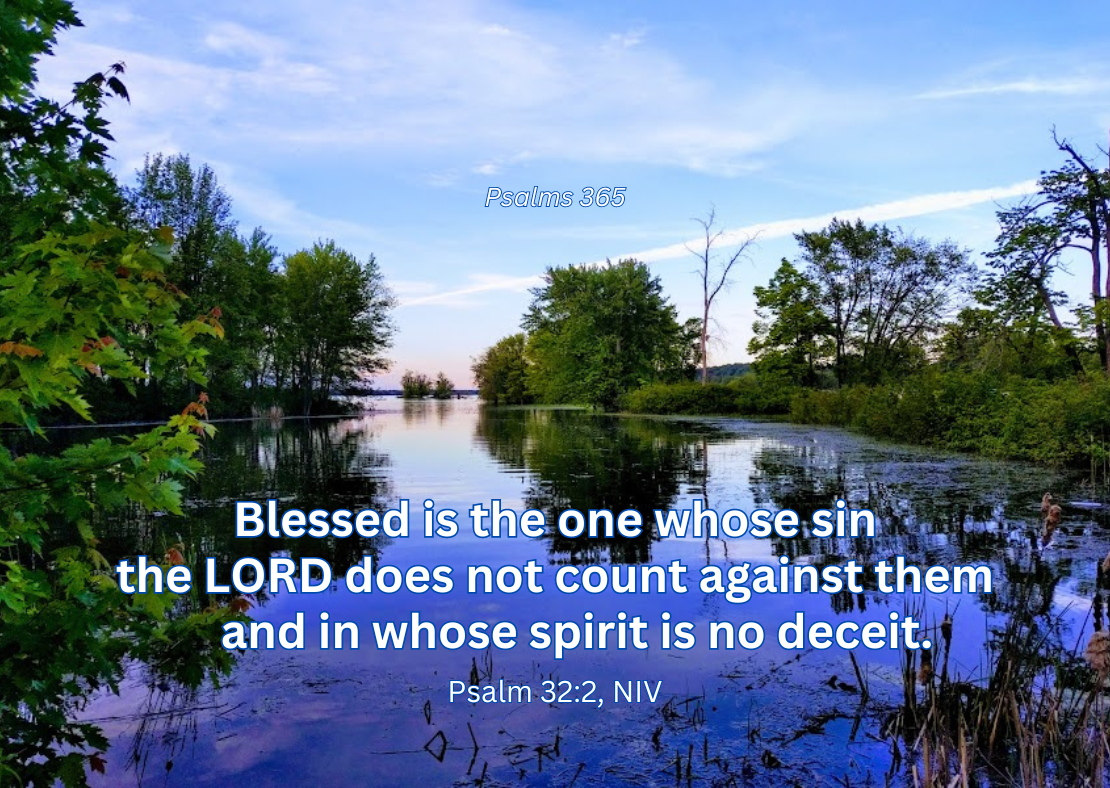
Perhaps it is better that we don’t know the particulars of David’s transgression here. A certain sense of personal spiritual superiority might set in. But sin is sin. Sin in any of its various forms fouls our relationship with God. James reminds us that a single sin can have huge consequences: “For whoever keeps the whole law and yet stumbles at one point is guilty of breaking all of it” (James 2:9).
What can break the sin dam and bring us back into a right relationship with God? David discovered the answer within this Psalm. Now, hear his pivotal words: Then I acknowledged my sin to you and did not cover up my iniquity. I said, “I will confess my transgressions to the LORD.”
Confession breaks the dam. David verbally brought his sin out in the open before God. He acknowledged what God knew all along. You see David’s sin was not hidden from God. It was in plain sight of the LORD from the moment of its conception.
Once again, the words of James are very instructive in this regard, as he states, “each one is tempted when, by his own evil desire, he is dragged away and enticed. Then, after desire has conceived, it gives birth to sin, and sin when it is full-grown, gives birth to death (James 1:14-15).
Sin was already working with deadly effect on David’s soul. By his own admission, his bones were wasting away, and his strength was sapped. Only a dam-busting experience could bring David back into right relationship with God, and restore the flow of praise, prayer and worship that had once been there.
One of the critical allied successes of World War II was the June 16, 1944, RAF raid on the Mohne and Eder dams on the Ruhr River system in Germany. To break the dams a specially designed spinning cylindrical bomb was created by British inventor Barnes Wallis. These huge bombs were dropped by specially modified Lancaster bombers from a height of sixty feet. The bomb would hit and skip across the surface of the water of the dam’s reservoir. They would then slam into the back of the dam, begin to sink, and then explode with massive dam-busting force. A decisive victory was achieved that night as these dam-busting bombs unleashed their power.
Fortunately, God has equipped each of us with dam-busting bombs to destroy the spiritual dams in our life—dams which our own sins have built. Words of confession and contrite acknowledgement are dam-busters. They break strongholds of sin, and in so doing they release the putrid dead waters that have backed up into our lives.
It is well worth noting that these putrid dead waters can be the cause of actual physical disease within our bodies. The human spirit is inextricably linked to the human body, and when our spiritual man is sick due to unrepented sin, physical ailments and sickness often follow. They are the natural by-products of a sin-blocked spirit.
When David states my bones were wasting away, and my strength was sapped as in the heat of summer, we can see these words simply as a nice poetic touch. But the stark reality is, spiritual sickness can produce a plethora of physical symptoms. Doctors have been aware of this link for many years now.
Again, the brother of our Lord has much to say on this point. Let’s look at his thoughts on this topic:
If you are sick, ask the church leaders to come and pray for you. Ask them to put olive oil on you in the name of the Lord. If you have faith when you pray for sick people, they will get well. The Lord will heal them, and if they have sinned, he will forgive them. If you have sinned, you should tell each other what you have done. Then you can pray for one another and be healed (James 5:14-16 CEV).
What stands out most clearly in this passage is the link between physical healing and forgiveness. Confession is the bridge that re-establishes our link to God, and it is God who is the source of both forgiveness and healing. Re-establish the link, and the current of God’s grace can once again flow into your life.
I do dramatizations of the Epistle of James, and it is always amazing to hear accounts of what happens when God’s people put His word into action. In one case a pastor contacted me to report how a young woman in his congregation was miraculously healed of rheumatoid arthritis after watching me doing a dramatization of James. She acted on the word of God. Her relationship with her father was completely broken down. After confessing her faults and seeking restoration, God not only healed that relationship, He also healed her of the arthritis that had been crippling her body for years. The sin dam was broken, and God flooded her body with healing.
Can you hear the joy in David’s voice as he announces to the world, “And you forgave the guilt of my sin?”
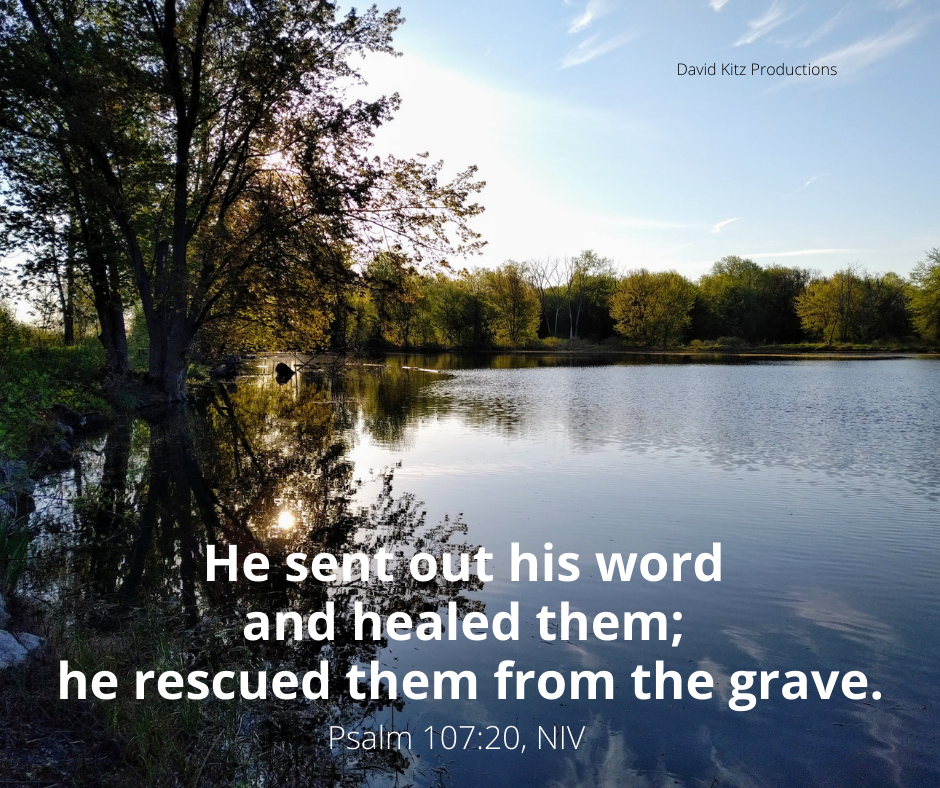 The forgiveness of God is amazing. It breaks the chains of sin’s bondage. There is no liberation like the liberation of full and free forgiveness. It frees the tormented soul from guilt and sets the liberated individual on the path to heaven, the very path that all the saints have trod. Oh, that our nation would be awakened by the joyous cry of liberated sinners. We need a society-changing sinners’ liberation.
David experienced the dam-busting, soul-liberating power of the LORD’s forgiveness. Is it any wonder then that he begins this Psalm by announcing, “Blessed is he whose transgressions are forgiven, whose sins are covered. Blessed is the man whose sin the LORD does not count against him and in whose spirit is no deceit.”
David knew this blessed state of forgiveness. Now for him, the long ledger of sin has been wiped clean. The debt has been paid. Any person who finds himself in such a position is truly blessed.
Yesterday’s gospel reading, at my home church here in Ottawa, was the Beatitudes from Jesus Sermon on the Mount. Each beatitude begins with the phrase, “Blessed are …” I wonder if in his mind, Jesus was using the opening lines of Psalm thirty-two as his springboard for launching into the Beatitudes. The blessed state of the forgiven is certainly a key theme throughout Jesus’ teaching and ministry.
There is a rather curious statement in the opening lines of this Psalm, and it is made in regard to our sins being covered. We are wonderfully blessed when our sins are covered. Yet only a few lines down David laments the fact that he tried to cover up his iniquity. On the one hand he is saying that our sin being covered is a good thing, and on the other hand covering our sins is terrible. David, what do you mean?
The question we need to ask ourselves is, “Who is covering my sin?”
If you are covering your sin, it is an abomination—an affront to God. God can see your sin and any amount of cover-up that you attempt is utter foolishness before the all-seeing, all-knowing LORD of the universe. Before Him the whole of it, is always fully exposed. David’s attempt to hide his iniquity was an act of sheer stupidity. Any of our attempts at sin-hiding, fall under the same category. It is a form of spiritual deceit. We must bring our sins out into the open before God. That’s what David eventually did, and that’s when forgiveness flowed. At that moment, David entered that blessed state, the blessed state of the forgiven.
But what happens to that exposed sin? God covers it. As believers who stand on this side of the cross, we know that Jesus covers it with his blood. Only the all-seeing, all-knowing God can cover our sin so well that even He cannot find it.
God gave us a lesson in sin covering on its very first occurrence in Genesis. Adam and Eve hid and covered their nakedness with fig leaves. Their cover-up was not acceptable to the LORD back then, even as our cover-up is unacceptable to Him now. We read, “The LORD God made garments of skin for Adam and his wife and clothed them” (Genesis 3:21).
The LORD covered them. He shed the blood of an animal to provide a covering of skins for them. Because I need a covering today, two thousand years ago the LORD God shed the blood of His one and only Son, so that I too could be covered. O, what a blessed covering that is!
Because of Jesus I am blessed. I am forgiven! How about you?
Bringing Life to the Psalms
- Words of contrite confession are like dam-busting bombs. Are there unconfessed sins that are clogging and hindering your relationship with God? Make it your priority to confess these sins to God. If your relationship with others has been affected, seek reconciliation with them. God desires that all our relationships be healthy and filled with the free-flowing life of His Spirit.
- Do a James five health check. If you are sick or disabled in anyway, ask the church leaders to anoint you with oil and pray for you. Jesus Christ is the same yesterday and today and forever (Hebrews 13:8). His healing grace is available to those who humbly call on him. And remember he still makes house calls.
- Read the Beatitudes as recorded in Matthew 5:3-12. Consider possible attitudinal links to Psalm 32.
- If forgiveness is a key theme in Jesus’ ministry and teaching, can you think of accounts in the Gospels that reflect this? Stumped? Here are a few quick references to check out: Mark 2:1-12; Luke 23:39-43; Luke 19:1-10; Luke 7:36-50; Luke 18:9-14
Today’s post is the sixth chapter from the book Psalms Alive! Connecting Heaven & Earth by David Kitz. To find out more or purchase click here.




 I love the Psalms