James: the Lynchpin of Our Faith — Chapter 5
The family rift that is evident in John’s Gospel did not appear overnight. Undoubtedly, it had been growing for years. Most likely it worsened after Joseph’s death. His authority as the head of the home would certainly have had a calming effect, but with his passing, the simmering rivalry between the sons of Joseph and the firstborn son of Mary boiled to the surface.
Luke tells us that Jesus was thirty years old when he began his public ministry (Luke 3:23). All four gospel writers agree that it was his relative, John the Baptist, who lit the spark in Jesus that set the world ablaze. Jesus’ baptism by his cousin John was the starting point of the meteoric rise of Jesus’ ministry (Luke 1:36). The latent potential of his divine DNA suddenly came alive. His baptism experience marked a dramatic turning point in his life.
When all the people were being baptized, Jesus was baptized too. And as he was praying, heaven was opened and the Holy Spirit descended on him in bodily form like a dove. And a voice came from heaven: “You are my Son, whom I love; with you I am well pleased.” (Luke 3:21–22)
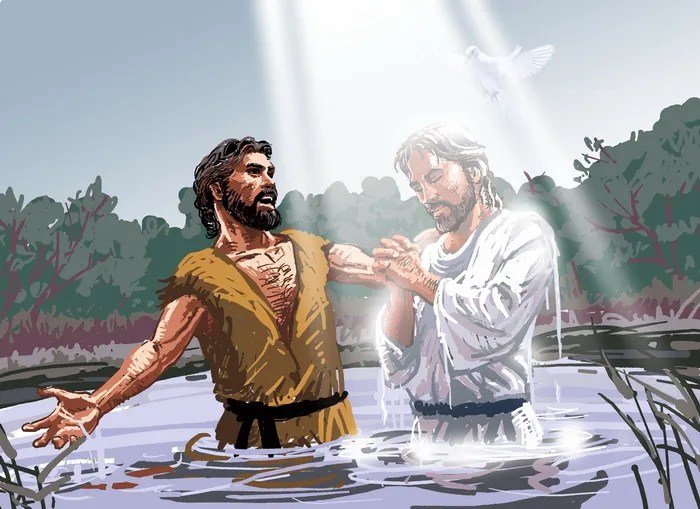
Photo via pastorunlikely.com
The three synoptic gospels, Matthew, Mark and Luke provide essentially the same description of this transformative event. The Triune God is manifest: Father, Son and Holy Spirit. The Father speaks words of affirmation to his Son, and the Holy Spirit descends in bodily form to empower Jesus for the mission that lay before him. The gospel writers leave no doubt that everything that follows in Jesus’ ministry had its starting point in this turning-point experience.
If Jesus the man ever questioned his own divinity, every shred of doubt was removed in that moment. This was heaven-sent confirmation. His Father had spoken—had spoken audibly. From the age of twelve, Jesus knew of his divine origin—his life source—and now he knew his destiny. He was God’s son. Though his brothers rejected him, though the world rejected him, he knew the love of his Father. And in the days that followed, nothing would deflect him from doing his Father’s will.
Called, chosen and approved by his Father, Jesus was now ready to walk out his redemptive mission.
John the Evangelist, the gospel writer, gives us a different perspective on this event. In John’s gospel we see the baptism of Jesus through the eyes of the one who performed it, John the Baptist:
The next day John saw Jesus coming toward him and said, “Look, the Lamb of God, who takes away the sin of the world! This is the one I meant when I said, ‘A man who comes after me has surpassed me because he was before me.’ I myself did not know him, but the reason I came baptizing with water was that he might be revealed to Israel.”
Then John gave this testimony: “I saw the Spirit come down from heaven as a dove and remain on him. And I myself did not know him, but the one who sent me to baptize with water told me, ‘The man on whom you see the Spirit come down and remain is the one who will baptize with the Holy Spirit.’ I have seen and I testify that this is God’s Chosen One.” (John 1:29–34)
John the Baptist’s testimony adds considerably to our understanding of this life-defining event. Chiefly, he identifies for us who Jesus really is. In a moment of divine revelation, he declares, “Look, the Lamb of God, who takes away the sin of the world!”
John the Baptist did not live to witness Jesus’ death on the cross, but in that instant, he caught a glimpse of what lay ahead for the man he identified as the Messiah. He saw the sacrificial nature of Jesus’ mission.
In his own words, John tells us his own mission has now been fulfilled. “The reason I came baptizing with water was that he might be revealed to Israel.”
John the Baptist’s ministry will decrease; the ministry of the Christ, the anointed one, will increase. The torch has been passed. The new covenant has begun.
The Baptist makes no mention of the Father’s affirming voice from heaven, but he provides more detail about the coming of the Holy Spirit. He emphasizes that the Spirit remained on Jesus. From that moment on, the miraculous power that is evident in Jesus’ life can be directly attributed to the Holy Spirit remaining on him.
John’s endorsement of Jesus’ divine calling and ministry stand in sharp contrast to the rejection Jesus would later experience from James and the other members of his immediate family. For reasons we will never fully know, this blood relative recognized in Jesus what his brothers completely missed. Those who are too close sometimes fail to grasp what is patently evident to an outsider. Undoubtedly, John’s affirmation of Jesus carried considerable weight, since he was a public figure of national renown. Yet as we will see, it did not appear to persuade James.
This raises the question of where James stood regarding John the Baptist. There is no indication in scripture that James and the other family members submitted to John’s baptism. The gospel writers and John in particular give us the impression that Jesus acted alone. He came for baptism apart from his family. This was solely his decision, without the support or presence of his family.
This seems rather unusual given that John the Baptist was a close relative, and there was a strong bond between Mary and John’s mother Elizabeth at the time of their pregnancies—a bond so strong that Mary spent three months living in the home of Zechariah and Elizabeth (Luke 1:39–56). Though the gospels are silent on this matter, it is easy to imagine these two families spending time with each other on special occasions such as the Passover. It is not unreasonable to surmise that as boys, John, Jesus, and James were playmates. Did they drift apart over time or was there a sudden rupture in relations?
In his adult life did James disapprove of John the Baptist’s message and tactics? The gospels leave the impression that John’s call for repentance and baptism was broadly accepted by the people of the time, but he raised the ire of one particular group.
But when he [John] saw many of the Pharisees and Sadducees coming to where he was baptizing, he said to them: “You brood of vipers! Who warned you to flee from the coming wrath? Produce fruit in keeping with repentance. And do not think you can say to yourselves, ‘We have Abraham as our father.’ I tell you that out of these stones God can raise up children for Abraham.” (Matthew 3:7–9)
Later in Jesus’ interaction with the Pharisees and religious authorities, it is abundantly clear that they have rejected John’s call for repentance. See Matthew 21:23–27. If James embraced the teachings of the Pharisees, it is probable that he opposed John’s message and his call for baptism. With their strict adherence to the Law and their extreme pride in Jewish heritage, the Pharisees and their teachings might have found a welcome home within the mind of James. His writings have often been described as having a legalistic bent.
If as a young man James fell under the sway of the Pharisees, he would find himself opposing both John the Baptist and Jesus, his own brother. Again, though the scriptures are silent on this topic, it seems quite likely that this was a family divided along religious lines.
The writers of the synoptic Gospels tell us that immediately following his baptism, Jesus entered a forty-day period of fasting:
At once the Spirit sent him out into the wilderness, and he was in the wilderness forty days, being tempted by Satan. He was with the wild animals, and angels attended him. (Mark 1:12–13)
Then, having overcome the temptations of the flesh and of Satan, (see Mathew 4:1-11) Jesus began his public ministry in the power of the Holy Spirit and under the watchful eye of his heavenly Father. The impact across the region is felt almost immediately.
Matthew gives us this summative overview:
Jesus went throughout Galilee, teaching in their synagogues, proclaiming the good news of the kingdom, and healing every disease and sickness among the people. News about him spread all over Syria, and people brought to him all who were ill with various diseases,
those suffering severe pain, the demon-possessed, those having seizures, and the paralyzed; and he healed them. Large crowds from Galilee, the Decapolis, Jerusalem, Judea and the region across the Jordan followed him. (Matthew 4:23–25)
What had come over the carpenter’s son? What did Jesus’ family think of this dramatic turn of events? Within a few months this young man, conceived out of wedlock, had become a much sought after religious teacher, a healer, and a crowd-gathering celebrity. Did they approve?
Mark’s Gospel provides us with a clear answer:
Then Jesus entered a house, and again a crowd gathered, so that he and his disciples were not even able to eat. When his family heard about this, they went to take charge of him, for they said, “He is out of his mind.” (Mark 3:20–21)
The answer is an unambiguous “No!” No, they did not approve. They thought he was insane. We know from John’s Gospel that Jesus’ brothers did not believe in him. Now we discover that they truly thought he had gone mad. Their own words best convey their rendered judgement, “He is out of his mind.”
They considered him to be a raving lunatic incapable of conducting his own affairs. Why else would they go to take charge of him? Furthermore, they were not alone in this opinion. Mark’s account continues:
And the teachers of the law who came down from Jerusalem said, “He is possessed by Beelzebul! By the prince of demons he is driving out demons.”
So Jesus called them over to him and began to speak to them in parables: “How can Satan drive out Satan? If a kingdom is divided against itself, that kingdom cannot stand. If a house is divided against itself, that house cannot stand. And if Satan opposes himself and is divided, he cannot stand; his end has come. In fact, no one can enter a strong man’s house without first tying him up. Then he can plunder the strong man’s house. Truly I tell you, people can be forgiven all their sins and every slander they utter, but whoever blasphemes against the Holy Spirit will never be forgiven; they are guilty of an eternal sin.”
He said this because they were saying, “He has an impure spirit.” (Mark 3:22–30)
In brief, Jesus’ family thought he was insane and the teachers of the law from Jerusalem thought he was demon possessed. The opinion of these teachers of the law may have had a good deal of influence on James. It is worth noting that these would be the same religious leaders from Judea that according to John were trying to kill Jesus. See John 7:1. This can hardly be described as a resounding endorsement of Jesus’ ministry!
But then Jesus has always been a controversial figure throughout history. The great twentieth-century thinker C.S. Lewis, in his defense of orthodox Christian faith, makes this insightful statement regarding Jesus:
I am trying here to prevent anyone saying the really foolish thing that people often say about Him: I’m ready to accept Jesus as a great moral teacher, but I don’t accept his claim to be God. That is the one thing we must not say. A man who was merely a man and said the sort of things Jesus said would not be a great moral teacher. He would either be a lunatic—on the level with the man who says he is a poached egg—or else he would be the Devil of Hell. You must make your choice. Either this man was, and is, the Son of God, or else a madman or something worse. You can shut him up for a fool, you can spit at him and kill him as a demon or you can fall at his feet and call him Lord and God, but let us not come with any patronizing nonsense about his being a great human teacher. He has not left that open to us. He did not intend to. (C.S. Lewis, Mere Christianity (MacMillan, 1952), pp. 55–56.)

His enduring love stretches beyond the horizon — photo by David Kitz
There is no convenient middle ground concerning Jesus. It has always been thus, even for the members of his immediate family. Yet there is one thing abundantly clear from Mark’s account: this is a deeply divided family. Mary may have believed in the messianic mission of her firstborn son, but it is apparent her other sons do not. They believe Jesus is out of his mind, and, bringing their mother with them, they set off to rescue their errant half-brother from his delusion.
In his discussion with the teachers of the law, Jesus refutes the idea that he is demon possessed with the argument that a kingdom or a house divided against itself cannot stand. There is a good deal of irony at play here since his own family is divided, and now he finds himself on the outs with most of them. Do they too believe he is demon possessed? Quite possibly, though we are not explicitly told.
Mark continues his account of these events:
Then Jesus’ mother and brothers arrived. Standing outside, they sent someone in to call him. A crowd was sitting around him, and they told him, “Your mother and brothers are outside looking for you.”
“Who are my mother and my brothers?” he asked.
Then he looked at those seated in a circle around him and said, “Here are my mother and my brothers! Whoever does God’s will is my brother and sister and mother.” (Mark 3:31–35)
Obedient Christian believers—Christ’s followers—draw a great deal of warmth and comfort from this passage. They are identified as brothers, sisters, and mothers to their Lord. What amazing words of love and embrace!
But there is a stinging flip side to this affirmation. The members ofJesus’ own family stand excluded. Both literally and figuratively they are on the outside—on the outside of the home looking in. For them this is a backhanded rebuke of the highest magnitude. They are not deemed to be part of this happy family of followers—Jesus’ spiritual family—but neither do they want to be.
What appears to follow (though Mark provides us with no further details) is a classic standoff. We are not even told if Jesus agrees to go out and meet with his biological family; presumably he did not. If he knew their intentions, it may have been wise to not meet with them. The brothers might try to take him by force.
Were harsh words exchanged? Perhaps.
Did Jesus try to reassure them that he was sound of mind? Maybe. The silence of scripture on this matter allows some room for conjecture.
But ultimately from the three gospel accounts that record this incident, (Matthew 12:46–50, Mark 3:31–35, Luke 8:19–21) we can only reach one conclusion: Jesus continues on with his ministry, and his brothers returned to Nazareth without their wayward older sibling. They may consider him insane, but Jesus is not about to change course and yield to their will. He is doing his Father’s will. He is going about his Father’s business.
The rift between them has widened immeasurably. Can it ever be bridged? In effect Jesus has disowned them, and they in turn have abandoned him to his own will. The gulf between them is enormous.
In the days ahead the implications of this rift will play out in stunning ways.
New from David Kitz
James—the brother of Jesus—who was this man? What evidence do we have that this “brother of our Lord” even existed?
David Kitz digs deep into archeology, family dynamics, church history, and the biblical texts. What emerges from his research is a portrait of a decisive, pivotal leader who embodied the will and character of Jesus Christ.
But how did James—James the unbeliever—transform to become a leader who changed the course of world history? In these pages you will uncover the answer and rediscover for yourself the life-changing power of the gospel.
To view further details or purchase directly from the author click here.






 I love the Psalms