Tags

21 Saturday Mar 2020
21 Saturday Mar 2020
Tags

Wild pin cherries — Photo by David Kitz
20 Friday Mar 2020
20 Friday Mar 2020
Reading: Psalm 8
For the director of music. According to gittith. A psalm of David.
LORD, our Lord,
how majestic is your name in all the earth!
You have set your glory in the heavens.
Through the praise of children and infants
you have established a stronghold against your enemies,
to silence the foe and the avenger.
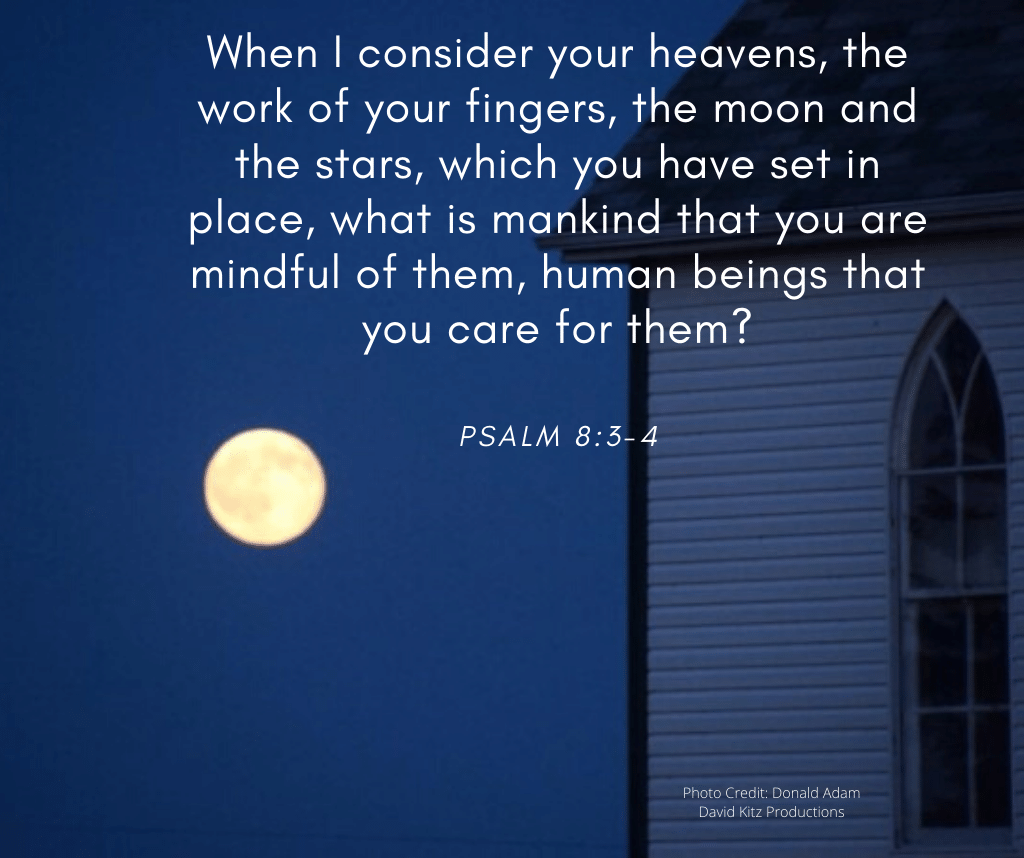
When I consider your heavens, the work of your fingers,
the moon and the stars, which you have set in place,
what is mankind that you are mindful of them,
human beings that you care for them?
You have made them a little lower than the angels
and crowned them with glory and honor.
You made them rulers over the works of your hands;
you put everything under their feet: all flocks and herds,
and the animals of the wild, the birds in the sky,
and the fish in the sea, all that swim the paths of the seas.
LORD, our Lord,
how majestic is your name in all the earth (NIV).*

Beyond the moon, Landestreu Church, SK — photo courtesy of Donald Adam.
Reflection
There’s something exquisitely beautiful about this psalm. Yes, in it we see the glory of the heavens, the sun, moon and stars—the vast array of heavenly bodies. But there’s more to it than that. This psalm is more than a pretty poetic picture of the heavens.
It’s about perspective. In the grand scheme of things David grasps his true size—his insignificance. Beneath a canopy of stars, he has a transcendent moment—a God moment. He realizes the immensity of God. In the material realm you and I are just a transitory flicker across the face of time. That’s why David asks, “When I consider your heavens, the work of your fingers, the moon and the stars, which you have set in place, what is mankind that you are mindful of them, human beings that you care for them?” (v. 3-4)
In the vastness of the universe, what am I but a speck. Why would God even consider me? But He does! That’s the wonder of this psalm, and the wonder of our God. He is mindful of you and your concerns. God has crowned human beings—you and I—with glory and honor (v. 5). What an awesome privilege; what an enormous responsibility! When did that happen you might ask?
Well, it happened at creation. God placed humankind as the rulers of all creation. That’s a huge responsibility, a responsibility we have often failed to fulfill. But God reaffirmed His love and commitment to us at the cross. Jesus considered you so significant that he bled and died for you. Now that’s significance—eternal significance in the face of God’s own Son.
Response: Heavenly Father, Creator of the universe, thank you for considering me. Thank you for being mindful of my daily concerns. I bring them to you, my majestic, all-encompassing Lord. Amen.
Your Turn: Have you had a transcendent moment—a God moment? How did that happen?
This post by award-winning author David Kitz will be published in book format later in 2020 by Elk Lake Publishing under the title 365 Days through the Psalms.
19 Thursday Mar 2020
19 Thursday Mar 2020
Tags
Reading: Psalm 7
Verses 10-17
My shield is God Most High,
who saves the upright in heart.
God is a righteous judge,
a God who displays his wrath every day.
If he does not relent, he will sharpen his sword;
he will bend and string his bow.
He has prepared his deadly weapons;
he makes ready his flaming arrows.
Whoever is pregnant with evil
conceives trouble and gives birth to disillusionment.
Whoever digs a hole and scoops it out
falls into the pit they have made.
The trouble they cause recoils on them;
their violence comes down on their own heads.
I will give thanks to the LORD because of his righteousness;
I will sing the praises of the name of the LORD Most High (NIV).*

Roadrunner Photo by Pixabay on Pexels.com
Reflection
Ah justice, sweet justice! When we take justice into our own hands, it always has a boomerang effect. I am reminded of Wile E. Coyote and the Roadrunner when I read these words from Psalm 7: Whoever digs a hole and scoops it out falls into the pit they have made (v. 15).
In those Saturday cartoons of my youth, poor Wile E. must have dug a hundred pits and he fell into them every time. Every clever scheme backfired catastrophically. The Roadrunner always escaped. To paraphrase the words of this psalm, the trouble Wile E. caused recoiled on him; his violence came down on his own head (v. 16). Even now can you picture the anvil falling on the hapless coyote, as he lies in a crumpled heap at the bottom of the canyon? The cartoonist and the psalmist must have been reading from the same script!
Somehow we often have the mistaken impression that getting even works—that scoring points at the expense of our neighbor elevates us somehow. If snide sarcasm and put-downs elevate us, then it’s the kind of elevation we often see in cartoons. Our clever, cutting remarks run us out off the edge of a cliff, and like the cartoons, there we stand in the middle of thin air—the last one to realize we are heading down fast. That’s justice, sweet justice, Psalm 7 style.
If as this psalm states, God displays his wrath every day (v. 11b), it’s because we reap the reward of our sinful actions. In our selfishness, we harm instead of building up those around us. We try to pull ahead by pulling others down. It’s a strategy that’s doomed to failure. It always backfires. God and the Roadrunner will see to that.
Response: Heavenly Father, today show me how I can build others up instead of tearing them down. I want to be more like you, Lord Jesus. You came to lift others up. In my interactions today, help me do the same. Amen.
Your Turn: Have you encouraged someone lately with a positive word? Did that bring a reward?
This post by award-winning author David Kitz will be published in book format later in 2020 by Elk Lake Publishing under the title 365 Days through the Psalms.
18 Wednesday Mar 2020
18 Wednesday Mar 2020
Tags
Heart, hidden, judge, mind, transparency
Reading: Psalm 7
A shiggaion of David, which he sang to the LORD
concerning Cush, a Benjamite.
(Verses 1-9)
LORD my God, I take refuge in you;
save and deliver me from all who pursue me,
or they will tear me apart like a lion
and rip me to pieces with no one to rescue me.
LORD my God, if I have done this and there is guilt on my hands—
if I have repaid my ally with evil or without cause have robbed my foe—
then let my enemy pursue and overtake me;
let him trample my life to the ground and make me sleep in the dust.
Arise, LORD, in your anger; rise up against the rage of my enemies.
Awake, my God; decree justice.
Let the assembled peoples gather around you,
while you sit enthroned over them on high.
Let the LORD judge the peoples.
Vindicate me, LORD, according to my righteousness,
according to my integrity, O Most High.
Bring to an end the violence of the wicked and make the righteous secure—
you, the righteous God who probes minds and hearts (NIV).*

Photo by FOX on Pexels.com
Reflection
Have you ever been falsely accused? Have you been accused of wrong doing by someone you consider a friend? That can be a deeply hurtful experience. In the context of this psalm, that’s the situation that David found himself in. He stands accused of repaying his ally with evil.
How did David respond? Did he strike down his accuser? Remember that David is the king. It is within his power to act—to unleash his vengeance. Is that his just and righteous response? No, he takes his case before the LORD. In prayer he declares, “Let the LORD judge the peoples (v. 8a).” He invites God to judge him. He presents his case before the righteous God who probes minds and hearts (v. 9b).
That takes some courage; that takes some integrity. That takes a level of faith and transparency that we often see lacking in men of position and power. Are you willing to let God probe your heart and your mind? What might He find hidden away in there? The writer of the Book of Hebrews reminds us about the power of God’s word, “For the word of God is alive and active. Sharper than any double-edged sword, it penetrates even to dividing soul and spirit, joints and marrow; it judges the thoughts and attitudes of the heart” (Hebrews 4:12).
David was a man of God. He submitted his heart and mind to the all-seeing eye of God. He wanted the sin source cut off within him. Right thinking and righteous judgment begin when God and His word gain entry to your heart.
Response: LORD, I open my heart and my mind to your probing. I have nothing to hide, since you see all and know all, even the hidden things of the heart. Help me repent where needed. Amen.
Your Turn: Are you transparent before God? Why do we think we can hide something from God?
This post by award-winning author David Kitz will be published in book format later in 2020 by Elk Lake Publishing under the title 365 Days through the Psalms.
17 Tuesday Mar 2020
17 Tuesday Mar 2020
Reading: Psalm 6
For the director of music. With stringed instruments.
According to sheminith. A psalm of David.
LORD, do not rebuke me in your anger or discipline me in your wrath.
Have mercy on me, LORD, for I am faint;
heal me, LORD, for my bones are in agony.
My soul is in deep anguish.
How long, LORD, how long?
Turn, LORD, and deliver me; save me because of your unfailing love.
Among the dead no one proclaims your name.
Who praises you from the grave?
I am worn out from my groaning.
All night long I flood my bed with weeping and drench my couch with tears.
My eyes grow weak with sorrow; they fail because of all my foes.
Away from me, all you who do evil, for the LORD has heard my weeping.
The LORD has heard my cry for mercy; the LORD accepts my prayer.
All my enemies will be overwhelmed with shame and anguish;
they will turn back and suddenly be put to shame (NIV).*

Foster’s driveway — photo by David Kitz
Reflection
The life of a God-follower isn’t all happy days and sunny skies, as some preachers might have you believe. On the contrary, hard times and grief may frequent our way. Does that mean we are out of the will of God? Has God abandoned us during these times of inner turmoil, struggle and hardship?
Judging by the life and experience of David as expressed through the psalms, the answer is a resounding, “No.” God has not abandoned you.
David met with God during these times of difficulty. He poured out his complaint before the LORD. He pleaded with God; he held nothing back. Take a look at some of the keywords in this psalm: agony, anguish, groaning, weeping, tears, and sorrow. David experienced all these emotions. He didn’t bottle them up. He poured them out before the LORD in prayer.
Many believers suffer from a form of spiritual constipation. They are filled with anger, hurt and bitter disappointment. Life has been hard, but they are afraid to take their anguish before God. They put on a brave face for the world and the church, but inwardly they are dying. They need a massive dose of the Psalms of David—psalms of self-emptying.
Fear not; God can handle your anguish and anger. He won’t smite you dead for being honest about your feelings. Here is some sound advice. Are you hurt or feeling broken? Take it to the Lord in prayer. Then take heart from what David says in the conclusion to this psalm, “The LORD has heard my cry for mercy; the LORD accepts my prayer (v. 9).“
Response: Dear God, I pour out my problems, hurts and struggles before you. Hear my prayer. I know you are a God of mercy. I open myself to you. Amen.
Your Turn: Do some Christians suffer from spiritual constipation? Does heartfelt prayer bring relief? Are you bottling up things that should be released to the Lord?
This post by award-winning author David Kitz will be published in book format later in 2020 by Elk Lake Publishing under the title 365 Days through the Psalms.

 I love the Psalms