Psalm 46:1-5
Of the Sons of Korah
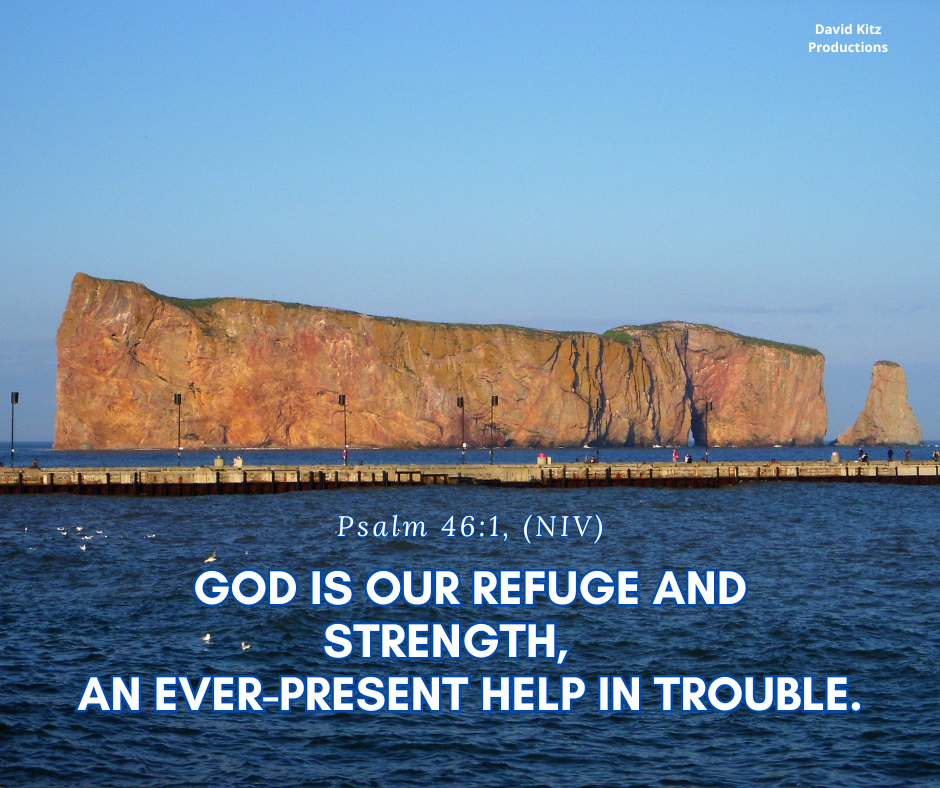
God is our refuge and strength,
an ever-present help in trouble.
Therefore we will not fear,
though the earth give way
and the mountains fall into the heart of the sea,
though its waters roar and foam
and the mountains quake with their surging. (Selah)
There is a river whose streams make glad the city of God,
the holy place where the Most High dwells.
God is within her, she will not fall;
God will help her at break of day.
Where were you on September 11th, 2001? What were you doing when you heard the news of the horrific attacks on the World Trade Center and the Pentagon? I was at school at the time, but I was on a break between classes. The equipment repairman had just arrived to fix some of the power tools in the woodworking shop. He seemed rather agitated as he reported, “A plane has hit the World Trade Center in New York.”
I was unfazed by this news, and I responded, “It’s probably just a small two-seater plane. What’s the big deal?”
“No. It was a big passenger jet,” the repairman said with a shake of his head. This made no sense to me, and with that said, the repairman returned to his truck, where he sat for a minute or two listening to the vehicle’s radio.
He returned in an even more animated state to report, “A second plane has crashed into the other tower.”
At this point I turned on the classroom radio and began listening to the reports myself. The true emotional impact of these events did not hit me however, until about an hour later. On a classroom television that was hastily moved into the school custodian’s office, I watched the towers come crashing to the ground. My whole body was left shaking.
Now many years later, the whole earth is still reverberating from the consequences of those events.
At church gatherings I do live spoken-word dramatizations of the fourteen psalms that form the basis for this book. But I cannot perform Psalm Forty-six without evoking memories of the day we call nine-eleven. Instantly, the pictures of the planes hitting the towers flash into my mind. Once again, the towers disintegrate and come crashing down onto the streets—down onto the people and rescue workers below.
But Psalm Forty-six begins with these words. God is our refuge and strength, an ever-present help in trouble. Therefore, we will not fear, though the earth give way …
The earth gave way on September 11th, 2001. If the earth falls out from under you—if everything you have known to be secure suddenly disintegrates—how can you not succumb to fear? Fear is a person’s natural response to such events. If the earth gives way beneath us, then the only one we have to hold onto is God. If all earthly securities disintegrate, the only remaining refuge is our heavenly Father.
I dare say that too many North American Christians know God only, as a God of sunny days, full bellies and prosperity. I would place myself in that category. For us personally, the earth has not fallen away from beneath us. What will become of us when it does? Are we even remotely prepared for such events? Can we ever be fully prepared? Are you ready for the hundred story plunge to the street below?
Against this backdrop, for all to hear the psalmist declares,
God is our refuge and strength, an ever-present help in trouble. Therefore we will not fear, though the earth give way and the mountains fall into the heart of the sea, though its waters roar and foam and the mountains quake with their surging.
On December 26th, 2004, at 7:58:53 a.m. local time, the mountains beneath the sea off the coast of Indonesian island of Sumatra, began to quake. That quake registered 9.2 magnitude on the Richter scale, making it the second most powerful quake ever recorded. It also was the longest earthquake in duration. This devastating temblor unleashed a tsunami that claimed the lives of an estimated 229,866 people. The ocean surge reached a height of thirty metres in places, and it killed people as distant as 8,000 km from the epicenter.
Since that date, I cannot perform Psalm Forty-six without evoking memories of the Boxing Day Tsunami. Instantly the pictures of walls of water come flooding into my mind. Once again whole villages are scoured off the coast like so much worthless refuse that is swept out to sea. Men, women and children disappear in a muddy seething swill of saltwater debris.
More recently on March 11th, 2011, northern Japan was devastated by an enormous earthquake and tsunami. Video of the ensuing destruction is impossible to forget.
But despite all this—in the midst of all this—as though he had been granted a preview of these very events, the psalmist speaks up, “God is our refuge and strength, an ever-present help in trouble. Therefore we will not fear, though the earth give way and the mountains fall into the heart of the sea, though its waters roar and foam and the mountains quake with their surging.”
From this scene of utter devastation, the psalmist transitions to the polar opposite. He brings us to the Gates of Splendor, and within those gates we find “there is a river whose streams make glad the city of God, the holy place where the Most High dwells. God is within her, she will not fall; God will help her at break of day.
What a contrast! Here is our place of refuge. Here in that holy place, we are face to face with God, the God who is our strength. We are at the source point of gladness. There is an endless supply of the water of life within this sacred city. The Master calls, “Come and drink.”
Are you drinking even now?
How can we face an uncertain future without fear, when the world around us is being torn apart? That question is really the primary focus of this psalm. Here beside the river of God we can find the answer.
Lloyd Ogilvie in his book, Facing the Future without Fear[1], points out that God’s most frequently repeated command in the scriptures is, “Fear not.”
We are not to fear men, or circumstances or the demons of hell. We are not to fret or worry. After all, worry is simply a case of borrowing fear from the Bank of Insecurity in order to make a down payment on a future event, which despite our worries is unlikely to occur. Now, that truly is an unwise investment. Ogilvie points out that in the Bible, there are 366 commands for us not to fear, one for every day of the year, including one for leap-year. In short, God’s word for us daily is, “Fear not!”
Why is our ability to overcome fear so important to God? Could it be that God sees that fear imprisons us? It prevents us from doing God’s will for our lives. Fear locks us into patterns of behaviour that keep us from growing and maturing in our faith. If we are afraid of what others think, we will never share our faith. If we are afraid to risk going without, we will never know the full joy of true giving. If we fear rejection, we will never risk opening our hearts to love. If we play it safe and like a turtle keep our head in our shell, we will never truly experience life—life to the full.
On a stormy night, Peter stepped out of a boat in the middle of a lake and walked on the water. Think of it. What a perfectly insane thing to do! He rejected fear and chose Jesus. Jesus called him out of that boat. He said, “Come” (Matthew 14:29).
You can only do what Peter did, if you know the one who is calling you. Peter knew Jesus. He recognized his call, and he stepped out of natural security (the boat) onto the supernatural security of Christ’s call. He walked by faith, a faith that transcends what is seen and reaches into the heavenly realm, “the holy place where the Most High dwells.“
Psalm Forty-six calls us to life on that higher plane. We can overcome fear, if we have tasted the waters of those streams that make glad the city of God. This is the same living water that Jesus offered to the woman at the well. In the midst of the storms of life, the psalmist invites us to come to that higher plane. He calls us aside. In times of trouble, he invites us to embrace our citizenship in the city of God.

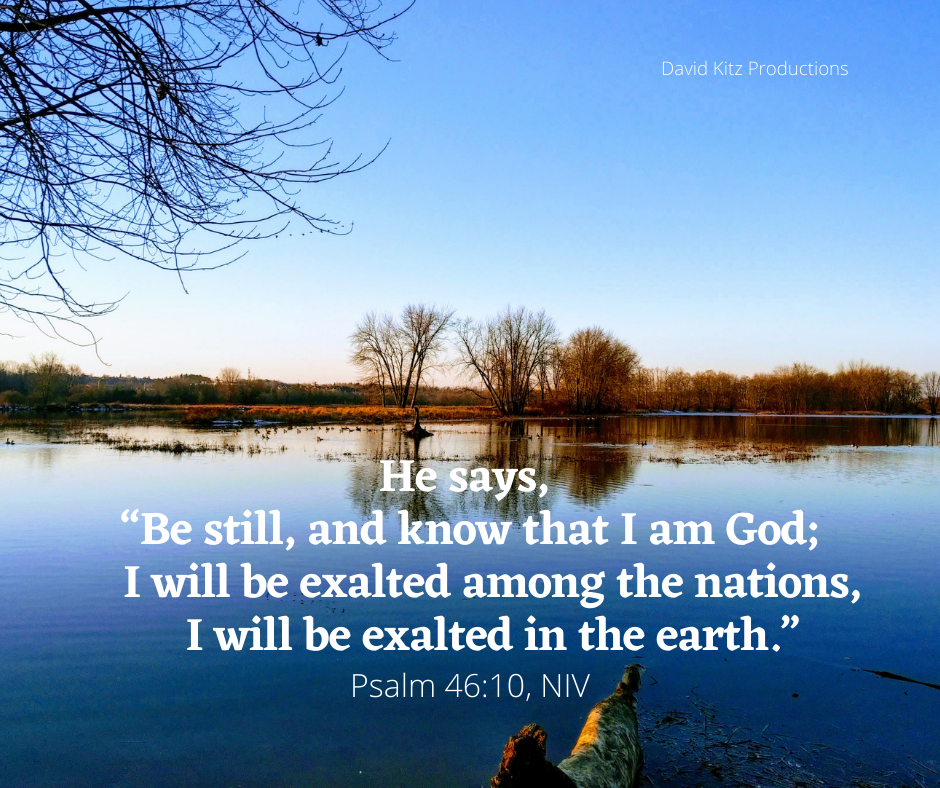
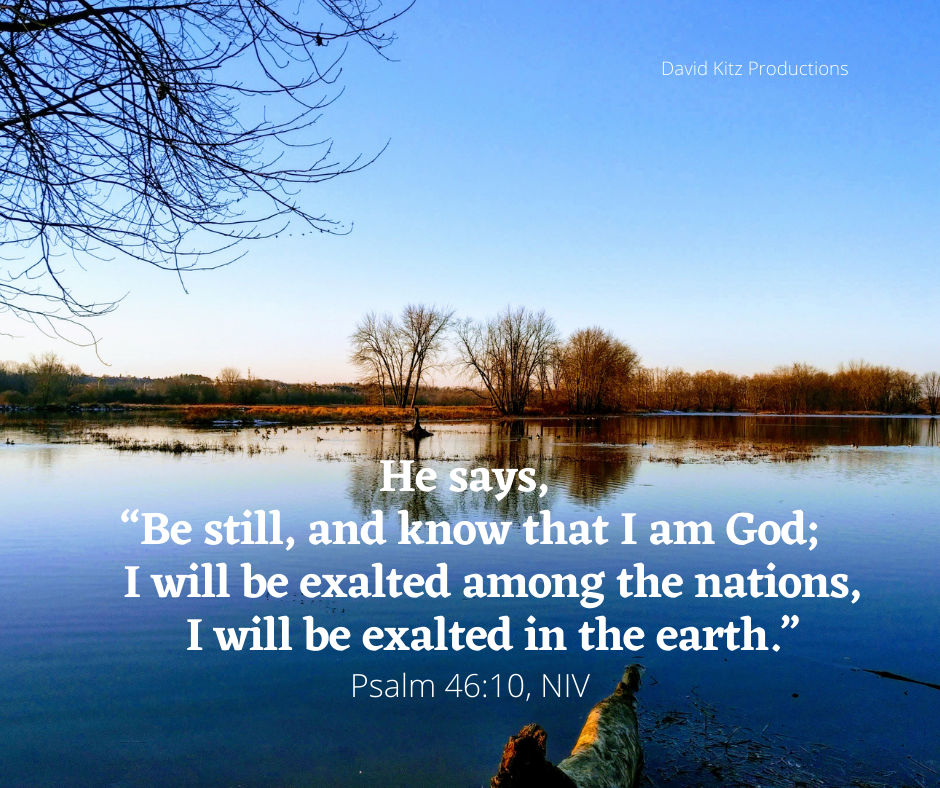
Morning calm — Petrie Island — photo by David Kitz
How can we face an uncertain future without fear? If you have died to the elemental passions of this world, you can live your life beyond fear and worry. Dead men do not panic. The apostle Paul urged the Colossian believers to acknowledge their death to this world and embrace their new life in Christ: “Set your minds on things above, not on earthly things. For you died, and your life is now hidden with Christ in God” (Colossians 3:2-3).
Repeatedly in his epistles, Paul likens baptism to death, burial and resurrection. This is our point of identification with Christ as we begin a new life of faith in him. And a life of faith is precisely what we are called to as believers in our resurrected Lord, who has ascended to the heavenly Jerusalem before us. That life of faith triumphs over fear. It turns defeat into conquest, doubt into certainty, death into the ultimate victory.
My own hunger for a deeper knowledge of the psalms was sparked by a middle-aged couple, John and Clare Tremblay. The Tremblays had attended our church for a few years, but then they moved to another part of the city, and we lost touch. Upon their return to our neighborhood, we discovered that Clare had developed diabetes and gone blind. I began to make regular pastoral visits to their home. On these visits it became my habit to read a psalm to Clare, while John stood nearby. She drew such strength and comfort from these psalms; you could see her face light up every time a psalm was read. Unfortunately, her condition declined rapidly. After a number of falls, it became clear that she was unable to walk. Soon she was confined to a long-term care facility. Even there she found her refuge in the psalms. It seemed to be the only thing that could put a smile on her face.
You see for that moment Clare was no longer blind, but rather she could see, and she was sitting by the “river whose streams make glad the city of God, the holy place where the Most High dwells.” While she listened to the psalms, her mind was set on things above where her life was hidden with Christ in God. Within those psalms she found God—the God who is an ever-present help in time of trouble.
As time went by I could see in Clare the truth of these words “God is within her, she will not fall; God will help her at break of day.”
One morning Clare found herself there, in the very presence of the LORD. This psalm had become her reality. Her funeral became a celebration of the psalms she loved, and the God of refuge that she found within those psalms.
After Clare’s passing, I paid a number of visits to John to offer some comfort and support to him as he mourned the loss of his wife. “Pastor, could you read me a psalm?” John asked.
Of course I brought my Bible along to do just that. He sat in rapt attention as I read. He got that wistful, far off look in his eyes, and I knew where he was. He was crouched by one of those streams that make glad the city of God. He was having a good thirst-quenching drink.
On one of those visits John complained of a backache, and I suggested he have a doctor check it out. A few weeks later John’s daughter-in-law called. John was in the hospital. The backache was spinal cancer, and the doctors said that John had only a month to live. In fact, he lasted only three weeks. John was on a three week, hundred story plunge to death—a plunge he faced without a hint of fear.
I recall those hospital visits. They were tinged with bittersweet warmth. John had watched his bride of forty years face death with faith and courage. Now he did the same. Through a fog of pain John would smile up at me, and in a hoarse whisper he would say, “Pastor, could you read me a psalm?”
On my last visit with John, I read Psalm Forty-six. I cleared my throat and began, “God is our refuge and strength, an ever-present help in trouble. Therefore we will not fear, though the earth give way …”
John smiled his biggest smile. He knew the truth of those words even as the earth beneath him was giving way.
John and Clare were both in their early sixties. They died within six months of each other. In me they sparked an ongoing love for the Book of Psalms. It’s a love that I trust will carry me into eternity, even as it carried them.
[1] Facing the Future Without Fear: Prescriptions for Courageous Living in the New Millennium, (paperback) by Lloyd J. Ogilvie, Vine Books, 2002 edition.
Bringing Life to the Psalms
- Read the account of Peter and Jesus walking on the water as found in Matthew 14:22-36. Consider what this story says to you about walking with Jesus. What does it say to you about faith and fear? Is Jesus calling you to a walk of faith? Is he calling you out of your comfort zone?
- What do you think Paul means when he says, “Set your minds on things above, not on earthly things. For you died, and your life is now hidden with Christ in God” (Colossians 3:2-3). How can you live your life here on earth and simultaneously in heaven with Christ? Setting your mind takes personal discipline. It involves purposeful thought. What godly disciplines help you set your mind on things above?
- Has God been a God of sunny days, and prosperity for you? Praise God for all the good times. Have you also faced adversity and trouble as you walked with the LORD? How did your faith help you overcome?
Today’s post is Chapter 9 from the book Psalms Alive! Connecting Heaven & Earth by David Kitz. To find out more or purchase click here.






![BGBG_v4.3_150[1818]](https://davidkitz.blog/wp-content/uploads/2021/07/bgbg_v4.3_1501818.jpg)


 I love the Psalms