Telling the Next Generation

Tags

, , ,

Reading: Psalm 78:1-8
A maskil of Asaph.
My people, hear my teaching;
listen to the words of my mouth.
I will open my mouth with a parable;
I will utter hidden things, things from of old—
things we have heard and known,
things our ancestors have told us.
We will not hide them from their descendants;
we will tell the next generation the praiseworthy deeds of the L
ORD,
his power, and the wonders he has done.
He decreed statutes for Jacob and established the law in Israel,
which he commanded our ancestors to teach their children,
so the next generation would know them,
even the children yet to be born,
and they in turn would tell their children.
Then they would put their trust in God
and would not forget his deeds but would keep his commands.
They would not be like their ancestors—
a stubborn and rebellious generation,
whose hearts were not loyal to God,
whose spirits were not faithful to him
(NIV).*

girls on desk looking at notebook

Photo by Pixabay on Pexels.com

Reflection
Psalm 78 begins with a simple imperative statement: My people, hear my teaching; listen to the words of my mouth.

Hearing and listening are very simple commands. There is nothing particularly difficult about hearing or listening. But…but it seems most of humanity’s problems stem from not hearing or listening. Most marital breakdowns come result from a refusal to listen to one another. Intergenerational conflict results from a breakdown in communication. One party may be speaking, but the other party isn’t listening. Even on the international stage, when nations refuse to talk to one another, the next step is usually war.

Why do we stop listening or hearing? Is it because we don’t like what the other person is saying? How does that affect our relationship with God? Have we stopped listening to His voice because we don’t like what He says? Have we stopped listening to the voice of our conscience? Good listening starts with listening to the LORD. When our children stop listening to us, we have a problem. Have we in turn listened to them? Telling the next generation the praiseworthy deeds of the LORD starts with us hearing and really listening to God. Our children are so very important to us. But it all starts with the LORD. He has something to say to you today. Are you listening?

Response: LORD God, today give me ears to hear what your Spirit is saying to me. I want a listening heart. Help me to really hear the others in my family and workplace. Thanks for listening to me. Amen.

Your Turn: Have you stopped listening to God. How do we change and become better listeners?

* NEW INTERNATIONAL VERSION, COPYRIGHT ©1973, 1978, 1984, 2011 BY BIBLICA

BGBG_v4.3_150[1818]

Please pray for the people of Ukraine!

Volume I of Psalms 365: Develop a Life of Worship and Prayer has won the 2021 Best Book of the Year Award and for those who love God’s word, it’s an ideal way to daily meet with the Lord. For a closer look at Volumes II and III click here.

Excerpt 12 from The Soldier Who Killed a King

Tags

, , , ,

A journey to the cross is a journey to repentance. It’s a journey to deep personal change. Will you take this journey with me?

Date: Six thirty in the morning, Friday, April 7 A.D.
Jesus trial before Pontius Pilate begins.

The governor peered over the heads of the men directly in front of him. He scanned the assemblage on the street, took in the significance of it all, and then cleared his throat. “Where is the man?”
Jonathon turned quickly. On reaching the first step, he beckoned beyond our pikemen to three of his own temple guards, who then advanced with their prisoner—Jesus of Nazareth.
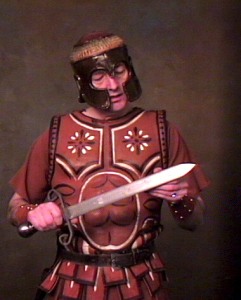
Picture Cent-helmetHe was a mess, almost unrecognizable. His hair was matted. He had been spat upon. The spittle was drying in his beard. There were red welts on his face and neck, a blood-oozing gash above his left eye, a discernable limp to his gait.

It was apparent that during the night they’d had their way with him.
He was escorted to a position directly before me. Intuitively I knew he was my man now, my charge.
A twitch of Pilate’s eyebrow hinted his surprise at the condition of the man.
“Loose him,” he directed with a slight wave of his hand.
Two temple guards hastened to unfasten the leather strap binding Jesus’s arms to his torso. The third man freed the prisoner’s hands. With a second wave of his hand, Pilate dismissed the temple guards, who repositioned themselves on the first step and stood facing the proceedings.
Pilate took a seat on the throne of judgment, which had been brought out for him by two attendants. Raising the scroll in his left hand, he asked, “What charges are you bringing against this man?”
It was clear from this gesture that he was referring to the charges written on the scroll he now clutched in his hand. Undoubtedly he had read these charges himself, and in all likelihood had discussed them
with the assessor standing to his right. But he wanted the high priest to articulate them. “If he were not a criminal, we would not have handed him over to you,” Caiaphas said with a huff.
A rather cheeky response, I thought.
“Take him yourselves and judge him by your own law,” Pilate answered.
Here Annas interjected, “But we have no right to execute anyone.”
A devious response if there ever was one. The temple, in fact, routinely acted as bothbiblical-fiction-award-2017_orig judge and executioner in religious matters and had been granted full authority to do so. Death by stoning was commonplace. I had witnessed Annas himself cast the first stone at some hapless adulteress within the first week of my arrival here ten years ago. No, the temple had the right to execute, and these crafty fellows could surely find grounds to execute this man. They just didn’t want the blood on their hands. They did not want to be blamed for the death of this rabbi. For many he had become the hope of the nation. No, they wanted us to do the job, to act as their executioners. They wanted him judged and executed under Roman law. What Caiaphas said next made this abundantly clear.
“We have found this man”—he aimed a bony finger at Jesus—“subverting our nation. He opposes payment of taxes to Caesar and claims to be Messiah, a king.”
Now here was a capital offense—a capital offense under Roman law.
The Weasel had backed the Badger into a corner, and he was relishing the moment. These charges would need further examination. But Pilate would not proceed in full view of a gloating high priest, urged on by his consorts and a handpicked audience. He retreated.
He abruptly arose from his throne, fixed his eyes on me, and said, “Bring the man.” He motioned with a jerk of his head toward the great doors behind us and then marched off into his residence.
I stepped down to escort Jesus, but he was already in motion. It became clear that the steps were painful for him. I put my hand to his elbow.

American readers click this link to purchase The Soldier Who Killed a King.

Canadian readers click this link to purchase The Soldier Who Killed a King directly from the author.

The Path through the Sea

Tags

, , ,

Reading: Psalm 77:16-20
The waters saw you, God,
the waters saw you and writhed;
the very depths were convulsed.
The clouds poured down water,
the heavens resounded with thunder;
your arrows flashed back and forth.
Your thunder was heard in the whirlwind,
your lightning lit up the world;
the earth trembled and quaked.
Your path led through the sea,
your way through the mighty waters,
though your footprints were not seen.
You led your people like a flock
by the hand of Moses and Aaron
(NIV).*

Perce1

Perce, Quebec — photo by David Kitz

Reflection
Psalm 77 began with the psalmist in a state of anguish approaching despair. He was filled with questions for the LORD—questions but no answers. This was followed by the psalmist’s decision to recall the miracle-working power of the LORD. He reflects on Israel’s release from bondage in Egypt and in today’s reading he describes their escape through the Red Sea. Your path led through the sea, your way through the mighty waters, though your footprints were not seen.

Sometimes life will bring us to difficult or even impossible situations. We can see no way forward and it’s impossible to turn back. That’s the situation the people of Israel found themselves in as they set out to escape from Egypt. The sea blocked the way before them, and the Egyptian army was pursuing them from behind. They had nowhere to turn but to the LORD.

What did the LORD do? He didn’t take Israel around the problem or over it. He took them through it. We read these words: Your path led through the sea…

During the dark days of World War II, Winston Churchill gave his nation this advice, “If you are going through hell, keep going.”

Don’t stop. Don’t give up and hang your head in despair. You don’t know the moment when the LORD will intervene on your behalf. You don’t know when the sea will part. You don’t know when you will be called to follow the LORD’s invisible footprints onto the floor of the sea. That requires faith—steps of faith. And don’t dillydally along the way. If you are going through hell, keep going. If you are going through a personal Red Sea experience, keep going. You don’t want to be caught in the middle. That’s what happened to Egypt’s army. Have faith the LORD will bring you through, and by all means keep going. Persevere.

Response: LORD God, I am facing some difficult challenges. Give me the faith and the courage to keep going. I trust you will bring me through—through hell and high water by the power of Jesus. Amen.

Your Turn: Are you facing difficult times? How has the LORD brought you through hard times in the past?

* NEW INTERNATIONAL VERSION, COPYRIGHT ©1973, 1978, 1984, 2011 BY BIBLICA

BGBG_v4.3_150[1818]

Pray for the people of Ukraine!

Volume I of Psalms 365: Develop a Life of Worship and Prayer has won the 2021 Best Book of the Year Award and for those who love God’s word, it’s an ideal way to daily meet with the Lord. For a closer look at Volumes II and III click here.

Excerpt 11 from The Soldier Who Killed a King

Tags

, , , ,

A journey to the cross is a journey to repentance. It’s a journey to deep personal change. Will you take this journey with me?

Date: Five forty-five in the morning, Friday, April 7 A.D.
In today’s reading, a messenger from Pontius Pilate arrives at the home of Marcus Longinus, the Roman centurion, with the news that Jesus has been arrested.

“Sir, I have just come from the governor. You are to report to the Praetorium immediately. Jesus of Nazareth has been arrested. The high priest has brought him before the governor for judgment.”
“Is that so?” I said in a state of consternation. “Who sent you?”
“The governor himself. He said you were familiar with the Galilean.”
I blew a short puff of air through my nostrils. All of Jerusalem was somewhat familiar with the Galilean.
“So he wants me there immediately?”
“Immediately, sir.” He shifted from one foot to the other and then, as if to justify thisCentur. Sw response, he added, “The high priest and a big delegation, maybe three hundred men, maybe more, arrived at the palace door at first light. They had the prisoner—Jesus—with them.”

“Tell the governor I’m on my way.”
With a quick nod of my head, I dismissed the messenger. Instantly he turned and began his run back to the governor’s residence. I took one step back inside the gate and began barking orders.
“You, you, and you!” I stabbed my index finger in the direction of the most dressed and prepared-looking soldiers. “Strap on your swords and follow me. Now!”
Then, addressing the other soldiers, I announced, “The rest of you, meet me at the Praetorium as soon as you are ready.”
“Claudius”—I nodded in his direction—“you are in charge. I’ll give everyone their assignment for the day when they get there.”
I stepped back through the gate and began covering the ground with long, quick strides. My three recruits had to run to catch up. With each stride a new thought came jogging into my head. Stupid Arius! Why didn’t he tell me the messenger was from Pilate? I would have moved a good deal faster.
Obviously my concerns about the prophet had moved up the chain of command. Flavio must have informed Pilate about my worries and the actions I had taken, hence this unusual move—a direct summons by the governor. I harbored the hope that he would consult directly with me on the matter. Three hundred men! Three hundred men at first light? The Weasel must have had a busy night. It takes a good deal of effort to set your troops in array. Caiaphas must have been hatching this plot for a good long while. 4485 TWITTER
But the Weasel caught his prey! What a sweet bit of treachery that must have been. I wondered how he pulled that off. Now the high priest would move in for the kill. We would see if he could slaughter his own Passover lamb. The people! If the pilgrims, especially the Galilean pilgrims, knew their Messiah had been seized, there could be a mass revolt. That must be why the Weasel had done his dirty work in the dark of the night. And furthermore, he had played out this drama at the zenith of the festival, while minds and hearts were on faith, home, and family. Here was a cunning scheme worthy of the Fox, played out by the Weasel.
Undoubtedly most of the population would still be unaware of these developments, even as I had been caught off guard. Off guard but not surprised. I could smell this coming.
My conversation with Renaldo at the bathhouse came echoing back. It gave me an eerie feeling knowing I had spoken like some prophetic oracle. It made me wonder from where that insight had really come.
“By Jupiter! I forgot the spikes.” I wheeled around while reaching out my hand to halt the soldier at my side. Addressing him directly, I said, “I forgot them—the spikes. They’re in a pouch hanging on a peg in my bedchamber. My wife, she’ll know where they are. Ask her to get the pouch for you. Then bring it to me at the Praetorium. Oh, and tell the other men to hurry. This is urgent.” I fixed my eyes on him to stress the importance of this last statement and then added, “Now run.”

American readers click this link to purchase The Soldier Who Killed a King.

Canadian readers click this link to purchase The Soldier Who Killed a King directly from the author.

Yes, I Will Remember Your Miracles

Tags

, , , ,

Reading: Psalm 77:10-15
Then I thought, “To this I will appeal:
the years when the Most High stretched out his right hand.
I will remember the deeds of the L
ORD;
yes, I will remember your miracles of long ago.
I will consider all your works
and meditate on all your mighty deeds.”
Your ways, God, are holy.
What god is as great as our God?
You are the God who performs miracles;
you display your power among the peoples.
With your mighty arm you redeemed your people,
the descendants of Jacob and Joseph
(NIV).*

img_20211020_0832446

Photo by David Kitz

Reflection
Psalm 77 began with the psalmist in a state of anguish approaching despair. He was filled with questions for the LORD—questions but no answers. This brings us to our reading for today. After pouring out his complaint, the psalmist recalls the mighty works of the LORD.

“To this I will appeal: the years when the Most High stretched out his right hand. I will remember the deeds of the LORD; yes, I will remember your miracles of long ago. I will consider all your works and meditate on all your mighty deeds.”

When in doubt, remember. In a time of suffering, remember. When troubles assail from every side, remember. What should we remember? Remember the God who performs miracles. Remember He is your personal redeemer. The blood Jesus shed was for you. The resurrection he accomplished was for you. The forgiveness he offers is for you.

During trying times, I will consider all your works and meditate on all your mighty deeds.

Our faith isn’t tested and purified in the good times while the choir sings sweetly in the background. Faith is tested and purified in the furnace of affliction. There’s no lineup of volunteers signing up for affliction. The gospel that is often presented today is branded as affliction-free. But Jesus gave no such promise. He promised persecution to those who leave all to follow him. (See Mark 10:29-31).

Paul, the apostle, makes this assertion: We also glory in our sufferings, because we know that suffering produces perseverance; perseverance, character; and character, hope. And hope does not put us to shame, because God’s love has been poured out into our hearts through the Holy Spirit, who has been given to us (Romans 5:3-5).

As you face difficult times, reflect on the ever-present, never-changing, miracle-working power of God.

Response: LORD God, you are at work on my behalf even when I can’t see it. I believe in you, the miracle-working God. May my meditation center on you and your word because your word brings light. Amen.

Your Turn: Does God have your attention when you are in trouble or pain? Have times of suffering prompted you to grow in perseverance and character? Reflect on that growth.

* NEW INTERNATIONAL VERSION, COPYRIGHT ©1973, 1978, 1984, 2011 BY BIBLICA

BGBG_v4.3_150[1818]

Pray for the people of Ukraine!

Volume I of Psalms 365: Develop a Life of Worship and Prayer has won the 2021 Best Book of the Year Award and for those who love God’s word, it’s an ideal way to daily meet with the Lord. For a closer look at Volumes II and III click here.

Excerpt 10 from The Soldier Who Killed a King

Tags

, , ,

A journey to the cross is a journey to repentance. It’s a journey to deep personal change. Will you take this journey with me?

Date: Mid afternoon on Thursday, April 6th, 30 A.D.
In today’s reading, Governor Pontius Pilate gives a brief speech formally welcoming Herod the tetrarch to Jerusalem.

At last the two mounted commanders arrived before Pilate’s chariot. They were motioned to take their position on either side. After a brief confusion of feet, the royal litter managed to turn sideways so the royal couple could face the governor as he stood upon his imperial chariot. The trumpeters sounded the fanfare. When the last note had echoed off the marble wall, Pilate unrolled the parchment handed to him by an attendant. He cleared his throat and began his oration.
Free WW-e FACEBOOK-2 (2)
“It was under the rule of the great and wise Emperor Caesar Augustus that this magnificent temple behind us began to take shape. He recognized the desire of the Jewish people for a central place to worship. It was Herod the great Idumean king who oversaw the construction of this masterpiece of the empire, and today it stands as a symbol of Roman respect for the unity and diversity of all the peoples of the empire. It is only fitting today that I, as the emperor’s representative, welcome the son of this master builder, Herod Antipas, the tetrarch of Galilee and Perea.”
With a wave of his hand, Pilate signaled the sounding of a second trumpet fanfare. As the first note was sounded, he stepped off the chariot and then graciously lent a hand to his wife. Thus accompanied by his mate, he swaggered over to the royal litter to personally greet Herod and Herodias, who both stood to meet them.
Greetings were exchanged, none of which I could discern from a distance. After a brief discussion Claudia joined Herodias in the royal litter. Herod barked out some orders. The litter bearers stood to their feet and headed off in the direction of the governor’s residence. Apparently the ladies would have their own time together.
At a leisurely pace Pilate escorted Herod over to where the priestly delegation waited.Soldier book
It was an unusual sight, these three hostile, inflated men exchanging greetings and meaningless pleasantries. Herod Antipas, Pontius Pilate, and Joseph Caiaphas; the Fox, the Badger, and the Weasel. All three were kings in their own right, within their own jurisdiction. All three craved more power, absolute power, while fiercely holding one another in check.
Pilate turned to me and gave a quick, tight nod. I signaled up to Claudius, and the great Golden Gate, the Messiah Gate, was hoisted, granting entrance to the three competing kings.
Only the fourth king, the people’s king—the donkey king—only he was absent.

American readers click this link to purchase The Soldier Who Killed a King.

Canadian readers click this link to purchase The Soldier Who Killed a King directly from the author.

When We Have More Questions than Answers

Tags

, , , ,

Reading: Psalm 77:1-9
For the director of music. For Jeduthun. Of Asaph. A psalm.
I cried out to God for help;
I cried out to God to hear me.
When I was in distress, I sought the Lord;
at night I stretched out untiring hands,
and I would not be comforted.
I remembered you, God, and I groaned;
I meditated, and my spirit grew faint.
You kept my eyes from closing;
I was too troubled to speak.
I thought about the former days,
the years of long ago;
I remembered my songs in the night.
My heart meditated and my spirit asked:
“Will the Lord reject forever?
Will he never show his favor again?
Has his unfailing love vanished forever?
Has his promise failed for all time?
Has God forgotten to be merciful?
Has he in anger withheld his compassion?”
(NIV).*

silhouette of man during nighttime

Photo by brenoanp on Pexels.com

Reflection
Sometimes in our walk of faith, we go through dark days. Answers to our prayers do not come quickly. We are left wondering if God even hears or cares. The opening verses of Psalm 77 reflect the psalmist’s mood of desolation, which approaches despair. The psalmist has more questions than the Lord has answers. At least that’s how it appears. “Will the Lord reject forever? Will he never show his favor again? Has his unfailing love vanished forever? Has his promise failed for all time? Has God forgotten to be merciful? Has he in anger withheld his compassion?”  

Last Friday morning, I was on a pleasant spring walk through a quiet residential neighborhood with my sister. Suddenly without warning, I was struck by a car backing out of a driveway. In an instant, pleasure was replaced by searing pain. My right knee was skinned and bleeding. Ligaments in my left ankle were torn. Now I hobble about on crutches. Surgery may be needed.

Like the psalmist, my week since the accident has been filled with questions. Questions by police officers. Questions by family members and friends. Questions by insurance claim specialists. Questions by doctors. And in my quiet moments, I have had a few questions for the Lord, “Why did you allow this to happen? What should my response be? How long will this pain last? When will I be able to walk normally again? Did I do something wrong to bring on this pain?”

Response: LORD God, I don’t have the answers. You do. Your word tells me to “give thanks in all circumstances; for this is God’s will for you in Christ Jesus” (1 Thessalonians 5:18). Help me to do just that in these circumstances. You are always worthy of praise even when I don’t understand. Amen.

Your Turn: Do you have questions for God when life seems to go off the rails? With the passing of time has the Lord provided some answers?

* NEW INTERNATIONAL VERSION, COPYRIGHT ©1973, 1978, 1984, 2011 BY BIBLICA

BGBG_v4.3_150[1818]

Pray for the people of Ukraine!

Volume I of Psalms 365: Develop a Life of Worship and Prayer has won the 2021 Best Book of the Year Award and for those who love God’s word, it’s an ideal way to daily meet with the Lord. For a closer look at Volumes II and III click here.

Excerpt 9 from The Soldier Who Killed a King

Tags

, , , ,

A journey to the cross is a journey to repentance. It’s a journey to deep personal change. Will you take this journey with me?

In today’s reading, the rivalry and tension between the Governor Pontius Pilate, and Joseph Caiaphas, the high priest are on full display. The two leaders are waiting for the official arrival of Herod the tetrarch. Date: Mid afternoon on Thursday, April 6th, 30 A.D.

When all were in position, I called for the lowering of the heavy, grated iron gate. From now on, the Passover celebrants would be forced to use an alternate entrance or exit.
In short order the toga-clad governor, Pontius Pilate, arrived on his gold-ornamented chariot. The gate was raised. By the governor’s side stood Claudia Procula lavishly dressed in full-length scarlet. Her bejeweled opulence contrasted sharply with the poverty common to most women of this province. The chariot took a position allowing the ruling couple to look out to the Mount of Olives, in readiness for the approaching king.
The only missing player was Caiaphas. In due time his delegation arrived, and the enormous gate was hauled up once more on creaking chains, only to be lowered again when the priestly party had exited.
4485 TWITTER
Pilate had been gazing down the road stretched out before him when Caiaphas arrived, and it was only the coarse rattle coming from the gate chains behind him that alerted him to the approach of the high priest and his delegation. He turned, stepped down from the chariot, and briskly strode over to the dumbfounded cleric. The expression on Caiaphas’s face said it all. He clearly did not expect to see Pilate here. He had intended this to be a discreet, private tour and consultation.
“You’re expecting someone?” Pilate brusquely inquired.
An uncomfortable pause followed. Caiaphas cast a hasty glance at those accompanying him, adjusted the folds in his robe, cleared his rusty throat, and replied, “Yes, King Herod requested a tour of the great temple.”
“Did he now?” There was a coldness in Pilate’s voice that betrayed the utter contempt he felt toward this Jewish leader. “Ahh!” He gestured grandly. “There is no king in these parts. I know of no king.” Then spotting me on horseback nearby, the governor turned and in mock sincerity called out, “Centurion. Is there a king around here?”
“We have no king here but Caesar,” I answered, joining in the sport.
“The centurion says there is no king but Caesar. Do you have some other king I’m unaware of? Perhaps I should meet this king.”
By now the high priest was well beyond flustered. He had stepped into a trap. Surrounded by Roman troops and cut off from the safety of the temple’s hallowed sanctum, he was now being hectored by his chief political rival. It seemed more than he could endure. He began to tremble uncontrollably, whether from fear or anger I could not tell.
“Your Excellency”—he swallowed hard—“I was referring to the . . . te-tetrarch of Galilee.” 
“The te-tetrarch?” Pilate mimicked not only the high priest’s tremulous stammer, but also the rusty-gate scratch of his voice. “Is that so? Well, the tetrarch is no king. And he certainly isn’t your king.” Then with slow, icy deliberation, Pilate said, “There is no king here but Caesar. Did you hear that?”
This was no rhetorical question. “Yes, Your Excellency. I heard.”Biblical fiction winner 2017
“Do you, any of you”—he scanned the delegation—“have any other king?”
The cowering dogs dutifully answered, “No, we have no other king.”
Caiaphas, however, was silent. A fact well noted by the governor.
Then Pilate took a step closer to the trembling priest, pointed a bony finger in his face, and hissed, “Now don’t forget that, you old goat, or your blood will be running down the Kidron! Did you hear that?”
“I . . . I am your servant, Your Excellency,” Caiaphas rasped.
“Ha!” Pilate laughed an icy laugh in a show of disdain for that remark. Then he turned on his heels and marched back to his chariot, where once more he joined his wife.
For a full minute there was stunned silence from the religious delegation, and then suddenly they all began to speak at once in a huddle of hushed tones like schoolboys after a tongue-lashing from the headmaster.
But there was murder in the high priest’s eye. Nothing childish there. From my vantage point I could see that. He didn’t have the means, but he most certainly had the intent.
I am sure that if the gate had been open, the delegation would have returned to the safety of the sanctuary to plot their revenge, but that option was not open to them. They were trapped in this pocket, surrounded by hated foreign troops, subject to the whim and ridicule of their enemy, awaiting the arrival of their pretentious savior king.
Long, awkward moments passed. But they were saved from this interminable purgatory by Herod’s arrival.

American readers click this link to purchase The Soldier Who Killed a King.

Canadian readers click this link to purchase The Soldier Who Killed a King directly from the author.

The LORD Has Made His Salvation Known

Tags

, , ,

I will praise the LORD!

brown and green grass field during sunset

Photo by Jonathan Petersson on Pexels.com

Reading: Psalm 98:1-3

Sing to the LORD a new song,
    for he has done marvelous things;
his right hand and his holy arm
   have worked salvation for him.
The LORD has made his salvation known
    and revealed his righteousness to the nations.
He has remembered his love
 and his faithfulness to Israel;
all the ends of the earth have seen
    the salvation of our God.

* NEW INTERNATIONAL VERSION, COPYRIGHT ©1973, 1978, 1984, 2011 BY BIBLICA

BGBG_v4.3_150[1818]

Pray for the people of Ukraine!

Volume I of Psalms 365: Develop a Life of Worship and Prayer has won the 2021 Best Book of the Year Award and for those who love God’s word, it’s an ideal way to daily meet with the Lord. For a closer look at Volumes II and III click here.

Excerpt 8 from The Soldier Who Killed a King

Tags

, , ,

A journey to the cross is a journey to repentance. It’s a journey to deep personal change. Will you take this journey with me?

In today’s reading, Marcus, the centurion, rides back into Jerusalem on horseback. As he rides his mind turns over his thoughts about Jesus of Nazareth. Date: Near noon on Thursday, April 6th, 30 A.D.

We continued on to the fortress, but my mind was on the Northern Messiah. His penetrating eyes haunted my thoughts. There was a power there that I had no ability to fathom. I was reminded of Ruth’s words. Ruth was one of our household servants, a Jewish girl. When at the supper table I had told Zelda about Jesus and his miraculous powers, Ruth’s eyes brightened. I asked her if she knew anything about this man.
biblical-fiction-award-2017_orig“Oh, yes,” she’d said. “Almost a year ago he healed a blind beggar from the Lower City. Jesus made some mud, put it on the beggar’s eyes, and sent him to wash in the Pool of Siloam. When he washed, he could see. It was a miracle. I’ve seen this man myself. I know it’s true,” she earnestly avowed.
When I’d asked her about this power Jesus had and where it came from, she bowed her head and answered, “From God.”
But she seemed somehow uncomfortable with her answer. She added, “It must be from God. He does good things. But our leaders aren’t sure. They think it may be demon power. But demons don’t heal the sick.”
Maybe the religious leaders were right. Maybe it was demonic power that made the blind see. It seemed preposterous. But why had I heard this voice? Why did this man trouble me so? Thinking of him seemed to stir up nothing but torment within me, and I didn’t even know why. I felt strangely attracted to him, yet at the same time repelled.
Then there was this talk about the kingdom of God. Maybe Timaeus was right about this prophet. The words of the wealthy merchant came back to me: “You don’t talk about a kingdom in this place and get away with it. Rome will see to that!”
Maybe we would see to it. Maybe we should see to it soon. But Jesus’s enemies were the same pompous, self-serving leaders I despised. He had aligned himself with the common man, with the poor, the oppressed, the sick and suffering. And he didn’t just champion their cause for personal benefit like some crass politician lobbying for the emperor’s favor. No, he healed them. He fed them. He walked with them, ate with them. He was one of them. He was their king, whether he wore a crown or not. I saw that clearly when he entered on the donkey. He was the donkey king. A horse would have put him above the crowd. A horse would have meant elevating himself like all the other egotistical men who led in this upside-down world.
In his case others would have to do the elevating.
The meaning of his entry on Sunday came clear to me now. It was a perspective gained from my comfortable perch on the back of my own noble steed.
By the time I reached the fortress for the second time in the week, I resolved to shut this Messiah out of my mind. He didn’t fit any of my categories for human behavior or religious thought. He was beyond understanding, an unwelcome intruder into my city and my thought life.

American readers click this link to purchase The Soldier Who Killed a King.

Canadian readers click this link to purchase The Soldier Who Killed a King directly from the author.