• Home
  • About
  • DavidKitz.ca
  • Youtube Videos
  • Books by David
  • Books on Amazon.com

I love the Psalms

~ Connecting daily with God through the Psalms

I love the Psalms

Tag Archives: atheist

Atheism Is Not a Modern Phenomenon

21 Friday Jun 2024

Posted by davidkitz in Psalm 14, Psalms

≈ Leave a comment

Tags

Atheism, atheist, David, fear of God, fool, God, God's judgment, Psalms, salvation, sin, the LORD

Today’s Devotion from Psalms 365

Reading: Psalm 14
For the director of music. Of David.
The fool says in his heart, “There is no God.”
They are corrupt, their deeds are vile;
there is no one who does good.
The L
ORD looks down from heaven on all mankind
to see if there are any who understand, any who seek God.
All have turned away, all have become corrupt;
there is no one who does good, not even one.
Do all these evildoers know nothing?
They devour my people as though eating bread;
they never call on the L
ORD.
But there they are, overwhelmed with dread,
for God is present in the company of the righteous.
You evildoers frustrate the plans of the poor,
but the L
ORD is their refuge.
Oh, that salvation for Israel would come out of Zion!
When the L
ORD restores his people,
let Jacob rejoice and Israel be glad!
(NIV) *

img_20230821_1535256

Clear sailing — photo by David Kitz

Reflection
Apparently, atheism is not a modern phenomenon. Three thousand years ago in David’s time, there were people who said in their heart, “There is no God.” Atheism has a long and ignoble pedigree. I say ignoble because as David observes, it is the fool who says, “There is no God.”

There is a footnote in my Bible indicating the word translated in this psalm as fool denotes someone who is morally deficient. David goes on to describe this moral deficiency. He uses the words corrupt and vile. In fact, there is a complete absence of anything good. But this isn’t just David’s indictment against a few errant atheists; this is the LORD’s view of all mankind. All have turned away, all have become corrupt; there is no one who does good, not even one. In the New Testament, Paul the Apostle quotes from this psalm in his epistle to the Romans as he outlines the depravity of humanity.

Is there a link between unbelief and the sinful state of the human soul? Does sin breed unbelief? There is ample biblical and anecdotal evidence that it does. When Adam and Eve sinned, in an instant, they turned from God seekers to God avoiders. Add a little more sin, and it’s only a short step for a God avoider to become a God denier.

We deny the existence of God to avoid accountability for our sin. We foolishly assume that since we can’t see God, He can’t see us and our misdeeds. Better yet why not pretend God doesn’t exist? Then we are at liberty to sin as much as we please without fear of God’s judgment. That sounds like morally deficient reasoning to me. But the fool fools only himself.

Response: Father, I want to seek you always, especially when I sin. That’s when I need you most. You have the remedy for my sin—the blood of Jesus. You forgive me and clean me up. Amen.

Your Turn: Does sinful conduct affect or infect your belief system? How does sin cloud our reasoning?

Para la publicación de Salmos 365 de hoy en español haga clic aquí.

* NEW INTERNATIONAL VERSION, COPYRIGHT ©1973, 1978, 1984, 2011 BY BIBLICA

BGBG_v4.3_150[1818]

Please pray for peace to return to Israel, Gaza, and Ukraine!

Volume I of Psalms 365: Develop a Life of Worship and Prayer won the Best Book of the Year Award from The Word Guild and Volume II has won the Best Devotional of the Year Award. For those who love God’s word, this three-book series is an ideal way to daily meet with the Lord. To purchase or for a closer look click here.

New from David Kitz
TheElishaCodeCVR5

To purchase or for a closer look click here.

A Steadfast Heart

29 Friday Dec 2023

Posted by davidkitz in Psalm 108

≈ 5 Comments

Tags

atheist, David, praise to God, steadfast heart, sunrise, worship

Reading: Psalm 108:1-5
A song. A psalm of David.
My heart, O God, is steadfast;
I will sing and make music with all my soul.
Awake, harp and lyre!
I will awaken the dawn.
I will praise you, L
ORD, among the nations;
I will sing of you among the peoples.
For great is your love, higher than the heavens;
your faithfulness reaches to the skies.
Be exalted, O God, above the heavens;
let your glory be over all the earth
(NIV). *
Psalm 19-1

Reflection
This morning did you awaken the dawn or did the dawn awaken you? For those who are early risers awakening the dawn becomes much easier as the days get shorter, and we approach the winter solstice. I confess that this morning and most autumn and winter mornings I am awake before sunrise.

There is something quite magical about watching the sunrise and spread its golden rays across the eastern sky. I was treated to a magnificent sunrise display last Monday. I was driving east across the prairies and as each mile slipped by the glory along the horizon grew more and more intense. I pity the poor atheist who has no one to praise when he beholds such a display.

For believers, praise for our God springs naturally from our lips when we see God paint the sky with golden hues of splendor. In such moments David’s call to worship becomes our own: Awake, harp and lyre! I will awaken the dawn. I will praise you, LORD, among the nations; I will sing of you among the peoples.

Can you picture David taking up his harp and breaking into song as he locks his eyes on the rising sun? David was a most remarkable character. What sets David apart from other individuals we meet in the pages of scripture? He was a man of spectacular failings. His adulterous affair with Bathsheba and the treacherous means he used to dispatch her husband stand out. But there’s nothing remarkable about spectacular failings and shortcomings. These are common to man.

What stands out about David’s character is his steadfastness to the LORD. The opening lines of Psalm 108 hold the key to understanding David’s overcoming nature. My heart, O God, is steadfast; I will sing and make music with all my soul.

Despite his failings, David remained steadfast in his love for God. Secondly, he was wholehearted in his praise to God. When things came off the rails, he did not turn away from the LORD or stop praising Him. He repented and God forgave him. Then David gave thanks. David’s example is there for us to follow.

Response: LORD God, I always want to have a thankful heart that is quick to praise you. Help me to be steadfast in love and praise even when the way ahead is difficult. You are my help and my glory. Amen.

Your Turn: What does being steadfast in your faith look like for you? What activities promote your steadfastness?

* NEW INTERNATIONAL VERSION, COPYRIGHT ©1973, 1978, 1984, 2011 BY BIBLICA

BGBG_v4.3_150[1818]

Please pray for peace to return to Israel and Ukraine!

Volume I of Psalms 365: Develop a Life of Worship and Prayer won the Best Book of the Year Award from The Word Guild and Volume II has won the Best Devotional of the Year Award. For those who love God’s word, this three-book series is an ideal way to daily meet with the Lord.TheElishaCodeCVR5To purchase or for a closer look click here.

David Awakens the Dawn

15 Tuesday May 2018

Posted by davidkitz in Bible, Devotionals, God's word, Psalm 108, Psalms

≈ 7 Comments

Tags

atheist, David, dawn, Manitoba, music, prairie, praise, Psalm 108, repent, steadfast, sunrise, thankful, the LORD

Reading: Psalm 108
A song. A psalm of David.
(Verses 1-5)
My heart, O God, is steadfast;
I will sing and make music with all my soul.
Awake, harp and lyre!
I will awaken the dawn.
I will praise you, L
ORD, among the nations;
I will sing of you among the peoples.
For great is your love, higher than the heavens;
your faithfulness reaches to the skies.
Be exalted, O God, above the heavens;
let your glory be over all the earth
(NIV).

Reflection
This morning did you awaken the dawn or did the dawn awaken you? For those who are early risers awakening the dawn becomes much easier as the days get shorter and we approach the winter solstice. But just the opposite is true now. I confess that this morning I did not awake before sunrise.

img_20161114_074737

Manitoba sunrise, “Awake my soul” — photo by David Kitz

There is something quite magical about watching the sunrise and spread its golden rays across the eastern sky. I was treated to a magnificent sunrise display last Monday. I was driving east across the prairies and as each mile slipped by the glory along the horizon grew more and more intense. I pity the poor atheist who has no one to praise when he beholds such a display.

For believers, praise for our God springs naturally from our lips when we see God paint the sky with golden hues of splendor. In such moments David’s call to worship becomes our own: Awake, harp and lyre! I will awaken the dawn. I will praise you, LORD, among the nations; I will sing of you among the peoples. 

Can you picture David taking up his harp and breaking into song as he locks his eyes on the rising sun? David was a most remarkable character. What sets David apart from other individuals we meet in the pages of scripture? He was a man of spectacular failings. His adulterous affair with Bathsheba and the treacherous means he used to dispatch her husband stand out. But there’s nothing remarkable about spectacular failings and shortcomings. These are common to man.

What stands out about David’s character is his steadfastness to the LORD. The opening lines of Psalm 109 hold the key to understanding David’s overcoming nature. My heart, O God, is steadfast; I will sing and make music with all my soul. 

Despite his failings, David remained steadfast in his love for God. Secondly, he was wholehearted in his praise for God. When things came off the rails, he did not turn away from the LORD or stop praising Him. He repented and God forgave him. Then David gave thanks. David’s example is there for us to follow.

Response: LORD God, I always want to have a thankful heart that is quick to praise you. Help me to be steadfast in love and praise even when the way ahead is difficult. You are my help and my glory. Amen.

Your Turn: What does being steadfast look like for you?

The Fool Says, “There is no God.”

03 Friday Nov 2017

Posted by davidkitz in Bible, Devotionals, Psalm 53, Psalms

≈ 8 Comments

Tags

Atheism, atheist, David, fear of God, fool, God, laws, love of God, moral rot, salvation, Zion

Reading:                                        Psalm 53

For the director of music. According to mahalath. A maskil of David.
The fool says in his heart, “There is no God.”
They are corrupt, and their ways are vile;
there is no one who does good.
God looks down from heaven on all mankind
to see if there are any who understand,
any who seek God.
Everyone has turned away, all have become corrupt;
there is no one who does good, not even one.
Do all these evildoers know nothing?
They devour my people as though eating bread;
they never call on God.
But there they are, overwhelmed with dread,
where there was nothing to dread.
God scattered the bones of those who attacked you;
you put them to shame, for God despised them.
Oh, that salvation for Israel would come out of Zion!
When God restores his people,
let Jacob rejoice and Israel be glad!
(NIV).

Reflection
There is something very fresh and current about Psalm 53. Though David penned this psalm in about 1000 BC, he is describing today’s world. The fools of the world in the twenty-first century are still busy spouting their lies. The fool says in his heart, “There is no God.”

2017-09-29g

Vermont countryside — photo by David kitz

The fool, using the logic of a fool, observes that there is no God. But it is God’s observations about mankind that strike me as being more accurate: They are corrupt, and their ways are vile; there is no one who does good. God looks down from heaven on all mankind to see if there are any who understand, any who seek God. Everyone has turned away, all have become corrupt; there is no one who does good, not even one.

When God is taken out of the picture, corruption runs rampant, and no set of laws or regulations will change that. The problem is not laws or regulations; the problem is the state of a person’s heart. Without the love and fear of God, restraint is cast off and everyone does what is right in their own eyes. See Judges 21:25.

You see the fool doesn’t stop at claiming there is no God. He takes matters to the next logical step. In the absence of God, he asserts that he is god. He is the master of his own domain and not accountable to anyone but himself. This quickly leads to moral rot of the worst kind, since the devious mind of man can self-justify even the most heinous crimes. On a personal level it’s a rot that we must all guard against. None of us can claim moral perfection. When we do, we turn God into a liar.

Response: LORD God of heaven and earth. I bow my knees before you. Grant me a pure heart so that I can see you at work all around me. In Jesus’ name, I pray. Amen.

Your Turn: Do believers deny the existence of God when they wilfully engage in corrupt behavior?

The Fool Fools only Himself

13 Tuesday Jun 2017

Posted by davidkitz in Psalm 14, Psalms

≈ 3 Comments

Tags

Adam and Eve, Atheism, atheist, corrupt, David, depravity, fool, God, Paul, sin, the LORD, Unbelief

Reading:                                            Psalm 14

For the director of music. Of David.

The fool says in his heart, “There is no God.”
They are corrupt, their deeds are vile;
there is no one who does good.
The L
ORD looks down from heaven on all mankind
to see if there are any who understand, any who seek God.
All have turned away, all have become corrupt;
there is no one who does good, not even one.
Do all these evildoers know nothing?
They devour my people as though eating bread;
they never call on the L
ORD.
But there they are, overwhelmed with dread,
for God is present in the company of the righteous.
You evildoers frustrate the plans of the poor,
but the L
ORD is their refuge.
Oh, that salvation for Israel would come out of Zion!
When the L
ORD restores his people,
let Jacob rejoice and Israel be glad!
(NIV)

Reflection
Apparently, atheism is not a modern phenomenon. Three thousand years ago in David’s time, there were people who said in their heart, “There is no God.” Atheism has a long and ignoble pedigree. I say ignoble because as David observes, it is the fool who says, “There is no God.”

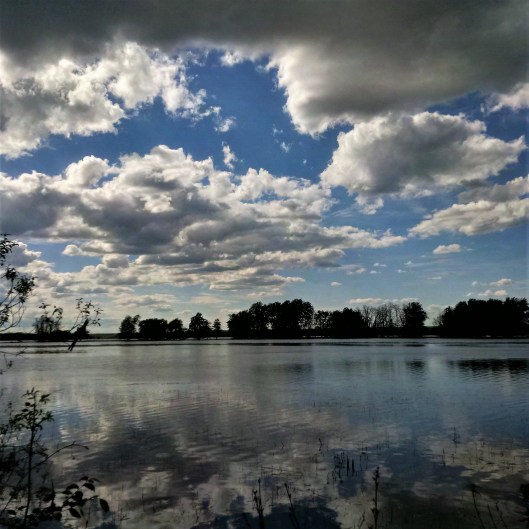
2017-05-28d

Reflected clouds, Orleans, ON — photo by David Kitz

There is a footnote in my Bible indicating that the word translated in this psalm as fool denotes someone who is morally deficient. David goes on to describe this moral deficiency. He uses the words corrupt and vile. In fact there is a complete absence of anything good. But this isn’t just David’s indictment against a few errant atheists; this is the LORD’s view of all mankind. All have turned away, all have become corrupt; there is no one who does good, not even one. In the New Testament, Paul the Apostle quotes from this psalm in his epistle to the Romans as he outlines the depravity of humanity.

Is there a link between unbelief and the sinful state of the human soul? Does sin breed unbelief? There is ample biblical and anecdotal evidence that it does. When Adam and Eve sinned, in an instant, they turned from God seekers to God avoiders. Add a little more sin, and it’s only a short step for a God avoider to become a God denier.

We deny the existence of God to avoid accountability for our sin. We foolishly assume that since we can’t see God, He can’t see us and our misdeeds. Better yet, why not pretend that God doesn’t exist? Then we are at liberty to sin as much as we please without fear of God’s judgment. That sounds like morally deficient reasoning to me. The fool fools only himself.

Response: Father, I want to seek you always, especially when I sin. That’s when I need you most. You have the remedy for my sin—the blood of Jesus. You forgive me and clean me up. Amen.

Your Turn: Does sinful conduct affect or infect your belief system? Does sin cloud our reasoning?

Strongholds in Ruins

08 Thursday Sep 2016

Posted by davidkitz in Psalm 89, Psalms

≈ 2 Comments

Tags

archeologists, atheist, Creator, Darwin, Jerusalem, spiritual attacks, stronholds, Via Dolorosa

This is a repeat of a post that was inadvertently published on Sunday, September 5th.

Reading:                                          Psalm 89

Verses 38-45

But you have rejected, you have spurned,
you have been very angry with your anointed one.
You have renounced the covenant with your servant
and have defiled his crown in the dust.
You have broken through all his walls
and reduced his strongholds to ruins.
All who pass by have plundered him;
he has become the scorn of his neighbors.
You have exalted the right hand of his foes;
you have made all his enemies rejoice.

 Indeed, you have turned back the edge of his sword
and have not supported him in battle.
You have put an end to his splendor
and cast his throne to the ground.
You have cut short the days of his youth;
you have covered him with a mantle of shame
(NIV).

Reflection

Though we cannot be absolutely certain, it seems likely that Psalm 89 was written during the time of the Babylonian invasion of Judea. These were days of disaster brought on by idolatry as the people turned away from God. The rebellious King of Judah suffered a catastrophic defeat as the words of this psalm state: You have put an end to his splendor and cast his throne to the ground. You have cut short the days of his youth; you have covered him with a mantle of shame.

Via Dolorosa

Via-Dolorosa in Jerusalem — photo courtesy of Lois Morrow

In the last few decades the church in North America has also experienced a number of defeats or setbacks. Enemies of the Christian faith have risen up and become bold in their attacks. Just as ancient Jerusalem was attacked and laid low, so too Christian belief systems have been under constant assault. The walls and strongholds of our faith have been undermined.

Two unshakeable biblical truths have come under relentless attack. The first is the truth of creation. Our God is the Creator of the universe—the source point of all matter and life. Since the days of Darwin, who incidentally believed in God, atheists have mounted a ferocious attack on this foundational truth. The Christian response has often been jingoistic or at best disjointed. A more coherent and scientifically sound defense is needed.

The second truth that has been under continual attack is the veracity of the Bible. God’s holy word is mocked and routinely discredited especially at our universities. The word of God is our stronghold. Over and over again it has been proven to be accurate, reliable and true. Archeologists and scholars have marvelled at the veracity and authenticity of God’s word. But the real proof of the inerrancy of God’s word does not come from scholarly research. It comes from the transformed lives of believers.

Response: LORD God, my trust is in you and your word. Creator God, I want my faith to be as secure for me as the earth beneath my feet and the air in my lungs. You are all around me. Thank you, Lord. Amen.

Your Turn: Have attacks on your faith caused doubt? How did you overcome?

The God of Nerve Endings

07 Monday Mar 2016

Posted by davidkitz in Monday Meditation, Psalms

≈ 1 Comment

Tags

atheist, God, Jesus, nerves, pain, pleasure, Suffering

You listen to the longings of those who suffer. You offer them hope, and you pay attention to their cries for help (Psalm 10:17, CEV).

Eric E. Wright 6

Photo by Eric E. Wright

Reflection

This week’s I Love the Psalms theme is suffering.

We all suffer or have suffered in various ways, whether it’s physical, psychological or emotional pain. To be human is to suffer.

Our God is the God of nerve endings. We were designed to feel both pain and pleasure. The same nerve endings that give us joy and pleasure can scream out in pain and agony.

Have you heard an atheist railing against God because He allows humans to experience joy and pleasant sensations? Of course not, but God is blamed for allowing suffering. The God of nerve endings allows us to experience both pleasure and pain, and I’m so glad He does.

But beyond all this God hears us when we suffer.

You listen to the longings of those who suffer. You offer them hope, and you pay attention to their cries for help (Psalm 10:17, CEV).

God understands our pleasure and our pain because in the body of Jesus, He fully became one of us.

Response: Lord Jesus, I thank you for identifying with our problems, suffering and weakness. I determine in my heart to thank and praise you both in times of joy and in times of pain. Amen.

Your Turn: How do you respond to suffering? Why is it difficult to praise God in hard times?

Psalms 365: Develop a Life of Worship and Prayer

Psalms 365 Volume II

Psalms 365 vol 3
— Psalms 365 Volume III

Psalms

Recent posts

  • Ready for the King of Glory December 19, 2025
  • My Spirit Rejoices in God My Savior December 18, 2025
  • Joining the Generation That Seeks God December 18, 2025
  • Why Am I So Favored December 17, 2025
  • How Can You Find the Good Life? December 17, 2025
  • The Power of the Most High December 16, 2025
  •  The Earth Turns to the LORD December 16, 2025

Calendar

December 2025
M T W T F S S
1234567
891011121314
15161718192021
22232425262728
293031  
« Nov    

Blog Posts

Comments

  • davidkitz on Joining the Generation That Seeks God
  • cjsmissionaryminister on God Sent His Son
  • cjsmissionaryminister on The God of the Broken

Blog at WordPress.com.

Privacy & Cookies: This site uses cookies. By continuing to use this website, you agree to their use.
To find out more, including how to control cookies, see here: Cookie Policy
  • Subscribe Subscribed
    • I love the Psalms
    • Join 1,378 other subscribers
    • Already have a WordPress.com account? Log in now.
    • I love the Psalms
    • Subscribe Subscribed
    • Sign up
    • Log in
    • Report this content
    • View site in Reader
    • Manage subscriptions
    • Collapse this bar
 

Loading Comments...