• Home
  • About
  • DavidKitz.ca
  • Youtube Videos
  • Books by David
  • Books on Amazon.com

I love the Psalms

~ Connecting daily with God through the Psalms

I love the Psalms

Tag Archives: David

The Hidden God and the Hiding Place

30 Sunday Mar 2025

Posted by davidkitz in Psalm 32, Psalms

≈ Leave a comment

Tags

Bible, cougar encounter, David, faith, fear factor, fear of God, forgiveness, God, Jesus, nearness of God, Prayer, Psalms, seeking God, the LORD

Psalm 32:6-7

Therefore let everyone who is godly pray to you,
while you may be found;
Surely when the mighty waters rise,
they will not reach him.
You are my hiding place;
You will protect me from trouble
and surround me with songs of deliverance. (NIV) *

In the previous stanza of this psalm, David has just received the marvellous dam-busting forgiveness of God. Can you hear the excitement still ringing in David’s voice? He has just experienced a wonderful release from a load of guilt. But now in his next breath he has some advice for us, and here it is. Therefore let everyone who is godly pray to you, while you may be found.

We are to pray to God while He may be found. This raises some interesting questions. Is God unavailable at times? If God cannot be found, is He hiding? Furthermore, if God is hiding, where does He hide?

At this point I feel like jumping to my feet, like a lawyer in the court of reason, and shouting out, “I object! All that David has told us about God so far would lead us to believe that God is always close at hand. Didn’t David testify to this earlier in Psalm twenty-three? He said the following words about the LORD his shepherd: Even though I walk through the valley of the shadow of death, I will fear no evil, for you are with me. And now it seems David is telling us that there are times when God cannot be found. Which is it David? It can’t be both.”

Ah, but it is both. This is one of those great divine paradoxes. The God, who is near, even in my heart, can also be distant—light years away, both in time and place. There exists a perceived distance between us that can vary according to the state of my heart—that is according to the state of my relationship with God.

The fact remains that we cannot see God. We can see evidence of His handiwork all around us. Our infinitely complex human bodies and finely tuned senses are themselves proof of His existence, yet Him we cannot see. He is a hidden God, and when we walk beside Him, we walk by faith and not by sight.

Repeatedly in the scriptures we are commanded to seek after the LORD. I find this to be a rather curious expression. We cannot see God, and yet we are commanded to seek Him, as though He might suddenly appear over the next hill, or around the next bend in the road. Suddenly, in unexpected ways, we may encounter God. In reality the Psalms are all about encounters with God. Psalm nineteen began that way. Suddenly the starry hosts began talking to David about God, declaring His glory. We may pick up the Bible, and suddenly it speaks to our deepest need—the need of the moment, and we know that this is the voice of God with a word specifically for us today.

Even the ungodly people of this world recognize that people encounter God. They use expressions like, “He found God,” to describe someone’s conversion to faith in Christ.

As a young lad growing up on a farm in Saskatchewan, I had a very frightening experience that left me totally baffled for several days. I was about eleven years old at the time, and my younger brother, who always accompanied me, was about nine. During our summer vacation we loved to tramp about the wooded pastureland that surrounded our farm home. In the far corner of the pasture, we found a secluded spot, where we chopped down a few saplings and set up a makeshift tent.

My dog, Champ, always tagged along on these excursions. On one of these outings, while we were relaxing by our tent, Champ went totally berserk. He began barking frantically. He ran in tight circles around us. Every hair on his back stood erect. He was totally panicked.

We looked about to see what had set the dog into such a sudden frenzy but could see nothing. But his urgent alarm grew even more intense. The dog was completely beside himself with fear as he continued to run circles around us. Each frantic bark urged us out of there. I picked up the axe and together we ran for our lives. From what we ran, my brother and I could only guess. Was it some large wild animal? A malicious human intruder? I had never seen my dog react this way to anything or anyone.

We reported this event to our parents, who listened with interest, but they could offer no further insight, except to say that it was wise to heed Champ’s warning and leave. We were spooked by this happening, and for well over a week we did not return to our favourite spot.

Finally, we took courage and on a sunny summer afternoon, we set out for our secluded campsite once again. Of course, Champ tagged along with us. All went well until we were very near our destination. As we emerged into an open grassy area, Champ suddenly went ballistic. But this time I clearly saw the cause of his alarm. There a short distance ahead, a huge tawny cat—a cougar—reared up and bounded off into the woods.
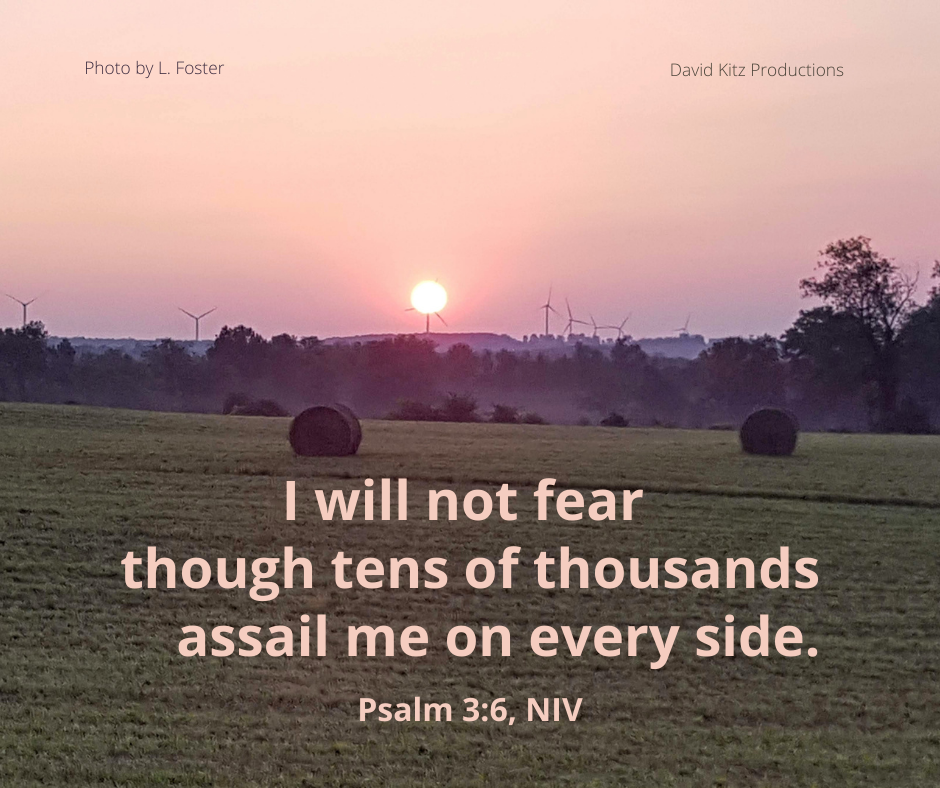
We froze in our tracks. We were shaken to the core. But now we knew what was out there. On that earlier occasion, only my faithful dog stood between us and that powerful predator. Without his fierce protection, two prairie boys may well have become a hungry cougar’s lunch and supper.

In a peculiar way, an unexpected encounter with the living God can be a lot like an encounter with a cougar. Suddenly, we realize our every move has been studied and watched; we are not alone. And that other being out there, watching us, is much bigger and more powerful than we are. Are you really prepared to meet Him around the next curve in the road, or just over the next hill?

Sometimes I think we seriously underestimate the fear factor when we speak of God with those who do not know Him. They are not prepared to meet Him, and the very thought of meeting Him should send them into bouts of soul-cleansing terror. The writer of the Book of Hebrews reminds us that “it is a dreadful thing to fall into the hands of the living God (Hebrews 10:31). In many instances, I believe intuitively, the ungodly understand this truth better than believers do. When was the last time you heard a soul-stirring message on the fear of the LORD? We prefer our God to be soft and cuddly, so we have defanged and de-clawed the Lion of the Tribe of Judah. We have relegated the God of fearful judgment to those unread pages of the Old Testament. Surely, we reason that God has reformed His ways.

But my God is still an awesome God. I have carefully avoided the use of the word awesome to describe the Almighty up to this point. I have avoided the word because it is over used and has lost its power. In its original form the word awesome connotes a confrontation—an encounter—with knee-buckling, soul-arresting, pant-wetting consequences. Awesome? Our God is not awesome. He is uber-awesome. No human language can begin to capture the vast and fearful awesomeness of this holy God.

Yet, it is this fear-inducing God that we are to seek. Why seek after a lesser god? We are commanded to search for Him, while He may be found. But why would we want to find this God, a God of holiness and judgment? How can we even coexist with this uber-awesome God?
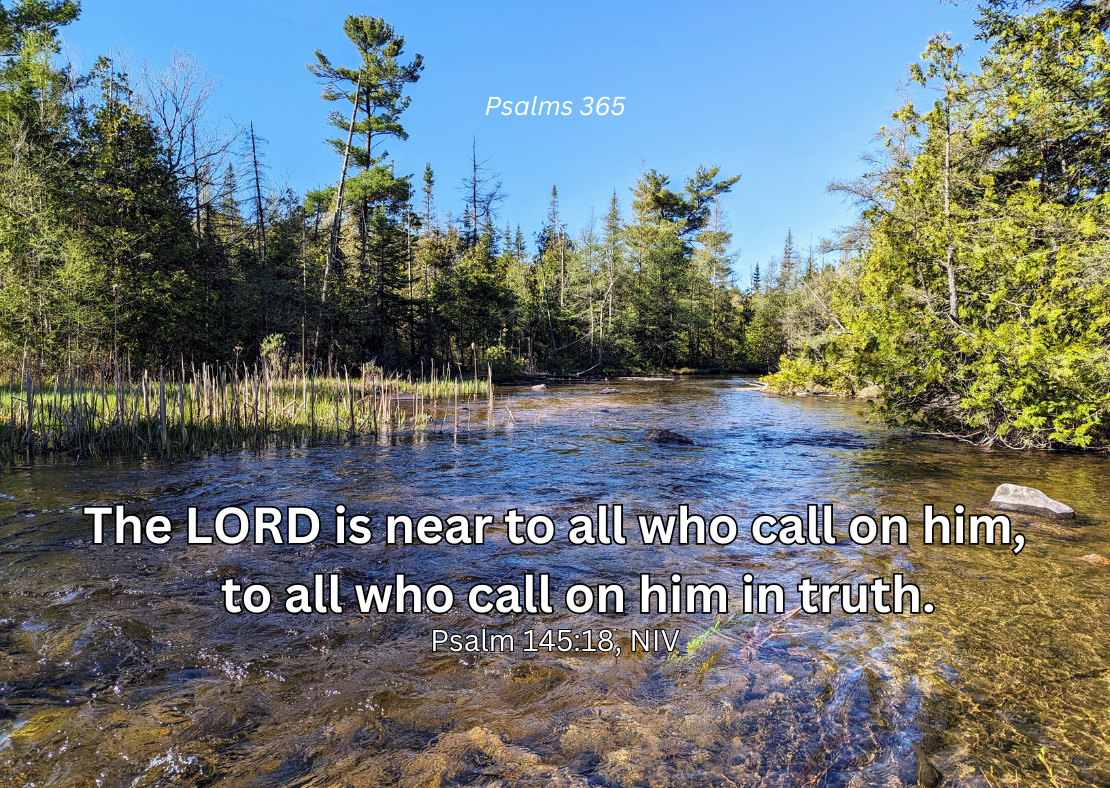
We must seek and find Him so that we can be forgiven. That is the only way that we can cohabit the same neck of the woods. And remember that though this God is hidden, He always knows our exact whereabouts, and He can pounce upon us in love or in judgment at any moment He chooses. David knew he needed to find Him so that he could be forgiven. I need His forgiveness too. I need this all-powerful, holy God on my side. I do not want to meet Him in judgment around the next bend. But rather I need to find God so that I can be reconciled to Him. Then I will discover that this hidden God is working behind the scenes on my behalf.

In 1 Chronicles we read of David celebrated the arrival of the Ark of the Covenant in Jerusalem, by teaching Asaph and his priestly associates a psalm. In that psalm David calls on the people of Israel to “look to the LORD and his strength; seek his face always. (1 Chronicles 16:11).

When in humility I call out to the strong One, and find Him, I want His strength working with me, in me and on my behalf.

About five hundred years after David taught the words to the above-mentioned Psalm, the idolatrous people of Judah went into exile. After a long siege Jerusalem was sacked and burned. The temple of the LORD was destroyed. Jeremiah, the weeping prophet, was charged with delivering God’s stark message of judgment to the people of that time.

What I find most remarkable about this grievous time of judgment is God’s command to Jeremiah. He is ordered by the LORD not to pray for the people of his homeland, “Do not pray for this people nor offer any plea or petition for them, because I will not listen when they call to me in the time of their distress” (Jeremiah 11:14).

In effect, God was saying that this was one of those times when He would be hidden from His people. He would not hear their prayers. They may seek after the LORD, but He would not be found. Though they cry out, the heavens would be as brass. Though I wish it were otherwise, there are times when God simply cannot be found. We read the word of God, and it is as dry and palatable as sawdust on our tongue. Our prayers fall to the ground lifeless like so much deadwood, and though we wait, no answer comes.

Fortunately seasons change. The cold winter of the soul does not last forever. Later, speaking of a time yet to come, Jeremiah reports, “Then you will call upon me and come to pray to me, and I will listen to you. You will seek and find me when you seek me with all your heart. I will be found by you,” declares the LORD, “and will bring you back from captivity” (Jeremiah 29:12-14).
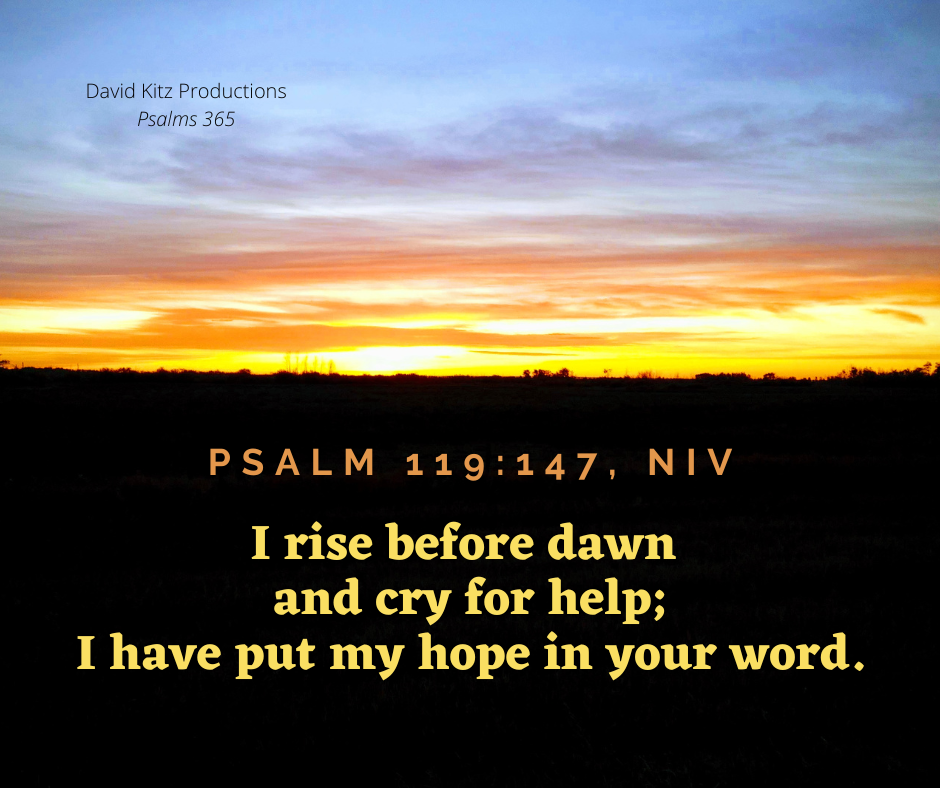
The lesson we can draw from all this is that we should never presume that God is standing by to do our beckoning. He reveals himself to us when, and as He sees fit. One believer may hear the audible voice of God, while another can hear of God only through someone else. To one believer God’s word is a feast of unmatched proportions, while another may struggle to glean even a single kernel from His word. One believer hears the wondrous love of God being trumpeted straight into his heart; another questions if God even cares. Strangely, on the road of life, the above-mentioned believers may find their roles completely reversed tomorrow. He, who was so full of faith, may find himself racked with doubt. He, who was so close, may find himself estranged.

If we have seen His face today, we cannot presume the hidden God will be showing us His face tomorrow. We must rejoice in what He has revealed of Himself today and holdfast, for we do not know what tomorrow brings.

So then let’s heed David as he admonishes us, “Let everyone who is godly pray to you, while you may be found.” 

If we have found the LORD, been forgiven by Him, and reconciled to Him, then we can build our lives on that rock, which is Christ. We can experience the security of the next statement that David makes in this Psalm. Surely when the mighty waters rise, they will not reach him. You are my hiding place; you will protect me from trouble and surround me with songs of deliverance.
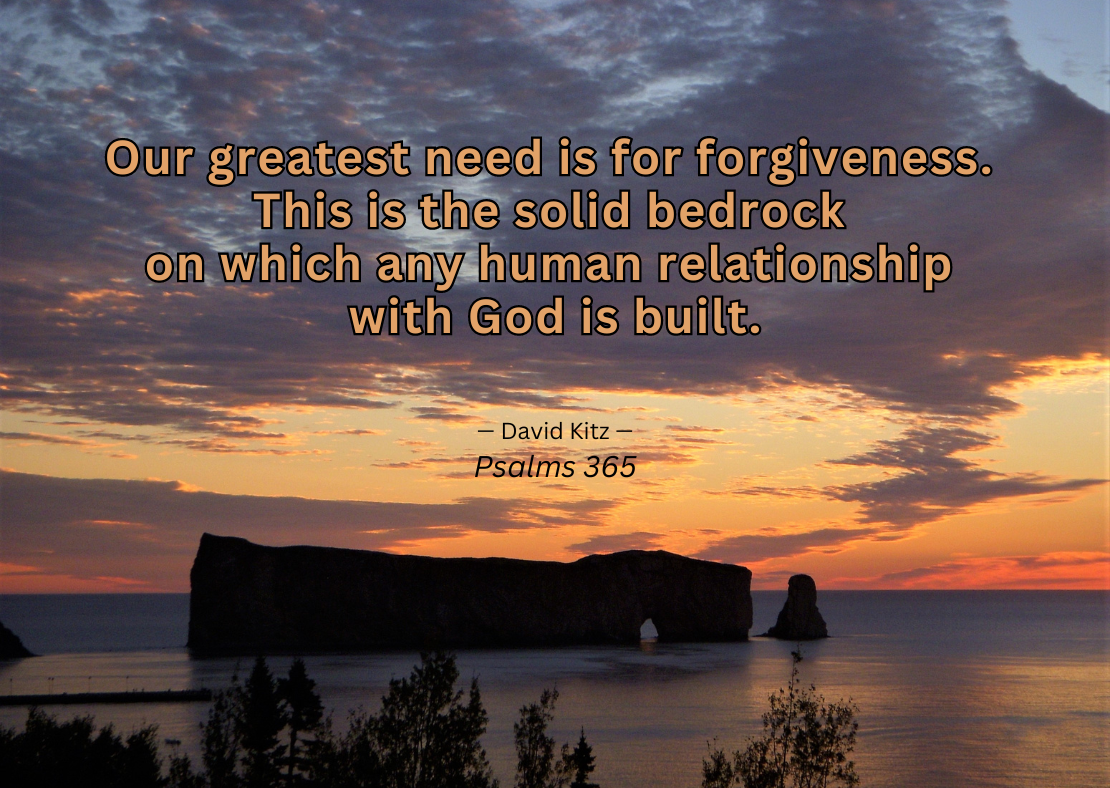
The Rock, which is Christ, stands above all else. There is no higher ground. He towers above the storms of life, immovable and secure. Surely, Jesus had this very passage in mind when he told the parable of the wise and foolish builders, as found in Matthew chapter seven. If we put Christ’s teaching into practice, we have a foundation set upon that high Rock. Though the storm winds blow, the rains beat down and the flood streams rise, they will not reach Him. And the destructive force of the mighty waters will not reach us either, if our life is built on Him.

At times of catastrophe, we can find rest in this hiding place. Noah knew that hiding place, during the greatest calamity to hit this planet. He also built his house, the ark, upon the Rock. When the rains began, it was the LORD who closed the door shutting him in. While all outside perished, Noah and his family were hidden in God. 

In the greatest storm to hit Europe during the twentieth century, a young Dutch woman found a hiding place in God. While Nazi terror reigned, Corrie ten Boom found refuge in the words of this psalm. Amid the horror of the concentration camp, she found a secret place, a hiding place secure from the raging storm.[1] 

The LORD becomes our hiding place. Take a moment to imagine that. The uber-awesome, hidden God becomes our hiding place. I am tucked snugly between the paws of the great and fearsome Lion of the Tribe of Judah. None can harm me there. No cougar, no wild beast, no human scheme, no demon from hell, can snatch me from between those fearsome, gentle paws. And while the storm rages, while the demons gnash their teeth, while kingdoms fall, I can hear the Lion’s purr. He is protecting me from trouble. He is surrounding me with songs of deliverance.

[1] The Hiding Place, by Corrie ten Boom, Random House Inc., 1982, paperback.

Bringing Life to the Psalms

  1. Have you read any of the books in the Chronicles of Narnia series by C. S. Lewis? Aslan, the great lion in the series, represents Christ, our redeeming king. Consider reading, The Lion, the Witch, and the Wardrobe, or you can rent the movie. Be prepared for a blessing as you draw the links between this children’s story and the great truths of the Gospel message
  2. What are you doing to seek God? This week take special note of how God reveals Himself to you. Watch for Him. If we are not careful, we can miss the ways He manifests His presence in our lives. A journal can be helpful way to record these events.
  3. We all need a shelter from the storms of life. Are you going through a difficult time right now? Throw yourself into the arms of Jesus. He knows how to shelter you.
  4. The God we seek also revealed Himself as the Saviour—the predator God—who actively seeks us. Jesus said, “The Son of Man came to seek and to save what was lost” (Luke 19:10). Take a moment to read the account of how Jesus pounced on Zacchaeus the tree-sitting tax collector. Jesus is a hunter—hunting sinners that he might save them. Read Luke 19:1-10 to catch a glimpse of the Lion of the Tribe of Judah on the prowl.
  5. There is something quite unnatural about humans seeking after God. C.S. Lewis said it was like the mouse seeking the cat. How is seeking God unnatural though we are commanded to do it?

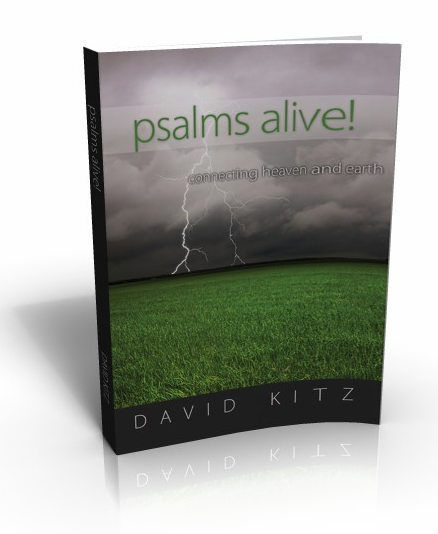
Today’s post is the seventh chapter from the book Psalms Alive! Connecting Heaven & Earth by David Kitz. To find out more or purchase click here.
Breaking the Dam

23 Sunday Mar 2025

Posted by davidkitz in Psalm 32, Psalms

≈ Leave a comment

Tags

beavers, Bible, confess, dam, David, forgiveness, forgiveness of sins, God, Jesus, Prayer, Psalms, the LORD, transgressions

Psalm 32:1-5

A Psalm of David
 

Blessed is he whose transgressions are forgiven,
whose sins are covered.
Blessed is the man whose sin the LORD does not count against him
and in whose spirit is no deceit. 
When I kept silent,
my bones wasted away through my groaning all day long.
For day and night your hand was heavy upon me;
My strength was sapped as in the heat of summer. (Selah)
Then I acknowledged my sin to you
and did not cover up my iniquity.
I said, “I will confess my transgressions to the LORD”
And you forgave the guilt of my sin. (Selah) 

Beavers are certainly among the most intelligent and industrious of all of God’s creatures. They are ingenious designers and builders of both homes and dams, which completely transform the environment in which they live. Only humans outperform them in this regard. In the wilderness their activity and its effects are a sight well worth seeing.

However, to the rural property owner, the arrival of beavers can turn into a disaster of appalling proportions. The gentle flowing stream that was a source of much pleasure is now blocked. Prized trees are daily being felled by these industrious little devils. Acres of valuable land are being turned into a fetid swamp. As the dam’s reservoir rises, hundreds more trees succumb to drowning. Their stark branches and dead trunks punctuate the sky. A blocked stream can produce an atrocious mess.

A right relationship with God is like a flowing stream. In such a relationship there is a natural giving to God that includes prayer, worship, time spent in His word, and periods of quiet communion. In turn, God by the Holy Spirit pours His peace, love and joy into our lives. And just as trees naturally line a riverbank, there is a verdant fruitfulness that comes to the believer as that refreshing current is allowed to flow.

Sin acts like a boulder hindering the flow of God’s Spirit in our lives. As more and more unrepented sin piles up, a dam is formed. Suddenly prayer stops. Worship and thanksgiving that once cascaded so freely from our lips comes to a halt. The word of God becomes boring, and we find other interests. Times of quiet communion with our Maker are replaced by a search for other things or for constant entertainment.

Now let’s read David’s description of the spiritual swamp his life was turning into because of unconfessed sin.

            “When I kept silent, my bones wasted away through my groaning all day long. For day and night your hand was heavy upon me. My strength was sapped as in the heat of summer.”

The flow had stopped. Where was the overflowing cup experience of Psalm twenty-three? At this point David’s cup—his soul—was sitting stagnant. And in the natural realm any liquid left unstirred becomes foul as time goes by.

As I write this, on the veranda below me there’s a small coffee table, and on that table sits a bottle of orange juice. I first noticed this bottle exactly a week ago when I first arrived here in Chicago. After passing this bottle several times on the way up to my room, I became curious and went over for a closer inspection. That’s when I discovered why the bottle was there. It was acting as a paperweight to keep a handwritten note from blowing away. No one would move the bottle in the hope that the unknown person, to whom the note was addressed, would finally show up. In the past few days, due to the summer sun and heat, the orange juice has taken on a rather brown hue.

Judging from David’s comment regarding the strength sapping heat of summer, we might assume that the contents of his soul had taken on a rather brown hue as well. The problem was he kept silent. Sin has an insidious way of silencing our relationship with God. We are not told what sin or transgression produced this damming effect. Yet that is just what it was. A dam caused by sin was now completely blocking up David’s relationship with God.

Perhaps it is better that we don’t know the particulars of David’s transgression here. A certain sense of personal spiritual superiority might set in. But sin is sin. Sin in any of its various forms fouls our relationship with God. James reminds us that a single sin can have huge consequences: “For whoever keeps the whole law and yet stumbles at one point is guilty of breaking all of it” (James 2:9).

What can break the sin dam and bring us back into a right relationship with God? David discovered the answer within this Psalm. Now, hear his pivotal words: Then I acknowledged my sin to you and did not cover up my iniquity. I said, “I will confess my transgressions to the LORD.”

Confession breaks the dam. David verbally brought his sin out in the open before God. He acknowledged what God knew all along. You see David’s sin was not hidden from God. It was in plain sight of the LORD from the moment of its conception.

Once again, the words of James are very instructive in this regard, as he states, “each one is tempted when, by his own evil desire, he is dragged away and enticed. Then, after desire has conceived, it gives birth to sin, and sin when it is full-grown, gives birth to death (James 1:14-15).

Sin was already working with deadly effect on David’s soul. By his own admission, his bones were wasting away, and his strength was sapped. Only a dam-busting experience could bring David back into right relationship with God, and restore the flow of praise, prayer and worship that had once been there.

One of the critical allied successes of World War II was the June 16, 1944, RAF raid on the Mohne and Eder dams on the Ruhr River system in Germany. To break the dams a specially designed spinning cylindrical bomb was created by British inventor Barnes Wallis. These huge bombs were dropped by specially modified Lancaster bombers from a height of sixty feet. The bomb would hit and skip across the surface of the water of the dam’s reservoir. They would then slam into the back of the dam, begin to sink, and then explode with massive dam-busting force. A decisive victory was achieved that night as these dam-busting bombs unleashed their power.

Fortunately, God has equipped each of us with dam-busting bombs to destroy the spiritual dams in our life—dams which our own sins have built. Words of confession and contrite acknowledgement are dam-busters. They break strongholds of sin, and in so doing they release the putrid dead waters that have backed up into our lives.

It is well worth noting that these putrid dead waters can be the cause of actual physical disease within our bodies. The human spirit is inextricably linked to the human body, and when our spiritual man is sick due to unrepented sin, physical ailments and sickness often follow. They are the natural by-products of a sin-blocked spirit.

When David states my bones were wasting away, and my strength was sapped as in the heat of summer, we can see these words simply as a nice poetic touch. But the stark reality is, spiritual sickness can produce a plethora of physical symptoms. Doctors have been aware of this link for many years now.

Again, the brother of our Lord has much to say on this point. Let’s look at his thoughts on this topic:

If you are sick, ask the church leaders to come and pray for you. Ask them to put olive oil on you in the name of the L
ord. If you have faith when you pray for sick people, they will get well. The Lord will heal them, and if they have sinned, he will forgive them. If you have sinned, you should tell each other what you have done. Then you can pray for one another and be healed (James 5:14-16 CEV).

What stands out most clearly in this passage is the link between physical healing and forgiveness. Confession is the bridge that re-establishes our link to God, and it is God who is the source of both forgiveness and healing. Re-establish the link, and the current of God’s grace can once again flow into your life.

I do dramatizations of the Epistle of James, and it is always amazing to hear accounts of what happens when God’s people put His word into action. In one case a pastor contacted me to report how a young woman in his congregation was miraculously healed of rheumatoid arthritis after watching me doing a dramatization of James. She acted on the word of God. Her relationship with her father was completely broken down. After confessing her faults and seeking restoration, God not only healed that relationship, He also healed her of the arthritis that had been crippling her body for years. The sin dam was broken, and God flooded her body with healing.

Can you hear the joy in David’s voice as he announces to the world, “And you forgave the guilt of my sin?”

The forgiveness of God is amazing. It breaks the chains of sin’s bondage. There is no liberation like the liberation of full and free forgiveness. It frees the tormented soul from guilt and sets the liberated individual on the path to heaven, the very path that all the saints have trod. Oh, that our nation would be awakened by the joyous cry of liberated sinners. We need a society-changing sinners’ liberation.

David experienced the dam-busting, soul-liberating power of the LORD’s forgiveness. Is it any wonder then that he begins this Psalm by announcing, “Blessed is he whose transgressions are forgiven, whose sins are covered. Blessed is the man whose sin the LORD does not count against him and in whose spirit is no deceit.”

David knew this blessed state of forgiveness.  Now for him, the long ledger of sin has been wiped clean. The debt has been paid. Any person who finds himself in such a position is truly blessed.

Yesterday’s gospel reading, at my home church here in Ottawa, was the Beatitudes from Jesus Sermon on the Mount. Each beatitude begins with the phrase, “Blessed are …” I wonder if in his mind, Jesus was using the opening lines of Psalm thirty-two as his springboard for launching into the Beatitudes. The blessed state of the forgiven is certainly a key theme throughout Jesus’ teaching and ministry.

There is a rather curious statement in the opening lines of this Psalm, and it is made in regard to our sins being covered. We are wonderfully blessed when our sins are covered. Yet only a few lines down David laments the fact that he tried to cover up his iniquity. On the one hand he is saying that our sin being covered is a good thing, and on the other hand covering our sins is terrible. David, what do you mean?

The question we need to ask ourselves is, “Who is covering my sin?”

If you are covering your sin, it is an abomination—an affront to God. God can see your sin and any amount of cover-up that you attempt is utter foolishness before the all-seeing, all-knowing LORD of the universe. Before Him the whole of it, is always fully exposed. David’s attempt to hide his iniquity was an act of sheer stupidity. Any of our attempts at sin-hiding, fall under the same category. It is a form of spiritual deceit. We must bring our sins out into the open before God. That’s what David eventually did, and that’s when forgiveness flowed. At that moment, David entered that blessed state, the blessed state of the forgiven.

But what happens to that exposed sin? God covers it. As believers who stand on this side of the cross, we know that Jesus covers it with his blood. Only the all-seeing, all-knowing God can cover our sin so well that even He cannot find it.

God gave us a lesson in sin covering on its very first occurrence in Genesis. Adam and Eve hid and covered their nakedness with fig leaves. Their cover-up was not acceptable to the LORD back then, even as our cover-up is unacceptable to Him now. We read, “The LORD God made garments of skin for Adam and his wife and clothed them” (Genesis 3:21).

The LORD covered them. He shed the blood of an animal to provide a covering of skins for them. Because I need a covering today, two thousand years ago the LORD God shed the blood of His one and only Son, so that I too could be covered. O, what a blessed covering that is!

Because of Jesus I am blessed. I am forgiven! How about you?


Bringing Life to the Psalms

  1. Words of contrite confession are like dam-busting bombs. Are there unconfessed sins that are clogging and hindering your relationship with God? Make it your priority to confess these sins to God. If your relationship with others has been affected, seek reconciliation with them. God desires that all our relationships be healthy and filled with the free-flowing life of His Spirit.
  2. Do a James five health check. If you are sick or disabled in anyway, ask the church leaders to anoint you with oil and pray for you. Jesus Christ is the same yesterday and today and forever (Hebrews 13:8). His healing grace is available to those who humbly call on him. And remember he still makes house calls.
  3. Read the Beatitudes as recorded in Matthew 5:3-12. Consider possible attitudinal links to Psalm 32.
  4. If forgiveness is a key theme in Jesus’ ministry and teaching, can you think of accounts in the Gospels that reflect this? Stumped? Here are a few quick references to check out: Mark 2:1-12; Luke 23:39-43; Luke 19:1-10; Luke 7:36-50; Luke 18:9-14

Today’s post is the sixth chapter from the book Psalms Alive! Connecting Heaven & Earth by David Kitz. To find out more or purchase click here.

Your Sworn Faithfulness

23 Sunday Mar 2025

Posted by davidkitz in Psalm 89

≈ Leave a comment

Tags

anointed, Bible, David, enemies, God's wrath, praise the LORD, Prayer, Psalms

I will praise the LORD!

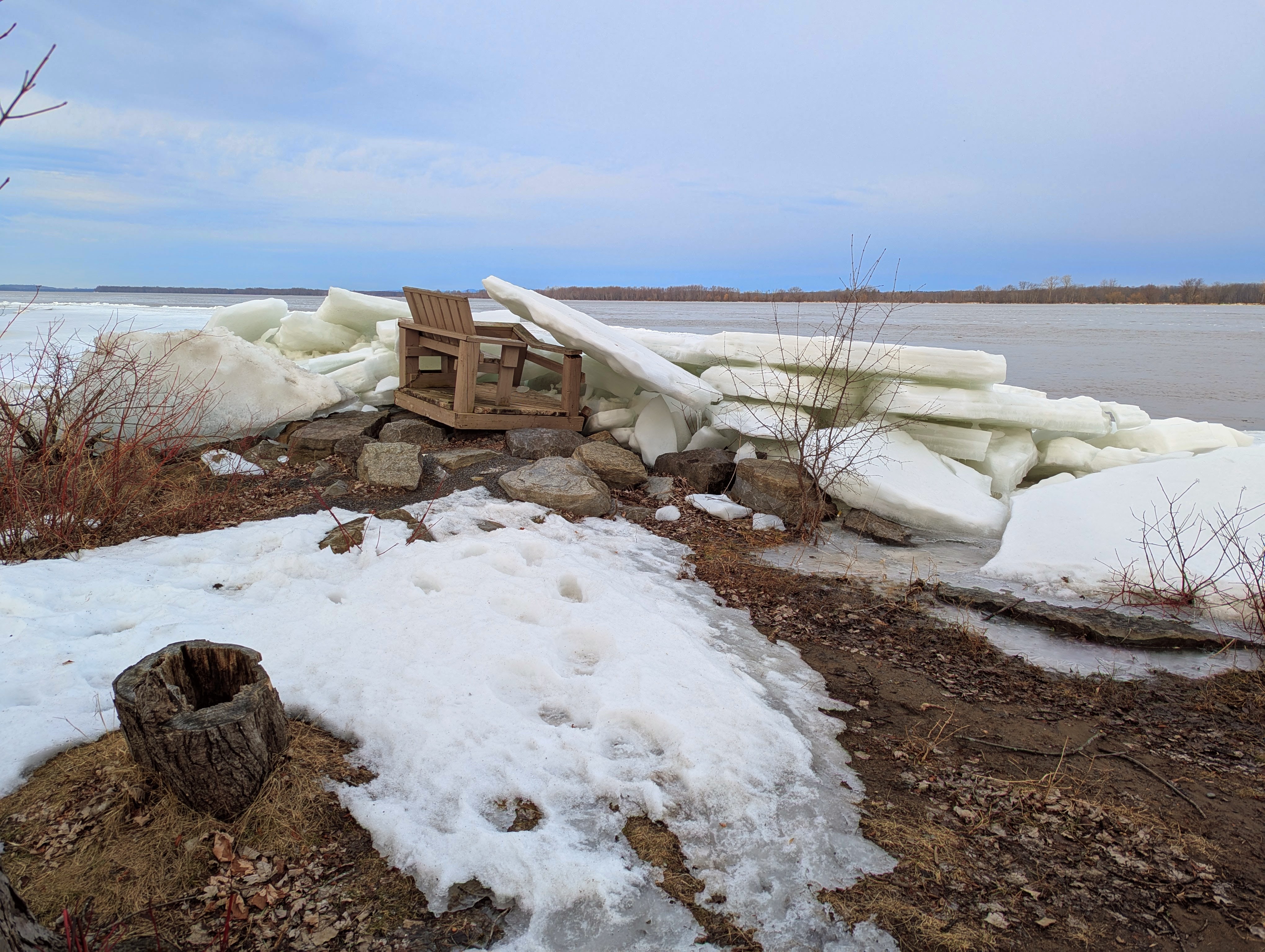
Ice jam on the shore of the Ottawa River — photo by David Kitz

Psalm 89:46-52

How long, LORD?
Will you hide yourself forever?

    How long will your wrath burn like fire?
Remember how fleeting is my life.
    For what futility you have created all humanity!
Who can live and not see death,
    or who can escape the power of the grave?
Lord, where is your former great love,
    which in your faithfulness you swore to David?
Remember, Lord, how your servant has been mocked,
    how I bear in my heart the taunts of all the nations,
the taunts with which your enemies, LORD, have mocked,
    with which they have mocked
every step of your anointed one.

Praise be to the LORD forever!
Amen and Amen.
*

Para la publicación de Salmos 365 de hoy en español haga clic aquí.

bgbg_v4.3_1501818
* NEW INTERNATIONAL VERSION, COPYRIGHT ©1973, 1978, 1984, 2011 BY BIBLICA

Please pray for peace to return to Israel, Gaza, and Ukraine!

Volume I of Psalms 365: Develop a Life of Worship and Prayer won the Best Book of the Year Award from The Word Guild and Volume II has won the Best Devotional of the Year Award. For those who love God’s word, this three-book series is an ideal way to begin the new year, and daily meet with the Lord. To purchase or for a closer look click here.

RGB72PsalmsVol2

A gripping read from David Kitz.
4485 SHARABLE-2

This biblically accurate novel is ideal for the Lent/Easter season.
For details click here.

The Rock My Savior.

22 Saturday Mar 2025

Posted by davidkitz in Psalm 89

≈ Leave a comment

Tags

anointed, Bible, David, God, praise the LORD, Prayer, Psalms, Savior, strength, the LORD, warrior

I will praise the LORD!


Psalm 89:19-29

Once you spoke in a vision,
    to your faithful people you said:
“I have bestowed strength on a warrior;
    I have raised up a young man from among the people.
I have found David my servant;
    with my sacred oil I have anointed him.
My hand will sustain him;
    surely my arm will strengthen him.
The enemy will not get the better of him;
    the wicked will not oppress him.
I will crush his foes before him
    and strike down his adversaries.
My faithful love will be with him,
    and through my name his horn will be exalted.
I will set his hand over the sea,
    his right hand over the rivers.
He will call out to me, ‘You are my Father,
    my God, the Rock my Savior.’
And I will appoint him to be my firstborn,
    the most exalted of the kings of the earth.
I will maintain my love to him forever,
    and my covenant with him will never fail.
I will establish his line forever,
    his throne as long as the heavens endure.
*

Para la publicación de Salmos 365 de hoy en español haga clic aquí.

bgbg_v4.3_1501818
* NEW INTERNATIONAL VERSION, COPYRIGHT ©1973, 1978, 1984, 2011 BY BIBLICA

Please pray for peace to return to Israel, Gaza, and Ukraine!

Volume I of Psalms 365: Develop a Life of Worship and Prayer won the Best Book of the Year Award from The Word Guild and Volume II has won the Best Devotional of the Year Award. For those who love God’s word, this three-book series is an ideal way to begin the new year, and daily meet with the Lord. To purchase or for a closer look click here.

RGB72PsalmsVol2

A gripping read from David Kitz.
4485 SHARABLE-2

This biblically accurate novel is ideal for the Lent/Easter season.
For details click here.

Psalm 23 — You Are with Me

16 Sunday Mar 2025

Posted by davidkitz in Psalm 23, Psalms

≈ 2 Comments

Tags

Darwin Awards, David, enemies, God, good shepherd, Jesus, Psalm 23, Psalms, sheep, the LORD

Psalm 23:4-6

Even though I walk through the valley
of the
shadow of death,
I will fear no evil,
for you are with me.
Your rod and your staff,
they comfort me.
You prepare a table before me
in the presence of my enemies.
You anoint my head with oil;
my cup overflows.
Surely goodness and love will follow me
all the days of my life,
and I will dwell in the house of the
LORD
forever. (NIV)

I’m alone tonight, and I’m eight hundred miles from home. One of my adult sons came with me on this trip to Chicago, but he left this afternoon for an overnight side trip with a friend. It rained all day, leaving me trapped indoors. I was hoping for some change in the weather, so I could go for a walk this evening, but the drizzle continues. I responded to an e-mail from my wife, but now I’m alone with my thoughts.

Life does not always hand us sunny days. I am reminded of that as I turn to this portion of Psalm twenty-three. As we follow the Good Shepherd, He may take us on a path we would not willingly choose. The valley of the shadow of death alludes to events and situations more serious than a bit of rainy-day blues. The loss of a parent, a child or a life partner is a deep valley indeed. But David’s response is most interesting. He confidently states, “I will fear no evil, for you are with me.”

But I can hear the incredulous sceptics asking, “David, you’re not afraid of evil? Don’t you know there is an enormous amount of evil out on the loose in this world? There is cancer. There’s AIDS and dementia. There are terrorists on the loose. Crime is rampant. Families are disintegrating. Our nation’s youth are going to hell in a filth-laced hip-hop spouting hand basket. David, you need to tune into the news. There are wars and rumours of wars, earthquakes and famines. We are living in the end times.”

To all this David’s reply is the same, “I will fear no evil, for you are with me.”

David’s confidence is unshaken. It is unshaken because he knows the Good Shepherd. He knows him well. And we can know him too. Jesus is not a fair-weather friend who disappears at the first hint of trouble. No, when the times get tough, He draws all the closer. During our darkest hour He holds us closest.

We need to remember who penned this Psalm. David repeatedly went through times of horrific loss. After achieving victory after victory, he lost favour with King Saul and had to flee for his life. He lost the affection of his first wife. He endured years of depravation as he was hunted like a common criminal. At one point he lost favour with his own men, and they were about to stone him. Jonathan, his dearest friend was killed in battle. His own beloved son led a revolt against him and sought to kill him. His closest friends and advisers turned away from him. He mourned the death of two of his sons. David was all too well acquainted with the valley of death. He descended its steep slopes on many occasions.

But despite all this he assures us, “I will fear no evil, for you are with me.” 

You see David was never alone. In his darkest hour the Bible records, David found strength in the LORD his God (1 Samuel 30:6). During those terrible times the Good Shepherd was near. He was in the service of the God who is with us.

David asserts, “Your rod and your staff, they comfort me.”

During those difficult times David drew comfort from the LORD’s presence right there beside him. There are really two aspects to be considered here when we look at the statement, “Your rod and your staff, they comfort me.” Both aspects are protective. On the one hand the Good Shepherd provides protection against the encroaching intruder; on the other hand, he protects us from ourselves.

Let’s look at the encroaching intruder first. I have spent enough time trekking about the forested wilderness of Canada to draw a certain comfort from carrying a good, sturdy stick. There is no telling what you may encounter around the next bend or over the next ridge. Not all wildlife fits under the category of small and cute.

Falling glory — photo by David Kitz

As a shepherd, David was keenly aware of predators that might harm his flock. Now listen to David’s boldness as he tells Saul how he defended his own flock of sheep:

“Your servant has been keeping his father’s sheep. When a lion or a bear came and carried off a sheep from the flock, I went after it, struck it and rescued the sheep from its mouth. When it turned on me, I seized it by its hair, struck it and killed it. Your servant has killed both the lion and the bear …” (1 Samuel 17:34-  36).

David knew how to use the rod to defend and rescue his flock. And he, himself was rescued from certain death, time and time again, by the Good Shepherd. The proverbial cat with nine lives has nothing on David. As you read first and second Samuel, you come to realize how frequently David escaped from the jaws of death. This rescuer of sheep was himself rescued on numerous occasions. He knew the comfort of the shepherd’s rod.

O, and what a tenacious Shepherd we serve! The Good Shepherd fights for His sheep. The roaring lion may approach but now listen to Jesus words concerning the sheep of His pasture. He says, “No one can snatch them out of my hand.”

There is a wonderful security that we can rest in as we follow this Heaven-sent Shepherd. 

Now let’s examine the second protective aspect we see in this statement, “Your rod and your staff, they comfort me.”

The LORD, who is my shepherd, protects me from myself. Sheep are not the brightest stars in the firmament. Intellectually, they do not rank very high in the animal kingdom. Some would go so far as to say that they are rather stupid. Consequently, sheep are apt to put themselves in harm’s way, rather than having the prudence to avoid it. 

Though as a collective, humanity sits on top of the intellectual heap, our innate ability to make stupid decisions is renowned. The annual Darwin Awards are a testimony to the ridiculously stupid things people do. These are actions stupid enough to get the instigators killed. This definitely is one award list you don’t want your name to appear on.

I confess that I have made enough dumb mistakes to fill every page of this book. Please excuse me for not providing all the details. If you have lived long enough, and have kept good records, you could probably do the same. Our daily prayer needs to be, “Dear Lord Jesus, please save me from myself.”

puzzlewharehouse.com

(Curiously, within two hours of writing the above paragraph, I locked my keys in my car. LORD, did I really need a fresh reminder of my ability to make dumb mistakes? I rest my case.)

In the spiritual realm we are particularly blind to danger. We prance right over to newest trap the devil has set for us. Snares? Pitfalls? What are those? We butt, shove and jostle the other sheep so we can get the best possible cliff-side view. Spiritual danger? What’s that?

The Good Shepherd wields the shepherd’s staff for good reason. He needs that staff to pull us back to safety. I am sure that the pastor of every church in the land could come up with a list of candidates for a Christian version of the Darwin Awards. To my shame, I might make that list myself.  

“Dear Lord Jesus, please save me from myself.”

Where would I be if the Good Shepherd lost His staff? May my grateful confession always be, “Your rod and your staff, they comfort me.”

You prepare a table before me in the presence of my enemies.

The stark truth is Satan and his cohorts have me surrounded. There is trouble and disaster lurking on every side. But in the middle of all this Jesus has prepared a feast for me—a banquet table spread with the most nutritious and delectable fare. There is the fresh-daily bread of heaven—the word of God. For the parched soul there is an endless supply of the water of life. Every fruit of the Spirit is there in abundance. And this Good Shepherd, who laid down His life for the sheep, has put His own body and blood on that banquet table. Now with a nail-scarred hand outstretched, he beckons, “Come. Come my beloved. Come and dine.”

Now don’t neglect His invitation. He will meet you there. And as you dine, be ever mindful of His words, “Whoever eats my flesh and drinks my blood has eternal life, and I will raise him up at the last day” (John 6:54).

David declares, “You anoint my head with oil.”

Surely as David penned these particular words, his mind recalled the most significant event of his life. No, it wasn’t the day he slew Goliath, or the day he was crowned king of all Israel and Judah. It was the day that the venerable old prophet Samuel dropped in on Jesse and his family for a visit. David being the youngest son was nearly overlooked, as he was out tending the sheep. Let’s take a brief look at what happened that day.

Samuel took the horn of oil and anointed him in the presence of his brothers, and from that day on the Spirit of the LORD came upon David in power (1 Samuel 16:13).

Photo by Kat Smith on Pexels.com

This passage makes it clear that all the great accomplishments of David’s life flowed from this singular experience. The Spirit of the LORD came upon David, and he killed the lion and the bear. The Spirit of the LORD came upon David, and he slew Goliath. The Spirit of the LORD came upon David, and he defeated the Philistines time and time again. And on and on it goes. There was a power source that came into David’s life that day, which defies natural explanation. It came as he was anointed, and the above passage makes it abundantly clear that this power source was the Spirit of the LORD.

David was anointed for a purpose. That purpose was to serve and lead the people of Israel. In due time that anointing brought him to the throne room. Has God anointed you to serve? Has the Holy Spirit come upon you in power?

Just a few hours ago I returned from a cycling excursion. It’s about seven miles from where I am staying here in Chicago to the downtown. I set out at a leisurely pace along beautiful Lakeshore Park. My pace quickened as I neared Navy Pier, my turn around point at the downtown core. This part of the trip was a breeze. After a brief rest I headed back. That’s when I discovered why the trip downtown had been so easy. The wind had been at my back. They don’t call Chicago the windy city without cause. Now my whole body was a sail pushing me in the opposite direction. I put in twice the effort and got half the results.

Trying to do God’s work and will without the help of the Holy Spirit is like that. But when the wind of God’s Spirit is at your back, there is real power in every stride you take. David experienced the anointing of the Good Shepherd, and it totally transformed his life.  The same Good Shepherd has an anointing for you as well.

When God’s anointing is present in someone’s life, their cup overflows. David’s experience in this regard can be yours as well. The good life that comes from following the Good Shepherd is an overflowing life. The Good Shepherd supplies more than enough joy, more than enough peace, more than enough love, mercy and forgiveness.

Take God at his word. As you follow the Good Shepherd expect goodness and love to follow you all the days of your life. Following Jesus is not intended to be a temporary measure, and neither is His blessing on your life intended to be temporary. His desire for you is a good life, a good life that extends through all eternity.

Now hear David’s finally confident declaration, “I will dwell in the house of the LORD forever.”

The Good Shepherd prepared a place for David. It’s a place in the household of God.  Before his departure Jesus told all his followers, “In my Father’s house are many rooms; if it were not so, I would have told you. I am going there to prepare a place for you” (John 14:2).

David’s occupying a room in that big house right now, and some great day in the future I plan to walk by that room. I expect I will hear a trickling noise, or maybe it will even be a gushing noise coming from within that room. That’s because I am sure of this one thing. David’s wonderful cup is still overflowing, and goodness and mercy are still following his every move.

Bringing Life to the Psalms

  1. Consider reading the biblical account of David’s life found in the Old Testament books of First and Second Samuel. These books provide a wonderful backdrop for any study of the Psalms.
  2. David was anointed for a purpose. Have you discovered how God wants you to serve Him? Take time to pray for clarity in this regard. Too many of God’s people are wondering aimlessly, when He longs to anoint them powerfully for specific service. We are called to serve. Into what vocation has God called you?
  3. Pull up a chair to the LORD’s banquet table. Be sure to read a portion of God’s word every day. When possible, make the celebration of the Lord’s Supper a regular part of your corporate worship routine.
  4. Take a minute to reread this entire incomparable psalm. What is the Good Shepherd saying to you by His Spirit?

Today’s post is the fifth chapter from the book Psalms Alive! Connecting Heaven & Earth by David Kitz. To find out more or purchase click here.
The Eternal Reign of King Jesus

10 Monday Mar 2025

Posted by davidkitz in Psalms

≈ Leave a comment

Tags

covenant, David, eternity, faith, history, Jesus, king, kingdom, promise, prophecy, Reflection, reign, Scripture, submission, worship

Today’s Devotion from Psalms 365 by David Kitz

Reading: Psalm 89:30-37
“If his sons forsake my law
and do not follow my statutes,
if they violate my decrees
and fail to keep my commands,
I will punish their sin with the rod,
their iniquity with flogging;
but I will not take my love from him,
nor will I ever betray my faithfulness.
I will not violate my covenant
or alter what my lips have uttered.
Once for all, I have sworn by my holiness—
and I will not lie to David—
that his line will continue forever
and his throne endure before me like the sun;
it will be established forever like the moon,
the faithful witness in the sky” (NIV). *

Reflection
Today’s reading from Psalm 89 continues the theme of King David’s endless rule through his offspring. “Once for all, I have sworn by my holiness—and I will not lie to David—that his line will continue forever and his throne endure before me like the sun; it will be established forever like the moon, the faithful witness in the sky” (v. 35-37).

There is however a sizeable problem with this promise to David for those who know biblical Jewish history. After the death of David’s son, the wise King Solomon, Israel was divided. The rebellious people of the northern Kingdom fell into idolatry and chose a new king, who was not a descendant of David. Despite warning after warning from prophets sent by God, Israel continued in its idolatrous ways until the nation was destroyed and swept away by Assyrian invaders in 720 BC.

On the other hand, for hundreds of years, generation after generation a descendant of David sat on the throne of the southern Kingdom of Judah. For the most part these were kings who followed in the footsteps of their ancestor David. They worshipped the LORD, unlike the idolatrous northern kings of Israel who ruled from their capital Samaria. But eventually pagan practises found their way into Judea as well. In succession, several kings—descendants of David—turned to worship idols. God’s judgment fell on Judah too when the Babylonians invaded and destroyed Jerusalem in 582 BC.

So, what is the point of this brief history lesson? The point is precisely this: These words from Psalm 89 are a lie, and God is a liar—a sworn liar to David—unless we view Jesus as the royal heir who rules for all eternity. The Jewish kingdom came to an end. No Jewish king has ruled over a Jewish kingdom for more than 2,000 years. But Jesus, the eternal son of King David reigns. Is he reigning over your life?

Response: LORD God, I submit to the reign of Jesus. You are my King—my King now and forever. Help me to govern my life according to your will and purpose. I praise you, my Savior and King. Amen.

Your Turn: Is Jesus your King? How can you show your submission to his rule today?

Para la publicación de Salmos 365 de hoy en español haga clic aquí.

bgbg_v4.3_1501818
* NEW INTERNATIONAL VERSION, COPYRIGHT ©1973, 1978, 1984, 2011 BY BIBLICA

Please pray for peace to return to Israel, Gaza, and Ukraine!

Volume I of Psalms 365: Develop a Life of Worship and Prayer won the Best Book of the Year Award from The Word Guild and Volume II has won the Best Devotional of the Year Award. For those who love God’s word, this three-book series is an ideal way to begin the new year, and daily meet with the Lord. To purchase or for a closer look click here.

RGB72PsalmsVol2

A gripping read from David Kitz.
4485 SHARABLE-2

To purchase or for a closer look click here.

Psalm 23 — The Good Life

09 Sunday Mar 2025

Posted by davidkitz in Psalms Alive!

≈ 2 Comments

Tags

Bible, David, God, good shepherd, Jesus, Prayer, Psalm 23, Psalms, Righteousness, sheep, shepherd, the LORD

Psalm 23:1-3
A Psalm of David

The LORD is my shepherd,
I shall not be in want.
He makes me lie down in green pastures;
He leads me beside quiet waters.
He restores my soul.
He guides me in paths of righteousness
for his name’s sake.

Yesterday I went for a long walk and pleasant walk through Lincoln Park, which straddles Lake Michigan in Chicago. It was a perfect summer day. Children were playing on the long sandy beach. Waves danced in the sunlight.

From that weekday afternoon stroll, several visual vignettes remain cemented in my mind. There were the four strapping young men caught up in a game of beach volleyball. Another fine-looking young man rolled by me on his bicycle. Later I saw him stretched out on the seawall, stripped to his shorts, perfecting his tan. Down by the marina, two attractive young ladies in bathing suits were in animated conversation as I walked by. One of them even glanced my way. Farther on, sitting on a park bench, a first-time father dandled and bounced his blond two-year-old on his knees. The beaming lad greeted me with a smile that simply invited conversation. Still at the marina, a middle-aged couple parked their Cadillac SUV. Later I saw them sail their yacht out of the bay. It was a perfect day for sailing.

Ah, the good life! There’s nothing like it. People in pursuit of the good life, that’s what I was watching. In fact, that’s what I, myself was enjoying—a slice of the good life.

The truth is all of us want the good life. Is that a wrong desire? Or is it simply the way God made us. We want a life filled with pleasant experiences—a life we can look back on and say, “Now that was a life worth living. That was a good life!

Somehow many of us have developed a rather perverse view of God. Isn’t He that supreme killjoy in the sky? Doesn’t He get His kicks by shutting down anything resembling fun? We have this sense that if we are enjoying ourselves too much, God somehow can’t be in it. Has God become for you a severe, demanding taskmaster?

Gatineau & Ottawa from the Chief William Commanda Bridge — photo by David Kitz

Is that a correct biblical view of God? And what does all this have to do with Psalm twenty-three? Well, if there is a biblical recipe or prescription for the good life, I would say that it can be found in the words of this Psalm. This is a Psalm that drips with satisfaction. It oozes with the very fullness of life; it overflows with a quiet peace. There is a mellow ripeness to these words that runs down your chin, lights a spark in your eye, and puts a spring in your step. 

The LORD is my shepherd, I shall not be in want. 

The first line is the key to it all. Is the LORD your shepherd? If He is, then all the rest follows. The fullness, the goodness, the love, simply come trailing along behind Him as you follow in His steps. This is so easy, so obvious; you can miss it, because it seems far too simple.

We live in a world that is in feverish pursuit of the good life. The self-centered pursuit of happiness has become the crowning, but ever elusive goal. The word ‘pursuit’ says it all. Apparently, happiness is something we are to chase after. According to this life model, more is always better, to settle for sufficiency is to settle for second best. The race is on. To the winner goes the ever-retreating prize. Oops! There it goes. It just slipped over the next hill.

What a profoundly different model for the good life is found within the words of this Psalm. The good life, which in our hearts we all seek, is anchored in the Good Shepherd. Jesus is that Good Shepherd. Listen to his words, “I am the good shepherd; I know my sheep, and my sheep know me” (John 10:14).

At rest — photo by David Kitz

It is in following Him, rather than following our own desires, that happiness comes. There is an abundance that comes into play the moment we surrender our stubborn will to the Good Shepherd. Now hear the promise in David’s words, “I shall not be in want.”

There is freedom from worry contained in these words. He is the shepherd of ‘more-than-enough.’ One Bible translation puts this promise of sufficiency this way, “I don’t lack a thing.” David sees himself as amply supplied. That is the very nature of the Good Shepherd. He will always make sure his followers have more than enough.

It is worth noting that Jesus first great sermon zeroed right in on this concept of freedom from worry. He wanted his disciples, his followers, to fully understand this, so he teaches that He who clothes the grass of the field will clothe them as well. He who feeds the birds will be sure to provide food for them as well. And this freedom from worry is not rooted in some mindless feel-good sloganeering. No, it is rooted in the sure and dependable promise of God. Hear Jesus as he throws out the challenge to all of us, “Seek first his kingdom and his righteousness, and all these other things will be given to you as well (Matthew 6:33).

The Good Shepherd is still calling his sheep. Those who hear his voice and follow will know the full meaning of these words: I shall not be in want.

To a world caught up in chasing after happiness, the Good Shepherd brings rest.

He makes me lie down in green pastures; he leads me beside quiet waters.

Our God is a God of rest. Rest was his idea. The Almighty was not exhausted by the work of creation. He did not rest on the seventh day because He was plum tuckered out. He rested for our sakes, to teach us a permanent lesson on the value of rest and relaxation. He beckons us to come away to the quiet waters. There is something calming about a body of water. There is a therapy to be found at the water’s edge. Water at rest brings rest to the weary soul. There is a kind of divine magic that quiet water can work upon our frazzled psyche. I dare say all of us have felt its power.

He restores my soul.

O, what promise there is in these words! Can you hear the Good Shepherd calling? Listen to his beckoning call, “Come to me, all you who are weary and burdened, and I will give you rest” (Matthew 11:28).

To the world weary, to the chasers after fleeting pleasure, to those battered by disappointment, to those trapped in the downward spiral of sin, Jesus is calling. To those who hear and follow he brings rest. And with that rest comes restoration.

There is a great redeeming lesson here. We are not saved by our works. A never-ending cycle of human effort will not open heaven’s door. The door is opened when we come to rest—rest in Jesus—rest in the nail scarred hands of the Good Shepherd. He has done the work for you. Now just come and rest. Rest in Him. Your soul’s salvation is a rest. It’s not a work. It’s not achieved by your effort, because salvation’s source is not in you, but in Him.

The Good Shepherd is in the complete restoration business. He restores souls burned out by addiction, brings hope to the depressed, victory to the defeated, imperishable value to those tossed out on the trash heap of society.

He restores my soul. Has he restored your soul? If you put your souls in His hands, Jesus will do the work.

He guides me in paths of righteousness for his name’s sake.
Here we see the shepherd in his most visible and obvious role. He is the guide, the leader of the flock. He takes the sheep out to pasture and then back to the sheepfold. Have you surrendered the leadership role in your life to the Good Shepherd? Are your decisions made in full submission to the LORD? Are you the leader, or is He?

This is not a decision that is settled once for all time. On the contrary this is a daily conscious decision to follow where the Good Shepherd leads. Where He leads today, may be totally different from where He leads tomorrow. Are you willing to change course? Are your ears open to hear the shepherd’s call?

David grew up doing the work of a shepherd, so we can assume he knew a great deal about sheep. One of the distinguishing features of sheep is their predisposition to flock together and be followers. Goats on the other hand are a stubborn, ornery and independent lot. They follow no one. They are masters of their own destiny. Are you a goat or a sheep?

Men in particular are raised to be independent, self-directed leaders. Surrendering leadership to someone else runs contrary to our upbringing, what we have been taught at school, how we have been socialized, and our natural disposition. But that is exactly what the LORD asks us to do. 

It is precisely this aspect of Psalm twenty-three, which personally gives me the most trouble. You see, I always think I know what is best for me. Why should I let someone else decide what is best for my life? Yes, in my mind I can tell myself that God is good, and that He will be good to me, but He’s not living in my skin, facing my problems, or confined to the limitations that I encounter.

But wait just a minute. Let’s examine those three objections one by one.

 ‘He’s not living in my skin.’ That’s an outright lie spawned by the devil. I invited Christ into my heart.  He is in residence there. Jesus is in fact living in my skin. He is at work within me, helping me daily to live out His characteristics and attributes. The apostle Paul writes, “Christ lives in me. The life I live in the body, I live by faith in the Son of God, who loved me and gave himself for me” (Galatians 2:20). In effect, what Paul is saying here is that the Good Shepherd laid down his life for me, and now He has taken up residence within me, and as I live by faith, He will pilot me on the right course for my life. 

Now let’s look at the second objection. ‘He’s not facing my problems.’ This can only be true if I have if I have blocked my ears to the Good Shepherd’s call, and if I am hastily trotting off in the opposite direction. Please keep in mind that choosing to cut and run is an option which any believer can choose at any time. You see, when I first surrendered to Christ, a huge vacuum cleaner did not descend from the sky and suck the brains out of my head. My brain was not replaced by a circuit board connected by wireless to the Great Central Control up in the sky. My decision to follow Jesus must be renewed daily. The Good Shepherd leaves my free will intact. I am always free to choose or reject Him and His plan for my life.

If I truly belong to the Good Shepherd, then my problems are His problems. He is my burden bearer. I am yoked with Him. Jesus and I form a two-man team. Listen to His words, “Take my yoke upon you and learn from me, for I am gentle and humble in heart, and you will find rest for your souls. For my yoke is easy and my burden is light” (Matthew 11:29-30). 

The Good Shepherd is gentle and humble, not harsh and demanding. As I bring my problems to him, I find they are lighter. He carries the heavy end, while I find the rest that I desperately need.

Now what about that last objection, ‘He’s not confined to the limitations that I encounter?’ This objection presumes that Jesus is unsympathetic about the obstacles and difficulties that I face in life. Over and over again, I am frustrated by my limited resources, lack of time, and an inability to see what the future holds. The truth is this is precisely why I need to submit my life to the Good Shepherd. He knows the future, can supply limitless resources, and can arrange my time for maximum benefit. When I choose to follow Him, He knows exactly what is over the next hill. Furthermore, He has made provision in advance. Why then do I foolishly cling to the mistaken notion that I know what is best, when I am blind to what lies ahead? Pride and a lack of trust are the most likely causes of this spiritual short-sightedness.

Photo by Pixabay on Pexels.com

To experience the good life that the Good Shepherd would lead us into, we must humble ourselves and follow. We must trust that He is truly good all the time, even in times when we do not understand his leading, or why He has us walking on this particular path. I have found that in time as I submit and follow, He makes all things clear. He can be trusted. 

Finally, we need to recognize the full truth of these words, “He guides me in paths of righteousness for his name’s sake.“ The paths he chooses for us are paths of righteousness. Righteousness is not always the easiest path. We can be sure it is the best path, but the easiest? We have no guarantee of that. Doing the right thing does not always lead to accolades from our peers or those above us in rank or responsibility. But ultimately our accountability is to a much higher authority. The Good Shepherd reminds us that, “Wide is the gate and broad the road that leads to destruction, and many enter through it. But small is the gate and narrow the road that leads to life, and only a few find it” (Matthew 7:13-14). Jesus is the guide along that narrow road.

Remember Jesus has you walking paths of righteousness for his name’s sake. The good life is about bringing glory and honor to Him. You see it’s not about you or me at all. It’s all about Him. The good life cannot be lived for self. It must be lived for Jesus and others. That’s where the blessing is. The richest lives are the poured-out lives. They overflow with goodness, love and peace because they have tapped into the ocean of God.

Bringing Life to the Psalms

  1. Consider reading a biography of a person who truly lived the good life. People like Hudson Taylor, Mother Teresa, William Wilberforce, Helen Keller and Martin Luther King spring to my mind. Perhaps you can think of others who heard the Good Shepherd and then followed with all their heart.
  2. Plan a rest break, preferably beside some quiet water. Use some of that rest time to read, reread and meditate on Psalm twenty-three.
  3. What objections do you raise rather than following the Good Shepherd? Do they follow a similar pattern to those raised in this chapter? Which one do you use most frequently?
  4. Have you left the path Jesus has for you? If he is calling you back, make this the day you heed His voice and follow Him anew.

Today’s post is the fourth chapter from the book Psalms Alive! Connecting Heaven & Earth by David Kitz. To find out more or purchase click here.


I Will Make Your Faithfulness Known

09 Sunday Mar 2025

Posted by davidkitz in Psalm 89

≈ 2 Comments

Tags

Bible, David, generations, God, God's faithfulness, praise the LORD, Prayer, Psalms, the LORD

I will praise the LORD!


Psalm 89:1-8

A maskil of Ethan the Ezrahite.

I will sing of the LORD’s great love forever;
    with my mouth I will make your faithfulness known
    through all generations.
I will declare that your love stands firm forever,
    that you have established your faithfulness
in heaven itself.
You said, “I have made a covenant with my chosen one,
    I have sworn to David my servant,
‘I will establish your line forever
    and make your throne firm through all generations.’”

    The heavens praise your wonders, LORD,
your faithfulness too,
in the assembly of the holy ones.

For who in the skies above can compare with the LORD?
Who is like the LORD among the heavenly beings?
In the council of the holy ones God is greatly feared;
he is more awesome than all who surround him.
Who is like you, LORD God Almighty?
You, LORD, are mighty,
and your faithfulness surrounds you.
” 
*

Para la publicación de Salmos 365 de hoy en español haga clic aquí.

bgbg_v4.3_1501818
* NEW INTERNATIONAL VERSION, COPYRIGHT ©1973, 1978, 1984, 2011 BY BIBLICA

Please pray for peace to return to Israel, Gaza, and Ukraine!

Volume I of Psalms 365: Develop a Life of Worship and Prayer won the Best Book of the Year Award from The Word Guild and Volume II has won the Best Devotional of the Year Award. For those who love God’s word, this three-book series is an ideal way to begin the new year, and daily meet with the Lord. To purchase or for a closer look click here.

RGB72PsalmsVol2

A gripping read from David Kitz.
4485 SHARABLE-2

This biblically accurate novel is ideal for the Lent/Easter season.
For details click here.

In the Day of Your Power

07 Friday Mar 2025

Posted by davidkitz in Psalm 89, Psalms

≈ Leave a comment

Tags

Bible, David, God, Jesus, Melchizedek, Prayer, priest, Psalms, Savior, strength, the LORD

Today’s quote and prayer from
“Psalms 365: Develop a Life of Worship and Prayer”
by David Kitz.

Reading: Psalm 89:19-29

LORD God,
 I am thankful for Jesus.
I am thankful that in the dark long ago
you devised a plan to send a Savior
to this world.
You sent a better son than David.
You sent Jesus,
my Redeemer.

Amen.

— — —

A Psalm of David.

The LORD said to my Lord,
“Sit at My right hand,
Till I make Your enemies Your footstool.”
The LORD shall send the rod of Your strength out of Zion.
Rule in the midst of Your enemies!
Your people shall be volunteers
In the day of Your power;
In the beauties of holiness,
from the womb of the morning,
You have the dew of Your youth.
The LORD has sworn
And will not relent,
“You are a priest forever
According to the order of Melchizedek.”
(Psalms 110:1-4)*

Para la publicación de Salmos 365 de hoy en español haga clic aquí.

bgbg_v4.3_1501818
* NEW KING JAMES VERSION

Please pray for peace to return to Israel, Gaza, and Ukraine!

New from David Kitz
Winner of the 2024 Word Award of Merit in Biblical Studies
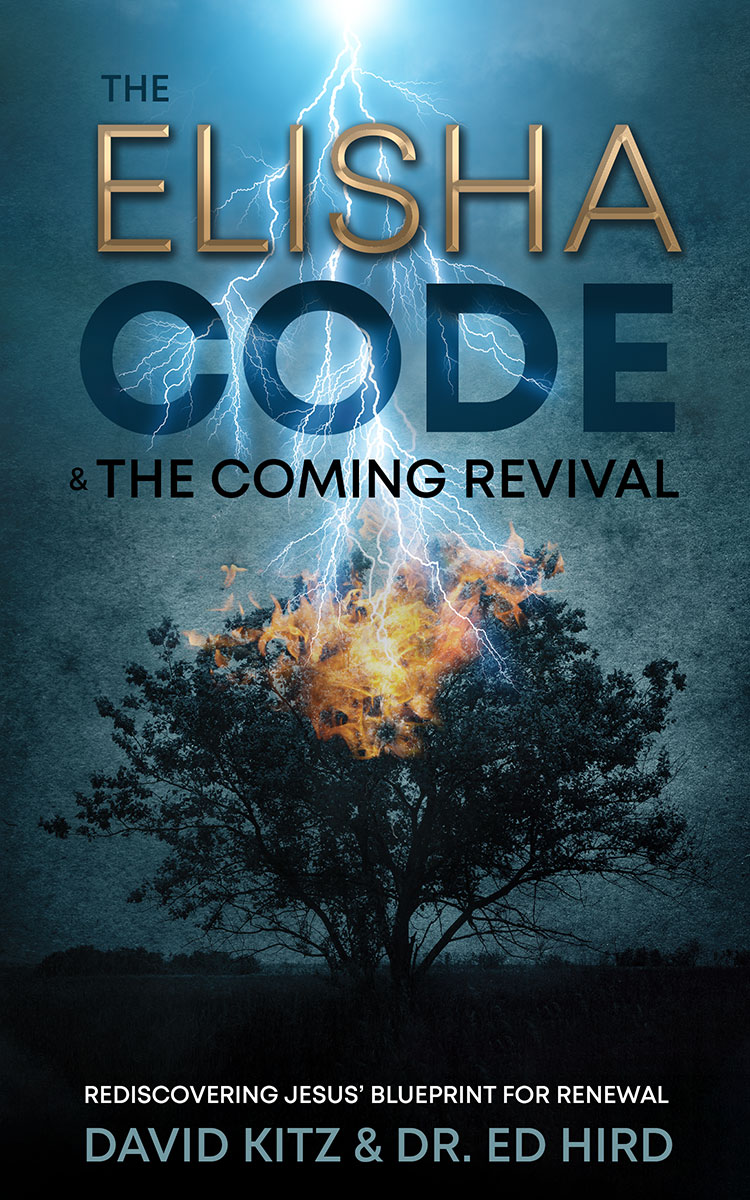
TheElishaCodeCVR5

To purchase or for a closer look click here.

Volume I of Psalms 365: Develop a Life of Worship and Prayer won the Best Book of the Year Award from The Word Guild and Volume II has won the Best Devotional of the Year Award. For those who love God’s word, this three-book series is an ideal way to daily meet with the Lord. To purchase or for a closer look click here.

This biblically accurate novel is ideal for the Lent/Easter season.
For details click here.

The Firstborn King

07 Friday Mar 2025

Posted by davidkitz in Psalms

≈ 3 Comments

Tags

anointing, covenant, David, faithfulness, Jesus, kingship, promise, prophecy, Savior, thanksgiving

Today’s Devotion from Psalms 365 by David Kitz

Reading: Psalm 89:19-29
Once you spoke in a vision,
to your faithful people you said:
“I have bestowed strength on a warrior;
I have raised up a young man from among the people.
I have found David my servant; with my sacred oil I have anointed him.
My hand will sustain him; surely my arm will strengthen him.
The enemy will not get the better of him;
the wicked will not oppress him.
I will crush his foes before him and strike down his adversaries.
My faithful love will be with him,
and through my name his horn will be exalted.
I will set his hand over the sea, his right hand over the rivers.
He will call out to me, ‘You are my Father,
my God, the Rock my Savior.’
And I will appoint him to be my firstborn,
the most exalted of the kings of the earth.
I will maintain my love to him forever,
and my covenant with him will never fail.
I will establish his line forever,
his throne as long as the heavens endure (NIV). *

Reflection
Who is the principal figure in the Old Testament canon? Some would argue for Moses, the liberator of a nation of slaves. Others would go farther back yet to Abraham, the ancestral father of the nation of Israel. Here in Psalm 89, Ethan the Ezrahite and author of this psalm casts his vote in favor of David.

David’s name appears more frequently in the Bible than any name including the name of Jesus. Here in Psalm 89, Ethan draws a direct prophetic link to Jesus, the Son of God. He writes this about David: He will call out to me, ‘You are my Father, my God, the Rock my Savior.’ And I will appoint him to be my firstborn, the most exalted of the kings of the earth (v. 26-27).

No other man in the Holy Scriptures can claim to be appointed as God’s firstborn. This is an honor that is reserved for David alone. But David prefigures or foreshadows Jesus, the true Son of God. Jesus was not appointed to the role of God’s son. He was conceived and born into this world as the divine Son of the Most High. Through the miracle of incarnation, the son of Mary was also the Son of God and the Savior of the world. And this Mary was of royal lineage. She was a direct descendant of King David.

In Jesus Christ these words find their fulfillment: I will maintain my love to him [David] forever, and my covenant with him will never fail. I will establish his [David’s] line forever, his throne as long as the heavens endure (v. 28-29).

Response: LORD God, I am thankful for Jesus. I am thankful that in the dark long ago you devised a plan to send a Savior to this world. You sent a better son than David. You sent Jesus. Amen.

Your Turn: Are you thankful for God’s Son? Why? How will you express your appreciation today?

Para la publicación de Salmos 365 de hoy en español haga clic aquí.

bgbg_v4.3_1501818
* NEW INTERNATIONAL VERSION, COPYRIGHT ©1973, 1978, 1984, 2011 BY BIBLICA

Please pray for peace to return to Israel, Gaza, and Ukraine!

Volume I of Psalms 365: Develop a Life of Worship and Prayer won the Best Book of the Year Award from The Word Guild and Volume II has won the Best Devotional of the Year Award. For those who love God’s word, this three-book series is an ideal way to begin the new year, and daily meet with the Lord. To purchase or for a closer look click here.

RGB72PsalmsVol2

A gripping read from David Kitz.
4485 SHARABLE-2

This biblically accurate novel is ideal for the Lent/Easter season.
For details click here.

← Older posts
Newer posts →

Psalms 365: Develop a Life of Worship and Prayer

Psalms 365 Volume II

Psalms 365 vol 3
— Psalms 365 Volume III

Psalms

Recent posts

  • Adversity Brings Character Development March 17, 2026
  • Jesus Predicts Peter’s Denial March 16, 2026
  • What brings success? March 16, 2026
  • A Prayer to the God of My Life March 15, 2026
  • A House Divided March 15, 2026
  • Longing for God March 14, 2026
  • A New Command March 13, 2026

Calendar

March 2026
M T W T F S S
 1
2345678
9101112131415
16171819202122
23242526272829
3031  
« Feb    

Blog Posts

Comments

  • davidkitz on What brings success?
  • cjsmissionaryminister on What brings success?
  • davidkitz on A House Divided

Blog at WordPress.com.

Privacy & Cookies: This site uses cookies. By continuing to use this website, you agree to their use.
To find out more, including how to control cookies, see here: Cookie Policy
  • Subscribe Subscribed
    • I love the Psalms
    • Join 1,382 other subscribers
    • Already have a WordPress.com account? Log in now.
    • I love the Psalms
    • Subscribe Subscribed
    • Sign up
    • Log in
    • Report this content
    • View site in Reader
    • Manage subscriptions
    • Collapse this bar
 

Loading Comments...