• Home
  • About
  • DavidKitz.ca
  • Youtube Videos
  • Books by David
  • Books on Amazon.com

I love the Psalms

~ Connecting daily with God through the Psalms

I love the Psalms

Tag Archives: epistle of James

James—His Death and Legacy

19 Sunday Jul 2026

Posted by davidkitz in Books by David Kitz

≈ 1 Comment

Tags

Christ, church, conspiracy, epistle of James, faith, Gentile, gospel, James, James the brother of Jesus, Jerusalem, Jesus, Judaism, leadership, ossuary, Paul, Peter, power of words, Scripture, wisdom, writing voice

———— Epilogue ————
The Tipping Point

James: the Lynchpin of Our Faith

After Paul gives his mission report before James and the elders in Acts 21, one of the elders (possibly James) makes a statement that hints at the growing power and influence of the church in Jerusalem:

When they heard this, they praised God. Then they said to Paul: “You see, brother, how many thousands of Jews have believed, and all of them are zealous for the law.” (Acts 21:20)

Scholars are divided about the size and influence of the Jewish church prior to the sacking of Jerusalem and the destruction of the temple by the Romans in AD 70. In addition to Luke’s account in Acts, there is a growing body of evidence from the historical record that suggests the Jewish church was reaching a cultural or religious tipping point. That would mean the growth in the numbers of adherents was so significant it was possible to imagine Christianity becoming the dominant belief system right in heart of Judaism.

Historically, the possibility of an outbreak of persecution increases significantly when the rapid growth of Christianity approaches a tipping point within a previously homogeneous culture. This was the case in Japan when the warrior general Toyotomi Hideyoshi unleashed a wave of persecution. On February 5, 1597, he ordered the crucifixion of twenty-six Christians in Nagasaki to discourage conversions, which were becoming increasingly common. By the late 1500s Christianity in Japan was reaching a tipping point. Martyrdom and slaughter stopped the spread of Christianity in its tracks.

The triumphal entry into Jerusalem

Currently, much of Boko Haram’s persecution of Christians in northern Nigeria can be seen as a backlash against the rapid growth of the faith in that predominantly Muslim region during recent decades.

For the church in Jerusalem, severe persecution after the martyrdom of Stephen was followed by a period of relative peace due to the conversion of their chief antagonist Saul of Tarsus. For roughly two decades there was an uneasy peace between the two camps. But the growth of Christianity among the Jewish diaspora did not sit well with Jewish religious authorities. Similarly, the churches’ inclusion of Gentile converts in the faith raised the ire of Jewish religious purists. The riot surrounding Paul’s arrest in the temple courts was proof of that.

High taxes and unrest with Rome only compounded the religious tension. Religious zealots resisted paying taxes since Roman coinage was offensive to them.

Roman coins had pictures of their goddess Roma or their divine emperor, which broke Jewish religious strictures against graven images and paying tribute to other gods. To make matters worse, the procurators who collected these impossible sums (Pontius Pilate was one) were in the main corrupt men who despised Jews. (1)

It appears that a tipping point was reached with the election of the new high priest Ananus. Ananus found an ideal opportunity to act against James, this troubling thorn in his side.

According to the Jewish historian Josephus, writing ca. 94, James with “certain others” was stoned in 62 at the instigation of the Sadducee high priest Ananus, as one of his first acts as high priest. Ananus was able to carry out the execution because the newly appointed Roman procurator, Albinius, had not arrived yet in Palestine. (2)

Give me oil in my lamp — Matthew 25:1-13

There is no scriptural account of the death of James. What knowledge we have comes from church tradition and relies heavily on two sources, the writings of Josephus noted above and Hegesippus. Hegesippus provides more of a plot line to this story.

According to Hegesippus, James met his death after being presented to the people at Passover to give his impartial judgment about Jesus. When he proclaimed Jesus as the Son of man, seated at God’ right hand, he was cast down from the temple, stoned and clubbed to death. (3)

There is something darkly fitting about the death of James. He died as his brother died:

• at the Passover
• with great brutality
• at the instigation of the high priest
• giving testimony to the divinity of Christ
• and according Hegesippus, asking for the forgiveness of his murderers.

The plot hatched by Ananus seems fitting as well. The plan was to lure James to the pinnacle of the temple so he could address the Passover crowd below. Surely the high priest knew that rather than deny his brother’s Messianic call, James would endorse him. He surely knew that James would find it difficult to resist an opportunity to testify to all gathered there that Jesus was the Christ.

All Ananus needed to do was to ensure that he had some conveniently placed henchmen in place to throw James off the wall and others of like persuasion below to guarantee his death. All proceeded exactly as planned—except the victim survived the fall. Those below made sure death came quickly.


The plot as described here bears some resemblance to an earlier plot hatched in co-operation with the Sanhedrin to have Paul murdered before he could provide a second round of testimony. This occurred after his arrest in the temple.

The next morning some Jews formed a conspiracy and bound them- selves with an oath not to eat or drink until they had killed Paul. More than forty men were involved in this plot. They went to the chief priests and the elders and said, “We have taken a solemn oath not to eat anything until we have killed Paul. Now then, you and the Sanhedrin petition the com-mander to bring him before you on the pretext of wanting more accurate information about his case. We are ready to kill him before he gets here.” (Acts 23:12–15)

In Paul’s case the plot was discovered in advance. The commander of the Roman garrison intervened by sending Paul at night and under heavy guard to Caesarea. Thanks to this Roman intervention, Paul’s life was spared.

But for James, whether by a stroke of good luck or through strategic planning, Ananus was able to ensure that the Roman authorities could not intervene in this bit of dirty business—since, as Josephus points out, the procurator Albinius had not yet arrived.

On this earlier occasion Paul’s life was spared, but four years later James was not so fortunate.

So, what became of the body of James? Again, from Hegesippus we read:

And so he suffered martyrdom; and they buried him on the spot, and the pillar erected to his memory still remains, close by the temple. This man was a true witness to both Jews and Greeks that Jesus is the Christ. (4)

If this report is to be believed (and there are grounds for doubt) then it brings into question the legitimacy of the stone ossuary discovered in 2002. With the destruction of Jerusalem and the temple in AD 70, the location of this burial spot and the memorial pillar are impossible to verify.

Roman Catholics would have us believe that the bones of James are buried at the cathedral in Santiago de Compostela in northern Spain. According to one Catholic tradition, his bones were brought there by boat after his death. Despite the popularity of the pilgrimage route known as Camino de Santiago, or the Way of James, the evidence of the historic James having any actual connection to this site is scant to nonexistent. The con-nection of James to Spain appears to belong to the realm of medieval myth and superstition.

If Christian believers collected James’ body after he was stoned, his bones may have ended up in a stone ossuary, since this was the burial practice during this historic period. Was it the stone ossuary currently belonging to Oded Golan? The verdict on that matter remains uncertain.

In 2012, after a trial lasting seven years, Oded Golan was acquitted of forging biblical artifacts. According to the trial judge’s verdict, as reported in the Times of Israel, there was insufficient scientific evidence to validate or disprove the authenticity of the ossuary.

In his ruling Wednesday, the judge went out of his way to say that the fact Golan had been found not guilty did not mean the artifacts were real.

His decision to clear Golan of forging the inscription on the James ossuary, he wrote, “does not mean that the inscription on the ossuary is authentic or that it was written 2,000 years ago. This will continue to be studied by scientists and archaeologists, and time will tell.

“Moreover,” he wrote, “it was not proven in any way that the words ‘the brother of Jesus’ necessarily refer to the ‘Jesus’ who appears in Christian writings.”

This applies to all of the artifacts in question, he added several hundred pages later in the lengthy text of his decision: “All that has been established is that the tools and the science currently at the disposal of the experts who testified were not sufficient to prove the alleged forgeries beyond a reasonable doubt as is
required by criminal law.” (5)

Time photo of the James Ossuary

What is clear from the verdict is that uncertainty remains. This line from the judge’s ruling is particularly revealing: “This will continue to be studied by scientists and archaeologists, and time will tell.”

In other words, further developments or research may yet confirm that the ossuary is linked to James the brother of Jesus. Of course, just the opposite may also occur. In short, the mystery remains.

What time has told us over the centuries is that James, whether in life or death, can generate a great deal of controversy and debate. We can be certain he will continue to inspire debate.

As for the legacy of James, after centuries of neglect there has been a revival of interest in this prominent New Testament figure. The life of James—the saint, the apostle, and the hinge to the Gentile world—is being studied and re-examined as never before. New books on his life and commentaries on his epistle are appear-ing. The church and the world are discovering the prominent—even preeminent—role that he played in the first century church.

Some of this interest comes from a renewed interest in discovering the Jewish roots of Christianity. At the same time, there has been a resurgence of Messianic Judaism in recent decades. As the first leader of the Jewish church, James quite naturally is a subject of great interest.

Finally, many scholars are discovering a deeper understanding of the Epistle of James. After centuries of de-nominational dogmatism, present-day theologians are discovering how James contributes to our under-standing of faith and salvation. They are seeing direct links between this epistle and the central teachings of Jesus from the Sermon on the Mount.


Yet one question remains: How is James, the brother of Jesus, the lynchpin of our faith?

For the answer to that question, we need to turn to a present-day farmer with a ninety-thousand-dollar tractor. That farmer knows everything on that new tractor can work perfectly, but the tractor is useless without a lynchpin. This is because the tractor is specifically designed to pull a myriad of farm implements—such as a seeder, a plow, a hay baler, and a variety of harvest equipment. A single lynchpin is needed to hitch the tractor to all those machines. A lynchpin is not optional. It’s essential.

The gospel message is like that powerful tractor. The gospel can accomplish great thing —but the soil needs to be cultivated, the seed needs to be planted, and the harvest needs to be brought in. Jesus used similar agricultural analogies in many of his kingdom parables. In the first-century church, James was the lynchpin in our faith that made all this possible.

How so you ask?

First, James verifies the truth of the resurrection far more effectively than anyone else. This brother—this close family member—had publicly opposed Jesus and his message. Then suddenly, after Jesus’ humiliating death as a blasphemous criminal, James flips. He testifies that Jesus is alive. He confesses his error and joins the apostles. This is an astonishing reversal that signals a transformative encounter with the resurrected Christ.


Second, James validates the truth of the born-again experience. This man who thought Christ was a lunatic suddenly changes. He embraces the faith he once mocked, joins the fellowship of believers, and is transformed by the gracious work of the Holy Spirit.

Third, James fully exemplifies the forgiveness and reconciliation embedded in the gospel message. After years of tension and animosity two brothers are fully reconciled. Where there was hate, love reigns.

Fourth—and most importantly—James throws open the door to the Gentile world for the gospel message. Intuitively he knows that this is what Jesus wants and what the scriptures predicted would happen.

Fifth, in his epistle, James declares a gospel message that works—a message that affirms the grace of God and challenges every believer to live a life of humility and service to others. James has a faith that is more than mental assent to a set of beliefs. It’s a call to practical love and action.

In all these ways James acts as the lynchpin for the gospel message. He secures the message so it can penetrate the hard soil of human hearts. He releases the seed of the word into the Gentile world, and he sees an abundant harvest through men like Paul. He ensures that the message preached is balanced, practical, and a true reflection of Jesus’ teaching. He was the sound leader the church needed. James was and is the essential lynchpin of our faith, who jumpstarted the first-century church.

After nearly two millennia of misinformation and neglect, James may finally be getting the respect he is due.

The stone box is empty. There are no bones in the ossuary, just as there are no bones in Jesus’ tomb. When the women came to the empty tomb at the dawning of the first Sunday of a new age, they were greeted by two angels who said, “Why do you look for the living among the dead? He is not here; he has risen!” (See Luke 24:5-6).

When we go looking for James, we too may discover that he is not among the dead. The Christian believer knows that along with Jesus, his brother James is smiling down from glory as he enjoys all the fuss an ancient stone box has stirred up.

(1) Joseph Cummins, Why Some Wars Never End: The Stories of the Longest Conflicts in History (Fair Winds, 2010), p. 85.
(2) W. A. Beardslee, James, The Interpreter’s Dictionary of the Bible, Volume 2, Edited by George Arthur Buttrick (Abingdon, 1984), p. 793.
(3) Beardslee, James, The Interpreter’s Dictionary of the Bible, Volume 2, pp. 793–794.
(4) Fragments from the Acts of the Church; Concerning the Martyrdom of James, the Brother of the Lord, from Book 5.
(5) Matti Friedman, “Oded Golan is not guilty of Forgery. So is the ‘James Ossuary’ for real?” The Times of Israel, (March 14, 2012).

New from David Kitz

James—the brother of Jesus—who was this man? What evidence do we have that this “brother of our Lord” even existed?

David Kitz digs deep into archeology, family dynamics, church history, and the biblical texts. What emerges from his research is a portrait of a decisive, pivotal leader who embodied the will and character of Jesus Christ.

But how did James—James the unbeliever—transform to become a leader who changed the course of world history? In these pages you will uncover the answer and rediscover for yourself the life-changing power of the gospel.

To view further details or purchase directly from the author click here.


James and Jesus—Reflecting His Brother’s Voice

12 Sunday Jul 2026

Posted by davidkitz in Books by David Kitz

≈ 3 Comments

Tags

Christ, church, epistle of James, faith, gospel, James, James the brother of Jesus, Jerusalem, Jesus, Judaism, leadership, Paul, Peter, power of words, Scripture, wisdom, writing voice

James: the Lynchpin of Our Faith — Chapter 19

A few weeks ago, I had a rather embarrassing experience. My wife handed me the telephone, saying, “It’s Josh.” Josh is my youngest son.

For some reason my wife’s comment did not register in my brain. My mind had been on my oldest son Tim. For the next five minutes, our phone conversation continued with me convinced that I was talking to Tim. It was only when some life circumstances did not align that I realized I was speaking to Josh. I felt truly em-barrassed. I had trouble distinguishing between my sons’ voices!

The plain truth of the matter is that brothers’ voices sound similar. There is something in the genetic make-up of the vocal cords and the oral structures that result in a similar sounding voice. Audiologists will tell you that every person’s voiceprint is unique, but there are vocal and speech pattern similarities within families. These develop not just because of genetics, but because they spend so much time speaking to each other.

In the same way writers have a voice. Each author has a distinctive way of writing. If you are familiar with an author’s writing style, you can often identify an unfamiliar piece of his or her writing by style alone. Just as each of us has unique fingerprints and voiceprints, we also have a unique way of writing—a writing voice.

When we examine the Epistle of James, we see a writing style—syntax, word choice, and sentence structure—that is unique to James. The other New Testament epistle writers—Peter, Paul, John, and Jude—each have a unique voice, a unique way they use written language to express their ideas.

What truly sets James apart is his brotherhood with Jesus. Since Jesus and James are brothers, can we find Jesus’ voice reflected in the Epistle of James? More specifically can we hear the voice, core values, and tone of Jesus through the written words of James? If these two men are really brothers, raised in the same household, exposed to the same values, then it logically follows that their voice would align in many respects.

It would seem only natural that Jesus and the regenerate James would have the same interests and ideals. Are these reflected in the Epistle of James? Is James animated by the same issues and concerns that animated the life of Jesus?

Jesus was not a writer; he has left us with no written text. Fortunately, the Gospels provide us with many direct quotations. But if Jesus wrote an epistle, would the voice in that epistle sound more like Paul or more like James? There are ample grounds to believe such an epistle would read a lot like James.

If you read the Epistle of James with your ear attuned for the voice and tone of Jesus, the epistle comes alive in a whole new way. The character of this epistle is reflective of the character of Jesus like no other piece of Christian literature.

With these questions in mind, let’s examine the Epistle of James to try and find the voice of Jesus in its text. The intent is not to provide a verse-by-verse commentary on the epistle. There are several fine commentaries on the market that do just that. Instead, this chapter provides an overview of the epistle, with a focus on indicators of James’ brotherhood with Jesus.

Discerning the actual structure of this epistle has been a problem for many Bible scholars. The letter appears to be series of vivid observations coupled with commands for righteous living.

Because it is filled with short, pithy sayings, some have compared the Epistle of James to the Book of Proverbs. To an extent the comparison is valid, since wisdom for living is one of James’ central themes, but the epistle is much more than a collection of proverbs.

A careful reading of the Epistle of James reveals a prevailing pattern. In the first chapter James introduces a series of topics or themes. Then over the next four chapters, he returns to each of these themes again and again. It’s as though he is driving in a nail. In the first chapter or occasion, this master carpenter sets the nail and gives it that initial penetrating tap, but then over the next four chapters he returns again and again to that same theme as he drives home his point.

This can be best illustrated by looking at a specific example. One of the dominant themes throughout the epistle is the injustice of the wealthy, how that contrasts with the poor, and ultimately how God will judge the rich. James introduces this theme with these words:

Any of God’s people who are poor should be glad that he thinks so highly of them. But any who are rich should be glad when God makes them humble. Rich people will disappear like wild flowers scorched by the burning heat of the sun. The flowers lose their blossoms, and their beauty is destroyed. That is how the rich will disappear, as they go about their business. (James 1:9–11, CEV)

In chapter two James touches on this theme again when he deals with how the rich should be treated when they come to a Christian meeting:

My friends, if you have faith in our glorious Lord Jesus Christ, you won’t treat some people better than others. Suppose a rich person wearing fancy clothes and a gold ring comes to one of your meetings. And suppose a poor person dressed in worn-out clothes also comes. You must not give the best seat to the one in fancy clothes and tell the one who is poor to stand at the side or sit on the floor. That is the same as saying that some people are better than others, and you would be acting like a crooked judge.

My dear friends, pay attention. God has given a lot of faith to the poor people in this world. He has also promised them a share in his kingdom that he will give to everyone who loves him. You mistreat the poor. But isn’t it the rich who boss you around and drag you off to court? Aren’t they the ones who make fun of your Lord? (James 2:1–7, CEV)
Finally, in chapter five James concludes by driving the nail home with his indictment against the rich:

You rich people should cry and weep! Terrible things are going to happen to you. Your treasures have rotted and moths have eaten your clothes. Your money has rusted and the rust will be evidence against you, as it burns your body like fire. Yet you keep on storing up wealth in these last days. You refused to pay the people who worked in your fields and now their unpaid wages are shouting out against you. The Lord All-Powerful has surely heard the cries of the workers who harvested your crops.

While here on earth, you have thought only of filling your own stomachs and having a good time. But now you are like fat cattle on their way to be butchered. You have con-demned and murdered innocent people, who couldn’t even fight back. (James 5:1–6, CEV)

James uses the same approach as he addresses other themes or topics. He introduces the theme of faith early in his epistle with this passage:

But when you ask for something, you must have faith and not doubt. Anyone who doubts is like an ocean wave tossed around in a storm. If you are that kind of person, you can’t make up your mind, and you surely can’t be trusted. So don’t expect the Lord to give you
anything at all. (James 1:6–8, CEV)

This is followed by the major faith/works discourse already cited earlier, where he discusses and contrasts the faith of Abraham and of demons (James 2:14–26).

Then in chapter five he drives the nail of faith deeper with these words:

If you are sick, ask the church leaders to come and pray for you. Ask them to put olive oil on you in the name of the Lord. If you have faith when you pray for sick people, they will get well. The Lord will heal them, and if they have sinned, he will forgive them. (James 5:14–15, CEV)

He delivers the final blow on this theme by using the illustration of Elijah’s prayer of faith:

The prayer of an innocent person is powerful, and it can help a lot. Elijah was just as human as we are, and for three and a half years his prayers kept the rain from falling. But when he did pray for rain, it fell from the skies and made the crops grow. (James 5:16b–18, CEV)

This pattern of introducing a theme and then returning again and again to drive it home is a feature that is unique to James’ writing style. But this pattern of repetition was also used by Jesus when he was teaching. Jesus did not give us one parable about the kingdom of God. In the thirteenth chapter of Matthew, he presents seven kingdom parables in a single teaching session.

Similarly, Jesus did not tell just one story to illustrate the truth of God’s love for a lost soul: he gave us three. In Luke 15 he gave us the story of the prodigal, the lost coin, and the lost sheep. This propensity for repetition, and for examining a truth from various angles, is a brotherly trait that James carried through into his writing.

Another pervasive style element that we have already touched on is James’ frequent use of the imperative. Jon Mark Ruthven pointed out that there are 52 commands in the 104 verses of James’ epistle. James makes far greater use of the imperative form than any other New Testament epistle writer. He writes as one having authority. This is only fitting since he served as the head of the mother church in Jerusalem.

But James’ authoritative tone also reflects the tone that Jesus projected. After completing his Sermon on the Mount, Jesus drew this reaction:

When Jesus had finished saying these things, the crowds were amazed at his teaching, because he taught as one who had authority, and not as their teachers of the law. (Matthew 7:28–29)

In this important respect, the voice of Jesus and the written voice of James are remarkably similar. Like his older brother, James calls his readers to action. There is nothing tentative or uncertain about the notes he sounds. His letter is a clarion call for right living and bold faith. As with Jesus, it’s this boldness that demands respect.

Here is a list of the major themes that James sequentially drives home with this authoritative writing style:

• Perseverance during times of testing (James 1:2–4, 1:12, 5:7–11)
• Wisdom for living right (James 1:5, 3:13–18)
• Faith applied in action and prayer (James 1:6–8, 1:27, 2:14–26, 5:14–18)
• Controlling the tongue (James 1:19–21, 1:26, 3:1–12, 4:11–12, 5:12)
• The injustice of wealth and poverty (James 1:9–11, 2:1–7, 5:1–6)
• Overcoming temptation (James 1:12–15, 4:1–9, 4:17, 5:16)
• The need for humility (James 1:21, 3:13, 4:6–10)
• Obeying God’s word (James 1:22–25, 2:8–13)
• The Lord’s return and eternal judgement (James 1:12, 2:12–13, 4:11–12, 5:7–9)
• Repentance and confession (James 4:7–9, 5:16)
• God’s opposition to pride and boasting (James 4:6, 4:13–17)

Some of these themes overlap and are interconnected as James builds his argument for right living by putting practical Christian faith into action. As he addresses each theme, this master carpenter is building a house on the solid rock of Christ’s teachings (Matthew 7:24–27).

Many commentators on the Epistle of James have noted a striking similarity in the style and content of this epistle and Jesus’ Sermon on the Mount. In particular, the epistle reflects the values set forth in the Be-atitudes.

Adding credence to this position, Tasker provides us with this observation:

The authorship of James the brother of the Lord is not only consonant with the note of authority which sounds throughout the epistle, and with the possible echoes of the speech of James at the council of Jerusalem, but also with the extent to which the writer has obviously been profoundly impressed by the teaching of Jesus as we know it today in the Sermon on the Mount. (1)

An author—any author—begins with a blank page, but what he chooses to write reflects his character and the thinking and values that occupy his mind. Keeping this statement in mind, why did James choose to focus on the major themes that he selected for his epistle?

It appears that he chose these themes because they were at the heart of Jesus’ teachings. As Tasker states, in his thinking James was “profoundly impressed by the teaching of Jesus.” Every aspect of his epistle reflects this.

Why does James identify himself with the poor and heap condemnation on the rich? Because Jesus did just that. The first Beatitude is “Blessed are the poor in spirit, for theirs is the kingdom of heaven” (Matthew 5:3). Throughout his ministry, Jesus identified with the poor and took a skewer to the rich and powerful. His story of the rich man and Lazarus is a fine example of this (Luke 16:19–31).

Jesus heals a demon possessed boy.

James’ attack on the excesses and injustice of the wealthy in James 5:1-6 bears a remarkable resemblance to Jesus’ attack on the hypocrisy of the Pharisees and teachers of the law in Matthew 23. The tone is virtually identical. None of the other New Testament writers take such a direct and confrontational approach. Furthermore, it is hard to ignore the current relevance of James’ words. With the world economy dominated and controlled by oligarchs and corporate greed, James pens an indictment worthy of his older brother.

Why does James define faith as he does? Why is his definition linked with actions Again, Jesus defined faith in terms of actions or deeds. In every instance where Jesus called for faith, he was not expecting mere intellectual acknowledgement. For Jesus faith is directly linked to words and actions.

When the tax collector Zacchaeus repents, Jesus declares, “Today salvation has come to this house, because this man, too, is a son of Abraham” (Luke 19:9). He makes this statement after Zacchaeus announces, “Look, Lord! Here and now I give half of my possessions to the poor, and if I have cheated anybody out of anything, I will pay back four times the amount” (Luke 19:8). For Jesus faith, deeds, and salvation form a seamless whole.

The Pauline approach to faith, deeds, and salvation is quite different. Faith, deeds, and salvation are treated as separate entities or components of a believer’s life experience. For Jesus and James these form a single package. For these brothers, faith, deeds, and salvation are integral to one another.

For both James and Jesus, active faith is not only called for but expected. Jesus repeatedly upbraided his disciples for their lack of faith. James exhibits the same character trait. He has the same high expectation of his readers.

But when you ask for something, you must have faith and not doubt. Anyone who doubts is like an ocean wave tossed around in a storm. If you are that kind of person, you can’t make up your mind, and you surely can’t be trusted. So don’t expect the Lord to give you anything at all. (James 1:6–8, CEV)

The words of James on this topic run parallel to the words of Jesus:

Therefore I tell you, whatever you ask for in prayer, believe that you have received it, and it will be yours. (Mark 11:24)

There is no room for doubt in the brothers’ approach to faith. They demand a full throttle commitment. James asserts, “The prayer offered in faith will make the sick person well; the Lord will raise them up” (James 5:15). There is no hesitation or equivocating in that statement. Faith will bring results. Bold, audacious faith brought results in Jesus’ ministry—and James leaves no room for doubt that a similar application of faith brought the same results in his own ministry. Furthermore, he expects results from his readers as they exercise their faith by heeding his words.

Jesus heals a paralytic (Mark 2:1-12).

But when you ask for something, you must have faith and not doubt. Anyone who doubts is like an ocean wave tossed around in a storm. If you are that kind of person, you can’t make up your mind, and you surely can’t be trusted. So don’t expect the Lord to give you anything at all. (James 1:6–8, CEV)

The words of James on this topic run parallel to the words of Jesus:

Therefore I tell you, whatever you ask for in prayer, believe that you have received it, and it will be yours. (Mark 11:24)

There is no room for doubt in the brothers’ approach to faith. They demand a full throttle commitment. James asserts, “The prayer offered in faith will make the sick person well; the Lord will raise them up” (James 5:15). There is no hesitation or equivocating in that statement. Faith will bring results. Bold, audacious faith brought results in Jesus’ ministry—and James leaves no room for doubt that a similar application of faith brought the same results in his own ministry. Furthermore, he expects results from his readers as they exercise their faith by heeding his words.

Words—yes, words—are at the very core of faith and life for these two men. The power of the tongue for good or evil is central to the Epistle of James. Perhaps no author has harnessed the written word quite as effectively as James in describing the havoc inflicted by the tongue. (See James 3:1–12.)

In his condemnation of the restless tongue, James was simply reflecting the words and thoughts of his brother:

You brood of vipers, how can you who are evil say anything good? For the mouth speaks what the heart is full of. A good man brings good things out of the good stored up in him, and an evil man brings evil things out of the evil stored up in him. (Matthew 12:34–35)

Again, this theme of the power of the tongue is central to James’ epistle because it was central to Jesus’ ministry. In his Sermon on the Mount, Jesus insisted that his followers not swear oaths. He taught, “All you need to say is simply ‘Yes’ or ‘No’; anything beyond this comes from the evil one” (Matthew 5:33–37). James essentially repeats the same admonition in James 5:12.

This profound emphasis on the spoken word is only fitting, since according to the scriptures Jesus is the living Word. He is the Word—the spoken Word—by which the heavens and the earth were formed (John 1:1-5). In his earthly ministry, he brought sight to the blind, hearing to the deaf, and health to the crippled body with a word. With his words he brought forgiveness and spiritual rebirth.

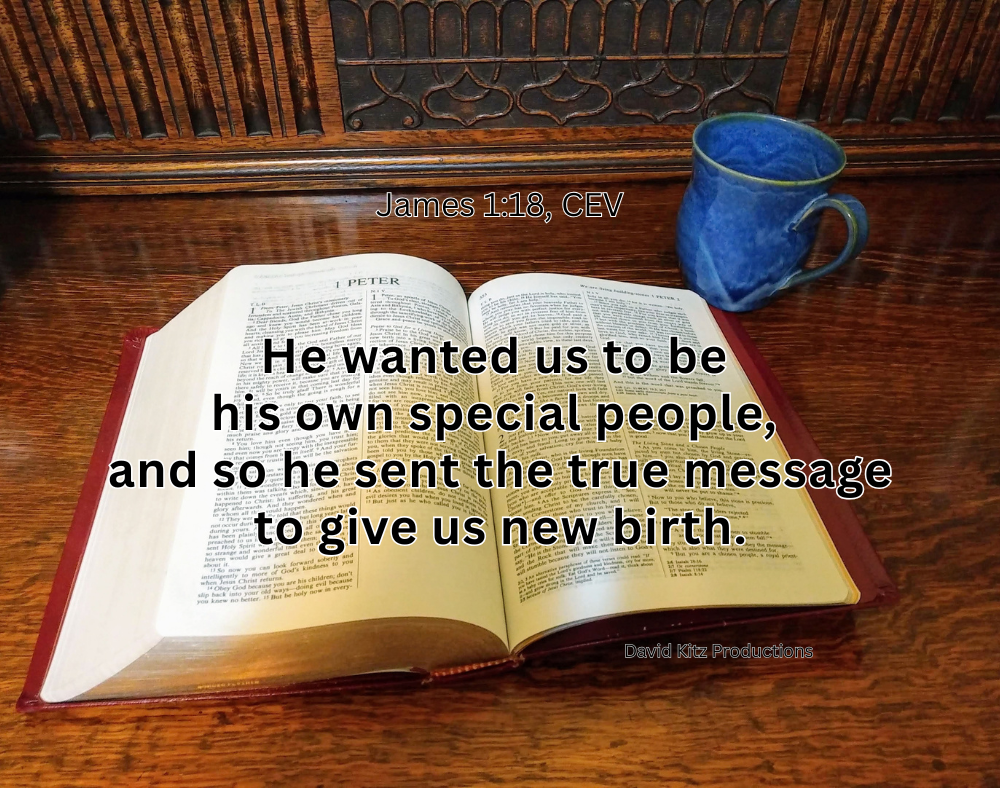
James affirms that the born-again experience comes through the word: “He chose to give us birth through the word of truth, that we might be a kind of firstfruits of all he created” (James 1:18).

It’s the power of the “word of truth” that James is lifting up throughout his epistle. He does that most effectively by systematically focusing on the core teachings of Jesus, as recorded in the Sermon on the Mount.

How can the “word of truth” be exalted by believers who have a careless or malicious tongue? That would be impossible, so James methodically builds his case for self-control of that most unruly member of the body.

On the flip side, though the tongue can be destructive, it also has creative power when it comes under the influence of God. As James points out, the prayer of faith can heal the sick. In addition, he states, “The prayer of a righteous person is powerful and effective” (James 5:16). It logically follows that when that most unruly member is tamed and harnessed by the Lord, great things are possible.

So then, if Jesus sent a letter to the church, how would that epistle read? There are many reasons to believe such an epistle would sound a lot like the Epistle of James. This would be so because James patterned his letter on the teachings of Jesus, and because James understood and knew his brother intimately, like no other man.

The voice and tone of Jesus are heard throughout this epistle because when the resurrected Christ broke through to the stubborn heart of James, the transformation made James even more like his brother. The brothers sound alike, because they are alike.

With his conversion James took on the character of Christ. Through his epistle he urges us to do the same.

(1) Tasker, The General Epistle of James, p. 28.

New from David Kitz

James—the brother of Jesus—who was this man? What evidence do we have that this “brother of our Lord” even existed?

David Kitz digs deep into archeology, family dynamics, church history, and the biblical texts. What emerges from his research is a portrait of a decisive, pivotal leader who embodied the will and character of Jesus Christ.

But how did James—James the unbeliever—transform to become a leader who changed the course of world history? In these pages you will uncover the answer and rediscover for yourself the life-changing power of the gospel.

To view further details or purchase directly from the author click here.


James—More than an Epistle of Straw

05 Sunday Jul 2026

Posted by davidkitz in Books by David Kitz

≈ Leave a comment

Tags

Bible, Bonhoeffer, Christ, Christianity, church, epistle, epistle of James, faith, good works, gospel, grace, James, James the brother of Jesus, Jerusalem, Jesus, Judaism, leadership, Martin Luther, Messiah, Paul, Peter, Reformation, Roman Catholic, Scripture, Soren Kierkegaard

James: the Lynchpin of Our Faith — Chapter 18

There is something quite unique about the Epistle of James. It does not easily fit into the pattern of the other apostolic writings. There is a sharpness—a directness—that many readers find both challenging and refreshing.

In his writing James goes for the jugular with the relentless precision of an attack dog. And what is he attacking? He is attacking the hypocrisy, lethargy, and complacency that can so easily set into a believer’s life.

When the epistle is read in its entirety, the reader may come away with a keen desire to repent. It is an epistle that demands change—that requires action—that convicts the wayward.

If you are looking for comfort, you won’t find it in the Epistle of James. If you are looking for a philosophical discussion on the merits of the gospel or a treatise on various doctrinal points, you won’t find that either. What you do find is an unequivocal call for right living. For practical-minded James, wisdom is not an intellectual exercise. Wis-dom must be expressed through right words and actions.

Are any of you wise or sensible? Then show it by living right and by being humble and wise in everything you do. But if your heart is full of bitter jealousy and selfishness, don’t brag or lie to cover up the truth. That kind of wisdom doesn’t come from above. It is earthly and selfish and comes from the devil himself. Whenever people are jealous or selfish, they cause trouble and do all sorts of cruel things. But the wisdom that comes from above leads us to be pure, friendly, gentle, sensible, kind, helpful, genuine, and sincere. When peacemakers plant seeds of peace, they will harvest justice. (James 3:13–18, CEV)

An appeal for humility, right living, and bold faith are at the core of this epistle.

Jon Mark Ruthven makes these observations on James’ purpose for writing the Epistle of James:

[The Epistle of ] James is primarily practical and ethical, emphasizing duty rather than doctrine. The author wrote to rebuke the shameful neglect of certain Christian duties. In doing so, he analyzed the nature of genuine faith and urged his readers to demonstrate the validity of their experience with Christ. His supreme concern was reality in religion, and he set forth the practical claims of the gospel. (1)

It is the uniqueness of the Epistle of James that led to the near rejection of this book from the canon of scripture in the sixteenth century. No other book of the New Testament has such a laser-like focus on right living. To be clear, the Epistle of James was readily accepted by the early church fathers and was author-itatively quoted by Origen in the first half of the third century.

According to R.V.G. Tasker, “the Epistle of James had become firmly established in the canon of the western part of Christendom by the end of the fourth century.” (2)

But the early reformers and Luther in particular had little use for the Epistle of James. Luther considered the letter an “epistle of straw,” since it lacked the doctrinal heft of the other epistles. He relegated the epistle to the back of his German translation of the New Testament because, among other things, he doubted that it was actually authored by James.

Citing J.H. Ropes, Tasker asserts that Erasmus and Luther “ascribed the letter to ‘some good, pious man who had taken some sayings from the apostle’s disciples.’” (3)

But Martin Luther’s problems with Epistle of James ran much deeper than uncertainty about the book’s authorship. Luther objected to one of the central tenets of James’ epistle. James boldly asserted that “faith without works is dead.” 

My friends, what good is it to say you have faith, when you don’t do anything to show that you really do have faith? Can that kind of faith save you? If you know someone who doesn’t have any clothes or food, you shouldn’t just say, “I hope all goes well for you. I hope you will be warm and have plenty to eat.” What good is it to say this, unless you do something to help? Faith that doesn’t lead us to do good deeds is all alone and dead!

Suppose someone disagrees and says, “It is possible to have faith without doing kind deeds.” I would answer, “Prove that you have faith without doing kind deeds, and I will prove that I have faith by doing them.” You surely believe there is only one God. That’s fine. Even demons believe this, and it makes them shake with fear.

Does some stupid person want proof that faith without deeds is useless? Well, our ancestor Abraham pleased God by putting his son Isaac on the altar to sacrifice him. Now you see how Abraham’s faith and deeds worked together. He proved that his faith was real by what he did. This is what the Scriptures mean by saying, “Abraham had faith in God, and God was pleased with him.” That’s how Abraham became God’s friend.

You can now see that we please God by what we do and not only by what we believe. For example, Rahab had been a prostitute. But she pleased God when she welcomed the spies and sent them home by another way.

Anyone who doesn’t breathe is dead, and faith that doesn’t do anything is just as dead! (James 2:14–26, CEV)

Luther had ushered in the Reformation on the doctrine of salvation by faith alone—sola fide. He had staked his faith and actions on the writings of Paul, which clearly stated that salvation came as a result of grace through faith and not of works.

We who are Jews by birth and not sinful Gentiles know that a person is not justified by the works of the law, but by faith in Jesus Christ. So we, too, have put our faith in Christ Jesus that we may be justified by faith in Christ and not by the works of the law, because by the works of the law no one will be justified. (Galatians 2:15–16, NIV)

Photo by Sora Shimazaki on Pexels.com

For Luther the Epistle of James represented a clear contradiction of his interpretation of the passage above from Galatians, and other passages from Paul’s epistles such as Ephesians 2:4–8 and Romans 5:1–2. James’ letter placed great emphasis on right living, while Paul’s letters emphasized the rightness of faith in Christ.

Under Luther’s leadership, justification before God by grace through faith became the central theme of the Reformation. Works had no part to play in personal salvation, since salvation was not earned. It came as a gift by God’s grace. But with statements such as, “As the body without the spirit is dead, so faith without deeds is dead” (James 2:26, NIV), James appeared to contradict the central tenet on which Luther’s understanding of faith was built. The Epistle of James appeared to undermine the founding premise of the entire Reformation.

Rather than reconcile these apparent doctrinal contradictions between two beloved apostles, Luther discounted James as an epistle of straw and shuffled it off to the back of his translation of the Bible—along with what he considered to be other low value books, such as Hebrews, Jude, and Revelation.

Tasker makes the following assessment:

He [Luther] had arbitrarily, and without any support from ancient manuscripts, placed the four books which he considered to be of doubtful apostolic authority and of secondary value doctrinally at the end of the New Testament published in 1522, to form a kind of supplement; and he did not number them in the table of contents. (4)

So, what exactly did Luther say about the Epistle of James? In context, here is J. H. Ropes’ translation from German of his 1522 words:

In fine, Saint John’s Gospel and in his first Epistle, Saint Paul’s epistles, especially those to the Romans, Galatians and Ephesians, and Saint Peter’s first epistle—these are the books which show thee Christ, and teach thee everything that is needful and blessed for thee to know even though thou never see or hear any other book or doctrine. Therefore is Saint James’s epistle a right strawy epistle in comparison with them, for it has no gospel character to it. (5)

The impact of this negative assessment of James’ epistle has rippled down through centuries. It has also colored our perspective of the person of James. He has been viewed as a theological lightweight beside the likes of Peter and Paul. But is this a fair and accurate assessment?

History has not been kind to James. Although James played a prominent and pivotal role in the first-century church, his role and his theological significance has largely been ignored, downplayed, or misunderstood down through the ages.

In the medieval period, the Roman Catholic Church drifted into what many reformers would call an idolatrous worship of Mary. This exaltation of Mary was matched with the development of several doctrinal positions which find no basis in scripture. These include the doctrine of the immaculate conception of Mary, her perpetual virginity, and her bodily assumption into heaven.

The doctrine of the perpetual virginity of Mary is particularly troublesome when it comes to our under-standing of James, since it strips him of his lineage and his direct brotherhood with Jesus. Thus emasculated, his words and life story lack the rightful authority and gravitas that this direct link to Christ confers.

With the emergence of the Reformation, with its emphasis on the centrality of the holy scriptures, it would only seem logical that James would regain the recognition he deserved. But alas, this was not the case. Luther found James’ epistle wanting because he viewed it as undermining the doctrine of sola fide.

Furthermore, Roman Catholic theologians drew comfort from the Epistle of James because in it they found the basis for two sacraments: the sacrament of divine unction (anointing the sick with oil for healing), and the sacrament of confession to the parish priest. Luther rejected both as sacraments of the church.

Though the early reformers recognized James’ lineage as the half-brother of Jesus, they found his theology suspect, since it appeared to contradict the writings of Paul. They believed, the Epistle of James appeared to undercut one of the foundational truths of the Reformation, namely the doctrine of justification by faith.

With the dawn of the Reformation, a great rift emerged in Christendom, which led to the formation of the various Protestant churches.

The Epistle of James lies right at the heart of that fault line. Catholicism embraced a more works-oriented path to salvation—a path apparently endorsed by James—while Protestantism embraced salvation by grace through faith—a path endorsed by Paul.

These opposing positions led to war and upheaval in Europe on a massive scale. All this is beyond strange when we consider that in their lifetime, according to the scriptures, Paul and James got along very well. They collaborated, respected one another, and each admired the other’s gifting and calling. Now some 1,500 years later, Christians were killing one another in an argument over letters that these two friends had written.

Photo by Pixabay on Pexels.com

Since the Reformation, some theologians would have us believe that these two men were at loggerheads, each with their doctrinal daggers drawn. As we have seen in earlier chapters, by examining their relationship through the lens of scripture, there is no basis for such an argument. Despite having strongly held views and differing spheres of in-fluence—Paul among the Gentile converts and James among Jewish converts—both were able to work with one another for the common good of the church.

So, are the theological differences between James and Paul more apparent than real? There certainly are several reasons to believe this is the case.

The first argument for a theological reconciliation between Paul and James has already been made. There is no evidence of relational conflict between Paul and James. Doctrinal conflict frequently leads to relational conflict, but the scripture provides us with no smoking gun in this regard. Texts written by Luke and Paul and the quoted words of James indicate a strong, healthy relationship between these two leaders.

Secondly, when examining a piece of writing, one needs to consider the author’s purpose. In his epistle, James was not writing with the purpose of laying out a theological framework for salvation, as was the case with Paul’s epistle to the Romans. James was writing an appeal to believers for righteous living. Much of Luther’s criticism of the Epistle of James is unwarranted. James is being faulted for what he did not write. This is like criticizing a dog for not being a cat.

Thirdly, on the surface it may appear that James and Paul are at odds on the role that faith and deeds play in salvation, but a closer examination reveals otherwise. For both Paul and James, having faith—saving faith—is not a passive response. True and saving faith is more than providing intellectual assent to a prescribed set of beliefs. That is precisely the argument that James is making when he claims that even demons believe in God, but their faith does not save them (James 2:19). For Paul as well, saving faith meant far more than intellectual assent.

Fourth, Paul and James agreed that genuine faith is personally transformative. Paul expected and called for personal transformation in the lives of every one of his converts. (See Ephesians 2:1–10.) How did that changed life reveal itself? Through deeds, of course. Time and again in his epistles, Paul calls for evidence of changed lives in the daily conduct of believers. Often these direct calls to action or works are found near the end of Paul’s epistles, since often he begins his letters by dealing with specific problems that have arisen in the church, or by presenting foundational truths of the Christian faith. (For examples of Paul’s calls to action, see Ephesians 4:25–6:20, 1 Thessalonians 5:12–22, and Colossians 3:18–4:6.)

James expected and called for personal transformation as well, but his epistle represents a shift from the Pauline paradigm. His entire epistle is a call for trans-formative, Christ-motivated actions, attitudes, and behavior.

In his discussion of the content of the Epistle of James, Jon Mark Ruthven makes this observation:

Rather than speculating or debating on religious theories, James directs his readers toward godly living. From the beginning to the end the mood of his letter is imperative. In 108 verses, 54 clear commands are given, and seven times James calls attention to his statements by using terms that are imperative in nature. This “bondservant of God” [James 1:1] writes as one supervising other slaves. The result is a statement of Christian ethics, which stands on par with any such teaching in the New Testament. (6)

The Word of God — photo by David Kitz

Finally, one needs to consider the work of the Holy Spirit. The Holy Spirit inspired both Paul and James to write their epistles. If we believe in the divine inspiration of the holy scriptures, it then follows that these two apostles, using their skills and experiences, wrote as the Holy Spirit directed them to write.

All Scripture is God-breathed and is useful for teaching, rebuking, correcting and training in righteousness, so that the servant of God may be thoroughly equipped for every good work. (2 Timothy 3:16–17)

From the earliest times the church has recognized the writings of James and Paul as God-breathed. If the Holy Spirit directed James to write an epistle focussed on practical Christian living, who are we question the wisdom of the Holy Spirit? Our understanding of what it means to live as a follower of Jesus would be considerably diminished without the Epistle of James.

In many respects James acts as a counterbalance to Paul. His epistle counters the notion of cheap grace that places no requirements on the believer. A hefty dose of Luther’s doctrine of sola fide can lead to a culture of easy believe-ism and an aversion to calls for personal holiness. Within such a church culture, anything that requires effort or personal sacrifice is frowned upon because it might be misconstrued as an attempt to earn one’s salvation.

In the last century, through his writing and the example he set by his life and death, the German Lutheran theologian Dietrich Bonhoeffer warned about the consequences of cheap grace—the results of which are a church rife with sin, which has no effective witness to the world because it conforms to the social and moral norms of the world. The Epistle of James is the biblical antidote to the easy believe-ism that Bonhoeffer warned against.

Similarly, a century before Bonhoeffer, the noted theologian and philosopher Soren Kierkegaard saw the Epistle of James as his chief weapon against the hypocrisy of his day.

It is surely both interesting and illuminating to recall that, when Soren Kierkegaard in the middle of the nineteenth century felt called to use his great gifts of eloquence and satire in a sustained warfare against the worldliness and hypocrisy of the contempor-ary Church, it was the Epistle of James that both inspired him for battle and supplied him with the ammunition with which to fight. (7)

It has been said that any doctrinal truth pushed to an extreme can lead to heresy. Though there is great truth in the doctrine of justification by grace through faith, when this teaching is embraced to the exclusion of other biblical truths, the result is a dis-tortion of truth, since it does not take into account the whole counsel of the Scriptures.

Kierkegaard was keenly aware of the effects of this distortion of truth. For him, according to one of his biographers, the Epistle of James represented the ideal counterweight.

Kierkegaard, while acknowledging the truth of Justification by Faith, as directed against “work-righteousness” and the assumption that one can earn his righteousness, had seen that the temper of the times “especially in Protestantism, and more especially in Denmark” required the proclamation of a complementary truth—a bringing to the fore of the practical, ethical side of Christianity, not by any means to the exclusion or minimizing of its dogmatic aspects, but to the exclusion of that barren orthodoxy which would make mere intellectual belief the primary act of Christian faith. The highly practical Epistle of James… was and remained Kierkegaard’s favourite Scripture. (8)

So, what are we to make of Luther’s assessment of the Epistle of James? Through the benefits of history and hindsight, we can see that this “right strawy Epistle” was and is the perfect counterweight to the excesses of sola fide, when this doctrine is pushed to the extreme while ignoring the full counsel of scripture.

Clearly Luther made an enormous contribution to our understanding of the Christian faith and his courage, determination, and hard work rescued many truths of the Bible from the dustbin of history. His translation of the Bible into the vernacular of the people unleashed a tidal wave that transformed Europe and the world. Thanks to his foundational work, people all over the world can read the Bible in their mother tongue and decide for themselves if this letter from James is an epistle of straw or an epistle filled with nuggets of pure gold.

(1) Ruthven, “Introduction: James,” Spirit Filled Life Bible, p. 1893.
(2) R.V.G. Tasker, The General Epistle of James: An Introduction and Commentary—Tyndale New Testament Commentaries (Eerdmans, 1983), p. 17.
(3) Tasker, The General Epistle of James, p. 21.
(4) Tasker, The General Epistle of James, p. 13.
(5) James Hardy Ropes, A Critical and Exegetical Commentary on the Epistle of St. James (Clark, 1916), p. 106.
(6) Ruthven, “Introduction: James,” Spirit Filled Life Bible, p. 1893.
(7) Tasker, The General Epistle of James, pp. 10–11.
(8) Robert Brettall, A Kierkegaard Anthology (Oxford University, 1947), p. 282.

New from David Kitz

James—the brother of Jesus—who was this man? What evidence do we have that this “brother of our Lord” even existed?

David Kitz digs deep into archeology, family dynamics, church history, and the biblical texts. What emerges from his research is a portrait of a decisive, pivotal leader who embodied the will and character of Jesus Christ.

But how did James—James the unbeliever—transform to become a leader who changed the course of world history? In these pages you will uncover the answer and rediscover for yourself the life-changing power of the gospel.

To view further details or purchase directly from the author click here.


Psalms 365: Develop a Life of Worship & Prayer

Psalms 365 Volume II

Psalms 365 vol 3
— Psalms 365 Volume III

Now available:

Psalms

Recent posts

  • The LORD Will Give What Is Good July 25, 2026
  • The Crucifixion of Jesus July 24, 2026
  •  God of Israel, Lord Over All July 24, 2026
  • The Soldiers Mock Jesus July 23, 2026
  • Your Posture in Prayer July 23, 2026
  • Jesus Before Pilate July 22, 2026
  • Righteousness & Peace Kiss July 22, 2026

Calendar

July 2026
M T W T F S S
 12345
6789101112
13141516171819
20212223242526
2728293031  
« Jun    

Blog Posts

Comments

  • davidkitz on Your Posture in Prayer
  • Steps Of Purpose on Your Posture in Prayer
  • davidkitz on God is a Sun & Shield

Blog at WordPress.com.

Privacy & Cookies: This site uses cookies. By continuing to use this website, you agree to their use.
To find out more, including how to control cookies, see here: Cookie Policy
  • Subscribe Subscribed
    • I love the Psalms
    • Join 1,350 other subscribers
    • Already have a WordPress.com account? Log in now.
    • I love the Psalms
    • Subscribe Subscribed
    • Sign up
    • Log in
    • Report this content
    • View site in Reader
    • Manage subscriptions
    • Collapse this bar
Loading Comments...