
Tags
Genesis, James, James the brother of Jesus, Jesus, Joseph, Mary and Joseph, Messiah, messianic, mult-colored coat, Nazareth
James: the Lynchpin of Our Faith — Chapter 4
One can easily assume that Jesus, and by extension James, grew up in an idyllic family. If God selected Mary to be the mother of God’s own son, then surely, she was a perfect mother—the perfect mother. Joseph too must have been a man of flawless character, a hardworking, salt-of-the-earth fellow with impeccable morals. Growing up in such a home in small-town Nazareth must have been like having your own corner of heaven in this rough and tumble, sin-stained world.
But in this fallen world there is no perfect home and no absolutely perfect family. The taint of sin and the machinations of our ancient foe are everywhere. If it were not so, this world would not need a Savior. It should come as no surprise then, that all was not always sweetness and light in the household of Joseph and Mary. God frequently uses deeply flawed characters.
Luke concludes his account of Jesus’ boyhood temple experience with this summary statement:
Then he [Jesus] went down to Nazareth with them [Mary and Joseph] and was obedient to them. But his mother treasured all these things in her heart. And Jesus grew in wisdom and stature, and in favor with God and man. (Luke 2:51–52)
There is no indication of any family tension in this statement. On the contrary, the opposite appears to be true, and undoubtedly there were many happy moments of family harmony in this home. But when we examine other passages from the four gospel accounts of Jesus life, we can see that below the surface, trouble was brewing within this holy family. How soon family tension and rivalry reared its ugly head remains open to debate, but as we will soon see, it certainly was present during the time of Jesus public ministry.
Sibling rivalry is common among multi-child families. Was there rivalry between Jesus and his brothers as they grew up? Most likely there was. In fact, the very notion of living with a morally perfect, intellectually superior older brother should send shivers of dread through any thinking child. How could any sibling possibly measure up to this older brother’s exemplary standard? Here we have the textbook recipe for childhood frustration and sibling resentment.
If Jesus reached an epiphany moment in the temple at age twelve, it is reasonable to surmise that James may have had a similar epiphany in his early teens—a moment when he realized that Jesus was profoundly different, and that unlike himself, Jesus was not the son of Joseph.
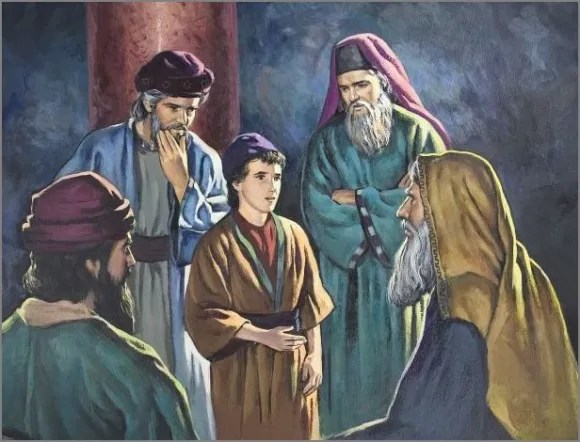
The Boy Jesus in the Temple Courts
This epiphany may have occurred in a rather ordinary way. Teens his own age may have told James that his brother was the son of another man. Small-town communities have a collective memory. Mary’s initial unexpected pregnancy likely had tongues wagging. Rumors spread and gain currency with time, and in due time that rumor may have circled round to James.
James did not conclude that Jesus was the Son of God. A more natural explanation was much more logical. It is reasonable to assume that in his judgment, James came to believe that Jesus was the product of his mother’s rather unfortunate union with another man. Scripture bears witness to this verdict.
The following passage from John’s Gospel provides us with ample evidence of the tension that was rife within this family:
After this, Jesus went around in Galilee. He did not want to go about in Judea because the Jewish leaders there were looking for a way to kill him. But when the Jewish Festival of Tabernacles was near, Jesus’ brothers said to him, “Leave Galilee and go to Judea, so that your disciples there may see the works you do. No one who wants to become a public figure acts in secret. Since you are doing these things, show yourself to the world.” For even his own brothers did not believe in him.
Therefore Jesus told them, “My time is not yet here; for you any time will do. The world cannot hate you, but it hates me because I testify that its works are evil. You go to the festival. I am not going up to this festival, because my time has not yet fully come.” After he had said this, he stayed in Galilee.
However, after his brothers had left for the festival, he went also, not publicly, but in secret. Now at the festival the Jewish leaders were watching for Jesus and asking, “Where is he?”
Among the crowds there was widespread whispering about him. Some said, “He is a good man.”
Others replied, “No, he deceives the people.” But no one would say anything publicly about him for fear of the leaders. (John 7:1–13)
John’s observation on the brothers’ advice is very enlightening. He states, “For even his brothers did not believe in him.” There was clearly a bitter tension here that the brothers’ words alone do not convey. The brothers that this passage refers to are of course James, Joseph, Simon and Judas (Jude), as identified in the Gospel accounts of Matthew, Mark, and Luke.
And what precisely did the brothers not believe about Jesus? From the context, it appears that they did believe in his miraculous powers; in fact, they challenged him to reveal himself to the world through them. The phrase that is translated “the works you do” in the New International Version is more freely translated “see your miracles” in the New Living Translation. So, it is clear that the brothers had heard the stories of Jesus’ miracles or had witnessed them personally. Now they want Jesus to reveal himself to the world. They say, “Since you are doing these things, show yourself to the world.”
The brothers’ unbelief went deeper than a surface acknowledgement of the miracles. They doubted his deity—his divine origin. To his brothers, Jesus was too familiar. He was Mary’s boy—their half-brother—nothing more. But beyond that, he was their half-brother, the bastard son, putting on airs, rising above his rightful station in life. Furthermore, they were jealous of his rising popularity as a person of considerable renown.
Here we see the truth of what John said in the introduction to his Gospel, “He [Jesus] was in the world, and though the world was made through him, the world did not recognize him. He came to that which was his own, but his own did not receive him” (John 1:10–11).

Photo by Pixabay on Pexels.com
Jesus was rejected by his own—by his own brothers. They did not recognize him as God or the Son of God.
As one of the three disciples within Jesus’ inner circle, John was likely a witness to this conversation between Jesus and his brothers. Now in his Gospel, John bears witness to the brother’s unbelief.
But John had another domestic source that may have enlightened him more fully on the brothers’ lack of faith. John was responsible for looking after Mary after Jesus’ death. Surely the issue of the brothers’ early rejection of the messianic Jesus was a topic of discussion at some point.
Undoubtedly, at times Mary would also have encountered the disparaging perspective that her younger sons had toward Jesus. Jesus did not easily fit into a world or even a family that prefers conformity. Those who are struggling to raise exceptional children may find some comfort in that. Often gifted children are misunderstood or not well-received socially by peers and even by adults.
Jesus sees through his brothers’ advice to their deep-seated antagonism, and consequently he responds harshly to their challenge to reveal himself to the world. But with his response, he provides a clue as to why they rejected him. “Jesus told them, ‘My time is not yet here; for you any time will do.’”
For the brothers, when they consider Jesus’ claims to deity, they see an elephant in the room—perhaps several of them. The largest problem may well be the death of their father Joseph. How could this healer of the sick, this miracle worker, this man who raised the dead to life on more than one occasion do nothing to prevent the death of their father?
The unspoken thought might go something like this, “So Jesus, you’re the Son of God! Well, why then did you let Dad die? Why didn’t you do something? Why do you go about healing perfect strangers, while your own family suffers?”
But how does Jesus respond? “Jesus told them, ‘My time is not yet here; for you any time will do.’”
That may be a fine answer for the public, but it does little to soothe an aching heart or comfort the doubting soul of a family member. Why did Jesus raise to life the son of the widow at Nain (Luke 7:11-17), but leave Joseph, his earthly father, to die?
Variations on this question confront us often. Why is one child spared in a school shooting, while others are gunned down by a madman? Why does one woman make a miraculous recovery from terminal cancer, while an equally worthy woman suffers and dies, leaving a grief-stricken family? These questions have no easy answer. None exists on this side of eternity.
Death stalks all of us, and ultimately death always claims its prize. A better question might be, “Why now? Why did this person die now? Why not later?”
“Jesus told them, ‘My time is not yet here; for you any time will do.’”

Photo by brenoanp on Pexels.com
There was no miracle for their father Joseph. Jesus’ time had not yet come. His time for doing miracles had not yet arrived. Earlier in John’s Gospel, Jesus made a similar pronouncement when Mary asked him to intervene when the wine ran out at the wedding in Cana. “‘Woman, why do you involve me?’ Jesus replied. ‘My time has not yet come.’” (John 2:4)
But despite this objection, Jesus proceeded to perform his first miracle as he turned water into wine. The question of timing remains. Why work a miracle in one situation, but not in another? Why heal one invalid at the pool of Bethesda (John 5:1-16), but leave many others to suffer?
Clearly, Jesus was working according to a different timetable. In the present, we tend to think as Jesus’ brothers thought. We could always use a miracle or two. For us, when it comes to receiving a miracle, “any time will do.”
At this point in John’s account, there is clearly a great gulf separating these brothers and Jesus, and Jesus does nothing to bridge it. On the contrary he expands the gulf and elaborates on it. Speaking of his brothers, he says, “The world cannot hate you, but it hates me because I testify that its works are evil. You go to the festival. I am not going up to this festival, because my time has not yet fully come.”
Implied in these remarks is the idea that the brothers are worldly and complicit with the evil of the world. Jesus sees himself as being on a great redemptive mission—a mission set in motion by his heavenly Father. It is a mission of impeccable, precise timing. He will not be distracted, bated or thrown off course by his brothers. For Jesus timing was everything. He will not be hurried into doing miracles or into revealing himself to the world. He will not be hurried to his death in Jerusalem. He is not a showman, a performer or an entertainer for the crowds.
He is a redeemer on a mission—a sacrificial lamb, the Passover lamb—saving himself for slaughter at the right time, the perfect time.

Photo by Kat Smith on Pexels.com
There is a double meaning in the phrase, “My time is not yet here.” For the brothers it meant the time for Jesus to reveal himself to the world through his miraculous powers, but for Jesus it also meant the time for his approaching death. The Jewish leaders were already plotting his demise. He did not want to speed that day by following his brothers’ ill-conceived ideas.
Jesus’ brothers understood none of this. They did not believe in him. James did not believe in him. The brothers proceeded to the feast while Jesus stayed for a time in Galilee. The rift between them is clearly defined. They did not travel together. They are walking separate paths. Jesus has his followers, his disciples, but his brothers are not numbered among them.
Unbelief and a sharp division in the family are not what we would expect from the union of Mary and Joseph. We would like to believe that Mary and Joseph did a stellar job in raising their children; after all they were selected by God for this specific assignment.
But let’s be clear: this was no easy task.
Many believe that Mary and Joseph disclosed to Jesus in an age-appropriate manner the divine nature of his origin and the broad outlines of his calling. Surely this was a part of their parental responsibility, a responsibility given to them by God.
Joseph certainly would have trained Jesus in the skills of carpentry. The family would have been active in the local synagogue. A synagogue education would include learning to read and write, but also committing reams of scripture to memory.
This would all be foundational to Jesus’ later ministry.
But the parental task of educating Jesus in his messianic calling would be far easier if there were no younger brothers around. Singling out a child for special status or treatment instantly creates family tension. Anyone named Joseph should know this well.
The brothers’ rejection of Jesus bears a striking resemblance to another example of sibling rivalry and rejection recorded in the last chapters of Genesis. When he was a teenager, the patriarch Joseph (Joseph of the multicolored coat) was rejected by his brothers. But this was no mild snub. Joseph’s brothers initially wanted to kill him, but they settled for selling him to Ishmaelites, who later sold him into slavery in Egypt. See Genesis chapters 37-50.
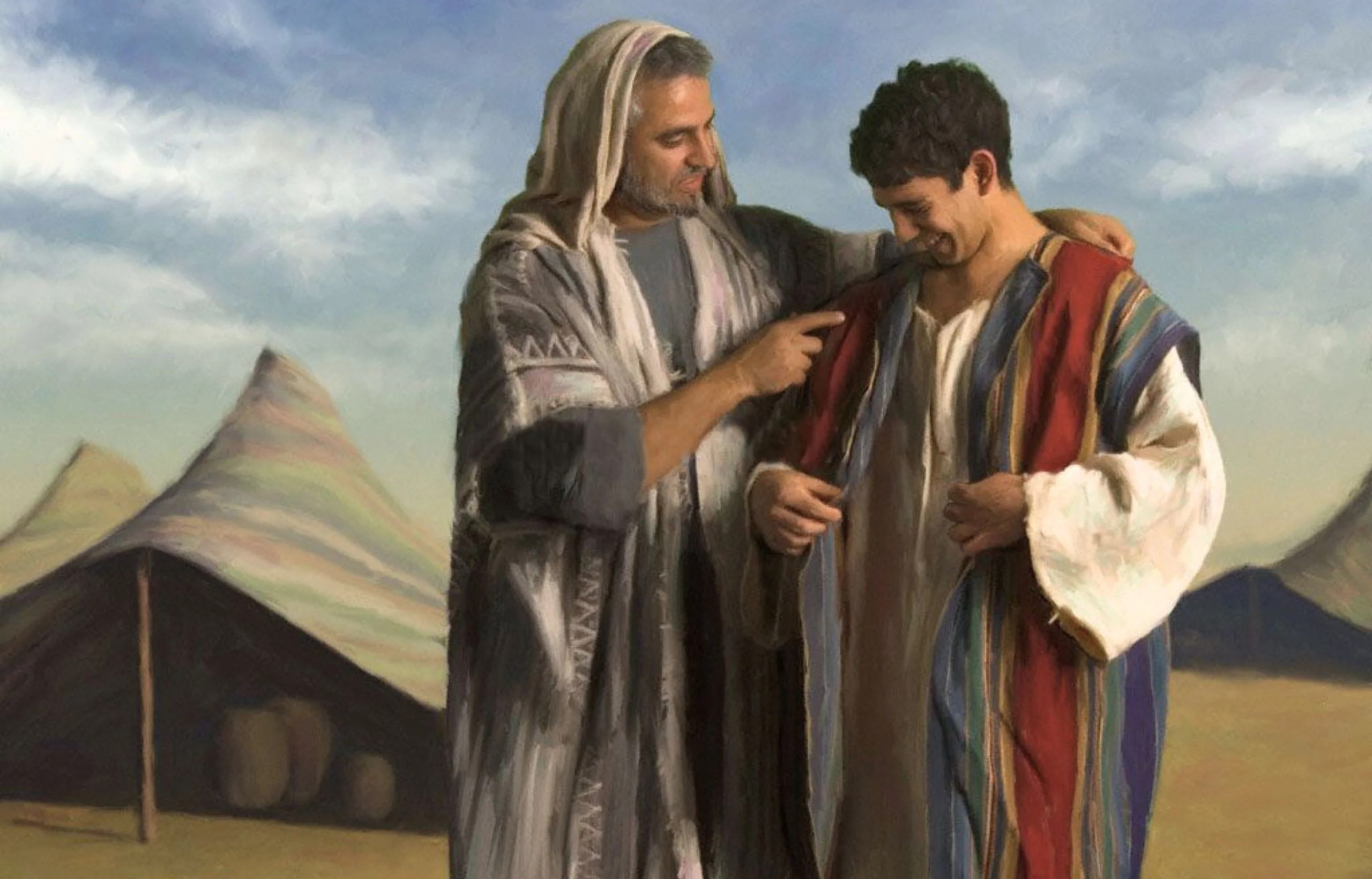
Photo by gracefiber.com
The New Testament Joseph surely must have had his Old Testament namesake in mind as he raised his own family. The parallels run deep. Many biblical scholars have noted that there is a striking similarity between the life of Jesus and the life of Joseph, the patriarch, whose story is recorded in Genesis.
Here in brief are some of these parallels:
• Both claimed a special relationship with their father—Jesus’ father being God, while Joseph’s father was Jacob, who is also called Israel, the father of the nation. (Luke 2:49, Genesis 37:3–4)
• Both had a revelation of their divine calling at or near puberty. (Luke 2:41–52; Genesis 37:5–11)
• Both were rejected by their brothers. (John 1:11 and John 7:5; Genesis 37:12–32)
• Though both were tempted, they lived a sinless or exemplary life. (Matthew 4:11 and 2 Corinthians 5:21; Genesis 39:6–15)
• Both were wrongly accused, arrested and suffered though innocent. (Mark 14:43–15:41; Genesis 39:19–21)
• After suffering both were exalted to rule. (Philippians 2:9–11; Genesis 41:41–44)
• Both brought deliverance or salvation—Joseph for Egypt, Jesus for the world. (John 3:16; Genesis 50:20)
• Both forgave those who wronged them and were reconciled with their brothers. (Luke 23:34; Genesis 50:21)
If the New Testament Joseph showed any special favoritism to Jesus, he risked repeating the mistakes of Jacob, the father of the Joseph of the Old Testament. In that instance, special treatment led directly to fierce resentment and forced exile from the family.
This may have left Joseph in a conundrum. Too much disclosure of Jesus’ divine origin and messianic calling put him at risk of resentment and rejection by his siblings. No disclosure at all could be interpreted as a failure of parental responsibility.
Even the meaning of term Messiah is problematic. We understand this word quite differently now. How did Joseph and Mary see their son’s calling? They were looking at him through first century Jewish eyes, and they likely had expectations and perspectives that were quite different from ours today.
The desire for a Jewish Messiah to arise from among the people was pervasive during this historic period. The felt need was for a strong leader to arise and rally the people, so they could overthrow the oppressive pagan rule of Rome by means of a bloody insurrection. From the Jewish perspective the need and the vision were clear. This Messiah—the anointed one—would re-establish the throne of David and with a rod of iron he would rule over Israel and the surrounding nations in righteousness and justice.
The firstborn son in Joseph’s household had the right lineage. He was a son of David and furthermore, at his birth his messianic call was confirmed by the words of angels, prophets and magi. Surely at the right time Joseph would or should instill into Jesus the imperatives of his messianic call. Did Joseph do this?
On this topic the scriptures are maddeningly silent. Joseph dies at some point between Jesus’ boyhood visit to the temple and the emergence of his public ministry. When or how is unknown.
If Joseph and Mary followed the wisdom of the day, they would have imparted an incorrect messianic vision. Several would-be messiahs rose up in rebellion against Rome before and after Jesus’ crucifixion. Each rebellion was brutally crushed until the Jews were finally expelled from Jerusalem and their homeland in 135 AD.
The rebellion that Jesus would eventually lead was a soft power rebellion that rejected bloodshed and the use of force. See John 18:36. But ultimately the kingdom of God, which Jesus founded, would triumph over the empire of Rome. Down through the ages to the present day, his followers have submitted to his rule within a kingdom that never ends.
In matters affecting family dynamics, timing is crucial. In the right time, the dreams of the Joseph of the technicolor coat would come true. His parents and brothers would bow down to him. Joseph, the son of Israel, became the ruler of all of Egypt.
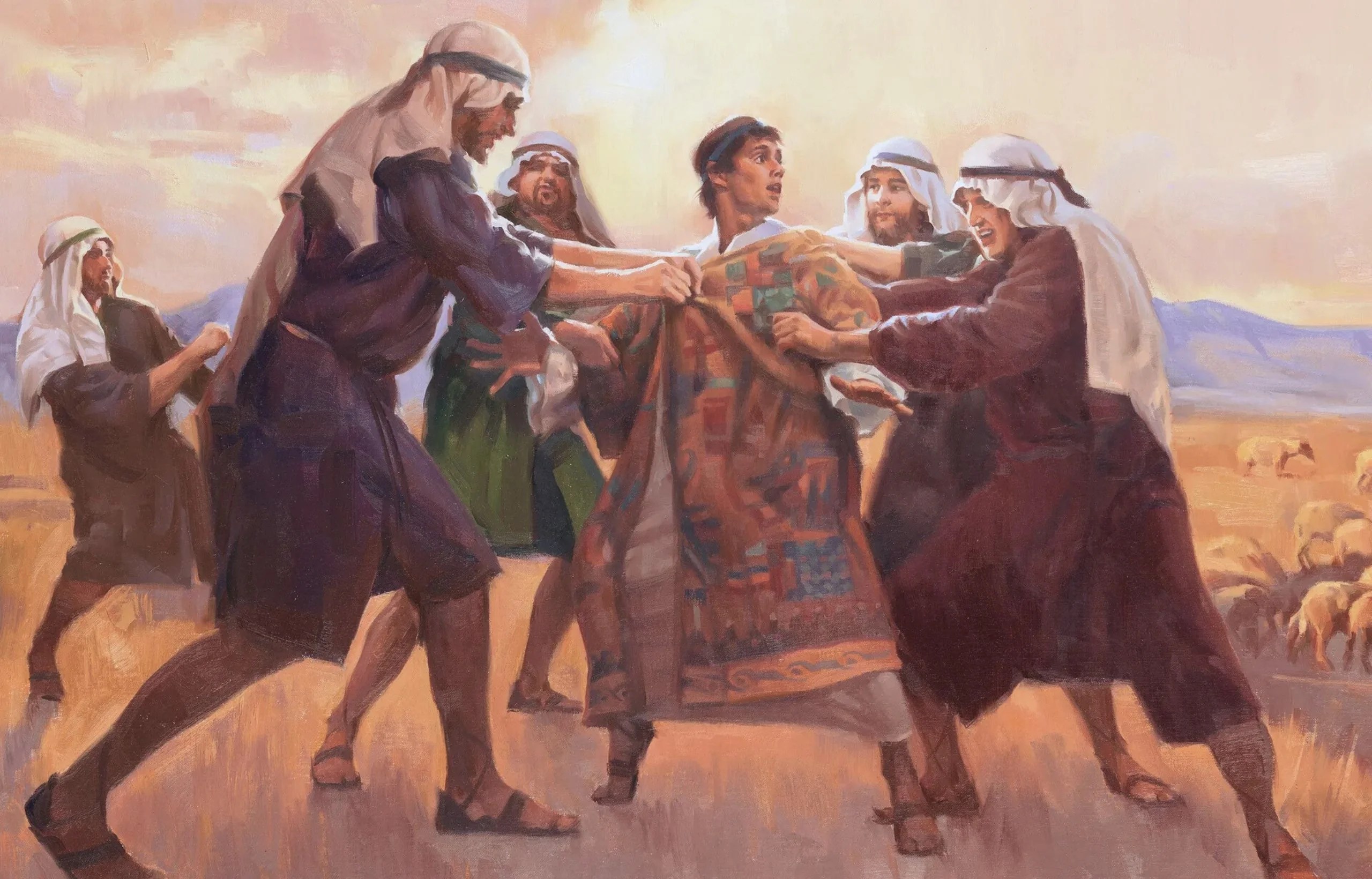
Picture by Gracefiber.com
In the right time, Jesus’ brothers beginning with James would recognize him as the Son of God and the Savior of the world. They too would bow before him as king. All would come in the right time, including reconciliation.
Prior to the disagreement with his unbelieving brothers cited in John 7, Jesus was in conflict with the Jewish leadership in Judea. This too was a conflict over timing. He had dared to heal a man on the Sabbath. See John 5. In his discourse with the Jewish leadership, Jesus gives us a glimpse into his modus operandi:
Very truly I tell you, the Son can do nothing by himself; he can do only what he sees his Father doing, because whatever the Father does the Son also does. For the Father loves the Son and shows him all he does. Yes, and he will show him even greater works than these, so that you will be amazed. For just as the Father raises the dead and gives them life, even so the Son gives life to whom he is pleased to give it. Moreover, the Father judges no one, but has entrusted all judgment to the Son, that all may honor the Son just as they honor the Father. Whoever does not honor the Son does not honor the Father, who sent him. (John 5:19–23)
These words leave no doubt about whose agenda Jesus is following. He is going about his Father’s business. The twelve-year-old has grown up. Joseph is dead. The thirty-year-old Jesus is moving according to the dictates of his heavenly Father. He does “only what he sees his Father doing.”
Without doubt, what Jesus does, he does in his Father’s perfect timing. As we shall see, pursuing his messianic call would bring him into direct conflict with his brother—James the unbeliever.
Did Joseph and Mary fail in their parental mandate because we see evidence of serious conflict and unbelief within their family? If these saintly parents were unable to raise their family in harmony and faith, what hope do Christian parents have today?
Concluding that Joseph and Mary somehow failed in their parental mandate is unwarranted. Right actions stemming from right motives are often misunderstood, particularly within the dynamics of a large and growing family. Children, particularly adult children, are accountable for their own attitudes and actions.
In some respects, the Genesis account of Joseph’s life serves as a template for what unfolds 1,500 years later in the family of Mary and Joseph. Division and conflict bubble to the surface, but ultimately all is resolved through salvation and forgiveness.
Interestingly, the Book of Genesis ends with this statement:
So Joseph died at the age of a hundred and ten. And after they embalmed him, he was placed in a coffin in Egypt. (Genesis 50:26)
Four hundred years later, after a great deliverance, the stone box containing Joseph’s bones was carried out of Egypt and into the land of Israel. There his bones found their ultimate resting place.
And Joseph’s bones, which the Israelites had brought up from Egypt, were buried at Shechem in the tract of land that Jacob bought for a hundred pieces of silver from the sons of Hamor, the father of Shechem. This became the inheritance of Joseph’s descendants. (Joshua 24:32)
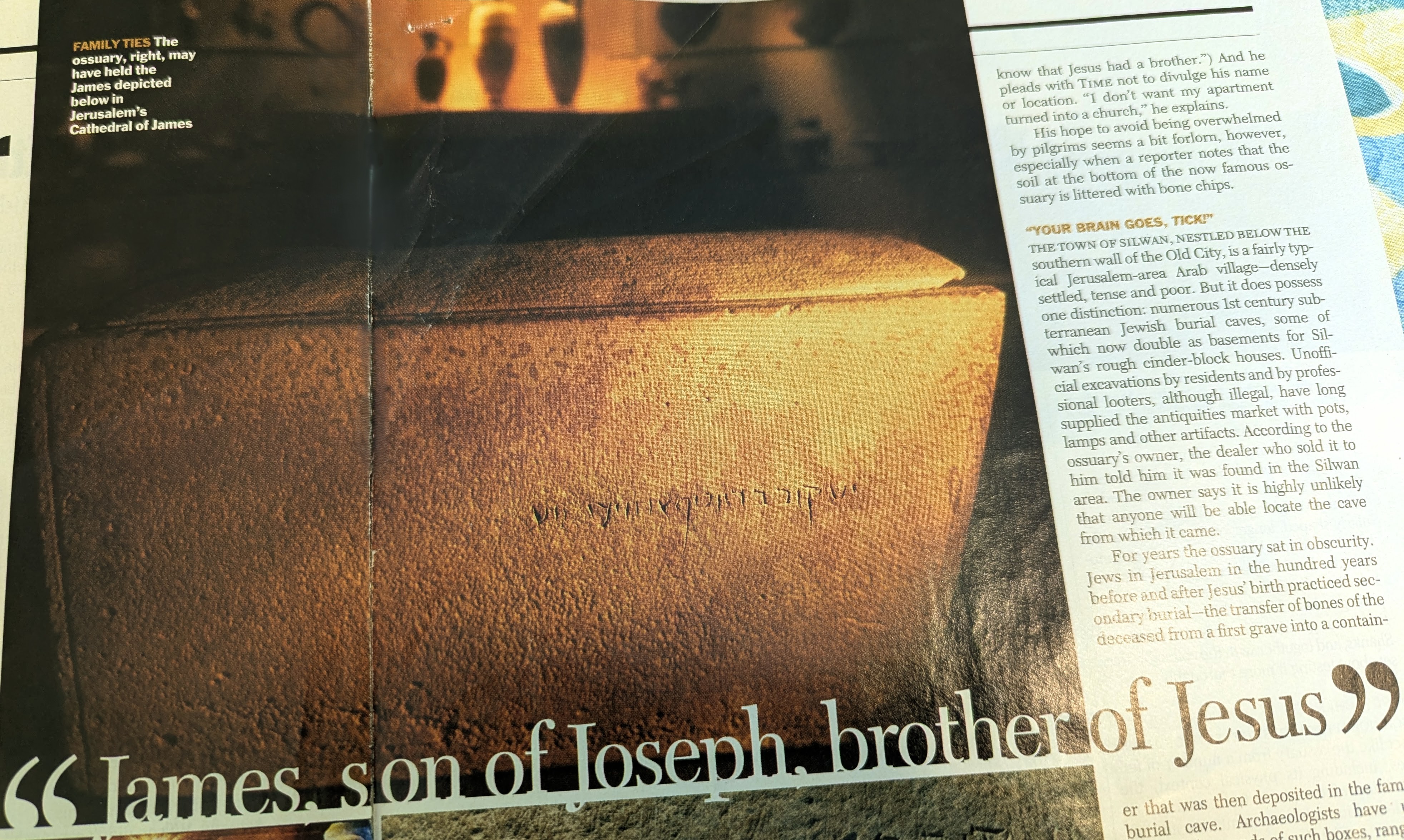
Time photo of the James Ossuary
Two thousand years after the death of the New Testament Joseph, we encounter another stone burial box. In the Hebrew language it bears this inscription: “James, son of Joseph, brother of Jesus.”
New from David Kitz
James—the brother of Jesus—who was this man? What evidence do we have that this “brother of our Lord” even existed?
David Kitz digs deep into archeology, family dynamics, church history, and the biblical texts. What emerges from his research is a portrait of a decisive, pivotal leader who embodied the will and character of Jesus Christ.
But how did James—James the unbeliever—transform to become a leader who changed the course of world history? In these pages you will uncover the answer and rediscover for yourself the life-changing power of the gospel.
To view further details or purchase directly from the author click here.






![BGBG_v4.3_150[1818]](https://davidkitz.blog/wp-content/uploads/2021/07/bgbg_v4.3_1501818.jpg)


 I love the Psalms