
Tags
angel of the Lord, conception, faith, gospel, holy family, Jacob, James, James the brother of Jesus, Jesus, Mary, Mary and Joseph, Nazareth, virgin birth
James: the Lynchpin of Our Faith — Chapter 2
James was conceived in the ordinary way—the way that is common to all humanity. There was no virgin birth for him, no choir of angels trumpeted his arrival, and no star appeared to signal his nativity. He was from what we can surmise, just an ordinary child, born into a very extraordinary family.
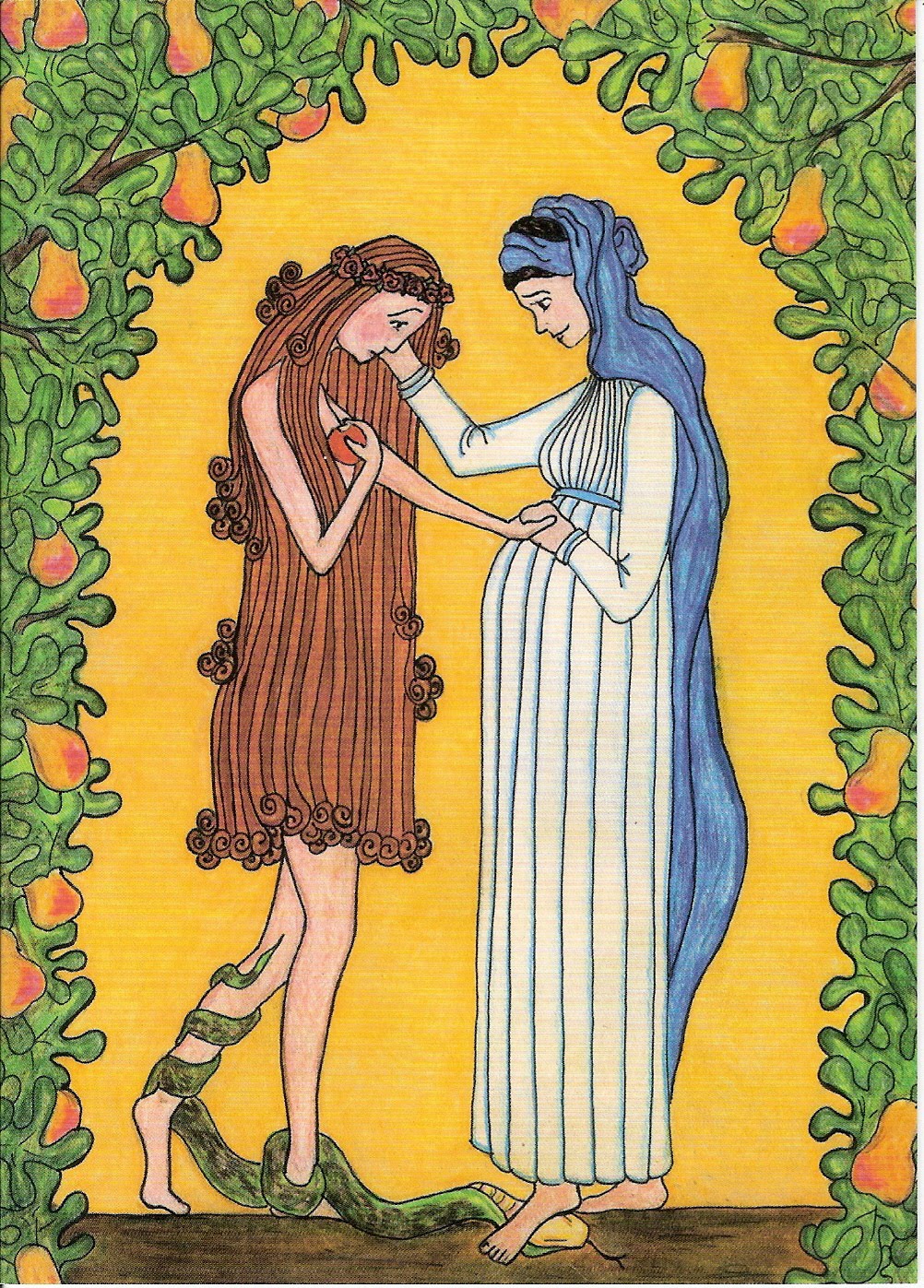
Mary Consoles Eve by Sr. Grace Remington
It should be noted that there are three men in the New Testament who bear the name James. Since they have the same name, the identity of these three men is often confused. The most prominent James during Jesus’ earthly ministry was James, the son of Zebedee. He was numbered among the twelve apostles. He was the older brother of the apostleJohn—the John who penned the Gospel that bears his name. Peter and the two sons of Zebedee were part of Jesus’ inner circle. During his ministry, Jesus often called Peter, James, and John apart from the other apostles to privately accompany him.2 But there was a second James within the apostolic circle. This was James, son of Alphaeus. He is sometimes called James the Less. Though he is numbered among the twelve disciples, he did not play a significant role in the New Testament narrative.
In contrast to these two men, James, the brother of Jesus, was never part of the apostolic team. The apostle James, the son of Zebedee was martyred early in the development of the church in Jerusalem (Acts 12:1–2), and we hear nothing further of James, son of Alphaeus, beyond a mention in the gospel accounts. Our purpose here is solely to focus on James, the brother of Jesus.
But was this James really born into this holy family? Roman Catholics revere Mary as a perpetual virgin; hence, they view any teaching that Mary had other children by Joseph as utter heresy. However, other children is precisely what we find when we examine the New Testament scriptures. In fact, we have already touched on a Bible verse that disproves the premise upon which this Catholic doctrine is based. Mary was not a perpetual virgin, not according to the Gospel of Matthew.
When Joseph woke up, he did what the angel of the Lord had commanded him and took Mary home as his wife. But he did not consummate their marriage until she gave birth to a son. And he gave him the name Jesus. (Matthew 1:24–25)
For our purpose, the key words in this passage are did not consummate. In other words, Joseph had no sexual union with Mary until after Jesus was born. It is interesting to look at how other Bible scholars have translated the original Greek of this passage. Here are some examples:
Then Joseph being raised from sleep did as the angel of the Lord had bidden him, and took unto him his wife: And knew her not till she had brought forth her firstborn son: and he called his name Jesus. (King James Version)
So when Joseph woke up, he married Mary, as the angel of the Lord had told him to. But he had no sexual relations with her before she gave birth to her son. And Joseph named him Jesus. (GNT)
And Joseph awoke from his sleep and did as the angel of the Lord commanded him, and took Mary as his wife, but kept her a virgin until she gave birth to a Son; and he called His name Jesus. (NASB)
When Joseph woke up he did what the angel had told him. He married Mary, but had no intercourse with her until she had given birth to a son. Then he gave him the name Jesus. (PHILLIPS)
All five of the translations cited above, while using different words, convey the same meaning. Mary remained a virgin until after the birth of the Christ child. Then after giving birth in due course, Joseph and Mary began normal sexual relations. This is what would be expected of any young married couple.
The King James Version (KJV) gives us the most literal translation of this passage. Matthew uses the Greek verb ginosko, which is translated into English as know, knew or to know. In this case, the verb is a negated progressive past tense, so in the KJV it is translated as knew her not. In the footnote to this passage the New American Standard Version more accurately renders the Greek used here as was not knowing her.
Matthew is using the verb know to convey the idea of carnal knowledge or sexual experience. By using the Greek form of this verb, he is harkening back to the first recorded instance of sexual relations in the Bible. “And Adam knew Eve his wife; and she conceived, and bare Cain, and said, “I have gotten a man from the LORD” (Genesis 4:1, KJV, emphasis added). Matthew’s Jewish readers would immediately understand the biblical reference to this form of knowledge.

Art by Hult –www.biblicalarchaeology.org
The chief point we need to recognize here is that Joseph’s state of not knowing her came to an end. Mary was a virgin until some point after Jesus was born. In Matthew 1:25, the preposition rendered until (NIV) or till (KJV) is of crucial importance. It signals an action or a state of being coming to an end at a fixed point in the future. The Greek word translated as until is heos and it is more literally translated as up to or unto. In other words, Joseph’s state of not knowing his wife Mary lasted up to the birth of Jesus. Thereafter, the marriage was consummated, as the NIV translation states.
Luke gives us further evidence that this marriage was consummated; he even provides a strong clue to the timing. After referring to Jesus’ circumcision on the eighth day following his birth (Luke 2:21), the gospel writer goes on to report on Mary’s purification rites.
When the time came for the purification rites required by the Law of Moses, Joseph and Mary took him [Jesus] to Jerusalem to present him to the Lord (as it is written in the Law of the Lord, “Every firstborn male is to be consecrated to the Lord”), and to offer a sacrifice in keeping with what is said in the Law of the Lord: “a pair of doves or two young pigeons.” (Luke 2:22–24)
Leon Morris, in his commentary on the Gospel of Luke, rightly points out that there are two religious rites recorded in this passage.
Two quite separate ceremonies are involved here, the presentation of the child and the purification of the mother. The Levitical law provided that after the birth of a son a woman would be unclean for seven days leading up to the circumcision and for a further thirty-three she should keep away from all holy things (for a daughter the time was doubled; Leviticus12:1–5).3
After the completion of this purification rite, it was deemed fitting and proper for a Jewish married couple to resume their sexual relationship. Because prior to Jesus’ birth there had been no sexual relations between Mary and Joseph, one can logically conclude that their marriage was consummated shortly after this temple ceremony, most likely on the same day.
While the doctrine of the virgin birth rests on a solid scriptural foundation, there are no scriptural grounds from which one can argue that Mary remained a perpetual virgin. Joseph was instructed by the angel to take Mary home as his wife (Matthew 1:20). No special instructions on abstinence were given. One can then logically assume that normal marital relations ensued. In fact, in Matthew 1:25 we are explicitly told that Joseph knew his wife (consummated the marriage) after the birth of Jesus. Furthermore, Luke provides us with a definitive time frame as to when sexual relations began. Being observant Jews in every way, the Holy Family followed the rites proscribed by the Law. This includes the full rites of marriage.

Photo by Jonathan Borba on Pexels.com
It should then come as no surprise when we read that other children were born to this family. All four gospels refer to Jesus’ brothers; two of the gospels list them by name.
Isn’t this the carpenter’s son? Isn’t his mother’s name Mary, and aren’t his brothers James, Joseph, Simon and Judas? (Matthew 13:55)
“Isn’t this the carpenter? Isn’t this Mary’s son and the brother of James, Joseph, Judas and Simon? Aren’t his sisters here with us?” And they took offense at him. (Mark 6:3)
In the context of the two passages above, Mary is clearly identified as the mother of Jesus and his brothers: James, Joseph, Simon, and Judas. The Judas recorded here should not be confused with Judas Iscariot, the disciple who betrayed Jesus. This Judas—the brother of James and half-brother of Jesus—is widely recognized as the New Testament author of the Book of Jude. Jude is a Greek language variant of Judas. In fact, this brother Judas identifies himself in the opening line of his New Testament epistle with these words: “Jude, a servant of Jesus Christ and a brother of James…” (Jude 1a).
The Mark 6:3 passage is significant because it establishes that there were also daughters born through the union of Mary and Joseph, as well as four sons. The fifth son is Jesus, the firstborn, who, according to scripture and long-established church doctrine, was conceived by the Holy Spirit.
Typically, children are listed according to their birth order. This appears to be precisely what is happening in the above passages. The sons are listed from oldest to youngest, though in Mark’s account Simon and Judas are reversed.
Since this was a patriarchal society, it should come as no great surprise that the daughters’ names are not mentioned. They may have been born after the boys listed here or perhaps interspersed among the boys in birth order. Matthew makes no reference to the sisters, while Mark mentions them but does not provide us with any names.
This passage from Mark is significant for another reason. The townspeople ask, “Isn’t this Mary’s son and the brother of James…?”
In a patriarchal society—one that does not bother to list sisters’ names—why not frame the question this way: “Isn’t this Joseph’s son?” By referring to Mary rather than Joseph, are the townspeople tacitly recognizing that Joseph was not the father of Jesus? This is a culturally unusual way of framing the question of lineage. It is presumed that Joseph died years earlier and that may explain why there is no reference made to him, but nonetheless it is peculiar that his name is not mentioned.
The list of brothers provides another clue about James. James is the anglicized version of the name Jacob, or in Hebrew Ya’aqov. Jacob, the Old Testament patriarch, was the second-born twin son of Isaac and Rebekah. Jacob’s older brother Esau was born with Jacob grasping onto his heel (Genesis 25:21–26).
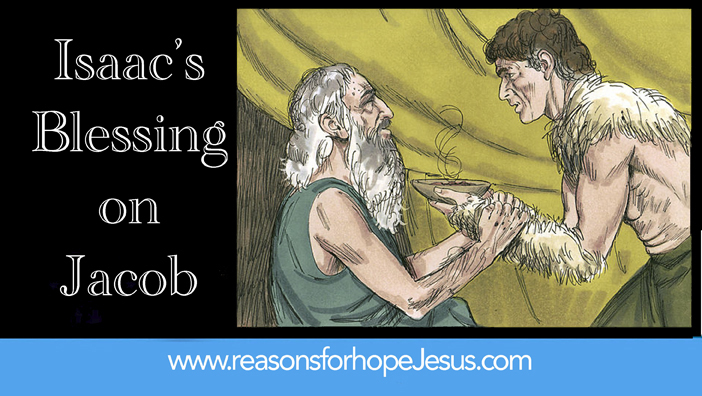 Ya’aqov or James was a particularly fitting name for a second son in a Jewish family. But the name also suggests a certain character. The original Jacob was continually grasping for more. He was not content with his second-place status in relation to his brother. He provoked Esau into selling his birthright (Genesis 25:27-34) and later he conspired with his mother to cheat Esau out of his father’s blessing (Genesis 27).
If in character and conduct James/Ya’aqov resembled his Old Testament counterpart, then in his formative years Jesus would experience very difficult and challenging times with his brother. As we will see, during Jesus’ ministry James played the role of Jacob, a supplanter or deceptive usurper to great effect.
The list of brothers from Matthew and Mark’s Gospels form part of a description of the same incident—Jesus’ return to his hometown of Nazareth at the height of his public ministry. A closer look at Mark’s account provides us with a fascinating glimpse into this messianic family and the interplay of hometown perceptions and dynamics.
Jesus left there and went to his hometown, accompanied by his disciples. When the Sabbath came, he began to teach in the synagogue, and many who heard him were amazed.
“Where did this man get these things?” they asked. “What’s this wisdom that has been given him? What are these remarkable miracles he is performing? Isn’t this the carpenter? Isn’t this Mary’s son and the brother of James, Joseph, Judas and Simon? Aren’t his sistershere with us?” And they took offense at him.
Jesus said to them, “A prophet is not without honor except in his own town, among his relatives and in his own home.” He could not do any miracles there, except lay his hands on a few sick people and heal them. He was amazed at their lack of faith. (Mark 6:1–6a)
There is a kind of small-town-plausibility to this story that is quite disarming. Local boy leaves home; makes the Big Time, surrounded by adoring crowds and an entourage of followers. Our heroic figure returns home, but rather than adulation, he is greeted by small-minded jealousy and skepticism. This is a situation that in various forms has played itself out a thousand times, in a thousand small towns throughout the ages and in every society. Reading between the lines you can perhaps hear the crowd’s unspoken thoughts. “He’s nothing special. I remember him as a runny-nosed little kid. We know his family. There’s nothing wonderful about them. Who does he think he is?”

Photo by Pixabay on Pexels.com
This outcome was to be expected. They had no faith in him. He was too familiar, too ordinary in their eyes. They were amazed at his wisdom and the reports of miracles, but in their eyes he had committed the sin of overreaching. He had gone well beyond the expected small-town norms. Over achievers must be put in their place, so “they took offence at him” (Matthew 13:57a; Mark 6:3b).
There’s a confounding mix of the ordinary meeting the highly extraordinary in this account—an encounter of the common man with the ultimate superhuman. And Jesus was both: common and supernatural. He was the carpenter turned Savior of the world. This hometown reaction is what you might expect when God takes on flesh and becomes one of us. No one knew quite how to handle Him. He does not fit the norm. He is incongruent in so many ways, far outside the norm of human experience. The easiest response is to reject Him.
What can we conclude about James, the subject of this book, from these observations? What we have portrayed here is a rather ordinary first-century Jewish family. James, the second son of Joseph the carpenter (Matthew 13:55), was conceived and came into the world through Mary in the same way as any other child on the planet. He had one older brother named Jesus and three younger brothers, in addition to at least two sisters. It seems clear that Joseph had passed away at some point before the hometown visit recorded in Mark 6:1–6 and Matthew 13: 53–58. Before taking up his public ministry, Jesus had worked in the family business as a carpenter. It seems highly likely that with Jesus’ departure, James would have continued in the family trade. It is equally clear that the townspeople of Nazareth largely rejected Jesus’ ministry. They had no faith in him and “took offence at him” (Matthew 13:57a;
Mark 6:3b).
So how did James respond to his brother’s rise to fame? As we will see, James, like those around him, showed himself to be a true hometown boy, a son of Nazareth. He too shared in their skepticism.
2) Matthew 17:1, Mark 5:37, Mark 9:2, Mark 14:33, Luke 8:51, Luke 9:28.
3 Leon Morris, Luke—Tyndale New Testament Commentaries (Eerdmans, 1984), pp. 86–87.
New from David Kitz
James—the brother of Jesus—who was this man? What evidence do we have that this “brother of our Lord” even existed?
David Kitz digs deep into archeology, family dynamics, church history, and the biblical texts. What emerges from his research is a portrait of a decisive, pivotal leader who embodied the will and character of Jesus Christ.
But how did James—James the unbeliever—transform to become a leader who changed the course of world history? In these pages you will uncover the answer and rediscover for yourself the life-changing power of the gospel.
To view further details or purchase directly from the author click here.
 I love the Psalms