
I will praise Him!

Purple stars bring backyard joy — photo by David Kitz
01 Saturday Jul 2017
Posted in Psalm 86, Psalms, Saturday's Psalm

Purple stars bring backyard joy — photo by David Kitz
21 Wednesday Jun 2017
Posted in Devotionals, Psalm 18, Psalms
Tags
cry for help, dark clouds, David, God, lightning, mercy, mercy of God, prairies, Prayer, rescue, storm clouds, storms of life, the LORD, thunder, thunderstorms, trouble, wind
Reading: Psalm 18
Verses 6-15
In my distress I called to the LORD; I cried to my God for help.
From his temple he heard my voice; my cry came before him, into his ears.
The earth trembled and quaked, and the foundations of the mountains shook;
they trembled because he was angry.
Smoke rose from his nostrils; consuming fire came from his mouth,
burning coals blazed out of it.
He parted the heavens and came down; dark clouds were under his feet.
He mounted the cherubim and flew; he soared on the wings of the wind.
He made darkness his covering, his canopy around him—
the dark rain clouds of the sky.
Out of the brightness of his presence clouds advanced,
with hailstones and bolts of lightning.
The LORD thundered from heaven; the voice of the Most High resounded.
He shot his arrows and scattered the enemy, with great bolts of lightning he routed them.
The valleys of the sea were exposed
and the foundations of the earth laid bare at your rebuke, LORD,
at the blast of breath from your nostrils (NIV).
Reflection
Maybe you are like me? I love thunderstorms. But watching a thunderstorm in a city is like watching a Christmas light display in broad daylight. There’s something missing. There’s no sense of broad expanse or sweeping grandeur.

A passing evening shower — photo by David Kitz
I grew up on the prairies and for sheer awe there’s nothing quite like viewing a thunderstorm slowly building in the western sky. There you are on a slow moving tractor working a field. There’s you, there’s miles of flat land, and there’s the sky. And the most active thing is the sky. Sometimes the storm clouds can hang there boiling and brooding for hours—lightning flashing in the distance. Then suddenly the air changes, the wind picks up, and look out! Lightning! Thunder! Fierce gusts of wind. Rain. Hail. It all comes at you—comes at you with a vengeance.
I love a thunderstorm. It puts me in my place. It lets me see who I am. I am a small man in a big world—a world I cannot control. I’m a man at the mercy of God. I’m always at the mercy of God whether I see the storm clouds building or not.
In this psalm, David pictures the LORD riding the wings of the wind, thundering from heaven, not to harm him, but storming in to rescue him in response to his cry for help. That’s my God. That’s the picture of God that I need etched onto my mind. He is the God who hears and answers, the God who helps in times of need. In a vast world, He hears the cry of little, insignificant me. I love a thunderstorm. It lets me see the LORD’s love and grace.
Response: Heavenly Father, may I always see you as my helper. Ride to my rescue when times are tough and I am in need. You are my help and defender. You are worthy of my praise. Amen.
Your Turn: Do the storms of life help you see God at work around you?
27 Saturday May 2017
Tags
desperate, forgive, forgiveness, generations, glory, God, mercy, nations, Savior, sins

Crabapple blossoms in spring — photo by David Kitz
19 Wednesday Apr 2017
Tags
God, mercy, pray, Psalm, psychology, rags, religious philosophy, Righteousness, Savior, sin, sinful nature
Reading: Psalm 143
A psalm of David.
(Verses 1-6)
LORD, hear my prayer,
listen to my cry for mercy;
in your faithfulness and righteousness come to my relief.
Do not bring your servant into judgment,
for no one living is righteous before you.
The enemy pursues me,
he crushes me to the ground;
he makes me dwell in the darkness like those long dead.
So my spirit grows faint within me;
my heart within me is dismayed.
I remember the days of long ago;
I meditate on all your works
and consider what your hands have done.
I spread out my hands to you;
I thirst for you like a parched land (NIV).
Reflection
On my best day, I need God’s mercy. On my worst day my need for outside help and mercy are evident to all. In truth, my need for the mercy of the LORD is never ending. All too often, we only call out to God in times of need or perceived difficulty. In reality our need for God’s help and mercy are constant.
![IMG_20170413_112744[206]](https://davidkitz.blog/wp-content/uploads/2017/04/img_20170413_112744206.jpg?w=529)
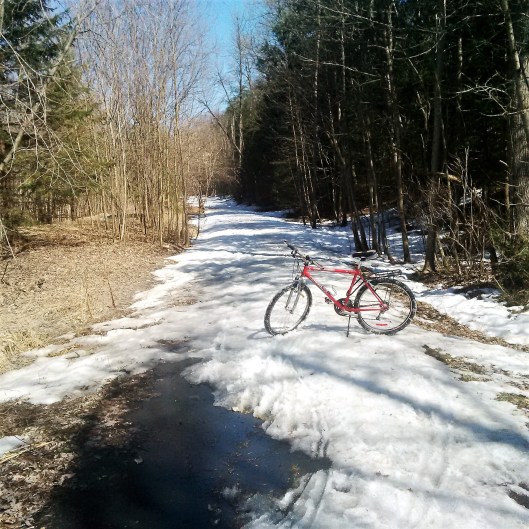
The last of the forest melt, Gatineau Park, QC — photo by David Kitz
David recognized that within himself he had no righteousness. In reality this is the starting point for a life transforming relationship with God. Contrary to a good deal of modern psychology and religious philosophy, we are not okay. We have a warped nature that is inclined to sin. It delights in rebelling against God. St. Paul describes this human condition with these words. For I know that good itself does not dwell in me, that is, in my sinful nature. For I have the desire to do what is good, but I cannot carry it out (Romans 7:18).
The prophet Isaiah described this universal human condition in this way. All of us have become like one who is unclean, and all our righteous acts are like filthy rags; we all shrivel up like a leaf, and like the wind our sins sweep us away (Isaiah 64:6).
Do I need God’s mercy? Yes, a thousand times yes!
Response: LORD God, I need your righteousness. My own righteousness is tainted with pride. I freely acknowledge my need for a Savior. You are my constant help. I thirst for you like a parched land. Amen.
Your Turn: Are you aware of your constant need for God’s mercy? Are you calling out to Him?
07 Friday Apr 2017
Tags
armor of God, battle, bicycle, bicycle helmets, bike, collided, concussion, cycling, helmet, helmet of salvation, mercy, minivan, porn sites, pornography, self-control, shield, the LORD
Reading: Psalm 140
(Verses 6-8)
I say to the LORD, “You are my God.”
Hear, LORD, my cry for mercy.
Sovereign LORD, my strong deliverer,
you shield my head in the day of battle.
Do not grant the wicked their desires, LORD;
do not let their plans succeed (NIV).
Reflection
On a beautiful spring evening almost twenty years ago, I went for a bicycle ride with my fourteen-year-old son, Josh. At that time, there were some beautiful mountain bike trails on a forest-covered escarpment above our home. After exploring these trails for a while the time came for us to return home.

Early spring cycling in Ottawa, Canada — photo by David Kitz
We crossed to the opposite side of the paved road and began our descent down the hill. Of course our bikes began to pick up speed—no pedaling needed. There was a traffic light at the bottom of the hill where we needed to make a right turn down our street. Soon Josh was well ahead of me. He went sailing around that corner at top speed and launched himself and his bike onto the sidewalk. What Josh could not see due to a tall hedge was the minivan pulling into the intersection directly ahead.
Boom! His bike collided with the back wheel and side of the minivan. Next, I see Josh’s body flying over the roof of the van. I expect to find him dead or disabled on the other side of the vehicle. Not so. Miraculously, not so! He was shaken but conscious. We rushed him to a hospital to have him checked. No signs of concussion were detected. Answered prayer and his bicycle helmet saved him. The minivan owner was not so fortunate. Josh’s head dented the rear roof column. Body shop repairs cost $1,600.
David voices this prayer in today’s reading from Psalm 140: Sovereign LORD, my strong deliverer, you shield my head in the day of battle.
Is your head shielded? It’s your body’s most crucial asset. You can lose a limb—several limbs—and survive. But your head is essential. A lot of Christians are losing the battle for their heads these days. By that I mean we are filling our minds with the philosophical garbage and filth of this world. Many of the most active sites on the World Wide Web are porn sites. Christian men are particularly vulnerable.
Paul, the apostle, admonishes us: Put on the full armor of God, so that you can take your stand against the devil’s schemes (Ephesians 6:11). One of the most important elements of that armor is the helmet of salvation. Are you certain of your salvation? Our salvation is as certain as the blood of Christ. It’s as certain as the empty tomb. But if we do not guard our minds and our eyes, which are the gateway to the mind, we can quickly find ourselves vulnerable. We need self-control and God’s help—His shielding. It doesn’t take long to pick up speed when your mind starts rolling downhill. Is your helmet on?
Response: Sovereign LORD, my strong deliverer, you shield my head in the day of battle. Do not grant the wicked their desires, LORD; do not let their plans succeed. I commit my thoughts and ways to you. Amen.
Your Turn: How vulnerable are you to attacks from the enemy? Are you holding your ground?
19 Sunday Feb 2017
Posted in Psalms, Sunday's Psalm

Sunset photo courtesy of Liz Kranz
13 Monday Feb 2017
Tags
communion, depths, forgiveness, God, Lake of the Praries, mercy, Psalms of Ascent, sin, the LORD, transgressions
Reading: Psalm 130
A song of ascents.
(Verses 1-4)
Out of the depths I cry to you, LORD;
LORD, hear my voice.
Let your ears be attentive
to my cry for mercy.
If you, LORD, kept a record of sins,
LORD, who could stand?
But with you there is forgiveness,
so that we can, with reverence, serve you (NIV).
Reflection
Psalm 130 is a perfect example of a psalm that brings us into the private inner sanctum of communion with God. Here is a portrait of a fallen man—a man on his knees before his Maker, the eternal One. Hear him now as he agonizes in prayer, “Out of the depths I cry out to you, O LORD; O LORD, hear my voice. Let your ears be attentive to my cry for mercy.”

Sunrise over Lake of the Prairies, MB — photo courtesy of Donald Adam
The opening lines of this psalm leave little doubt as to what has transpired. The psalmist has failed; he has missed the mark. He has transgressed, yet again. There is an abject poverty of spirit reflected in these words—a poverty that almost makes us cringe.
We do not know what sin, or list of sins has brought the psalmist to this wretched state. The transgression is left unstated. Was it anger, malice, or unbridled lust? Was it pride, greed or wilful dishonesty? Was this a transgression of the mind, of the tongue, of action or inaction? God knows.
I am always somewhat skeptical of those who claim they could never commit this or that sin. I think we rarely comprehend the depravity of our own hearts. Pushed into wrong circumstances, in the wrong environment, with the wrong peer group, who can plumb the depths to which a man or woman may sink? I can identify with the psalmist. I have added my own pile of dung to this world’s heap of moral filth. I too have found myself in the psalmist’s position, sobbing out these words, “Out of the depths I cry out to you, O LORD; O LORD, hear my voice. Let your ears be attentive to my cry for mercy.“
But despite my failings, despite my moral poverty, this great God—this God of holiness—is approachable. He is a God of mercy. The psalmist reminds himself and the LORD of His merciful nature with these words: If you, LORD, kept a record of sins, LORD, who could stand? But with you there is forgiveness, so that we can, with reverence, serve you.
I need daily reminders of God’s forgiveness and mercy. God the moral accountant is also the LORD of forgiveness. No one does forgiveness better than God. When we confess our sins, He destroys the record. What accountant does that?
Response: Father God, I thank you for forgiveness. I have failed you many times, but you are rich in mercy. You are a patient God. Thank you for destroying the record of my sins. Amen.
Your Turn: Have you been guilty of digging up the record of your sins—sins that have been forgiven?
02 Thursday Feb 2017
Tags
eye contact, intimacy, intimacy in prayer, mercy, Prayer, Psalm, Psalms of Ascent, slaves, the LORD
Reading: Psalm 123
A song of ascents.
I lift up my eyes to you,
to you who sit enthroned in heaven.
As the eyes of slaves look to the hand of their master,
as the eyes of a female slave look to the hand of her mistress,
so our eyes look to the LORD our God,
till he shows us his mercy.
Have mercy on us, LORD, have mercy on us,
for we have endured no end of contempt.
We have endured no end
of ridicule from the arrogant,
of contempt from the proud (NIV).
Reflection
Like every parent, I have had moments when I have needed to correct my children. In my professional life as a teacher, correcting a child’s behavior was a daily, sometimes minute-to-minute occurrence. In such situations eye contact is crucial. If the child does not make eye contact with you, you are wasting your breath. Your advice—your admonition—your warning—is going nowhere. You might as well speak to the wind. But in such situations, it is essential that you speak to the heart of the child.

Creek side, Grand Prairie, Alberta — photo courtesy of Morris Burgess
The eyes are the window of the heart. When someone is avoiding eye contact, in reality they are hiding their heart. They are closing their heart to you.
Of course the same principle is true when we consider our relationship with God. We need to make eye contact with the LORD. That’s why there is something truly intimate about this psalm. It’s all about making eye contact with God. It’s about opening your heart to the LORD and exposing what is deep inside you. You are showing when you lift your eyes to Him that you are ready to receive instruction. Yes, and correction too, if that is needed.
So the psalmist speaks these words: I lift up my eyes to you, to you who sit enthroned in heaven. He takes the position and the posture of a slave—a humble servant. He is looking for mercy—hoping for grace and blessing from the hand of His master.
This is perhaps the most intimate of the Songs of Ascent. Having come a great distance, the pilgrim is now in the LORD’s house. He has drawn nigh in the fullest sense. The pilgrim lifts his eyes—not to an idol, but to the LORD—the One who fills all, formed all, and transcends all. With eyes wide open he exposes his heart to God. He waits expectantly for the LORD’s instruction.
Prayer at its best is modeled for us in this psalm. It’s prayer with our eyes wide open to God.
Response: Father God, I come before you now. I lift up my eyes to you, to you who sit enthroned in heaven. Be merciful to me. Speak to me. Correct me, if I need correction. Give me direction. I am ready to receive instruction from you. I am your servant. Amen.
Your Turn: Are you drawing nigh to God? How do you make eye contact with God?
11 Friday Nov 2016
Tags
forgiveness, God, MacNutt SK, merciful, mercy, prodigals, Saskatchewan, Saskatchewan sunset, sin, sinful, sinful ways, sunset, the LORD
Reading: Psalm 106
(Verses 28-39)
They yoked themselves to the Baal of Peor
and ate sacrifices offered to lifeless gods;
they aroused the LORD’s anger by their wicked deeds,
and a plague broke out among them.
But Phinehas stood up and intervened,
and the plague was checked.
This was credited to him as righteousness
for endless generations to come.
By the waters of Meribah they angered the LORD,
and trouble came to Moses because of them;
for they rebelled against the Spirit of God,
and rash words came from Moses’ lips.
They did not destroy the peoples as the LORD had commanded them,
but they mingled with the nations and adopted their customs.
They worshiped their idols, which became a snare to them.
They sacrificed their sons and their daughters to false gods.
They shed innocent blood, the blood of their sons and daughters,
whom they sacrificed to the idols of Canaan,
and the land was desecrated by their blood.
They defiled themselves by what they did;
by their deeds they prostituted themselves (NIV).
Reflection
Psalm 106 began with with praise, but in verse three it transitioned to this opening thought, “Blessed are those who act justly, who always do what is right.”

Prairie sunset near MacNutt, Saskatchewan — photo by David Kitz
Now there’s a mind-blowing concept. Talk about setting the bar completely out of reach! Nobody—I repeat—nobody always does right and acts justly in every situation. Human fallibility and self-interest dictate to the contrary.
The psalmist then goes on to recount a litany of Israel’s sins. By my estimation there are nine major transgressions outlined in Israel’s history through this psalm. There’s a failure to remember God’s kindness. There’s rebellion, wickedness, idolatry, envy, sensual craving, impatience, ingratitude, unbelief, outright disobedience, bloodshed, human sacrifice and further rebellion.
What is truly remarkable about this psalm is not Israel’s sinful ways; sinful ways are common to all humanity. What is truly mind-boggling is God’s faithfulness and readiness to forgive. He hears us in our distress. He seeks out the lost and wayward. He welcomes back the sin infested prodigals knowing full well where they have been. That’s the wonder of our God. He is always, always, always ready to forgive, when we are ready to admit the error of our ways. Now that’s a reason for praise!
Response: Father God, I acknowledge that my people and my nation have been caught up in sinful ways. Please be merciful to us. We are deserving of your judgment. Forgive us through your son Jesus. Amen.
Your Turn: Are you ready to take a stand against sin in your life and community?
03 Saturday Sep 2016
Posted in Psalms, Saturday's Psalm