Tags

17 Tuesday Mar 2020
17 Tuesday Mar 2020
Reading: Psalm 6
For the director of music. With stringed instruments.
According to sheminith. A psalm of David.
LORD, do not rebuke me in your anger or discipline me in your wrath.
Have mercy on me, LORD, for I am faint;
heal me, LORD, for my bones are in agony.
My soul is in deep anguish.
How long, LORD, how long?
Turn, LORD, and deliver me; save me because of your unfailing love.
Among the dead no one proclaims your name.
Who praises you from the grave?
I am worn out from my groaning.
All night long I flood my bed with weeping and drench my couch with tears.
My eyes grow weak with sorrow; they fail because of all my foes.
Away from me, all you who do evil, for the LORD has heard my weeping.
The LORD has heard my cry for mercy; the LORD accepts my prayer.
All my enemies will be overwhelmed with shame and anguish;
they will turn back and suddenly be put to shame (NIV).*

Foster’s driveway — photo by David Kitz
Reflection
The life of a God-follower isn’t all happy days and sunny skies, as some preachers might have you believe. On the contrary, hard times and grief may frequent our way. Does that mean we are out of the will of God? Has God abandoned us during these times of inner turmoil, struggle and hardship?
Judging by the life and experience of David as expressed through the psalms, the answer is a resounding, “No.” God has not abandoned you.
David met with God during these times of difficulty. He poured out his complaint before the LORD. He pleaded with God; he held nothing back. Take a look at some of the keywords in this psalm: agony, anguish, groaning, weeping, tears, and sorrow. David experienced all these emotions. He didn’t bottle them up. He poured them out before the LORD in prayer.
Many believers suffer from a form of spiritual constipation. They are filled with anger, hurt and bitter disappointment. Life has been hard, but they are afraid to take their anguish before God. They put on a brave face for the world and the church, but inwardly they are dying. They need a massive dose of the Psalms of David—psalms of self-emptying.
Fear not; God can handle your anguish and anger. He won’t smite you dead for being honest about your feelings. Here is some sound advice. Are you hurt or feeling broken? Take it to the Lord in prayer. Then take heart from what David says in the conclusion to this psalm, “The LORD has heard my cry for mercy; the LORD accepts my prayer (v. 9).“
Response: Dear God, I pour out my problems, hurts and struggles before you. Hear my prayer. I know you are a God of mercy. I open myself to you. Amen.
Your Turn: Do some Christians suffer from spiritual constipation? Does heartfelt prayer bring relief? Are you bottling up things that should be released to the Lord?
This post by award-winning author David Kitz will be published in book format later in 2020 by Elk Lake Publishing under the title 365 Days through the Psalms.
14 Saturday Mar 2020
13 Friday Mar 2020
Reading: Psalm 5
For the director of music. For pipes. A psalm of David.
(Verses 1-7)
Listen to my words, LORD,
consider my lament.
Hear my cry for help, my King and my God, for to you I pray.
In the morning, LORD, you hear my voice;
in the morning I lay my requests before you
and wait expectantly.
For you are not a God who is pleased with wickedness;
with you, evil people are not welcome.
The arrogant cannot stand in your presence.
You hate all who do wrong;
you destroy those who tell lies.
The bloodthirsty and deceitful you, LORD, detest.
But I, by your great love,
can come into your house;
in reverence I bow down
toward your holy temple (NIV).

Winter sunrise courtesy of Louie Foster
Reflection
Are you a morning person? Are you most productive in the morning hours, or do revive after the sunsets? Our bodies move according to their own internal rhythm. Some people love to rise with the chirp of the first songbird, while others are true night owls. Often my wife catches her second wind in the evening as I’m fading into sweet oblivion.
It would seem that David was a morning person. Here in Psalm 5, we read these words from David: In the morning, LORD, you hear my voice; in the morning I lay my requests before you and wait expectantly.
David was one of those early birds that began calling out to God at the break of day. He knew God was listening. He made sure that the LORD heard his voice.
Is the LORD hearing your voice in the morning? Are you calling out to Him? Of course, your heavenly Father is pleased to hear your voice at any time, day or night. Is He familiar with your call?
But there’s more to this than just calling out to God and laying out your requests. David waits expectantly. He expects God to respond. He is listening, watching and waiting for the LORD’s reply. Have you built some wait time into your prayer time?
All too often our conversations with God are one sided. They are one sided because we blurt out our requests and rush off into our day. We don’t wait expectantly for the LORD’s reply. We don’t allow Him time to respond.
Response: Heavenly Father, I call out to you. I lay out my requests. Teach me to wait expectantly for you. Open my ears to hear your voice. I want to be tuned into you throughout my day. Amen.
Your Turn: Have you set aside a regular prayer time? What time works best for you?
This post by award-winning author David Kitz will be published in book format later in 2020 by Elk Lake Publishing under the title 365 Days through the Psalms.
17 Monday Feb 2020
Posted in Devotionals, Psalm 145, Psalms
Reading: Psalm 145
(Verses 17-21)
The LORD is righteous in all his ways
and faithful in all he does.
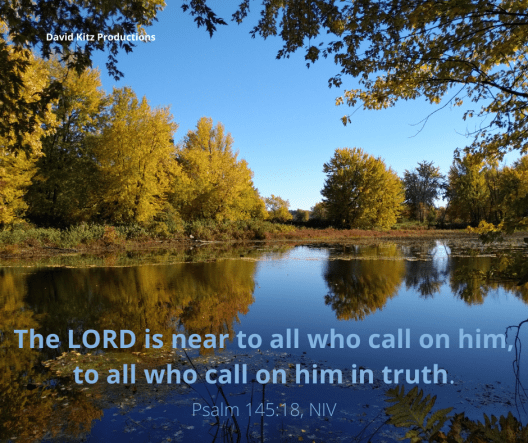
The LORD is near to all who call on him,
to all who call on him in truth.
He fulfills the desires of those who fear him;
he hears their cry and saves them.
The LORD watches over all who love him,
but all the wicked he will destroy.
My mouth will speak in praise of the LORD.
Let every creature praise his holy name
for ever and ever (NIV).*

As for God, his way is perfect — photo by David Kitz
Reflection
Psalm 145 begins with David calling us to praise the LORD, and it ends with a similar call to praise. David extols the virtues of the LORD. He sees Him as righteous and faithful. One can have these virtues, but still be distant or aloof. But that’s not how David sees the LORD.
David knows his God hears him when he prays. How does he know this? For David this isn’t an answer he learned from a textbook. He knows God hears prayer from personal experience. In his daily life David called out to the LORD over and over again in times of trouble, and over and over again the LORD helped him. That’s why he can record the following words in this psalm of praise: He fulfills the desires of those who fear him; he hears their cry and saves them.
What about you? Have you discovered from personal experience that God answers prayer? Have you called out to the LORD in a time of trouble? Has He brought help your way?
Just this week my wife lost/misplaced her driver’s license. This produced some anxious moments as she discovered this loss just as she was about to board a flight across the country. She had arranged a car rental at her destination, but without her driver’s license she could not access the car. Some desperate prayers were offered up and in due course, after she arrived at her destination, the answer came. The driver’s license was found.
Do we involve the LORD in our day to day activities? That should be the norm. Here is David’s testimony—the testimony of Holy Scripture: The LORD is near to all who call on him, to all who call on him in truth.
That should be our testimony in the daily grind of life, in the ups and the downs. The LORD is near 365 days of the year. Before Jesus ascended to heaven, he left his disciples with these words of assurance, “Surely I am with you always, to the very end of the age” (Matthew 28:20). We can rest assured that He is as near as our next breath.
Response: LORD God, I am so glad that you are not distant or aloof from those who call out to you. You are near to me. You answer prayer. My mouth will speak in praise of the LORD. Amen.
Your Turn: Can you testify that the LORD is near and He answers prayer?
10 Monday Feb 2020
Posted in Devotionals, Psalm 144, Psalms
Tags
Reading: Psalm 144
(Verses 5-10)
Part your heavens, LORD, and come down;
touch the mountains, so that they smoke.
Send forth lightning and scatter the enemy;
shoot your arrows and rout them.
Reach down your hand from on high;
deliver me and rescue me
from the mighty waters,
from the hands of foreigners
whose mouths are full of lies,
whose right hands are deceitful.
I will sing a new song to you, my God;
on the ten-stringed lyre I will make music to you,
to the One who gives victory to kings,
who delivers his servant David (NIV).*

Where the deer and the antelope play, near Maple Creek, Saskatchewan — photo by David Kitz
Reflection
“Lord, why don’t you come and fix this mess?” Have you ever thought that thought, or voiced that prayer?
When we look at the world around us, there are a great many things that appear to be coming off the rails. This past week the abandoned body of a toddler was found in a church parking lot in Edmonton. Where are the parents? They haven’t come forward. Who would harm a child like that? Sadly, you can check the news services and see that cases like this occur all too frequently all over the globe. It appears that the love of many has grown cold. See 2 Timothy 3:1-5.
Here’s a chilling statistic. In America on average every month fifty women are shot to death by their male partners. Meanwhile gun advocates keep insisting that more guns will keep America safe—safe from whom? In some cases the killers are the well-armed and well-intentioned men in our midst. All too often a gun in the home enables suicide.
On the international scene, wars, violence and mass migration are creating havoc and instability in Europe, the Middle East and North Africa. Terrorists and dictators continually amp up their threats. Has the world gone mad?
In this context, David’s prayer in this portion of Psalm 144 makes a lot of sense. Part your heavens, LORD, and come down; touch the mountains, so that they smoke. Send forth lightning and scatter the enemy; shoot your arrows and rout them.
David is asking for the LORD to come down and fix this mess. Down through the ages believers have prayed similar prayers. Jesus did come down to fix this mess, and the world he created turned on him and had him crucified. But we can be sure a final day is coming when he returns again triumphant.
Response: LORD, I look forward to the return of Jesus. He alone can fix this mess. Lord, help me to do what I can to speed your return. Let your gospel be preached in the entire world as a witness. Amen.
Your Turn: Do you believe the Lord will fix this mess? Do we have a role to play in Christ’s return?
31 Friday Jan 2020
Posted in Devotionals, Psalm 142, Psalms
Tags
Reading: Psalm 142
A maskil of David. When he was in the cave. A prayer.
(Verses 1-4)
I cry aloud to the LORD;
I lift up my voice to the LORD for mercy.
I pour out before him my complaint;
before him I tell my trouble.
When my spirit grows faint within me,
it is you who watch over my way.
In the path where I walk people have hidden a snare for me.
Look and see, there is no one at my right hand;
no one is concerned for me.
I have no refuge; no one cares for my life (NIV).*

Coming to the light — photo by David Kitz
Reflection
Have you been in a cave? Despite what we read and know about cavemen, caves are not great living spaces. They are dark and dank. They may be fine places to retreat to in times of mortal danger, but they leave much to be desired as a permanent habitation.
In desperate times, people hide in caves. That’s where David found himself as he hid from his jealous master, King Saul. Though he was innocent, Saul in a jealous rage attacked David and repeatedly tried to kill him. See 1 Samuel 19:9-24. Eventually, David fled to a cave in the Desert of En Gedi. This psalm, Psalm 142, was born in a desolate place—a cave in the Desert of En Gedi. See 1 Samuel 24.
Here David hit rock bottom. From this low point in his life he called out to the LORD with these words: I cry aloud to the LORD; I lift up my voice to the LORD for mercy. I pour out before him my complaint; before him I tell my trouble.
The Psalms are the prayer book of the Bible. With this psalm David provides us with an excellent example of prayer—prayer from the lowest position—the position of weakness and vulnerability. The future looked bleak for David. He was living the precarious life of a fugitive. At any time, he could be discovered or betrayed. Would today be his last day?
Where did David take his troubles? He took them to the LORD.
Where do you go with your troubles? Where do you take your complaints? The LORD’s complaint department is open for business. There you will find a listening ear.
There are a host of things that are unfair in this life—sometimes brutally unfair. Are we supposed to suppress our outrage? Should we hide our hurt and pretend that all is well, while on the inside the bottom is falling out of our life? No. A thousand times, no! Take it to the LORD in prayer. That’s what David did. He cried out to his God, and his God answered.
Response: LORD God, when I reach a low point you are there. Hear me when I am down. I bring my troubles and sorrows to you. They are more than I can bear. Jesus, be my burden bearer. Amen.
Your Turn: Are you in a cave or a desert place? Take some time to call out to God.
*New International Version, Copyright © 1973, 1978, 1984, 2011 by Biblica.
21 Tuesday Jan 2020
Posted in Devotionals, Psalm 139, Psalms
Reading: Psalm 139
(Verses 19-22)
If only you, God, would slay the wicked!
Away from me, you who are bloodthirsty!
They speak of you with evil intent;
your adversaries misuse your name.
Do I not hate those who hate you, LORD,
and abhor those who are in rebellion against you?
I have nothing but hatred for them;
I count them my enemies.

Reflection
As much as I love the psalms of the Bible, there are some psalms, or verses within psalms that I would just like to skip. I wish they weren’t there. Today’s reading from Psalm 139 is a prime example. The author’s words are filled with venom. Why are they even in the Bible? (Please bear with me.)
Passages like today’s reading are particularly troubling in light of Jesus’ teaching in the New Testament. In his great Sermon on the Mount, he gave us this teaching: “You have heard that it was said, ‘Love your neighbor and hate your enemy.’ But I tell you, love your enemies and pray for those who persecute you, that you may be children of your Father in heaven. He causes his sun to rise on the evil and the good, and sends rain on the righteous and the unrighteous” (Matthew 5:43-45).
Reconciling today’s reading from Psalm 139 with Jesus’ words makes my head hurt. Jesus calls us to an incredibly high standard—God’s standard. God shows kindness and love even to the unrighteous. They like us receive both sunshine and rain. Let’s face it, when someone hurts me, my default position is to hurt them back. That’s the natural human response. That’s the way it has been since the beginning, and the world is full of lasting scars—inter-generational scars because of it. Wounded people have been busy hurting other wounded people as hate builds on hate in the home, at work and internationally.
But Jesus came to interrupt that corrosive cycle. He asks us to counter that hurt—that slight—that injury with love. Now that’s truly revolutionary. It’s a revolt against the status quo of hatred that has poisoned human relations in our country and the world. Has someone gone out of their way to hurt you? Retaliate with an act of love. That’s what Jesus is saying.
Is that hard? Absolutely. It’s much easier to respond like the author of today’s reading from Psalm 139. So why is this portion of Psalm 139 in the Bible? Maybe it should be redacted—blacked over like a secret government file.
In reality, Psalm 139 like all the psalms, began as someone’s personal prayer—their personal interaction with God. They are pouring out their heart before God. It’s a heart that has been wounded by others. Should they bottle up those feelings and never express them to God? Of course not. We need to pour out our hurts to God. He alone can heal and change that wounded heart.
Response: LORD God, you know all my hurts. I bring them before you. Pour your love into me, so I can love my enemies. Show me the way forward. Jesus, you forgave even those who killed you. Amen.
Your Turn: Have you changed your default position from hate to love?
26 Thursday Dec 2019
Posted in Devotionals, Psalm 132, Psalms
Reading: Psalm 132
A song of ascents.
(Verses 1-5)
LORD, remember David
and all his self-denial.
He swore an oath to the LORD,
he made a vow to the Mighty One of Jacob:
“I will not enter my house or go to my bed,
I will allow no sleep to my eyes
or slumber to my eyelids,
till I find a place for the LORD,
a dwelling for the Mighty One of Jacob” (NIV).

The angel and the cross on Parliament Hill, Ottawa, ON
Reflection
This is the thirteenth psalm in the Songs of Ascent series. With this psalm, the author returns to a familiar theme—the glory of God’s presence in Zion. It is what has drawn the pilgrims to this holy place. They have come to worship and meet with God.
But this psalm has a different approach. It recounts the history of Zion and how this particular place was chosen as the site for Israel to worship God. It all began with David. At the prompting of the LORD, David chose Mount Zion to set up the Tabernacle of the LORD. But before Mount Zion could become a place of worship the stronghold of Zion had to be conquered. It was in enemy hands. Nevertheless, David captured the fortress of Zion—which is the City of David (2 Samuel 5:7).
In this psalm we hear of David’s vow. “I will not enter my house or go to my bed, I will allow no sleep to my eyes or slumber to my eyelids, till I find a place for the LORD, a dwelling for the Mighty One of Jacob”
In David’s case, finding a place for the LORD required self-denial. It involved a physical battle. There is a spiritual battle that we too need to fight so the LORD can occupy His rightful place in our lives. The enemy does not leave the strongholds in our mind without a fight. We must take action to evict him.
We live in a world where self-denial is rare, and often frowned upon. Our society pushes the easy life—the comfortable life—the path of least resistance. Self-denial in pursuit of a relationship with God is a foreign concept. In many churches fasting and prayer is a lost discipline.
Jesus encountered the same problem with his own disciples. While he was praying fervently in the Garden of Gethsemane, his disciples were fast asleep. “Simon,” he said to Peter, “are you asleep? Couldn’t you keep watch for one hour?” See Mark 14:32-42.
This inability to pray for an hour is an indicator that at our core we have not surrendered fully to God. Other things are more important. There is no self-denial. That TV show is more important. The game is more important. Perhaps our Zion is still occupied by the enemy and the LORD is not enthroned there.
Response: LORD God, help me to change. I want to put you first in my life. Come and occupy the throne of my life. I want my thoughts, words and actions to be governed by you, Lord Jesus. Amen.
Your Turn: Do you find self-denial difficult? Do you practice a variety of spiritual disciplines?
04 Wednesday Dec 2019
Posted in Devotionals, Psalm 119, Psalms
Tags
Reading: Psalm 119
ר Resh
(Verses 153-160)
Look on my suffering and deliver me,
for I have not forgotten your law.
Defend my cause and redeem me;
preserve my life according to your promise.
Salvation is far from the wicked,
for they do not seek out your decrees.
Your compassion, LORD, is great;
preserve my life according to your laws.
Many are the foes who persecute me,
but I have not turned from your statutes.
I look on the faithless with loathing,
for they do not obey your word.
See how I love your precepts;
preserve my life, LORD, in accordance with your love.
All your words are true;
all your righteous laws are eternal (NIV).

Ottawa River — photo by David Kitz
Reflection
As we draw near to the end of Psalm 119, I have a confession to make. Though in general, I love the Book of Psalms, Psalm 119 did not rank high in my affections. Though my views have changed, please bear with me now as I attempt to describe why at first I disliked this Psalm.
In my opinion the author of this psalm spends too much time posturing. He continually reminds God how good he is and how disgusting others are. Statements like this one set my teeth on edge: I look on the faithless with loathing, for they do not obey your word. See how I love your precepts; preserve my life, LORD, in accordance with your love.
Words like these remind me of the Pharisee bragging in the temple while the tax collector humbly calls out to God for mercy. Jesus concludes that the tax collector “went home justified before God. For all those who exalt themselves will be humbled, and those who humble themselves will be exalted” (Luke 18:14). I’m left wondering, how did the author of Psalm 119 return home? Was his prayer heard and accepted by the LORD?
The answer must be a resounding yes. Psalm 119 would not be in our Bible’s if it was not the divinely inspired word of God. So this question remains. How does the psalmist get away with using the sort of comparison that drew Jesus condemnation in his description of the Pharisee and the tax collector?
I believe the answer lies in posture. Psalm 119 is best prayed from a kneeling position. The psalmist is humbly—even desperately—calling out to God. The posture we assume influences the prayers we pray.
Response: Father God, teach me how to pray with a humble heart. Any righteousness or goodness I have comes from you. I will brag about your goodness and unfailing love for me. You are true. Amen.
Your Turn: What posture do you assume when you pray? How does your posture reflect your heart?