
• Home
  • About
  • DavidKitz.ca
  • Youtube Videos
  • Books by David
  • Books on Amazon.com

I love the Psalms

~ Connecting daily with God through the Psalms

I love the Psalms

Tag Archives: skeptics

The Mystery in a Box

08 Sunday Feb 2026

Posted by davidkitz in Psalms

≈ 4 Comments

Tags

archeologists, Bible, brother of Jesus, Christians, faith, James, James the brother of Jesus, New Testament, ossuary, skeptics

James: the Lynchpin of Our Faith — Introduction

Dear friends,
now we are children of God,
and what we will be has not yet been made known.
But we know that when Christ appears,
we shall be like him,
for we shall see him as he is.
(1 John 3:2, NIV

Who knew that a medium-size box could create such a stir? Archaeologists, academics, journalists, and theologians were intrigued. A debate raged for weeks about the authenticity of this ancient stone box. A sceptical public grew curious and hungered for more information. What did all this mean? What were the implications?

In the fall of 2002, the typical news cycle of war, politics, celebrity missteps, and market fluctuations was briefly interrupted by word that an ancient ossuary had been discovered. The inscription on this stone box read, “James, son of Joseph, brother of Jesus.”
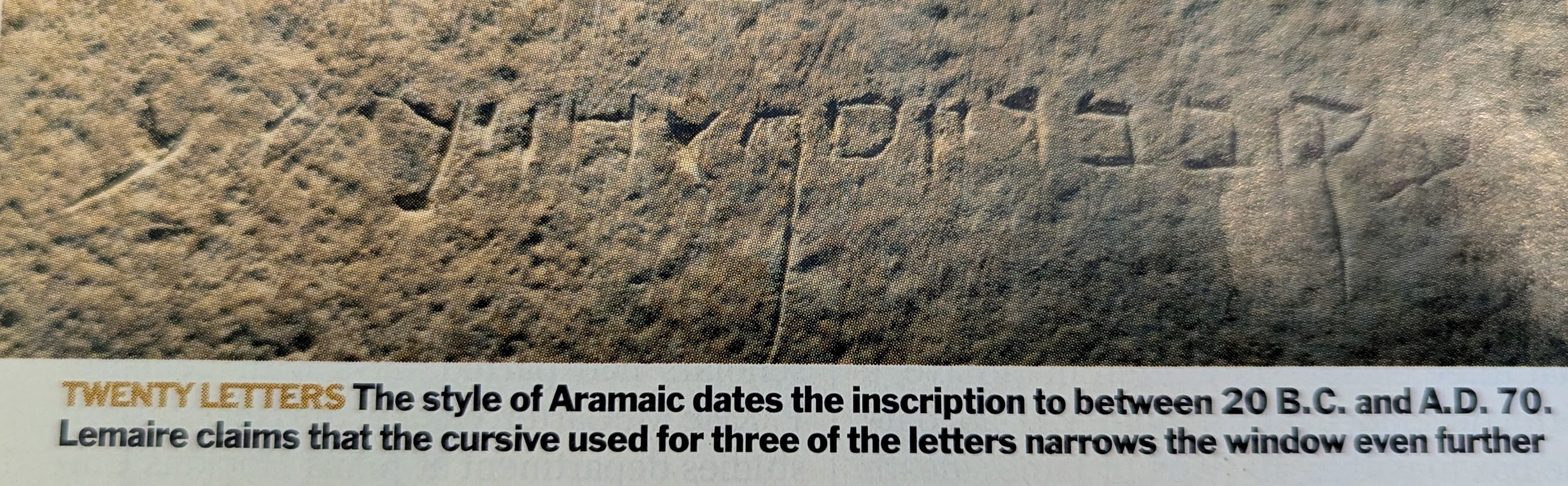
Photo Credit Time Magazine, November 4, 2002

Did Jesus have a brother? Were his brother’s bones once stored in this ancient ossuary? Who precisely was this James? Experts in ancient burial customs claimed that it was common practice to have the name of the father of the deceased inscribed on the burial box, but why include the brother’s name? Jesus—Jesus? Was this the Jesus of the New Testament, the one revered by millions as the Son of God?

The list of questions grew. Scholars speculated, while public curiosity reached a peak. Israeli authorities questioned how this 25 × 50 × 30cm stone box came into the hands of Oded Golan, a private collector of antiquities. Roman Catholic theologians chafed at the very notion that Jesus had a brother. Religious skeptics dredged up a variety of imaginative apocryphal scenarios.

Time magazine, in its November 4, 2002, edition reported that “Andre Lemaire, one of the world’s foremost scholars of ancient scripts, announced that ‘it seems very probable that this [box] is the ossuary of the James in the New Testament.’”
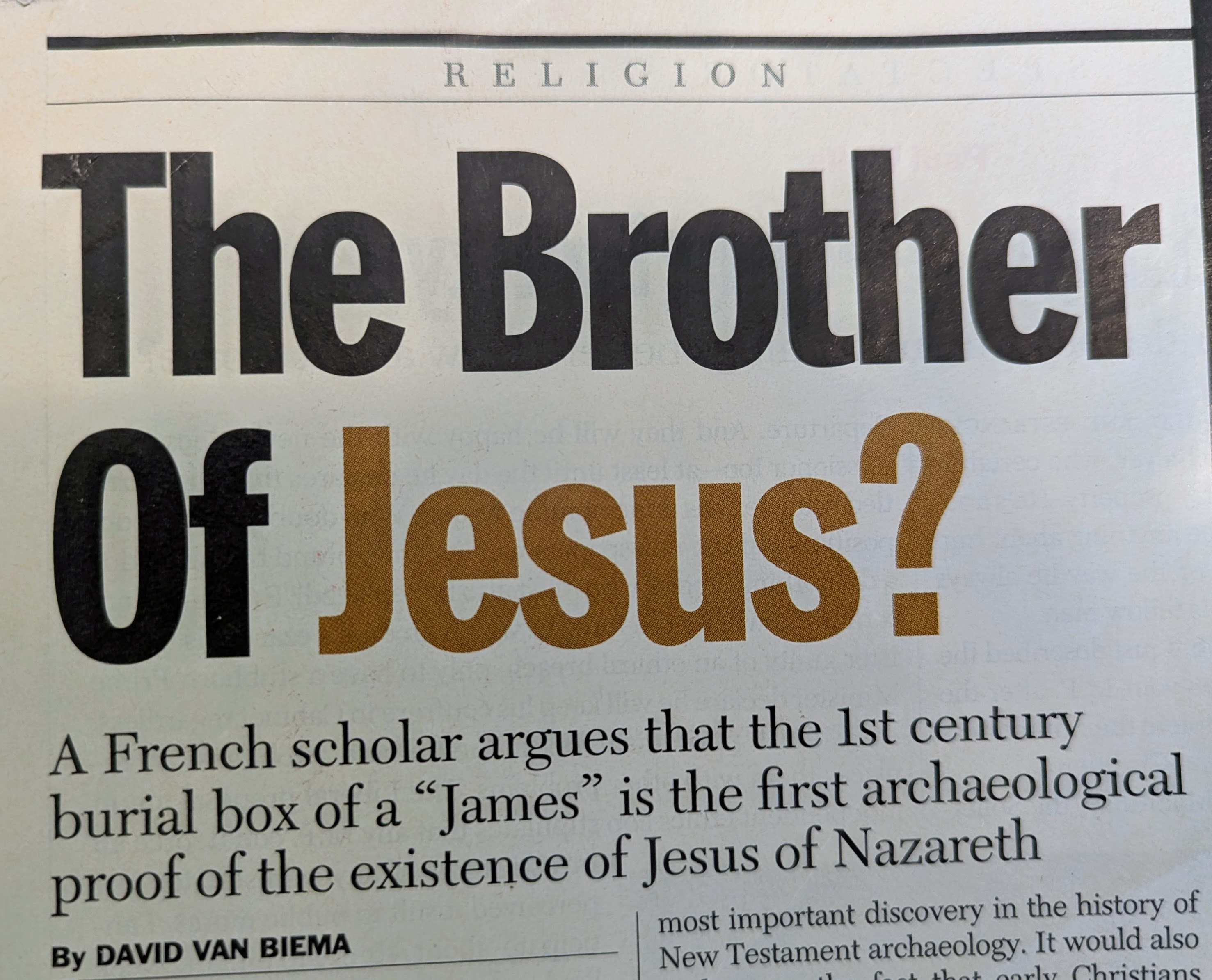
Time Magazine Headline, Nov. 4, 2002

Arrangements were made to have the James Ossuary examined by experts and placed on display at the Royal Ontario Museum (ROM) in Toronto. But alas, when the shipping container arrived by air from Jerusalem, it was discovered that the ancient stone box had fractured in transit. News outlets excitedly reported on this new ill-fated development.

Undeterred by these setbacks, repairs were hastily made to the ossuary, and the highly publicized exhibit went ahead as planned. Thousands flocked to the display at the ROM. In fact, the display curator at the time confessed to this author that no other ROM exhibit generated sucha widespread frenzy of interest in all his years of service.

This stone box—this ancient artifact—may well be the closest physical contact we have to Jesus, the subject of the gospels.

But storm clouds were brewing. Roman Catholic scholars dismissed the discovery on doctrinal grounds. According to long established Vatican teaching, Mary was a perpetual virgin. How could Jesus then have a brother? This teaching has persisted despite several passages in the New Testament which unequivocally refer to James as the brother of Jesus.

Some scholars questioned the authenticity of this discovery. Was the “brother of Jesus” portion of the inscription a forgery—a present day addition to boost the value of this artifact? Then there was the question of provenance. Where exactly was this ossuary discovered? Since the exact original location of this find was unknown, the context that archeologists rely on to ascertain authenticity was sadly missing. How did the ossuary come into the hands of Oded Golan? Was he simply an unscrupulous shyster out to make a fast buck by peddling fake or altered artifacts?

Golan’s activities and his artifacts raised the suspicion of the Israeli Antiquities Authority. For years the Antiquities Authority had been attempting to put a halt to the illegal trade in artifacts discovered in the Holy Land. Here was a high-profile case that could send a clear message to all who sought to profit from this trade. On July 22, 2003, Oded Golan was arrested in Jerusalem for allegedly forging and illegally trading in antiquities. But is the James ossuary a forgery? In a press release following Golan’s arrest, the ROM stood by its initial assessment:

Until the ROM receives convincing evidence to the contrary, we stand by our opinion that the James Ossuary is not a forgery. We had a limited amount of time to study it because of the amount of conservation work that was required after the Ossuary arrived at the Museum after being damaged in transit. The studies that were carried out on the inscription and broken fragments of the Ossuary, however, satisfied the ROM’s investigative team that it was an authentic artifact with an authentic inscription that might make it the Ossuary of James, the brother of Jesus. There is always a question of authenticity when objects do not come from a controlled archaeological excavation, as is the case with the James Ossuary.

While the authenticity of the James Ossuary remains in question, it is the life of James, the brother of Jesus, which is truly intriguing. (1 see footnote) The James of the Bible is far more than bones in a box. He was after all a living, breathing, flesh-and-blood man.
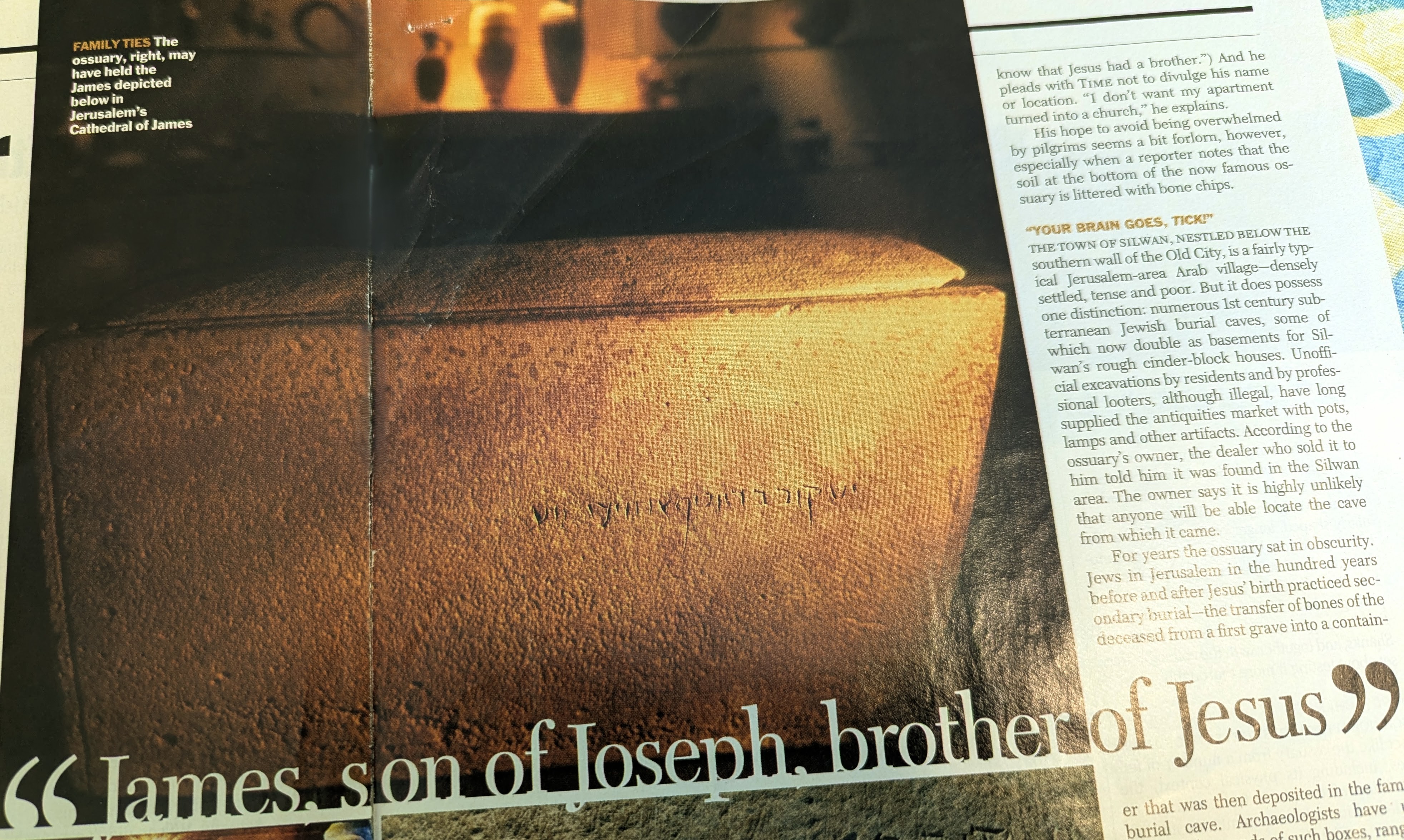
Time photo of the James Ossuary

Present-day believers and church goers view James as an obscure figure, if they know anything about him at all. If Catholics are asked who the most important figure in the early church was, most would answer Peter. If Protestants are asked the same question, they would answer Paul. Yet if we could step in a time machine and ask Peter and Paul the same question, they would both answer James.

Over the centuries the historic importance of James has been overlooked. In the great gallery of early church fathers, typically Peter, Paul, and John draw the most attention. But James’ contribution was truly foundational—even crucial.

Many may be surprised to know that the New Testament has a good deal to say about James, the man known to early Christians as the brother of the Lord. The time has come to put some flesh on those bones missing from the ossuary—to create a portrait of the biblical James—a man who had a monumental influence on the direction of the early church and by extension an impact that echoes down through world history to the present day.

It can be argued that James, known to some as James the Just, is in fact the lynchpin of the Christian faith. Without him the early church would have remained an obscure Jewish sect—an offbeat curiosity in the grand march of civilization. But due to James, the gospel message burst out of the narrow confines of the Jewish faith. It exploded across the Roman Empire and came to dominate the life and thought of the Western world for the next two millennia. Now with the rapid rise of Christianity in the nations of Africa, South America, and Asia, the time has come to take a closer look at the man who set this whole process—this train of events into motion: the man the Bible writers call James, the brother of our Lord.

1 For a thorough exploration of the James Ossuary and its implications for present-day Christianity, see Hershel Shanks and Ben Witherington III’s book The Brother of Jesus: The Dramatic Story & Meaning of the First Archaeological Link to Jesus & His Family (Harper Collins, 2003).

New from David Kitz

James—the brother of Jesus—who was this man? What evidence do we have that this “brother of our Lord” even existed?

David Kitz digs deep into archeology, family dynamics, church history, and the biblical texts. What emerges from his research is a portrait of a decisive, pivotal leader who embodied the will and character of Jesus Christ.

But how did James—James the unbeliever—transform to become a leader who changed the course of world history? In these pages you will uncover the answer and rediscover for yourself the life-changing power of the gospel.

To view further details or purchase directly from the author click here.
Something to Crow About

18 Saturday Feb 2023

Posted by davidkitz in Psalms

≈ 5 Comments

Tags

birds, Blue Jays, crow, crows, Jesus, love notes, skeptics, thanks

A True Story by David Kitz *

If you asked me if I like birds, without hesitation I would answer, “Yes.” If you asked me if I like crows, the quick answer would be, “Not so much.”

I suppose it’s their voice that irritates me the most. They can’t seem to hit the right note. It’s their early morning cawing that drives me insane. There’s nothing quite as irritating as a crow’s relentless caw near your window, as you try to get that well-earned hour of extra sleep on a Saturday morning.

I’m convinced someone should invent a beak muzzle for crows. For humane treatment, the muzzle should be designed to allow crows to peck their food and eat normally, but it would be instantly activated the moment they tried to caw.

Surely with all the recent improvements in technology such a device is possible. With the right marketing team, I’m sure the millions of these devices would be sold. For a moment think about the sales a beak muzzle commercial during the Super Bowl could generate!

And consider the prestige. The inventor of a beak muzzle for crows would undoubtedly be awarded the Nobel Prize for Peace—auditory peace—Saturday morning peace. Can there be a higher honor?

But a few years back I had a dramatic change of heart about crows.

It all started on a lazy Saturday afternoon in the summer. I was sitting in my living room watching a different flock of squawky birds—the Toronto Blue Jays. As I recall, those birds were in a tense match with their rivals the Yankees.

Suddenly, “KA-BANG!”

The whole house shook. My wife came running into the living room shouting, “What happened?”

After a moment of stunned silence I replied, “I have no idea.”

“Well, something hit the house,” she insisted.

“I think it hit the front window,” I offered.

Together we rushed over to our living room picture window. The window itself looked fine. But there on our front lawn lay a crumpled heap of black feathers.

I slipped on my shoes and headed out for a closer look. Sure enough, it was a big crow. The afflicted bird didn’t struggle to escape as I approached. He was in no condition to do so. His left wing rested in a splayed-wide state on the grass, while the other wing was tilted up awkwardly, but held close to the body.  His head and neck were skewed grotesquely to one side.

I crouched down for a better look. That’s when our eyes met.

Until that moment in my mind I had been saying, “Oh good, I’ll be rid of one of these pesky nuisances. And if he isn’t dead, out of mercy I’ll finish him off and bury him in the backyard.”

But his eyes said something quite different. He was still alive, and he clearly fixed his right eye on me. At the same time, his beak hung open as he frantically gasped for air. With each gulp he seemed to be saying, “Mercy! Mercy! I didn’t mean to collide with your window. Mercy!”    

We communed eye to eye like that for a few seconds. Then I repented of my murderous thoughts. I said a silent prayer of good health for my hapless feathered friend, stood up and walked back into the house. 

I discussed the state of my fallen comrade with Karen. After considering all the options, we both agreed it was best to leave the crow exactly where he was. Perhaps, he was just winded and would recover—a rather unlikely prospect I thought. But there was no harm in waiting.

I resumed watching those other birds—the Blue Jays. After a particularly tense inning of play, I got up to check on the casualty in the front yard. He was gone. The crow was completely gone. I walked out to the spot where he once lay to confirm his disappearance. I looked around the area. No sign of him.

As I re-entered our home, I had a smile on my face. I felt strangely happy that the bird had made good his escape without any intervention on my part.

I considered this event to be unusual, but not particularly impactful—except for the crow. And it certainly didn’t change my opinion about crows. But the story doesn’t end there.

About ten days later, early in the morning I found myself standing on my front lawn at about the same place where my fallen friend had landed. I was deep in thought—not about crows and their place in the world—but rather I was considering that great esoteric question common to man. Can I put off cutting the lawn for another day, or in the great scheme of things should I tackle this chore today?

Suddenly a crow interrupted my contemplation. He fluttered down from a large maple in my neighbor’s yard and landed on the front porch. From there he scooted closer onto the driveway. Then from there this audacious crow walked over to me on my front lawn.

I had never been approached by a crow before. I felt quite uncertain how I should respond. To be blunt, I was thunderstruck.

He on the other hand seemed completely at ease. He stopped about a meter from me. Then he looked me over as only a crow can do, cocking his head, first to one side, then the other. For a second time our eyes met. That’s when he began to speak, not with his squawky annoying voice, but with his eyes. Here’s what I heard him say—mind to mind:

“Sorry for dive bombing your house the other day. That was dumb of me.

Your mercy is appreciated. Thanks for praying for me.

As you can see, I’m fine now.”

And with that said, he turned abruptly, flapped his wings a few times and ascended to his lofty perch in my neighbor’s maple tree.

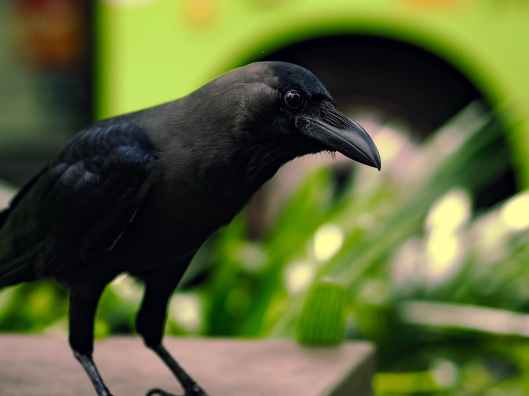
close up photo of a crow

Photo by Darvin Riego de Dios on Pexels.com

As for me, I returned to my house, a humble man.

Since that day I’ve thought a good deal about my interaction with that crow. Skeptics might well doubt the truth of my account. Can I prove that the crow that walked up to me was the same crow that collided with my window? No, I can’t. I can’t distinguish one crow from another. I can’t even tell if the crow I encountered was male or female. But I do know that researchers have found that crows have keen skills of human recognition and recall. Furthermore, I’ve read and heard countless stories that highlight the intelligence of these birds.

Accuse me of putting words in a bird’s beak if you like, but I believe that bird descended to my level and walked over to me with the express purpose of communicating with me in the best way he (or she) could. And he succeeded in his mission.

The Gospel of Luke records the account of Jesus healing ten lepers (Luke 17:11-19), but only one returned to give thanks. I showed mercy to just one crow, and he returned to express thanks. Which is the superior species?

About 5:30 this morning I awoke to the cawing of a crow. And you know something? For me that bird hit all the right notes.

I appreciate getting love notes—thank you notes—even from a crow.

* An earlier version of this story was published in A Taste of Hot Apple Cider.

Dig and Delve Conference Hits Its Target

21 Saturday Nov 2015

Posted by davidkitz in News Reports, Psalms

≈ 1 Comment

Tags

apologetics, Christian worldview, Dr. Fazale Rana, genetics, John Stackhouse, science, skeptics, University of Ottawa

Based on the enthusiasm expressed by some attendees, the recent Dig and Delve Conference in Ottawa, Canada was a huge success. Over lunch University of Ottawa students Noah Galbraith, Sebastian Tansil and Alex Hoffmann discussed what they saw as personal highlights of the conference.

22523010573_0d0be16593_o-718x475_c

Photo of Dr. John Patrick courtesy of Mark Peterkins for Spark Ottawa

Noah Galbraith was particularly impressed by Dr. Fazale Rana’s conference opening lecture entitled, “Finding Adam: Is There a Scientific Case for a Historical Adam and Eve?”

“I was impressed by the way he (Dr. Rana) integrated mainstream science with biblical teaching. And he used accessible language. You didn’t have to be a biology major to follow what he was saying.”

Dr. Rana presented evidence from the fields of microbiology and genetics, which indicates that all of humanity descended from a common ancestral couple—the Biblical Adam and Eve. Furthermore, the current scientific literature on this topic acknowledges this common descent from our first parents.

This is the second annual Dig and Delve Conference and it took place at Dominion-Chalmers United Church on Friday evening November 13th through Saturday the 14th.

George Sinclair of Church of the Messiah is the chairman of the organizing committee. He was pleased with the tenor of the conference and the growth in attendance.

“Last year we had 275 attend our inaugural conference, but this year by my estimation we doubled that number. It took a step of faith. We moved to a larger venue and looking back we can see it was the right move.”

Reverend Sinclair went on to explain that the committee’s goal is to grow this annual event into one of the premier world class conferences on Christian apologetics.

“We want to do apologetics humbly, not in a confrontational style. It should be an event where skeptics can ask their questions and get a respectful answer without hostility.”

The theme of this year’s conference was BEING HUMAN: Scientifically? Uniquely? Sexually? Freely? Really?

The organizers felt that, “With many contradictory voices at play it was important that we create a hospitable conference to reflect on the tough questions of human origins, sexual and gender identities, and most importantly a Biblical perspective on what it means to be the image of God in the world today. We hope that our conference will stir healthy conversations that push us toward lives of integrity as we follow Jesus.”

Back at the lunch table three university students were engaged in one of those healthy conversations. They were soon joined by a fourth friend Michael Tan.

Sebastian Tansil commented that he gained a lot from Dr. John Patrick’s lectures. “I realized we need to know how to think about these topics. We need to know the questions to ask.”

His friend Alex Hoffmann found John Stackhouse’s lecture on a survey of worldviews particularly meaningful. “Unlike the notions of karma, the Christian worldview makes it clear that because of our sin nature we are incapable of our own salvation.”

Michael Tan added that the real meat is the gospel. “We need to broaden our approach to the gospel. All these questions are avenues by which we can engage with others.”

It’s these conversations and the ones that will follow in the months ahead that will determine if Dig and Delve 2015 has truly hit its target.

Next year’s Dig and Delve Conference is slated for November 4th and 5th.

This report by David Kitz originally appeared in Spark Ottawa.

Psalms 365: Develop a Life of Worship and Prayer

Psalms 365 Volume II

Psalms 365 vol 3
— Psalms 365 Volume III

Psalms

Recent posts

  • Silence February 21, 2026
  • Commit Your Way to the LORD February 21, 2026
  • Generosity Is Never out of Season February 20, 2026
  • Your Heart’s Delight February 20, 2026
  • Generosity Is Never out of Season February 19, 2026
  • Givers & Takers February 19, 2026
  • Teach Me Your Paths February 18, 2026

Calendar

February 2026
M T W T F S S
 1
2345678
9101112131415
16171819202122
232425262728  
« Jan    

Blog Posts

Comments

  • K.L. Hale on Teach Me Your Paths
  • davidkitz on Teach Me Your Paths
  • K.L. Hale on Teach Me Your Paths

Blog at WordPress.com.

Privacy & Cookies: This site uses cookies. By continuing to use this website, you agree to their use.
To find out more, including how to control cookies, see here: Cookie Policy
  • Subscribe Subscribed
    • I love the Psalms
    • Join 1,385 other subscribers
    • Already have a WordPress.com account? Log in now.
    • I love the Psalms
    • Subscribe Subscribed
    • Sign up
    • Log in
    • Report this content
    • View site in Reader
    • Manage subscriptions
    • Collapse this bar
 

Loading Comments...