I will praise Him!
-

Prairie sunset near MacNutt, Saskatchewan — photo by David Kitz

26 Sunday Feb 2017
Posted in Psalms, Sunday's Psalm
Prairie sunset near MacNutt, Saskatchewan — photo by David Kitz
22 Wednesday Feb 2017
Tags
Creator, identity, Jesus, Ottawa ON, pilgrim, pilgrimage, pilgrims, praise, Rideau Canal, Rideau Canal Skateway, the LORD, worship
Reading: Psalm 134
A song of ascents.
Praise the LORD, all you servants of the LORD
who minister by night in the house of the LORD.
Lift up your hands in the sanctuary
and praise the LORD.
May the LORD bless you from Zion,
he who is the Maker of heaven and earth (NIV).
Reflection
This is the fifteenth and final psalm in the Songs of Ascent series. In reality, this psalm is the pilgrims’ farewell offering of worship to the LORD. After a week or more in Jerusalem, the time has arrived for the pilgrims to return to their homes. But on the evening before they set out on the return journey, they make one last visit to Mount Zion and the great Temple of the LORD. There they lift their hands in praise to the God of Israel. Early next morning, they will begin the arduous journey back home. But for now, it’s time to bless the LORD and offer thanks.

Skaters on the Rideau Canal, Ottawa, ON — photo by David Kitz
It is likely that the twelve-year-old Jesus sang this psalm with his parents on the final evening of their Passover pilgrimage to Jerusalem. On the following day the family departed for Nazareth where Joseph would resume his trade as a carpenter. When they left the next morning, they assumed Jesus was traveling with them in the large company of other pilgrims from their hometown. See Luke 2:41-52.
Typically, we read this account of the lost twelve-year-old Jesus from the viewpoint of a parent. We identify with the stress of losing a child in a big city. We would title this story, “Mary and Joseph find lost Jesus.” But the story reads quite differently, when we view it from the perspective of a child trying to discover who he really is. Viewed from Jesus’ perspective the title of the story might well be, “Lost Boy finds Himself” or “Lost Boy Discovers His Divinity.”
How did Jesus discover he was the son of God? Some believers might well reason that the answer is obvious. Jesus is God; therefore, he is omniscient. The all-knowing Jesus would surely know that he was God’s son. But many theologians would beg to differ. They view the humanity of Christ as all pervasive. Jesus was 100% human and as such he needed to learn and discover his identity even as any child does.
If through the incarnation Jesus fully took on humanity, then the boy Jesus needed to discover his divine identity. It may have been written into every fibre of his being, but he still needed to discover it, just as any young musical prodigy needs to explore and discover his or her gift. All divine gifts must be discovered and developed to reach their maximum potential.
How do we discover our true identity? From the account in Luke, it would appear that the boy Jesus discovered his true identity in the House of God. Perhaps it began as he lifted his hands in worship. We cannot fully discover who we are until we discover who God is. We must know our Creator to know ourselves. Self-understanding begins with knowing whose we are. You and I belong to the Father.
Response: Father God, I thank you for loving me and inviting me into your family. Lord Jesus, thank you for purchasing my redemption. Holy Spirit, I thank you for the confirmation that I am your child. Amen.
Your Turn: Do you know who you are? How is God the Father shaping your identity?
17 Friday Feb 2017
Tags
Ark of the Covenant, clothed, David, God, priest, priesthood, Psalms of Ascent, Righteousness, the LORD, worship, Zion
Reading: Psalm 132
(Verses 6-10)
We heard it in Ephrathah,
we came upon it in the fields of Jaar:
“Let us go to his dwelling place,
let us worship at his footstool, saying,
‘Arise, LORD, and come to your resting place,
you and the ark of your might.
May your priests be clothed with your righteousness;
may your faithful people sing for joy.’”
For the sake of your servant David,
do not reject your anointed one (NIV).
Reflection
David’s commitment and zeal for the presence of the LORD drew others to worship God. That’s what the opening lines of today’s reading are saying: We heard it in Ephrathah, we came upon it in the fields of Jaar: “Let us go to his dwelling place, let us worship at his footstool…”
We should never underestimate the power of our personal witness for Christ. Our zeal for God and love for His house can act as a magnet to draw others to worship Him. David’s self-denial in pursuit of God resulted in others discovering the power and grace of the LORD. By bringing the Ark of the Covenant to Zion, the City of David, David was declaring that he wanted the LORD in his home. He wanted Him close at hand—at the center of the government he was establishing over the land. See 2 Samuel 6.
Do we want God in our home? Is the LORD at the command center of your life and your daily affairs? Genuine worship brings God to the center. It removes the distance between us and God.

Clothed in righteousness — Grey Nuns Park, Ottawa, ON
The psalmist goes on to offer this prayer. “‘May your priests be clothed with your righteousness; may your faithful people sing for joy.’”
How are you dressed as you approach God? Apparently, clothing matters. It matters because as a redeemed child of God you are serving as a priest of the Most High. The apostle, Peter reminds us of our corporate calling and responsibility. But you are a chosen people, a royal priesthood, a holy nation, God’s special possession, that you may declare the praises of him who called you out of darkness into his wonderful light (1 Peter 2:9).
So then as priests offering sacrifices of praise, we have an opportunity to approach God. But how should we be clothed, you ask? St. Paul provides the answer. So in Christ Jesus you are all children of God through faith, for all of you who were baptized into Christ have clothed yourselves with Christ (Galatians 3:26-27). As a blood-bought believer you are clothed with the righteousness of Christ.
Response: Father God, I thank you for covering me with a garment of righteousness. It’s the supreme righteousness of Jesus. Help me to serve and worship you daily with a grateful heart. Amen.
Your Turn: Are you drawing near to God? Do you see yourself as part of a royal priesthood?
29 Sunday Jan 2017
Posted in Psalm 100, Psalms, Sunday's Psalm

Notre-Dame Cathedral Basilica, Ottawa, ON — photo by David Kitz
20 Thursday Oct 2016
Reading: Psalm 103
Of David.
(Verses 1-6)
Praise the LORD, my soul;
all my inmost being, praise his holy name.
Praise the LORD, my soul,
and forget not all his benefits—
who forgives all your sins
and heals all your diseases,
who redeems your life from the pit
and crowns you with love and compassion,
who satisfies your desires with good things
so that your youth is renewed like the eagle’s.
The LORD works righteousness
and justice for all the oppressed (NIV).
Reflection
Psalm 103 begins by David calling on his soul to praise the LORD. Many see praise and worship as a purely cathartic response to the manifest goodness of God. Something good happens to us. Unexpectedly, we get a thousand-dollar check in the mail. Quite naturally our response is praise to God.

The path ahead, Grey Nuns Park, Orleans, ON — photo by David Kitz
For many people, praise to God never progresses beyond this natural, cathartic level. If God does not bless, no praise is forthcoming. Our praise for the LORD becomes, or simply remains circumstance dependent. But that was not the case with David. His praise extended beyond simple catharsis. He taught his soul to praise the LORD in all circumstances. True biblical praise and worship is after all a spiritual exercise, a discipline we grow in, just as we grow in the discipline of prayer.
The LORD, the object of our praise, does not change with our circumstances. He is forever the same. Jesus Christ is the same yesterday and today and forever (Hebrews 13:8). He is constant, hence our praise and worship of him should be constant, unaffected by weather conditions, world events, the gyrations of the stock market, our swings of mood or our personal situation.
Of course this constancy in praise is something the natural man simply rebels against. Our world needs to be right in order for us to praise God aright, or so we reason. The only problem with this logic is that the world has never been right since the Fall. Death, disease, war and misery have been raining down on the children of Adam, since wilful disobedience to God first took root among us. And this is one weather forecast, for all humanity, that is not about to change—not until Christ returns.
If we are waiting for a perfect world before we lift our voice in praise to God, we will never praise Him. In fact, if our eyes are on the world, or on ourselves, there will always be grounds to withhold our praise. But then, the whole purpose of praise and worship is to lift up our eyes. We desperately need to get our eyes off ourselves, off the world, and onto God our Maker.
Response: Father God, I genuinely want to learn to praise you in all situations. You are always good, loving and worthy of praise. Along with David I declare, “Praise the LORD, my soul!” Amen.
Your Turn: Have you learned to praise God even in difficult times?
06 Thursday Oct 2016
Tags
awe-inspiring, God, holiness, holy, Holy Spirit, the LORD, worship
Reading: Psalm 99
Verses 1-5
The LORD reigns,
let the nations tremble;
he sits enthroned between the cherubim,
let the earth shake.
Great is the LORD in Zion;
he is exalted over all the nations.
Let them praise your great and awesome name—
he is holy.
The King is mighty, he loves justice—
you have established equity;
in Jacob you have done
what is just and right.
Exalt the LORD our God
and worship at his footstool;
he is holy (NIV).
Reflection
What does it mean to be holy? There are several shades of meaning for the word holy. It can mean being consecrated or dedicated for a special purpose. It also means righteous. But the definition that fits best in the light of Psalm 99 reads like this: awe-inspiring—having a character that evokes reverence (Encarta Dictionary).

Holiness breaks through — photo by David Kitz
The psalmist is effusive with his praise for the LORD, but three times in this short psalm, he centers back to this phrase: he is holy. Yes, the LORD reigns, He is righteous and exalted, but what has really caught the psalmist’s attention is the LORD’s holiness. That’s what sets Him apart and elevates Him above the stratosphere.
Has the LORD’s holiness caught your attention? Have you been filled with awe by the holiness of God? I fear that far too often we have diminished God. We have tried to make Him like us—powerful but a bit quirky—maybe short-tempered or set in His ways. What nonsense! Our God is holy. We need to wake up to that fact.
In the Beatitudes from his Sermon on the Mount Jesus said, “Blessed are the pure in heart, for they will see God” (Matthew 5:8). To clarify, I might add that the pure in heart will see the true God, not a distorted caricature. Our sinful nature has a way of distorting our view of the LORD. That’s why personal purity or holiness are so essential. The apostle Peter provides this admonition: As obedient children, do not conform to the evil desires you had when you lived in ignorance. But just as he who called you is holy, so be holy in all you do; for it is written: “Be holy, because I am holy” (1 Peter 1:14-16).
Response: LORD God, I want to see you at work in my life. Help me with the help of your Holy Spirit to clean up those areas that distort my view of you. You are holy. I worship you in the beauty of your holiness. Amen.
Your Turn: Are there times when you have seen God as short-tempered or set in His ways?
05 Wednesday Oct 2016
Reading: Psalm 98
Verses 7-9
Let the sea resound, and everything in it,
the world, and all who live in it.
Let the rivers clap their hands,
let the mountains sing together for joy;
let them sing before the LORD,
for he comes to judge the earth.
He will judge the world in righteousness
and the peoples with equity (NIV).
Reflection
What comes to mind when you think of God’s judgment? Do you envision pictures of doom, gloom and destruction? If that’s your response, you are not alone, but maybe you have the wrong set of pictures? Maybe you have a wrong understanding of God? Should the redeemed live in dread of God’s judgment?
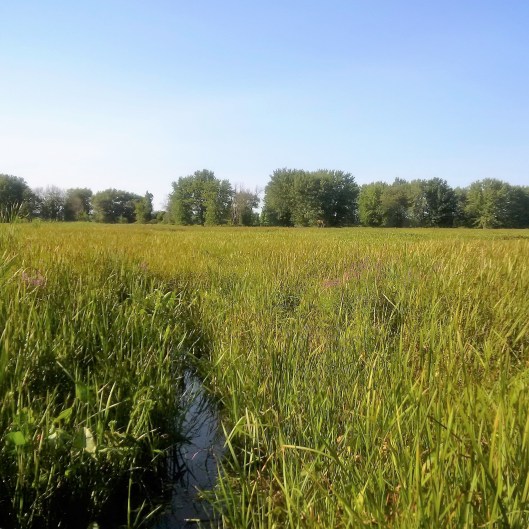
Ottawa River marsh, Orleans, ON — photo by David Kitz
Psalm 98 is a joyous anthem of praise to God—praise for the salvation the LORD has won for us. The psalmist begins this psalm by calling us to sing to the LORD a new song. In today’s reading, that call for praise and worship is extended to all of nature. Let the sea resound, and everything in it, the world, and all who live in it. Let the rivers clap their hands; let the mountains sing together for joy.
Have you seen any mountains singing for joy? Have you heard the rivers clap their hands? I love the pictures such thoughts put in my mind. In reality all of creation is speaking daily. The earth, sea and sky are telling of God’s mercy and glory. The setting sun shouts out the praises of God. Can you hear it?
According to the psalmist, there is a cause for this great celebration by the sea, the rivers and the mountains. These elements of creation are celebrating because the LORD is coming to judge the earth. He will judge the world in righteousness and the peoples with equity. In other words God’s judgment should bring joy not dread. The LORD will set things right.
For far too long we have lived in a world of injustice, suffering and death. When the LORD comes, He will bring all this pain and perversity to an end. The environmental degradation that we have caused will come to an end. The Eden that was lost because of mans’ sin will be restored. Once again we will have access to the Tree of Life. Best of all we will walk in sweet communion with our heavenly Father. Since God’s coming judgment will bring about all this, why wouldn’t we join the mountains as they sing for joy?
Many of us have a wrong understanding of God and a wrong understanding of the purpose for His judgment. His judgments are good. They bring about peace—the shalom of God. Here in Psalm 98 we have the promise of His word on that. He will judge the world in righteousness and the peoples with equity.
Response: LORD God, in the past I have dreaded your judgment, but now I recognize your goodness. Come quickly, Lord Jesus. I want to see this world set right through your power and grace. Amen.
Your Turn: Do you fear God’s judgment? Is that always a good thing? Can it be misunderstood?
28 Wednesday Sep 2016
Reading: Psalm 96
Verses 1-6
Sing to the LORD a new song;
sing to the LORD, all the earth.
Sing to the LORD, praise his name;
proclaim his salvation day after day.
Declare his glory among the nations,
his marvelous deeds among all peoples.
For great is the LORD and most worthy of praise;
he is to be feared above all gods.
For all the gods of the nations are idols,
but the LORD made the heavens.
Splendor and majesty are before him;
strength and glory are in his sanctuary (NIV).
Reflection
Who are you singing to? Let’s face it; most of us sing. We may not sing in a choir or in front of a crowd of thousands, but we sing. Maybe you sing in the shower. Maybe you just hum, whistle or sing a tune in your mind. Even though you may not fully vocalize your song, the music is still there bubbling beneath the surface.

Cathedral Grove, Vancouver Island, BC — photo by David Kitz
Psalm 96 urges us to sing that song to the LORD. Sing to the LORD a new song; sing to the LORD, all the earth. Sing to the LORD, praise his name; proclaim his salvation day after day.
I believe it’s in our nature to sing. Music is after all a universal activity enjoyed by people of every race and culture. This universality begs a question: Who put that love for music and song within us?
For believers the answer is obvious. God put music in our hearts and God puts songs on our lips. We sing because we are and because God is. Music is so fundamental—so fundamental to our being—that it’s hard to imagine our world without it. When we break forth in song we are doing what God designed us to do. You were designed to sing, just as you were designed to bring glory to God through the work of your hands or the fruit of your body. So let your voice bring honor, praise and glory to God. Sing out your worship with joy.
Psalm 96 is also a call for newness in worship. Why does God want a new song? Could it be because His mercy and love for us are continually renewed? In the midst of national tragedy, Jeremiah reminded us of this truth. Because of the LORD’s great love we are not consumed, for his compassions never fail. They are new every morning; great is your faithfulness (Lamentations 3:22-23).
Just as the changing seasons bring renewal to the earth and its vegetation, so to new songs of praise bring renewal to our worship. So whether you hum, whistle, or belt out songs in the choir, let your song ascend to the LORD. You are singing for Him and to Him.
Response: LORD God, I want to praise you. Give me news songs and new melodies to sing your praise. Great is the LORD and most worthy of praise. Amen.
Your Turn: Do you enjoy singing? Do you like both old and new worship songs?
25 Sunday Sep 2016
Posted in Psalms, Sunday's Psalm
Tags

River side trail, Orleans, ON — photo by David Kitz
16 Friday Sep 2016
Reading: Psalm 92
A psalm. A song. For the Sabbath day.
Verses 1-8
It is good to praise the LORD
and make music to your name, O Most High,
proclaiming your love in the morning
and your faithfulness at night,
to the music of the ten-stringed lyre
and the melody of the harp.
For you make me glad by your deeds, LORD;
I sing for joy at what your hands have done.
How great are your works, LORD,
how profound your thoughts!
Senseless people do not know,
fools do not understand,
that though the wicked spring up like grass
and all evildoers flourish,
they will be destroyed forever.
But you, LORD, are forever exalted (NIV).
Reflection
Why is music such a central part of the Christian worship experience? For the answer to that question we need to look no further than the opening lines of Psalm 92. It is good to praise the LORD and make music to your name, O Most High, proclaiming your love in the morning and your faithfulness at night, to the music of the ten-stringed lyre and the melody of the harp.

I sing for joy at what your hands have done — photo by David Kitz
To put it simply, praising the LORD is a good thing. Making music to honor the name of the Most High is a wholesome expression of our love for God. Furthermore, the LORD approves the use of musical instruments. The harp and the lyre are mentioned here, but there is no scriptural reason to limit the use of instruments.
Why do men sing love songs? Because they love the woman of their dreams—the object of their affection. The same holds true when we fall in love with God. The LORD becomes the object of our deepest affection. He is worthy of our praise.
Do you need some reasons to praise God? The psalmist provides us with some sound reasons: For you make me glad by your deeds, LORD; I sing for joy at what your hands have done. How great are your works, LORD, how profound your thoughts!
If the marvels of creation are insufficient to prompt us to praise, then consider for a moment the wonders of redemption. God sent His only begotten Son to suffer and die on our behalf. He purchased our eternal redemption with the shed blood of Jesus. Oh what love! What wondrous love! It makes me want to break out in song.
Response: LORD God, every morning I want to praise you. Thank you for the gift of music. Help me use my voice and every talent you have given me to express my praise to you. Amen.
Your Turn: Do you enjoy praising God? Do you save your praise for Sundays or is it expressed daily?

