Tags
I will praise Him!

Wild morning glory — photo by David Kitz

11 Saturday Aug 2018
Posted in Bible, God's word, Psalm 5, Psalms
Tags
Wild morning glory — photo by David Kitz
10 Friday Aug 2018
Posted in Bible, Devotionals, Psalm 135, Psalms
Tags
bondage, Israel, liberation, Pharaoh, Satan, slavery, taskmasters
Reading: Psalm 135
(Verses 8-14)
He struck down the firstborn of Egypt,
the firstborn of people and animals.
He sent his signs and wonders into your midst, Egypt,
against Pharaoh and all his servants.
He struck down many nations
and killed mighty kings—
Sihon king of the Amorites,
Og king of Bashan,
and all the kings of Canaan—
and he gave their land as an inheritance,
an inheritance to his people Israel.
Your name, LORD, endures forever,
your renown, LORD, through all generations.
For the LORD will vindicate his people
and have compassion on his servants (NIV).

The Ottawa River as the sunsets — photo by David Kitz
Reflection
Psalm 135 began with a call for the LORD’s people to praise Him. For the LORD has chosen Jacob to be his own, Israel to be his treasured possession.
In today’s reading, the psalmist continues by recounting how Israel came to be God’s treasured possession. It happened as the result of a great cosmic struggle. The descendants of the patriarch Israel (who was also called Jacob) were enslaved in Egypt. There they toiled under cruel taskmasters until by the hand of Moses the LORD sent his signs and wonders into their midst. After ten terrible plagues, Pharaoh finally relented and set God’s people free. Nevertheless, Pharaoh changed his mind and sent his army to pursue Israel. Again at the Red Sea, the LORD intervened. He parted the sea, for His chosen people, but brought it crashing down upon Egypt’s army.
Make no mistake; you too are part of a great cosmic struggle. You were born into a world that is under the control of Satan. Jesus called our adversary the ruler, or prince of this world (John 16:11). We were born under Satan’s authority and within his domain just as the Hebrew children were born into a state slavery in the land of Egypt. As we grow up, Satan has his taskmasters, who set us to work doing his bidding. It begins as we bow to peer pressure, but soon those things we choose begin to assert control. We can soon find ourselves in a downward spiral, imprisoned by sinful habits.
Only Jesus can liberate us from this bondage. At the cross he paid the full price for our redemption. Crossing the Red Sea foreshadows the New Testament sacrament of baptism. It signals our break with the old life—the old bondage. See 1 Corinthians 10:1-4. We have a new master now. His name is Jesus. He is the great liberator. He liberates us from the bondage of sin, and the taunts of the Accuser, who insists that we will never be good enough. But Jesus is our sufficiency. By his grace we are saved.
Response: Father God, I thank you for liberation. Through Jesus you freed me from the bondage of sin. I am eternally grateful. Fill me with the joy of your salvation. You saved me. Hallelujah! Amen.
Your Turn: Have you been liberated from the bondage of sin?
09 Thursday Aug 2018
Posted in Bible, Devotionals, God's word, Psalm 135, Psalms
Tags
Reading: Psalm 135
(Verses 1-7)
Praise the LORD.
Praise the name of the LORD;
praise him, you servants of the LORD,
you who minister in the house of the LORD,
in the courts of the house of our God.
Praise the LORD, for the LORD is good;
sing praise to his name, for that is pleasant.
For the LORD has chosen Jacob to be his own,
Israel to be his treasured possession.
I know that the LORD is great,
that our Lord is greater than all gods.
The LORD does whatever pleases him,
in the heavens and on the earth,
in the seas and all their depths.
He makes clouds rise from the ends of the earth;
he sends lightning with the rain
and brings out the wind from his storehouses (NIV).

Backyard bluebells — photo by David Kitz
Reflection
Like many of the psalms, Psalm 135 begins by calling us to worship. Specifically, this is a call to praise the LORD. Praise the LORD, for the LORD is good; sing praise to his name, for that is pleasant.
So what is the difference between praise and worship? Worship is a broad term that expresses itself in a variety of ways. The Encarta Dictionary defines worship as “the adoration, devotion, and respect given to a deity.”
We can show devotion, adoration and respect for God in wide range of ways. We can use our bodies to express worship by bowing, kneeling, falling prostrate, or lifting our hands and faces heavenward. We read that both David and Miriam danced before the LORD as an act of worship. See 2 Samuel 6:13-15 and Exodus 15:20-21.
Praise and thanksgiving are verbal forms of worship that reflect a heart of adoration. But why do the Psalms call on us to praise God so frequently? Is the LORD a grand, heavenly egomaniac who demands our worship to satisfy His desire for recognition and importance? Hardly.
Actually, just the opposite is true. God does not need our worship. We are the egomaniacs. Praise and worship counteracts the selfishness that is at the root of our sinful nature. We desperately need to get our eyes off ourselves and onto the One who is worthy of all praise. So here to counter what ales us is a simple but powerful prescription from your heavenly Father: Praise the LORD.
Response: Father God, I worship you. Thank you for sending Jesus to be my Savior. Holy Spirit, infuse my praise and worship with joy. You are so very good—so very kind to me. Let praise in all its varied forms flow from me to you. Amen.
Your Turn: What forms or expressions of worship are most meaningful to you?
08 Wednesday Aug 2018
Posted in Bible, Devotionals, God's word, Psalm 134, Psalms
Tags
child of God, Creator, identity, Jerusalem, Jesus, Songs of Ascent, temple
Reading: Psalm 134
A song of ascents.
Praise the LORD, all you servants of the LORD
who minister by night in the house of the LORD.
Lift up your hands in the sanctuary
and praise the LORD.
May the LORD bless you from Zion,
he who is the Maker of heaven and earth (NIV).
![IMG_20180629_1750359[3581]](https://davidkitz.blog/wp-content/uploads/2018/07/img_20180629_17503593581.jpg?w=529)
Columns at the gateway to the Acropolis in Athens, Greece — photo by David Kitz
It is likely that the twelve-year-old Jesus sang this psalm with his parents on the final evening of their Passover pilgrimage to Jerusalem. On the following day the family departed for Nazareth where Joseph would resume his trade as a carpenter. When they left the next morning, they assumed Jesus was traveling with them in the large company of other pilgrims from their hometown. See Luke 2:41-52.
Typically, we read this account of the lost twelve-year-old Jesus from the viewpoint of a parent. We identify with the stress of losing a child in a big city. We would title this story, “Mary and Joseph find lost Jesus.” But the story reads quite differently, when we view it from the perspective of a child trying to discover who he really is. Viewed from Jesus’ perspective the title of the story might well be, “Lost Boy finds Himself” or “Lost Boy Discovers His Divinity.”
How did Jesus discover he was the son of God? Some believers might well reason that the answer is obvious. Jesus is God; therefore, he is omniscient. The all-knowing Jesus would surely know that he was God’s son. But many theologians would beg to differ. They view the humanity of Christ as all pervasive. Jesus was 100% human and as such he needed to learn and discover his identity even as any child does.
If through the incarnation Jesus fully took on humanity, then the boy Jesus needed to discover his divine identity. It may have been written into every fibre of his being, but he still needed to discover it, just as any young musical prodigy needs to explore and discover his or her gift. All divine gifts must be discovered and developed to reach their maximum potential.
How do we discover our true identity? From the account in Luke, it would appear that the boy Jesus discovered his true identity in the House of God. Perhaps it began as he lifted his hands in worship. We cannot fully discover who we are until we discover who God is. We must know our Creator to know ourselves. Self-understanding begins with knowing whose we are. You and I belong to the Father.
Response: Father God, I thank you for loving me and inviting me into your family. Lord Jesus, thank you for purchasing my redemption. Holy Spirit, I thank you for the confirmation that I am your child. Amen.
Your Turn: Do you know who you are? How is God the Father shaping your identity?
07 Tuesday Aug 2018
Posted in Bible, Devotionals, God's word, Psalm 133, Psalms
Tags
anointing, God's blessing, Holy Spirit, love, renewal, unity
Reading: Psalm 133
A song of ascents. Of David.
How good and pleasant it is
when God’s people live together in unity!
It is like precious oil poured on the head,
running down on the beard,
running down on Aaron’s beard,
down on the collar of his robe.
It is as if the dew of Hermon
were falling on Mount Zion.
For there the LORD bestows his blessing,
even life forevermore (NIV).
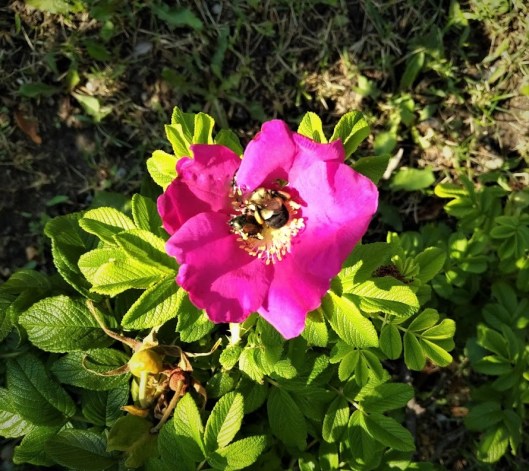
Bumble bee visits rose blossom — photo by David Kitz
Reflection
Short, but powerful and evocative—that’s my description of Psalm 133. I might also add, easily read, but difficult to put into practice. Unity among the people of God is that great elusive goal that seems to always disappear around the next bend in the road just as we approach it. But there God has commanded His blessing, if we could only reach that blessed state.
The psalmist uses two metaphors to portray this good and pleasant state of affairs. The first may appear to be rather messy and wasteful. Who wants oil running down their beard and onto their clothing? But in the Old Testament, prophets, priests and kings were anointed in just this way. It symbolized the release of divine authority and power into an individual’s life. The Spirit of God was coming upon them for public service. This concept forms an effective bridge to the coming of the Holy Spirit in the Book of Acts. When the waiting disciples were of one accord, the Holy Spirit was poured upon them; the anointing came. See Acts 2.
The second metaphor signifies rejuvenation. The dew of the morning is new each day. It refreshes and revives. When our social interactions are positive and enriching, the outcome is spiritual renewal and a deep sense of belonging. Recent studies have shown that social isolation may be a greater risk factor among the elderly than smoking or heart disease. Lack of meaningful interaction with others also has a negative impact on mental health.
The person who continually self-isolates is committing a slow form of suicide, both physically and spiritually. Satan loves the isolated believer—feasts on the mind of the isolated believer.
Simply put, we need each other. We need to be surrounded by loving caring relationships, at home, at work and in the church. On every level, unity of purpose coupled with unselfish love, refreshes and revives the weary soul. We all want God’s blessing. Well, here’s the key to God’s blessing. The LORD commands a blessing when God’s people live together in unity!
Response: Father God, help me sow words of love and unity. Open my eyes to see where I can bring a word of encouragement and affirmation to those around me. Make me an instrument of peace, love and unity today. Amen.
Your Turn: How can you avoid sowing seeds of discord? What can you do today to build unity or break out of self-isolation?
06 Monday Aug 2018
Posted in Bible, Devotionals, Psalm 132, Psalms
Reading: Psalm 132
(Verses 11-18)
The LORD swore an oath to David,
a sure oath he will not revoke:
“One of your own descendants
I will place on your throne.
If your sons keep my covenant
and the statutes I teach them,
then their sons will sit on your throne for ever and ever.”
For the LORD has chosen Zion,
he has desired it for his dwelling, saying,
“This is my resting place for ever and ever;
here I will sit enthroned, for I have desired it.
I will bless her with abundant provisions;
her poor I will satisfy with food.
I will clothe her priests with salvation,
and her faithful people will ever sing for joy.
“Here I will make a horn grow for David
and set up a lamp for my anointed one.
I will clothe his enemies with shame,
but his head will be adorned with a radiant crown” (NIV).

The muddy waters of Bilberry Creek — photo by David Kitz
Reflection
I am an armchair student of history. I enjoy reading history books, particularly books about war and great epic battles. In recent years, several books have appeared on the market, which examine alternate scenarios in history. The authors of these books imagine what might have happened if historic events had unfolded differently. For instance what might have happened if Lee Harvey Oswald’s gun had jammed as he attempted to shoot President Kennedy? How would the Kennedy presidency have unfolded? Or what would the world look like today, if cooler heads had prevailed and the great bloodbath commonly called World War I had been avoided? These are fascinating questions.
I call these “What if…” books. They imagine history unfolding differently. Today’s reading from Psalm 132 leaves me in a “What if…” frame of mind. The LORD made this promise to King David: “One of your own descendants I will place on your throne. If your sons keep my covenant and the statutes I teach them, then their sons will sit on your throne for ever and ever.”
God promised that history would unfold in a certain way. A descendant of David would sit on the throne of Israel in perpetuity. But there was a condition attached to that promise. God’s promise would be fulfilled, if the sons of David kept the covenant and the statutes. Unfortunately, that did not happen. The descendants of David disobeyed and succumbed to idolatry. But what if those sons had obeyed…
How will history be different, if I wholeheartedly obey the LORD?
Response: Father God, I thank you for your son, Jesus. He is the descendant of King David who fulfilled your covenant and now he reigns forever. King Jesus, I am your servant. Reign in my life today. Amen.
Your Turn: Is Jesus your king? How are you serving him?
05 Sunday Aug 2018
Posted in Bible, God's word, Psalm 4, Psalms
Tags

Be still before the LORD — photo by David Kitz
04 Saturday Aug 2018
Posted in Bible, God's word, Psalm 3, Psalms
Tags

Lake Placid, NY — photo by David Kitz
03 Friday Aug 2018
Posted in Bible, Devotionals, God's word, Psalm 132, Psalms
Reading: Psalm 132
(Verses 6-10)
We heard it in Ephrathah,
we came upon it in the fields of Jaar:
“Let us go to his dwelling place,
let us worship at his footstool, saying,
‘Arise, LORD, and come to your resting place,
you and the ark of your might.
May your priests be clothed with your righteousness;
may your faithful people sing for joy.’”
For the sake of your servant David,
do not reject your anointed one (NIV).
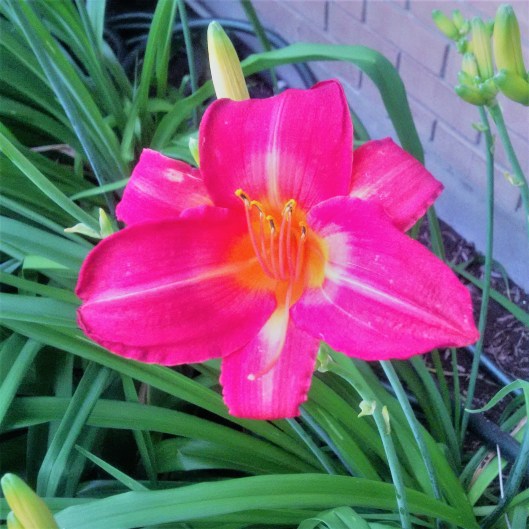
Day Lily — photo by David Kitz
Reflection
David’s commitment and zeal for the presence of the LORD drew others to worship God. That’s what the opening lines of today’s reading are saying: We heard it in Ephrathah, we came upon it in the fields of Jaar: “Let us go to his dwelling place, let us worship at his footstool…”
We should never underestimate the power of our personal witness for Christ. Our zeal for God and love for His house can act as a magnet to draw others to worship Him. David’s self-denial in pursuit of God resulted in others discovering the power and grace of the LORD. By bringing the Ark of the Covenant to Zion, the City of David, David was declaring that he wanted the LORD in his home. He wanted Him close at hand—at the center of the government he was establishing over the land. See 2 Samuel 6.
Do we want God in our home? Is the LORD at the command center of your life and your daily affairs? Genuine worship brings God to the center. It removes the distance between us and God. The Psalms of Ascent are all about removing the distance between us and our Creator. They’re about drawing near.
The psalmist goes on to offer this prayer. “‘May your priests be clothed with your righteousness; may your faithful people sing for joy.’”
How are you dressed as you approach God? Apparently, clothing matters. It matters because as a redeemed child of God you are serving as a priest of the Most High. The apostle, Peter reminds us of our corporate calling and responsibility. But you are a chosen people, a royal priesthood, a holy nation, God’s special possession, that you may declare the praises of him who called you out of darkness into his wonderful light (1 Peter 2:9).
So then as priests offering sacrifices of praise, we have an opportunity to approach God. But how should we be clothed, you ask? St. Paul provides the answer. So in Christ Jesus you are all children of God through faith, for all of you who were baptized into Christ have clothed yourselves with Christ (Galatians 3:26-27). As a blood-bought believer you are clothed with the righteousness of Christ. That’s a garment that never grows old or wears out.
Response: Father God, I thank you for covering me with a garment of righteousness. It’s the supreme righteousness of Jesus. Help me to serve and worship you daily with a grateful heart. Amen.
Your Turn: Are you drawing near to God? Do you see yourself as part of a royal priesthood?
02 Thursday Aug 2018
Posted in Bible, Devotionals, God's word, Psalm 132, Psalms
Reading: Psalm 132
A song of ascents.
(Verses 1-5)
LORD, remember David
and all his self-denial.
He swore an oath to the LORD,
he made a vow to the Mighty One of Jacob:
“I will not enter my house or go to my bed,
I will allow no sleep to my eyes
or slumber to my eyelids,
till I find a place for the LORD,
a dwelling for the Mighty One of Jacob” (NIV).

The waters of Georgian Bay, Bruce Peninsula National Park — photo by David Kitz
Reflection
This is the thirteenth psalm in the Songs of Ascent series. With this psalm, the author returns to a familiar theme—the glory of God’s presence in Zion. It is what has drawn the pilgrims to this holy place. They have come to worship and meet with God.
But this psalm has a different approach. It recounts the history of Zion and how this particular place was chosen as the site for Israel to worship God. It all began with David. At the prompting of the LORD, David chose Mount Zion to set up the Tabernacle of the LORD. But before Mount Zion could become a place of worship the stronghold of Zion had to be conquered. It was in enemy hands. Nevertheless, David captured the fortress of Zion—which is the City of David (2 Samuel 5:7).
In this psalm we hear of David’s vow. “I will not enter my house or go to my bed, I will allow no sleep to my eyes or slumber to my eyelids, till I find a place for the LORD, a dwelling for the Mighty One of Jacob”
In David’s case, finding a place for the LORD required self-denial. It involved a physical battle. There is a spiritual battle that we too need to fight so the LORD can occupy His rightful place in our lives. The enemy does not leave the strongholds in our mind without a fight. We must take action to evict him.
We live in a world where self-denial is rare, and often frowned upon. Our society pushes the easy life—the comfortable life—the path of least resistance. Self-denial in pursuit of a relationship with God is a foreign concept. In many churches fasting and prayer is a lost discipline.
Jesus encountered the same problem with his own disciples. While he was praying fervently in the Garden of Gethsemane, his disciples were fast asleep. “Simon,” he said to Peter, “are you asleep? Couldn’t you keep watch for one hour?” See Mark 14:32-42.
This inability to pray for an hour is an indicator that at our core we have not surrendered fully to God. Other things are more important. There is no self-denial. That TV show is more important. The game is more important. Perhaps our Zion is still occupied by the enemy and the LORD is not enthroned there.
Response: LORD God, help me to change. I want to put you first in my life. Come and occupy the throne of my life. I want my thoughts, words and actions to be governed by you, Lord Jesus. Amen.
Your Turn: Do you find self-denial difficult? Do you practice a variety of spiritual disciplines?
 I love the Psalms