• Home
  • About
  • DavidKitz.ca
  • Youtube Videos
  • Books by David
  • Books on Amazon.com

I love the Psalms

~ Connecting daily with God through the Psalms

I love the Psalms

Yearly Archives: 2022

My Hope Is in Your Word

04 Sunday Dec 2022

Posted by davidkitz in Psalm 119

≈ Leave a comment

Tags

praise the LORD, promises of God, salvation, trustworthy, word of God

I will praise the LORD!

img_20220312_1651071

Deep snow — photo by David Kitz

Reading: Psalm 119:81-88

כ Kaph
My soul faints with longing for your salvation,
    but I have put my hope in your word.
My eyes fail, looking for your promise;
    I say, “When will you comfort me?”
Though I am like a wineskin in the smoke,
    I do not forget your decrees.
How long must your servant wait?
    When will you punish my persecutors?
The arrogant dig pits to trap me,
    contrary to your law.
All your commands are trustworthy;
    help me, for I am being persecuted without cause.
They almost wiped me from the earth,
    but I have not forsaken your precepts.
In your unfailing love preserve my life,
    that I may obey the statutes of your mouth.

* NEW INTERNATIONAL VERSION, COPYRIGHT ©1973, 1978, 1984, 2011 BY BIBLICA

BGBG_v4.3_150[1818]

Please pray for the people of Ukraine!

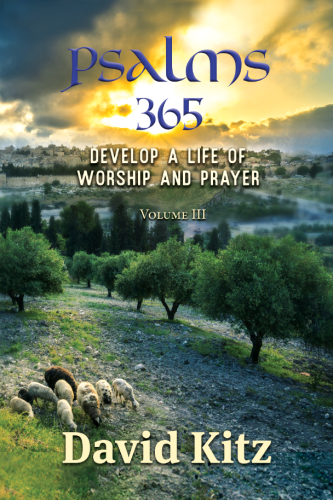
Volume I of Psalms 365: Develop a Life of Worship and Prayer won the Best Book of the Year Award from The Word Guild and Volume II has won the Best Devotional of the Year Award. For those who love God’s word, this three-book series is an ideal way to daily meet with the Lord. To purchase or for a closer look click here.

Formed by God

03 Saturday Dec 2022

Posted by davidkitz in Psalm 119

≈ Leave a comment

Tags

compassion, faithfulness, meditate, praise the LORD, promises of God

I will praise the LORD!

Falls Jann Jablonski

Photo by Jan Jablonski — Orleans, ON

Reading: Psalm 119:73-80

י Yodh
Your hands made me and formed me;
    give me understanding to learn your commands.
May those who fear you rejoice when they see me,
    for I have put my hope in your word.
I know, LORD, that your laws are righteous,
    and that in faithfulness you have afflicted me.
May your unfailing love be my comfort,
    according to your promise to your servant.
Let your compassion come to me that I may live,
    for your law is my delight.
May the arrogant be put to shame for wronging me without cause;
    but I will meditate on your precepts.
May those who fear you turn to me,
    those who understand your statutes.
May I wholeheartedly follow your decrees,
    that I may not be put to shame.

* NEW INTERNATIONAL VERSION, COPYRIGHT ©1973, 1978, 1984, 2011 BY BIBLICA

BGBG_v4.3_150[1818]

Please pray for the people of Ukraine!

Volume I of Psalms 365: Develop a Life of Worship and Prayer won the Best Book of the Year Award from The Word Guild and Volume II has won the Best Devotional of the Year Award. For those who love God’s word, this three-book series is an ideal way to daily meet with the Lord. To purchase or for a closer look click here.

I Meditate on Your Works

02 Friday Dec 2022

Posted by davidkitz in Psalm 143

≈ 1 Comment

Tags

meditate, pride, Righteousness, Savior

Today’s quote and prayer from
“Psalms 365: Develop a Life of Worship and Prayer”
by David Kitz.

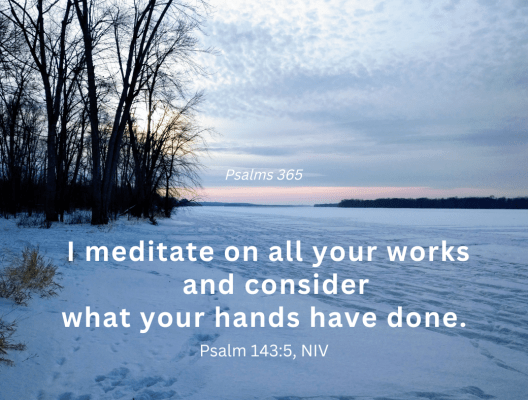
Psalm 143_5
Reading: Psalm 143:1-6

LORD God,
I need your righteousness.
My own righteousness is tainted with pride.
I freely acknowledge my need for a Savior.
You are my constant help.
I thirst for you like a parched land.
Amen.

* NEW INTERNATIONAL VERSION, COPYRIGHT ©1973, 1978, 1984, 2011 BY BIBLICA

BGBG_v4.3_150[1818]

Your prayers for the people of Ukraine are making a difference.

Volume I of Psalms 365: Develop a Life of Worship and Prayer won the Best Book of the Year Award from The Word Guild, and Volume II has won the Best Devotional of the Year Award. For those who love God’s word, this three-book series is an ideal way to daily meet with the Lord. To purchase or for a closer look click here.
RGB300Kitz2AWARD

My Cry for Mercy

02 Friday Dec 2022

Posted by davidkitz in Psalm 143

≈ 2 Comments

Tags

David, God's mercy, mercy, Prayer, Psalms

Reading: Psalm 143:1-6
A psalm of David.
LORD, hear my prayer,
listen to my cry for mercy;
in your faithfulness and righteousness come to my relief.
Do not bring your servant into judgment,
for no one living is righteous before you.
The enemy pursues me,
he crushes me to the ground;
he makes me dwell in the darkness like those long dead.
So my spirit grows faint within me;
my heart within me is dismayed.
I remember the days of long ago;
I meditate on all your works
and consider what your hands have done.
I spread out my hands to you;
I thirst for you like a parched land (NIV). *

img_20210220_0754062

Photo by David Kitz

Reflection
On my best day, I need God’s mercy. On my worst day my need for outside help and mercy are visible to all. In truth, my need for the mercy of the LORD is never ending. All too often, we only call out to God in times of need or perceived difficulty. In reality, our need for God’s help and mercy are constant.

Here in Psalm 143, as he so often does, David calls out for God’s mercy. In many respects David’s plea for mercy is rather repetitive throughout the psalms. Why would this be? Could it be that he is in constant need of God’s sustaining support and mercy? From the following request, we can see why David repeatedly prays for God’s mercy: Do not bring your servant into judgment, for no one living is righteous before you.

David recognized that within himself he had no righteousness. This is the starting point for a life transforming relationship with God. Contrary to a good deal of modern psychology and religious philosophy, we are not okay. We have a warped nature that is inclined to sin. It delights in rebelling against God. St. Paul describes this human condition with these words. For I know that good itself does not dwell in me, that is, in my sinful nature. For I have the desire to do what is good, but I cannot carry it out (Romans 7:18).

The prophet Isaiah described this universal human condition in this way. All of us have become like one who is unclean, and all our righteous acts are like filthy rags; we all shrivel up like a leaf, and like the wind our sins sweep us away (Isaiah 64:6).

Do I need God’s mercy? Yes, a thousand times yes!

Response: LORD God, I need your righteousness. My own righteousness is tainted with pride. I freely acknowledge my need for a Savior. You are my constant help.  I thirst for you like a parched land. Amen.

Your Turn: Are you aware of your constant need for God’s mercy? Are you calling out to Him?

* NEW INTERNATIONAL VERSION, COPYRIGHT ©1973, 1978, 1984, 2011 BY BIBLICA

BGBG_v4.3_150[1818]

Please pray for the people of Russia and Ukraine!

Volume I of Psalms 365: Develop a Life of Worship and Prayer won the Best Book of the Year Award from The Word Guild, and Volume II has won the Best Devotional of the Year Award. For those who love God’s word, this three-book series is an ideal way to daily meet with the Lord. To purchase or for a closer look click here.
Vol III 2021-07-17 at 8.15.36 AM

Negative Thought Patterns

01 Thursday Dec 2022

Posted by davidkitz in Psalm 142

≈ Leave a comment

Tags

habits, negative thoughts, thought patterns, victory

Today’s quote and prayer from
“Psalms 365: Develop a Life of Worship and Prayer”
by David Kitz.

Psalm 142_5
Reading: Psalm 142:5-7

LORD God,
set me free from the negative habits
and thought patterns that imprison me.
Help me identify them one by one,
and then help me gain the victory over them
in the power of Jesus.
Amen.

* NEW INTERNATIONAL VERSION, COPYRIGHT ©1973, 1978, 1984, 2011 BY BIBLICA

BGBG_v4.3_150[1818]

Your prayers for the people of Ukraine are making a difference.

Volume I of Psalms 365: Develop a Life of Worship and Prayer won the Best Book of the Year Award from The Word Guild, and Volume II has won the Best Devotional of the Year Award. For those who love God’s word, this three-book series is an ideal way to daily meet with the Lord. To purchase or for a closer look click here.
Vol III 2021-07-17 at 8.15.36 AM

Set Me Free from My Prison

01 Thursday Dec 2022

Posted by davidkitz in Psalm 142, Psalms

≈ 2 Comments

Tags

addictions, Prayer, prison, set free, trapped

Reading: Psalm 142:5-7
I cry to you, LORD;
I say, “You are my refuge,
my portion in the land of the living.”
Listen to my cry, for I am in desperate need;
rescue me from those who pursue me,
for they are too strong for me.
Set me free from my prison,
that I may praise your name.
Then the righteous will gather about me
because of your goodness to me (NIV). *

hands of a person with tattoo hanging from steel bars

Photo by RODNAE Productions on Pexels.com

Reflection
Though I have visited prisoners, I have never been imprisoned, at least not in the classic sense of imprisonment. But in the broader meaning of the word, we all have been confined to prisons—prisons of the mind. Some of us are prisoners of counterproductive habits, or prisoners within crippling relationships that hinder personal growth and fulfillment. Prisons come in many forms. Some of them are disguised as places of personal liberty, but all too often the thing we freely choose can become a cruel slave master.

When David prayed the words of this psalm, he was not in a prison. He was confined to a cave or the immediate region around a cave because he was a fugitive from King Saul who was trying to kill him. He voices this prayer: Listen to my cry, for I am in desperate need; rescue me from those who pursue me, for they are too strong for me. Set me free from my prison that I may praise your name.

Are you in a prison? Is fear of discovery locking you up? Are you trapped in habits, addictions or thought patterns that are too strong for you?

David was in a weak and vulnerable position. Saul, his personal enemy had an entire army on his side. For the second time in his life, David was in what we call the classic David and Goliath situation. He was outnumbered and in every way the advantage belonged to his opponent.

In such adverse circumstances we need God on our side. We need the resources of heaven to tip the scale in our favor. That is precisely what happened in David’s case. The LORD arranged situations that gave all the advantage to David. David ended up sparing Saul’s life on two occasions. For a full account read 1 Samuel 24 & 26.

David ends this psalm with an affirmation of his faith in God. Set me free from my prison that I may praise your name. Then the righteous will gather about me because of your goodness to me. That is exactly what happened. When the LORD set David free from his prison, righteous men took note, and they rallied around David as their leader because they saw that the LORD was with him.

Response: LORD God, set me free from the negative habits and thought patterns that imprison me. Help me identify them one by one, and then help me gain the victory over them in the power of Jesus. Amen.

Your Turn: Can you identify habits or thought patterns that harm your relationships with others? Prayer and praise are heaven directed change agents. Are you making use of these available resources?

* NEW INTERNATIONAL VERSION, COPYRIGHT ©1973, 1978, 1984, 2011 BY BIBLICA

BGBG_v4.3_150[1818]

Please pray for the people of Ukraine!

Volume I of Psalms 365: Develop a Life of Worship and Prayer won the Best Book of the Year Award from The Word Guild and Volume II has won the Best Devotional of the Year Award. For those who love God’s word, this three-book series is an ideal way to daily meet with the Lord. To purchase or for a closer look click here.

Low Rez PsalmsVol2SEAl

When I Reach a Low Point

30 Wednesday Nov 2022

Posted by davidkitz in Psalm 142

≈ Leave a comment

Tags

complaint, Jesus, sorrow, trouble

Today’s quote and prayer from
“Psalms 365: Develop a Life of Worship and Prayer”
by David Kitz.

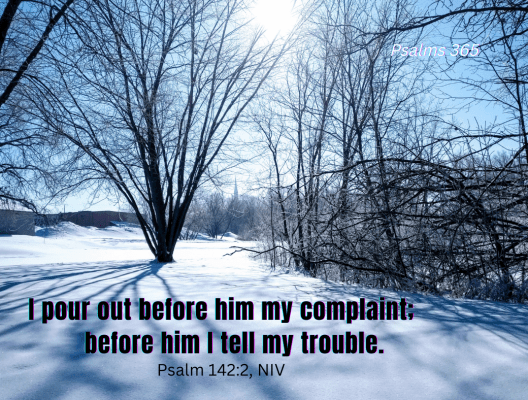
Psalm 142_2
Reading: Psalm 142:1-4

LORD God,
when I reach a low point,
you are there.
Hear me when I am down.
I bring my troubles and sorrows to you.
They are more than I can bear.
Jesus,
be my burden bearer.
Amen.

* NEW INTERNATIONAL VERSION, COPYRIGHT ©1973, 1978, 1984, 2011 BY BIBLICA

BGBG_v4.3_150[1818]

Your prayers for the people of Ukraine are making a difference.

Volume I of Psalms 365: Develop a Life of Worship and Prayer won the Best Book of the Year Award from The Word Guild, and Volume II has won the Best Devotional of the Year Award. For those who love God’s word, this three-book series is an ideal way to daily meet with the Lord. To purchase or for a closer look click here.
Low Rez PsalmsVol2SEAl

We All Need a Listening Ear

30 Wednesday Nov 2022

Posted by davidkitz in Psalm 142, Psalms

≈ 2 Comments

Tags

complaint, complaint department, David, Prayer, trouble

Reading: Psalm 142:1-4
A maskil of David. When he was in the cave. A prayer.
I cry aloud to the LORD;
I lift up my voice to the LORD for mercy.
I pour out before him my complaint;
before him I tell my trouble.
When my spirit grows faint within me,
it is you who watch over my way.
In the path where I walk people have hidden a snare for me.
Look and see, there is no one at my right hand;
no one is concerned for me.
I have no refuge; no one cares for my life (NIV). *

img_20221121_0804152-1Reflection
Have you been in a cave? Despite what we read and know about cavemen, caves are not great living spaces. They are dark and dank. They may be fine places to retreat to in times of mortal danger, but they leave much to be desired as a permanent habitation.

In desperate times, people hide in caves. That’s where David found himself as he hid from his jealous master, King Saul. Though he was innocent, Saul in a jealous rage attacked David and repeatedly tried to kill him. See 1 Samuel 19:9-24. Eventually, David fled to a cave in the Desert of En Gedi. This psalm, Psalm 142, was born in a desolate place—a cave in the Desert of En Gedi. See 1 Samuel 24.

Here David hit rock bottom. From this low point in his life, he called out to the LORD with these words: I cry aloud to the LORD; I lift up my voice to the LORD for mercy. I pour out before him my complaint; before him I tell my trouble.

The Psalms are the prayer book of the Bible. With this psalm David provides us with an excellent example of prayer—prayer from the lowest position—the position of weakness and vulnerability. The future looked bleak for David. He was living the precarious life of a fugitive. At any time, he could be discovered or betrayed. Would today be his last day?

Where did David take his troubles? He took them to the LORD.

Where do you go with your troubles? Where do you take your complaints? The LORD’s complaint department is open for business. There you will find a listening ear.

There are a host of things that are unfair in this life—sometimes brutally unfair. Are we supposed to suppress our outrage? Should we hide our hurt and pretend that all is well, while on the inside the bottom is falling out of our life? No. A thousand times, no! Take it to the LORD in prayer. That’s what David did. He cried out to his God, and his God answered.

Response: LORD God, when I reach a low point, you are there. Hear me when I am down. I bring my troubles and sorrows to you. They are more than I can bear. Jesus, be my burden bearer. Amen.

Your Turn: Are you in a cave or a desert place? Take some time to call out to God.

* NEW INTERNATIONAL VERSION, COPYRIGHT ©1973, 1978, 1984, 2011 BY BIBLICA

BGBG_v4.3_150[1818]

Please pray for the people of Ukraine!

Volume I of Psalms 365: Develop a Life of Worship and Prayer won the Best Book of the Year Award from The Word Guild and Volume II has won the Best Devotional of the Year Award. For those who love God’s word, this three-book series is an ideal way to daily meet with the Lord. To purchase or for a closer look click here.

RGB300Kitz2AWARD

A Call for Literary Prophets

29 Tuesday Nov 2022

Posted by davidkitz in Tuesday's Truth

≈ 8 Comments

Tags

Gandhi, Leo Tolstoy, Martin Luther, Martin Luther King, prophets, Putin, Russia, Ukraine

Jesus performed many other signs in the presence of his disciples,
which are not recorded in this book.
But these are written that you may believe that Jesus is the Messiah, the Son of God,
and that by believing you may have life in his name.
(John 20:30-31, NIV)

A Guest Post by Ed Hird with David Kitz

The Old Testament prophetic duo of Elijah and Elisha can be categorized as non-literary prophets, in contrast to a host of literary prophets such as Isaiah, Ezekiel, and Micah. In the same way, John the Baptist and Jesus are non-literary prophets of the New Testament period. They wrote nothing for us to read. In fact, the memory of their incredible lives and deeds would undoubtedly have faded into obscurity without the work of four diligent publicists named Matthew, Mark, Luke, and John. Such is the indelible power of the written word.

Have literary prophets arisen in our time—in the era in which we live? There are ample reasons to believe the answer is yes. But before we look for examples of current or historic literary prophets, a point of clarification is required. This search for literary prophets is not about adding to the established canon of Holy Scripture. The literary prophets we are talking about simply draw people back into relationship with God. This after all was the primary goal of godly prophetic voices down through the ages. Often that involved challenging the norms, beliefs, and systems of the time.

In this respect perhaps the greatest prophet of the last millennium was Martin Luther [1483-1546]. He brought Europe out of the dark ages andMartin Luther into the glorious light of the gospel—a gospel that had been distorted almost beyond recognition by layers of institutional corruption, false doctrine, and a profound ignorance of the Holy Scriptures.

How did Luther bring about such a radical change? The answer primarily lies in his work as a literary prophet. Scholars and historians agree that foremost among his literary works is his translation of the Bible into German, the vernacular of the people of central Europe. Of course, this inspired translators in other lands to produce Bibles in their local tongue. Suddenly, the Word of God was unleashed and active, changing hearts and lives across the continent and that work of Bible translation continues to this day.

None of this would have taken place with such speed without the invention of Gutenberg’s printing press which for the first time made the Scriptures affordable and readily available. New technology presents new opportunities to transmit the gospel message. Are we currently using the new technologies available to us to advance the redeeming message of Christ in the world?

In addition to translating the Bible, Luther authored a host of books, pamphlets, and tracts that expounded on biblical truth and exposed doctrinal error. He was a prophetic voice to his generation but through his writing, his message still resounds five hundred years later.

Four centuries after Luther, in eastern Europe, another literary figure arose to challenge the religious and political thinking of his time. His name was Leo Tolstoy [1828-1910].

What might it take for peace to come today between Ukraine and Russia? What seems impossible with people is still possible with God.

What if Ukrainians and Russians would both rediscover the message of peace, forgiveness, and reconciliation in Tolstoy’s War & Peace? Sadly, this book is currently banned in Ukraine because of the mistaken idea that it glorifies the Russian military.

After serving in the Crimean War as a young officer in the Russian army, Tolstoy became a committed pacifist. War & Peace never glorifies war, but rather, accurately portrays how war often embitters our souls, dehumanizes us, and robs us of the love of neighbor. Ironically, the Russian Orthodox Church excommunicated Tolstoy in 1901, partially because of his questioning their uncritical support for the Russian military.

Leo Tolstoy

A young Leo Tolstoy

Many see Tolstoy as a Russian Charles Dickens. Considered by many as the world’s best novel, War & Peace overwhelms potential readers by its 1,400-page size. What surprised us as readers was how deeply Jesus’ gospel message of forgiveness was woven into this book. God is mentioned 312 times in War & Peace. Outwardly, the book is about Napoleon’s invasion of Russia, but at a deeper level, it was about human conflict and how the Kingdom of God is the only solution.

The Russian Prince Andrei, who represented the glorification of war in War & Peace, initially despised forgiveness as just for women and children. After being mortally wounded, Andrei learns to forgive his dying enemy Anatole Kuragin, and his ex-fiancée Natasha who almost ran off with Anatole. He notably commented:

             Compassion, love of our brothers, for those who love us and for those who hate us, love of our enemies; yes, that love which God preached on earth…and I did not understand—that is what made me sorry to part with life, that is what remained for me had I lived. But now it is too late. I know it!

Andrei asks his doctor to get him a copy of the Gospels, saying that he had now a new source of happiness which had something to do with the Gospels. After discovering the law of love, Andrei met again with Natasha who was devastated with guilt and shame:

“Forgive me!” she whispered, raising her head and glancing at him. “Forgive me!”
“I love you,” said Prince Andrei…
“Forgive…!”
“Forgive what?” he asked.
“Forgive me for what I have do-ne!” faltered Natasha in a scarcely audible, broken whisper, and began kissing his hand more rapidly, just touching it with her lips.
“I love you more, better than before,” said Prince Andrei, lifting her face with his hand so as to look into her eyes.

This novel could have been called Love & Forgiveness. Seventy-two times, Tolstoy talks about forgiveness in War & Peace. It was not just about the war with Napoleon, it was about the war between the sexes.

Another character in War & Peace, Pierre Bezukhov, is like a Russian Forrest Gump. He is a tragically comic figure who awkwardly stumbles into all the key times of the Napoleonic conflict, unexpectedly being a savior figure, and allowing us to observe the historic conflict in person, up close. Everything about him is unlikely, from his being an illegitimate son to becoming the wealthiest person in all of Russia. Through dreams and visions, Pierre discovered on Napoleon’s battlefield that:

          To love life is to love God. Harder and more blessed than all else is to love this life in one’s sufferings, in innocent sufferings.

Through discovering God, Pierre experienced a deep tranquility and happiness. He was no longer tormented by the meaningless of life:

          …a simple answer was now always ready in his soul: “Because there is a God, that God without whose will not one hair falls from a man’s head.

Meeting God gave him such a new ability to listen that people regularly told Pierre their most intimate secrets. This deep listening was what caused the embittered princess Natasha to fall in love and marry him.

Tolstoy, a Russian aristocrat, became so enamored with the Sermon on the Mount that he gave away all his wealth and chose to live like a peasant, tilling the land. When he decided to give up all his book income, his wife threatened to divorce him, so he compromised by only giving away the money from any of his newly written books.

Tolstoy’s book The Kingdom of God Is Within You so impacted Mahatma Gandhi that he gave it out to his followers. Gandhi was so impressed by Tolstoy’s emphasis on the Sermon on the Mount (Matthew 5 to 7) that he read Jesus’ famous Sermon every day for the rest of his life. Tolstoy’s emphasis on non-violent resistance formed the basis of Gandhi’s campaign for Indian nationhood. Thus, through the influence of Tolstoy’s writing the entire subcontinent of India was transformed.

Martin Luther King Jr., after reading E. Stanley Jones’ book on Gandhi, discovered the nonviolent key for his civil rights movement in America. So, the torch light of a peace-making gospel passed from a Russian author to India and onto America.

Tolstoy’s passion for peace-making and forgiveness might even change Russian President Putin, if he would only take the time to read Tolstoy’s book.

The late British journalist and Christian apologist Malcolm Muggeridge deeply admired the genius of Tolstoy:

         Tolstoy was one of those truly great men who come into the world at long intervals, and we need them, and we rightly continue to look to them just as the Russians do, despite all the changes that have happened.

What if instead of resenting Russia for its tragic invasion of the Ukraine, we, like Tolstoy, began to pray passionately for its transformation? Could we have faith to believe that Russia will become a Sermon on the Mount nation, overflowing with peacemakers like Tolstoy? Let’s call out to God for such a miracle.

Martin Luther and Leo Tolstoy exemplify the incredible power of the printed page. Literary prophets are history shapers. They transformed nations and their influence remains to this day. We need more literary prophets—prophets for our time.

The written word inspires faith—life transforming faith. Perhaps John, the beloved, expressed this truth best when a the close of his Gospel he penned these immortal words: But these are written that you may believe that Jesus is the Messiah, the Son of God, and that by believing you may have life in his name (John 20:31).

Please pray for the people of Ukraine!

Volume I of Psalms 365: Develop a Life of Worship and Prayer won the Best Book of the Year Award from The Word Guild and Volume II has won the Best Devotional of the Year Award. For those who love God’s word, this three-book series is an ideal way to daily meet with the Lord. To purchase or for a closer look click here.
RGB300Kitz2AWARD

In Treacherous Times

29 Tuesday Nov 2022

Posted by davidkitz in Psalm 141, Psalms

≈ 3 Comments

Tags

Advent, opposition, refuge, snares, traps

Reading: Psalm 141:6-10
Their rulers will be thrown down from the cliffs,
and the wicked will learn that my words were well spoken.
They will say, “As one plows and breaks up the earth,
so our bones have been scattered at the mouth of the grave.”
But my eyes are fixed on you, Sovereign LORD;
in you I take refuge—do not give me over to death.
Keep me safe from the traps set by evildoers,
from the snares they have laid for me.
Let the wicked fall into their own nets,
while I pass by in safety (NIV). *

img_20220218_1033440

Photo by David Kitz

Reflection
King David lived in treacherous times, and the opening lines from today’s reading reflect that reality. In fact, in its entirety Psalm 141 is a prayer for protection and personal safety. David had enemies who were eager to see his demise.

On a personal level the same is true for every redeemed believer. The apostle Peter provides us with this reminder: Be alert and of sober mind. Your enemy the devil prowls around like a roaring lion looking for someone to devour (1 Peter 5:8). Our very survival depends on heeding Peter’s advice.

David pleads for safety from the traps and snares that have been set for him. This brings to mind the word circumspect. As we move forward in life, we should be alert and circumspect. Circumspect is actually a compound Latin word. The circum portion of the word means around, or literally in a circle. The spect portion of the word means to look or see; this is the root for words such as spectacle or inspect. The circumspect person is looking around, so he does not step into the snares of the enemy.

But if we are truly circumspect, we don’t only look down for snares and traps. It is essential that we also look up. David expresses this thought with these words. But my eyes are fixed on you, Sovereign LORD; in you I take refuge—do not give me over to death.

The writer of Hebrews urges us on in our faith with these words: Therefore, since we are surrounded by such a great cloud of witnesses, let us throw off everything that hinders and the sin that so easily entangles. And let us run with perseverance the race marked out for us, fixing our eyes on Jesus, the pioneer and perfecter of faith. For the joy set before him he endured the cross, scorning its shame, and sat down at the right hand of the throne of God. Consider him who endured such opposition from sinners, so that you will not grow weary and lose heart (Hebrews 12:1-3).

During this Advent season, when we reflect on Christ’s coming, we need eyes that are fixed on him. He knows where the snares are, and he is well able to deliver us from the jaws of the enemy.

Response: Sovereign LORD, I commit my thoughts and ways to you. Guide me in the way of holiness for your name’s sake. I fix my eyes on you, Jesus, babe in a manger, suffering Savior, and my risen Lord. Amen.

Your Turn: How alert are you to the devil’s tactics? What do you do to fix your eyes on Jesus?

* NEW INTERNATIONAL VERSION, COPYRIGHT ©1973, 1978, 1984, 2011 BY BIBLICA

BGBG_v4.3_150[1818]

Please pray for the people of Ukraine!

Volume I of Psalms 365: Develop a Life of Worship and Prayer won the Best Book of the Year Award from The Word Guild and Volume II has won the Best Devotional of the Year Award. For those who love God’s word, this three-book series is an ideal way to daily meet with the Lord. To purchase or for a closer look click here.

Vol III 2021-07-17 at 8.15.36 AM

← Older posts
Newer posts →

Psalms 365: Develop a Life of Worship and Prayer

Psalms 365 Volume II

Psalms 365 vol 3
— Psalms 365 Volume III

Psalms

Recent posts

  • Acting as though God Doesn’t Exist April 10, 2026
  • Betrayal & Trust April 9, 2026
  • The Third Day April 8, 2026
  • What About Spiritual Hygiene? April 8, 2026
  • Jesus Walked Along with Them April 7, 2026
  • How the mighty have fallen April 7, 2026
  • Their Words Seemed Like Nonsense April 6, 2026

Calendar

April 2026
M T W T F S S
 12345
6789101112
13141516171819
20212223242526
27282930  
« Mar    

Blog Posts

Enter your email address to follow this blog and receive notifications of new posts by email.

Comments

  • Kristi on Jesus Walked Along with Them
  • davidkitz on Their Words Seemed Like Nonsense
  • Their Words Seemed Like Nonsense – QuietMomentsWithGod on Their Words Seemed Like Nonsense

Blog at WordPress.com.

Privacy & Cookies: This site uses cookies. By continuing to use this website, you agree to their use.
To find out more, including how to control cookies, see here: Cookie Policy
  • Subscribe Subscribed
    • I love the Psalms
    • Join 1,383 other subscribers
    • Already have a WordPress.com account? Log in now.
    • I love the Psalms
    • Subscribe Subscribed
    • Sign up
    • Log in
    • Report this content
    • View site in Reader
    • Manage subscriptions
    • Collapse this bar
 

Loading Comments...