• Home
  • About
  • DavidKitz.ca
  • Youtube Videos
  • Books by David
  • Books on Amazon.com

I love the Psalms

~ Connecting daily with God through the Psalms

I love the Psalms

Author Archives: davidkitz

Rome will see to that!

25 Thursday Mar 2021

Posted by davidkitz in The Soldier Who Killed a King

≈ Leave a comment

Tags

centurion, Jesus, Jesus of Nazareth, kingdom, prophet, Rome

A journey to the cross is a journey to repentance. It’s a journey to deep personal change. Will you take this journey with me?

In today’s reading, Marcus the centurion, disguised in his civilian clothes, is in a discussion about Jesus with Timaeus, a linen merchant from Damascus.

“As for this Jesus of Nazareth?” He shrugged. “I know only a little more than you. My brother here in Jerusalem knew nothing about him. Had never heard the name. But I heard of him once, about a year ago, in Damascus.”
“In Damascus?”
“Yes. I’m in the linen trade.” He put his hand to an elaborately embroidered sleeve and stroked the pattern. “We supply market stalls in Galilee. One of our sellers there told me of this prophet. He had seen him in Galilee.”
“So what did he say about him?”
“Actually, he told me quite a lot, but I don’t know how much I can believe. He said this Jesus worked miracles.”
“Miracles? What do you mean, miracles?”4485 SHARABLE-1
“He said Jesus drove out demons, healed the sick. He told me about this one time he went out to hear this prophet, if that’s what he is. Jesus was on this hillside. Thousands had come to hear him speak. Matthias—that’s the man’s name—he said he had never heard anyone speak like him. ‘It was like heaven was talking.’ He kept saying that. ‘It was like heaven was talking.’”
Timaeus spread his arms heavenward in mock imitation. “Poor Matthias!” He shook his head.
“So was that the miracle? The way he talked?”
“No, no. It’s not that, though Matthias kept going on about ‘the kingdom of God.’ Whatever that is. I suppose he got that from this Jesus. Anyway, after they had been there all day—he said there were more than five thousand people—this prophet told them all to sit down in groups of fifty or a hundred. Then he prayed and started breaking bread. He fed that whole crowd. Every last one of them.”
“What’s so miraculous about that?”
“Matthias said he only had five loaves and two fish when he started. He was watching him, and Jesus just kept on breaking bread until the whole crowd was fed. Five thousand people.”
“Five thousand people?”
“More than five thousand people.” He shrugged incredulously. “Look, I wasn’t there. I’m just repeating this fool’s story. Matthias kept saying, ‘It was like he was giving himself to us! Like it came from inside him!’”
Now I was incredulous. I paused in my walk and asked, “What did he mean by that?”
“I swear by the altar, I have no idea.”
“So what do you make of this Matthias and his story?”
“Matthias? He’s a nutcase. And he’s from a fine family in Capernaum.” He frowned, shaking his head. “I know them well. It’s hard to believe he’d get into something like this. He’s following this prophet around the country. It’s all he talks about. He was probably up some tree yesterday breaking off palm branches.” He spat out the words in utter disgust.
“And Jesus of Nazareth?” He raised a stout index finger and waved it in my face. “There’s the real nutcase! There’s no nut like a religious nut! And this kingdom of God talk. It’ll end in disaster.”
He glanced about to see if other ears were listening.
I continued in a more hushed voice. “How do you mean? Do you think the Romans will get involved?”
“Look, I’m no prophet, but by the throne I swear.” He looked me square in the eyes. “You don’t preach about a kingdom in this place and get away with it. Rome will see to that!”
4485 FACEBOOK-1

For book purchases and a closer look at The Soldier Who Killed a King try Amazon or christianbook.com.

To download a free study guide for this high-impact, 288-page, bible-based novel visit: https://www.davidkitz.ca/centurion.php/free study guide PDF

Here’s a journey to the cross and the open tomb you will never forget.

Our Help and Shield

25 Thursday Mar 2021

Posted by davidkitz in Psalm 115, Psalms

≈ 9 Comments

Tags

help from God, protect, shield, trust in God

Reading: Psalm 115
(Verses 9-18)
All you Israelites, trust in the LORD—
    he is their help and shield.
House of Aaron, trust in the L
ORD—
    he is their help and shield.
You who fear him, trust in the L
ORD—
    he is their help and shield.
The LORD remembers us and will bless us:
    He will bless his people Israel,
    he will bless the house of Aaron,
he will bless those who fear the L
ORD—
    small and great alike.
May the LORD cause you to flourish,
    both you and your children.
May you be blessed by the L
ORD,
    the Maker of heaven and earth.
The highest heavens belong to the LORD,
    but the earth he has given to mankind.
It is not the dead who praise the L
ORD,
    those who go down to the place of silence;
it is we who extol the L
ORD, both now and forevermore.
Praise the LORD (NIV).*

crop black nurse in outerwear mask and face shield

Photo by Laura James on Pexels.com

Reflection
As a sharp contrast to placing our trust in the lifeless idols of this world, Psalm 115 calls us to place our trust in God. Today’s reading begins with a threefold call to trust the LORD. All you Israelites, trust in the LORD—he is their help and shield. House of Aaron, trust in the LORD—he is their help and shield. You who fear him, trust in the LORD—he is their help and shield.

For those who are logically minded, there is a simple equation or formula at work here. Trust in the LORD results in help and protection—he is their help and shield. Our trust or faith in God brings a response from Him. The LORD’s response is both active and passive. He provides help; He intervenes by actively assisting us. From personal experience I know the LORD has been my help. In the nick of time, He has provided words of knowledge and wisdom. He has been my constant guide. When needed most, He has opened the windows of heaven and poured out blessings. He has sent help in various forms, and in ways too numerous to mention. 

But the LORD is also our shield. He protects us from the slings and arrows of the evil one. He shields us from the enemy’s attacks, whether it is from physical harm and disease, or spiritual attacks that undermine our faith through faulty reasoning or deceptive philosophies. The LORD is our sure defense. We can draw strength from this promise: He will bless those who fear the LORD—small and great alike.

Response: Father God, I trust you to be my help and my shield. Keep me safe from the evil one. Thank you for all your help through the years. You have been faithful to keep your word. Amen.

Your Turn: Can you think of instances when God has helped you? What has He shielded you from recently?

* NEW INTERNATIONAL VERSION, COPYRIGHT ©1973, 1978, 1984, 2011 BY BIBLICA

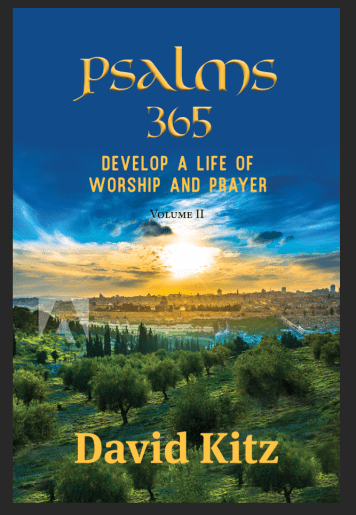
The first volume of Psalms 365: Develop a Life of Worship and Prayer by award-winning author David Kitz is now available. For a closer look at this 262-page daily devotional book click here.

“Hosanna to the Son of David!”

24 Wednesday Mar 2021

Posted by davidkitz in The Soldier Who Killed a King

≈ 3 Comments

Tags

Hosanna, Jesus of Nazareth, Passover, pilgrims, Son of David

A journey to the cross is a journey to repentance. It’s a journey to deep personal change. Will you take this journey with me?Soldier800kb

I could see him clearly now. Donkey or not, he had the look of a man who knew exactly what he was doing. Those about him might not know or understand, but he knew. He had a destination in mind, a purpose. You could see it on his face.
“Hosanna to the Son of David!”
“Blessed is he who comes in the name of the Lord!”
“Hosanna in the highest heaven!”
There was something else different about him. At the time I didn’t know what it was. I couldn’t put it into words for a long time. I think I noticed it because I had watched all those other men come into Rome in their triumphal processionals. They were conquerors, but still they were hollow men, feeding off the adulation of the crowd, thirsting but never satisfied. You could see them vainly drink it in, hoping it would somehow fill the empty soul.
This donkey-riding king wasn’t drinking from the crowd. I somehow sensed he was full already, and what he had within must have come from a different source.
“Hosanna in the highest heaven!”
“Hosanna to the Son of David!”
“Blessed is he who comes in the name of the Lord!”
Just at that moment a strange feeling seemed to rise within me. Maybe it was the joy of the crowd. I had expected anger. Maybe it was the children waving palm branches or the spontaneity of the singing? I don’t know. For one moment it all seemed to come together. It seemed right somehow. Like heaven and earth had finally, for a moment, come into agreement—an agreement that had never been achieved before.
“Hosanna in the highest heaven!”
He was much closer now.
“Hosanna to the Son of David!”
He was now within the shadow of the gate.
“Blessed is he who comes in the name of the Lord!”
At that moment he looked up. For an instant our eyes met. Then I heard a voice—clearly heard a voice say, “I have a future for you.”
I was confused.
I turned to Claudius and said, “What did you mean by that?”
“What did I mean by what?” He had a blank look on his face.
“By what you said about—about the future?”
“I didn’t say anything about the future, sir. I didn’t say anything.”
I was totally baffled. Was I hearing voices? This whole thing was making no sense, no sense at all. Passover pilgrims weren’t supposed to come into the city this way. We had a revolutionary on the loose—riding a donkey. And now I was hearing things?
I rubbed the sweat from my forehead, hoping for some clarity to emerge.
I had a hundred men whose lives were in danger from this Jewish Messiah and his horde of followers. That was what mattered.
By this time the donkey man had passed under the gate and was heading in the direction of the temple in the heart of the city.
I signaled for Claudius to follow as I raced down the stairs of the gatehouse. I emerged onto the street and grabbed the first two-legged bit of Jewish scum I saw. Pressing him against the stone wall, I demanded, “Who is that man?”
I pointed at the retreating figure on the donkey.
The poor wretch was in shock and seemed quite unable to get out a word.
Claudius reached for his sword.
“Je- Jesus of Nazareth,” he stammered and then quickly added, “the prophet from Nazareth in Galilee.”
I loosened my grip. Then in a voice loud enough for all near to hear, I announced, “Well, there is one thing I do know. We’re going to have to keep an eye on that man.”
4485 SHARABLE-2

For book purchases of The Soldier Who Killed a King try Amazon or christianbook.com.

To download a free study guide for this high-impact, 288-page, bible-based novel visit: https://www.davidkitz.ca/centurion.php/free study guide PDF

Here’s a journey to the cross and the open tomb you will never forget.

Where Are Your Idols?

24 Wednesday Mar 2021

Posted by davidkitz in Psalm 115, Psalms

≈ 7 Comments

Tags

idolatry, idols, leaders

Reading: Psalm 115
(Verses 1-8)
Not to us, LORD, not to us
but to your name be the glory,
because of your love and faithfulness.
Why do the nations say,
“Where is their God?”
Our God is in heaven; he does whatever pleases him.
 But their idols are silver and gold,
made by human hands.
They have mouths, but cannot speak,
eyes, but cannot see.
They have ears, but cannot hear,
noses, but cannot smell.
They have hands, but cannot feel,
feet, but cannot walk,
nor can they utter a sound with their throats.
Those who make them will be like them,
and so will all who trust in them
(NIV).*

170 Giant Bhudda

Giant Bhudda, Kamakura, Japan — photo by David Kitz

Reflection
Where are your idols? “I have none,” you say. Are you sure? Most readers of this post would deny being idol worshippers, but perhaps we have more idols than we care to admit.

Idolatry was commonly practiced during Israel’s kingdom era. In Old Testament times, the nations around God’s people all practiced various forms of idol worship. One might assume God’s redeemed people, who were rescued from slavery, would have nothing to do with such vile practices. But you would be wrong. Time and again Israel fell into idolatry.

King Solomon, who was revered for his wisdom, is a prime example of someone who condoned idol worship. Here’s what we read about this ‘esteemed’ leader: On a hill east of Jerusalem, Solomon built a high place for Chemosh the detestable god of Moab, and for Molek the detestable god of the Ammonites. He did the same for all his foreign wives, who burned incense and offered sacrifices to their gods (1 Kings 11:7-8).

When leaders go astray, there will be many who follow. In the church today, we have many leaders who have fallen captive to the god of Mammon—material goods. Jesus said, “No one can serve two masters. Either you will hate the one and love the other, or you will be devoted to the one and despise the other. You cannot serve both God and money” (Matthew 6:24).

Before we claim to be free from idols, we need to examine our hearts. Are we yielding to the Holy Spirit, or are we controlled by our desire for what this world has to offer?

Response: Father God, show me if there are idols in my life. In love, correct me when I stray. I want to serve you—put you first in my life. Lord Jesus, be my master. It’s an honor to serve you. Amen.

Your Turn: Are there other things that can become idols in your life?

* New International Version, Copyright ©1973, 1978, 1984, 2011 by Biblica

The first volume of Psalms 365: Develop a Life of Worship and Prayer by award-winning author David Kitz is now available. For a closer look at this 262-page daily devotional book click here.

Four in the afternoon, Sunday, April 2, AD 30

23 Tuesday Mar 2021

Posted by davidkitz in The Soldier Who Killed a King

≈ Leave a comment

Tags

Hosanna, Messiah, Passover, Son of David, The Soldier Who Killed a King

Free WW-e FACEBOOK-2 (2)
I
t was never like this before.
I have been posted in Jerusalem for ten years now, but in all that time, I have never seen a Passover crowd like this.
It wasn’t the numbers. I had seen that before.
The Passover pilgrims always come plodding into the city in reverent caravans. Some of them chant psalms. Others are silent, looking bone-weary as they trudge, like fretful herdsmen with children in tow. Undoubtedly, many are relieved that their holy city is finally in view.
But this year it was different. There was this man—at the center of the whole procession. There had never been a central figure before. Every movement within that huge throng seemed focused on him.
Squinting in a futile attempt to get a better view, I gave Claudius a backhanded slap to the shoulder and demanded, “What are they doing?”
“They’re climbing the trees, sir.”
“I can see that!” I snapped. “But what are they doing?”
“They seem to be tearing off the palm branches, sir.”
“What is going on here?” I said it more to myself than to any of the men standing near me. An uncomfortable feeling crept into me as the procession advanced.
“They don’t usually do this?” Claudius questioned.
“No . . . They’ve never done this before.” There was worry in my voice. Claudius had been recently assigned to this place, the festering armpit of the empire, and I was at a loss to explain what was happening before us. We were standing on the wall above the gate of Jerusalem, and less than a half mile away, we could see the jubilant pilgrims surging toward us in alarming numbers.
“They’re laying the palm branches on the road in front of that man—the man on the donkey.”
Until Claudius said it, I hadn’t noticed the donkey. Its small size and the frenzy of activity round about must have obscured this detail in the picture before me. What an odd way for this man to come. I could make no sense of it.
“They’re throwing down their cloaks before him.”
The sweat- glistened bodies of several men were clearly visible. Outer garments were being cast down before this man as a sign of homage. At the same time the rhythmic chanting of their voices became more distinct.
What were they singing? Could I pick up the words?
     “Hosanna to the Son of David!” 
     “Blessed is he who comes in the name of the Lord!” 
     “Hosanna in the highest heaven!”
That’s when it hit me like a barbarian’s club. I realized what I was witnessing. It was a triumphal entry—the entry of a king.
It was the words. The words they were now boisterously shouting. He was their Messiah. The Son of David! The one they were waiting for! The one who would rid them of the Romans. He would set up his glorious Jewish kingdom, here, in Jerusalem! This is what I had been warned about since the day I first set foot on this cursed Judean soil. And we, I and my men and the garrison in the city, were all that stood in their way.

For book purchases of The Soldier Who Killed a King try Amazon or christianbook.com.

To download a free study guide for this high-impact, 288-page, bible-based novel visit: https://www.davidkitz.ca/centurion.php/free study guide PDF

Here’s a journey to the cross and the open tomb you will never forget.

Why Did the Sea Flee?

23 Tuesday Mar 2021

Posted by davidkitz in Psalm 114, Psalms

≈ 5 Comments

Tags

miraculous, power of God, salvation, save, sea

Reading: Psalm 114
When Israel came out of Egypt,
Jacob from a people of foreign tongue,
 Judah became God’s sanctuary,
Israel his dominion.
The sea looked and fled,
the Jordan turned back;
the mountains leaped like rams,
the hills like lambs.
Why was it, sea, that you fled?
Why, Jordan, did you turn back?
Why, mountains, did you leap like rams,
you hills, like lambs?
Tremble, earth, at the presence of the Lord,
at the presence of the God of Jacob,
who turned the rock into a pool,
the hard rock into springs of water
(NIV).*

wave rolling in pure clear sea

Photo by Lachlan Ross on Pexels.com

Reflection
“Why?” A four-year-old’s favorite question is, “Why?” Here in Psalm 114, the psalmist has some why questions as well. “Why did the sea flee? Why did the Jordan River turn back? Why did those mountains and hills seem to skip and dance? Why?”

The answer of course is because of the jaw-dropping, eye-popping, heart-stopping power of God. God caused the sea to flee. He caused the Jordan to turn back. He caused mountains and hills to skip about and frolic like yearling lambs set free from the stall. What an awesome display! What an awesome God!

Psalm 114 is all about the overwhelming power of God. It is a grand portrayal of the pivotal event in the Old Testament Scriptures. Here within a few short verses we catch a panoramic view of God’s might on display, starting with Israel’s escape from Egypt, to their arrival in the Promised Land.

Why did the miracle-working LORD make the sea flee? Was it simply to display His awe-inducing power? Was it simply to create excitement among the million or more mortals, who were eyewitnesses to this divine wonder? In the Exodus account, the reason for this miraculous intervention is stated clearly: That day the LORD saved Israel from the hand of the Egyptians, and Israel saw the Egyptians lying dead on the shore. And when the Israelites saw the great power of the LORD displayed against the Egyptians, the people feared the LORD and put their trust in him and in Moses his servant (Exodus 14:30-31).

This power display had one primary purpose. That purpose was salvation. The LORD wanted to save people—His covenant people—from the vicious clutches of oppression and a tyranny. In short, the LORD works wonders so He can save people—so He can bring them into His Kingdom—so they can escape the sin systems of this world, and come under His loving rule.

Response: Father God, thank you for going all out to save me through the death and resurrection of your Son, Jesus. What a display of your love and power! Help me to love, fear and trust you. Amen.

Your Turn: Why did God save you? Is there a reason for His mercy?

* New International Version, Copyright ©1973, 1978, 1984, 2011 by Biblica

The first volume of Psalms 365: Develop a Life of Worship and Prayer by award-winning author David Kitz is now available. For a closer look at this 262-page daily devotional book click here.

To the Place Where it Sets

22 Monday Mar 2021

Posted by davidkitz in Psalm 113

≈ 1 Comment

Tags

praising God, sunrise, sunset

Today’s quote and prayer from the Psalms
Psalm 113_3 (1)
Father God,
your love is beyond comprehension.
Thank you for stooping down
and involving yourself in my life.
When I reach out to you,
Father God, you lift me up.
I praise you, LORD.
Amen.

The first volume of Psalms 365: Develop a Life of Worship and Prayer by award-winning author David Kitz is now available. For a closer look at this 262-page daily devotional book click here.

Stooping Down for Dirt Bags

22 Monday Mar 2021

Posted by davidkitz in Psalm 113, Psalms

≈ 4 Comments

Tags

dirty, dust, enthroned, trash

Reading: Psalm 113
Praise the LORD.
Praise the LORD, you his servants;
    praise the name of the L
ORD.
Let the name of the L
ORD be praised,
    both now and forevermore.
 From the rising of the sun to the place where it sets,
    the name of the L
ORD is to be praised.
The LORD is exalted over all the nations,
    his glory above the heavens.
Who is like the L
ORD our God,
    the One who sits enthroned on high,
who stoops down to look on the heavens and the earth?
He raises the poor from the dust
    and lifts the needy from the ash heap;
he seats them with princes, with the princes of his people.
He settles the childless woman in her home
    as a happy mother of children.
Praise the LORD (NIV).*

img_20190803_1956521

From the rising of the sun to the place where it sets — Photo by David Kitz

Reflection
In today’s reading the psalmist has a question for you and here it is: Who is like the LORD our God, the One who sits enthroned on high, who stoops down to look on the heavens and the earth?

Who indeed? Why would the exalted One, the enthroned One, stoop down? How undignified! Doesn’t the LORD know kings and potentates don’t bend over or stoop down? They certainly don’t do that sort of thing in public—not where they can be seen by others. Rulers rule from the seat of authority. They sit; they don’t stoop down. But our God stoops down. If the truth be told, it’s even worse than that.

The LORD gets His hands dirty. Actually, He has been getting His hands dirty from the very beginning. The LORD God formed a man from the dust of the ground and breathed into his nostrils the breath of life, and the man became a living being (Genesis 2:7). Now that was a failed experiment, if there ever was one. Those living, breathing human dust bags showed no gratitude. They disobeyed God at the first opportunity and down through the generations, humanity has continued that pattern of disobedience and ingratitude.

Now in this psalm we read this: He raises the poor from the dust and lifts the needy from the ash heap. Why would God show such affection for fallen humanity—humans who keep plunging deeper into the mire? There is no greater mystery. Our God keeps finding treasures in the trash—the human trash.

Still I keep wondering why anyone would stoop so low. Why would the One, who sits enthroned on high, stoop so low—low enough to die a criminal’s death on a cross? Why did the Lord stoop to rescue me? 

Response: Father God, your love is beyond comprehension. Thank you for stooping down and involving yourself in my life. When I reach out to you, Father God, you lift me up. I praise you, LORD. Amen.

Your Turn: Has the LORD lifted you from the ash heap? How did that make you feel?

* New International Version, Copyright ©1973, 1978, 1984, 2011 by Biblica

The first volume of Psalms 365: Develop a Life of Worship and Prayer by award-winning author David Kitz is now available. For a closer look at this 262-page daily devotional book click here.

The Soldier Who Killed a King — Foreword

21 Sunday Mar 2021

Posted by davidkitz in The Soldier Who Killed a King

≈ 3 Comments

Tags

David Kitz, novel, Roman, Roman centurion

What would it be like to live in the geopolitical center of the world during the first century, when donkeys and camels were the cars and trucks; conversations over a goblet of wine were the social media; and religious conflict influenced every facet of life? What would it be like to constantly live under the pagan political domination of Roman tyranny, while also enduring the oppressive ritualistic control of hypocritical religious bigots? What would it be like to live in the very week that this dark confused world was being invaded by heaven—a week when history would shift its time of reckoning from BC to AD?4485 SHARABLE-2

This gripping story, written by David Kitz, offers its readers a front row seat from where we can view the action. It’s a hidden camera on the helmet of a primary witness to this history altering drama, when the Sovereign of the Universe, quietly riding on a lowly donkey, overthrew the pomp and power of the most powerful empire this world has ever known. More than that, it’s a look into the mind and heart of a man, not unlike you or me, who was wrestling with the questions of the meaning and purpose of life.

As you read the thoughtful eyewitness account of The Soldier Who Killed a King, as told by Marcus the Roman centurion, you will feel his anxiety and anguish. And ultimately you too will exult in the answers he discovers, because—despite the time and cultural differences—his story is our story.

Pastor Barry Buzza
President Emeritus, Foursquare Gospel Church of Canada.

For book purchases of The Soldier Who Killed a King try Amazon or christianbook.com.

To download a free study guide for this high-impact, 288-page, bible-based novel visit: https://www.davidkitz.ca/centurion.php/free study guide PDF

Here’s a journey to the cross and the open tomb you will never forget.

Delivered from Death

21 Sunday Mar 2021

Posted by davidkitz in Psalm 116, Psalms

≈ 5 Comments

Tags

death, deliverance, tears, the land of the living

I will praise the LORD!

sunset beach people sunrise

Photo by Jill Wellington on Pexels.com

Return to your rest, my soul,
    for the LORD has been good to you.

For you, LORD, have delivered me from death,
    my eyes from tears,
    my feet from stumbling,
that I may walk before the LORD
    in the land of the living.

(Psalm 116:7-9, NIV)*

* New International Version, Copyright ©1973, 1978, 1984, 2011 by Biblica

The first volume of Psalms 365: Develop a Life of Worship and Prayer by award-winning author David Kitz is now available. For a closer look at this 262-page daily devotional book click here.

← Older posts
Newer posts →

Psalms 365: Develop a Life of Worship & Prayer

Psalms 365 Volume II

Psalms 365 vol 3
— Psalms 365 Volume III

Now available:

Psalms

Recent posts

  • Harvest Psalm May 8, 2026
  • Jesus Forgives and Heals a Paralyzed Man May 7, 2026
  • Ready to Burst into Song May 7, 2026
  • Jesus Restores Two Demon-Possessed Men May 6, 2026
  • They sharpen their tongues May 6, 2026
  • Jesus Calms the Storm May 5, 2026
  • Focus on the LORD May 5, 2026

Calendar

May 2026
M T W T F S S
 123
45678910
11121314151617
18192021222324
25262728293031
« Apr    

Blog Posts

Enter your email address to follow this blog and receive notifications of new posts by email.

Comments

  • davidkitz on Ready to Burst into Song
  • davidkitz on Jesus Calms the Storm
  • Jesus Calms the Storm – QuietMomentsWithGod on Jesus Calms the Storm

Blog at WordPress.com.

Privacy & Cookies: This site uses cookies. By continuing to use this website, you agree to their use.
To find out more, including how to control cookies, see here: Cookie Policy
  • Subscribe Subscribed
    • I love the Psalms
    • Join 1,345 other subscribers
    • Already have a WordPress.com account? Log in now.
    • I love the Psalms
    • Subscribe Subscribed
    • Sign up
    • Log in
    • Report this content
    • View site in Reader
    • Manage subscriptions
    • Collapse this bar

Loading Comments...