Tags
I will praise Him!

You have set your glory in the heavens — photo by David Kitz

19 Sunday Aug 2018
Posted in Bible, God's word, Psalm 8, Psalms
Tags
You have set your glory in the heavens — photo by David Kitz
18 Saturday Aug 2018
Posted in Bible, God's word, Psalm 7, Psalms
Tags

Petrie Island, Orleans, Ontario — photo by David Kitz
14 Tuesday Aug 2018
Posted in Bible, Devotionals, God's word, Psalm 136, Psalms
Reading: Psalm 136
(Verses 1-9)
Give thanks to the LORD, for he is good.
His love endures forever.
Give thanks to the God of gods.
His love endures forever.
Give thanks to the Lord of lords:
His love endures forever.
to him who alone does great wonders,
His love endures forever.
who by his understanding made the heavens,
His love endures forever.
who spread out the earth upon the waters,
His love endures forever.
who made the great lights—
His love endures forever.
the sun to govern the day,
His love endures forever.
the moon and stars to govern the night;
His love endures forever (NIV).

Babbling brook — photo by David Kitz
Reflection
Here are some straightforward facts about me. I love nature. I enjoy all four seasons. I love getting out of the house and hiking through the woods or riding my bicycle along nature trails. I am fascinated by the wildlife I encounter on these excursions. I like planting a backyard garden in spring, and harvesting the produce from it through the summer and fall. I feel knitted to the land and its seasons.
My love for God’s creation underpins my love for God. A God who created such a beautiful, wonder-filled world must be truly awesome—awesome beyond measure—because the universe He created is awesome beyond measure.
Psalm 136 extols the virtues of this awesome limitless God. His love endures forever. For a total of twenty-six verses the psalmist expounds on the goodness of the LORD. In response His people reply, “His love endures forever.”
Today’s reading lays the foundation for our worship. That foundation rests on the wonder of God’s creation. We are to give thanks to God because He alone does great wonders. By his understanding, [He] made the heavens, and spread out the earth upon the waters.
As you go through your day do you find moments where you give God thanks for the wonders of His creation? In an urban, man-made environment we can lose touch with nature and our Creator. We lose something precious—something fundamental to our well-being—when that happens.
Response: LORD God, help me to appreciate the wonder of your creation every day. Give me opportunities to see the beauty in it, because it’s a reflection of your magnificent character. Amen.
Your Turn: Do you enjoy nature? Does that appreciation of nature translate into love for God?
13 Monday Aug 2018
Posted in Bible, Devotionals, God's word, Psalm 135, Psalms
Tags
financial system, gold, idolatry, idols, silver, worship, worship of wealth
Reading: Psalm 135
(Verses 15-21)
The idols of the nations are silver and gold,
made by human hands.
They have mouths, but cannot speak,
eyes, but cannot see.
They have ears, but cannot hear,
nor is there breath in their mouths.
Those who make them will be like them,
and so will all who trust in them.
All you Israelites, praise the LORD;
house of Aaron, praise the LORD;
house of Levi, praise the LORD;
you who fear him, praise the LORD.
Praise be to the LORD from Zion,
to him who dwells in Jerusalem.
Praise the LORD (NIV).

Petrie Island, Ottawa, ON, CANADA — photo by David Kitz
Reflection
Though it may not be obvious, there is something timeless about the first sentence from today’s reading: The idols of the nations are silver and gold, made by human hands.
In today’s world shaping silver or gold into an idol may be unusual, but it still occurs. India and the nations of Southeast Asia have plenty of gold and silver idols. This is not a dying worship form. Many have been cast in recent years.
In the western world we frown on such openly idolatrous displays of wealth and worship. Or do we? Gold and silver represent wealth. In reality, we have simply transformed our worship of wealth from bulky commodities like silver and gold to more transferable assets like securities and paper currency. We are still guilty of bowing before silver and gold, but it comes with a different name. Now we call it the almighty dollar.
The almighty dollar, or more broadly speaking, the market, determines the ebb and flow of commerce, and by extension impacts every aspect of our daily lives. It is not an exaggeration to say we are caught up in financial system that is deeply idolatrous. Our society has taken the worship of wealth (Mammon) to new heights. We elect our political leaders not on the basis of morality or personal integrity, but rather can they deliver a higher level of GDP—put more money in our pockets.
Into this corrupt world, St. Peter speaks these words to those who have been called to follow Christ: For you know that it was not with perishable things such as silver or gold that you were redeemed from the empty way of life handed down to you from your ancestors, but with the precious blood of Christ, a lamb without blemish or defect (1 Peter 1:18-19).
Response: Father God, I need the right perspective on wealth and finances. Your precious blood is worth more than all the silver and gold this world has to offer. I bow before you as my Almighty Savior. Amen.
Your Turn: Is Jesus the Lord of your finances? Is your Redeemer more important than wealth?
12 Sunday Aug 2018
Posted in Bible, God's word, Psalm 5, Psalms

Marsh blossoms, Petrie Island, Ottawa, ON — photo by David Kitz
11 Saturday Aug 2018
Posted in Bible, God's word, Psalm 5, Psalms
Tags

Wild morning glory — photo by David Kitz
09 Thursday Aug 2018
Posted in Bible, Devotionals, God's word, Psalm 135, Psalms
Tags
Reading: Psalm 135
(Verses 1-7)
Praise the LORD.
Praise the name of the LORD;
praise him, you servants of the LORD,
you who minister in the house of the LORD,
in the courts of the house of our God.
Praise the LORD, for the LORD is good;
sing praise to his name, for that is pleasant.
For the LORD has chosen Jacob to be his own,
Israel to be his treasured possession.
I know that the LORD is great,
that our Lord is greater than all gods.
The LORD does whatever pleases him,
in the heavens and on the earth,
in the seas and all their depths.
He makes clouds rise from the ends of the earth;
he sends lightning with the rain
and brings out the wind from his storehouses (NIV).

Backyard bluebells — photo by David Kitz
Reflection
Like many of the psalms, Psalm 135 begins by calling us to worship. Specifically, this is a call to praise the LORD. Praise the LORD, for the LORD is good; sing praise to his name, for that is pleasant.
So what is the difference between praise and worship? Worship is a broad term that expresses itself in a variety of ways. The Encarta Dictionary defines worship as “the adoration, devotion, and respect given to a deity.”
We can show devotion, adoration and respect for God in wide range of ways. We can use our bodies to express worship by bowing, kneeling, falling prostrate, or lifting our hands and faces heavenward. We read that both David and Miriam danced before the LORD as an act of worship. See 2 Samuel 6:13-15 and Exodus 15:20-21.
Praise and thanksgiving are verbal forms of worship that reflect a heart of adoration. But why do the Psalms call on us to praise God so frequently? Is the LORD a grand, heavenly egomaniac who demands our worship to satisfy His desire for recognition and importance? Hardly.
Actually, just the opposite is true. God does not need our worship. We are the egomaniacs. Praise and worship counteracts the selfishness that is at the root of our sinful nature. We desperately need to get our eyes off ourselves and onto the One who is worthy of all praise. So here to counter what ales us is a simple but powerful prescription from your heavenly Father: Praise the LORD.
Response: Father God, I worship you. Thank you for sending Jesus to be my Savior. Holy Spirit, infuse my praise and worship with joy. You are so very good—so very kind to me. Let praise in all its varied forms flow from me to you. Amen.
Your Turn: What forms or expressions of worship are most meaningful to you?
08 Wednesday Aug 2018
Posted in Bible, Devotionals, God's word, Psalm 134, Psalms
Tags
child of God, Creator, identity, Jerusalem, Jesus, Songs of Ascent, temple
Reading: Psalm 134
A song of ascents.
Praise the LORD, all you servants of the LORD
who minister by night in the house of the LORD.
Lift up your hands in the sanctuary
and praise the LORD.
May the LORD bless you from Zion,
he who is the Maker of heaven and earth (NIV).
![IMG_20180629_1750359[3581]](https://davidkitz.blog/wp-content/uploads/2018/07/img_20180629_17503593581.jpg?w=529)
Columns at the gateway to the Acropolis in Athens, Greece — photo by David Kitz
It is likely that the twelve-year-old Jesus sang this psalm with his parents on the final evening of their Passover pilgrimage to Jerusalem. On the following day the family departed for Nazareth where Joseph would resume his trade as a carpenter. When they left the next morning, they assumed Jesus was traveling with them in the large company of other pilgrims from their hometown. See Luke 2:41-52.
Typically, we read this account of the lost twelve-year-old Jesus from the viewpoint of a parent. We identify with the stress of losing a child in a big city. We would title this story, “Mary and Joseph find lost Jesus.” But the story reads quite differently, when we view it from the perspective of a child trying to discover who he really is. Viewed from Jesus’ perspective the title of the story might well be, “Lost Boy finds Himself” or “Lost Boy Discovers His Divinity.”
How did Jesus discover he was the son of God? Some believers might well reason that the answer is obvious. Jesus is God; therefore, he is omniscient. The all-knowing Jesus would surely know that he was God’s son. But many theologians would beg to differ. They view the humanity of Christ as all pervasive. Jesus was 100% human and as such he needed to learn and discover his identity even as any child does.
If through the incarnation Jesus fully took on humanity, then the boy Jesus needed to discover his divine identity. It may have been written into every fibre of his being, but he still needed to discover it, just as any young musical prodigy needs to explore and discover his or her gift. All divine gifts must be discovered and developed to reach their maximum potential.
How do we discover our true identity? From the account in Luke, it would appear that the boy Jesus discovered his true identity in the House of God. Perhaps it began as he lifted his hands in worship. We cannot fully discover who we are until we discover who God is. We must know our Creator to know ourselves. Self-understanding begins with knowing whose we are. You and I belong to the Father.
Response: Father God, I thank you for loving me and inviting me into your family. Lord Jesus, thank you for purchasing my redemption. Holy Spirit, I thank you for the confirmation that I am your child. Amen.
Your Turn: Do you know who you are? How is God the Father shaping your identity?
07 Tuesday Aug 2018
Posted in Bible, Devotionals, God's word, Psalm 133, Psalms
Tags
anointing, God's blessing, Holy Spirit, love, renewal, unity
Reading: Psalm 133
A song of ascents. Of David.
How good and pleasant it is
when God’s people live together in unity!
It is like precious oil poured on the head,
running down on the beard,
running down on Aaron’s beard,
down on the collar of his robe.
It is as if the dew of Hermon
were falling on Mount Zion.
For there the LORD bestows his blessing,
even life forevermore (NIV).
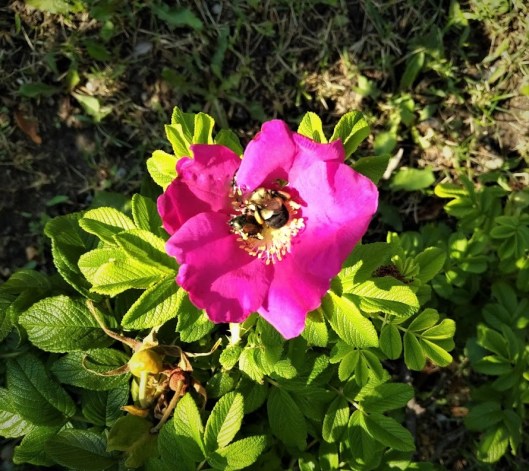
Bumble bee visits rose blossom — photo by David Kitz
Reflection
Short, but powerful and evocative—that’s my description of Psalm 133. I might also add, easily read, but difficult to put into practice. Unity among the people of God is that great elusive goal that seems to always disappear around the next bend in the road just as we approach it. But there God has commanded His blessing, if we could only reach that blessed state.
The psalmist uses two metaphors to portray this good and pleasant state of affairs. The first may appear to be rather messy and wasteful. Who wants oil running down their beard and onto their clothing? But in the Old Testament, prophets, priests and kings were anointed in just this way. It symbolized the release of divine authority and power into an individual’s life. The Spirit of God was coming upon them for public service. This concept forms an effective bridge to the coming of the Holy Spirit in the Book of Acts. When the waiting disciples were of one accord, the Holy Spirit was poured upon them; the anointing came. See Acts 2.
The second metaphor signifies rejuvenation. The dew of the morning is new each day. It refreshes and revives. When our social interactions are positive and enriching, the outcome is spiritual renewal and a deep sense of belonging. Recent studies have shown that social isolation may be a greater risk factor among the elderly than smoking or heart disease. Lack of meaningful interaction with others also has a negative impact on mental health.
The person who continually self-isolates is committing a slow form of suicide, both physically and spiritually. Satan loves the isolated believer—feasts on the mind of the isolated believer.
Simply put, we need each other. We need to be surrounded by loving caring relationships, at home, at work and in the church. On every level, unity of purpose coupled with unselfish love, refreshes and revives the weary soul. We all want God’s blessing. Well, here’s the key to God’s blessing. The LORD commands a blessing when God’s people live together in unity!
Response: Father God, help me sow words of love and unity. Open my eyes to see where I can bring a word of encouragement and affirmation to those around me. Make me an instrument of peace, love and unity today. Amen.
Your Turn: How can you avoid sowing seeds of discord? What can you do today to build unity or break out of self-isolation?
05 Sunday Aug 2018
Posted in Bible, God's word, Psalm 4, Psalms
Tags

Be still before the LORD — photo by David Kitz
 I love the Psalms