Tags
I will praise Him!

Lake Placid, NY — photo by David Kitz

04 Saturday Aug 2018
Posted in Bible, God's word, Psalm 3, Psalms
Tags
Lake Placid, NY — photo by David Kitz
03 Friday Aug 2018
Posted in Bible, Devotionals, God's word, Psalm 132, Psalms
Reading: Psalm 132
(Verses 6-10)
We heard it in Ephrathah,
we came upon it in the fields of Jaar:
“Let us go to his dwelling place,
let us worship at his footstool, saying,
‘Arise, LORD, and come to your resting place,
you and the ark of your might.
May your priests be clothed with your righteousness;
may your faithful people sing for joy.’”
For the sake of your servant David,
do not reject your anointed one (NIV).
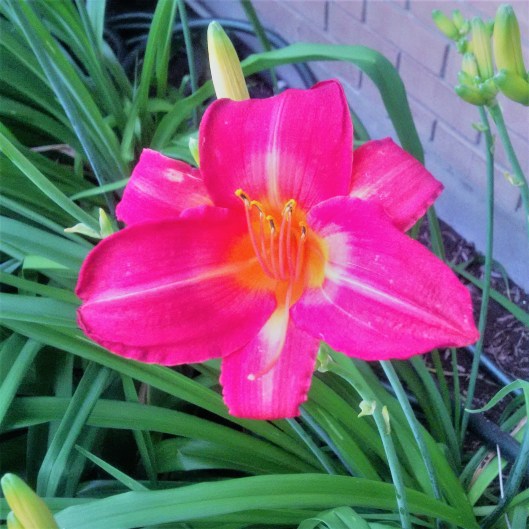
Day Lily — photo by David Kitz
Reflection
David’s commitment and zeal for the presence of the LORD drew others to worship God. That’s what the opening lines of today’s reading are saying: We heard it in Ephrathah, we came upon it in the fields of Jaar: “Let us go to his dwelling place, let us worship at his footstool…”
We should never underestimate the power of our personal witness for Christ. Our zeal for God and love for His house can act as a magnet to draw others to worship Him. David’s self-denial in pursuit of God resulted in others discovering the power and grace of the LORD. By bringing the Ark of the Covenant to Zion, the City of David, David was declaring that he wanted the LORD in his home. He wanted Him close at hand—at the center of the government he was establishing over the land. See 2 Samuel 6.
Do we want God in our home? Is the LORD at the command center of your life and your daily affairs? Genuine worship brings God to the center. It removes the distance between us and God. The Psalms of Ascent are all about removing the distance between us and our Creator. They’re about drawing near.
The psalmist goes on to offer this prayer. “‘May your priests be clothed with your righteousness; may your faithful people sing for joy.’”
How are you dressed as you approach God? Apparently, clothing matters. It matters because as a redeemed child of God you are serving as a priest of the Most High. The apostle, Peter reminds us of our corporate calling and responsibility. But you are a chosen people, a royal priesthood, a holy nation, God’s special possession, that you may declare the praises of him who called you out of darkness into his wonderful light (1 Peter 2:9).
So then as priests offering sacrifices of praise, we have an opportunity to approach God. But how should we be clothed, you ask? St. Paul provides the answer. So in Christ Jesus you are all children of God through faith, for all of you who were baptized into Christ have clothed yourselves with Christ (Galatians 3:26-27). As a blood-bought believer you are clothed with the righteousness of Christ. That’s a garment that never grows old or wears out.
Response: Father God, I thank you for covering me with a garment of righteousness. It’s the supreme righteousness of Jesus. Help me to serve and worship you daily with a grateful heart. Amen.
Your Turn: Are you drawing near to God? Do you see yourself as part of a royal priesthood?
02 Thursday Aug 2018
Posted in Bible, Devotionals, God's word, Psalm 132, Psalms
Reading: Psalm 132
A song of ascents.
(Verses 1-5)
LORD, remember David
and all his self-denial.
He swore an oath to the LORD,
he made a vow to the Mighty One of Jacob:
“I will not enter my house or go to my bed,
I will allow no sleep to my eyes
or slumber to my eyelids,
till I find a place for the LORD,
a dwelling for the Mighty One of Jacob” (NIV).

The waters of Georgian Bay, Bruce Peninsula National Park — photo by David Kitz
Reflection
This is the thirteenth psalm in the Songs of Ascent series. With this psalm, the author returns to a familiar theme—the glory of God’s presence in Zion. It is what has drawn the pilgrims to this holy place. They have come to worship and meet with God.
But this psalm has a different approach. It recounts the history of Zion and how this particular place was chosen as the site for Israel to worship God. It all began with David. At the prompting of the LORD, David chose Mount Zion to set up the Tabernacle of the LORD. But before Mount Zion could become a place of worship the stronghold of Zion had to be conquered. It was in enemy hands. Nevertheless, David captured the fortress of Zion—which is the City of David (2 Samuel 5:7).
In this psalm we hear of David’s vow. “I will not enter my house or go to my bed, I will allow no sleep to my eyes or slumber to my eyelids, till I find a place for the LORD, a dwelling for the Mighty One of Jacob”
In David’s case, finding a place for the LORD required self-denial. It involved a physical battle. There is a spiritual battle that we too need to fight so the LORD can occupy His rightful place in our lives. The enemy does not leave the strongholds in our mind without a fight. We must take action to evict him.
We live in a world where self-denial is rare, and often frowned upon. Our society pushes the easy life—the comfortable life—the path of least resistance. Self-denial in pursuit of a relationship with God is a foreign concept. In many churches fasting and prayer is a lost discipline.
Jesus encountered the same problem with his own disciples. While he was praying fervently in the Garden of Gethsemane, his disciples were fast asleep. “Simon,” he said to Peter, “are you asleep? Couldn’t you keep watch for one hour?” See Mark 14:32-42.
This inability to pray for an hour is an indicator that at our core we have not surrendered fully to God. Other things are more important. There is no self-denial. That TV show is more important. The game is more important. Perhaps our Zion is still occupied by the enemy and the LORD is not enthroned there.
Response: LORD God, help me to change. I want to put you first in my life. Come and occupy the throne of my life. I want my thoughts, words and actions to be governed by you, Lord Jesus. Amen.
Your Turn: Do you find self-denial difficult? Do you practice a variety of spiritual disciplines?
01 Wednesday Aug 2018
Posted in Bible, Devotionals, God's word, Psalm 131, Psalms
Tags
Reading: Psalm 131
A song of ascents. Of David.
My heart is not proud, LORD,
my eyes are not haughty;
I do not concern myself with great matters
or things too wonderful for me.
But I have calmed and quieted myself,
I am like a weaned child with its mother;
like a weaned child I am content.
Israel, put your hope in the LORD
both now and forevermore (NIV).

Watson Lake, Yukon — photo courtesy of Liz Kranz
Reflection
In my personal quiet time this morning I highlighted this verse. When pride comes, then comes disgrace, but with humility comes wisdom (Proverbs 11:2).
The wisdom that comes with humility is a rare commodity in today’s world. It appears that the crude bravado of boasting egocentrics is winning the day. Every field of human endeavor has its loudmouthed champions—men who heap scorn on meeker souls.
But Jesus has a message that runs completely contrary to this approach. In his Sermon on the Mount, he said, “Blessed are the meek, for they will inherit the earth” (Matthew 5:5). On another occasion, the disciples asked Jesus this question, “Who, then, is the greatest in the kingdom of heaven?”
This is Jesus’ response. “Truly I tell you, unless you change and become like little children, you will never enter the kingdom of heaven. Therefore, whoever takes the lowly position of this child is the greatest in the kingdom of heaven. And whoever welcomes one such child in my name welcomes me.” (See Matthew 18:1-5).
Jesus turns this world’s operating system on its head. He heaps honor on the weak, the humble and the vulnerable. He praises the soul of the weaned child—the one who takes the position of humility. Of course, Jesus is right. The folly of the proud ends in disgrace, but the humility of the meek ends in honor and a glorious inheritance.
Your eternal destiny is determined by your humility. These words of Jesus are an ominous warning: “Truly I tell you, unless you change and become like little children, you will never enter the kingdom of heaven.”
I need to become like the weaned child of Psalm 131. Can I truthfully say these words? My heart is not proud, LORD, my eyes are not haughty. Have I calmed and quieted myself? Am I like a weaned child with its mother? Am I content? Becoming like the weaned child requires change. I need to change. Jesus asks me to change. How about you?
Response: Father God, help me to change. I want to become more like Jesus. He was the servant of all. Help me to avoid the pitfall of pride. Teach how to quiet my soul and be content in you. Amen.
Your Turn: Are you learning to quiet your soul before God?
31 Tuesday Jul 2018
Posted in Bible, Devotionals, God's word, Psalm 130, Psalms
Tags
hope, redemption, silence, Songs of Ascent, the LORD, waiting
Reading: Psalm 130
(Verses 5-8)
I wait for the LORD, my whole being waits,
and in his word I put my hope.
I wait for the LORD
more than watchmen wait for the morning,
more than watchmen wait for the morning.
Israel, put your hope in the LORD,
for with the LORD is unfailing love
and with him is full redemption.
He himself will redeem Israel
from all their sins (NIV).

More than watchmen wait for the morning — photo by David Kitz
Reflection
Psalm 130 can be divided into three distinct sections: the confessional approach, the wait, and the LORD’s response. In yesterday’s reading, we looked at the confessional approach. The psalmist came before his God and poured out his heart. In desperation he pleaded for mercy and forgiveness. At the same time he acknowledged the extreme mercy of God. He knows full well that this God forgives the undeserving.
Now, the psalmist waits: “I wait for the LORD, my soul waits, and in his word I put my hope. My soul waits for the LORD more than watchmen wait for the morning, more than watchmen wait for the morning.”
This is the step that is most frequently missing in our communion with God. We cannot wait; we rush on. We have things to do, people to see, a life to live. We have no time to wait for the LORD’s response. But without waiting, we cannot hear the LORD speaking to our hearts. The rush of life takes over. We do not hear our Savior speak the words of divine pardon. Prayer is reduced to one way communication. We speak into the silence, and allow no time for the God of silence to answer back.
But in his time of silence, the psalmist heard from God. In this third section of the psalm, the author is no longer addressing the LORD in prayer. Now he is addresses us. The wait is over. God has spoken, and now the psalmist rises to his feet. He has a message from the LORD for us—the Israel of God.
Israel, put your hope in the LORD, for with the LORD is unfailing love and with him is full redemption.
For Israel, there was a long wait. The promised Messiah was a long time in coming. The centuries slipped by. Generation after generation passed on, but the word of the LORD stood firm. A Redeemer was coming. With an uncanny accuracy the Old Testament prophets foretold the coming of the Christ. Many of those prophetic words are found within the Psalms. The Lord Jesus is our fount of hope—our Redeemer. He is love and the source of unfailing love. It is he who with his blood redeemed us, body, soul and spirit. In the person of Jesus, God took on human flesh. On the cross he fulfilled these words. “He himself will redeem Israel from all their sins.”
Response: Father God, I thank you for your prophetic word because it points to Jesus. Lord Jesus, thank you for laying down your life to redeem me, and all those who bow before you in repentance. Amen.
Your Turn: Are you taking time to listen for the voice of God in prayer?
30 Monday Jul 2018
Posted in Bible, Devotionals, God's word, Psalm 130, Psalms
Tags
confess, forgiveness, God's mercy, Lord, sins, Songs of Ascent
Reading: Psalm 130
A song of ascents.
(Verses 1-4)
Out of the depths I cry to you, LORD;
LORD, hear my voice.
Let your ears be attentive
to my cry for mercy.
If you, LORD, kept a record of sins,
LORD, who could stand?
But with you there is forgiveness,
so that we can, with reverence, serve you (NIV).

Ottawa River wetlands — photo by David Kitz
Reflection
Psalm 130 is a perfect example of a psalm that brings us into the private inner sanctum of communion with God. Here is a portrait of a fallen man—a man on his knees before his Maker, the eternal One. Hear him now as he agonizes in prayer, “Out of the depths I cry out to you, O LORD; O LORD, hear my voice. Let your ears be attentive to my cry for mercy.”
The opening lines of this psalm leave little doubt as to what has transpired. The psalmist has failed; he has missed the mark. He has transgressed, yet again. There is an abject poverty of spirit reflected in these words—a poverty that almost makes us cringe.
We do not know what sin, or list of sins has brought the psalmist to this wretched state. The transgression is left unstated. Was it anger, malice, or unbridled lust? Was it pride, greed or wilful dishonesty? Was this a transgression of the mind, of the tongue, of action or inaction? God knows.
I am always somewhat skeptical of those who claim they could never commit this or that sin. I think we rarely comprehend the depravity of our own hearts. Pushed into wrong circumstances, in the wrong environment, with the wrong peer group, who can plumb the depths to which a man or woman may sink? I can identify with the psalmist. I have added my own pile of dung to this world’s heap of moral filth. I too have found myself in the psalmist’s position, sobbing out these words, “Out of the depths I cry out to you, O LORD; O LORD, hear my voice. Let your ears be attentive to my cry for mercy.“
But despite my failings, despite my moral poverty, this great God—this God of holiness—is approachable. He is a God of mercy. The psalmist reminds himself and the LORD of His merciful nature with these words: If you, LORD, kept a record of sins, LORD, who could stand? But with you there is forgiveness, so that we can, with reverence, serve you.
I need daily reminders of God’s forgiveness and mercy. God the moral accountant is also the LORD of forgiveness. No one does forgiveness better than God. When we confess our sins, He destroys the record. What accountant does that?
Response: Father God, I thank you for forgiveness. I have failed you many times, but you are rich in mercy. You are a patient God. Thank you for destroying the record of my sins. Thank you for the blood Jesus shed so I could be washed clean. Amen.
Your Turn: Have you been guilty of digging up the record of your sins—sins that have been forgiven?
29 Sunday Jul 2018
Posted in Bible, God's word, Psalm 2, Psalms
Tags

Green’s Creek Point on the Ottawa River — photo by David Kitz
He said to me, “You are my son;
today I have become your father.
Ask me,
and I will make the nations your inheritance,
the ends of the earth your possession.
You will break them with a rod of iron;
you will dash them to pieces like pottery.”
28 Saturday Jul 2018
Posted in Bible, God's word, Psalm 1, Psalms

A tree planted by streams of water — photo by David Kitz
27 Friday Jul 2018
Posted in Bible, Devotionals, God's word, Psalm 129, Psalms
Reading: Psalm 129
A song of ascents.
“They have greatly oppressed me from my youth,”
let Israel say;
“they have greatly oppressed me from my youth,
but they have not gained the victory over me.
Plowmen have plowed my back
and made their furrows long.
But the LORD is righteous;
he has cut me free from the cords of the wicked.”
May all who hate Zion
be turned back in shame.
May they be like grass on the roof,
which withers before it can grow;
a reaper cannot fill his hands with it,
nor one who gathers fill his arms.
May those who pass by not say to them,
“The blessing of the LORD be on you;
we bless you in the name of the LORD” (NIV).

“The blessing of the LORD be on you.” — photo by David Kitz
Reflection
A few years back I had a conversation with a Jewish friend about what it means to be numbered among God’s chosen people. I found his response quite surprising.
“Most people see being God’s chosen as a great honor or a blessing. The reality is quite different. The reality is persecution. The reality is envy and hatred by your neighbors. The reality is six million dead in the Holocaust. We are God’s chosen people. Is that a blessing? Sometimes it feels like a curse.”
Psalm 129 reflects the truth of my friend’s words: “They have greatly oppressed me from my youth, but they have not gained the victory over me. Plowmen have plowed my back and made their furrows long.”
Often we make the assumption that being chosen by God will bring great blessing. But being called and chosen does not mean trouble free. The apostle Paul was God’s called and chosen messenger to the Gentiles, but fulfilling his mission involved tremendous suffering, beatings, imprisonment and ultimately martyrdom. See 2 Corinthians 11:22-33. Paul makes this observation about his calling: For it seems to me that God has put us apostles on display at the end of the procession, like those condemned to die in the arena. We have been made a spectacle to the whole universe, to angels as well as to human beings (1 Corinthians 4:9).
Genuinely following Jesus in the world today can lead directly to persecution. Amnesty International reports that 80% of the systemic persecution in the world today is targeted at Christians. There is often a price to pay for being God’s chosen.
Response: Father God, I pray for those who are facing severe persecution, whatever their faith may be. But I pray especially for my brothers and sisters in Christ. Have mercy on them for Jesus sake. Amen.
Your Turn: Do you see yourself as chosen by God? He has called you to be His child by regeneration.
26 Thursday Jul 2018
Posted in Bible, Devotionals, God's word, Psalm 128, Psalms
Reading: Psalm 128
A song of ascents.
Blessed are all who fear the LORD,
who walk in obedience to him.
You will eat the fruit of your labor;
blessings and prosperity will be yours.
Your wife will be like a fruitful vine
within your house;
your children will be like olive shoots
around your table.
Yes, this will be the blessing
for the man who fears the LORD.
May the LORD bless you from Zion;
may you see the prosperity of Jerusalem
all the days of your life.
May you live to see your children’s children—
peace be on Israel (NIV).

Blooming clematis — a fruitful vine — photo by David Kitz
Reflection
I got an unexpected call from my son this morning. “Can we have lunch together today?” he asked.
“Sure,” I responded without hesitation. Who can say no to such a request? We went out to a pizza place for their buffet lunch. We enjoyed a leisurely conversation. There was no urgency to our discussion. He shared a few minor work frustrations, while I did the same. This was simply a father and son enjoying each other’s company, talking a little sports and discussing whatever came to mind.
According to Psalm 128, I was appreciating one of the olive shoots around my table. Now that’s a unique way to view your son or daughter. Children are a blessing, and when adult children enjoy spending time with their parents that’s a double blessing. At a time when many adult children are estranged from their parents or separated by long distances, the opportunity to spend time together at the drop of a hat is a real blessing. As a parent you are enjoying the fruit of your labor. You are reaping the rewards from years spent pouring into the lives of your children.
This is the ninth psalm of the series of psalms known as Songs of Ascent or Psalms of Ascent. These were psalms used by pilgrims as they made the annual trek to Jerusalem for celebrations such as the Feast of Tabernacles or the Passover. In some respects, these ancient holy days roughly correspond to our present day holidays such as Easter, Thanksgiving and Christmas. Families today often make long journeys to celebrate together what at their core are religious holidays. Family togetherness is a central feature of such events. We should not be surprised then that this entire psalm highlights the blessings of family unity.
It should be noted that the blessings of family begin with obedience and the fear of the LORD.
Response: Father God, I love my family. I am so blessed to have children who love you, Lord. Watch over them, I pray. Keep their hearts tender before you. Help them to daily hear your voice. Amen.
Your Turn: Are you estranged from family members? Can you build a bridge back to that loved one?
 I love the Psalms