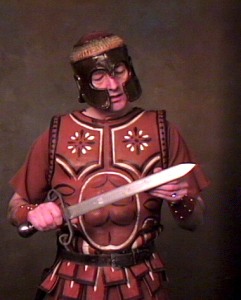
Excerpt 25 for Lent from The Soldier Who Killed a King

Tags

, , , , , , , , , , ,

A journey to the cross is a journey to repentance. It’s a journey to deep personal change. Will you take this journey with me?

Date: Seven fifteen in the morning, Friday, April 7 30A.D.
Jesus is questioned by Herod Antipas.

“Jesus of Nazareth,” the Fox pompously intoned. “The prophet of Galilee. I’ve longed to see you, my most noteworthy subject.”
With that Herod arose, and holding his robe shut, he approached the Messiah. He inspected the taller man, walked fully around him. Noticing the welts and the dried spittle, he looked my way and asked, “Is this your work, centurion?”
“No, Your Majesty.” My eyes darted to Jonathon and back to Herod again.
“Ah, the high priest’s work!” the Fox remarked grandly as he turned to Jonathon. “I didn’t think you temple boys were capable.”
This bit of sarcasm drew an acknowledging nod and a slight smile from the chief temple guard. Here was a backhanded compliment from the pretentious Fox.
“Your Majesty, I have here a letter from His Excellency the governor and certain chargesJames Wri brought by—”
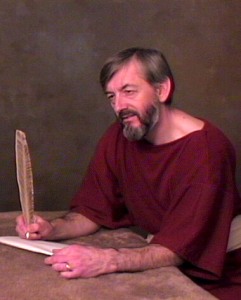
The king halted me with an uplifted hand and a shake of his head.
“That can wait, centurion.” He paused, and then with a certain dramatic flourish, he began. “We have here a man of rare talent. He makes the lame to walk, the blind to see, has cured the leper. I have heard reports that he has raised the dead.” And then spotting a gold chalice on the inlaid table, he seized it by the stem and with relish declared, “He has even turned water into wine.”
He lifted the chalice before the Messiah and grandly asked, “Isn’t that so, Jesus?”
The Messiah did not answer him a word.
If Herod was perturbed by this silence, he didn’t show it. “Servant girl!” he hollered. “Servant girl!”
An attractive young woman entered from the door on the left, and with short, quick steps, she made her way before the tetrarch. She bowed low.
“Fill this chalice with water and bring it back.”
He stared after her as she left.
I noticed Herodias following his hungry gaze.
“Soon we will see if this prophet can perform the works of which we heard.” He nodded his head with an eager enthusiasm. Then addressing Jesus, he asked, “Tell us of your magic arts.”
The Messiah fixed his eyes straight ahead. He looked beyond the Fox and did not answer him a word. His silence was challenging enough.

4485 TWITTER

American readers click this link to purchase The Soldier Who Killed a King.

Canadian readers click this link to purchase The Soldier Who Killed a King directly from the author.


A New Song

Tags

, , , , , , , , , , , ,

Reading:                                      Psalm 96

(Verses 1-6)
Sing to the LORD a new song;
sing to the L
ORD, all the earth.
Sing to the L
ORD, praise his name;
proclaim his salvation day after day.
Declare his glory among the nations,
his marvelous deeds among all peoples.
For great is the LORD and most worthy of praise;
he is to be feared above all gods.
For all the gods of the nations are idols,
but the L
ORD made the heavens.
Splendor and majesty are before him;
strength and glory are in his sanctuary
(NIV).

Reflection
Who are you singing to? Let’s face it; most of us sing. We may not sing in a choir or in front of a crowd of thousands, but we sing. Maybe you sing in the shower. Maybe you just hum, whistle or sing a tune in your mind. Even though you may not fully vocalize your song, the music is still there bubbling beneath the surface.

2017-07-03c

Splendor and majesty are before him — photo by David Kitz

Psalm 96 urges us to sing that song to the LORD. Sing to the LORD a new song; sing to the LORD, all the earth. Sing to the LORD, praise his name; proclaim his salvation day after day. 

I believe it’s in our nature to sing. Music is after all a universal activity enjoyed by people of every race and culture. This universality begs a question: Who put that love for music and song within us?

For believers the answer is obvious. God put music in our hearts and God puts songs on our lips. We sing because we are and because God is. Music is so foundational—so fundamental to our being—that it’s hard to imagine our world without it. When we break forth in song we are doing what God designed us to do. You were designed to sing, just as you were designed to bring glory to God through the work of your hands or the fruit of your body. So let your voice bring honor, praise and glory to God. Sing out your worship with joy.

Psalm 96 is also a call for newness in worship. Why does God want a new song? Could it be because His mercy and love for us are continually renewed? In the midst of national tragedy, Jeremiah reminded us of this truth. Because of the LORD’s great love we are not consumed, for his compassions never fail. They are new every morning; great is your faithfulness (Lamentations 3:22-23).

Just as the changing seasons bring renewal to the earth and its vegetation, so to new songs of praise bring renewal to our worship. So whether you hum, whistle, or belt out songs in the choir, let your song ascend to the LORD. You are singing for Him and to Him.

Response: LORD God, I want to praise you. Give me news songs and new melodies to sing your praise. Your goodness and love abounds. Great is the LORD and most worthy of praise. Amen.

Your Turn: Do you enjoy singing? Do you like both old and new worship songs?

Excerpt 24 for Lent from The Soldier Who Killed a King

Tags

, , , , , , , , , , ,

A journey to the cross is a journey to repentance. It’s a journey to deep personal change. Will you take this journey with me?

Date: Seven in the morning, Friday, April 7 A.D.
Jesus trial before Pontius Pilate continues.

In due course we all resumed our previous positions. At this point I fully expected Pilate to pronounce the prisoner guilty of high treason. After all, this Messiah had freely confessed to being a king. But I can only guess that Jesus’s words did have an impact on the governor. Upon taking his seat, Pilate announced, “I find no basis for a charge against him.”
A murmur arose from beyond the pikemen.
Caiaphas was livid. He let fly with a torrent of accusations, the last of these being that Jesus had threatened to destroy the temple and then rebuild it in three days.
Showing extraordinary patience, Pilate let the high priest rage. When Caiaphas’s fury was spent, Pilate turned to Jesus and asked, “Don’t you hear the testimony they are bringing against you?”
Free WW-e FACEBOOK-2 (2)
But Jesus answered him not a word. His silence itself became a challenge. Pilate had cleared him. Why should he answer to these further allegations?
Though stunned by this silence, Pilate repeated his position. “I find no basis for a charge against him.”
Once again discontent began to rumble through the crowd on the street.
At this point I expected the trial to end and the prisoner to be released. Let the crowds rage. Rome had spoken.
But Annas stepped smartly into the breach. “He stirs up the people all over Judea by his teaching. He started in Galilee and has come all the way here.”
“Is he a Galilean?” Pilate asked. “Under Herod’s jurisdiction?”
“Yes,” the flustered Caiaphas confessed, not knowing where this questioning might lead. “Then to Herod he should go,” was Pilate’s prompt response. “Why drag me into this?” He sneered at the high priest.
The governor seemed weary of the whole affair, and for the third time that morning, he found a way to dodge and retreat.
This trial was over.
The dark-eyed Badger rose from his judgment seat. He walked over to Jesus, the accused, and with a rather cunning smile and a nod, he said, “Off to Herod you will go, man of truth.”

American readers click this link to purchase The Soldier Who Killed a King.

Canadian readers click this link to purchase The Soldier Who Killed a King directly from the author.
A Hard Heart?

Tags

, , , , , , , , , , , , ,

Reading:                                      Psalm 95

(Verses 7-11)
Today, if only you would hear his voice,
“Do not harden your hearts as you did at Meribah,
as you did that day at Massah in the wilderness,
where your ancestors tested me;
they tried me, though they had seen what I did.
For forty years I was angry with that generation;
I said, ‘They are a people whose hearts go astray,
and they have not known my ways.’
So I declared on oath in my anger,
‘They shall never enter my rest’”
(NIV).

Reflection
Long before we knew about the medical condition known as hardening of the arteries, there existed another condition called hardening of the heart. Hardening of the heart is not a deadly medical condition; it’s a deadly spiritual condition. Those who suffer from hardening of the heart have a hard time hearing God, and when they do hear God, they tend to stop their ears, or they do their best to pretend that God hasn’t spoken.

2017-06-28 purple stars

Purple stars bring backyard joy — photo by David Kitz

Although we can safely say that this condition has existed since the human species stepped out of Eden, the first reported case of hardening of the heart occurred about 3,500 years ago. In the Book of Exodus we read that Pharaoh developed a severe case of hardening of the heart. But when Pharaoh saw that there was relief, he hardened his heart and would not listen to Moses and Aaron, just as the LORD had said (Exodus 8:15).

Time and again as the ten plagues ravaged Egypt, we read that Pharaoh hardened his heart and he would not let the people of Israel go. In several instances we read that the LORD hardened Pharaoh’s heart. But let’s be clear about this condition. Heart hardening only happens with the willing participation of the individual. Don’t go about blaming God for your hard heart. Hearts harden due to our willful disregard of God’s Spirit and His laws.

Neither should we presume that heart hardening only happens with a certain type of person. We are all prone to develop this spiritual malady. Our ancestry or genetic makeup offers no protection. The Egyptian Pharaoh developed a heart, but ultimately the Israelites—the people that the LORD pried free from Pharaoh also developed the same condition. That’s why the psalmist issues this warning: Today, if only you would hear his voice, “Do not harden your hearts as you did at Meribah, as you did that day at Massah in the wilderness,  where your ancestors tested me; they tried me, though they had seen what I did.”

The key to avoiding a hard heart is hearing and heeding the voice of God. It’s just that simple.

Response: LORD, give me ears that hear your voice gently speaking to me. Give me a heart that is quick to obey. I want a tender heart that reflects your love for me and for others. I pray in Jesus’ name. Amen.

Your Turn: Does a hard heart toward others result in a hard heart toward God? What are your thoughts?

Excerpt 23 for Lent from The Soldier Who Killed a King

Tags

, , , , , , , , ,

A journey to the cross is a journey to repentance. It’s a journey to deep personal change. Will you take this journey with me?

Date: Six fifty in the morning, Friday, April 7 A.D.
Jesus trial before Pontius Pilate continues.

When we entered the judgment hall, the dark-eyed Badger was seething. He knew Caiaphas was using him. He had said so to the assessor. He let fly a string of profanity. “He has me trapped!” he snarled. “Trapped like a rat in a stone water jar.” And with that he tossed the list of charges onto his desk.
James ThtThen he turned to Jesus in the center of the room. He looked him over, walked fully around him. Pilate sighed and nervously ran his fingers through his thinning hair. He made a smacking sound with his lips and asked, “Are you the king of the Jews?”
“You have said so,” came his equivocal answer.
This answer left the governor rocking on his heels. He brought a finger to his lips in pensive thought.
Jesus was not making an acquittal any easier.
But after a moment Jesus continued. “Is that your own idea, or did others talk to you about me?”
“Am I a Jew?”
Pilate shot back with an ample measure of haughty contempt. “Your own people and chief priests handed you over to me.” He continued the questioning. “What is it you have done?”
“My kingdom is not of this world,” Jesus said, and to drive home this point, he added, “If it were, my servants would fight to prevent my arrest by the Jewish leaders. But now my kingdom is from another place.”
Certain words that Claudius had spoken came echoing back into my mind. He had been convinced that this kingdom Jesus spoke of was somehow different from kingdoms as we know them. Now I heard it from this would-be Messiah’s mouth. He was no armed insurrectionist, and he had offered the actions of his followers as proof.
But Pilate seized on that word—kingdom. “You are a king, then!” Pilate deduced.
With calm, clear deliberation the prophet spoke. “You say that I am a king. In fact, the reason I was born and came into the world is to testify to the truth. Everyone on the side of truth listens to me.”
It almost seemed from this response that Jesus was operating from, and speaking on,Biblical fiction winner 2017 some higher plane—a dimension I had witnessed him operate from during the healings at the temple. He was inviting Pilate to join him in discovering this higher ground of truth.
Pilate would not be moved. They were speaking past each other.
“What is truth?” Pilate shrugged. The question was rhetorical. He had no intention of being dragged into a philosophical discussion with this prophet of the Jewish masses. Once again, the Badger retreated.
Grabbing the list of charges from off his desk, he motioned for us to follow him back outside.

American readers click this link to purchase The Soldier Who Killed a King.

Canadian readers click this link to purchase The Soldier Who Killed a King directly from the author.

 

In His Hands

Tags

, , , , , , , , , , , , ,

Reading:                                      Psalm 95

(Verses 1-7)
Come, let us sing for joy to the LORD;
let us shout aloud to the Rock of our salvation.
Let us come before him with thanksgiving
and extol him with music and song.
For the LORD is the great God,
the great King above all gods.
In his hand are the depths of the earth,
and the mountain peaks belong to him.
The sea is his, for he made it,
and his hands formed the dry land.
Come, let us bow down in worship,
let us kneel before the L
ORD our Maker;
for he is our God
and we are the people of his pasture,
the flock under his care
(NIV).

Reflection
I can’t read this opening portion of Psalm 95 without the folk spiritual “He’s Got the Whole World in His Hands” springing to mind. The psalmist makes this declaration: In his hand are the depths of the earth, and the mountain peaks belong to him. The sea is his, for he made it, and his hands formed the dry land. In other words, He’s got the whole world in His hands.

2017-06-24 L

Evening fishing near Durham, ON — photo by David Kitz

There is something deeply reassuring about that thought. The great loving God, the Creator of the universe, has the whole world in His hands. But more specifically, our heavenly Father has you and me in His hands. If we grasp this biblical truth, it has broad personal implications.

Early this morning I met with a weekly gathering of men to pray and study God’s word. One of the co-leaders of the group is going through a great personal tragedy. His young, vibrant wife is dying of pancreatic cancer. Unless the Lord miraculously intervenes, his school-age son and daughter will soon be without a mother. At the close of our meeting we placed our hands on this husband and father and prayed. The LORD has the whole world in his hands including this young family.

Do we understand the LORD’s purposes in all this? No. We would be fools to think we do. We can content ourselves in knowing that these great matters—these matters of life and death are in God’s hands. They are loving hands—hands that in the person of Jesus were scarred and pierced by nails. I’ll be content to be held in those hands.

Knowing this, let’s heed the psalmist’s call. Come, let us bow down in worship, let us kneel before the LORD our Maker; for he is our God and we are the people of his pasture, the flock under his care.

Response: LORD God, you know all things. We were created for your purpose. Help us to live our lives in service to you. We are the flock under your care. Please extend your hand of mercy and blessing to those we know who are suffering or grieving. Amen.

Your Turn: Does knowing your life is in God’s hands bring you reassurance?

Excerpt 22 for Lent from The Soldier Who Killed a King

Tags

, , , , , , , ,

A journey to the cross is a journey to repentance. It’s a journey to deep personal change. Will you take this journey with me?

Date: Six thirty in the morning, Friday, April 7 A.D.
Jesus trial before Pontius Pilate begins.

The governor peered over the heads of the men directly in front of him. He scanned the assemblage on the street, took in the significance of it all, and then cleared his throat. “Where is the man?”
Jonathon turned quickly. On reaching the first step, he beckoned beyond our pikemen to three of his own temple guards, who then advanced with their prisoner—Jesus of Nazareth.
Picture Cent-helmetHe was a mess, almost unrecognizable. His hair was matted. He had been spat upon. The spittle was drying in his beard. There were red welts on his face and neck, a blood- oozing gash above his left eye, a discernable limp to his gait.
It was apparent that during the night they’d had their way with him.
He was escorted to a position directly before me. Intuitively I knew he was my man now, my charge.
A twitch of Pilate’s eyebrow hinted his surprise at the condition of the man.
“Loose him,” he directed with a slight wave of his hand.
Two temple guards hastened to unfasten the leather strap binding Jesus’s arms to his torso. The third man freed the prisoner’s hands. With a second wave of his hand, Pilate dismissed the temple guards, who repositioned themselves on the first step and stood facing the proceedings.
Pilate took a seat on the throne of judgment, which had been brought out for him by two attendants. Raising the scroll in his left hand, he asked, “What charges are you bringing against this man?”
It was clear from this gesture that he was referring to the charges written on the scroll he now clutched in his hand. Undoubtedly he had read these charges himself, and in all likelihood had discussed them
with the assessor standing to his right. But he wanted the high priest to articulate them. “If he were not a criminal, we would not have handed him over to you,” Caiaphas said with a huff.
A rather cheeky response, I thought.
“Take him yourselves and judge him by your own law,” Pilate answered.
Here Annas interjected, “But we have no right to execute anyone.”
A devious response if there ever was one. The temple, in fact, routinely acted as bothbiblical-fiction-award-2017_orig judge and executioner in religious matters and had been granted full authority to do so. Death by stoning was commonplace. I had witnessed Annas himself cast the first stone at some hapless adulteress within the first week of my arrival here ten years ago. No, the temple had the right to execute, and these crafty fellows could surely find grounds to execute this man. They just didn’t want the blood on their hands. They did not want to be blamed for the death of this rabbi. For many he had become the hope of the nation. No, they wanted us to do the job, to act as their executioners. They wanted him judged and executed under Roman law. What Caiaphas said next made this abundantly clear.
“We have found this man”—he aimed a bony finger at Jesus—“subverting our nation. He opposes payment of taxes to Caesar and claims to be Messiah, a king.”
Now here was a capital offense—a capital offense under Roman law.
The Weasel had backed the Badger into a corner, and he was relishing the moment. These charges would need further examination. But Pilate would not proceed in full view of a gloating high priest, urged on by his consorts and a handpicked audience. He retreated.
He abruptly arose from his throne, fixed his eyes on me, and said, “Bring the man.” He motioned with a jerk of his head toward the great doors behind us and then marched off into his residence.
I stepped down to escort Jesus, but he was already in motion. It became clear that the steps were painful for him. I put my hand to his elbow.

American readers click this link to purchase The Soldier Who Killed a King.

Canadian readers click this link to purchase The Soldier Who Killed a King directly from the author.

When Anxiety was Great

Tags

, , , , , , , , , , , , , , , ,

Reading:                                     Psalm 94

(Verses 16-23)
Who will rise up for me against the wicked?
Who will take a stand for me against evildoers?
Unless the L
ORD had given me help,
I would soon have dwelt in the silence of death.
When I said, “My foot is slipping,”
your unfailing love, L
ORD, supported me.
When anxiety was great within me,
your consolation brought me joy.
Can a corrupt throne be allied with you—
a throne that brings on misery by its decrees?
The wicked band together against the righteous
and condemn the innocent to death.
But the L
ORD has become my fortress,
and my God the rock in whom I take refuge.
He will repay them for their sins
and destroy them for their wickedness;
the L
ORD our God will destroy them (NIV).

Reflection
Here is a question that is well worth asking at election time, or really at any time during the life of a nation: Can a corrupt throne be allied with you—a throne that brings on misery by its decrees?

2018-03-09

Late winter snowfall — photo by David Kitz

Whatever your political persuasion, this is a question that has relevance. Corruption isn’t a problem that is unique to just one party. It transcends the political spectrum. Corruption and poorly designed laws or decrees can bring misery to millions. According to the psalmist, it has happened in the past and as long as we live in a fallen world, it will continue into the future.

If we fix our eyes on the problems of this world, we can soon find ourselves in despair. Like the psalmist, in times of worry, we need to turn to the LORD. When I said, “My foot is slipping,” your unfailing love, LORD, supported me. When anxiety was great within me, your consolation brought me joy.

That’s the good news of the gospel. In times of anxiety we have someone to turn to. His name is Jesus. He was familiar with suffering and adversity. In Psalm 55 we read, “Cast your cares on the LORD and he will sustain you; he will never let the righteous be shaken” (Psalm 55:22). The apostle Peter reiterates the same thought: Cast all your anxiety on him [God] because he cares for you (1 Peter 5:7).

In times of trouble the unfailing love of the LORD will sustain you. In times of loss His consolation will bring you joy. That’s the promise of Psalm 94. It’s a promise that’s worth clinging to in good times and bad, and yes, even in election years.

Response: LORD God, I am so glad that first and foremost I live under your Kingdom rule. You are my King. I find unfailing love and consolation in knowing you. Guide the leaders of our land into paths of righteousness, wisdom and truth. Amen.

Your Turn: Are you facing adversity now? How can I pray for you?

Excerpt 21 for Lent from The Soldier Who Killed a King

Tags

, , , , , , , , , , ,

A journey to the cross is a journey to repentance. It’s a journey to deep personal change. Will you take this journey with me?

Date: Five forty-five in the morning, Friday, April 7 A.D.
In today’s reading, a messenger from Pontius Pilate arrives at the home of Marcus Longinus, the Roman centurion, with the news that Jesus has been arrested.

“Sir, I have just come from the governor. You are to report to the Praetorium immediately. Jesus of Nazareth has been arrested. The high priest has brought him before the governor for judgment.”
“Is that so?” I said in a state of consternation. “Who sent you?”
“The governor himself. He said you were familiar with the Galilean.”
I blew a short puff of air through my nostrils. All of Jerusalem was somewhat familiar with the Galilean.
“So he wants me there immediately?”
“Immediately, sir.” He shifted from one foot to the other and then, as if to justify thisCentur. Sw response, he added, “The high priest and a big delegation, maybe three hundred men, maybe more, arrived at the palace door at first light. They had the prisoner—Jesus—with them.”
“Tell the governor I’m on my way.”
With a quick nod of my head, I dismissed the messenger. Instantly he turned and began his run back to the governor’s residence. I took one step back inside the gate and began barking orders.
“You, you, and you!” I stabbed my index finger in the direction of the most dressed and prepared-looking soldiers. “Strap on your swords and follow me. Now!”
Then, addressing the other soldiers, I announced, “The rest of you, meet me at the Praetorium as soon as you are ready.”
“Claudius”—I nodded in his direction—“you are in charge. I’ll give everyone their assignment for the day when they get there.”
I stepped back through the gate and began covering the ground with long, quick strides. My three recruits had to run to catch up. With each stride a new thought came jogging into my head. Stupid Arius! Why didn’t he tell me the messenger was from Pilate? I would have moved a good deal faster.
Obviously my concerns about the prophet had moved up the chain of command. Flavio must have informed Pilate about my worries and the actions I had taken, hence this unusual move—a direct summons by the governor. I harbored the hope that he would consult directly with me on the matter. Three hundred men! Three hundred men at first light? The Weasel must have had a busy night. It takes a good deal of effort to set your troops in array. Caiaphas must have been hatching this plot for a good long while. 4485 TWITTER
But the Weasel caught his prey! What a sweet bit of treachery that must have been. I wondered how he pulled that off. Now the high priest would move in for the kill. We would see if he could slaughter his own Passover lamb. The people! If the pilgrims, especially the Galilean pilgrims, knew their Messiah had been seized, there could be a mass revolt. That must be why the Weasel had done his dirty work in the dark of the night. And furthermore, he had played out this drama at the zenith of the festival, while minds and hearts were on faith, home, and family. Here was a cunning scheme worthy of the Fox, played out by the Weasel.
Undoubtedly most of the population would still be unaware of these developments, even as I had been caught off guard. Off guard but not surprised. I could smell this coming.
My conversation with Renaldo at the bathhouse came echoing back. It gave me an eerie feeling knowing I had spoken like some prophetic oracle. It made me wonder from where that insight had really come.
“By Jupiter! I forgot the spikes.” I wheeled around while reaching out my hand to halt the soldier at my side. Addressing him directly, I said, “I forgot them—the spikes. They’re in a pouch hanging on a peg in my bedchamber. My wife, she’ll know where they are. Ask her to get the pouch for you. Then bring it to me at the Praetorium. Oh, and tell the other men to hurry. This is urgent.” I fixed my eyes on him to stress the importance of this last statement and then added, “Now run.”

American readers click this link to purchase The Soldier Who Killed a King.

Canadian readers click this link to purchase The Soldier Who Killed a King directly from the author.

Blessed is the One You Discipline

Tags

, , , , , , , , , , ,

Reading:                                      Psalm 94

(Verses 8-15)
Take notice, you senseless ones among the people;
you fools, when will you become wise?
Does he who fashioned the ear not hear?
Does he who formed the eye not see?
Does he who disciplines nations not punish?
Does he who teaches mankind lack knowledge?
 The L
ORD knows all human plans;
he knows that they are futile.
Blessed is the one you discipline, LORD,
the one you teach from your law;
you grant them relief from days of trouble,
till a pit is dug for the wicked.
For the L
ORD will not reject his people;
he will never forsake his inheritance.
Judgment will again be founded on righteousness,
and all the upright in heart will follow it
(NIV).

Reflection
Do I like discipline? Hardly. Do I like self-discipline? Not really. Discipline sounds difficult or unpleasant. Self-discipline and self-denial are twin brothers. I don’t like either of them. They are two tough customers that demand that I change, but I don’t like change. My flesh—my stubborn sinful nature—resists change.

2017-09-02

Splendor and majesty are before Him — photo by David Kitz

On the other hand, do I like the fruits of self-discipline? Absolutely. Self-discipline pays huge dividends. In any field of endeavor, in due time self-discipline will bring rewards. Athletes succeed because of self-discipline. Fortunes are accumulated through self-discipline. But those same fortunes can be frittered away through a lack of discipline. Strength of character does not develop naturally; it develops through adversity and self-discipline.

Discipline comes in two forms, internally or externally. Both are needed if we are to become people of the cross.  Son though he was, he [Jesus] learned obedience from what he suffered and, once made perfect, he became the source of eternal salvation for all who obey him (Hebrews 5:8-9). If Jesus learned obedience through the discipline of suffering, should we not expect to experience the same?

Here in Psalm 94 we learn that the LORD disciplines nations. The following admonition reminds us of the vital role that discipline plays in the life of the believer: “My son, do not make light of the Lord’s discipline, and do not lose heart when he rebukes you, because the Lord disciplines the one he loves, and he chastens everyone he accepts as his son.” Endure hardship as discipline; God is treating you as his children. For what children are not disciplined by their father? If you are not disciplined—and everyone undergoes discipline—then you are not legitimate, not true sons and daughters at all (Hebrews 12:5-8).

Response: LORD God, I confess that I need your discipline. I want to become like your Son, Jesus. Help me to learn from the difficult experiences of life. I want to live my life as your obedient child. Amen.

Your Turn: Do you appreciate God’s discipline? Are you enjoying the fruit of self-discipline?