
Tags
AB Simpson, Aimee Semple McPherson, Andrew Murray, Bible, broken, brokenness, Christ, David, Jacob, Jesus, Prayer, the LORD
And He said,
“Your name shall no longer be called Jacob, but Israel;
for you have struggled with God and with men,
and have prevailed.”
(Genesis 32:28, NKJV)
The people whom God uses to change the world have first been radically changed by the Spirit of God. Often, these world changers have experienced major setbacks. We might even say they have been broken by God, but they have come through those experiences transformed and empowered by the Spirit.
There is a pattern that emerges as we look back at the lives of the three revival leaders we have examined thus far. Each of them reached a breaking point.
A. B. Simpson was a successful minister, who through much hard work, built a large church but he experienced burnout and a physical breakdown. From this low point, God healed him and raised him up to bring healing and salvation to thousands.
Similarly, Aimee Semple McPherson experienced a complete physical breakdown that left her hospitalized and at the point of death. She had returned from the mission field as a widow and a broken woman. She transitioned to a new life but steadfastly resisted God’s call. But God broke her resistance, miraculously restored her health, and catapulted her into a healing ministry that changed the trajectory of the church in America and the world.
Andrew Murray had what many would consider a successful ministry. But he too reached a breaking point. He lost his voice for two years. From this low point, God healed, transformed, and restored Murray to a far more effective and far-reaching ministry.
The common thread running through these life stories is that all three leaders encountered a breaking point. God broke them. Why would God do such a thing? Do we need to be broken to become effective ministers of the gospel of Christ?
There are several stories in the Bible that illustrate this need for God to break us.
The life story of the patriarch Jacob serves as the primary example of God taking a man to a breaking point. Jacob was a grasper. He grabbed for power. This is graphically illustrated by the way he came into this world. He arrived grasping his twin brother’s heel.[i] From the moment of birth, we see Jacob attempting to supplant Esau, his older brother, through cunning and deception.
Jacob succeeds first by trading a pot of lentil stew for Esau’s birthright (Genesis 25:29-35), and later by conspiring with his mother to rob Esau of his father’s blessing (Genesis 27:1-41). When Esau threatens to kill him, Jacob flees to the distant home of his uncle Laban.
Repeatedly, Jacob bargains with God, and God answers his prayers. Perhaps this is the most remarkable feature of Jacob’s life story. The LORD sticks with this deceiver and blesses him despite his devious ways. His life is a portrait of God’s unmerited favor in the face of constant opposition.
Jacob met his cunning, devious double in the person of Uncle Laban. First, Laban deceived Jacob by swapping Leah for her sister Rachel on his wedding night. There is more than a little divine justice at play in Laban’s clever deception. Jacob who cheated his blind father is cheated blind in his own marriage bed. The irony in this outcome is striking. Jacob is required to work seven years for Leah and then seven more years for Rachel, his true love.[ii]
Then, over the years, Laban changed Jacob’s wages ten times. But despite Laban’s constant readjustments, Jacob’s flocks and herds grew and prospered. God’s blessing bestowed by Isaac remained on Jacob.[iii]
But eventually, God brought Jacob to a breaking point. It happened on Jacob’s return to his homeland.
Jacob gets word that his brother Esau is coming to meet him with 400 men. Why would Esau come with 400 men unless he intended to carry out the threat, he uttered twenty years earlier? Suddenly, Jacob’s life is on the line, and not only his life, but also the lives of his two wives and his twelve sons. His family and all the wealth he accumulated over years of hard labor is about to be wiped out. He finds himself in a truly desperate situation with no way out.
In exchange for his life, he offers to bargain away all his livestock, his wives, and his children. But will this desperate ploy satisfy the angry brother he has cheated? Jacob sends all he has ahead of him. To his servants he says:
“When my brother Esau meets you and asks, ‘Who do you belong to, and where are you going, and who owns all these animals in front of you?’ then you are to say, ‘They belong to your servant Jacob. They are a gift sent to my lord Esau, and he is coming behind us’” (Genesis 32:17-18, NIV).
But Jacob stays back on the opposite side of the Jabok River. There alone in the dark for the whole night, Jacob wrestled with a man. But in truth, he wrestled with God.
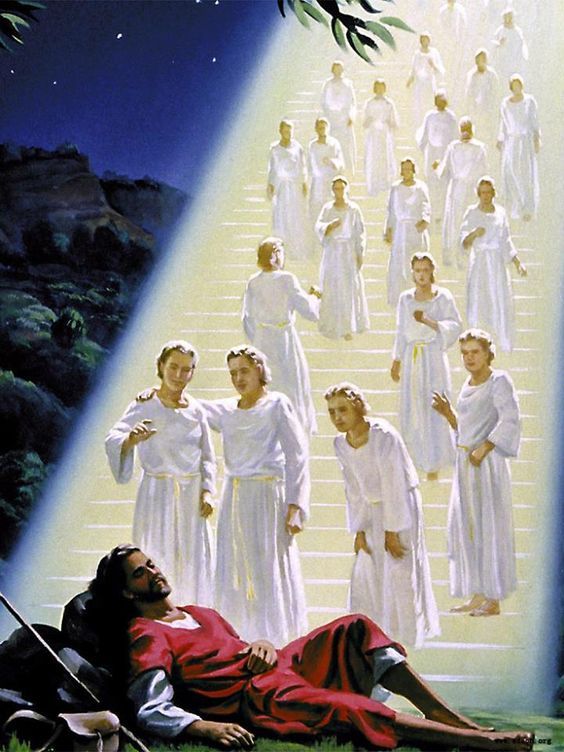
Jacob’s Ladder — Genesis 28:12
Many Bible scholars view this man as a Christophany—a preincarnate appearance of Christ. Christ came down from heaven to break this obstinate cheater—break him and change him into a vessel he could use for his glory and his eternal purpose.
When the man saw that he could not overpower him, he touched the socket of Jacob’s hip so that his hip was wrenched as he wrestled with the man. Then the man said, “Let me go, for it is daybreak.”
But Jacob replied, “I will not let you go unless you bless me.”
The man asked him, “What is your name?”
“Jacob,” he answered.
Then the man said, “Your name will no longer be Jacob, but Israel, because you have struggled with God and with humans and have overcome.”
Jacob said, “Please tell me your name.”
But he replied, “Why do you ask my name?” Then he blessed him there.
So Jacob called the place Peniel, saying, “It is because I saw God face to face, and yet my life was spared” (Genesis 32:25-30).
There can be no doubt who the stronger man was at Peniel. With a simple touch Jacob’s
hip was wrenched. With a simple touch Christ healed the sick, raised the crippled, and restored sight to the blind. But here with a simple touch, Christ wrenched Jacob’s hip and left him limping for the rest of his days.
Why this stark contrast? We can easily understand why Christ would heal a crippled beggar, but why would he break a man? Why break Jacob?
The simple answer is because Jacob needed to be broken. The wild horse serves no one. The wild stallion serves only himself. Only the broken horse is fit for the master’s service. All of Jacob’s service was self-serving, and that includes his service to Laban. From Peniel onward Jacob—broken Jacob—was serving the LORD.

Galloping Horses – Image courtesy of Tina Phillips at FreeDigitalPhotos.net
David, the man after God’s own heart, needed to be broken too. David was true to the LORD in the wilderness with jealous King Saul in hot pursuit, but after he assumed the throne of Israel his fleshly desires led him astray. After his sin with Bathsheba, God needed to break him. The events that followed this sordid affair brought the humility so essential to effective service to God. Psalm 51 reflects the heart cry of a broken man.
This need for the servant of God to be broken by God appears in the New Testament as well. Peter needed to be broken by Jesus. Peter was a natural leader—sure of himself in all situations—ready to step out of a boat and even walk on water. That takes more than a little courage. But that confident self-assurance needed to be broken, and Jesus knew how to do it.
It only took the third crowing of a rooster to break Peter and reduce him to a blubbering, sobbing mess. Jesus knows how to break the strongest men. But he also knows how to restore them.
Three times Jesus asked, “Simon son of John, do you love me?”[iv] Three times Peter affirmed his love for the Lord, and three times Jesus affirmed Peter’s calling:
Jesus said, “Feed my lambs” (John 21:15).
Jesus said, “Take care of my sheep” (John 21:16).
Jesus said, “Feed my sheep” (John 21:17).

Photo by kailash kumar on Pexels.com
The broken Peter was now ready for service. He would fulfill the prophetic words Jesus had spoken over him before his fall and now in his restoration.
“Simon, Simon, Satan has asked to sift all of you as wheat. But I have prayed for you, Simon, that your faith may not fail. And when you have turned back, strengthen your brothers” (Luke 22:31-32, NIV).
The broken Peter had been humbled. Now Jesus ruled Peter. Now the Master was truly the Master and Lord of all.
Have you been broken by Jesus? Most Christians are eager to serve the Lord, but only in an advisory capacity. Peter was quick to give Jesus advice on how he should avoid the cross. See Matthew 16:21-27.
The Lord is not looking for our advice. He is looking for our obedience.
Jesus himself needed to be broken. His Heavenly Father broke him on the cross where he cried out, “Eli, Eli, lema sabachthani?” (Which means “My God, my God, why have you forsaken me?”) (Matthew 27:46, NIV).
When Jesus broke, he broke the stranglehold of sin over humanity. His breaking was essential for the salvation of our souls.
As disciples of our Lord Jesus, we can expect to be broken as well. We need to become like our Master in every way.
Saul of Tarsus was zealous to serve the God of his fathers, so zealous he persecuted the church. Jesus himself intervened in Saul’s life in order to break him. On the road to Damascus, Saul was confronted by Jesus—arrested by Jesus—blinded and broken by him.
Out of his brokenness Paul ministered the gospel to the Gentile world of his day. Through his writing he continues to speak to millions today.
Have we been confronted by Jesus? Has he opposed you at any point in your life? Have you been broken by him? In the power of our own flesh, we can do many good and noble things in the name of our Lord. Many fine churches have been built through clever marketing and ingenuity. Human effort and talent can carry us a long way.
In the eyes of many, A. B. Simpson had a successful ministry before Christ broke him. Andrew Murray was powerfully used by God before God broke him and set him aside for two years. But both these men came out of their time of brokenness refined and empowered by the Spirit of God. In their hearts there had been a regime change. The risen Christ was fully in charge now and the Spirit of God was directing them forward.
Are you and I ready to be broken and poured out at the feet of Jesus?
Then Mary took a pound of very costly oil of spikenard, anointed the feet of Jesus, and wiped His feet with her hair. And the house was filled with the fragrance of the oil (John 12:3, NIV).
This is the fourteenth weekly excerpt from the award-winning book
The Elisha Code & the Coming Revival
A soul-gripping read. Is a return-to-Jesus revival possible in our time?
This book points the way forward.
For details click here.







 I love the Psalms