• Home
  • About
  • DavidKitz.ca
  • Youtube Videos
  • Books by David
  • Books on Amazon.com

I love the Psalms

~ Connecting daily with God through the Psalms

I love the Psalms

Tag Archives: crucifixion

Reading 32 for Lent from “The Soldier Who Killed a King”

06 Saturday Apr 2019

Posted by davidkitz in Lent, Psalms, The Soldier Who Killed a King

≈ 1 Comment

Tags

centurion, crucifixion, Golgotha, Messiah, Pilate

A journey to the cross is a journey to repentance. It’s a journey to deep personal change. Will you take this journey with me?

Date: Seven in the morning, Saturday, April 8, 30 A.D.
Annas meets with Pontius Pilate and asks that Jesus’ tomb be guarded.

Pilate was seated even as I saw him yesterday. He wore a rather haggard look, as though he had slept on the bloodstained rocks of Golgotha. He motioned for the temple delegation to step forward. I waited at the back of the room in a repetition of the governor’s late- day interview with Joseph of Arimathea.
Annas bowed and began. “Sir, we remember that while he was still alive that deceiver said, ‘After three days I will rise again.’”
A strange tingle ran through me as he said this. Pilate rubbed his hands.
Annas continued. “So give the order for the tomb to be made secure until the third day. Otherwise, his disciples may come and steal the body and tell the people that he has been raised from the dead.” Then he concluded by lifting a bony finger and saying, “This last deception will be worse than the first.”
On hearing this, Pilate sighed deeply, then beckoned me forward. There was worry in his eyes. “The centurion here, Marcus Longinus, is fully acquainted with the case of the Galilean prophet. He oversaw his crucifixion.” Then he addressed me directly. “Is that not so?”
I nodded. “Yes, sir. It is as you say.”
With that he raised his hands and motioned both parties together. Then, speaking directly to all of us, he said, “Take a guard. Go, make the tomb as secure as you know how.” Rubbing his guilt- stained hands once more, the Badger got up and skulked off. Free WW-e FACEBOOK-2 (2)Annas was jubilant. With eagerness in his voice, he turned to address me. “How soon can you have your troops at the tomb?”
“We should be there in about an hour.”
“Excellent! These two gentlemen will meet you there. They will ensure that all is in order. Understood?”
“Yes. Understood,” I said. Then I addressed the Pharisees. “Do you know which tomb? Do you know where it is?”
Annas answered for them. “Ah, they know it well.” He gave a contemptuous snort. “The traitor’s tomb, Joseph of Arimathea!”
“I will bring my men and meet you there then.” I gave a slight bow with my head. The chamberlain saw us to the door, and then I was off, back to my home.
I shook my head several times in disbelief as I trudged back. Every time I tried to extricate myself from this Messiah pit, this kingdom of God affair, this abysmal hole, I would find myself sucked in even deeper. And now it had happened again. Was there no escape?
Would I ever be allowed to speak my mind before Pilate?

To download a free study guide for this high-impact, bible-based novel visit: https://www.davidkitz.ca/centurion.php/free study guide PDF

For book purchases of The Soldier Who Killed a King try Amazon or https://www.christianbook.com

Reading 29 for Lent from “The Soldier Who Killed a King”

03 Wednesday Apr 2019

Posted by davidkitz in Lent, The Soldier Who Killed a King

≈ Leave a comment

Tags

crucifixion, darkness, Jesus, mother, soldiers

A journey to the cross is a journey to repentance. It’s a journey to deep personal change. Will you take this journey with me?

Date: About noon, Friday, April 7 30A.D.
The crucifixion of Jesus.

Now there was movement on the Mother’s Hill. A middle-aged couple came down. Their heads were hanging. They clung to each other, supported each other, every step an anguish. They made their way before the encircling pikemen.
I knew who they were—knew why they had come. Here were the broken parents, broken beyond this world’s repair. I met them at the base of the hill, told them they had some time.
They advanced up the Skull. She fell, fell whimpering before her son. Thaddaeus. Boisterous soldiers fell silent and then walked off, right off the hill. The family was alone with their grief.
4485 TWITTER
Having witnessed this grim but welcoming reception, another party stepped off the Mother’s Hill and advanced to Golgotha. This was a group of five. The women clung to one another in couples. They were shepherded by a tall young man. His fresh face and scant beard bore witness to his youth. I recognized him. He had been with Jesus, had stood closest to him.
He introduced himself. He said his name was John. I received his party—ushered them by the outer ring of soldiers.
They were bowed by the sight. They clung to one another afresh, repulsed by the horror of what met their eyes.
After a few moments the young man came before two of the huddled older women. He stooped to speak with one of the women—the Christ’s mother, I assumed. Then with his arm about her shoulder, John advanced up the rock mound.
Jesus saw them.
He struggled.
“Woman . . . behold your son!”
There was a double- edged meaning here, almost too painful for words. At first I thought he was simply referring to himself—to his own wretched state. And perhaps on one level he was.
His body sagged. But then he thrust himself up and forward for another breath, and with his next words his meaning became clear. To the young man, to his disciple, he said, “Behold your mother!”
He had committed his mother into this disciple’s care. She fell to her knees. She trembled, unable to speak. Only wretched sobbing was heard from within the circle of the hill.
In due time I led both families off. They left willingly. This was too much to bear, too much to watch.
From his cross Animal watched the Mother’s Hill. But no one came. That’s when he broke—broke like a clay pot dropped onto the hard rock of the Skull.
He sobbed. He moaned.
His tears flowed like rivers into his dark, young beard.
But no mother came. No one came at all. Free WW-e FACEBOOK-2 (2)
The wind picked up. The sky grew dark. Then it grew darker yet. The horses began to neigh and paw the ground. In the distance a dog barked. It was a bark that changed to a howl but ended in a whimper. I looked about. I could see it on every face. It was fear. Raw fear. This was not the dark of cloud or storm. This was the sun covering, hiding its face from what it saw upon the earth.
A total darkness descended, as black as any night.
There was a discord here—a discord utter and complete. If heaven and earth had come into some perfect union—some perfect harmony—on the day Jesus arrived in this city, it was in blaring dissonance now. Blaring dissonance echoed off the empty chambers of my soul.
It was a deafening darkness.
The mocking crowds fell silent. The highway traffic stopped. All was still.
Silent.
Only the three men were heard. Heard in the darkness. Three men working to maintain this perverted thing called life.
Working.
Pushing up.
Up to catch a breath.

To download a free study guide for this high-impact, bible-based novel visit: https://www.davidkitz.ca/centurion.php/free study guide PDF

For book purchases of The Soldier Who Killed a King try Amazon or https://www.christianbook.com

Reading 28 for Lent from “The Soldier Who Killed a King”

02 Tuesday Apr 2019

Posted by davidkitz in Lent, The Soldier Who Killed a King

≈ 1 Comment

Tags

Christ, crucifixion, Jesus, king, Messiah

A journey to the cross is a journey to repentance. It’s a journey to deep personal change. Will you take this journey with me?

Date: Nine thirty in the morning, Friday, April 7 30A.D.
The crucifixion of Jesus.

I tipped the bucket to one side to get enough swill to fill the dipper. I offered it to Jesus. He took a sip, worked the liquid around in his mouth, discerned the true nature of this bitter potion, and then spit it out. It left a dark stain on the dull gray rock near his feet.
“It will dull the pain,” I said emphatically.
He raised his eyes. They locked with mine. I saw in him the same look, the samebiblical-fiction-award-2017_orig determination I saw on the first day I set eyes on him, the day he rode the donkey into this city. I could still see he had a destination in mind. Some mystical purpose he somehow felt compelled to fulfill.
I dropped my gaze. He must be a fool. In his condition, in this situation, he must be a fool. A fool who unnerved me, but a fool nonetheless.
Once more I offered the drink.
With lips pressed tight, he shook his head.
He was a fool. An arrogant fool! A fool who thinks he’s tough—who can handle this—who can take it straight.
We would see who’s tough. I would show him who’s tough!
Let the big show begin.
“Now, boys!” I called out to the crew. Still wearing the purple robe, he was snatched like a young child and slammed down onto the crossbeam.
A cheer went up.
My right hand seized the hammer from Octavio. My left fumbled, then dove into, the nail pouch.
I dropped my knee onto his fingers.
Stabbed the sharpened point of the spike into the base of the palm.
Raised the hammer.
Xchuuuung!
An enormous cheer went up from the crowd.
Blood spurted across my thigh.
Xchuuuung!
Xchuuuung!
Xchuuuung!
One in.
The Christ was silent. Still . . .
Octavio urged me on. “That’s it, Marcus!”
I sprang to my feet, remembering the full rush of battle. Then scrambled to the other arm. From just off the hill, in the throng, a chant began and established itself. “More. More. More. More.”
Knee on fingers.
“More!”
Spike jabbed in.
“More!”
Hammer raised.
“More!”
Xchuuuung!
“More!”
Xchuuuung!
“More!”
Xchuuuung!
Two in. The Christ was silent.
Still . . . He was still beneath the piercing blows.
I rose, panting. Heart pounding. Bloodied hand dripping. Seeing a stainfree area farther up my hairy arm, I wiped it across my sweat-drenched brow.
Octavio saluted me with a smile and a thumbs-up signal.
The crowd roared their approval.
This time it was Octavio who yelled, “Hoist him up.”
The Christ was dragged gasping—desperately gasping—to an upright position before the death mast.
Now they could see him, and the crowd went wild with frenzied excitement. Cheering. Clapping. Hooting. Bloodlust took hold.
The props were applied to the arms of the crossbeam.
A new chant went up. 4485 SHARABLE-2
“Raise him up!”
“Raise him up!”
“Raise him up!”
Octavio signaled, and the men in back lifted the beam on which the Christ was pinned above their heads.
Then we all saw it—saw the obvious. He was still clothed. The purple robe billowed out as it was caught by a sudden cold gust of wind. The sight of it brought all my frenzied demons to the fore.
I stepped before him, looked into his agonized face, and said, “You won’t be needing this . . . king of the Jews.”
Then to the cheers of my men, I spit into his face. I added my spittle to all the rest that had dried and was clinging to his beard.
I untied the royal robe and dropped it in a heap to my right. Finally, with a wicked smile, and to cheers all around, I snatched his breechcloth from off his loins.
I tossed it to Octavio. He held it up. A trophy!
We laughed. We all laughed. It was a laugh not our own.
I recognized it. It was Herod’s laugh.
When he had regained some composure, the head jailer started the final count.
“Ready . . . one . . . two . . . three . . . now!”
To chants of “Raise him up, raise him up,” the Christ, the Messiah, the king, was lifted up—up before the world.
His head twisted from side to side in writhing agony. His whip-sliced back slammed against the upright as he was dragged higher.
Then with a flesh-tearing lurch, the notch in the horizontal beam found its match in the vertical. The rope was flung around, then drawn tight, securing the two cross members as one.
The silent Christ hung. He hung naked and bleeding before a jeering world.
Only the last spike remained. Awkwardly, I fumbled for it.
But a creeping unease overshadowed me. I glanced over my shoulder. Claudius stood alone, off to the side. Silent . . . He was ghastly pale and silent, transfixed by the sight before him.
I handed the last nail and the hammer back to Octavio and said, “You do it.” He snorted his surprise, but then set quickly to his task.

To download a free study guide for this high-impact, bible-based novel visit: https://www.davidkitz.ca/centurion.php/free study guide PDF

For book purchases of The Soldier Who Killed a King try Amazon or christianbook.com.

Judgment Day is Coming

25 Monday Mar 2019

Posted by davidkitz in Devotionals, Psalm 50, Psalms

≈ 3 Comments

Tags

crucifixion, God's judgment, judgment, justice, summons, the LORD

Reading: Psalm 50
A psalm of Asaph.
(Verses 1-6)
The Mighty One, God, the LORD,
speaks and summons the earth
from the rising of the sun to where it sets.
From Zion, perfect in beauty,
God shines forth.
Our God comes and will not be silent;
a fire devours before him,
and around him a tempest rages.
He summons the heavens above,
and the earth, that he may judge his people:
“Gather to me this consecrated people,
who made a covenant with me by sacrifice.”
And the heavens proclaim his righteousness,
for he is a God of justice
(NIV).

53556600_10102411588724471_8891070223889727488_o (1)

Balmaha, Scotland — photo courtesy of Jan Jablonski

Reflection
Psalm 50 begins by reminding us that Judgment Day is coming. A great summoning will take place. We will all gather before the throne of God. Rich and poor, the powerful and the weak, the living and the dead—all will gather before the LORD. None are excused. The Mighty One, God, the LORD, speaks and summons the earth from the rising of the sun to where it sets. 

On the day before his crucifixion Jesus elaborated at some length on this great summoning. For some it will be a day of joy and gladness; for others it will be a day of dread and sorrow. “When the Son of Man comes in his glory, and all the angels with him, he will sit on his glorious throne. All the nations will be gathered before him, and he will separate the people one from another as a shepherd separates the sheep from the goats. He will put the sheep on his right and the goats on his left” (Matthew 25:31-33).

What kind of day will it be for you?

It will certainly be a day of justice. The world is crying out for justice. All too often in this world—in this life—there is no such thing. The innocent suffer, while the perpetrators get off free. They gloat in their pride, while swaddled in luxury. On that great day—that Judgment Day—the tables will be turned. The great Judge of all the earth will see to that. And so He should. Since the fall of man, the world is crying out for justice.

It is well worth noting that in his account of Judgment Day, Jesus decides if we will enter into bliss or torment based on how we treat others. He states, “The King will reply, ‘Truly I tell you, whatever you did for one of the least of these brothers and sisters of mine, you did for me’ (Matthew 25:40).

Response: LORD God, help me to live my life in joyous preparation for that great summoning when wrong will be made right. Help me to be merciful so that I will receive your mercy in Jesus’ name. Amen.

Your Turn: How can we prepare our hearts and live our lives aright in the knowledge that Judgment Day is coming?

How Will the Ends of the Earth Turn to the LORD?

06 Thursday Dec 2018

Posted by davidkitz in Bible, Devotionals, Psalm 22, Psalms

≈ 3 Comments

Tags

crucifixion, good news, gospel, prophetic, redemption, resurrection

Reading: Psalm 22
(Verses 27-31)
All the ends of the earth
will remember and turn to the L
ORD,
and all the families of the nations
will bow down before him,
for dominion belongs to the L
ORD
and he rules over the nations.
All the rich of the earth will feast and worship;
all who go down to the dust will kneel before him—
those who cannot keep themselves alive.
Posterity will serve him;
future generations will be told about the Lord
.
They will proclaim his righteousness,
declaring to a people yet unborn:
He has done it!
(NIV)

Gatineau P 2015-10-27

Gatineau Park — photo by David Kitz

Reflection
This final portion of Psalm 22 signals the ultimate triumph of the Lord Jesus Christ. In the first half of this psalm Christ’s humiliation, suffering and death by crucifixion are vividly portrayed. With stunning accuracy and detail, David depicts these events from Christ’s perspective. Only God-breathed prophetic insight could reveal such truth through a human vessel. For prophecy never had its origin in the human will, but prophets, though human, spoke from God as they were carried along by the Holy Spirit (2 Peter 1:21).

With today’s reading we discover the worldwide impact of Christ’s redemptive death and resurrection. All the ends of the earth will remember and turn to the LORD, and all the families of the nations will bow down before him, for dominion belongs to the LORD and he rules over the nations.

Christ’s gospel—the good news of the Kingdom—has been voiced abroad. Death, hell and the grave have been conquered. Jesus Christ is Lord over all! Keep in mind that this turning to the LORD by all the families of the nations was an alien concept to the people of Israel during David’s time. Yet again, David spoke prophetically of the time when the gospel message would burst forth from its Jewish cocoon and be declared and received by ready hearts all over the world. Our Savior’s commission will be fulfilled. “Therefore go and make disciples of all nations, baptizing them in the name of the Father and of the Son and of the Holy Spirit, and teaching them to obey everything I have commanded you. And surely I am with you always, to the very end of the age” (Matthew 28:19-20).

We have the promise of the world-wide spread of the gospel from generation to generation. Posterity will serve him; future generations will be told about the Lord. They will proclaim his righteousness, declaring to a people yet unborn: He has done it!

Response: Father, thank you for the good news of the gospel. Jesus is alive and reigns forever. Help me to do my part in bringing the message of your love and redemption to the world. I want to see people from all nations turning to you in repentance and faith. Amen.

Your Turn: How can we spread the good news? What are you doing to tell His story?

Final Note: This concludes our meditations on Psalm 22. This psalm is ideal for consideration during Lent and Easter, but currently we are beginning Advent. Nevertheless, I believe it is appropriate at any time of year to reflect on the redemptive purpose for Christ’s mission to our corner of the cosmos.

Be blessed as you look forward to His second coming.

A Suffering Savior

03 Monday Dec 2018

Posted by davidkitz in Bible, Devotionals, Psalm 22, Psalms

≈ 6 Comments

Tags

blood, crucifixion, Dieppe Raid, Jesus, redemption, Savior, Suffering

Reading: Psalm 22
(Verses 9-15)
Yet you brought me out of the womb;
you made me trust in you, even at my mother’s breast.
From birth I was cast on you;
from my mother’s womb you have been my God.
Do not be far from me,
for trouble is near and there is no one to help.
Many bulls surround me;
strong bulls of Bashan encircle me.
Roaring lions that tear their prey
open their mouths wide against me.
I am poured out like water,
and all my bones are out of joint.
My heart has turned to wax; it has melted within me.
My mouth is dried up like a potsherd,
and my tongue sticks to the roof of my mouth;
you lay me in the dust of death
(NIV).

cross jesus summit cross

Photo by Pixabay on Pexels.com

Reflection
As we continue this meditation on Psalm 22, it is essential that we bear in mind that prophetically this is the crucifixion psalm. As stated in my previous post, the crucifixion is portrayed from the victim’s point of view—Jesus’ point of view. Through the poetic medium of this psalm, Jesus is speaking. He is describing his thoughts amid the horror of his excruciating affliction.

I recently read an account of the disastrous Dieppe Raid of 1942. In one scene from the carnage on the Normandy beach, a horribly-mangled, mortally-wounded young man is trapped in coils of razor wire. With his last desperate breaths what does he do? He cries out for his mother. In the pain of death the thoughts of grown men often turn to the soothing remembrance of their mother’s love. For our Savior it was no different. But from birth Jesus put his trust in God. Yet you brought me out of the womb; you made me trust in you, even at my mother’s breast. From birth I was cast on you; from my mother’s womb you have been my God.

As Jesus hangs pinned to the cross, he is encircled by his accusers—strong bulls of Bashan—who hurl insults at him. Peering down at his mangled and bleeding body he laments, I am poured out like water, and all my bones are out of joint. My heart has turned to wax; it has melted within me. 

As the heat of the day builds, the trickle of blood continues and severe dehydration sets in. He cries out, “I thirst!” (John 19:28). This is our Savior’s confession—his stark reality—a reality he endured for our redemption. My mouth is dried up like a potsherd, and my tongue sticks to the roof of my mouth; you lay me in the dust of death.

Response: Father God, thank you for sending your Son Jesus to this cruel world to suffer on my behalf. Your unconditional love for me was demonstrated on the cross for all to see. I thank you. Amen.

Your Turn: What does Jesus suffering mean for you?

Why I Believe in Prophecy?

30 Friday Nov 2018

Posted by davidkitz in Bible, Devotionals, Psalm 22, Psalms

≈ 8 Comments

Tags

crucifixion, David, forsaken, Jesus, messianic, messianic psalm

Reading: Psalm 22
For the director of music. To the tune of “The Doe of the Morning.”
A psalm of David.
(Verses 1-8)
My God, my God, why have you forsaken me?
Why are you so far from saving me,
so far from my cries of anguish?
My God, I cry out by day, but you do not answer,
by night, but I find no rest.
Yet you are enthroned as the Holy One;
you are the one Israel praises.
In you our ancestors put their trust;
they trusted and you delivered them.
To you they cried out and were saved;
in you they trusted and were not put to shame.
But I am a worm and not a man,
scorned by everyone, despised by the people.
All who see me mock me;
they hurl insults, shaking their heads.
“He trusts in the L
ORD,” they say, “let the LORD rescue him.
Let him deliver him, since he delights in him”
(NIV).

jesus_on_cross_crucifixion-full (2)

“My God, my God, why have you forsaken me?”

Reflection
Do you believe in prophecy?

Psalm 22 is the most graphic description of Christ’s crucifixion found anywhere in the Bible. Yet here it is—tucked away among the Psalms—written roughly 900 years before the birth of Christ. How can this be? During David’s time, crucifixion as a form of execution had not yet been invented. Furthermore, crucifixion is portrayed from the victim’s point of view—Jesus’ point of view.

“My God, my God, why have you forsaken me?” These are the words of Jesus on the cross and they form the opening line of this psalm. Of course, Jesus knew he was quoting this psalm when he cried out in anguish.

But did his arrogant mockers know that they too were fulfilling scriptural prophecy as they hurled their insults, “He trusts in the LORD,” they say, “let the LORD rescue him. Let him deliver him, since he delights in him.” These words from Psalm 22 find an uncanny parallel in the verbal abuse thrown at Jesus in Matthew 27:43 where we read, “He trusts in God. Let God rescue him now if he wants him, for he said, ‘I am the Son of God.’”  

Remarkably, David saw it all. Through the inspiration of the Holy Spirit, he beheld the cross nine centuries in advance. I believe in prophecies to come because of prophecies fulfilled.  

Response: Father, thank you for sending your Son Jesus to this cruel world to suffer on my behalf. Thank you that I can put my trust in Your Holy Word. It was, is and will be forever true and trustworthy. Amen.

Your Turn: Why do you have confidence in God’s word?

Excerpt 29 for Lent from The Soldier Who Killed a King

29 Thursday Mar 2018

Posted by davidkitz in Books by David Kitz, Christ's Passion, Good Friday, Lent, The Soldier Who Killed a King

≈ 1 Comment

Tags

Christ, crucifixion, disciple, Golgotha, Jesus

A journey to the cross is a journey to repentance. It’s a journey to deep personal change. Will you take this journey with me?

Date: About noon, Friday, April 7 30A.D.
The crucifixion of Jesus.

Now there was movement on the Mother’s Hill. A middle-aged couple came down. Their heads were hanging. They clung to each other, supported each other, every step an anguish. They made their way before the encircling pikemen.
I knew who they were—knew why they had come. Here were the broken parents, broken beyond this world’s repair. I met them at the base of the hill, told them they had some time.
They advanced up the Skull. She fell, fell whimpering before her son. Thaddaeus. Boisterous soldiers fell silent and then walked off, right off the hill. The family was alone with their grief.
4485 TWITTER
Having witnessed this grim but welcoming reception, another party stepped off the Mother’s Hill and advanced to Golgotha. This was a group of five. The women clung to one another in couples. They were shepherded by a tall young man. His fresh face and scant beard bore witness to his youth. I recognized him. He had been with Jesus, had stood closest to him.
He introduced himself. He said his name was John. I received his party—ushered them by the outer ring of soldiers.
They were bowed by the sight. They clung to one another afresh, repulsed by the horror of what met their eyes.
After a few moments the young man came before two of the huddled older women. He stooped to speak with one of the women—the Christ’s mother, I assumed. Then with his arm about her shoulder, John advanced up the rock mound.
Jesus saw them.
He struggled.
“Woman . . . behold your son!”
There was a double- edged meaning here, almost too painful for words. At first I thought he was simply referring to himself—to his own wretched state. And perhaps on one level he was.
His body sagged. But then he thrust himself up and forward for another breath, and with his next words his meaning became clear. To the young man, to his disciple, he said, “Behold your mother!”
He had committed his mother into this disciple’s care. She fell to her knees. She trembled, unable to speak. Only wretched sobbing was heard from within the circle of the hill.
In due time I led both families off. They left willingly. This was too much to bear, too much to watch.
From his cross Animal watched the Mother’s Hill. But no one came. That’s when he broke—broke like a clay pot dropped onto the hard rock of the Skull.
He sobbed. He moaned.
His tears flowed like rivers into his dark, young beard.
But no mother came. No one came at all. Free WW-e FACEBOOK-2 (2)
The wind picked up. The sky grew dark. Then it grew darker yet. The horses began to neigh and paw the ground. In the distance a dog barked. It was a bark that changed to a howl but ended in a whimper. I looked about. I could see it on every face. It was fear. Raw fear. This was not the dark of cloud or storm. This was the sun covering, hiding its face from what it saw upon the earth.
A total darkness descended, as black as any night.
There was a discord here—a discord utter and complete. If heaven and earth had come into some perfect union—some perfect harmony—on the day Jesus arrived in this city, it was in blaring dissonance now. Blaring dissonance echoed off the empty chambers of my soul.
It was a deafening darkness.
The mocking crowds fell silent. The highway traffic stopped. All was still.
Silent.
Only the three men were heard. Heard in the darkness. Three men working to maintain this perverted thing called life.
Working.
Pushing up.
Up to catch a breath.

American readers click this link to purchase The Soldier Who Killed a King.

Canadian readers click this link to purchase The Soldier Who Killed a King directly from the author.


Excerpt 28 for Lent from The Soldier Who Killed a King

28 Wednesday Mar 2018

Posted by davidkitz in Books by David Kitz, Christ's Passion, Good Friday, Lent, The Soldier Who Killed a King

≈ Leave a comment

Tags

blood, bloodlust, Christ, crucifixion, David Kitz, Jesus, king, Messiah, pierced, repentance, The Soldier Who Killed a King

A journey to the cross is a journey to repentance. It’s a journey to deep personal change. Will you take this journey with me?

Date: Nine thirty in the morning, Friday, April 7 30A.D.
The crucifixion of Jesus.

I tipped the bucket to one side to get enough swill to fill the dipper. I offered it to Jesus. He took a sip, worked the liquid around in his mouth, discerned the true nature of this bitter potion, and then spit it out. It left a dark stain on the dull gray rock near his feet.
“It will dull the pain,” I said emphatically.
He raised his eyes. They locked with mine. I saw in him the same look, the samebiblical-fiction-award-2017_orig determination I saw on the first day I set eyes on him, the day he rode the donkey into this city. I could still see he had a destination in mind. Some mystical purpose he somehow felt compelled to fulfill.
I dropped my gaze. He must be a fool. In his condition, in this situation, he must be a fool. A fool who unnerved me, but a fool nonetheless.
Once more I offered the drink.
With lips pressed tight, he shook his head.
He was a fool. An arrogant fool! A fool who thinks he’s tough—who can handle this—who can take it straight.
We would see who’s tough. I would show him who’s tough!
Let the big show begin.
“Now, boys!” I called out to the crew. Still wearing the purple robe, he was snatched like a young child and slammed down onto the crossbeam.
A cheer went up.
My right hand seized the hammer from Octavio. My left fumbled, then dove into, the nail pouch.
I dropped my knee onto his fingers.
Stabbed the sharpened point of the spike into the base of the palm.
Raised the hammer.
Xchuuuung!
An enormous cheer went up from the crowd.
Blood spurted across my thigh.
Xchuuuung!
Xchuuuung!
Xchuuuung!
One in.
The Christ was silent. Still . . .
Octavio urged me on. “That’s it, Marcus!”
I sprang to my feet, remembering the full rush of battle. Then scrambled to the other arm. From just off the hill, in the throng, a chant began and established itself. “More. More. More. More.”
Knee on fingers.
“More!”
Spike jabbed in.
“More!”
Hammer raised.
“More!”
Xchuuuung!
“More!”
Xchuuuung!
“More!”
Xchuuuung!
Two in. The Christ was silent.
Still . . . He was still beneath the piercing blows.
I rose, panting. Heart pounding. Bloodied hand dripping. Seeing a stainfree area farther up my hairy arm, I wiped it across my sweat- drenched brow.
Octavio saluted me with a smile and a thumbs-up signal.
The crowd roared their approval.
This time it was Octavio who yelled, “Hoist him up.”
The Christ was dragged gasping—desperately gasping—to an upright position before the death mast.
Now they could see him, and the crowd went wild with frenzied excitement. Cheering. Clapping. Hooting. Bloodlust took hold.
The props were applied to the arms of the crossbeam.
A new chant went up. 4485 SHARABLE-2
“Raise him up!”
“Raise him up!”
“Raise him up!”
Octavio signaled, and the men in back lifted the beam on which the Christ was pinned above their heads.
Then we all saw it—saw the obvious. He was still clothed. The purple robe billowed out as it was caught by a sudden cold gust of wind. The sight of it brought all my frenzied demons to the fore.
I stepped before him, looked into his agonized face, and said, “You won’t be needing this . . . king of the Jews.”
Then to the cheers of my men, I spit into his face. I added my spittle to all the rest that had dried and was clinging to his beard.
I untied the royal robe and dropped it in a heap to my right. Finally, with a wicked smile, and to cheers all around, I snatched his breechcloth from off his loins.
I tossed it to Octavio. He held it up. A trophy!
We laughed. We all laughed. I
t was a laugh not our own.
I recognized it. It was Herod’s laugh.
When he had regained some composure, the head jailer started the final count.
“Ready . . . one . . . two . . . three . . . now!”
To chants of “Raise him up, raise him up,” the Christ, the Messiah, the king, was lifted up—up before the world.
His head twisted from side to side in writhing agony. His whip-sliced back slammed against the upright as he was dragged higher.
Then with a flesh-tearing lurch, the notch in the horizontal beam found its match in the vertical. The rope was flung around, then drawn tight, securing the two cross members as one.
The silent Christ hung. He hung naked and bleeding before a jeering world.
Only the last spike remained. Awkwardly, I fumbled for it.
But a creeping unease overshadowed me. I glanced over my shoulder. Claudius stood alone, off to the side. Silent . . . He was ghastly pale and silent, transfixed by the sight before him.
I handed the last nail and the hammer back to Octavio and said, “You do it.” He snorted his surprise, but then set quickly to his task.

American readers click this link to purchase The Soldier Who Killed a King.

Canadian readers click this link to purchase The Soldier Who Killed a King directly from the author.

Bill Pink’s Review of The Soldier Who Killed a King

03 Saturday Mar 2018

Posted by davidkitz in book review, Books by David Kitz, Good Friday, Lent, Psalms

≈ 6 Comments

Tags

centurion, Christ, crucifixion, David Kitz, Easter, Jesus, King Herod, Marcus Longinus, Pontius Pilate, Savior, Scripture, Son of God, trial

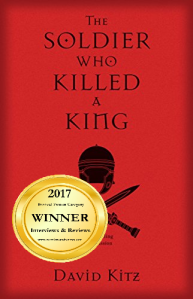
It is hard to imagine a more ironic, more chilling dramatic exclamation than the confession of Jesus’ executioner, “Surely, He was the Son of God” (Matt. 27:54).  In The Soldier, David Kitz gives a name to the Roman executioner – Marcus Longinus. Then he gives us an hour-by-hour account of the week in Marcus’ life in the run-up to the fatal hammer blows that drove spikes into Jesus’ broken body.

4485 TWITTER

            As I began to read The Soldier, I wondered if it would be a fascinating documentary of the last week of Jesus’ ministry on Earth. Fascinating it is. The sights, sounds and smells of the Jewish Passover week come to life, from the noisy, smelly commerce in sacrificial animals to the literal river of red sacrificial blood flowing through the temple aqueducts.

Political forces delicately dance in Jerusalem. High Priest Caiaphas, Samaritan King Herod Antipas, and Roman Governor Pontius Pilate, cordial but venomous enemies, vie for control of the holy city. We see and hear the week unfold through Marcus’ eyes and ears. He fears for the very lives of his men as tumultuous crowds swell Jerusalem. Two were recently murdered by Zealot terrorists. Crowds quickly become mobs, and only the iron discipline of his small garrison insulates the city from disaster.

The Soldier soon becomes more than a documentary. Marcus becomes a man we know intimately as husband, father and brave military officer. We see his family and career jeopardized by the mental anguish of post traumatic stress disorder. Horrific visions of bloody murders populate Marcus’ dreams at night and force contemplation of suicide by day.

Jesus rides into this mix of professional anxiety and personal anguish on a donkey. From a great distance He picks Marcus out of a crowd of thousands and speaks audibly to him alone and to him specifically, saying, “I have a future for you.” During the week, Marcus is repelled by Jesus and drawn to Jesus. He fears Jesus’ power over the crowds. He is the dumbfounded eye witness to Jesus’ healing miracles. He rejoices while Jesus humiliates moneychangers and Pharisees. He hopes Jesus will be acquitted by Pilate. He feels almost personally betrayed when Jesus might have saved Himself, but deliberately does not.  Ordered to crucify Jesus, Marcus does so obediently and resolutely.

I could empathize with Marcus. Like Marcus, I was a career soldier. Like him, I had superiors I admired and those I did not. I had peers who were my friends and those I loathed.  I worried about missions I was given when they endangered subordinates I was responsible for, and, admittedly, when they jeopardized my career if they failed. Unlike Marcus, I have not literally whipped my Savior and pierced his flesh with nails. But like Marcus, my personal sins have caused Jesus to suffer pain on the cross.

The Soldier is a two-fold page turner. It is better than an exciting read. Those of usbiblical-fiction-award-2017_orig blessed with a lifetime of church have heard the story of Christ’s trial and crucifixion as often as our lives have seen Easter Sundays. We have read the Biblical account, in all four gospels, many times. Yet, as I turned the pages of The Soldier, eagerly, I also found myself compulsively turning the pages of the Bible to sort out exactly which details of that week Kitz lifts literally from Scripture and which tidbits his imagination supplies. The blend is seamless. For instance, the lame boy Christ heals in Scripture becomes Kitz’ Lucas, a three-dimensional character twice cursed by the world and twice miraculously loved by Christ. What Christian author hopes for more than for it to be said that his work sends readers scurrying into the pages of the Holy Bible?

We are all Marcus. All of us, like Marcus, have heard Jesus promise us a future. We have all been drawn to Jesus and been afraid of Jesus; we have rejoiced with Jesus, and we have all felt alone when our lives spiraled out of control in sin and remorse. Jesus has stretched out His hands to all of us, and, like Marcus, we have all driven spikes into them. When we read David Kitz’s The Soldier Who Killed a King, we too, confess, “Surely, He is the Son of God.”

American readers click this link to purchase The Soldier Who Killed a King.

Canadian readers click this link to purchase The Soldier Who Killed a King directly from the author.

← Older posts
Newer posts →

Psalms 365: Develop a Life of Worship and Prayer

Psalms 365 Volume II

Psalms 365 vol 3
— Psalms 365 Volume III

Psalms

Recent posts

  • Don’t Step into the Hate Trap January 12, 2026
  • A Fortress of Salvation January 11, 2026
  • Finishing Well and Growing in Fruitfulness  January 11, 2026
  • I Call to You for Help January 10, 2026
  • Above All Gods January 9, 2026
  • The Need for a Place of Refuge January 9, 2026
  • David Dances before the LORD January 8, 2026

Calendar

January 2026
M T W T F S S
 1234
567891011
12131415161718
19202122232425
262728293031  
« Dec    

Blog Posts

Comments

  • davidkitz on Above All Gods
  • davidkitz on Above All Gods
  • davidkitz on David Dances before the LORD

Blog at WordPress.com.

Privacy & Cookies: This site uses cookies. By continuing to use this website, you agree to their use.
To find out more, including how to control cookies, see here: Cookie Policy
  • Subscribe Subscribed
    • I love the Psalms
    • Join 1,381 other subscribers
    • Already have a WordPress.com account? Log in now.
    • I love the Psalms
    • Subscribe Subscribed
    • Sign up
    • Log in
    • Report this content
    • View site in Reader
    • Manage subscriptions
    • Collapse this bar
 

Loading Comments...