• Home
  • About
  • DavidKitz.ca
  • Youtube Videos
  • Books by David
  • Books on Amazon.com

I love the Psalms

~ Connecting daily with God through the Psalms

I love the Psalms

Tag Archives: farm

A Four-Legged Champ

05 Sunday Mar 2023

Posted by davidkitz in Books by David Kitz

≈ 6 Comments

Tags

cougar, cows, David Kitz, dog, farm, Saskatchewan

A true story by David Kitz *


“Do you think this one will make it?”

“No.” My sister Edith shook her head in glum resignation.

As we gazed down at this shivering, whimpering, pup, the prospects for his survival beyond a year were anything but promising. You see, in the space of five years we had gone through a string of canine disasters.

Five years earlier, our dog Collie—yes, he was a collie—had passed on after a long life of service on the farm. All future dogs were inevitably compared with Collie. For the Kitz family, he represented the gold standard in dogs.

The next dog was Pubby, a fiercely loyal black spaniel that met his grim fate when he was hit by a car.

Next on the list, Topsy, an excellent cow-herder, was in a terrible accident with a snowplow.

A young lab, Sandy, though lovable, turned out to be completely useless as a farm dog—dumb as a stump.

Our last dog, Buddy, proved to be even worse than Sandy. He chased chickens, and when he caught them, he killed them. Naturally, my mother would have none of this. Buddy’s term as a farm dog was abruptly cut short.

Now, all six Kitz children were staring at a scrawny brown pup of uncertain pedigree. After these five disasters, we were almost afraid to become attached—hesitant to open ourselves to love yet another dog and face more disappointment.

But a whimpering pup has a way of tugging at your heart strings. He spent much of his first week curled up on an old towel in a cardboard box in the basement. One by one, each of the six Kitz children ventured downstairs to comfort this timid, whining, puppy.

My memory is that during this time, I adopted him and he became my dog. Dale, my younger brother, disputes this. In retrospect, I guess that, despite our initial misgivings, we all claimed him as our own. Or he claimed us.

We named him Champ. I believe I was the one to come up with that name, but this too is open to dispute. It was a rather bold name
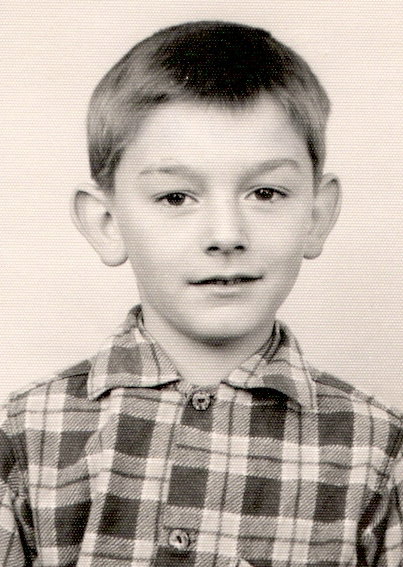
School Boy

David Kitz at about the time Champ arrived.

for a dog that didn’t look much like a champion. Even when he reached adult size, he was still scrawny, fine-boned, and barely knee-high. Did he weigh twenty-five pounds? Possibly not.

His hair and ears were a silky brown, lovely for stroking, but the rest of his short body fur had an odd grizzled appearance, a mix of various shades of brown, black and white.

What breed was he? I have no idea. I have never since seen a dog like him. Some odd mix, I guess. The Champ breed.

On the Kitz farm, every animal needed to prove its worth and that included dogs.

Farms in Saskatchewan are big, and at 1,120 acres, our farm was no exception. In addition to fields of wheat, barley, and oats, my dad had eighty head of cattle. We had a dairy herd and a beef herd on separate pastures about a mile apart. The dairy cows would be brought to the barn for milking twice daily.

Nothing is more frustrating than having to tramp across 160 acres after an ornery cow. Believe me, I know, having done it more than a few times. A good cattle dog will do this chore for you and save you much time and trouble.

Champ took to cow herding like a duck to water. He loved instilling the fear of God into thousand-pound steers. He would get behind them and then bark and nip at their hocks (ankles) to get them to move. Doing this just right requires a good deal of precision and agility. Precision, because ideally the dog bite should be hard enough to cause pain, but insufficient to pierce the skin. Agility, because the startled bovine kicks back reflexively and the dog needs to move fast and in the right direction. I’ve seen a kick from a cow send a slow-moving dog flying through the air.

Champ seemed to instinctively know what to do. With lightning speed, he applied just enough jaw pressure to get the desired result, and then he got out of the way. In a matter of seconds, he could turn a cantankerous ton of live beef into a spectacle of meek compliance. He demanded respect, and knew exactly how to get it.

Cows aren’t dumb creatures. Usually, it took only one encounter with Champ to establish who was boss. After that, the mere sight of the dog brought obedient submission.

With Champ as helper, rounding up the herd and moving it to a new location became much easier. A single command from one of the Kitz children— “Sic’um!”—and Champ did all the work.

Champ seemed to have an innate intelligence—much more than the average dog. But he had two other strong character traits as well.

First, he was incredibly eager to please his human masters. In fact, nothing delighted him more. If we were happy with him, his tail wagged with such enthusiasm that his entire hindquarters joined in the rhythm. A simple pat on the head after a job well done was enough to send him into spasms of pure joy.

Second, he hated being reprimanded. When a voice was raised in correction, he was totally crushed. His head would drop. He would tuck his tail tightly between his legs and slink away with the most mournful look on his honest face. With quick, baleful glances, his eyes would plead, “I didn’t mean to! I’m sorry! So sorry!” With his intelligence, his eagerness to please, and his strong desire to avoid a mistake, learning and obedience training was a cinch.

Furthermore, Champ was a dog with a conscience. If he transgressed some established rule, like coming onto the porch without permission, he would skitter away in a state of cowering humility. Not once did he find himself on the receiving end of any form of corporal punishment from me. It wasn’t needed. He learned to watch your eyes and the expression on your face. If you were happy, he was beyond happy. In my later life as a teacher, when a student was caught red-handed in some infraction, I would long to see half the contrition shown by my dog Champ.

At command, Champ showed his aggressive side when herding cattle, but in truth he was a soft-hearted mush pot. Nothing brought out this characteristic more fully than the birth of a farm animal. When my dad rose in the early morning to check on the cattle, he’d know immediately if a calf had been born during the night. As Dad stepped out the door of the house, Champ would greet him in a state of total ecstasy. He’d hustle dad over to the barn where he would stand over the newborn with a doggish grin as if to say, “Look, what happened here! Isn’t it wonderful?”

Champ took it upon himself to be the guardian of any newborn animals. The cows, for the most part, understood his intentions and put up with his hovering enthusiasm. But Champ was equally enthused about newborn piglets, kittens, or chicks, and his guardian instinct would immediately kick in.
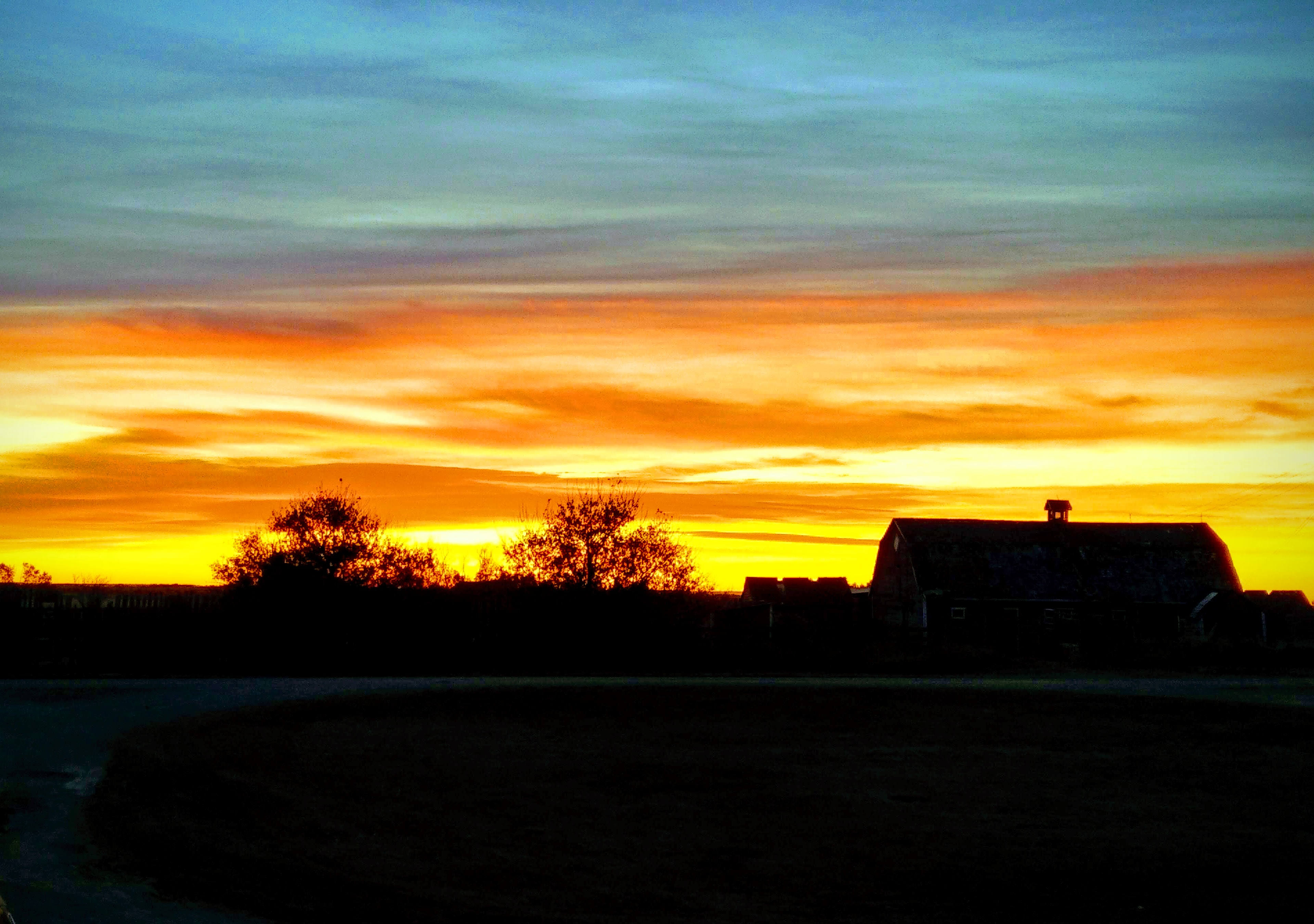
img_20191008_0741537-effects

The Kitz barn at sunrise, MacNutt, SK — photo by David Kitz

However, despite valiant efforts on his part, Champ’s intentions were sometimes misunderstood. This led to a farmyard standoff I’ll never forget. One afternoon, our bantam hen sauntered over to the house to display her clutch of freshly hatched chicks. When he saw this brood of fluffballs, Champ went into paroxysms of ecstasy. He ran in circles, wagging his tail, and barked his joyous greeting for all to hear.

The poor hen had no idea what to make of this crazy dog. Sensing a threat, she hastily gathered her chicks under her wings.

Champ reacted in shock. Clearly, this hen had swallowed these chicks whole. This could only mean one thing. He had to rescue them. He lowered his head and barked angrily at the hen.

This only confirmed the hen’s worst fears and she went into a full defensive posture. No chick would escape from beneath her wings while this vicious beast was about.

Meanwhile, the humans on the scene were doubled over in laughter.

Eventually, someone restrained Champ and the hen allowed the chicks to resume their roaming.

In due time, the dog and hen arrived at peace terms. There was plenty of skepticism on both sides, but from that day on, an uneasy truce prevailed.

Little did I suspect that one day I would be in need of Champ’s watchful protection.

During our summer vacations, my younger brother Dale and I loved to tramp about the wooded pasture land that surrounded our farm home. The summer I was eleven, we found a secluded spot in the far corner of the pasture, where we chopped down a few saplings and set up a makeshift tent. Champ always tagged along on these excursions.

One day, while Dale and I were relaxing by our tent, Champ began barking frantically. He ran in tight circles around us. Every hair on his back stood erect. To us, he seemed totally panicked.

We looked about to see what had set the dog into such an astonishing frenzy, but could see nothing. But his urgent alarm grew even more intense. The dog was completely beside himself with fear, running in circles around us. Each frantic bark seemed to urge us to get out of there.

I picked up the axe, and together the three of us ran for our lives. What we were running from Dale and I could only guess. Was it some large wild animal? A malicious human intruder? I had never seen my dog react this way to anything or anyone before.

We reported this event to our parents, who listened with interest, but could offer no further insight except to say that we were wise to heed Champ’s warning and leave.

We were spooked by this, and for two weeks we didn’t return to our favorite spot.

Finally, we took courage, and on a sunny summer afternoon, we set out for our secluded campsite once again. Of course Champ tagged along with us.

All went well until we were near our destination. As we emerged into an open grassy area, Champ suddenly went ballistic. But this time we clearly saw the cause of his alarm.

A short distance ahead of us, a huge tawny cat—a cougar—reared up and bounded off into the woods with Champ in hot pursuit! Dale and I froze in our tracks, shaken to the core.

Wisely, Champ’s pursuit was brief. He returned after the cougar dashed into the woods. But now we knew what was out there. On the earlier occasion, only our faithful dog stood between us and that powerful predator. Without Champ’s fierce protection, two prairie boys may well have become a meal for a hungry cougar.

A week later, after the morning milking, Champ and I were leading the cows back to the pasture when I spotted the waist-high cougar standing on the driveway leading to the machine shed. Completely fearless, Champ was off like a shot! Again, the cougar fled—and this time it didn’t return.

For me, these three cougar encounters became the stuff of legend. You see, up to this point, no one in recent years had ever reported seeing a cougar in Saskatchewan. During my childhood, cougars were commonly called mountain lions, because their range had been reduced to the Rocky Mountains. When I spoke of this experience to friends at school, they scoffed at me in disbelief.

Even my parents were doubtful. They never saw the big cat, although my dad saw Champ’s reaction to the second sighting from a distance.

After a while, I learned to keep my mouth shut about this matter. But I knew what I had witnessed.

Twenty years later, a cougar was hit and killed on a roadway about thirty miles from our farm. After that news report, I spoke openly about my childhood experience with the cougar. The evidence of the big cat’s presence was now irrefutable.

Unfortunately, in recent years, cougar attacks on humans have become increasingly common. Each time I hear of such reports, I think of Champ.

I owe fifty plus years of my life to that skinny, whimpering pup in a cardboard box.

As for me, I grew up and moved to Edmonton for university. I married and settled there.

My younger brother took over the farm. Every time I returned home, my dear four-legged friend would greet me. He’d rest his head on my knee and I would stroke his silky head.

Of course, each year he was getting older. On one of those summer trips it was clear his health was failing. He knew it. We all knew it. It was so hard to leave that last time.

Jesus said, “No one has greater love than this—that one lays down his life for his friends” (John 15:13 NET).

The first one to demonstrate that kind of friendship—that kind of love for me was a champion—a fearless, four-legged Champ.

* An earlier version of this story was published in Hot Apple Cider with Cinnamon.
Looking Back at 2022

02 Monday Jan 2023

Posted by davidkitz in Uncategorized

≈ Leave a comment

Tags

depression, drought, farm, mother, prairie, Queen Elizabeth II, the Queen

My most popular post for 2022 was not a story or devotional I wrote. It was a real-life account written by my mother, whose 100 hundredth birthday I hoped to celebrate on December 28th, 2022. Instead, she graduated into the presence of Jesus six months short of that centennial milestone.

Queen EII

Queen Elizabeth II

My mother, Wanda Kitz, was looking forward to getting her congratulatory letter from Queen Elizabeth II. (All Canadians who reach 100 years get a signed commendation from the reigning monarch.) But alas, the Queen too passed away before my Mom’s 100th birthday. Perhaps, they met in person in the mansions of glory to celebrate her birthday. That thought puts a smile on my face.

In many ways for me 2022 was a milestone year. I lost two queens, my mother and the only reigning monarch I knew. I was born in 1952, seventeen days after the death of King George VI, and Elizabeth’s ascent to the throne. Her reign and my mother’s life have been two constants throughout my seventy years on this planet.

Here then with fond and thankful memories is my mother’s story.


Two Boxcars and Two Cents

By Wanda Kitz

My father Gotlieb Ziebart was born in Russia in 1886. He came to Canada in 1912, just before the First World War. He came to Wolseley, Saskatchewan. He helped build the number one highway. Later he took up a homestead, section 35, township 16, range 24, West 3 degrees, new, Maple Creek – Piepot on the prairies of southwestern Saskatchewan.

Wanda

Wanda Kitz (nee Ziebart) 1922-2022

He married my mother, Emily Wuschke in 1917. She was from Bateman, Saskatchewan. Her parents came over to Canada from Poland in 1911 when my mother was ten years old. There were nine children. The youngest was born in Canada, and she was only nine months old when her father passed away. The oldest boy in the family was sixteen. When his father died, he stayed at home to farm and the other kids went working. The boys were hired to tend cattle for neighbors and the girls babysat. They stayed wherever they worked. Their pay was a place to sleep, their daily food, and maybe a secondhand pair of shoes or a coat. They got home once in two or three months. Things were tough.

My parents lived on the homestead for about five years. I was the third child born there. Their farm was seconded by ranchers, and they wanted dad’s land, so he sold it and moved to Bateman and then to Mankota.

My father was a good farmer and by 1928 we had a car, a tractor, and a threshing machine and two lines of horses. He also had cattle and five kids. But he lived on rented land.

So he bought a farm at Mossbank. Mother had three brothers living there. His hopes were high for a great future for his family. He put all his money down for a down payment on the farm. Then the depression came. Markets crashed, not just the stock market, but the market for grain and everything the farm produced.

Drought came.

He lost everything.

The drought lasted for eight years. Things were rough. The government gave us relief – two dollars per person per month. By that time there were six children, but dad wouldn’t take anything for the baby.

He said, “I have milk. I will feed him.”

So we got twelve dollars a month. That was during the winter. When the grass got green, the government relief was cut off. My father was a proud man, and he didn’t take anything from anyone, least of all the government.

As the drought worsened, the people that had a little money just packed up and left for the Peace River country in northern Alberta, or they moved to B.C. There were beautiful homes and farmyards left vacant. They were simply abandoned. The land didn’t get seeded. The wind and the grasshoppers took care of it.

By 1937 things were so bad, the government offered to help the farmers to move out. Dad was one of them. They could move you, or watch you starve. There was no feed for the cattle. The government wanted you to sell them. I remember having to go and pump water every two hours until the well was dry. Then we would wait two hours and go pump again.

Dad and three of his friends went land hunting. Dad came back and said he had bought a farm. The other men said they were going to buy later, but they never did.

We were moving – moving from the treeless prairie to the bush country.

The prairie was all we knew.

Mother and us kids were not happy about the move. At Mossbank, mother had brothers and sisters and a mother. We kids had all our cousins and friends. But we moved to Aaron, Saskatchewan – post office White Beach. Dad had sold horses and cattle and made a down payment of $150.00 on a farm on the west end of Thunder Hill. It was more than four hundred miles to the northeast, very near the Manitoba border. For us it was like moving to another world.

How did we get there?

The government gave us two boxcars on a freight train. They said they would pay the passenger tickets to get the family there, and it would take two days for the freight train to arrive. The freight cars came, but nothing to move the family. No money. No money from the government, and dad didn’t have any.

You are on your own. You do what you must.

We had two days to load. In one freight car, dad put the cattle at one end, and the farm implements at the other end. Everything was taken apart. The seed drill, the binder, the hay rake, the wagon, and the horse drawn sleigh, everything was packed into the rail car. On the other end of the car were the nine horses, pigs in a crate, chickens, a dog and a cat, and then more farm implements piled up on one side. On the other railcar he put a wagon box. On the far end of the box was the furniture stacked from bottom to top. The dining room buffet was at the bottom, the dresser on top, and then the sewing machine on top of that. I can still see it all stacked and crammed in.

Mother and five kids lived in the wagon box. Dad and my oldest brother could stay with the cattle in the other car. They were legal. But the rest of us, the family, we were stowaways.

Right on the top of all the implements dad put the harrows, and we unrolled a mattress over them. We could lie up there, but couldn’t sit. It was too cramped. I spent most of my time up there.

The train stopped in every town, and every time it stopped or started it gave this awful jar. Our heads would hit the steel bars on the roof of the car. It was terrible. Terrible!

It was so hot! No air!

We were shut up with the animals. The stench!

Dad was told it would take us two days. We left Mossbank on the thirteenth of August in the afternoon at about three o’clock. We were prairie refugees. Dust bowl refugees. We traveled from Mossbank to Avonlea, and they left us sitting there until the next day, about thirty-five miles from Mossbank.

The next day we went from Avonlea to Moose Jaw and then on to Regina.

The third day we went to Saskatoon and sat there in the stifling prairie heat.

On the fourth day we started east and made it to Humboldt. We stayed there overnight.

On the fifth day we got to Aaron at about suppertime. We had traveled five days. The cattle and horses had little or no water or feed. The cattle were let out of the cars once, into the stockyards, but not the horses.

We had very little food and water. We almost died in the heat. It was August 13th to the 18th, 1937.

Hot. Dry. Dusty. Unrelenting heat.

black and pink train

Photo by Felix Mittermeier on Pexels.com

Mother had prepared some food for on the way, enough for two days. She had roasted two chickens. When the railway station agent in Mossbank couldn’t sell us tickets, he was mad. Dad had no money. The agent wanted to squeal on him, so dad gave him the two roasted chickens and then dad told him to keep his mouth shut. But we starved.

I will never forget all this as long as I live.

That first evening in Aaron, mother and my sister and I stayed with the people from whom dad had bought the land. They gave us supper and a bed for the night. Dad and the boys stayed with the boxcars. They looked after the cattle and started unloading and setting the wagons together.

The next morning, I and two of my brothers were put in charge of the cattle. We were to take them to our farm ten miles away. We were strangers in a strange land. The cattle had never seen trees before. All this bush was foreign to them. They went through everything, fences and all. They wanted to go home, and so did we – back to where we came from.

By noon we were about halfway. There was an open field where the hay had been cut, so we let the cows graze and rest there. We went to a farmhouse and asked for water. Then we went back to the cattle and waited for dad to come with the wagons.

The people in the farmhouse were good to us. When afternoon began turning to evening, they came and asked us to come and have supper with them. We waited until midnight before dad finally came. Then we took the cattle the rest of the way. They followed the wagon in the dark, and this time they had sense enough to stay on the road.

When we got to our home, there were renters living on the land. It was August and they had to take off the crop. They were Ukrainian and couldn’t speak any English, but they had two boys, eight and ten years old. They could speak English because they learned it at school, so that is how we communicated with them. They gave mother and my sister and me a spot on the floor to sleep. Dad and the boys found some hay to sleep on. The next day they gave us a granary to use as a house until they moved out.

I was fourteen years old when we moved north to Aaron. Come September, my sister and one brother and I went to White Beech School. I was in grade eight. We got to know some very nice people. After all these years I still keep in touch with my old school pal Eva. She lives in Benito.

When we got there in mid-August, we had to make hay and feed for the winter. The people around us were very kind. They helped us out by giving us patches of hay land that they hadn’t cut. They gave us potatoes and vegetables too. We had never seen tomatoes in a garden before, or carrots or dry beans. In the south there was no such thing. There was no rain, only grasshoppers and dust storms. Here in the north everything was green – grass so tall you couldn’t walk through it. And it rained!

But winter came.

The government was supposed to send us relief for a year from Mossbank, but it didn’t come until Christmas. Dad had no money. The storekeeper at White Beech gave us credit so we could get coal oil and matches and a few groceries, or we would have starved in the dark.

For Christmas we kids wrote a letter to our friends and cousins in Mossbank. We were so homesick for them and our old home! We gave the letter to dad. But he couldn’t mail it. He didn’t have the two cents for postage stamps. He carried that letter in his pocket. He didn’t have the heart to tell us. Eventually in spring we found the crumpled envelope in dad’s jacket pocket.

That spring dad planted wheat on Thunder Hill. It came up and grew like nothing we had ever seen. We had high hopes. But everything rusted out. A rust fungus killed the wheat as it headed out. Most of the wheat was burned in the field. There was nothing in it. That first year in the north was harder to take than all the years of drought on the prairie. There the land had taught us to expect nothing. And we got nothing. But here the land, the sky and the falling rain promised to give us the moon. But come September, it too gave us nothing – a harvest of hardship.

After I passed my grade eight, I went out working for $5.00 a month. I finally worked my way to Roblin, Manitoba, and then to MacNutt, Saskatchewan where I met Ewald Kitz. We were married in 1943. A year later my parents moved to Dropmore, Manitoba where they farmed until they retired to Roblin. Mother passed away in 1970, and dad in 1977 at the age of ninety-one.

As long as I live, I will never forget that train trip from Mossbank to Aaron. Even now if I happen to be at a railway crossing when the train goes by, it still sends hot and cold shivers down my spine. Unbelievable!

I still can’t throw anything away. I always think of the hard times I went through growing up. I guess that’s why I make World Relief quilts. I know what it’s like to be without, what it’s like to be forced to pack up and leave home.

Note: My Mother was welcomed into her heavenly home on July 9, 2022. Here is an account of the hardships of her childhood that she wrote about a decade ago. We have much to be thankful for.

Two Boxcars and Two Cents

17 Sunday Jul 2022

Posted by davidkitz in family

≈ 19 Comments

Tags

depression, drought, family, farm, Saskatchewan

My Mother was welcomed into her heavenly home on July 9, 2022. Here is an account of the hardships of her childhood that she wrote about a decade ago. We have much to be thankful for.

My father Gotlieb Ziebart was born in Russia in 1886. He came to Canada in 1912, just before the First World War. He came to Wolseley, Saskatchewan. He helped build the number one highway. Later he took up a homestead, section 35, township 16, range 24, West 3 degrees, new, Maple Creek – Piepot on the prairies of southwestern Saskatchewan.

Wanda

Wanda Kitz (nee Ziebart) 1922-2022

He married my mother, Emily Wuschke in 1917. She was from Bateman, Saskatchewan. Her parents came over to Canada from Poland in 1911 when my mother was ten years old. There were nine children. The youngest was born in Canada, and she was only nine months old when her father passed away. The oldest boy in the family was sixteen. When his father died, he stayed at home to farm and the other kids went working. The boys were hired to tend cattle for neighbors and the girls babysat. They stayed wherever they worked. Their pay was a place to sleep, their daily food, and maybe a secondhand pair of shoes or a coat. They got home once in two or three months. Things were tough.

My parents lived on the homestead for about five years. I was the third child born there. Their farm was seconded by ranchers, and they wanted dad’s land, so he sold it and moved to Bateman and then to Mankota.

My father was a good farmer and by 1928 we had a car, a tractor, and a threshing machine and two lines of horses. He also had cattle and five kids. But he lived on rented land.

So he bought a farm at Mossbank. Mother had three brothers living there. His hopes were high for a great future for his family. He put all his money down for a down payment on the farm. Then the depression came. Markets crashed, not just the stock market, but the market for grain and everything the farm produced.

Drought came.

He lost everything.

The drought lasted for eight years. Things were rough. The government gave us relief – two dollars per person per month. By that time there were six children, but dad wouldn’t take anything for the baby.

He said, “I have milk. I will feed him.”

So we got twelve dollars a month. That was during the winter. When the grass got green, the government relief was cut off. My father was a proud man, and he didn’t take anything from anyone, least of all the government.

As the drought worsened, the people that had a little money just packed up and left for the Peace River country in northern Alberta, or they moved to B.C. There were beautiful homes and farmyards left vacant. They were simply abandoned. The land didn’t get seeded. The wind and the grasshoppers took care of it.

By 1937 things were so bad, the government offered to help the farmers to move out. Dad was one of them. They could move you, or watch you starve. There was no feed for the cattle. The government wanted you to sell them. I remember having to go and pump water every two hours until the well was dry. Then we would wait two hours and go pump again.

Dad and three of his friends went land hunting. Dad came back and said he had bought a farm. The other men said they were going to buy later, but they never did.

We were moving – moving from the treeless prairie to the bush country.

The prairie was all we knew.

Mother and us kids were not happy about the move. At Mossbank, mother had brothers and sisters and a mother. We kids had all our cousins and friends. But we moved to Aaron, Saskatchewan – post office White Beach. Dad had sold horses and cattle and made a down payment of $150.00 on a farm on the west end of Thunder Hill. It was more than four hundred miles to the northeast, very near the Manitoba border. For us it was like moving to another world.

How did we get there?

The government gave us two boxcars on a freight train. They said they would pay the passenger tickets to get the family there, and it would take two days for the freight train to arrive. The freight cars came, but nothing to move the family. No money. No money from the government, and dad didn’t have any.

You are on your own. You do what you must.

We had two days to load. In one freight car, dad put the cattle at one end, and the farm implements at the other end. Everything was taken apart. The seed drill, the binder, the hay rake, the wagon, and the horse drawn sleigh, everything was packed into the rail car. On the other end of the car were the nine horses, pigs in a crate, chickens, a dog and a cat, and then more farm implements piled up on one side. On the other railcar he put a wagon box. On the far end of the box was the furniture stacked from bottom to top. The dining room buffet was at the bottom, the dresser on top, and then the sewing machine on top of that. I can still see it all stacked and crammed in.

Mother and five kids lived in the wagon box. Dad and my oldest brother could stay with the cattle in the other car. They were legal. But the rest of us, the family, we were stowaways.

Right on the top of all the implements dad put the harrows, and we unrolled a mattress over them. We could lie up there, but couldn’t sit. It was too cramped. I spent most of my time up there.

The train stopped in every town, and every time it stopped or started it gave this awful jar. Our heads would hit the steel bars on the roof of the car. It was terrible. Terrible!

It was so hot! No air!

We were shut up with the animals. The stench!

Dad was told it would take us two days. We left Mossbank on the thirteenth of August in the afternoon at about three o’clock. We were prairie refugees. Dust bowl refugees. We traveled from Mossbank to Avonlea, and they left us sitting there until the next day, about thirty-five miles from Mossbank.

The next day we went from Avonlea to Moose Jaw and then on to Regina.

The third day we went to Saskatoon and sat there in the stifling prairie heat.

On the fourth day we started east and made it to Humboldt. We stayed there overnight.

On the fifth day we got to Aaron at about suppertime. We had traveled five days. The cattle and horses had little or no water or feed. The cattle were let out of the cars once, into the stockyards, but not the horses.

We had very little food and water. We almost died in the heat. It was August 13th to the 18th, 1937.

Hot. Dry. Dusty. Unrelenting heat.

Mother had prepared some food for on the way, enough for two days. She had roasted two chickens. When the railway station agent in Mossbank couldn’t sell us tickets, he was mad. Dad had no money. The agent wanted to squeal on him, so dad gave him the two roasted chickens and then dad told him to keep his mouth shut. But we starved.

I will never forget all this as long as I live.

That first evening in Aaron, mother and my sister and I stayed with the people from whom dad had bought the land. They gave us supper and a bed for the night. Dad and the boys stayed with the boxcars. They looked after the cattle and started unloading and setting the wagons together.

The next morning, I and two of my brothers were put in charge of the cattle. We were to take them to our farm ten miles away. We were strangers in a strange land. The cattle had never seen trees before. All this bush was foreign to them. They went through everything, fences and all. They wanted to go home, and so did we – back to where we came from.

By noon we were about halfway. There was an open field where the hay had been cut, so we let the cows graze and rest there. We went to a farmhouse and asked for water. Then we went back to the cattle and waited for dad to come with the wagons.

The people in the farmhouse were good to us. When afternoon began turning to evening, they came and asked us to come and have supper with them. We waited until midnight before dad finally came. Then we took the cattle the rest of the way. They followed the wagon in the dark, and this time they had sense enough to stay on the road.

When we got to our home, there were renters living on the land. It was August and they had to take off the crop. They were Ukrainian and couldn’t speak any English, but they had two boys, eight and ten years old. They could speak English because they learned it at school, so that is how we communicated with them. They gave mother and my sister and me a spot on the floor to sleep. Dad and the boys found some hay to sleep on. The next day they gave us a granary to use as a house until they moved out.

I was fourteen years old when we moved north to Aaron. Come September, my sister and one brother and I went to White Beech School. I was in grade eight. We got to know some very nice people. After all these years I still keep in touch with my old school pal Eva. She lives in Benito.

When we got there in mid-August, we had to make hay and feed for the winter. The people around us were very kind. They helped us out by giving us patches of hay land that they hadn’t cut. They gave us potatoes and vegetables too. We had never seen tomatoes in a garden before, or carrots or dry beans. In the south there was no such thing. There was no rain, only grasshoppers and dust storms. Here in the north everything was green – grass so tall you couldn’t walk through it. And it rained!

But winter came.

The government was supposed to send us relief for a year from Mossbank, but it didn’t come until Christmas. Dad had no money. The storekeeper at White Beech gave us credit so we could get coal oil and matches and a few groceries, or we would have starved in the dark.

For Christmas we kids wrote a letter to our friends and cousins in Mossbank. We were so homesick for them and our old home! We gave the letter to dad. But he couldn’t mail it. He didn’t have the two cents for postage stamps. He carried that letter in his pocket. He didn’t have the heart to tell us. Eventually in spring we found the crumpled envelope in dad’s jacket pocket.

That spring dad planted wheat on Thunder Hill. It came up and grew like nothing we had ever seen. We had high hopes. But everything rusted out. A rust fungus killed the wheat as it headed out. Most of the wheat was burned in the field. There was nothing in it. That first year in the north was harder to take than all the years of drought on the prairie. There the land had taught us to expect nothing. And we got nothing. But here the land, the sky and the falling rain promised to give us the moon. But come September, it too gave us nothing – a harvest of hardship.

After I passed my grade eight, I went out working for $5.00 a month. I finally worked my way to Roblin, Manitoba, and then to MacNutt, Saskatchewan where I met Ewald Kitz. We were married in 1943. A year later my parents moved to Dropmore, Manitoba where they farmed until they retired to Roblin. Mother passed away in 1970, and dad in 1977 at the age of ninety-one.

As long as I live, I will never forget that train trip from Mossbank to Aaron. Even now if I happen to be at a railway crossing when the train goes by, it still sends hot and cold shivers down my spine. Unbelievable!

I still can’t throw anything away. I always think of the hard times I went through growing up. I guess that’s why I make World Relief quilts. I know what it’s like to be without, what it’s like to be forced to pack up and leave home.

Our Rock of Refuge

22 Friday Dec 2017

Posted by davidkitz in Advent, Bible, Christmas, Devotionals, Psalm 71, Psalms

≈ 5 Comments

Tags

Canadian prairies, childhood, Christmas, crops, farm, fortress, foundation, hope, praise, psalmist, refuge, Rock, Sovereign LORD

Reading:                                      Psalm 71

(Verses 1-8)
In you, LORD, I have taken refuge;
let me never be put to shame.
In your righteousness, rescue me and deliver me;
turn your ear to me and save me.
Be my rock of refuge,
to which I can always go;
give the command to save me,
for you are my rock and my fortress.
Deliver me, my God, from the hand of the wicked,
from the grasp of those who are evil and cruel.
For you have been my hope, Sovereign LORD,
my confidence since my youth.
From birth I have relied on you;
you brought me forth from my mother’s womb.
I will ever praise you.
I have become a sign to many;
you are my strong refuge.
My mouth is filled with your praise,
declaring your splendor all day long
(NIV).

Reflection
I must confess that I have a bit of a love/hate relationship with rocks. I grew up on a farm on the Canadian prairies and annually the rich soil produced two crops—a crop of grain and a crop of rocks. Grain crops such as wheat, barley and oats were welcomed—the rocks not so much.

2017-12-11b

Pre-Christmas blessings — photo by David Kitz

Simply working the soil in spring would bring the rocks to the surface. It was our job as children to help our dad to pick those rocks and haul them off the fields. For the most part it was tedious work. That’s the unpleasant part of my relationship with rocks. But as for the rocks themselves, for the most part I liked them. They came in a huge variety of shapes, colors, sizes and textures. I found them fascinating.

For the psalmist, the LORD was his solid foundation—his rock of refuge in a changing world. Hear his prayer: Be my rock of refuge, to which I can always go; give the command to save me, for you are my rock and my fortress. 

In the shifting circumstances of life, it is essential that we have those things that remain solid and unwavering. From our childhood onward we need a rock of refuge from the storms of life—a rock to which we can always go in good times and bad.

It’s wonderful when we can say with the psalmist, “From birth I have relied on you; you brought me forth from my mother’s womb. I will ever praise you.”

Response: LORD God, thank you for being my solid rock. Your faithfulness has steadied me in stormy times. You have been my help and strength, my shelter and fortress. Amen.

Your Turn: How has the Lord been a solid rock for you? Do you find yourself drawing closer to the Lord as Christmas approaches?

Psalms 365: Develop a Life of Worship and Prayer

Psalms 365 Volume II

Psalms 365 vol 3
— Psalms 365 Volume III

Psalms

Recent posts

  • May the LORD Grant All Your Requests December 20, 2025
  • A Horn of Salvation December 19, 2025
  • Ready for the King of Glory December 19, 2025
  • My Spirit Rejoices in God My Savior December 18, 2025
  • Joining the Generation That Seeks God December 18, 2025
  • Why Am I So Favored December 17, 2025
  • How Can You Find the Good Life? December 17, 2025

Calendar

December 2025
M T W T F S S
1234567
891011121314
15161718192021
22232425262728
293031  
« Nov    

Blog Posts

Comments

  • davidkitz on Joining the Generation That Seeks God
  • cjsmissionaryminister on God Sent His Son
  • cjsmissionaryminister on The God of the Broken

Blog at WordPress.com.

Privacy & Cookies: This site uses cookies. By continuing to use this website, you agree to their use.
To find out more, including how to control cookies, see here: Cookie Policy
  • Subscribe Subscribed
    • I love the Psalms
    • Join 1,377 other subscribers
    • Already have a WordPress.com account? Log in now.
    • I love the Psalms
    • Subscribe Subscribed
    • Sign up
    • Log in
    • Report this content
    • View site in Reader
    • Manage subscriptions
    • Collapse this bar
 

Loading Comments...