• Home
  • About
  • DavidKitz.ca
  • Youtube Videos
  • Books by David
  • Books on Amazon.com

I love the Psalms

~ Connecting daily with God through the Psalms

I love the Psalms

Tag Archives: Messiah

The Messiah King

16 Tuesday Aug 2022

Posted by davidkitz in Psalm 110

≈ Leave a comment

Tags

Jesus, king, Messiah

Today’s quote and prayer from
“Psalms 365: Develop a Life of Worship and Prayer”
by David Kitz.

Psalm 110
Reading: Psalm 110

Father God,
thank you for sending Jesus
into the world to be my personal Messiah.
Jesus, you suffered and died for me.
Now extend your reign as conquering king
over me and through me.
Amen.

* NEW INTERNATIONAL VERSION, COPYRIGHT ©1973, 1978, 1984, 2011 BY BIBLICA

Please pray for the people of Ukraine!

Volume I of Psalms 365: Develop a Life of Worship and Prayer has won the 2021 Best Book of the Year Award and for those who love God’s word, it’s an ideal way to daily meet with the Lord. For a closer look at Volumes II and III click here.

The Most Messianic Psalm?

16 Tuesday Aug 2022

Posted by davidkitz in Psalm 110, Psalms

≈ 10 Comments

Tags

Adonai, David, Messiah, messianic psalm, the LORD, Yahweh

Reading: Psalm 110
Of David. A psalm.
The LORD says to my Lord:
“Sit at my right hand until I make your enemies a footstool for your feet.”
The LORD will extend your mighty scepter from Zion, saying,
“Rule in the midst of your enemies!”
Your troops will be willing on your day of battle.
Arrayed in holy splendor,
your young men will come to you
like dew from the morning’s womb.
The LORD has sworn and will not change his mind:
“You are a priest forever, in the order of Melchizedek.”
The Lord is at your right hand;
he will crush kings on the day of his wrath.
He will judge the nations, heaping up the dead
and crushing the rulers of the whole earth.
He will drink from a brook along the way,
and so he will lift his head high
(NIV).

img_20220811_1922015

Photo by David Kitz

Reflection
Psalm 110 is perhaps the most messianic psalm in the entire psalter. Jesus made a direct reference to the opening line of this psalm in a discussion he had with the Pharisees in the temple courts during the week of his crucifixion. See Matthew 22:41-46 and Luke 20:41-44.

Jesus asks, “What do you think about the Messiah? Whose son is he?” In response the Pharisees answer, “The son of David.”

But Jesus refutes their answer by quoting from Psalm 110. His answer does not carry the same punch in the English language quote we see in Matthew, because we fail to see the distinction between the first ‘LORD’ and the second ‘Lord’. We see these words as synonymous, but in the original Hebrew they most certainly are not. The first LORD is Yahweh (Jehovah), but the second Lord is Adonai, the Messiah.

Speaking prophetically by the Spirit, David was referring to his Adonai—his Messiah. By quoting this scripture, Jesus was affirming his designation by God as the Messiah the Jewish nation had longed to see. The long wait was over. Jesus the Messiah was standing directly in front of Pharisees who were blind to his presence and his deity.

This Lord or Adonai is also the divinely designated priest who will present his own body as a sacrifice on the cross. The LORD has sworn and will not change his mind: “You are a priest forever, in the order of Melchizedek.” The writer of the Book of Hebrews has a great deal to say about the priesthood of Melchizedek. He systematically reasons that Jesus is our heaven-sent prophet, priest and king. See Hebrews chapters 6-8.   

Response: Father God, thank you for sending Jesus into the world to be my personal Messiah. Jesus, you suffered and died for me. Now extend your reign as conquering king over me and through me. Amen.

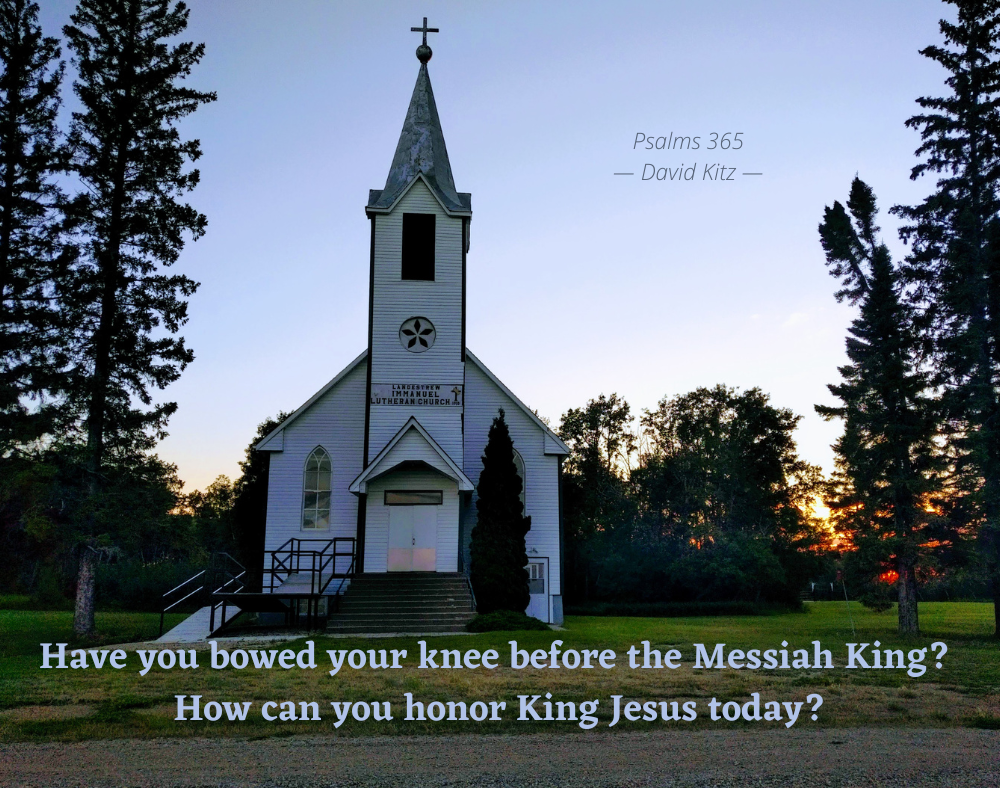
Your Turn: Have you bowed your knee before the Messiah King? How can you honor King Jesus today?

* NEW INTERNATIONAL VERSION, COPYRIGHT ©1973, 1978, 1984, 2011 BY BIBLICA

BGBG_v4.3_150[1818]

Please pray for the people of Ukraine!

Volume I of Psalms 365: Develop a Life of Worship and Prayer has won the 2021 Best Book of the Year Award and for those who love God’s word, it’s an ideal way to daily meet with the Lord. For a closer look at Volumes II and III click here.

Your Anointed One

26 Thursday May 2022

Posted by davidkitz in Psalm 89

≈ 1 Comment

Tags

anointed, Christ, Jesus of Nazareth, Messiah

Reading: Psalm 89:46-52
How long, LORD? Will you hide yourself forever?
How long will your wrath burn like fire?
 Remember how fleeting is my life.
For what futility you have created all humanity!
Who can live and not see death,
or who can escape the power of the grave?
Lord, where is your former great love,
which in your faithfulness you swore to David?
Remember, Lord, how your servant has been mocked,
how I bear in my heart the taunts of all the nations,
the taunts with which your enemies, L
ORD, have mocked,
with which they have mocked every step of your anointed one.
Praise be to the LORD forever!
Amen and Amen
(NIV).*

original_9a423d1f-3154-4f62-ad12-1a529cf66907_img_20220514_2033260

Photo by David Kitz

Reflection
Many people believe that Christ is Jesus’ last name. That is not true. The Bible does not tell us Jesus’ family name. Often, he is identified by the town that he is from—Jesus of Nazareth. So, what then is the significance of the word Christ or Khristos in the Greek? Christ is a title. One might even call it a job description. It means the anointed one, the one designated by God to rule and reign over his people. The Greek word Khristos or Christ corresponds to the Hebrew word Mashiach or Messiah. The anointed one or Christ was and is the son of David, who rules over the house of Jacob and the Israel of God. Just as David was anointed to be king of Israel, Jesus is anointed to be our king for this life and eternity.

When we read Psalm 89 with the understanding that the anointed one is also the Christ, the psalm takes on a whole new layer of meaning. Yes, during the fall of Jerusalem to the Babylonians, the anointed one was mocked. But this is also true of Jesus, the anointed Son of David, who was led off to be crucified outside the city gate. These words were fulfilled in Christ: Remember, Lord, how your servant has been mocked, how I bear in my heart the taunts of all the nations, the taunts with which your enemies, LORD, have mocked, with which they have mocked every step of your anointed one.

But there is a significant difference between the Old Testament, anointed one, and our New Testament Christ. The psalmist asks this question: Who can live and not see death, or who can escape the power of the grave?

The implicit answer is that no one can escape death and the grave. But… but there is One—One, who tasted death on our behalf—One, who escaped the power of the grave. His name is Jesus. He is the Christ, the anointed One, and our Messiah. He is the One who by virtue of the resurrection is King now and forevermore.

Response: LORD God, I thank you for Jesus, the Christ, the anointed One. Thank you for your death, burial and resurrection. I join with the psalmist in saying, “Praise be to the LORD forever! Amen and Amen.”

Your Turn: In what way is Christ a job description? What job has he done and is he doing for you?

* NEW INTERNATIONAL VERSION, COPYRIGHT ©1973, 1978, 1984, 2011 BY BIBLICA

BGBG_v4.3_150[1818]

Please pray for the people of Ukraine!

Volume I of Psalms 365: Develop a Life of Worship and Prayer has won the 2021 Best Book of the Year Award and for those who love God’s word, it’s an ideal way to daily meet with the Lord. For a closer look at Volumes II and III click here.

Excerpt 21 from The Soldier Who Killed a King

16 Saturday Apr 2022

Posted by davidkitz in Books by David Kitz

≈ 2 Comments

Tags

Golgotha, Messiah, Pontius Pilate, tomb

A journey to the cross is a journey to repentance. It’s a journey to deep personal change. Will you take this journey with me?

Date: Seven in the morning, Saturday, April 8, 30 A.D.
Annas meets with Pontius Pilate and asks that Jesus’ tomb be guarded.

Pilate was seated even as I saw him yesterday. He wore a rather haggard look, as though he had slept on the bloodstained rocks of Golgotha. He motioned for the temple delegation to step forward. I waited at the back of the room in a repetition of the governor’s late-day interview with Joseph of Arimathea.
Annas bowed and began. “Sir, we remember that while he was still alive that deceiver said, ‘After three days I will rise again.’”
A strange tingle ran through me as he said this. Pilate rubbed his hands.
Annas continued. “So give the order for the tomb to be made secure until the third day. Otherwise, his disciples may come and steal the body and tell the people that he has been raised from the dead.” Then he concluded by lifting a bony finger and saying, “This last deception will be worse than the first.”
On hearing this, Pilate sighed deeply, then beckoned me forward. There was worry in his eyes. “The centurion here, Marcus Longinus, is fully acquainted with the case of the Galilean prophet. He oversaw his crucifixion.” Then he addressed me directly. “Is that not so?”
I nodded. “Yes, sir. It is as you say.”
With that he raised his hands and motioned both parties together. Then, speaking directly to all of us, he said, “Take a guard. Go, make the tomb as secure as you know how.” Rubbing his guilt- stained hands once more, the Badger got up and skulked off. Free WW-e FACEBOOK-2 (2)Annas was jubilant. With eagerness in his voice, he turned to address me. “How soon can you have your troops at the tomb?”
“We should be there in about an hour.”
“Excellent! These two gentlemen will meet you there. They will ensure that all is in order. Understood?”
“Yes. Understood,” I said. Then I addressed the Pharisees. “Do you know which tomb? Do you know where it is?”
Annas answered for them. “Ah, they know it well.” He gave a contemptuous snort. “The traitor’s tomb, Joseph of Arimathea!”
“I will bring my men and meet you there then.” I gave a slight bow with my head. The chamberlain saw us to the door, and then I was off, back to my home.
I shook my head several times in disbelief as I trudged back. Every time I tried to extricate myself from this Messiah pit, this kingdom of God affair, this abysmal hole, I would find myself sucked in even deeper. And now it had happened again. Was there no escape?
Would I ever be allowed to speak my mind before Pilate?

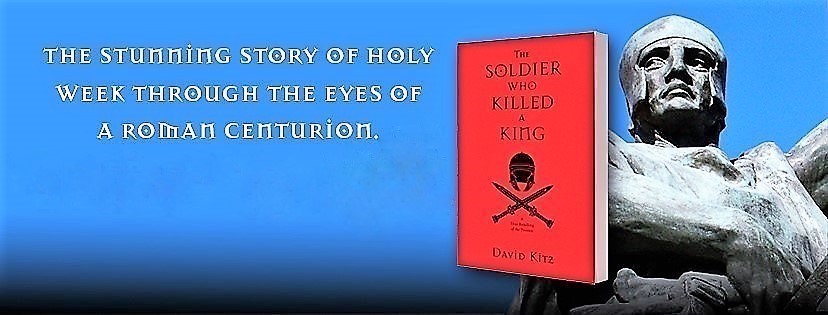
American readers click this link to purchase The Soldier Who Killed a King.

Canadian readers click this link to purchase The Soldier Who Killed a King directly from the author.

Excerpt 18 from The Soldier Who Killed a King

12 Tuesday Apr 2022

Posted by davidkitz in Books by David Kitz

≈ Leave a comment

Tags

Christ, crucifixion, Messiah, The King

A journey to the cross is a journey to repentance. It’s a journey to deep personal change. Will you take this journey with me?

Date: Nine thirty in the morning, Friday, April 7 30A.D.
The crucifixion of Jesus.

I tipped the bucket to one side to get enough swill to fill the dipper. I offered it to Jesus. He took a sip, worked the liquid around in his mouth, discerned the true nature of this bitter potion, and then spit it out. It left a dark stain on the dull gray rock near his feet.
“It will dull the pain,” I said emphatically.
He raised his eyes. They locked with mine. I saw in him the same look, the samebiblical-fiction-award-2017_orig determination I saw on the first day I set eyes on him, the day he rode the donkey into this city. I could still see he had a destination in mind. Some mystical purpose he somehow felt compelled to fulfill.
I dropped my gaze. He must be a fool. In his condition, in this situation, he must be a fool. A fool who unnerved me, but a fool nonetheless.
Once more I offered the drink.
With lips pressed tight, he shook his head.
He was a fool. An arrogant fool! A fool who thinks he’s tough—who can handle this—who can take it straight.
We would see who’s tough. I would show him who’s tough!
Let the big show begin.
“Now, boys!” I called out to the crew. Still wearing the purple robe, he was snatched like a young child and slammed down onto the crossbeam.
A cheer went up.
My right hand seized the hammer from Octavio. My left fumbled, then dove into, the nail pouch.
I dropped my knee onto his fingers.
Stabbed the sharpened point of the spike into the base of the palm.
Raised the hammer.
Xchuuuung!
An enormous cheer went up from the crowd.
Blood spurted across my thigh.
Xchuuuung!
Xchuuuung!
Xchuuuung!
One in.
The Christ was silent. Still . . .
Octavio urged me on. “That’s it, Marcus!”
I sprang to my feet, remembering the full rush of battle. Then scrambled to the other arm. From just off the hill, in the throng, a chant began and established itself. “More. More. More. More.”
Knee on fingers.
“More!”
Spike jabbed in.
“More!”
Hammer raised.
“More!”
Xchuuuung!
“More!”
Xchuuuung!
“More!”
Xchuuuung!
Two in. The Christ was silent.
Still . . . He was still beneath the piercing blows.
I rose, panting. Heart pounding. Bloodied hand dripping. Seeing a stain free area farther up my hairy arm, I wiped it across my sweat- drenched brow.
Octavio saluted me with a smile and a thumbs-up signal.
The crowd roared their approval.
This time it was Octavio who yelled, “Hoist him up.”
The Christ was dragged gasping—desperately gasping—to an upright position before the death mast.
Now they could see him, and the crowd went wild with frenzied excitement. Cheering. Clapping. Hooting. Bloodlust took hold.
The props were applied to the arms of the crossbeam.
A new chant went up. 4485 SHARABLE-2
“Raise him up!”
“Raise him up!”
“Raise him up!”
Octavio signaled, and the men in back lifted the beam on which the Christ was pinned above their heads.
Then we all saw it—saw the obvious. He was still clothed. The purple robe billowed out as it was caught by a sudden cold gust of wind. The sight of it brought all my frenzied demons to the fore.
I stepped before him, looked into his agonized face, and said, “You won’t be needing this . . . king of the Jews.”
Then to the cheers of my men, I spit into his face. I added my spittle to all the rest that had dried and was clinging to his beard.
I untied the royal robe and dropped it in a heap to my right. Finally, with a wicked smile, and to cheers all around, I snatched his breechcloth from off his loins.
I tossed it to Octavio. He held it up. A trophy!
We laughed. We all laughed. I
t was a laugh not our own.
I recognized it. It was Herod’s laugh.
When he had regained some composure, the head jailer started the final count.
“Ready . . . one . . . two . . . three . . . now!”
To chants of “Raise him up, raise him up,” the Christ, the Messiah, the king, was lifted up—up before the world.
His head twisted from side to side in writhing agony. His whip-sliced back slammed against the upright as he was dragged higher.
Then with a flesh-tearing lurch, the notch in the horizontal beam found its match in the vertical. The rope was flung around, then drawn tight, securing the two cross members as one.
The silent Christ hung. He hung naked and bleeding before a jeering world.
Only the last spike remained. Awkwardly, I fumbled for it.
But a creeping unease overshadowed me. I glanced over my shoulder. Claudius stood alone, off to the side. Silent . . . He was ghastly pale and silent, transfixed by the sight before him.
I handed the last nail and the hammer back to Octavio and said, “You do it.” He snorted his surprise, but then set quickly to his task.

American readers click this link to purchase The Soldier Who Killed a King.

Canadian readers click this link to purchase The Soldier Who Killed a King directly from the author.

Excerpt 17 from The Soldier Who Killed a King

11 Monday Apr 2022

Posted by davidkitz in Books by David Kitz

≈ Leave a comment

Tags

Caiaphas, crucify, Jesus, Messiah, Pilate

A journey to the cross is a journey to repentance. It’s a journey to deep personal change. Will you take this journey with me?

Date: Eight forty in the morning, Friday, April 7 30A.D.
The trial of Jesus ends. The verdict is delivered.
Characters: Pontius Pilate (the Badger), Caiaphas (the Weasel)

Pilate was already seated, ready to pronounce judgment. A thin smile was now on his face. The cunning Badger would make the most of his final moves. When Jesus was in position, he began. Once more he motioned in the direction of the Christ, and to all assembled he announced, “Here is your king.”
“Take him away!” came the instant response. “Take him away! Crucify him!”
There was vehement insistence coming from the crowd. Some began to hurl dust in theBiblical fiction winner 2017 air. This was verging on a riot, a point that was surely obvious to the governor, yet he played them on.
“Shall I crucify your king?” Pilate called back to the throng.
“We have no king but Caesar,” the Weasel spat back.
The Badger’s eyebrows shot up.
The governor smiled and nodded. It was a smile of triumphant satisfaction. We have no king but Caesar. The Badger mulled over these words. I knew he had waited years for these words. After all he had endured in this place, wasn’t it well worth hearing this confession from the high priest’s mouth?
Ironically, the governor had Jesus to thank for the high priest’s sudden conversion and submission to imperial Rome. This declaration would never have come forth from the Weasel’s lips, except to secure the conviction of the good Galilean. Caiaphas was willing to stoop before Rome in order to spill the blood of this prophet. Here was the true measure of his hatred for the Northern Messiah.
Pilate knew all this, and he drew a good measure of perverse satisfaction from it. He understood his foe.
He called for his personal attendant to bring a basin of water. Now he would lay the blame where the bloody blame belonged. With the attendant holding the basin before him, Pilate made a great show of washing his hands before the crowd, and with insistence in his voice, he declared, “I am innocent of the blood of this man.”
Here was the feint, the great pretend.
Next came the dodge.
With water still dripping from his hands, he looked out over the crowd and declared, “You yourselves see to it.”
He spoke as though he had abdicated—bore no responsibility for the blood that now trickled down Jesus’s back. He absolved himself of that and of all that would soon flow on Golgotha.
This Badger could throw a bit of dirt.
Free WW-e FACEBOOK-2 (2)
It was fitting for Annas the aged priest to respond. It was he who answered for the people. With his finger pointed at Jesus and his gaze fixed on him, he replied, “His blood be on us.” Then he paused as though looking down through the generations of time. “And on our children,” he added with a cold, sardonic stare.
Out on the street the people answered, “Yes!” They nodded their agreement with this verdict.

American readers click this link to purchase The Soldier Who Killed a King.

Canadian readers click this link to purchase The Soldier Who Killed a King directly from the author.

Excerpt 15 from The Soldier Who Killed a King

09 Saturday Apr 2022

Posted by davidkitz in Books by David Kitz

≈ Leave a comment

Tags

Herod, Jesus, Messiah, prophet

A journey to the cross is a journey to repentance. It’s a journey to deep personal change. Will you take this journey with me?

Date: Seven fifteen in the morning, Friday, April 7 30A.D.
Jesus is questioned by Herod Antipas.

“Jesus of Nazareth,” the Fox pompously intoned. “The prophet of Galilee. I’ve longed to see you, my most noteworthy subject.”
With that Herod arose, and holding his robe shut, he approached the Messiah. He inspected the taller man, walked fully around him. Noticing the welts and the dried spittle, he looked my way and asked, “Is this your work, centurion?”
“No, Your Majesty.” My eyes darted to Jonathon and back to Herod again.
“Ah, the high priest’s work!” the Fox remarked grandly as he turned to Jonathon. “I didn’t think you temple boys were capable.”
This bit of sarcasm drew an acknowledging nod and a slight smile from the chief temple guard. Here was a backhanded compliment from the pretentious Fox.
“Your Majesty, I have here a letter from His Excellency the governor and certain chargesJames Wri brought by—”
The king halted me with an uplifted hand and a shake of his head.
“That can wait, centurion.” He paused, and then with a certain dramatic flourish, he began. “We have here a man of rare talent. He makes the lame to walk, the blind to see, has cured the leper. I have heard reports that he has raised the dead.” And then spotting a gold chalice on the inlaid table, he seized it by the stem and with relish declared, “He has even turned water into wine.”
He lifted the chalice before the Messiah and grandly asked, “Isn’t that so, Jesus?”
The Messiah did not answer him a word.
If Herod was perturbed by this silence, he didn’t show it. “Servant girl!” he hollered. “Servant girl!”
An attractive young woman entered from the door on the left, and with short, quick steps, she made her way before the tetrarch. She bowed low.
“Fill this chalice with water and bring it back.”
He stared after her as she left.
I noticed Herodias following his hungry gaze.
“Soon we will see if this prophet can perform the works of which we heard.” He nodded his head with an eager enthusiasm. Then addressing Jesus, he asked, “Tell us of your magic arts.”
The Messiah fixed his eyes straight ahead. He looked beyond the Fox and did not answer him a word. His silence was challenging enough.
4485 TWITTER

American readers click this link to purchase The Soldier Who Killed a King.

Canadian readers click this link to purchase The Soldier Who Killed a King directly from the author.

Excerpt 14 from The Soldier Who Killed a King

08 Friday Apr 2022

Posted by davidkitz in Books by David Kitz

≈ Leave a comment

Tags

Caiaphas, Jesus, king, Messiah, Pilate

A journey to the cross is a journey to repentance. It’s a journey to deep personal change. Will you take this journey with me?

Date: Seven in the morning, Friday, April 7 A.D.
Jesus trial before Pontius Pilate continues.

In due course we all resumed our previous positions. At this point I fully expected Pilate to pronounce the prisoner guilty of high treason. After all, this Messiah had freely confessed to being a king. But I can only guess that Jesus’s words did have an impact on the governor. Upon taking his seat, Pilate announced, “I find no basis for a charge against him.”
A murmur arose from beyond the pikemen.
Caiaphas was livid. He let fly with a torrent of accusations, the last of these being that Jesus had threatened to destroy the temple and then rebuild it in three days.
Showing extraordinary patience, Pilate let the high priest rage. When Caiaphas’s fury was spent, Pilate turned to Jesus and asked, “Don’t you hear the testimony they are bringing against you?”
Free WW-e FACEBOOK-2 (2)
But Jesus answered him not a word. His silence itself became a challenge. Pilate had cleared him. Why should he answer to these further allegations?
Though stunned by this silence, Pilate repeated his position. “I find no basis for a charge against him.”
Once again discontent began to rumble through the crowd on the street.
At this point I expected the trial to end and the prisoner to be released. Let the crowds rage. Rome had spoken.
But Annas stepped smartly into the breach. “He stirs up the people all over Judea by his teaching. He started in Galilee and has come all the way here.”
“Is he a Galilean?” Pilate asked. “Under Herod’s jurisdiction?”
“Yes,” the flustered Caiaphas confessed, not knowing where this questioning might lead. “Then to Herod he should go,” was Pilate’s prompt response. “Why drag me into this?” He sneered at the high priest.
The governor seemed weary of the whole affair, and for the third time that morning, he found a way to dodge and retreat.
This trial was over.
The dark-eyed Badger rose from his judgment seat. He walked over to Jesus, the accused, and with a rather cunning smile and a nod, he said, “Off to Herod you will go, man of truth.”

American readers click this link to purchase The Soldier Who Killed a King.

Canadian readers click this link to purchase The Soldier Who Killed a King directly from the author.

Excerpt 12 from The Soldier Who Killed a King

06 Wednesday Apr 2022

Posted by davidkitz in Books by David Kitz

≈ Leave a comment

Tags

Caiaphas, executioner, Jesus of Nazareth, Messiah, Pilate

A journey to the cross is a journey to repentance. It’s a journey to deep personal change. Will you take this journey with me?

Date: Six thirty in the morning, Friday, April 7 A.D.
Jesus trial before Pontius Pilate begins.

The governor peered over the heads of the men directly in front of him. He scanned the assemblage on the street, took in the significance of it all, and then cleared his throat. “Where is the man?”
Jonathon turned quickly. On reaching the first step, he beckoned beyond our pikemen to three of his own temple guards, who then advanced with their prisoner—Jesus of Nazareth.
Picture Cent-helmetHe was a mess, almost unrecognizable. His hair was matted. He had been spat upon. The spittle was drying in his beard. There were red welts on his face and neck, a blood-oozing gash above his left eye, a discernable limp to his gait.
It was apparent that during the night they’d had their way with him.
He was escorted to a position directly before me. Intuitively I knew he was my man now, my charge.
A twitch of Pilate’s eyebrow hinted his surprise at the condition of the man.
“Loose him,” he directed with a slight wave of his hand.
Two temple guards hastened to unfasten the leather strap binding Jesus’s arms to his torso. The third man freed the prisoner’s hands. With a second wave of his hand, Pilate dismissed the temple guards, who repositioned themselves on the first step and stood facing the proceedings.
Pilate took a seat on the throne of judgment, which had been brought out for him by two attendants. Raising the scroll in his left hand, he asked, “What charges are you bringing against this man?”
It was clear from this gesture that he was referring to the charges written on the scroll he now clutched in his hand. Undoubtedly he had read these charges himself, and in all likelihood had discussed them
with the assessor standing to his right. But he wanted the high priest to articulate them. “If he were not a criminal, we would not have handed him over to you,” Caiaphas said with a huff.
A rather cheeky response, I thought.
“Take him yourselves and judge him by your own law,” Pilate answered.
Here Annas interjected, “But we have no right to execute anyone.”
A devious response if there ever was one. The temple, in fact, routinely acted as bothbiblical-fiction-award-2017_orig judge and executioner in religious matters and had been granted full authority to do so. Death by stoning was commonplace. I had witnessed Annas himself cast the first stone at some hapless adulteress within the first week of my arrival here ten years ago. No, the temple had the right to execute, and these crafty fellows could surely find grounds to execute this man. They just didn’t want the blood on their hands. They did not want to be blamed for the death of this rabbi. For many he had become the hope of the nation. No, they wanted us to do the job, to act as their executioners. They wanted him judged and executed under Roman law. What Caiaphas said next made this abundantly clear.
“We have found this man”—he aimed a bony finger at Jesus—“subverting our nation. He opposes payment of taxes to Caesar and claims to be Messiah, a king.”
Now here was a capital offense—a capital offense under Roman law.
The Weasel had backed the Badger into a corner, and he was relishing the moment. These charges would need further examination. But Pilate would not proceed in full view of a gloating high priest, urged on by his consorts and a handpicked audience. He retreated.
He abruptly arose from his throne, fixed his eyes on me, and said, “Bring the man.” He motioned with a jerk of his head toward the great doors behind us and then marched off into his residence.
I stepped down to escort Jesus, but he was already in motion. It became clear that the steps were painful for him. I put my hand to his elbow.

American readers click this link to purchase The Soldier Who Killed a King.

Canadian readers click this link to purchase The Soldier Who Killed a King directly from the author.

Excerpt 11 from The Soldier Who Killed a King

05 Tuesday Apr 2022

Posted by davidkitz in Books by David Kitz

≈ 3 Comments

Tags

Caiaphas, high priest, Messiah, Passover, Pilate

A journey to the cross is a journey to repentance. It’s a journey to deep personal change. Will you take this journey with me?

Date: Five forty-five in the morning, Friday, April 7 A.D.
In today’s reading, a messenger from Pontius Pilate arrives at the home of Marcus Longinus, the Roman centurion, with the news that Jesus has been arrested.

“Sir, I have just come from the governor. You are to report to the Praetorium immediately. Jesus of Nazareth has been arrested. The high priest has brought him before the governor for judgment.”
“Is that so?” I said in a state of consternation. “Who sent you?”
“The governor himself. He said you were familiar with the Galilean.”
I blew a short puff of air through my nostrils. All of Jerusalem was somewhat familiar with the Galilean.
“So he wants me there immediately?”
“Immediately, sir.” He shifted from one foot to the other and then, as if to justify thisCentur. Sw response, he added, “The high priest and a big delegation, maybe three hundred men, maybe more, arrived at the palace door at first light. They had the prisoner—Jesus—with them.”
“Tell the governor I’m on my way.”
With a quick nod of my head, I dismissed the messenger. Instantly he turned and began his run back to the governor’s residence. I took one step back inside the gate and began barking orders.
“You, you, and you!” I stabbed my index finger in the direction of the most dressed and prepared-looking soldiers. “Strap on your swords and follow me. Now!”
Then, addressing the other soldiers, I announced, “The rest of you, meet me at the Praetorium as soon as you are ready.”
“Claudius”—I nodded in his direction—“you are in charge. I’ll give everyone their assignment for the day when they get there.”
I stepped back through the gate and began covering the ground with long, quick strides. My three recruits had to run to catch up. With each stride a new thought came jogging into my head. Stupid Arius! Why didn’t he tell me the messenger was from Pilate? I would have moved a good deal faster.
Obviously my concerns about the prophet had moved up the chain of command. Flavio must have informed Pilate about my worries and the actions I had taken, hence this unusual move—a direct summons by the governor. I harbored the hope that he would consult directly with me on the matter. Three hundred men! Three hundred men at first light? The Weasel must have had a busy night. It takes a good deal of effort to set your troops in array. Caiaphas must have been hatching this plot for a good long while. 4485 TWITTER
But the Weasel caught his prey! What a sweet bit of treachery that must have been. I wondered how he pulled that off. Now the high priest would move in for the kill. We would see if he could slaughter his own Passover lamb. The people! If the pilgrims, especially the Galilean pilgrims, knew their Messiah had been seized, there could be a mass revolt. That must be why the Weasel had done his dirty work in the dark of the night. And furthermore, he had played out this drama at the zenith of the festival, while minds and hearts were on faith, home, and family. Here was a cunning scheme worthy of the Fox, played out by the Weasel.
Undoubtedly most of the population would still be unaware of these developments, even as I had been caught off guard. Off guard but not surprised. I could smell this coming.
My conversation with Renaldo at the bathhouse came echoing back. It gave me an eerie feeling knowing I had spoken like some prophetic oracle. It made me wonder from where that insight had really come.
“By Jupiter! I forgot the spikes.” I wheeled around while reaching out my hand to halt the soldier at my side. Addressing him directly, I said, “I forgot them—the spikes. They’re in a pouch hanging on a peg in my bedchamber. My wife, she’ll know where they are. Ask her to get the pouch for you. Then bring it to me at the Praetorium. Oh, and tell the other men to hurry. This is urgent.” I fixed my eyes on him to stress the importance of this last statement and then added, “Now run.”

American readers click this link to purchase The Soldier Who Killed a King.

Canadian readers click this link to purchase The Soldier Who Killed a King directly from the author.

← Older posts
Newer posts →

Psalms 365: Develop a Life of Worship and Prayer

Psalms 365 Volume II

Psalms 365 vol 3
— Psalms 365 Volume III

Psalms

Recent posts

  • The God of Turn-Arounds January 12, 2026
  • A Fortress of Salvation January 11, 2026
  • Finishing Well and Growing in Fruitfulness  January 11, 2026
  • I Call to You for Help January 10, 2026
  • Above All Gods January 9, 2026
  • The Need for a Place of Refuge January 9, 2026
  • David Dances before the LORD January 8, 2026

Calendar

January 2026
M T W T F S S
 1234
567891011
12131415161718
19202122232425
262728293031  
« Dec    

Blog Posts

Comments

  • davidkitz on Above All Gods
  • davidkitz on Above All Gods
  • davidkitz on David Dances before the LORD

Blog at WordPress.com.

Privacy & Cookies: This site uses cookies. By continuing to use this website, you agree to their use.
To find out more, including how to control cookies, see here: Cookie Policy
  • Subscribe Subscribed
    • I love the Psalms
    • Join 1,381 other subscribers
    • Already have a WordPress.com account? Log in now.
    • I love the Psalms
    • Subscribe Subscribed
    • Sign up
    • Log in
    • Report this content
    • View site in Reader
    • Manage subscriptions
    • Collapse this bar
 

Loading Comments...