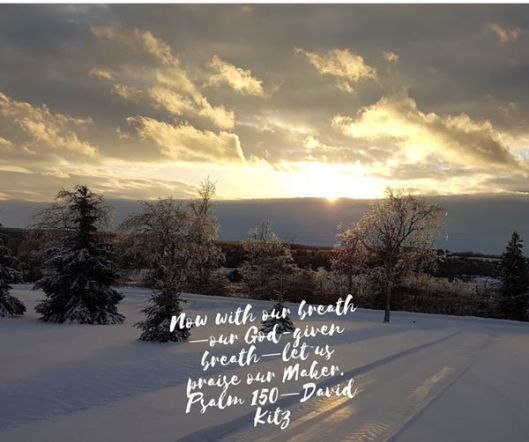
Psalm 150
08 Sunday Mar 2020

08 Sunday Mar 2020
08 Sunday Mar 2020
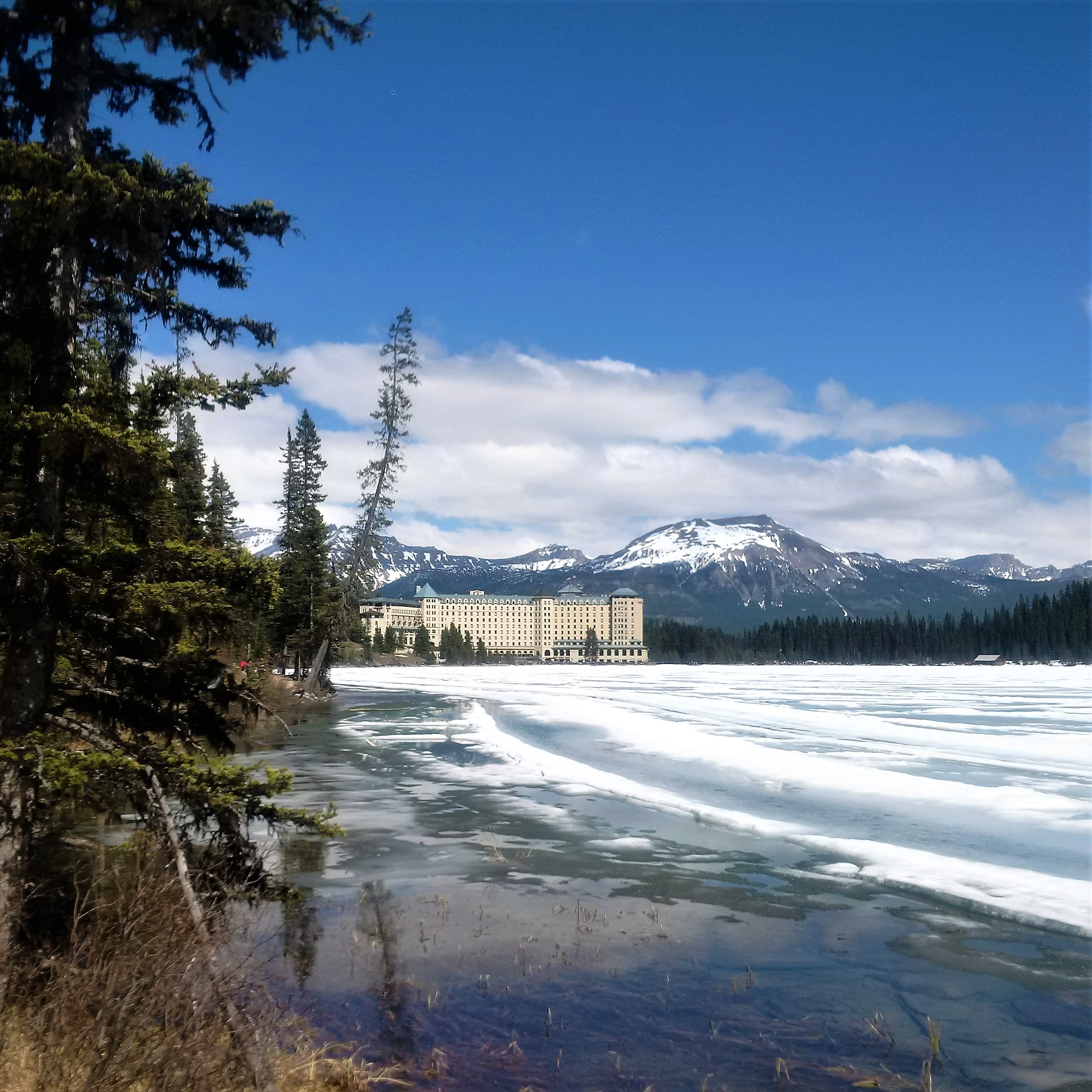
Chateau Lake Louise — photo by David Kitz
05 Thursday Mar 2020
Posted in Devotionals, Psalm 150, Psalms
Tags
Holy Spirit, joy, praise, praise the LORD, Psalm 150, Psalms
Reading: Psalm 150
Praise the LORD.
Praise God in his sanctuary;
praise him in his mighty heavens.
Praise him for his acts of power;
praise him for his surpassing greatness.
Praise him with the sounding of the trumpet,
praise him with the harp and lyre,
praise him with timbrel and dancing,
praise him with the strings and pipe,
praise him with the clash of cymbals,
praise him with resounding cymbals.
Let everything that has breath praise the LORD.
Praise the LORD (NIV).*

Photo courtesy of Liz Kranz
Reflection
We have reached the crescendo—the conclusion and the high point of the Book of Psalms. Hallelujah and praise the LORD!
The word praise appears thirteen times in this final psalm. The number thirteen is suggestive of Jesus and his apostles. He is at the core—the very center of God ordained worship.
Eight forms or instruments of praise are listed in this psalm. Eight is the number of new beginnings. Seven suggests completeness, so we see that God rested on the seventh day. But eight signals a new start. In the same way, these eight means or instruments of praise do not represent a complete list. They simply suggest the varied ways in which we can express our praise to the LORD. We have only just begun to discover and explore the many ways in which we can show our gratitude to our Creator.
No one—no living being—is excluded from this call to praise. Let everything that has breath praise the LORD.
This call for all the breathing to praise the LORD is truly fitting. We received our original breath from the LORD. Then the LORD God formed a man from the dust of the ground and breathed into his nostrils the breath of life, and the man became a living being (Genesis 2:7). Now with our breath—our God-given breath—let us praise our Maker.
In the same way after his resurrection Jesus breathed on his disciples. Again Jesus said, “Peace be with you! As the Father has sent me, I am sending you.” And with that he breathed on them and said, “Receive the Holy Spirit” (John 20:21-22).
We need the breath of God in us—the breath of the Holy Spirit in us to live—to truly live in the overcoming power and joy of the psalms. For the Holy Spirit’s presence I will praise the LORD!
Response: LORD God, I praise you. You are my strength and my song. Help me to discover new ways to praise you because you are good. Let my entire life reflect your redemptive presence in me. Amen.
Your Turn: Why are you breathing? Is praising God an integral part of your purpose?
This post by award-winning author David Kitz will be published in book format later in 2020 by Elk Lake Publishing under the title 365 through the Psalms.
03 Tuesday Mar 2020
Posted in Devotionals, Psalm 149, Psalms
Tags
Reading: Psalm 149
(Verses 1-5)
Praise the LORD.
Sing to the LORD a new song,
his praise in the assembly of his faithful people.
Let Israel rejoice in their Maker;
let the people of Zion be glad in their King.
Let them praise his name with dancing
and make music to him with timbrel and harp.
For the LORD takes delight in his people;
he crowns the humble with victory.
Let his faithful people rejoice in this honor
and sing for joy on their beds (NIV).*

Landestreu Church — photo by David Kitz
Reflection
I previously wrote that as we draw to the end of the Book of Psalms, we are slowly building to a crescendo of praise to the LORD. Today’s reading from Psalm 149 expands and amps up the level of praise.
For some praise to the LORD is one dimensional. It involves singing a hymn or worship chorus to the LORD in a place of worship at a designated time. Usually this simply means in church on a Sunday morning. But praise that is birthed by the Spirit of God can be much more than just that. Psalm 149 calls for a wide range of praise. It begins by calling for a new song. Sing to the LORD a new song, his praise in the assembly of his faithful people.
It would seem that the Creator would like to hear something fresh and creative. That’s so much like Him. After all, His mercies are new every morning. See Lamentations 3:22-23. Now don’t get me wrong. There is a place for the tried and true, and the old and familiar. But genuine praise is like fresh homemade bread. It’s best served warm from the oven. Stale worship invigorates no one.
Secondly, our praise for the LORD can take a variety of forms. Let Israel rejoice in their Maker; let the people of Zion be glad in their King. Let them praise his name with dancing and make music to him with timbrel and harp.
Just yesterday I watched a couple do a beautiful dance to a popular worship chorus. The words, the music, and their expressive movements, added heartfelt meaning to their praise. God was glorified in their dance. We were created to move and our posture and movements can reflect an expressive exuberance for God.
Finally, Spirit initiated praise knows no bounds. It refuses to be confined to a church building. It is after all an outward expression of a thankful heart. There is a place for praise, wherever we find ourselves, whether it’s on a park bench, a subway car, or as we stroll down the grocery aisle. Praise the LORD!
Response: LORD God, renew in me a heart of praise. I want to lose my self-consciousness as I praise you. This is all about you. True worship is not about me. I want to praise you with my whole being. Amen.
Your Turn: Is it possible to be God focused when we are self-focused or self-conscious?
This post by award-winning author David Kitz will be published in book format later in 2020 by Elk Lake Publishing under the title 365 through the Psalms.
28 Friday Feb 2020
Posted in Devotionals, Psalm 148, Psalms
Tags
Reading: Psalm 148
(Verses 7-12)
Praise the LORD from the earth,
you great sea creatures and all ocean depths,
lightning and hail, snow and clouds,
stormy winds that do his bidding,
you mountains and all hills,
fruit trees and all cedars,
wild animals and all cattle,
small creatures and flying birds,
kings of the earth and all nations,
you princes and all rulers on earth,
young men and women,
old men and children (NIV).*

Etienne Brule Lookout, Gatineau Park, QB — photo by David Kitz
Reflection
Psalm 148 began with a call for praise for the LORD from the angels, who are heaven’s messengers, from the heavenly hosts and all the heavenly bodies. In today’s reading, the psalmist expands this call for praise to all the creatures of the earth, the elements of nature, wind, cloud and ocean depths, and finally to all humanity.
There is a logical progression in this call for thunderous praise. The call begins with what is distant, the galaxies and the heavenly beings, and then it descends to the earth, and finally it touches humanity. It becomes personal. We are called to praise God. Will you join the swelling chorus?
John, the beloved, gives us a picture of what heaven’s praise party looks like.
Then I looked and heard the voice of many angels, numbering thousands upon thousands, and ten thousand times ten thousand. They encircled the throne and the living creatures and the elders. In a loud voice they were saying: “Worthy is the Lamb, who was slain, to receive power and wealth and wisdom and strength and honor and glory and praise!” (Revelation 5:11-12).
Our Lord taught us to pray, “Our Father in heaven, hallowed be your name, your kingdom come, your will be done, on earth as it is in heaven” (Matthew 6:9b-10).
Surely, it is the will of God that He be praised and worshiped on earth just as He is around His throne in heaven. The purpose of God’s Kingdom—the Kingdom that Jesus came to establish—is to bring heaven to earth. God did not remain distant. In the person of Jesus, He came to dwell among us. He brought and is presently bringing the will of God to the earth through the Holy Spirit. For that Jesus is to be praised. Let all of creation praise Him—praise Him from the earth, because from it we were formed. As we reflect on his first coming let the praise for our Lord ascend from you and me.
Response: LORD God, let your Holy Spirit be active among us. Help us to love and serve you and those around us. Help me to bring a little bit of heaven—a little bit of your will to the earth today. Amen.
Your Turn: How do you picture heaven? What does a little bit of heaven on earth look like to you?
This post by award-winning author David Kitz will be published in book format later in 2020 by Elk Lake Publishing under the title 365 through the Psalms.
27 Thursday Feb 2020
Posted in Devotionals, Psalm 148, Psalms
Tags
Reading: Psalm 148
(Verses 1-6)
Praise the LORD.
Praise the LORD from the heavens;
praise him in the heights above.
Praise him, all his angels;
praise him, all his heavenly hosts.
Praise him, sun and moon;
praise him, all you shining stars.
Praise him, you highest heavens
and you waters above the skies.
Let them praise the name of the LORD,
for at his command they were created,
and he established them for ever and ever—
he issued a decree that will never pass away (NIV).*

Praise him, sun and moon — photo by David Kitz
Reflection
As we draw to the end of the Book of Psalms, we are slowly building to a crescendo. It’s a crescendo of praise for the LORD. Today’s reading from Psalm 148 represents another stepping stone in that rising crescendo of praise.
The word praise appears nine times in this six-verse portion of the psalm. The psalmist repeatedly calls for all of creation to praise the LORD—to praise him. In today’s reading the call to praise is focused on the heavenly realm. You would think that the angels and the heavenly hosts would need no reminder to praise the LORD, but nevertheless the psalmist calls on them to praise their Creator. Praise him, all his angels; praise him, all his heavenly hosts. Praise him, sun and moon; praise him, all you shining stars.
If the angels need a praise prompter, then I know that I certainly do. There are days when I have a greater tendency to complain than to praise. If I am feeling a bit out of sorts or experiencing discomfort, it doesn’t take much to trip me into full-blown, grumble mode with a side order of self-pity tacked on for good measure. Praise for the LORD is a distant thought or a faint memory.
But has God changed? Has His mercy been diminished because I have a grumbly tummy or a kink in my neck? Of course not. The LORD is constantly worthy of praise—even in hard times—especially in hard times. In hard times I need to change my focus. I need to lift up my eyes to the heavens. I need to see the big picture rather than be caught up in the trifling details of my life. God is still on His throne even if I burn the toast or spill that glass of milk. Praise has greater significance at such times because it springs from a troubled heart that has shifted to become a thankful overcoming heart.
In the midst of his great suffering, Job made this declaration about his faithfulness to the LORD, “Though he slay me, yet will I hope in him” (Job 13:15a). Will that be your testimony? In all these things, the LORD, our great Creator, remains steadfast and worthy of praise.
Response: LORD God, give me a heart that is eager to praise you—even in hard times—especially in hard times. Your constant care for us does not change. Let my praise for you be just as constant. Amen.
Your Turn: Do you have a greater tendency to grumble or praise? Can you change that tendency?
 This post by award-winning author David Kitz will be published in book format later in 2020 by Elk Lake Publishing under the title 365 through the Psalms.
17 Monday Feb 2020
Posted in Devotionals, Psalm 145, Psalms
Reading: Psalm 145
(Verses 17-21)
The LORD is righteous in all his ways
and faithful in all he does.
The LORD is near to all who call on him,
to all who call on him in truth.
He fulfills the desires of those who fear him;
he hears their cry and saves them.
The LORD watches over all who love him,
but all the wicked he will destroy.
My mouth will speak in praise of the LORD.
Let every creature praise his holy name
for ever and ever (NIV).*

As for God, his way is perfect — photo by David Kitz
Reflection
Psalm 145 begins with David calling us to praise the LORD, and it ends with a similar call to praise. David extols the virtues of the LORD. He sees Him as righteous and faithful. One can have these virtues, but still be distant or aloof. But that’s not how David sees the LORD.
David knows his God hears him when he prays. How does he know this? For David this isn’t an answer he learned from a textbook. He knows God hears prayer from personal experience. In his daily life David called out to the LORD over and over again in times of trouble, and over and over again the LORD helped him. That’s why he can record the following words in this psalm of praise: He fulfills the desires of those who fear him; he hears their cry and saves them.
What about you? Have you discovered from personal experience that God answers prayer? Have you called out to the LORD in a time of trouble? Has He brought help your way?
Just this week my wife lost/misplaced her driver’s license. This produced some anxious moments as she discovered this loss just as she was about to board a flight across the country. She had arranged a car rental at her destination, but without her driver’s license she could not access the car. Some desperate prayers were offered up and in due course, after she arrived at her destination, the answer came. The driver’s license was found.
Do we involve the LORD in our day to day activities? That should be the norm. Here is David’s testimony—the testimony of Holy Scripture: The LORD is near to all who call on him, to all who call on him in truth.
That should be our testimony in the daily grind of life, in the ups and the downs. The LORD is near 365 days of the year. Before Jesus ascended to heaven, he left his disciples with these words of assurance, “Surely I am with you always, to the very end of the age” (Matthew 28:20). We can rest assured that He is as near as our next breath.
Response: LORD God, I am so glad that you are not distant or aloof from those who call out to you. You are near to me. You answer prayer. My mouth will speak in praise of the LORD. Amen.
Your Turn: Can you testify that the LORD is near and He answers prayer?
02 Thursday Jan 2020
Posted in Devotionals, Psalm 135, Psalms
Reading: Psalm 135
(Verses 1-7)
Praise the LORD.
Praise the name of the LORD;
praise him, you servants of the LORD,
you who minister in the house of the LORD,
in the courts of the house of our God.
Praise the LORD, for the LORD is good;
sing praise to his name, for that is pleasant.
For the LORD has chosen Jacob to be his own,
Israel to be his treasured possession.
I know that the LORD is great,
that our Lord is greater than all gods.
The LORD does whatever pleases him,
in the heavens and on the earth,
in the seas and all their depths.
He makes clouds rise from the ends of the earth;
he sends lightning with the rain
and brings out the wind from his storehouses (NIV).

He makes clouds rise from the ends of the earth — photo by David Kitz
Reflection
Like many of the psalms, Psalm 135 begins by calling us to worship. Specifically, this is a call to praise the LORD. Praise the LORD, for the LORD is good; sing praise to his name, for that is pleasant.
So what is the difference between praise and worship? Worship is a broad term that expresses itself in a variety of ways. The Encarta Dictionary defines worship as “the adoration, devotion, and respect given to a deity.”
We can show devotion, adoration and respect for God in wide range of ways. We can use our bodies to express worship by bowing, kneeling, falling prostrate, or lifting our hands and faces heavenward. We read that both David and Miriam danced before the LORD as an act of worship. See 2 Samuel 6:13-15 and Exodus 15:20-21.
Praise and thanksgiving are verbal forms of worship that reflect a heart of adoration. But why do the Psalms call on us to praise God so frequently? Is the LORD a grand, heavenly egomaniac who demands our worship to satisfy His desire for recognition and importance? Hardly.
Actually, just the opposite is true. God does not need our worship. We are the egomaniacs. Praise and worship counteracts the selfishness that is at the root of our sinful nature. We desperately need to get our eyes off ourselves and onto the One who is worthy of all praise. So here to counter what ales us, is a simple but powerful prescription from your heavenly Father: Praise the LORD.
Response: Father God, I worship you. Thank you for sending Jesus to be my Savior. Holy Spirit, infuse my praise and worship with joy. You are so very good—so very kind to me. Let praise in all its varied forms flow from me to you. Amen.
Your Turn: What forms or expressions of worship are most meaningful to you?
27 Friday Dec 2019
Posted in Devotionals, Psalm 132, Psalms
Reading: Psalm 132
(Verses 6-10)
We heard it in Ephrathah,
we came upon it in the fields of Jaar:
“Let us go to his dwelling place,
let us worship at his footstool, saying,
‘Arise, LORD, and come to your resting place,
you and the ark of your might.
May your priests be clothed with your righteousness;
may your faithful people sing for joy.’”
For the sake of your servant David,
do not reject your anointed one (NIV).

Snowy arch — photo by David Kitz
Reflection
David’s commitment and zeal for the presence of the LORD drew others to worship God. That’s what the opening lines of today’s reading are saying: We heard it in Ephrathah, we came upon it in the fields of Jaar: “Let us go to his dwelling place, let us worship at his footstool…”
We should never underestimate the power of our personal witness for Christ. Our zeal for God and love for His house can act as a magnet to draw others to worship Him. David’s self-denial in pursuit of God resulted in others discovering the power and grace of the LORD. By bringing the Ark of the Covenant to Zion, the City of David, David was declaring that he wanted the LORD in his home. He wanted Him close at hand—at the center of the government he was establishing over the land. See 2 Samuel 6.
Do we want God in our home? Is the LORD at the command center of your life and your daily affairs? Genuine worship brings God to the center. It removes the distance between us and God. The Psalms of Ascent are all about removing the distance between us and our Creator. They’re about drawing near.
The psalmist goes on to offer this prayer. “‘May your priests be clothed with your righteousness; may your faithful people sing for joy.’”
How are you dressed as you approach God? Apparently, clothing matters. It matters because as a redeemed child of God you are serving as a priest of the Most High. The apostle, Peter reminds us of our corporate calling and responsibility. But you are a chosen people, a royal priesthood, a holy nation, God’s special possession, that you may declare the praises of him who called you out of darkness into his wonderful light (1 Peter 2:9).
So then, as priests offering sacrifices of praise, we have an opportunity to approach God. But how should we be clothed, you ask? St. Paul provides the answer. So in Christ Jesus you are all children of God through faith, for all of you who were baptized into Christ have clothed yourselves with Christ (Galatians 3:26-27). As a blood-bought believer you are clothed with the righteousness of Christ. That’s a garment that never grows old or wears out.
Response: Father God, I thank you for covering me with a garment of righteousness. It’s the supreme righteousness of Jesus. Help me to serve and worship you daily with a grateful heart. Amen.
Your Turn: Are you drawing near to God? Do you see yourself as part of a royal priesthood?
05 Thursday Dec 2019
Posted in Devotionals, Psalm 119, Psalms
Reading: Psalm 119
ש Sin and Shin
(Verses 161-168)
Rulers persecute me without cause,
but my heart trembles at your word.
I rejoice in your promise
like one who finds great spoil.
I hate and detest falsehood
but I love your law.
Seven times a day I praise you
for your righteous laws.
Great peace have those who love your law,
and nothing can make them stumble.
I wait for your salvation, LORD,
and I follow your commands.
I obey your statutes,
for I love them greatly.
I obey your precepts and your statutes,
for all my ways are known to you (NIV).

Petrie Island reflections — photo by David Kitz
Reflection
We live in troubled times—times of domestic and foreign conflict. Turmoil abounds. If you follow world events, it seems we are sitting on a ticking time bomb. Problems and conflicts abound, and those conflicts spill across borders as people desperately seek a better life.
Into this world of uncertainty, the psalmist speaks these words. Great peace have those who love your law, and nothing can make them stumble.
If we are looking for peace in this world, we are sure to be disappointed. The ways of the world lead directly to conflict, as human greed and pride compete for dominance. This should not surprise us since the world and the systems of the world are controlled by our adversary, the prince of darkness.
Again the psalmist reminds us. Great peace have those who love your law, and nothing can make them stumble.
Our peace is not found in the world; it is found in loving your law, which is the word of God. The good news is that this word of God did not simply remain as pages in a book. It became flesh to live with us. The Word became flesh and made his dwelling among us. We have seen his glory, the glory of the one and only Son, who came from the Father, full of grace and truth (John 1:14).
Furthermore, Jesus, the living word, gives us this promise, “Peace I leave with you; my peace I give you. I do not give to you as the world gives. Do not let your hearts be troubled and do not be afraid” (John 14:27).
Response: Father God, grant me your peace. Now by faith I receive the promise of your everlasting peace. And the peace of God, which transcends all understanding, will guard your hearts and your minds in Christ Jesus (Philippians 4:7). Thank you, Lord Jesus. My sins are forgiven. Amen.
Your Turn: What brings you peace? Do you need the peace of Christ?
 I love the Psalms