I will praise Him!

Morning glories — photo by David Kitz

18 Sunday Aug 2019
Morning glories — photo by David Kitz
04 Sunday Aug 2019
Tags

Green’s Creek, Ottawa, Ontario — photo by David Kitz
09 Saturday Feb 2019

Winter path in Grey Nuns Park, Ottawa, ON — photo by David Kitz
14 Monday Jan 2019
Posted in Bible, Devotionals, Psalm 32, Psalms
Reading: Psalm 32
(Verses 8-11)
I will instruct you and teach you in the way you should go;
I will counsel you and watch over you.
Do not be like the horse or the mule,
which have no understanding
but must be controlled by bit and bridle
or they will not come to you.
Many are the woes of the wicked,
but the LORD’s unfailing love
surrounds the one who trusts in him.
Rejoice in the LORD and be glad, you righteous;
sing, all you who are upright in heart! (NIV)

Reflected clouds, Orleans, ON — photo by David Kitz
Reflection
In Psalm 32 God speaks back. David begins this psalm and we clearly can hear his voice addressing us, as he tells how wonderful it is to be forgiven. He then goes on to speak of his own struggle with unconfessed sin. Finally, he tells us of the great relief he experienced as he is pardoned and restored to a place of close fellowship with the LORD. But then abruptly in verse eight, we hear a different voice. God is speaking. The LORD responds to what David has said. Through this psalm David is modelling true prayer. This psalm is two-way communication.
We have heard David’s words; let’s hear God’s words now. I will instruct you and teach you in the way you should go; I will counsel you and watch over you.
Clearly this is not the voice of David. David is not going to counsel and watch over us. This is the work of the LORD. The LORD will teach and guide us. It is His role to shepherd the flock of His pasture.
These words, from verse eight to the end of this psalm are coming from the LORD. David has heard God speak, and now he is passing on this message from the LORD directly to us. In this respect David is fulfilling the role of a prophet. He is acting as God’s spokesperson. In fact in Acts 2:30, Peter asserts that David was a prophet. And what is a prophet? In the simplest terms, it is someone who hears God, and then passes on God’s message to others.
Do you hear God? This is no idle, rhetorical question. It is essential to our Christian faith that we as believers hear the voice of God. I would go so far as to say, that you cannot experience salvation unless you first hear God. Jesus said, “My sheep listen to my voice; I know them, and they follow me. I give them eternal life, and they shall never perish” John 10:27-28a (NIV).
In short, we must be able to hear Jesus in order to follow Him, and it is in following Him that we receive eternal life. Hearing God’s voice is of paramount importance.
Response: LORD God, give me ears to hear what you have to say to me. Please instruct me and teach me in the way I should go. Then give me grace to obey. I put my trust in you, O LORD. Amen.
Your Turn: Do you hear God’s voice? How does He speak to you? Have you heard the Lord’s voice recently? How do you distinguish God’s voice from all the other voices that you hear?
11 Friday Jan 2019
Posted in Bible, Devotionals, Psalm 32, Psalms
Tags
Reading: Psalm 32
(Verses 6-7)
Therefore let everyone who is godly pray to you,
while you may be found;
surely when the mighty waters rise,
they will not reach him.
You are my hiding place;
you will protect me from trouble
and surround me with songs of deliverance (NIV).

Photo by Pixabay on Pexels.com
Reflection
In the previous stanza of this psalm, David received the amazing dam-busting forgiveness of God. He has just experienced a wonderful release from a load of guilt. But now in his next breath he has some advice for us, and here it is. Therefore let everyone who is godly pray to you, while you may be found.
We are to pray to God while He may be found. This raises some interesting questions. Is God unavailable at times? If God cannot be found, is He hiding? Furthermore, if God is hiding, where does He hide?
At this point I feel like jumping to my feet, like a lawyer pleading a case in the court of reason, and shouting out, “I object! All that David has told us about God so far would lead us to believe that God is always close at hand. Didn’t David testify to this earlier in Psalm twenty-three? He said the following words about the LORD his shepherd: Even though I walk through the valley of the shadow of death, I will fear no evil, for you are with me. And now it seems David is telling us that there are times when God cannot be found. Which is it David? It can’t be both.”
Ah, but it is both. This is one of those great divine paradoxes. The God, who is near, even in my heart, can also be distant—light years away, both in time and space. There exists a perceived distance between us that can vary according to the state of my heart—according to the state of my relationship with God.
The fact remains that we cannot see God though we see evidence of His handiwork all around us. Our infinitely complex human bodies and finely tuned senses are themselves proof of His existence, yet Him we cannot see. He is a hidden God, and when we walk beside Him, we walk by faith and not by sight.
Repeatedly in the scriptures we are commanded to seek after the LORD. I find this to be a rather curious expression. We cannot see God, and yet we are commanded to seek Him, as though He might suddenly appear over the next hill, or around the next bend in the road. Suddenly, in unexpected ways, we may encounter God. In reality the Psalms are all about encounters with God. Psalm nineteen began that way. Suddenly the starry hosts began talking to David about God, declaring His glory. We may pick up the Bible, and suddenly it speaks to our deepest need—the need of the moment, and we know that this is the voice of God with a word specifically for us today. Even the ungodly people of this world recognize that people encounter God. They use expressions like, “He found God,” to describe someone’s conversion to faith in Christ. The LORD invites us to play the most amazing game: Hide ‘n’ seek with God.
Response: LORD God, I want to seek after you. Show yourself to me today in this grand adventure called life. I want to have an encounter with you. I want to know what it means to be found by you. Amen.
Your Turn: Have you had a recent encounter with God? Do you sense His nearness or distance?
16 Tuesday Oct 2018
Posted in Bible, Devotionals, Psalm 2, Psalms
Reading: Psalm 2
Why do the nations conspire and the peoples plot in vain?
The kings of the earth rise up and the rulers band together
against the LORD and against his anointed, saying,
“Let us break their chains and throw off their shackles.”
The One enthroned in heaven laughs; the Lord scoffs at them.
He rebukes them in his anger and terrifies them in his wrath, saying,
“I have installed my king on Zion, my holy mountain.”
I will proclaim the LORD’s decree:
He said to me, “You are my son; today I have become your father.
Ask me, and I will make the nations your inheritance,
the ends of the earth your possession.
You will break them with a rod of;
you will dash them to pieces like pottery.”
Therefore, you kings, be wise; be warned, you rulers of the earth.
Serve the LORD with fear and celebrate his rule with trembling.
Kiss his son, or he will be angry and your way will lead to your destruction,
for his wrath can flare up in a moment.
Blessed are all who take refuge in him (NIV).
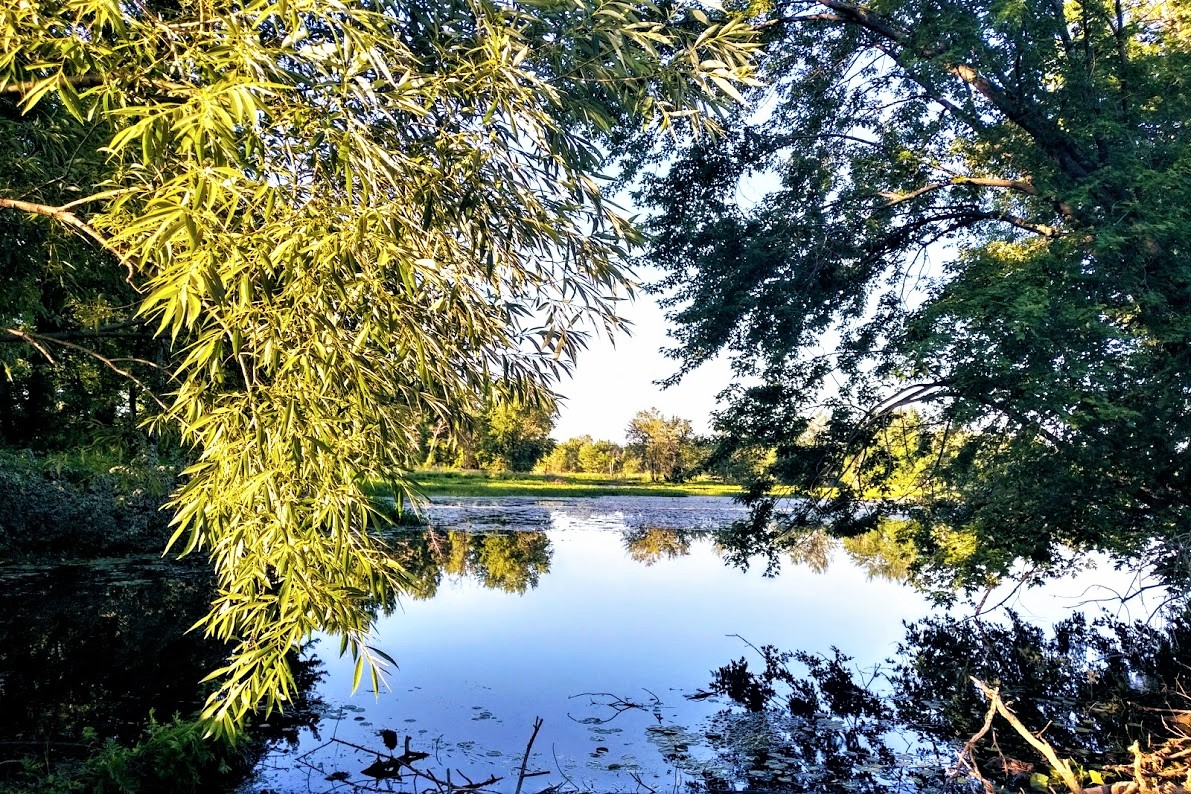
Petrie Island morning — photo by David Kitz
Reflection
Kisses are so close-up and personal, so intimate. I don’t know about you, but I don’t kiss everyone I meet. Kisses are reserved for those special people in my life—people I know and trust—people I love.
Here in Psalm 2, kings and rulers are commanded to kiss the Son of God. What an odd command? What is the significance of this? The kiss in this case signals full submission to the supreme potentate. Kings and rulers are to submit to the overarching rule of Christ over themselves, their affairs and their entire domain.
Psalm 2 is the first of several messianic psalms scattered throughout the Book of Psalms. There is nothing subtle about the messianic message found here. The LORD has installed His anointed as king in Zion and furthermore this anointed one is identified as the Son of God. The term the LORD’s “anointed” is frequently translated as Messiah or Christ.
In the Book of Acts, we see the apostles viewed this psalm as the prophetic fulfillment of Christ’s mission during his last days in Jerusalem. The anointed Son of God was rejected by Herod and Pilate, the rulers of that time. They refused to kiss the Son. See Acts 4:23-31.
But what about me? Have I kissed the Son? Have I submitted to his will for my life? In my own small way, I too am a monarch, a ruler of my own domain. Today, will I allow him to rule over me, my conduct, my activities, and my financial affairs?
Response: Dear Lord Jesus, thank you for your unconditional love. You want only the best for me. I yield to you. Help me to embrace your will and purpose for my life. I trust in you. I love you, Lord. With my lips I kiss the Son. Amen.
Your Turn: Have you kissed the Son? How can you show your love and loyalty to Jesus today?
15 Monday Oct 2018
Posted in Bible, Devotionals, Psalm 1, Psalms
Tags
Bible, David Kitz, fruit, Psalm, redemption, tree
Reading: Psalm 1
Blessed is the one
who does not walk in step with the wicked
or stand in the way that sinners take
or sit in the company of mockers,
but whose delight is in the law of the LORD,
and who meditates on his law day and night.
That person is like a tree planted by streams of water,
which yields its fruit in season
and whose leaf does not wither—
whatever they do prospers.
Not so the wicked!
They are like chaff that the wind blows away.
Therefore the wicked will not stand in the judgment,
nor sinners in the assembly of the righteous.
For the LORD watches over the way of the righteous,
but the way of the wicked leads to destruction (NIV).

Weeping willow, Grey Nuns Park, Orleans, ON — photo by David Kitz
Reflection
Have you ever noticed the prominent role that trees play in the Bible? The creation account in Genesis begins with God planting two very special trees in the Garden of Eden: the Tree of Life and the Tree of the Knowledge of Good and Evil. After our first parent’s disobedience, we were banned from access the Tree of Life. But the amazing, good news of the Bible is that at the end of the book, in the last chapter of the Book of Revelation, God restores our access to the Tree of Life (Revelations 22:1-5).
In a very real sense the Bible is a story about trees.
Here in the very first Psalm, the life of the righteous is compared to a fruit-bearing tree, flourishing by streams of water. The psalmist presents a picture of tranquil beauty. Is that a picture of my life, or am I caught up in busyness? Sometimes I feel more like windblown chaff—rather worthless and lacking a sense of direction.
But that’s where the other tree at the heart of the Bible comes into play. It stands on a hill called Calvary. There my Saviour bled and died. There he showed me my true worth. There my sins were washed away, never to be remembered again. That’s where I became righteous, not by works that I had done, but by the grace and forgiveness of Christ.
What a beautiful tree! The tree on Mount Calvary isn’t beautiful because of its leaves. It’s beautiful because of its fruit—the fruit of redemption purchased by the blood of Jesus. My righteousness is solely due to him.
Response: Dear Lord Jesus, thank you for your sacrifice. Help me to always remember that you are the true source of my righteousness. At your prompting help me to rid myself of the worthless chaff in my life. Wind of God, blow on me. Water of life, refresh my soul. May I be fruitful, Lord, for you. Amen.
Your Turn: Have you knelt before the tree on Mount Calvary?
12 Friday Oct 2018
Posted in Bible, Devotionals, Psalms
Tags
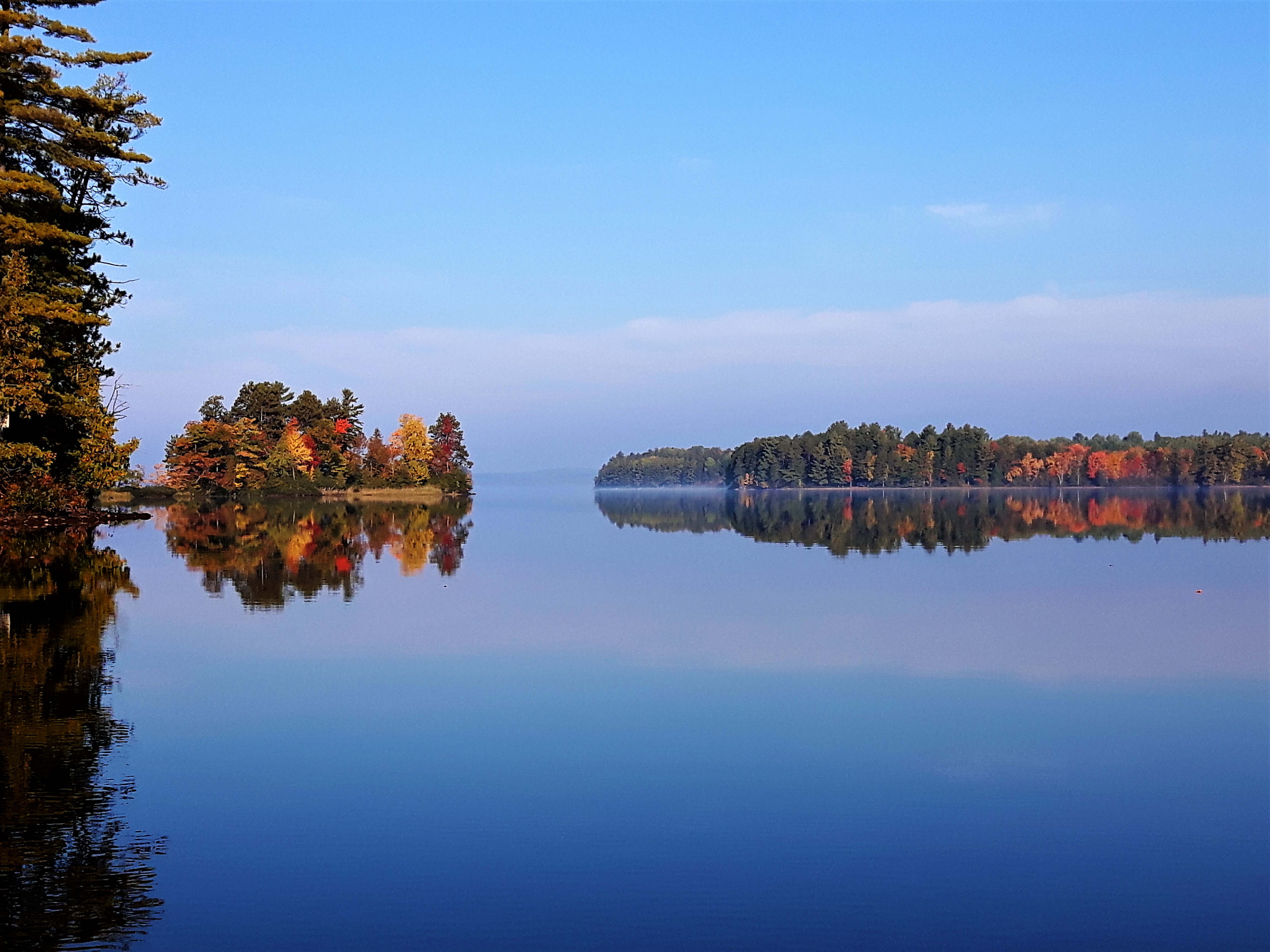
Quiet beauty, Round Lake, Ontario — photo courtesy of Liz Kranz
Yesterday’s Psalm 150 post signals the end of the Book of Psalms. But is it really the end? Technically, Psalm 150 is the last of the biblical psalms, but God’s people have not stopped writing psalms. Down through the ages, God’s spirit has continued to move on people’s hearts, and in response they have written psalms and hymns and spiritual songs.
Paul, the apostle, gave this advice to the Ephesian church: Do not get drunk on wine, which leads to debauchery. Instead, be filled with the Spirit, speaking to one another with psalms, hymns, and songs from the Spirit. Sing and make music from your heart to the Lord, always giving thanks to God the Father for everything, in the name of our Lord Jesus Christ (Ephesians 5:18-20).
Psalm writing and singing have never ended, just as worship has never ended. It will continue through all eternity.
Those who have faithfully followed this post have journeyed through the entire Book of Psalms—from Psalm 1 to Psalm 150. In total I have written 365 devotional posts on the Psalms; a devotional post for every day of the year. At some point I hope to have these posts published in book form. If you think this is a good idea, please let me know in a comment below.
Is this really the end of my daily posts?
No. On Monday I will start the sequence once more beginning at Psalm 1. I hope you will continue the journey. Each time through we can gain new insights.
Response: LORD God, thank you for your holy word. Help me to read, study and apply it to my daily life. Amen.
Your Turn: Have you enjoyed this journey through the Psalms? Is there some aspect of these posts that you have particularly appreciated?
08 Tuesday May 2018
Posted in Bible, Devotionals, God's word, Psalm 107, Psalms
Tags
desert, Jesus, Orleans, prisoners, prosperity, Psalm, rebellious ways, redemption, the LORD, thirst
Reading: Psalm 107
(Verses 1-9)
Give thanks to the LORD, for he is good;
his love endures forever.
Let the redeemed of the LORD tell their story—
those he redeemed from the hand of the foe,
those he gathered from the lands,
from east and west, from north and south.
Some wandered in desert wastelands,
finding no way to a city where they could settle.
They were hungry and thirsty,
and their lives ebbed away.
Then they cried out to the LORD in their trouble,
and he delivered them from their distress.
He led them by a straight way
to a city where they could settle.
Let them give thanks to the LORD for his unfailing love
and his wonderful deeds for mankind,
for he satisfies the thirsty
and fills the hungry with good things (NIV).
Reflection
This psalm is different. It’s unique among the 150 psalms in the Bible because it presents us with various vignettes of redemption—brief stories or scenes where the LORD rains down his mercy and rescues the wayward and downtrodden.
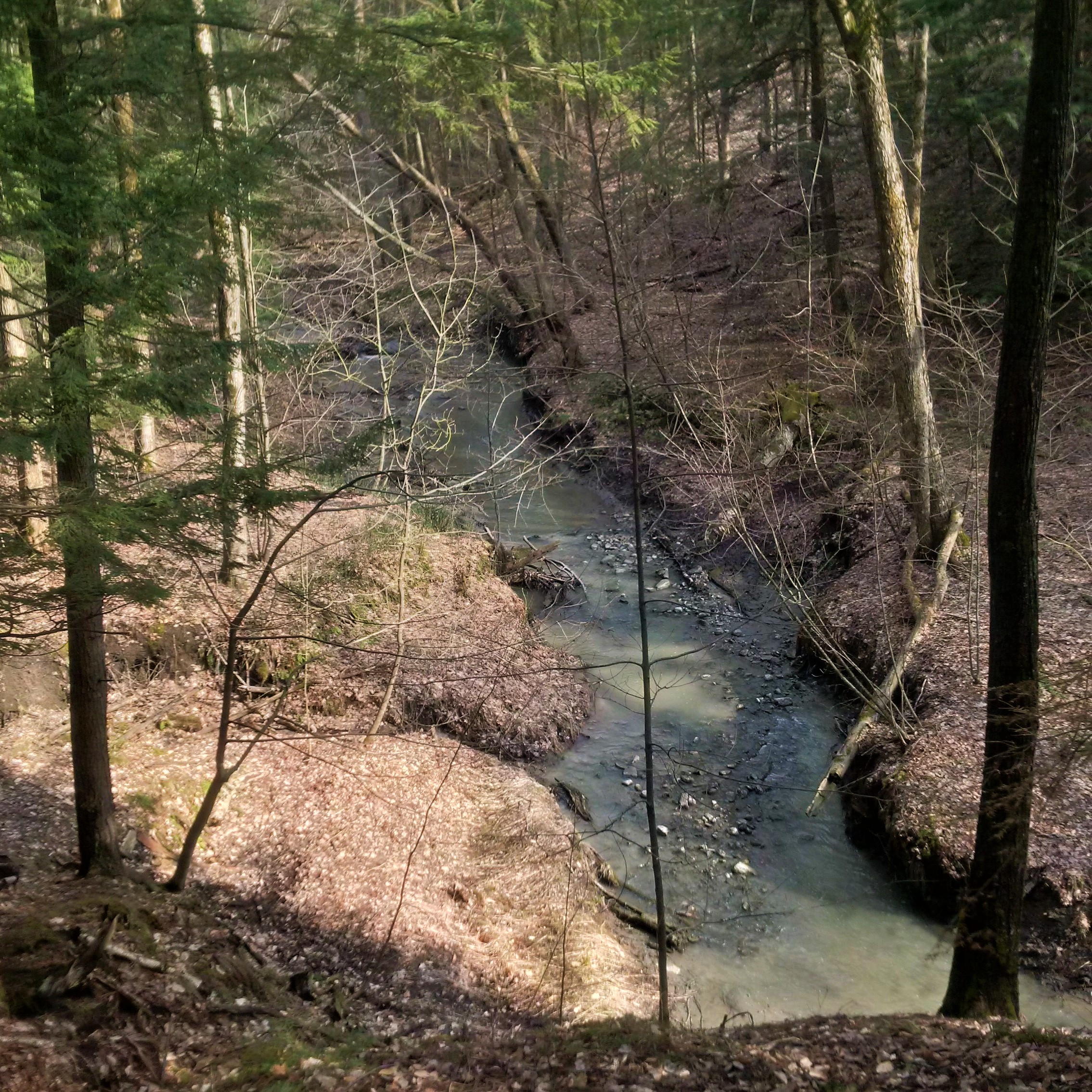
Babbling creek in a deep ravine, Orleans, ON — photo by David Kitz
In verse two the psalmist declares, “Let the redeemed of the LORD tell their story.” Then as the psalm progresses, he goes on to describe five scenes or stories of redemption. The desert-stranded traveler is rescued; the prisoner is set free, the rebellious are brought healing and encouragement, those lost in a storm-tossed sea find a safe harbor, and prosperity returns to the inhabitants of a parched wasteland. In every situation, the great God of heaven hears the cries of His people and shows them His plenteous mercy.
What a good God we serve! With the psalmist we exclaim, “His love endures forever!”
If you are a follower of Jesus, you too have a story of redemption to tell. He rescued you from a downward hellish spiral just as real as those described in this psalm. Some rescues come in the nick of time; others come early on, before we sink neck-deep into trouble. We might call them preemptive rescues. Whatever your personal story, it’s a testimony worth telling. God intervened in your life, and the good news is He stands ready to intervene again at the very moment you cry out to Him.
He loves to redeem His people. It’s in His nature. Spiritually, are you in a desert place? Call out to Him.
Response: Father God, I am thankful that I have a story of redemption. You intervened in my life. Today I thank you for satisfying my thirst and filling my life with good things. Amen.
Your Turn: Do you have a story of redemption to tell? Was it pre-emptive or in the nick of time?
03 Tuesday Apr 2018
Posted in Bible, Devotionals, Psalm 99, Psalms
Tags
Aaron, consequences, David, discipline, Edmonton, forgiveness, forgiving, holy, Moses, promised land, Psalm, Samuel, selfish, sin, the LORD, transgressions, witchcraft, worship
Reading: Psalm 99
(Verses 6-9)
Moses and Aaron were among his priests,
Samuel was among those who called on his name;
they called on the LORD
and he answered them.
He spoke to them from the pillar of cloud;
they kept his statutes and the decrees he gave them.
LORD our God,
you answered them;
you were to Israel a forgiving God,
though you punished their misdeeds.
Exalt the LORD our God
and worship at his holy mountain,
for the LORD our God is holy (NIV).
Reflection
David’s name appears in the text of several of the psalms, but this is the only psalm that lists other heroes of the faith. Moses, Aaron and Samuel, three heavy hitters of the Old Testament, are honored here. They are honored because they called on the LORD and he answered them.

Wild roses, Edmonton, Alberta — photo by David Kitz
I could quibble with the choice of these three. Moses struck the rock in anger when he was told to speak to it and thereby bring forth water for the people. As a consequence, he was not allowed to enter the Promised Land. Aaron gave into the people’s will and fashioned an idol—the golden calf. Samuel appointed Saul as the first king of Israel—a man who became a disappointing, disastrous leader who descended into witchcraft.
But… But then can I claim to be error free in the way I have lived my life? Like Moses I have lost my patience in more than one situation. If God treated me like Moses, there would be little hope of me reaching the Promised Land. Like Aaron I have a tendency to be led astray by the crowd, and like the prophet Samuel, at times I have backed people who stumbled badly and betrayed the Lord.
I have not lived a flawless life. That’s why I take comfort in these words: LORD our God, you answered them; you were to Israel a forgiving God, though you punished their misdeeds.
I need a forgiving God. I need a God who forgives my transgressions—those times when I think I know better, but of course I’m wrong. And if I am truly honest, I also admit that I need a God who punishes my misdeeds. If there are no consequences for my wrong doing, my transgressions will escalate. I need the discipline of the LORD, or I will go astray by following my own selfish desires. Just like the ancient people of Israel I need to live under the wise and loving rule of a holy God. How about you? Do you need a forgiving God?
Response: LORD God, you are holy. I want to live in a way that honors you. You know my failings and shortcomings. Forgive me as I call on you. I am needy, but in you I find all that I need. Amen.
Your Turn: If there were no consequences for sin would that change your life and conduct? Do you fear the consequences that come from wrong doing?
 I love the Psalms