• Home
  • About
  • DavidKitz.ca
  • Youtube Videos
  • Books by David
  • Books on Amazon.com

I love the Psalms

~ Connecting daily with God through the Psalms

I love the Psalms

Tag Archives: repent

David Awakens the Dawn

15 Tuesday May 2018

Posted by davidkitz in Bible, Devotionals, God's word, Psalm 108, Psalms

≈ 7 Comments

Tags

atheist, David, dawn, Manitoba, music, prairie, praise, Psalm 108, repent, steadfast, sunrise, thankful, the LORD

Reading: Psalm 108
A song. A psalm of David.
(Verses 1-5)
My heart, O God, is steadfast;
I will sing and make music with all my soul.
Awake, harp and lyre!
I will awaken the dawn.
I will praise you, L
ORD, among the nations;
I will sing of you among the peoples.
For great is your love, higher than the heavens;
your faithfulness reaches to the skies.
Be exalted, O God, above the heavens;
let your glory be over all the earth
(NIV).

Reflection
This morning did you awaken the dawn or did the dawn awaken you? For those who are early risers awakening the dawn becomes much easier as the days get shorter and we approach the winter solstice. But just the opposite is true now. I confess that this morning I did not awake before sunrise.

img_20161114_074737

Manitoba sunrise, “Awake my soul” — photo by David Kitz

There is something quite magical about watching the sunrise and spread its golden rays across the eastern sky. I was treated to a magnificent sunrise display last Monday. I was driving east across the prairies and as each mile slipped by the glory along the horizon grew more and more intense. I pity the poor atheist who has no one to praise when he beholds such a display.

For believers, praise for our God springs naturally from our lips when we see God paint the sky with golden hues of splendor. In such moments David’s call to worship becomes our own: Awake, harp and lyre! I will awaken the dawn. I will praise you, LORD, among the nations; I will sing of you among the peoples. 

Can you picture David taking up his harp and breaking into song as he locks his eyes on the rising sun? David was a most remarkable character. What sets David apart from other individuals we meet in the pages of scripture? He was a man of spectacular failings. His adulterous affair with Bathsheba and the treacherous means he used to dispatch her husband stand out. But there’s nothing remarkable about spectacular failings and shortcomings. These are common to man.

What stands out about David’s character is his steadfastness to the LORD. The opening lines of Psalm 109 hold the key to understanding David’s overcoming nature. My heart, O God, is steadfast; I will sing and make music with all my soul. 

Despite his failings, David remained steadfast in his love for God. Secondly, he was wholehearted in his praise for God. When things came off the rails, he did not turn away from the LORD or stop praising Him. He repented and God forgave him. Then David gave thanks. David’s example is there for us to follow.

Response: LORD God, I always want to have a thankful heart that is quick to praise you. Help me to be steadfast in love and praise even when the way ahead is difficult. You are my help and my glory. Amen.

Your Turn: What does being steadfast look like for you?

Is your relationship with God steadfast or cyclical?

14 Monday May 2018

Posted by davidkitz in Bible, Devotionals, God's word, Psalm 107, Psalms

≈ Leave a comment

Tags

blessing, cyclical, desert, God's blessing, God's love, mercy, redemption, repent, steadfast, streams, thankful, the LORD

Reading: Psalm 107  
(Verses 33-43)
He turned rivers into a desert,
flowing springs into thirsty ground,
and fruitful land into a salt waste,
because of the wickedness of those who lived there.
He turned the desert into pools of water
and the parched ground into flowing springs;
there he brought the hungry to live,
and they founded a city where they could settle.
They sowed fields and planted vineyards that yielded a fruitful harvest;
he blessed them, and their numbers greatly increased,
and he did not let their herds diminish.
Then their numbers decreased, and they were humbled
by oppression, calamity and sorrow;
he who pours contempt on nobles
made them wander in a trackless waste.
But he lifted the needy out of their affliction
and increased their families like flocks.
The upright see and rejoice, but all the wicked shut their mouths.
Let the one who is wise heed these things
and ponder the loving deeds of the L
ORD (NIV).

Reflection
I wish I could say that I was always steadfast in my love for the LORD and steadfast in the pursuit of His will and purpose for my life. But in reality my walk with God has been cyclical. There have been times when I have sensed God’s great love and intimacy, and other times when I have followed the Lord from a distance.

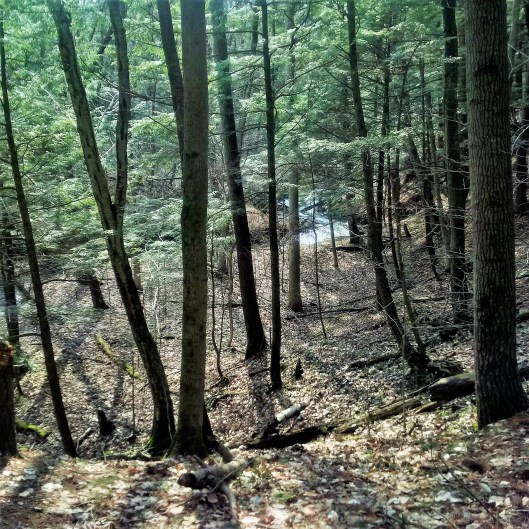
2018-04-28b

The forest floor and the green of spring — photo by David Kitz

In this concluding portion of Psalm 107, we see the cyclical nature of our love for God on full display. As people cry out to the LORD in their distress, He hears and answers their prayers. The LORD blesses them abundantly. He turned the desert into pools of water and the parched ground into flowing springs; there he brought the hungry to live, and they founded a city where they could settle.

But with increased prosperity, people often forget God who brought the blessing. They assume that wealth and good times have arrived simply because of their own effort. Yes, God expects us to exert some effort. But we can put in effort and get no increase. Ultimately, God is the source of every blessing. Every good and perfect gift is from above, coming down from the Father of the heavenly lights, who does not change like shifting shadows (James 1:17).

When we forget to be thankful, we set ourselves on a downward spiral where again we will soon need to repent and call out to God for mercy. We need national and personal steadfastness to the LORD. 

Response: Father God, thank you for my personal story of redemption. Help me to always remain thankful. I don’t want to be trapped in a cycle. Help me to be steadfast in pursuing your will. Amen.

Your Turn: Are you steadfast or cyclical in your pursuit of God?

Excerpt 14 for Lent from The Soldier Who Killed a King

08 Thursday Mar 2018

Posted by davidkitz in Books by David Kitz, Christ's Passion, Lent, Psalms

≈ 1 Comment

Tags

baptize, Caesar, Holy Week, hypocrites, Jesus, Jesus of Nazareth, John the Baptist, Jordan River, Lent, repent, Rome

A journey to the cross is a journey to repentance. It’s a journey to deep personal change. Will you take this journey with me?

In today’s reading, Marcus is in conversation with his nephew, the young soldier Claudius. Claudius is reporting on the activities and the message of Jesus of Nazareth on Tuesday of Holy Week.

Claudius went on. “One thing I do know for sure: those fancy-robed religious leaders don’t like him much. Jesus had taught for a while this morning, when all of a sudden the high priest, along with maybe ten other officials, came marching in. They demanded to know by what authority he was doing these things.

DSC_0060

A Roman centurion

He didn’t answer them, but instead he asked them a question. He asked them, ‘By what authority did John baptize?’ They talked it over and then said, ‘We don’t know.’ So he said he wouldn’t answer their question either. They just turned around and left in a holy huff. You could really tell the crowd around Jesus just loved the way he handled these high and mighty holy types.” Claudius abruptly turned to me and asked, “Who was this John anyway?”
“A few years back he caused quite a stir. Thousands of people went out to the Jordan River to hear him. He insisted that people repent, turn from their sins, and then he would baptize them in the river. Even some of my own men went out to hear him. In the end, Herod the tetrarch had him beheaded.”
After reflecting a moment on the day’s events, I caustically commented, “That bloody old Fox hasn’t changed much.”
“Anyway,” Claudius continued, “from then on Jesus would teach for a while, and then some new high-powered delegation would arrive to question him. They weren’t sincere in their questions. It was like they were trying to trap him into saying something they could later use against him. That’s all I think they were after. But in the end Jesus always turned the tables on them. He exposed their real motives. He saw right through them.”
I felt a certain remembered discomfort when Claudius said those words. After all, Jesus’s eyes had shone a light on the darkness of my own soul. I don’t know why I felt so naked, so transparent before this man.
“But, Claudius, what makes you so sure he’s not here to kick out the Romans?”
“It was the way he answered one of those fancy-robed delegations. They asked him if it was lawful to pay taxes to Caesar. He called them hypocrites right to their faces. He accused them of trying to trap him. Then he asked for a coin. He demanded to know biblical-fiction-award-2017_origwhose portrait and inscription were on it. When they answered, ‘Caesar’s,’ he jumped on them—like a cat onto a nest of mice. ‘So give back to Caesar what is Caesar’s, and to God what is God’s,’ he told them. Even at a distance, I could see their mouths drop and their ears catch fire. They left like cowering dogs with their tails between their legs.”
Claudius became even more animated as he said, “The crowd—the crowd loved it. You could really tell the people loved seeing those phony religious officials get a taste of a little humility. I’m sure they haven’t tasted it for a good long while.”
Then to conclude, he said, “That’s why I don’t think he’s a threat to us. He’s not opposed to paying taxes. Nothing he said all day makes me think he’s got a quarrel with Rome. But he’s sure got the religious leaders worried and bothered. Later in the day he went after them full force. Called them hypocrites, blind guides, a brood of vipers!”
“Ooo! I’m sure they were pleased,” I said sarcastically.
This assessment confirmed what Renaldo and I had been thinking. I had heard the same thing reflected back to me by Flavio. This latest evidence on taxes lent considerable weight to the conclusion Claudius had drawn. But I still felt uneasy. Jesus simply struck me as such a huge, larger-than-life figure—the kind of person you don’t dismiss lightly, no matter what others say. I somehow felt that all we had done thus far was scratch the surface. I’m not sure I really understood him at all. How could I begin to fathom what he was trying to accomplish?

American readers click this link to purchase The Soldier Who Killed a King.

Canadian readers click this link to purchase The Soldier Who Killed a King directly from the author.

The LORD Will Give What Is Good

14 Wednesday Feb 2018

Posted by davidkitz in Bible, Devotionals, Psalm 85, Psalms

≈ 1 Comment

Tags

abandoned, difficulties, error, faithfulness, harvest, listening to God, Orleans, peace, promises of God, repent, Righteousness, sin, storms of life, the LORD, trouble

Reading:                                      Psalm 85

(Verses 8-13)
I will listen to what God the LORD says;
he promises peace to his people, his faithful servants—
but let them not turn to folly.
Surely his salvation is near those who fear him,
that his glory may dwell in our land.
Love and faithfulness meet together;
righteousness and peace kiss each other.
Faithfulness springs forth from the earth,
and righteousness looks down from heaven.
 The L
ORD will indeed give what is good,
and our land will yield its harvest.
Righteousness goes before him
and prepares the way for his steps
(NIV).

Reflection
Psalm 85 began with the psalmist reflecting on a wonderful time of God’s favor and forgiveness. God’s grace had been abundant and a source of great joy. But that is not the present reality. It would seem that for some reason God’s hand of blessing has been lifted and the psalmist finds himself crying out for mercy and revival. Will you not revive us again, that your people may rejoice in you? Show us your unfailing love, LORD, and grant us your salvation.

2018-02-05d

Snowy trail, Orleans, Ontario — photo by David Kitz

Times of hardship and personal setbacks can leave us wondering if God has abandoned us. Have we sinned? Has God withdrawn His blessing from our lives? Will He shows us His kindness once again? In difficult times these questions often flood our minds.

After pleading for restoration and pouring out his troubles before God the psalmist makes this statement, “I will listen to what God the LORD says.” 

Now that’s sound advice. Listening to what God says is always a good idea. It resolves inner conflict and brings peace of mind. And what does God the LORD say? “He promises peace to his people, his faithful servants—but let them not turn to folly.”

Often we feel that when things aren’t going right in our lives, we must be at fault. Perhaps we are and we should repent. But there are other times when the hardships we face are not due to sin or error on our part. Troubles and difficulties come to all of us. On such occasions the LORD promises us peace. He assures us that we are walking in His will and He is right there with us in the midst of life’s storms. Here is His promise for you: The LORD will indeed give what is good, and our land will yield its harvest. Righteousness goes before him and prepares the way for his steps.

Hang onto the righteousness of God. He is about to step into your life in a beautiful way.

Response: LORD God, I turn to you in the middle of my difficulties. Open my ears to hear your voice speaking to me. I trust you to lead me. Come and step into my life. Amen.

Your Turn: Can you recall occasions when God has stepped into your life? What did that look like?

The Repentance Psalm

31 Tuesday Oct 2017

Posted by davidkitz in Bible, Devotionals, Psalm 51, Psalms

≈ 9 Comments

Tags

adultery, David, humble, king, King of Israel, murder, Nathan, Nathan the prophet, Philistines, repent, repentance, repentance psalm, sin, sinned, the LORD, transgressions

Reading:                                       Psalm 51

For the director of music. A psalm of David. When the prophet Nathan came to him after David had committed adultery with Bathsheba.
(Verses 1-9)
Have mercy on me, O God, according to your unfailing love;
according to your great compassion blot out my transgressions.
Wash away all my iniquity and cleanse me from my sin.
For I know my transgressions,
and my sin is always before me.
Against you, you only, have I sinned
and done what is evil in your sight;
so you are right in your verdict and justified when you judge.
Surely I was sinful at birth,
sinful from the time my mother conceived me.
Yet you desired faithfulness even in the womb;
you taught me wisdom in that secret place.
Cleanse me with hyssop, and I will be clean;
wash me, and I will be whiter than snow.
Let me hear joy and gladness;
let the bones you have crushed rejoice.
Hide your face from my sins and blot out all my iniquity
(NIV).

Reflection
Psalm 51 is the great repentance psalm. Nothing matches the deep contrition expressed here by David. There can be little doubt that David was truly remorseful for what he had done. He says it with words, but according to the Scriptures, his actions which followed also revealed a repentant heart. There is no blame shifting here; David takes full responsibility for his actions. Hear his humble plea: For I know my transgressions and my sin is always before me. Against you, you only, have I sinned and done what is evil in your sight; so you are right in your verdict and justified when you judge.

img_20161017_084132

The path ahead, Grey Nuns Park, Orleans, ON — photo by David Kitz

When Saul and Jonathan were slain in battle by the Philistines, David composed this lament. “Your glory, O Israel, lies slain upon your high places! How the mighty have fallen!” (2 Samuel 1:19 NRSV). David might well have sung this lament for himself. Here he was the vaunted King of Israel, the LORD’s anointed, and he had a fellow soldier murdered to cover up the adulterous affair he was having with this loyal soldier’s wife. This was the conduct of David—the man of God! Yes. “How the mighty have fallen!”

The amazing part of this story is not David’s sin or the depths of his depravity. The amazing part is that he repented—earnestly repented. In our day leader after leader has been caught red-handed in unscrupulous practices. But do they repent? Do they come clean and change their ways? Not likely. Most often they continue in denial. Those with absolute power continue to govern ruthlessly. Nathan, the prophet, was fortunate that King David heard the voice of God speaking through a human vessel. David was quick to humble himself and repent. How do you respond when confronted with your sin? 

Response: LORD God, I want to be like David—quick to acknowledge my sin and repent. Grant me a soft heart—a sensitive heart—a repentant heart in Jesus’ name. Amen.

Your Turn: How can we maintain a repentant heart before God? What hinders repentance?

Troubled by my Sin?

25 Monday Sep 2017

Posted by davidkitz in Bible, Devotionals, Psalm 38, Psalms

≈ 1 Comment

Tags

Blame, confess, David, God, grace, Moses, Ottawa ON, Ottawa River, repent, repentance, Savior, sin, the LORD

Reading:                                      Psalm 38

(Verses 17-22)
For I am about to fall,
and my pain is ever with me.
I confess my iniquity;
I am troubled by my sin.
Many have become my enemies without cause;
those who hate me without reason are numerous.
Those who repay my good with evil
lodge accusations against me,
though I seek only to do what is good.
LORD, do not forsake me;
do not be far from me, my God.
Come quickly to help me,
my Lord and my Savior
(NIV).

Reflection
Today’s reading is the concluding portion of Psalm 38. As noted previously, this entire psalm is a lament over sin, and the trouble and affliction it has brought into David’s life. Rather than blaming others or blaming God, David takes responsibility for his self-inflicted difficulties. In anguish of spirit he cries out, “I confess my iniquity; I am troubled by my sin.”

2017-09-19

The Ottawa River, Ottawa, ON — photo by David Kitz

Are you troubled by your sin, or do you revel in it? Have the consequences of sin started to bite. The writer of the Book of Hebrews tells us that Moses “chose to be mistreated along with the people of God rather than to enjoy the fleeting pleasures of sin” (Hebrews 11:25). There are pleasures in sin for a season, but the long term consequences are pain and death. It would appear from a full reading of this psalm that David is suffering some of the consequences of his misguided sin.

But David has the correct response. He confesses his sin and throws himself upon the mercies of God. Hear his humble plea, “LORD, do not forsake me; do not be far from me, my God. Come quickly to help me, my Lord and my Savior.”

God’s ears are always open to that kind of prayer. We may believe that we have fallen too far –that our sin is too great –that we have sunk too low. But God hears our cry and His grace is sufficient. His mercy knows no bounds. The blood of Christ flows to the lowest valley. He can cleanse the vilest heart, if we call out to Him.

Repentance is a wonderful gift, perhaps the greatest gift of all. At various times in his life David fell into the grip of sin. But David knew how to repent and as a result he found favor in the eyes of God. Discover the gift of repentance today. It’s more than feeling sorry for yourself. It’s a 180-degree turn from pursuing sin to pursuing God.

Response: LORD God, grant me the gift of repentance. I am thankful that Jesus died on the cross to wash me clean. Hallelujah! I want to pursue you, Lord. You are my help and my righteousness. My salvation comes from you. Amen.

Your Turn: Are you troubled by sin? Have you found a remedy?

Know my Heart

30 Thursday Mar 2017

Posted by davidkitz in Psalm 139, Psalms

≈ 10 Comments

Tags

Bible, comfort, encouragement, exposure, Grey Nuns Park, Heart, hiding, hiding from God, Jesus, Psalm, Psalms, repent, search, self-deception, self-flattery, top ten

Reading:                                         Psalm 139

(Verses 23-24)

Search me, God, and know my heart;

test me and know my anxious thoughts.

See if there is any offensive way in me,

and lead me in the way everlasting (NIV).

Reflection

In my opinion, Psalm 139 rates in the top ten of the 150 psalms in the Bible. Many find deep comfort and encouragement in it. It is arguably the most intimate or personal psalm. Take a minute to read the entire psalm and you will see for yourself why I draw these conclusions.

IMG_20170325_072353[153]

Shine your light on me, Grey Nuns Park, Orleans, ON — photo by David Kitz

The Psalm begins by pointing out the futility of fleeing from God. We can’t hide from Him though we may try. The prophet Jonah discovered this truth the hard way. In Jonah’s case, it took three days and three nights in the belly of a huge fish to come around to right perspective. See Jonah 1 & 2. How long does it take for us to realize how foolish it is to run from God? I dare say some of us sink below sea-level before the wisdom of Psalm 139 takes hold.

Though the psalmist begins by discussing the futility of hiding from God, he concludes by asking for God to search his heart. He willingly comes before the LORD and asks to be tested. That takes humility and courage—more humility and courage than many of us can muster.

Search me, God, and know my heart; test me and know my anxious thoughts. This appears to be a very straightforward request, but there are intricacies to this statement that deserve some careful consideration.

Does God need to search my heart? Does He need to search for anything? Not really. He already knows everything that’s there. I’m the one who doesn’t know what is in my own heart. I’m the one who is surprised when some emotion is triggered, or I react in an unpredictable or irrational way. Do I understand my heart? Do I know what is lurking down there? My knowledge is partial at best. Self-flattery and subtle forms of self-deception can blind me to what is really in my heart.

When we are asking God to search us and test us, we are really asking to begin a process of self-discovery. We are exposing our soul to God, so He can point out what is there. Then you and I can repent and turn our heart-hidden sins over to God. I cannot trust myself to see and acknowledge what is there. I need God’s help. By nature I am a hider. Jesus is the Great Seeker. Remember he came to seek and save the lost. See Luke 19:10.self-f

Jesus is the one who can see if there is any offensive way in me. He is the Good Shepherd, the one who will lead me in the way everlasting. When I freely confess my need for him, his blood cleanses me from the darkest sins. Real freedom for us begins with exposure—exposure to the penetrating searchlight of God.

Response: LORD God, you know my heart. You know what triggers my wrong responses. Search me and show me what needs to change and how to make those changes. Lead me in the way everlasting. Amen.

Your Turn: How well do you know your heart?

Newer posts →

Psalms 365: Develop a Life of Worship and Prayer

Psalms 365 Volume II

Psalms 365 vol 3
— Psalms 365 Volume III

Psalms

Recent posts

  • A New Command March 13, 2026
  • Altered by the Altar March 13, 2026
  • Judas Took the Bread March 12, 2026
  • Hope for the Downcast March 12, 2026
  • Jesus Washes His Disciples Feet March 11, 2026
  • Thirst for the LORD March 11, 2026
  • Jesus Predicts His Betrayal March 10, 2026

Calendar

March 2026
M T W T F S S
 1
2345678
9101112131415
16171819202122
23242526272829
3031  
« Feb    

Blog Posts

Comments

  • davidkitz on Hope for the Downcast
  • atimetoshare.me on Hope for the Downcast
  • davidkitz on Jesus Predicts His Betrayal

Blog at WordPress.com.

Privacy & Cookies: This site uses cookies. By continuing to use this website, you agree to their use.
To find out more, including how to control cookies, see here: Cookie Policy
  • Subscribe Subscribed
    • I love the Psalms
    • Join 1,384 other subscribers
    • Already have a WordPress.com account? Log in now.
    • I love the Psalms
    • Subscribe Subscribed
    • Sign up
    • Log in
    • Report this content
    • View site in Reader
    • Manage subscriptions
    • Collapse this bar
 

Loading Comments...