• Home
  • About
  • DavidKitz.ca
  • Youtube Videos
  • Books by David
  • Books on Amazon.com

I love the Psalms

~ Connecting daily with God through the Psalms

I love the Psalms

Tag Archives: transgressions

Because of His Great Love for Us

05 Thursday Jun 2025

Posted by davidkitz in Psalm 113

≈ 2 Comments

Tags

Christ Jesus, grace of God, Jesus, love of God, mercy of God, Prayer, Psalms, redeeming love, transgressions

Today’s quote and prayer from
“Psalms 365: Develop a Life of Worship and Prayer”
by David Kitz.


Reading: Psalm 113

Father God,
 your love is beyond comprehension.
Thank you for stooping down
and involving yourself in my life.
When I reach out to you,
Father God,
you lift me up.
I praise you, Lord Jesus,
for redeeming me.
Amen.

— — — —

As for you,
you were dead in your transgressions and sins,

in which you used to live
when you followed the ways of this world
and of the ruler of the kingdom of the air,
the spirit who is now at work
in those who are disobedient.

All of us also lived among them at one time,
gratifying the cravings of our flesh
and following its desires and thoughts.
Like the rest,
we were by nature deserving of wrath.

But because of his great love for us,
God, who is rich in mercy,

made us alive with Christ
even when we were dead in transgressions—
it is by grace you have been saved.

And God raised us up with Christ
and seated us with him
in the heavenly realms in Christ Jesus,

in order that in the coming ages
he might show the incomparable riches of his grace,
expressed in his kindness to us in Christ Jesus.

(Ephesians 1:1-7 NIV)*

Para la publicación de Salmos 365 de hoy en español haga clic aquí.

bgbg_v4.3_1501818
* NEW INTERNATIONAL VERSION, COPYRIGHT ©1973, 1978, 1984, 2011 BY BIBLICA

Please pray for peace to return to Israel, Gaza, and Ukraine!

Volume I of Psalms 365: Develop a Life of Worship and Prayer won the Best Book of the Year Award from The Word Guild and Volume II has won the Best Devotional of the Year Award. For those who love God’s word, this three-book series is an ideal way to daily meet with the Lord. To purchase or for a closer look click here.

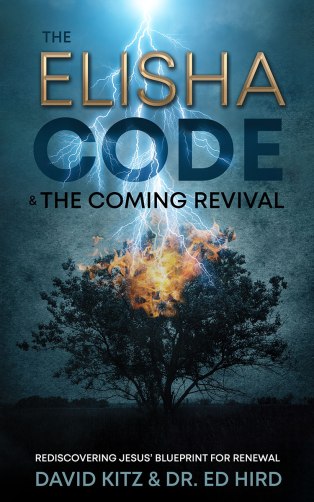
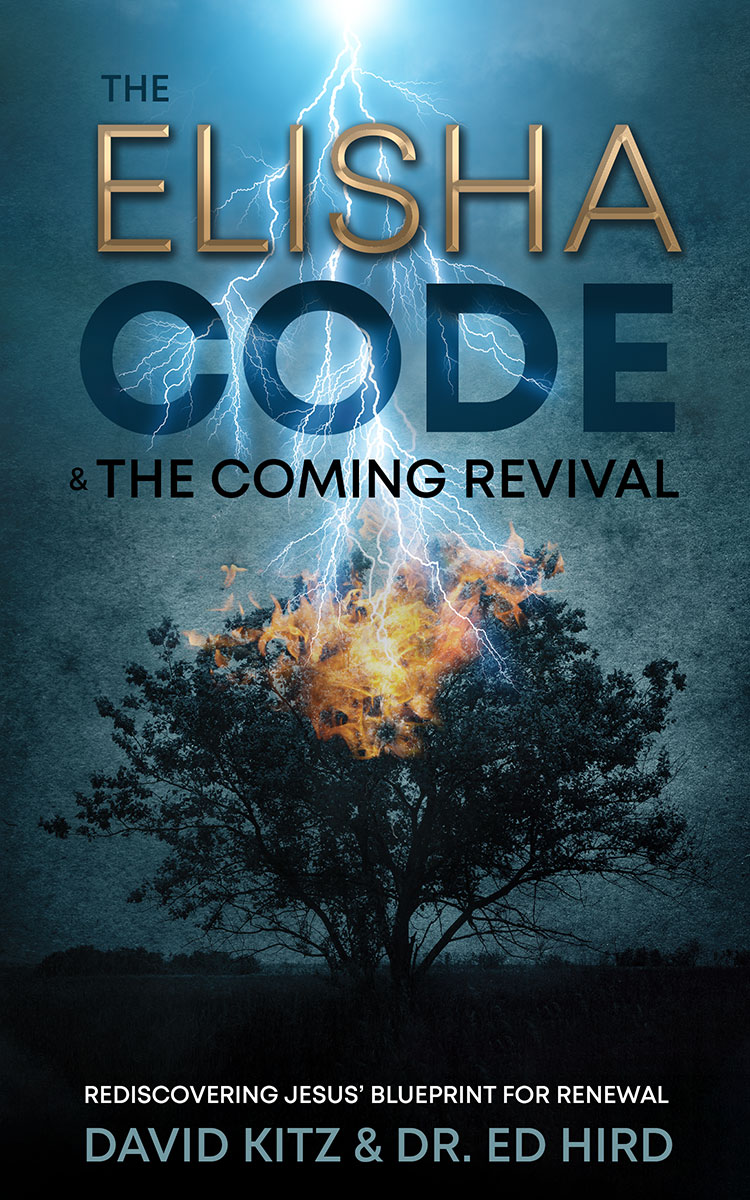
A gripping read from David Kitz.
Is a return-to-Jesus revival possible in our time?
This book points the way forward.
For details click here.

Breaking the Dam

23 Sunday Mar 2025

Posted by davidkitz in Psalm 32, Psalms

≈ Leave a comment

Tags

beavers, Bible, confess, dam, David, forgiveness, forgiveness of sins, God, Jesus, Prayer, Psalms, the LORD, transgressions

Psalm 32:1-5

A Psalm of David
 

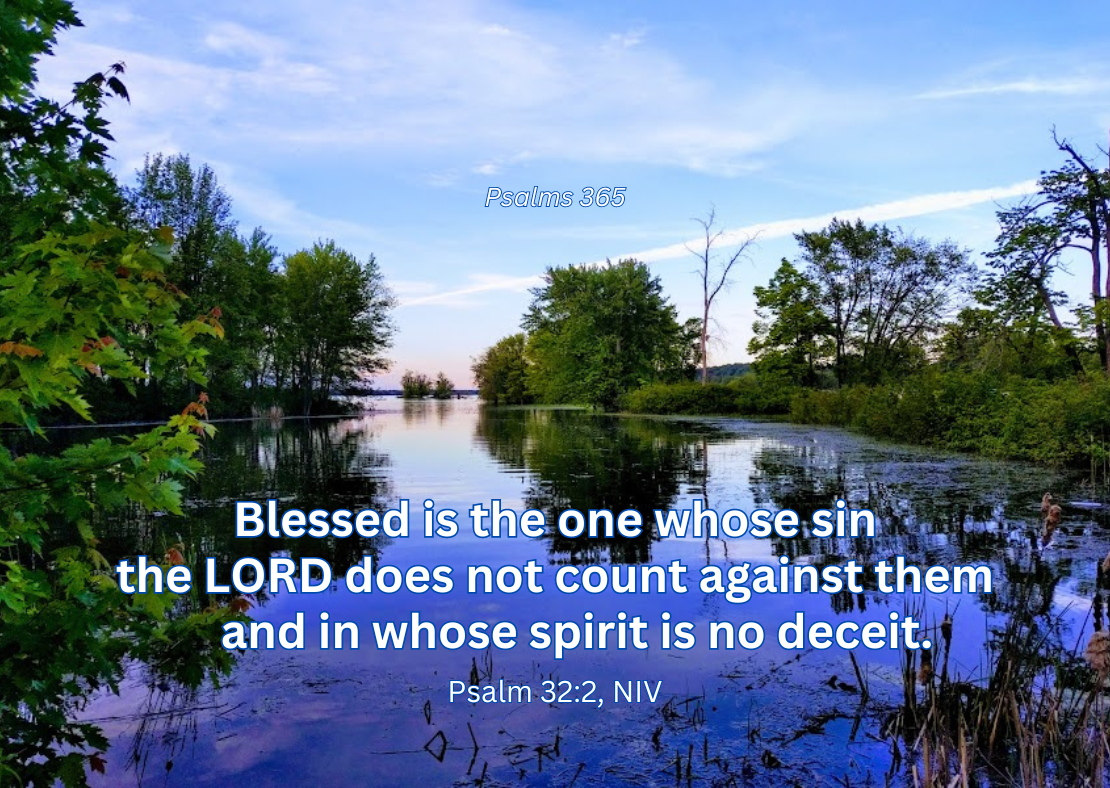
Blessed is he whose transgressions are forgiven,
whose sins are covered.
Blessed is the man whose sin the LORD does not count against him
and in whose spirit is no deceit. 
When I kept silent,
my bones wasted away through my groaning all day long.
For day and night your hand was heavy upon me;
My strength was sapped as in the heat of summer. (Selah)
Then I acknowledged my sin to you
and did not cover up my iniquity.
I said, “I will confess my transgressions to the LORD”
And you forgave the guilt of my sin. (Selah) 

Beavers are certainly among the most intelligent and industrious of all of God’s creatures. They are ingenious designers and builders of both homes and dams, which completely transform the environment in which they live. Only humans outperform them in this regard. In the wilderness their activity and its effects are a sight well worth seeing.

However, to the rural property owner, the arrival of beavers can turn into a disaster of appalling proportions. The gentle flowing stream that was a source of much pleasure is now blocked. Prized trees are daily being felled by these industrious little devils. Acres of valuable land are being turned into a fetid swamp. As the dam’s reservoir rises, hundreds more trees succumb to drowning. Their stark branches and dead trunks punctuate the sky. A blocked stream can produce an atrocious mess.

A right relationship with God is like a flowing stream. In such a relationship there is a natural giving to God that includes prayer, worship, time spent in His word, and periods of quiet communion. In turn, God by the Holy Spirit pours His peace, love and joy into our lives. And just as trees naturally line a riverbank, there is a verdant fruitfulness that comes to the believer as that refreshing current is allowed to flow.

Sin acts like a boulder hindering the flow of God’s Spirit in our lives. As more and more unrepented sin piles up, a dam is formed. Suddenly prayer stops. Worship and thanksgiving that once cascaded so freely from our lips comes to a halt. The word of God becomes boring, and we find other interests. Times of quiet communion with our Maker are replaced by a search for other things or for constant entertainment.

Now let’s read David’s description of the spiritual swamp his life was turning into because of unconfessed sin.

            “When I kept silent, my bones wasted away through my groaning all day long. For day and night your hand was heavy upon me. My strength was sapped as in the heat of summer.”

The flow had stopped. Where was the overflowing cup experience of Psalm twenty-three? At this point David’s cup—his soul—was sitting stagnant. And in the natural realm any liquid left unstirred becomes foul as time goes by.

As I write this, on the veranda below me there’s a small coffee table, and on that table sits a bottle of orange juice. I first noticed this bottle exactly a week ago when I first arrived here in Chicago. After passing this bottle several times on the way up to my room, I became curious and went over for a closer inspection. That’s when I discovered why the bottle was there. It was acting as a paperweight to keep a handwritten note from blowing away. No one would move the bottle in the hope that the unknown person, to whom the note was addressed, would finally show up. In the past few days, due to the summer sun and heat, the orange juice has taken on a rather brown hue.

Judging from David’s comment regarding the strength sapping heat of summer, we might assume that the contents of his soul had taken on a rather brown hue as well. The problem was he kept silent. Sin has an insidious way of silencing our relationship with God. We are not told what sin or transgression produced this damming effect. Yet that is just what it was. A dam caused by sin was now completely blocking up David’s relationship with God.

Perhaps it is better that we don’t know the particulars of David’s transgression here. A certain sense of personal spiritual superiority might set in. But sin is sin. Sin in any of its various forms fouls our relationship with God. James reminds us that a single sin can have huge consequences: “For whoever keeps the whole law and yet stumbles at one point is guilty of breaking all of it” (James 2:9).

What can break the sin dam and bring us back into a right relationship with God? David discovered the answer within this Psalm. Now, hear his pivotal words: Then I acknowledged my sin to you and did not cover up my iniquity. I said, “I will confess my transgressions to the LORD.”

Confession breaks the dam. David verbally brought his sin out in the open before God. He acknowledged what God knew all along. You see David’s sin was not hidden from God. It was in plain sight of the LORD from the moment of its conception.

Once again, the words of James are very instructive in this regard, as he states, “each one is tempted when, by his own evil desire, he is dragged away and enticed. Then, after desire has conceived, it gives birth to sin, and sin when it is full-grown, gives birth to death (James 1:14-15).

Sin was already working with deadly effect on David’s soul. By his own admission, his bones were wasting away, and his strength was sapped. Only a dam-busting experience could bring David back into right relationship with God, and restore the flow of praise, prayer and worship that had once been there.

One of the critical allied successes of World War II was the June 16, 1944, RAF raid on the Mohne and Eder dams on the Ruhr River system in Germany. To break the dams a specially designed spinning cylindrical bomb was created by British inventor Barnes Wallis. These huge bombs were dropped by specially modified Lancaster bombers from a height of sixty feet. The bomb would hit and skip across the surface of the water of the dam’s reservoir. They would then slam into the back of the dam, begin to sink, and then explode with massive dam-busting force. A decisive victory was achieved that night as these dam-busting bombs unleashed their power.

Fortunately, God has equipped each of us with dam-busting bombs to destroy the spiritual dams in our life—dams which our own sins have built. Words of confession and contrite acknowledgement are dam-busters. They break strongholds of sin, and in so doing they release the putrid dead waters that have backed up into our lives.

It is well worth noting that these putrid dead waters can be the cause of actual physical disease within our bodies. The human spirit is inextricably linked to the human body, and when our spiritual man is sick due to unrepented sin, physical ailments and sickness often follow. They are the natural by-products of a sin-blocked spirit.

When David states my bones were wasting away, and my strength was sapped as in the heat of summer, we can see these words simply as a nice poetic touch. But the stark reality is, spiritual sickness can produce a plethora of physical symptoms. Doctors have been aware of this link for many years now.

Again, the brother of our Lord has much to say on this point. Let’s look at his thoughts on this topic:

If you are sick, ask the church leaders to come and pray for you. Ask them to put olive oil on you in the name of the L
ord. If you have faith when you pray for sick people, they will get well. The Lord will heal them, and if they have sinned, he will forgive them. If you have sinned, you should tell each other what you have done. Then you can pray for one another and be healed (James 5:14-16 CEV).

What stands out most clearly in this passage is the link between physical healing and forgiveness. Confession is the bridge that re-establishes our link to God, and it is God who is the source of both forgiveness and healing. Re-establish the link, and the current of God’s grace can once again flow into your life.

I do dramatizations of the Epistle of James, and it is always amazing to hear accounts of what happens when God’s people put His word into action. In one case a pastor contacted me to report how a young woman in his congregation was miraculously healed of rheumatoid arthritis after watching me doing a dramatization of James. She acted on the word of God. Her relationship with her father was completely broken down. After confessing her faults and seeking restoration, God not only healed that relationship, He also healed her of the arthritis that had been crippling her body for years. The sin dam was broken, and God flooded her body with healing.

Can you hear the joy in David’s voice as he announces to the world, “And you forgave the guilt of my sin?”

The forgiveness of God is amazing. It breaks the chains of sin’s bondage. There is no liberation like the liberation of full and free forgiveness. It frees the tormented soul from guilt and sets the liberated individual on the path to heaven, the very path that all the saints have trod. Oh, that our nation would be awakened by the joyous cry of liberated sinners. We need a society-changing sinners’ liberation.

David experienced the dam-busting, soul-liberating power of the LORD’s forgiveness. Is it any wonder then that he begins this Psalm by announcing, “Blessed is he whose transgressions are forgiven, whose sins are covered. Blessed is the man whose sin the LORD does not count against him and in whose spirit is no deceit.”

David knew this blessed state of forgiveness.  Now for him, the long ledger of sin has been wiped clean. The debt has been paid. Any person who finds himself in such a position is truly blessed.

Yesterday’s gospel reading, at my home church here in Ottawa, was the Beatitudes from Jesus Sermon on the Mount. Each beatitude begins with the phrase, “Blessed are …” I wonder if in his mind, Jesus was using the opening lines of Psalm thirty-two as his springboard for launching into the Beatitudes. The blessed state of the forgiven is certainly a key theme throughout Jesus’ teaching and ministry.

There is a rather curious statement in the opening lines of this Psalm, and it is made in regard to our sins being covered. We are wonderfully blessed when our sins are covered. Yet only a few lines down David laments the fact that he tried to cover up his iniquity. On the one hand he is saying that our sin being covered is a good thing, and on the other hand covering our sins is terrible. David, what do you mean?

The question we need to ask ourselves is, “Who is covering my sin?”

If you are covering your sin, it is an abomination—an affront to God. God can see your sin and any amount of cover-up that you attempt is utter foolishness before the all-seeing, all-knowing LORD of the universe. Before Him the whole of it, is always fully exposed. David’s attempt to hide his iniquity was an act of sheer stupidity. Any of our attempts at sin-hiding, fall under the same category. It is a form of spiritual deceit. We must bring our sins out into the open before God. That’s what David eventually did, and that’s when forgiveness flowed. At that moment, David entered that blessed state, the blessed state of the forgiven.

But what happens to that exposed sin? God covers it. As believers who stand on this side of the cross, we know that Jesus covers it with his blood. Only the all-seeing, all-knowing God can cover our sin so well that even He cannot find it.

God gave us a lesson in sin covering on its very first occurrence in Genesis. Adam and Eve hid and covered their nakedness with fig leaves. Their cover-up was not acceptable to the LORD back then, even as our cover-up is unacceptable to Him now. We read, “The LORD God made garments of skin for Adam and his wife and clothed them” (Genesis 3:21).

The LORD covered them. He shed the blood of an animal to provide a covering of skins for them. Because I need a covering today, two thousand years ago the LORD God shed the blood of His one and only Son, so that I too could be covered. O, what a blessed covering that is!

Because of Jesus I am blessed. I am forgiven! How about you?


Bringing Life to the Psalms

  1. Words of contrite confession are like dam-busting bombs. Are there unconfessed sins that are clogging and hindering your relationship with God? Make it your priority to confess these sins to God. If your relationship with others has been affected, seek reconciliation with them. God desires that all our relationships be healthy and filled with the free-flowing life of His Spirit.
  2. Do a James five health check. If you are sick or disabled in anyway, ask the church leaders to anoint you with oil and pray for you. Jesus Christ is the same yesterday and today and forever (Hebrews 13:8). His healing grace is available to those who humbly call on him. And remember he still makes house calls.
  3. Read the Beatitudes as recorded in Matthew 5:3-12. Consider possible attitudinal links to Psalm 32.
  4. If forgiveness is a key theme in Jesus’ ministry and teaching, can you think of accounts in the Gospels that reflect this? Stumped? Here are a few quick references to check out: Mark 2:1-12; Luke 23:39-43; Luke 19:1-10; Luke 7:36-50; Luke 18:9-14

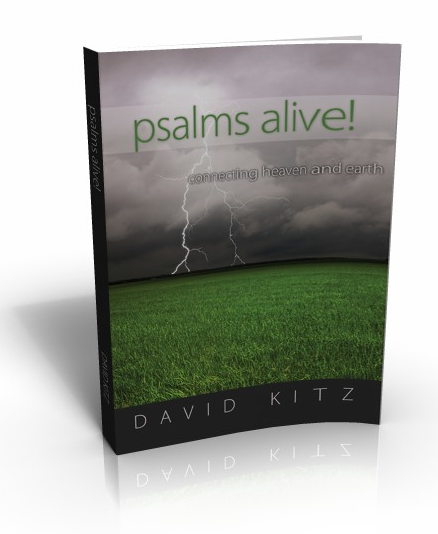
Today’s post is the sixth chapter from the book Psalms Alive! Connecting Heaven & Earth by David Kitz. To find out more or purchase click here.

The Third Witness Prompts Response

02 Sunday Mar 2025

Posted by davidkitz in Psalms, Psalms Alive!

≈ Leave a comment

Tags

confession, Creator, David, God, God's forgiveness, Holy Spirit, Jesus, meditation, Prayer, Psalms, the LORD, transgressions, wilful sins, witness

Psalm 19:12-14
Who can discern his errors?
Forgive my hidden faults.
Keep your servant also from wilful sins;
may they not rule over me.
Then will I be blameless,
innocent of great transgression.
May the words of my mouth
and the meditation of my heart
be pleasing in your sight,
O LORD, my Rock and my Redeemer. (NIV)

What is your response to God’s word and His voice as it speaks to your heart?

That’s exactly what we find here in this final portion of Psalm 19. Here we see David’s response to God. God has been doing the talking thus far. God has been speaking to David through the stars, through the night sky, and the blazing heat of the sun—the first witness. He has spoken to him through the Word of God—His written revelation—the second witness. Now as this Psalm draws to a close, we hear David responding back to God.

In actuality, David is responding to the third witness. His heart is bearing witness to the reality of God. His conscience is convicting him of his sin and of the righteousness of God. We all have this third witness within us—a witness that will not be silenced, though we may try to drown out this inner voice of the Spirit.

This dialogue between God and man is one of the unique features of the Psalms. The Psalms are not simply the statements of a man in prayer, or even the words of a man caught up in praise and worship of his Creator. God speaks back, or as we see here in this Psalm, God initiates the conversation. We are eaves dropping on a conversation between a human being—someone just like us, caught up in the same travails and passions—and the transcendent, eternal God of the universe.

What a conversation! What communion we find here! This isn’t God pronouncing His dictates from heaven, though He has every right to do so. This is God whispering in the ear of an individual who is struggling to know and understand God’s will. And if God can speak to David in this manner, then there is hope for us. God can speak to us too. Surely this is why the Psalms have resonated with humankind throughout the ages. 

If along with David, we have heard the voices of the first and second witness, then there is only one appropriate response. It is the response recorded here in Holy Scriptures. If we see and grasp the awesome power and majesty of God, if through His word we have glimpsed His holiness, then we are brought low. We are humbled before him. Our greatest achievements are nothing. Our pride dissolves. Our weakness, our smallness is self-evident in the presence of the LORD of heaven and earth. We are exposed; our sin is exposed before this holy, magnificent God. 

Hear David’s response, “Who can discern his errors? Forgive my hidden faults.

We all stand naked of soul before our Creator. The all-seeing One knows us. He knows us intimately. There are no secrets in His all-encompassing dominion. He sees all. He knows all. We can hide nothing from Him.

But hiding is the human heart’s first response. Adam and Eve did it first. They hid from their Creator immediately after their initial sin. In fact, hiding is what our Adamic nature does best. Since our first parents fall, we have had thousands of years to perfect the art of hiding. And it truly is an art. We have all seen and heard a young child’s amateur attempts at a lie. And lies are simply a verbal attempted at hiding the truth. As we mature, we become ever more sophisticated at hiding the truth. We excuse our faults and quickly sweep them under the carpet, and for many of us the thickest and most luxurious carpets are religious carpets. They are great for hiding a multitude of sins.

One of my earliest childhood memories is an attempt to hide from my mother. I hid behind the living room drapes. They were made of thick, heavy material. I could not see her through them, so I reasoned that I must be safe. My feet were left exposed, and the form of my body was obvious as I pressed my back against the wall. It’s not hard to guess the outcome of this bit of childish foolery.

 All of us have tried to play peek-a-boo with God. Our faulty reasoning goes something like this. If I hide from Him, and I can’t see Him—if I completely ignore Him —He must not be there. I cannot see Him; He cannot see me. He will pass by without noticing me.

But a barefaced encounter with the Almighty exposes all. We have come to the Light. Nothing is hidden or can be hidden. We can’t play peek-a-boo with God.

David has been found by God. He has been found naked, just as our first parents were found naked in the Garden. Ah, but that’s not what the Adam and Eve story says. The Bible says, “they sewed fig leaves together and made coverings for themselves” (Genesis 3:7).

They were not naked. No, Eve and Adam had managed to pull a curtain over themselves as they hid in God’s living room. But their feet were exposed, even as their butts were pressed against the proverbial wall.

The truth is they were naked of soul before the all-seeing God. We are always naked of soul before Him, no matter what outer garb we put on.

Hence, David’s first response to God is so appropriate, “Who can discern his errors? Forgive my hidden faults.”

With these words, David is giving voice, to his inner voice, his conscience. The third witness is testifying to the reality of God—a God before whom, we must all give account. The God, who speaks externally through creation, and his holy written word, also speaks from within the human heart. His voice is prompting David to respond.

David is confessing that before the all-seeing One, he is naked. Not only is he fully exposed, but he is incapable of fully discerning his own sin. He cannot see himself in his entirety. Only God can see him completely.

We should note our inability to fully see ourselves is true on every level. All too often, we are blind to the consequences of our actions, blind to our character faults, blind to the annoying quirks that drive others from us. We cannot stand outside of ourselves and see ourselves fully or accurately. This is as true on the physical level as it is on the spiritual level.

Think on the following statement for a moment: You have never seen your own face. It’s true. A photograph of your face is an image of your face caught in time, but it is only an image. It is not your face. The image of your face in a mirror is just that. It is an image; it is not your face. The truth is you have never seen your own face. Only others can see your full physical form.

Only God can see you in your entirety, spirit, soul and body. He sees you from the outside and from the inside, from your beginning to your end.

 In this Psalm, David finds himself face to face with this all-seeing, all-knowing God. In humility he pleads, “Forgive my hidden faults.”

If we perceive God correctly, and if we assess ourselves accurately and honestly, then we quickly realize our greatest need. Our greatest need is for forgiveness. This is the bedrock on which any human relationship with God is built.

Next, because David longs to live in relationship with this amazing God, he cries out for holiness, “Keep your servant also from wilful sins; may they not rule over me. Then will I be blameless, innocent of great transgression (Psalm 19:13).

 We should note here that there are degrees of sin. For example, John the disciple, writes in his first letter, “There is a sin that leads to death” (1 John 5:16). John then goes on to state that, “All wrongdoing is sin, and there is a sin that does not lead to death (1 John 5:16).

But perhaps nowhere in all of the scriptures are the degrees of sin more clearly delineated than here in this passage. David begins by asking, “Who can discern his errors?”

There is no intent in errors. We all make mistakes. In this great exam called life, errors will occur. Even the most spiritually studious fall short of perfection. To sin is to miss the mark, and all, even the saintliest, will from time to time miss God’s mark of perfection.

David asks God to forgive hidden sins. We all possess an ample supply of these. Some sins are hidden from others. We may confess these sins to God, but to others they remain a secret that we take with us to our graves.

Yet other sins are hidden from us. We fail to see our own faults, which may be glaringly obvious to others. A truly good friend will not only forgive our faults, but in time he will help us to see and overcome these hidden sins.
Now as David prays, he asks, “Keep your servant also from wilful sins; may they not rule over me.”

Here we have transitioned from errors, which are unintentional sins, to the realm of wilful sins. This is a conscious decision to do wrong, to disobey God and His laws or requirements. This is a very slippery slope. Notice how wilful sin can turn into a controlling monster. We begin by wilfully choosing to disobey, but when this sin has taken root and is allowed to grow, something changes. It grows into a monstrosity. What we freely chose, now chooses us. We become its slave. It rules over us. Our will is overpowered. Any addict can testify to the ravenous power of this sin monster. Every wilful sin has an addictive power associated with it. That’s why David wants to avoid this trap. He prays, “Keep your servant also from wilful sins.”

David longs to be “blameless, innocent of great transgression.”

What is great transgression? It could be argued that it is sin that leads to death. James, the brother of our LORD writes, “We are tempted by our own desires that drag us off and trap us. And when sin is finished with us, it leaves us dead” (James 1:14-15).

But within David beats a different heart. He longs for holiness. His desire is for a blameless life—a life lived in relationship with God. It’s as though David is saying to God, “Those evening walks you took with Adam in the Garden, can we go for one of those LORD?”

Hear his prayer, “May the words of my mouth and the meditation of my heart be pleasing in your sight, O LORD, my Rock and my Redeemer.”

With these words David has identified the source of sin and the cornerstone of any hope for holiness, as we live out our lives on this earth. The source point is the human heart. If our hearts are right before God, there is hope. If our hearts are fixed on our Rock and our Redeemer, we can bring pleasure to Him.

Jesus said, “The things that come out of the mouth come from the heart, and these make a man ‘unclean’. For out of the heart come evil thoughts, murder, adultery, sexual immorality, theft, false testimony, slander. These make a man unclean” (Matthew 15:18-20).

Jesus knew the desperately wicked state of our hearts. David knew his own heart too. He knew it needed cleansing and forgiveness. That’s why he cries out for it. He knew that our mouths speak from the overflow of the heart. The meditation of the heart must be pure if the words we speak are to bring life and encouragement.

Your words are important. There is no such thing as an idle word. In a world that constantly spews forth verbal sewer filth, God is looking for those with a pure heart. Your heavenly Father does not need a stethoscope to check the condition of your heart. He only needs to listen to the words coming out of your mouth.

Notice how David wants his words and his heart to bring pleasure to God. His prayer is that they be pleasing in His sight. O, to bring pleasure to the all-seeing One! That is his prayer. He does not wish to hide; hiding is futile. No, he longs to consciously live his life in the full and constant view of the LORD.

We have all endured annoying music, droning noises or irritating voices that grate on our nerves. But the opposite is so refreshing. Soothing music, joyful noises and happy voices invigorate us. They bring gladness into our lives.

Like David, make it your goal to bring gladness to your Rock and your Redeemer. Put a smile on your Father’s face.   

Bringing Life to the Psalms

  1. Read James 2:1-12. There is no clearer biblical discourse on the power of the tongue for both good and evil. Heed the advice found there.
  2. Do you have a foul mouth? Determine to clean up your conversation. When you slip up make Psalm 19:14 your prayer.
  3. Is the third witness—the inner voice of God’s Spirit—speaking to you? Take time to respond to God. Use David’s prayer in this final portion of Psalm 19 as a pattern for your own response to the Holy Spirit’s prompting.
  4. Take time to meditate on God’s word. Select a passage and read it repeatedly. See it; smell it; taste it. Let it become part of you. In our rushed world become a cow. Lie down, relax and chew your mental cud. Meditating on God’s word is like that.
  5. Psalm 19 has a Trinitarian structure that points to the Triune God, who is the source point of all Holy Scripture. The first portion of this psalm introduces us to our heavenly Father, the LORD God of creation. The second portion extols the virtues of the Word of God. John’s Gospel introduces Jesus as the Word of God. The Word became flesh and made his dwelling among us. We have seen his glory, the glory of the one and only Son, who came from the Father, full of grace and truth (John 1:14). Finally, we witness the convicting power of the Holy Spirit as David cries out, “Forgive my hidden faults. Keep your servant also from wilful sins; may they not rule over me” (Psalm 19:12-13). The concept of the Trinity was and is foreign to the Jewish faith, yet it is written into its foundational texts. How do you account for the remarkable presence of this coded truth?
  6. Now take a minute to reread all of Psalm 19. What is God saying to you by His Spirit?

Today’s post is the third chapter from the book Psalms Alive! Connecting Heaven & Earth by David Kitz. To find out more or purchase click here.
I Know My Transgressions

17 Tuesday Sep 2024

Posted by davidkitz in Psalm 36, Psalms

≈ Leave a comment

Tags

compassion, Jesus, judge, mercy of God, repentance, sinful, transgressions, verdict

Today’s quote and prayer from
“Psalms 365: Develop a Life of Worship and Prayer”
by David Kitz.Psalm 36_1-4 -365

Reading: Psalm 36:1-4

Father God,
help me to see a true picture of myself.
If I see sin in my life,
help me to change.
Grant me the gift of repentance
through Jesus,
who loved me to the point of death on a cross.

Amen.

— — —

Have mercy on me, O God,
    according to your unfailing love;
according to your great compassion
    blot out my transgressions.
Wash away all my iniquity
    and cleanse me from my sin.

For I know my transgressions,
    and my sin is always before me.
Against you, you only, have I sinned
    and done what is evil in your sight;
so you are right in your verdict
    and justified when you judge.
Surely I was sinful at birth,
    sinful from the time my mother conceived me.
Yet you desired faithfulness even in the womb;
    you taught me wisdom in that secret place.
(Psalm 51:1-6), NIV)*

Para la publicación de Salmos 365 de hoy en español haga clic aquí.

* NEW INTERNATIONAL VERSION, COPYRIGHT ©1973, 1978, 1984, 2011 BY BIBLICA

BGBG_v4.3_150[1818]

Please pray for peace to return to Israel, Gaza, and Ukraine!

Volume I of Psalms 365: Develop a Life of Worship and Prayer won the Best Book of the Year Award from The Word Guild and Volume II has won the Best Devotional of the Year Award. For those who love God’s word, this three-book series is an ideal way to daily meet with the Lord. To purchase or for a closer look click here.

RGB300Kitz2AWARD

New from David Kitz
TheElishaCodeCVR5

To purchase or for a closer look click here.

Have Mercy on Me, O God

03 Saturday Aug 2024

Posted by davidkitz in Psalm 51

≈ Leave a comment

Tags

cleansing, cleansing from sin, compassion, David, gladness, joy, praise the LORD, Prayer, sins, transgressions

I will praise the LORD!

pxl_20240723_002342439.mp_

Sunset photo by David Kitz

Reading: Psalm 51:1-9

For the director of music. A psalm of David.
When the prophet Nathan came to him
after David had committed adultery with Bathsheba.

Have mercy on me, O God,
    according to your unfailing love;
according to your great compassion
    blot out my transgressions.
Wash away all my iniquity
    and cleanse me from my sin.
For I know my transgressions,
    and my sin is always before me.
Against you, you only, have I sinned
    and done what is evil in your sight;
so you are right in your verdict
    and justified when you judge.
Surely I was sinful at birth,
    sinful from the time my mother conceived me.
Yet you desired faithfulness even in the womb;
    you taught me wisdom in that secret place.
Cleanse me with hyssop, and I will be clean;
    wash me, and I will be whiter than snow.
Let me hear joy and gladness;
    let the bones you have crushed rejoice.
Hide your face from my sins
    and blot out all my iniquity.
*

Para la publicación de Salmos 365 de hoy en español haga clic aquí.

* NEW INTERNATIONAL VERSION, COPYRIGHT ©1973, 1978, 1984, 2011 BY BIBLICA

Please pray for peace to return to Israel, Gaza, and Ukraine!

Volume I of Psalms 365: Develop a Life of Worship and Prayer won the Best Book of the Year Award from The Word Guild and Volume II has won the Best Devotional of the Year Award. For those who love God’s word, this three-book series is an ideal way to daily meet with the Lord. To purchase or for a closer look click here.

A gripping summer read from David Kitz
4485 SHARABLE-2

To purchase or for a closer look click here.

My Moral Poverty

13 Wednesday Mar 2024

Posted by davidkitz in Psalm 130

≈ 2 Comments

Tags

depravity, forgiveness, holiness, Jesus, mercy of God, Poverty, Prayer, Psalms, sins, the LORD, transgressions

Today’s Devotion from the Psalms

Reading: Psalm 130:1-4
A song of ascents.
Out of the depths I cry to you, LORD;
LORD, hear my voice.
Let your ears be attentive
to my cry for mercy.
If you, LORD, kept a record of sins,
LORD, who could stand?
But with you there is forgiveness,
so that we can, with reverence, serve you
(NIV). *

a tattooed man praying while holding a book

Photo by cottonbro on Pexels.com

Reflection
Psalm 130 is a perfect example of a psalm that brings us into the private inner sanctum of communion with God. Here is a portrait of a fallen man—a man on his knees before his Maker, the eternal One. Hear him now as he agonizes in prayer, “Out of the depths I cry out to you, O LORD; O LORD, hear my voice. Let your ears be attentive to my cry for mercy.”

The opening lines of this psalm leave little doubt as to what has transpired. The psalmist has failed; he has missed the mark. He has transgressed, yet again. There is an abject poverty of spirit reflected in these words—a poverty that almost makes us cringe.

We do not know what sin, or list of sins has brought the psalmist to this wretched state. The transgression is left unstated. Was it anger, malice, or unbridled lust? Was it pride, greed, or wilful dishonesty? Was this a transgression of the mind, of the tongue, of action or inaction? God knows.

I am always somewhat skeptical of those who claim they could never commit this or that sin. I think we rarely comprehend the depravity of our own hearts. Pushed into wrong circumstances, in the wrong environment, with the wrong peer group, who can plumb the depths to which a man or woman may sink? I can identify with the psalmist. I have added my own pile of dung to this world’s heap of moral filth. I too have found myself in the psalmist’s position, sobbing out these words, “Out of the depths I cry out to you, O LORD; O LORD, hear my voice. Let your ears be attentive to my cry for mercy.“

But despite my failings, despite my moral poverty, this great God—this God of holiness—is approachable. He is a God of mercy. The psalmist reminds himself and the LORD of His merciful nature with these words: If you, LORD, kept a record of sins, LORD, who could stand? But with you there is forgiveness, so that we can, with reverence, serve you.

I need daily reminders of God’s forgiveness and mercy. God the moral accountant is also the LORD of forgiveness. No one does forgiveness better than God. When we confess our sins, He destroys the record. What accountant does that?

Response: Father God, I thank you for forgiveness. I have failed you many times, but you are rich in mercy. You are a patient God. Thank you for destroying the record of my sins. Thank you for the blood Jesus shed so I could be washed clean. Amen.

Your Turn: Have you been guilty of digging up the record of your sins—sins that have been forgiven? What do you do to be reminded of God’s mercy and forgiveness?

* NEW INTERNATIONAL VERSION, COPYRIGHT ©1973, 1978, 1984, 2011 BY BIBLICA

BGBG_v4.3_150[1818]

Please pray for peace to return to Israel, Gaza, and Ukraine!

Volume I of Psalms 365: Develop a Life of Worship and Prayer won the Best Book of the Year Award from The Word Guild and Volume II has won the Best Devotional of the Year Award. For those who love God’s word, this three-book series is an ideal way to daily meet with the Lord. To purchase or for a closer look click here.

4485 SHARABLE-2

Are you ready for a journey to the cross?
For a closer look or to purchase click here.

Blessed to Be Forgiven

17 Saturday Feb 2024

Posted by davidkitz in Psalm 32, Psalms

≈ Leave a comment

Tags

confess, confession, deliverance, forgiveness of sins, guilt, Prayer, protection, Psalms, the LORD, transgressions

I will praise the LORD!

Psalm 87_7

Reading: Psalm 32:1-7

Of David. A maskil.

Blessed is the one
    whose transgressions are forgiven,
    whose sins are covered.
Blessed is the one
    whose sin the LORD does not count against them
    and in whose spirit is no deceit.
When I kept silent,
    my bones wasted away
    through my groaning all day long.
For day and night
    your hand was heavy on me;
my strength was sapped
    as in the heat of summer.
Then I acknowledged my sin to you
    and did not cover up my iniquity.
I said, “I will confess
    my transgressions to the LORD.”
And you forgave the guilt of my sin.
Therefore let all the faithful pray to you
    while you may be found;
surely the rising of the mighty waters
    will not reach them.
You are my hiding place;
    you will protect me from trouble
    and surround me with songs of deliverance.*

* NEW INTERNATIONAL VERSION, COPYRIGHT ©1973, 1978, 1984, 2011 BY BIBLICA

BGBG_v4.3_150[1818]

Please pray for peace to return to Israel and Ukraine!

Volume I of Psalms 365: Develop a Life of Worship and Prayer won the Best Book of the Year Award from The Word Guild and Volume II has won the Best Devotional of the Year Award. For those who love God’s word, this three-book series is an ideal way to daily meet with the Lord. To purchase or for a closer look click here.TheElishaCodeCVR5

To purchase or for a closer look click here.

The Sin of Forgetfulness

15 Friday Dec 2023

Posted by davidkitz in Psalm 106, Psalms

≈ 2 Comments

Tags

Creator, disobedience, experiences with God, forgetting God, sinful, transgressions

Reading: Psalm 106:6-15
We have sinned, even as our ancestors did;
we have done wrong and acted wickedly.
When our ancestors were in Egypt,
they gave no thought to your miracles;
they did not remember your many kindnesses,
and they rebelled by the sea, the Red Sea.
Yet he saved them for his name’s sake,
to make his mighty power known.
He rebuked the Red Sea, and it dried up;
he led them through the depths as through a desert.
He saved them from the hand of the foe;
from the hand of the enemy he redeemed them.
The waters covered their adversaries;
not one of them survived.
Then they believed his promises and sang his praise.
But they soon forgot what he had done
and did not wait for his plan to unfold.
 In the desert they gave in to their craving;
in the wilderness they put God to the test.
 So he gave them what they asked for,
but sent a wasting disease among them
(NIV). *

2021-02-09

January trail — photo by David Kitz

Reflection
Psalm 106 begins with the psalmist pleading for God’s favor. He longs to be included among the blessed, who are saved and numbered among the LORD’s chosen ones. But in today’s reading we discovered the terrible truth. Sinful conduct has been rampant among God’s people; therefore, the psalmist makes this confession. We have sinned, even as our ancestors did; we have done wrong and acted wickedly.

As this psalm progresses, the psalmist catalogues an ever-growing list of transgressions. But what sets this downward progression into motion is a bout of forgetfulness. The psalmist laments, they did not remember your many kindnesses, and they rebelled by the sea, the Red Sea. Later he comments: But they soon forgot what he had done and did not wait for his plan to unfold.

Usually, we do not consider forgetfulness to be a sin. But there is such a thing as willful forgetfulness. We remember those things we consider important. We forget the trivial—those things we consider of little significance. The redeemed people of Israel experienced the wonder-working power of God, yet they treated these events as though they were of little significance. They failed to grasp the paramount significance of these events and as result they stumbled into grumbling and disobedience. Do we grasp the significance of God’s interaction with us? The great Creator reaches out to us. There’s nothing insignificant in that. These are the high points in our sojourn through this life.

Response: Father God, I want to treasure the experiences I have with you. Each one is significant as you guide me in your way. Help me be attentive to your voice, your word, and your Spirit. Amen.

Your Turn: Have you been guilty of forgetting those times when God has spoken to you? This week try to listen for His voice.

* NEW INTERNATIONAL VERSION, COPYRIGHT ©1973, 1978, 1984, 2011 BY BIBLICA

BGBG_v4.3_150[1818]

Please pray for peace to return to Israel and Ukraine!

Volume I of Psalms 365: Develop a Life of Worship and Prayer won the Best Book of the Year Award from The Word Guild and Volume II has won the Best Devotional of the Year Award. For those who love God’s word, this three-book series is an ideal way to daily meet with the Lord.TheElishaCodeCVR5

                                To purchase or for a closer look click here.

So Great Is His Love

22 Sunday May 2022

Posted by davidkitz in Psalm 103

≈ Leave a comment

Tags

anger, compassionate, Righteousness, the LORD, transgressions

I will praise the LORD!

img_20220501_1734216

Before the leaves appear — photo by David Kitz

Reading: Psalm 103:6-12

The LORD works righteousness
    and justice for all the oppressed.
He made known his ways to Moses,
    his deeds to the people of Israel:
The LORD is compassionate and gracious,
    slow to anger, abounding in love.
He will not always accuse,
    nor will he harbor his anger forever;
he does not treat us as our sins deserve
    or repay us according to our iniquities.
For as high as the heavens are above the earth,
    so great is his love for those who fear him;
as far as the east is from the west,
    so far has he removed our transgressions from us.

* NEW INTERNATIONAL VERSION, COPYRIGHT ©1973, 1978, 1984, 2011 BY BIBLICA

BGBG_v4.3_150[1818]

Pray for the people of Ukraine!

Volume I of Psalms 365: Develop a Life of Worship and Prayer has won the 2021 Best Book of the Year Award and for those who love God’s word, it’s an ideal way to daily meet with the Lord. For a closer look at Volumes II and III click here.

The Prophetic Word for Today

15 Friday Apr 2022

Posted by davidkitz in Good Friday

≈ 2 Comments

Tags

peace, punishment, Savior, transgressions

About seven centuries before Christ’s suffering and death the prophet Isaiah penned these words. Let’s reflect on them and let our love for our Savior grow.

Who has believed our message
    and to whom has the arm of the Lord been revealed?
He grew up before him like a tender shoot,
    and like a root out of dry ground.
He had no beauty or majesty to attract us to him,
    nothing in his appearance that we should desire him.
He was despised and rejected by mankind,
    a man of suffering, and familiar with pain.
Like one from whom people hide their faces
    he was despised, and we held him in low esteem.

img_20211111_1625480

Photo by David Kitz

Surely he took up our pain
    and bore our suffering,
yet we considered him punished by God,
    stricken by him, and afflicted.
But he was pierced for our transgressions,
    he was crushed for our iniquities;
the punishment that brought us peace was on him,
    and by his wounds we are healed.
We all, like sheep, have gone astray,
    each of us has turned to our own way;
and the Lord has laid on him
    the iniquity of us all.

He was oppressed and afflicted,
    yet he did not open his mouth;
he was led like a lamb to the slaughter,
    and as a sheep before its shearers is silent,
    so he did not open his mouth.
By oppression and judgment he was taken away.
    Yet who of his generation protested?
For he was cut off from the land of the living;
    for the transgression of my people he was punished.[b]
He was assigned a grave with the wicked,
    and with the rich in his death,
though he had done no violence,
    nor was any deceit in his mouth (Isaiah 53:1-9).*

* NEW INTERNATIONAL VERSION, COPYRIGHT ©1973, 1978, 1984, 2011 BY BIBLICA

BGBG_v4.3_150[1818]

Please pray for the people of Ukraine!

Volume I of Psalms 365: Develop a Life of Worship and Prayer has won the 2021 Best Book of the Year Award and for those who love God’s word, it’s an ideal way to daily meet with the Lord. For a closer look at Volumes II and III click here.


← Older posts

Psalms 365: Develop a Life of Worship and Prayer

Psalms 365 Volume II

Psalms 365 vol 3
— Psalms 365 Volume III

Psalms

Recent posts

  • A Horn of Salvation December 19, 2025
  • Ready for the King of Glory December 19, 2025
  • My Spirit Rejoices in God My Savior December 18, 2025
  • Joining the Generation That Seeks God December 18, 2025
  • Why Am I So Favored December 17, 2025
  • How Can You Find the Good Life? December 17, 2025
  • The Power of the Most High December 16, 2025

Calendar

December 2025
M T W T F S S
1234567
891011121314
15161718192021
22232425262728
293031  
« Nov    

Blog Posts

Comments

  • davidkitz on Joining the Generation That Seeks God
  • cjsmissionaryminister on God Sent His Son
  • cjsmissionaryminister on The God of the Broken

Blog at WordPress.com.

Privacy & Cookies: This site uses cookies. By continuing to use this website, you agree to their use.
To find out more, including how to control cookies, see here: Cookie Policy
  • Subscribe Subscribed
    • I love the Psalms
    • Join 1,377 other subscribers
    • Already have a WordPress.com account? Log in now.
    • I love the Psalms
    • Subscribe Subscribed
    • Sign up
    • Log in
    • Report this content
    • View site in Reader
    • Manage subscriptions
    • Collapse this bar
 

Loading Comments...