Psalm 113:1-3
Praise, O servants of the LORD,
praise the name of the LORD.
Let the name of the LORD be praised,
both now and forever more.
From the rising of the sun to the place where it sets,
the name of the LORD is to be praised.
At the time of this writing another Christmas has come and gone. I am sitting across from our family Christmas tree as I write this chapter. Snow is gently falling outside my living room window. It’s that relaxing time of year, the festive interlude between Christmas Day and New Year’s Day. It’s a time to get your spiritual battery recharged, before the onslaught of the work routine returns along with the coming of a new year. As long as I can avoid big box stores and shopping malls, it’s a peaceful time. I can spend extra time with the LORD and with family.
Praise the LORD!
Yes, praise the LORD for those relaxing times, when the pace of life slows down. We live in a rushed world, where quiet times and silent moments get crowded to the margins of our existence.
Silence? Silence is a rare experience in our rapid fire, entertainment-hyped world. I wonder if Silent Night is such a popular carol, because silence is a commodity we rarely experience, but inwardly we long for it.

The people of the ancient world knew silence. It surrounded them like a huge comforting blanket. They did not awaken to the blare of the radio or the din of urban traffic. But even so, they purposefully set apart times to get away and seek the LORD. Even the Son of God needed those times. After feeding the five thousand, Jesus did not throw a party with his disciples to celebrate his miracle. No, we read that “he went up on a mountainside by himself to pray (Matthew 14:23).
Jesus longed to commune with his Father. He needed silent nights for that. He needed alone times.
How about you? If Jesus needed those quiet times—alone with God times—I know I most certainly do. And the starting point for any meaningful time with the LORD is the point of praise. We are to “enter his gates with thanksgiving and his courts with praise; give thanks and praise his name” (Psalm 100:4).
That is precisely how Psalm 113 begins. It starts with praise:
Praise the LORD! Praise, O servants of the LORD, praise the name of the LORD. Let the name of the LORD be praised, both now and forever more. From the rising of the sun to the place where it sets, the name of the LORD is to be praised.
And who precisely are we to praise? Both in Psalm 100 and Psalm 113 the admonition is crystal clear. We are to praise the name of the LORD. Shout to the LORD, all the earth. Worship the LORD with gladness; come before him with joyful songs (Psalm 100:1-2).
Now it must be noted that the psalmist did not instruct us to praise the name of the Lord. He instructed us to praise the name of the LORD. Did you catch the distinction? There is a huge difference between the words, Lord and LORD that we can easily skip over or dismiss.
With enough money and influence, almost anyone can become a lord—a British lord. Conrad Black, the newspaper baron, renounced his Canadian citizenship in order to become Lord Black of Crossharbour. Along with the title of lord, comes a seat in the House of Lords in the British Parliament.
In this world there are many lords, and would-be lords, but there is only one LORD. The LORD is the Lord of both the heavens and the earth. His kingdom reign has no beginning or end; it is eternal. His dominion knows no bounds. The LORD is truly Lord of all, including Crossharbour. His seat, the throne of the universe, lies beyond the highest heavens. His glory never ceases. It is never tarnished by scandal, never debouched by sin. He is without peer. He is the LORD of lords.
In most Bible translations the word LORD is actually a kind of acronym. The capitalized letters of the word LORD stand for the Divine Name, the Hebrew language “Tetragrammaton.” The Hebrews considered the Name too sacred to be spoken—a practice which is still followed among worshipping Jews today. An exact transliteration of the Hebrew word for LORD into English would yield YHWH. Biblical scholars and experts in linguistics agree that with the addition of Hebrew vowel markers, this word would most likely be pronounced Yahweh. However, instead of speaking out the word Yahweh, Hebrew speakers would substitute the word Adonai, which means Lord. The name Yahweh was deemed too holy to be spoken by human lips. In deference to this tradition, and in honor of the sacred Name, modern translators have substituted the capitalized word LORD for YHWH.
Accordingly, the opening verses of Psalm 113 could also be rendered thus:
Praise YHWH! Praise, O servants of YHWH, praise the name of YHWH. Let the name of YHWH be praised, both now and forever more. From the rising of the sun to the place where it sets, the name of YHWH is to be praised.
How sacred is the name of the LORD to you? Does it roll off your tongue with little meaning, or in your mind and heart is it truly linked to the LORD of Lords? Do you reverence His Name as his chosen people do? His glory and his character are resident within his Name, the sacred name of the LORD. Do you speak his Name thoughtlessly?
This is after all, the LORD, whose name means I AM. He is the self-existent One, without beginning or end. He is the One, who when asked, declared his identity to Moses. God said to Moses, “I AM WHO I AM. This is what you are to say to the Israelites: ‘I AM has sent me to you'” (Genesis 3:14).
It was this same Moses who came down Mount Sinai with the Ten Commandments etched on tables of stone. One of those commands reads as follows:
You shall not misuse the name of the LORD your God, for the LORD will not hold anyone guiltless who misuses his name (Exodus 20:7).
In the spirit realm invocation is a power laden term. To invoke someone’s name simply means to give voice to that name. If you call out my name in a public gathering, you will quickly get my attention. Our ears are always tuned to hear our own name. I may be surrounded by indecipherable babble but toss my name into the midst of that babble, and I’ll pick up my ears every time—not only that—I’ll come right over to find out what is being said about me. That is the power of invocation.
The same is true in the spirit realm. We even have a common saying to express this truth, “Speak of the Devil, and he’ll show up.”
If the power of invocation works with me, and it works with the Devil, who is not omnipresent, then you can be certain that it works with the name of the LORD. Speak his Name, and He will show up. In Psalm 35, David declares, “The eyes of the LORD are on the righteous and his ears are attentive to their cry.” And David goes on to assert, “The righteous cry out, and the LORD hears them; he delivers them from all their troubles” (Psalm 34:15, 17).
The prophet Joel takes this truth one step further, while speaking of the troubled times before the LORD’s return, he states, “And everyone who calls on the name of the LORD will be saved” (Joel 2:32).
Amid this world’s babble, the LORD will always hear his name. He will show up. He will eavesdrop on every conversation, when his name is mentioned. He will hear every whispered prayer. He will stop by every meal, where grace is spoken. He is there, by your side, even when death comes knocking. Just speak his name.
This is the power of invocation; it is the power resident in his name—the name of the LORD. Therefore, it behoves us to use his name aright, not flippantly or as swear word. That is the Devil’s game, and we play on his side when we besmirch or desecrate the holy Name. I have no time or respect for those who misuse my name. Why would we expect the LORD Almighty to be any different?
But my ears are always open to praise. It puts a smile on my face. Would it be any different with the LORD? When we gather to praise the LORD, He will be present at the mention of his name. A variant reading of Psalm 22:3 declares, “Yet you are holy, enthroned on the praises of Israel.”
I rather like the thought of making a place for the LORD among us. As we praise his name, He comes to be with us. He pulls up a chair and sits with us for a time. He is enthroned on our praise. Through our praise we make room for Him in our lives. Our praises, whether spoken or sung, form an open invitation to Him. It is as though we are saying, “LORD, come sit with us for a while. Come be enthroned among us.”

The Lord is on his heavenly throne — photo by David Kitz
So let his praise resound. Let the name of the LORD be praised, both now and forever more.
Our praises join with others to form a continuum of praise for the LORD. It is a continuum that stretches back to the dawn of time. Can you imagine Adam waking on that first morning to a beautiful dawn in the Garden of Eden? He stretches, and then in thanksgiving he raises his hands and his voice in praise to his Creator. We join our voices with Adam and Eve, our first parents, when we too praise our Creator. We join our voices in praise with Abraham, the father of all who are justified by faith. We join with David, who danced before the LORD with all his might in celebration of the mercy of God. We blend our praise with the prophet Isaiah, who saw the LORD high and exalted, with six-winged seraphs calling out, “Holy, holy, holy is the LORD Almighty; the whole earth is full of his glory” (Isaiah 6:3).
This eternal praise continuum extends back to include all the heavenly hosts from before the earth took form. It encompasses all of creation, both past and present, the birds, the animals and the sea creatures. It draws all of life into worship. Let everything that has breath praise the LORD (Psalm 150:6).
It includes the women, who Jesus met on the best morning since creation—resurrection morning. Jesus greeted them, and then these women “came to him, clasped his feet and worshipped him (Matthew 28:9).
Oh, what a moment of praise! It still resounds. It will resound throughout history. We are united in our praise with Thomas, who touched the wounds of the living Christ. Then overwhelmed, he exclaimed in humble worship, “My Lord and my God!” (John 20:28).
Our praise for the LORD unites with the praises of the martyrs throughout the ages. It echoes from the catacombs and the arches of the Roman Coliseum, through the Middle Ages and the Reformation, right onto the back pages of today’s newspaper. We bow our knees in unison with all these who suffer for his Name. We bow with them in worship. We bow to the King of kings and the LORD of lords.
In praise to the LORD, we join with Handel to declare that our Messiah has come and his Kingdom reign will never cease. Praise the LORD! Strike up the chorus. Hallelujah! He is our Ode to Joy.

Purple stars bring backyard joy — photo by David Kitz
The glory of his name is not bound by the confines of time and place. It supersedes national boundaries. The LORD, who parted the Red Sea, also parted the Iron Curtain. He took his own special sledgehammer to the Berlin Wall. He is LORD of the nations, whether they acknowledge him or not.
In the face of Christ, we see the LORD. In his name we have redemption. The apostle Paul declares, “God exalted him to the highest place and gave him the name that is above every name, that at the name of Jesus every knee should bow, in heaven and on earth and under the earth, and every tongue confess that Jesus Christ is Lord, to the glory of God the Father” (Philippians 2:9-11).
Now we join with the psalmist and declare, “From the rising of the sun to the place where it sets, the name of the LORD is to be praised.”
Yes, praise the LORD! Praise his name. Praise Deity clothed in humanity, who in the temple courts confessed his name, “I tell you the truth… before Abraham was born, I AM!” (John 8:58).
On bended knee we confess, “Jesus Christ is Lord.”
Yes, He is LORD!
Bringing Life to the Psalms
- Were you aware of the distinction between the words, LORD and Lord, before you read this chapter? Does this knowledge affect your use of the name of the LORD?
- The great, “I am,” statements of Christ recorded in John’s Gospel are a direct link to Yahweh, who is the Great I AM. John’s Gospel most clearly portrays the deity of Christ. Take a moment to read Jesus’ bold confession of his deity in John 8:48-59.
- We are instructed to pray in Jesus’ name. Take a moment to read those instructions afresh as found in John 14:5-14.
- Are you aware of the power of invocation? Be assured the LORD has ears to hear and He will show up. He will honor his name.
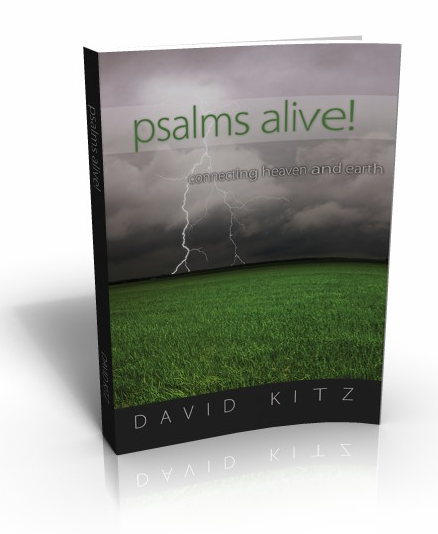
Today’s post is Chapter 18 from the book Psalms Alive! Connecting Heaven & Earth by David Kitz. To find out more or purchase click here.



 Is a return-to-Jesus revival possible in our time?






 I love the Psalms