Come and Fix It
18 Wednesday Nov 2020

18 Wednesday Nov 2020
18 Wednesday Nov 2020
Tags
Reading: Psalm 79
A maskil of Asaph.
(Verses 1-7)
O God, the nations have invaded your inheritance;
they have defiled your holy temple,
they have reduced Jerusalem to rubble.
They have left the dead bodies of your servants
as food for the birds of the sky,
the flesh of your own people for the animals of the wild.
They have poured out blood like water
all around Jerusalem,
and there is no one to bury the dead.
We are objects of contempt to our neighbors,
of scorn and derision to those around us.
How long, LORD? Will you be angry forever?
How long will your jealousy burn like fire?
Pour out your wrath on the nations
that do not acknowledge you,
on the kingdoms that do not call on your name;
for they have devoured Jacob
and devastated his homeland (NIV).*

Autumn stillness — photo by David Kitz
Reflection
Have you caught a glimpse of the devastation? It seems that the psalmist, Asaph, had a good look at it. Now take a good look at his words. They have left the dead bodies of your servants as food for the birds of the sky, the flesh of your own people for the animals of the wild. They have poured out blood like water all around Jerusalem, and there is no one to bury the dead.
This description reads like a segment of the evening newscast. Of course the newscast has plenty of disturbing visuals to go with it. When we look at conflict zones like Syria, Iraq and Afghanistan, we realize that bloodshed and violence are all too common in our world. Jihadi violence has spread to European cities too. But we don’t have to go overseas to find images of death and destruction. Just last week in my city an unarmed black man was beaten to death by two police officers. As is so often the case, the images were caught on camera. Violence and bloodshed are present in our cities too.
Has the world gone mad? Are we sinking deeper and deeper into depravity? Have our minds become numb to the carnage? Or are we joining with the psalmist in crying out, “How long, LORD?” How long will you let this insanity continue? LORD, won’t you come and fix this broken messed up world?
Our hearts cry out for justice, mercy and peace—justice for those who have been wronged, mercy for those who have been wounded and broken, and peace for all who are troubled in soul and spirit. He who testifies to these things says, “Yes, I am coming soon.” Amen. Come, Lord Jesus (Revelation 22:20).
Response: LORD God, please have mercy on the people of this world. We need you here—right here with us in this broken world. Come and fix it. Come and fix us, Lord Jesus. Amen.
Your Turn: Are you concerned about the state of your city, your country and the world?
Some good news: The first volume of Psalms 365: Develop a Life of Worship and Prayer by award-winning author David Kitz will be published in November, 2020, by Elk Lake Publishing. Two additional volumes will follow in 2021 to complete the three volume set of devotions from the Psalms.
17 Tuesday Nov 2020
Posted in Psalms
Tags
17 Tuesday Nov 2020
Tags
Reading: Psalm 78
(Verses 65-72)
Then the Lord awoke as from sleep,
as a warrior wakes from the stupor of wine.
He beat back his enemies;
he put them to everlasting shame.
Then he rejected the tents of Joseph,
he did not choose the tribe of Ephraim;
but he chose the tribe of Judah,
Mount Zion, which he loved.
He built his sanctuary like the heights,
like the earth that he established forever.
He chose David his servant
and took him from the sheep pens;
from tending the sheep he brought him
to be the shepherd of his people Jacob,
of Israel his inheritance.
And David shepherded them with integrity of heart;
with skillful hands he led them (NIV).*

Serene November morning — photo by David Kitz
Reflection
Up to this point Psalm 78 has catalogued a long list of Israel’s transgressions. They have been a stubborn and rebellious people who have been unfaithful to the LORD. They have been unfaithful despite His mercy and the miracles He has performed on their behalf. Now this final portion of the psalm represents a turning point in the history of the nation.
Once again, the LORD intervened in the affairs of Israel. He chose David his servant and took him from the sheep pens; from tending the sheep he brought him to be the shepherd of his people Jacob, of Israel his inheritance.
God chose a man; He chose a leader. Often the LORD chooses the most unlikely candidates for leadership. He did not go to the palace; He went to the sheep pen. He overlooked Jonathan, the courageous royal son of Saul, and instead He called out David, the youngest son of Jesse—a man after God’s own heart.
What does God consider when He looks for a leader? When selecting the next king, the prophet Samuel was told, “The LORD does not look at the things people look at. People look at the outward appearance, but the LORD looks at the heart” (1 Samuel 16:7). The LORD is not looking for physical strength or a handsome face, but he is looking for integrity of heart.
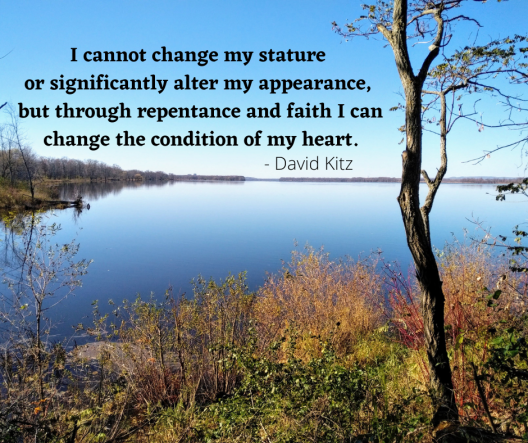
That should give hope to every one of us. I cannot change my stature or significantly alter my appearance, but through repentance and faith I can change the condition of my heart.
Response: LORD God, I want a heart of integrity—a heart that is pleasing to you. Help me to become an instrument that you will use for your good purpose in this strife-torn world. Amen.
Your Turn: Can we change our hearts or is that God’s job? What role do we play?
Some good news: The first volume of Psalms 365: Develop a Life of Worship and Prayer by award-winning author David Kitz will be published in November, 2020, by Elk Lake Publishing. Two additional volumes will follow in 2021 to complete the three volume set of devotions from the Psalms.
16 Monday Nov 2020
Tags

16 Monday Nov 2020
Reading: Psalm 78
(Verses 56-64)
But they put God to the test
and rebelled against the Most High;
they did not keep his statutes.
Like their ancestors they were disloyal and faithless,
as unreliable as a faulty bow.
They angered him with their high places;
they aroused his jealousy with their idols.
When God heard them, he was furious;
he rejected Israel completely.
He abandoned the tabernacle of Shiloh,
the tent he had set up among humans.
He sent the ark of his might into captivity,
his splendor into the hands of the enemy.
He gave his people over to the sword;
he was furious with his inheritance.
Fire consumed their young men,
and their young women had no wedding songs;
their priests were put to the sword,
and their widows could not weep (NIV).*

November days — photo by David Kitz
Reflection
Sin has consequences. We can pretend it isn’t so, but we’re fooling ourselves. Unchecked sin on a personal level can have devastating consequences—consequences that lead to heartache and an early grave. I think we all know individuals who became trapped in sin and wandered down a self-destructive path.
Today’s reading from Psalm 78 reminds us that a whole nation can abandon God and become mired in the consequences of sin. The nation of Israel did just that. The psalmist tells us they were disloyal and faithless, as unreliable as a faulty bow.
When Israel abandoned God, He in turn abandoned them. We read, “He rejected Israel completely. He abandoned the tabernacle of Shiloh, the tent he had set up among humans. He sent the ark of his might into captivity, his splendor into the hands of the enemy. He gave his people over to the sword; he was furious with his inheritance.”
Has God changed? If the LORD abandoned His people in ancient times, will He treat our nation—any nation that turns away from Him differently today? There are consequences for sin and that truth applies to nations too. When collectively we abandon the ways of God and the precepts He has established from the foundations of the world, we can expect dire days ahead. That’s what happened to ancient Israel, and it can happen to us today as well.
Response: LORD God, collectively as a nation, we have wandered away from you. LORD in your mercy lead us back to the center of your holy will. Give us repentant hearts that seek your face. Amen.
Your Turn: Are you concerned about the spiritual state of your nation? What are you doing about it?
Some good news: The first volume of Psalms 365: Develop a Life of Worship and Prayer by award-winning author David Kitz will be published in November, 2020, by Elk Lake Publishing. Two additional volumes will follow in 2021 to complete the three volume set of devotions from the Psalms.
15 Sunday Nov 2020
Tags
14 Saturday Nov 2020
Tags

MacNutt, Saskatchewan at sunrise — photo by David Kitz
13 Friday Nov 2020
Tags
13 Friday Nov 2020
Reading: Psalm 78
(Verses 50-55)
He prepared a path for his anger;
he did not spare them from death
but gave them over to the plague.
He struck down all the firstborn of Egypt,
the firstfruits of manhood in the tents of Ham.
But he brought his people out like a flock;
he led them like sheep through the wilderness.
He guided them safely, so they were unafraid;
but the sea engulfed their enemies.
And so he brought them to the border of his holy land,
to the hill country his right hand had taken.
He drove out nations before them
and allotted their lands to them as an inheritance;
he settled the tribes of Israel in their homes (NIV).*

Photo by Jill Wellington on Pexels.com
Reflection
Understanding God’s choice is not a simple matter. Today’s reading from Psalm 78 draws our attention to the choices God makes. Why did God choose the people of Israel? Why did He decide to get behind this rebellious people? Why did the LORD throw His active support behind a slave revolt? Why did He show mercy to Israel, but pour out His wrath on Egypt?
Of course we can ask the same questions on a personal level. Why did God choose to save me from my personal pile of sin and destructive habits? Why did He show me the incredible love of Jesus through his death on the cross? Why did the message of the gospel touch me so deeply and transform me so radically, while it bounced off others around me like a babble of meaningless words?
We may never know the answers to these questions. What I do know is that God did not choose the best and the greatest when He chose Israel. Furthermore, at this present time, God overlooked the best and the greatest and instead He chose you and me. St. Paul writes, “My dear friends, remember what you were when God chose you. The people of this world didn’t think that many of you were wise. Only a few of you were in places of power, and not many of you came from important families. But God chose the foolish things of this world to put the wise to shame. He chose the weak things of this world to put the powerful to shame” (1 Corinthians 1:26-27, CEV).
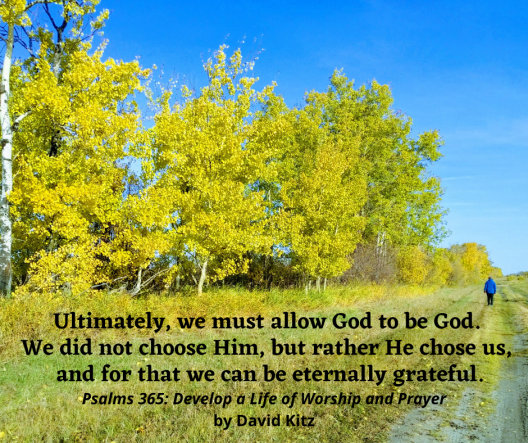
St. Paul writes, “The god who rules this world has blinded the minds of unbelievers. They cannot see the light, which is the good news about our glorious Christ, who shows what God is like” (2 Corinthians 4:4). Why does the light go on for some, but not for others? We could spend an eternity pondering these questions and not arrive at a satisfactory answer. Ultimately, we must allow God to be God. We did not choose Him, but rather He chose us and for that we can be eternally grateful.
Response: LORD God, I am thankful that your Spirit sought me out and drew me to the cross of Jesus. I bow before you in praise and gratitude. I pray that you will show the same mercy to many others. Give me a heart of compassion for those who have not experienced your saving grace. Amen.
Your Turn: Do you understand God’s sovereign choice? How do you respond?
Some good news: The first volume of Psalms 365: Develop a Life of Worship and Prayer by award-winning author David Kitz will be published in November, 2020, by Elk Lake Publishing. Two additional volumes will follow in 2021 to complete the three volume set of devotions from the Psalms.


