• Home
  • About
  • DavidKitz.ca
  • Youtube Videos
  • Books by David
  • Books on Amazon.com

I love the Psalms

~ Connecting daily with God through the Psalms

I love the Psalms

Category Archives: Psalms

Stop Hate the Cycle

04 Thursday Sep 2025

Posted by davidkitz in Psalms

≈ 2 Comments

Tags

Bible, devotion, enemies, faith, forgiveness, grace, healing, hurt, Jesus, love, Prayer, Psalms, reconciliation, Reflection

Today’s Devotion from Psalms 365 by David Kitz

Reading: Psalm 139:19-22
If only you, God, would slay the wicked!
Away from me, you who are bloodthirsty!
They speak of you with evil intent;
your adversaries misuse your name.
Do I not hate those who hate you, LORD,
and abhor those who are in rebellion against you?
I have nothing but hatred for them;
I count them my enemies. *

Photo by Porapak Apichodilok on Pexels.com

Reflection
As much as I love the psalms of the Bible, there are some psalms, or verses within psalms that I would just like to skip. I wish they weren’t there. Today’s reading from Psalm 139 is a prime example. The author’s words are filled with venom. Why are they even in the Bible? (Please bear with me.)

Passages like today’s reading are particularly troubling in light of Jesus’ teaching in the New Testament. In his great Sermon on the Mount, he gave us this teaching: “You have heard that it was said, ‘Love your neighbor and hate your enemy.’ But I tell you, love your enemies and pray for those who persecute you, that you may be children of your Father in heaven. He causes his sun to rise on the evil and the good, and sends rain on the righteous and the unrighteous” (Matthew 5:43-45).

Reconciling today’s reading from Psalm 139 with Jesus’ words makes my head hurt. Jesus calls us to an incredibly high standard—God’s standard. God shows kindness and love even to the unrighteous. They like us receive both sunshine and rain. Let’s face it, when someone hurts me, my default position is to hurt them back. That’s the natural human response. That’s the way it has been since the beginning, and the world is full of lasting scars—intergenerational scars because of it. Wounded people have been busy hurting other wounded people as hate builds on hate in the home, at work and internationally.

But Jesus came to interrupt that corrosive cycle. He asks us to counter that hurt—that slight—that injury with love. Now that’s truly revolutionary. It’s a revolt against the status quo of hatred that has poisoned human relations in our country and the world. Has someone gone out of their way to hurt you? Retaliate with an act of love. That’s what Jesus is saying.

Is that hard? Absolutely. It’s much easier to respond like the author of today’s reading from Psalm 139. So why is this portion of Psalm 139 in the Bible? Maybe it should be redacted—blacked over like a secret government file.

Psalm 139 like all the psalms, began as someone’s personal prayer—their personal interaction with God. They are pouring out their heart before God. It’s a heart that has been wounded by others. Should they bottle-up those feelings and never express them to God? Of course not. We need to pour out our hurts to God. He alone can heal and change that wounded heart.

Response: LORD God, you know all my hurts. I bring them before you. Pour your love into me, so I can love my enemies. Show me the way forward. Jesus, you forgave even those who killed you. Amen.

Your Turn: Have you changed your default position from hate to love?

Para la publicación de Salmos 365 de hoy en español haga clic aquí.

bgbg_v4.3_1501818
* NEW INTERNATIONAL VERSION, COPYRIGHT ©1973, 1978, 1984, 2011 BY BIBLICA

Please pray for peace to return to Israel, Gaza, and Ukraine!

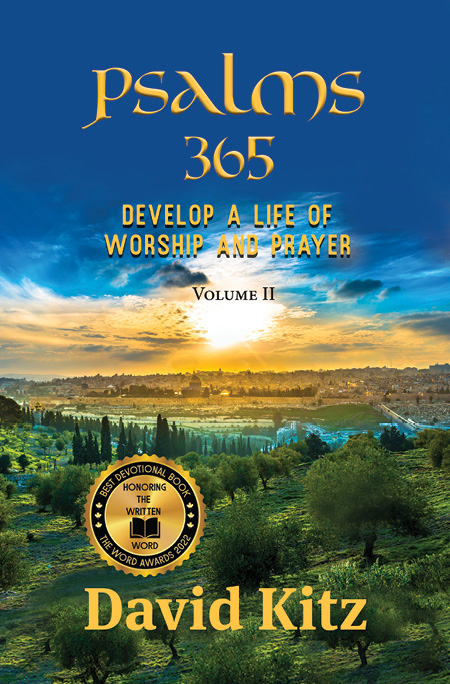
Volume I of Psalms 365: Develop a Life of Worship and Prayer won the Best Book of the Year Award from The Word Guild and Volume II has won the Best Devotional of the Year Award. For those who love God’s word, this three-book series is an ideal way to daily meet with the Lord. To purchase or for a closer look click here.

A gripping read from David Kitz.
Is a return-to-Jesus revival possible in our time?
This book points the way forward.
For details click here.

Divine Design

03 Wednesday Sep 2025

Posted by davidkitz in Psalms

≈ Leave a comment

Tags

creation, faith, gratitude, intimacy, life, miracle, Psalm, purpose, Reflection, sight

Today’s Devotion from Psalms 365 by David Kitz

Reading: Psalm 139:13-18
For you created my inmost being;
you knit me together in my mother’s womb.
I praise you because I am fearfully and wonderfully made;
your works are wonderful,
I know that full well.
My frame was not hidden from you
when I was made in the secret place,
when I was woven together in the depths of the earth.
Your eyes saw my unformed body;
all the days ordained for me were written in your book
before one of them came to be.
How precious to me are your thoughts, God!
How vast is the sum of them!
Were I to count them,
they would outnumber the grains of sand—
when I awake, I am still with you (NIV). *

Photo by Frans Van Heerden on Pexels.com

Reflection
Psalm 139 is a psalm of incredible intimacy—divine intimacy. God knows us; sees us; loves us like the LORD only can. He has known us and cared for us from the moment of conception. We need to make that statement personal because it is personal. The Almighty has known me and cared for me from the moment of my conception.

For you created my inmost being; you knit me together in my mother’s womb. I praise you because I am fearfully and wonderfully made; your works are wonderful, I know that full well.

Last week, I had lens replacement surgery on my left eye. The same surgery was done on my right eye three weeks earlier. This highly skilled tinkering with my eyes has left me in awe of the gift of sight. What a miracle! Yes, the surgeon worked wonders. My sight has been restored without the need for eyeglasses—something I have needed and have worn since the age of eight. Now for first time in 60 years, I can roll out of bed and not reach for my glasses.

What I truly appreciate is the original miracle—the gift of sight itself; a gift we are born with. Because the miracle of sight is so universal, we take it for granted. But when that precious gift is lost or threatened, we appreciate it again with new eyes. I join with the psalmist in making this declaration: I praise you because I am fearfully and wonderfully made; your works are wonderful, I know that full well (v. 13-14).

God took the time to knit you together in your mother’s womb. You can be sure He didn’t miss a stitch. You were formed according to His plan to live for His purpose. Wow! What an awesome privilege. And all the days ordained for [you and] me were written in [God’s] book before one of them came to be (v. 16).

Response: LORD God, thank you for the gift of life, for sight, sound, and touch. You thought of me. What joy that brings! Help me to live the days assigned to me with gladness and gratitude. Amen.

Your Turn: Do we take our physical gifts for granted? How do you cultivate an attitude of gratitude?

Para la publicación de Salmos 365 de hoy en español haga clic aquí.

bgbg_v4.3_1501818
* NEW INTERNATIONAL VERSION, COPYRIGHT ©1973, 1978, 1984, 2011 BY BIBLICA

Please pray for peace to return to Israel, Gaza, and Ukraine!

Volume I of Psalms 365: Develop a Life of Worship and Prayer won the Best Book of the Year Award from The Word Guild and Volume II has won the Best Devotional of the Year Award. For those who love God’s word, this three-book series is an ideal way to daily meet with the Lord. To purchase or for a closer look click here.

A gripping read from David Kitz.
Is a return-to-Jesus revival possible in our time?
This book points the way forward.
For details click here.

The Foreknowledge of God the Father

02 Tuesday Sep 2025

Posted by davidkitz in Psalm 139, Psalms

≈ Leave a comment

Tags

Bible, blood of Christ, chosen by God, foreknowledge, God's elect, God's grace, Jesus, peace, Prayer, Psalms, remedy, the LORD

Today’s quote and prayer from
“Psalms 365: Develop a Life of Worship and Prayer”

Today’s Reading: Psalm 139:7-12

LORD God,
you know me.
You know all my sins,
my weaknesses and shortcomings.
Yet you love me.
I bring all these things before you.
Wash me clean.
Jesus,
your shed blood is my remedy.
Amen.

— — — —
 
Peter, an apostle of Jesus Christ,
To God’s elect,
exiles scattered throughout the provinces of Pontus,
Galatia, Cappadocia, Asia and Bithynia,
who have been chosen
according to the foreknowledge of God the Father,
through the sanctifying work of the Spirit,
to be obedient to Jesus Christ
and sprinkled with his blood:
Grace and peace be yours in abundance.

(1 Peter 1:1-2 NIV)*

Para la publicación de Salmos 365 de hoy en español haga clic aquí.

bgbg_v4.3_1501818
* NEW INTERNATIONAL VERSION, COPYRIGHT ©1973, 1978, 1984, 2011 BY BIBLICA

Please pray for peace to return to Israel, Gaza, Iran, and Ukraine!

Volume I of Psalms 365: Develop a Life of Worship and Prayer won the Best Book of the Year Award from The Word Guild and Volume II has won the Best Devotional of the Year Award. For those who love God’s word, this three-book series is an ideal way to daily meet with the Lord. To purchase or for a closer look click here.

A gripping read from David Kitz.
Is a return-to-Jesus revival possible in our time?
This book points the way forward.

Seeking God Instead of Hiding

02 Tuesday Sep 2025

Posted by davidkitz in Psalms

≈ Leave a comment

Tags

devotion, faith, forgiveness, gospel, grace, hope, Jesus, Light, mercy, Psalm, redemption, Reflection, salvation, Scripture, truth

Today’s Devotion from Psalms 365 by David Kitz

Reading: Psalm 139:7-12
Where can I go from your Spirit?
Where can I flee from your presence?
If I go up to the heavens, you are there;
if I make my bed in the depths, you are there.
If I rise on the wings of the dawn,
if I settle on the far side of the sea,
even there your hand will guide me,
your right hand will hold me fast.
If I say, “Surely the darkness will hide me
and the light become night around me,”
even the darkness will not be dark to you;
the night will shine like the day,
for darkness is as light to you (NIV). *

My soul finds rest in God — photo by David Kitz

Reflection
One of my favorite games as a child was hide and seek. Whenever a group of kids got together, it wouldn’t take long before someone would say, “Hey, let’s play hide ’n’ seek.” We settled on who would be the seeker, and off we went, happily playing until the adults eventually called an end to our fun.

I preferred being the hider rather than the seeker. What about you? There seems to be something fun, even natural about hiding. We should be good at it. Humankind has been hiding since that fateful day in the Garden of Eden. After willfully disobeying God, what was the first thing Adam and Eve did? They hid. First, they hid their nakedness from each other; then they hid from their loving Creator. Humanity has been playing hide and seek from God ever since. And yes, we are the hiders.

We should be the seekers—seekers after God. Instead, we find ourselves hiding our sins and hiding from our God and Savior. What utter foolishness this is? The psalmist expresses this reality so well. Where can I go from your Spirit? Where can I flee from your presence? If I go up to the heavens, you are there; if I make my bed in the depths, you are there (v. 7-8).

We can’t hide from God. Why can’t we, you ask. Because He is God—all knowing—present everywhere. This behavior—this hiding from God—is nothing more than profound stupidity on our part. Why do we even attempt such an impossible feat? Are we so blinded by guilt and shame that we can’t face the One to whom we must give an account? But the Grand Accountant has also provided the remedy for our sin and the guilt and shame that follows.

The remedy is the blood of Jesus. He is the atoning sacrifice that brings us back into fellowship with God. He became one of us so he could lead us, like errant sheep back to our Father God. There is no need to hide. Speaking of himself, Jesus said, “For the Son of Man came to seek and to save the lost” (Luke 19:10).

Response: LORD God, you know me. You know all my sins, my weaknesses and shortcomings. Yet you love me. I bring all these things before you. Wash me clean. Jesus, your shed blood is my remedy. Amen.

Your Turn: Have you been playing hide and seek with God? Is it time to stop hiding and start seeking?

Para la publicación de Salmos 365 de hoy en español haga clic aquí.

bgbg_v4.3_1501818
* NEW INTERNATIONAL VERSION, COPYRIGHT ©1973, 1978, 1984, 2011 BY BIBLICA

Please pray for peace to return to Israel, Gaza, and Ukraine!

Volume I of Psalms 365: Develop a Life of Worship and Prayer won the Best Book of the Year Award from The Word Guild and Volume II has won the Best Devotional of the Year Award. For those who love God’s word, this three-book series is an ideal way to daily meet with the Lord. To purchase or for a closer look click here.

A gripping read from David Kitz.
Is a return-to-Jesus revival possible in our time?
This book points the way forward.
For details click here.

The Search Within

01 Monday Sep 2025

Posted by davidkitz in Psalms

≈ Leave a comment

Tags

anniversary, faith, family, gift, God, grace, Heart, love, marriage, Prayer, Psalm, Reflection, search, timing, trust

Today’s Devotion from Psalms 365 by David Kitz

Reading: Psalm 139:1-6
For the director of music. Of David. A psalm.
You have searched me, LORD,
and you know me.
You know when I sit and when I rise;
you perceive my thoughts from afar.
You discern my going out and my lying down;
you are familiar with all my ways.
Before a word is on my tongue
you, LORD, know it completely.
You hem me in behind and before,
and you lay your hand upon me.
Such knowledge is too wonderful for me,
too lofty for me to attain (NIV). *

Reflection
Last night I got a phone call from my son. The long search was finally over. The gift had been found. This morning, I met him at church, and he gave me this semi-precious gift.

What is it you ask? It’s a necklace I purchased for my wife in a grand, continent-wide conspiracy of love. Last June my wife made a solo trip to Edmonton to visit her Dad. While there, she went shopping with one of her friends and fell in love with a cut rock necklace. This friend secretly sent me a message inquiring if I would pay her to purchase this rare find. Without hesitation I agreed. I always find it difficult to buy jewelry for my wife. I never know what she might like. Furthermore, our 40th anniversary was coming in December. What a delightful surprise this gift would be!

A few weeks later my son and his wife went on a business trip to Edmonton, and they brought the necklace back with them, and I secretly mailed the payment to our friend. All of this was working out so well—too well! Only a father and son team of bumbling males could mess this up. And they did.

June to December is a long time—enough time for me to completely forget about this necklace. We had a great anniversary celebration, but all the while I had this niggling feeling that I had forgotten something. Two weeks later, I got a text message from our mutual friend in Edmonton inquiring about how Karen liked her necklace. Oops! This sent me into a frantic search for my precious gift. I must have hidden it in a safe place. In desperation I called my son. He also searched—all to no avail. We concluded that God knew exactly where the necklace was, and it would be found at the right moment. Well, yesterday that moment arrived. In God’s perfect time, Karen will get her necklace.

Today’s psalm reading speaks of God searching our hearts. Does God really need to do that? I doubted it. Jesus knows exactly what is in there. See John 2:23-25. We are the ones who need to search our hearts. We don’t know what is hidden inside us. Is it rotting garbage or something precious?

Response: LORD God, turn on your light inside of me. You know my deep hurts and inner struggles. You are familiar with all my ways. Cleanse me from within. By grace and faith, I am your child. Amen.

Your Turn: Have you been hiding things from God? Do you have a hurt to bring to Jesus?


For all celebrating Labour Day, may you know God’s boundless blessing!

Para la publicación de Salmos 365 de hoy en español haga clic aquí.

bgbg_v4.3_1501818
* NEW INTERNATIONAL VERSION, COPYRIGHT ©1973, 1978, 1984, 2011 BY BIBLICA

Please pray for peace to return to Israel, Gaza, and Ukraine!

Volume I of Psalms 365: Develop a Life of Worship and Prayer won the Best Book of the Year Award from The Word Guild and Volume II has won the Best Devotional of the Year Award. For those who love God’s word, this three-book series is an ideal way to daily meet with the Lord. To purchase or for a closer look click here.

A gripping read from David Kitz.
Is a return-to-Jesus revival possible in our time?
This book points the way forward.
For details click here.

Full Redemption

31 Sunday Aug 2025

Posted by davidkitz in Psalms, Psalms Alive!

≈ Leave a comment

Tags

forgiveness of sins, God, Jesus, mercy of God, Prayer, Psalm 130, Psalms, redemption, the LORD

Psalm 130

A Song of Ascents

Out of the depths I cry out to you, O LORD;
O Lord, hear my voice.
Let your ears be attentive to my cry for mercy.
If you, O LORD, kept a record of sins,
O Lord, who could stand?
But with you there is forgiveness;
therefore you are feared.

I wait for the LORD, my soul waits,
and in his word I put my hope.
My soul waits for the Lord
more than watchmen wait for the morning,
more than watchmen wait for the morning.

O Israel, put your hope in the LORD,
for with the LORD is unfailing love
and with him is full redemption.
He himself will redeem Israel
from all their sins. (NIV)

I have a secret to share. One of the reasons I love the psalms so much is because by reading them I can become a spiritual voyeur. The psalms let me see what most people hide. They take me gently by the hand and lead me into the inner sanctum of the human soul. Here I see men in travail with their God. Here I see the ecstasy of worship—joyous and unrestrained. Here I see everything laid bare before the One who sees all. Here I discover what it means to know God and be fully known by Him.

I come away saying, “So this is what loving God looks like. So, this is what it means to be in a soul-bonding relationship with the Maker of the universe.”

In the psalms we catch a glimpse of these intimate times with God, and we discover how these times can become our own. This is the Bible’s explicit, How-to-Manual for Intimacy with God.

Psalm 130 is a perfect example of a psalm that brings us into the private inner sanctum of communion with God. Here is a portrait of a fallen man—a man on his knees before his Maker, the eternal One. Hear him now as he agonizes in prayer, “Out of the depths I cry out to you, O LORD; O Lord, hear my voice. Let your ears be attentive to my cry for mercy.”

Photo by cottonbro on Pexels.com

The opening lines of this psalm leave little doubt as to what has transpired. The psalmist has failed; he has missed the mark. He has transgressed, yet again. There is an abject poverty of spirit reflected in these words—a poverty that almost makes us cringe.

We do not know what sin, or list of sins has brought the psalmist to this wretched state. The transgression is left unstated. Was it anger, malice, or unbridled lust? Was it pride, greed or wilful dishonesty? Was this a transgression of the mind, of the tongue, of action or inaction? Or was it some combination or permutation of all of these? God knows. We are left guessing.

But a forthright appraisal of my own soul leaves ample latitude for the scope and the severity of sin. I am always somewhat skeptical of those who sanctimoniously claim they could never commit this or that sin. I think we rarely comprehend the depravity of our own hearts. Pushed into wrong circumstances, in the wrong environment, with the wrong peer group, who can plumb the depths to which a man or woman may sink?

I am human, tainted by the fall, by the original transgression. I can identify with the psalmist. I have added my own pile of dung to this world’s heap of moral filth. I too have found myself in the psalmist’s position, sobbing out these words, “Out of the depths I cry out to you, O LORD; O Lord, hear my voice. Let your ears be attentive to my cry for mercy.”   

But … despite my failings, despite my moral poverty, this great God—this God of holiness—is approachable. He is a God of mercy. The psalmist reminds himself and the LORD of His merciful nature.

            “If you, O LORD, kept a record of sins, O Lord, who could stand? But with you there is forgiveness; therefore you are feared.”

I need daily reminders of the mercy of God. God the moral accountant is also the Lord of forgiveness. No one does forgiveness better than God. He destroys the record. What accountant does that?

It is income tax time right now, as I complete this manuscript. So, I find myself caught between completing this book and completing my tax return. My accountant always insists that I keep all my receipts, all my records, and every slip of paper. He warns that at some point in the future the revenue department may decide to do an audit of my tax account.

But with God there is no future audit. Every sin I have brought to Him has been erased. It’s been destroyed. The LORD has no record of it. He can’t find it, and He’s not even looking for it. It’s gone. Gone forever! 

Wow! What an amazing God! He makes sins disappear. He keeps no records. He is a forgiving God; hence He is feared. The psalmist clearly states, “But with you there is forgiveness; therefore you are feared.”

Now that is a rather curious statement. The forgiveness of God produces in us a reverent fear of the Great Forgiver. We respect, honor, and worship the LORD because He forgives—not because He mocks us for our errors, and slams us into the jail cell of guilt. No, just the opposite is true. God forgives, not once or twice, but repeatedly. He forgives on day one thousand just as freely as He did on day one. He has no remembrance of our first offence. He has no record of it. A purposeful, divine senility has set in. Yet the Ancient of Days is still omniscient; He knows everything. He chooses to forgive me, and to see me as faultless. I have an unblemished record, because there is no record of my wrongs.

Because He forgives, I love Him. Because He forgives, I fear Him, and I will serve Him all the days of my life. He is a shelter for the fallen. He is help for the failing. He is an anchor for the wayward. When I cry out from the depths, He hears. The LORD is there.

And He is here now. He listens. He is listening to your thoughts. His Holy Spirit convicts us of sin and then wrenches us into alignment with the Almighty. Yes, the gentle Holy Spirit forces us into soul-altering repentance. By forcing us, I mean the Spirit works on our stubborn, hell-bent will until we yield to the will of God. This is the soul-wrenching experience of every God-encountering believer, and we are witnessing such an encounter here within this psalm.    

Psalm 130 can be divided into three distinct sections: the confessional approach, the wait, and the LORD’s response. Thus far, we have been looking at the confessional approach. The psalmist comes before his God and pours out his heart. In desperation he pleads for mercy and forgiveness. At the same time, he acknowledges the extreme mercy of God. He knows full well that this God forgives the undeserving.

Now, the psalmist waits.

            “I wait for the LORD, my soul waits, and in his word I put my hope. My soul waits for the Lord more than watchmen wait for the morning, more than watchmen wait for the morning.”

This is the step that is most frequently missing in our communion with God. We cannot wait. We rush on. We have things to do, people to see, a life to live. We have no time to wait for the LORD’s response.

But without waiting, we cannot hear the LORD speaking to our hearts. The rush of life takes over. We do not hear Him speak the words of divine pardon. We do not hear the voice of our Saviour. Prayer is reduced to one way communication. We speak into the silence and allow no time for the God of silence to answer back. By our actions we insist that God must respect our timetable.

How many times has the LORD tried to call you and all that He has heard from your end of the line is an annoying busy signal? Will our merciful God continue to call?

What a different response we see from the psalmist. “I wait for the LORD, my soul waits, and in his word I put my hope. My soul waits for the Lord more than watchmen wait for the morning, more than watchmen wait for the morning.”

Misty morning sunrise — Orleans, ON — photo by David Kitz

The repetition of that last line adds a certain gravity to every word. There is resolute determination in these words. I can hear the psalmist saying to himself, “I’m not going anywhere until the LORD answers. I need to hear His voice for myself. I need to hear the pardon from His lips.”

In this time of waiting, the psalmist turns to the written word of God. He states, “In his word I put my hope.”

Where do you turn as you wait for God to answer your prayers?

Turn to God’s word. Read it. Meditate on it. Let it fill your soul. From the pages of His word, God speaks. Put your hope in God’s enduring word.

Now in Psalm 130, we encounter the third transition within the poetic structure of this psalm. There is a one-line break and then the psalmist continues.  There is a dramatic change from this point on. Here is the third section—the LORD’s response. The psalmist is no longer addressing the LORD in humble prayer. Now he is addressing us. It is as though the psalmist has heard from God within that blank line on the page. The waiting is over. God has spoken, and now the psalmist rises to his feet. He has a message from the LORD for us—the Israel of God.

            “O Israel, put your hope in the LORD, for with the LORD is unfailing love and with him is full redemption.”

For Israel, there was a long wait. The promised Messiah was a long time in coming. The centuries slipped by. Generation after generation passed on, but the word of the LORD stood firm. A redeemer was coming. The ongoing question remained, “Will he come in my day? Will I see his face?”

With an uncanny accuracy the Old Testament prophets foretold the coming of the Christ. Many of those prophesies are found within the Book of Psalms. In Psalm 22, with agonizing detail, David portrayed Christ’s suffering on the cross. Jesus himself drew attention to this prophetic link, as he cried out from the cross, “My God, my God, why have you forsaken me?” (Psalm 22:1; Matthew 27:46).  

Now speaking with personal assurance that his sins are forgiven, the psalmist declares, “O Israel, put your hope in the LORD, for with the LORD is unfailing love and with him is full redemption.”

The LORD is our fount of hope. He is love and the source of unfailing love. It is He who will redeem us, body, soul and spirit.

            “He himself will redeem Israel from all their sins.”

This is not a job for sacrificial lambs and goats, or the ashes of a heifer. The LORD “himself will redeem Israel from all their sins.”

What a revelation! Redemption in the old covenant involved the shedding of blood. From the time of the first Passover, the firstborn of Israel belonged to the LORD. They were to be redeemed by an animal sacrifice. But here through the voice of the psalmist the LORD makes clear that the old sacrificial system will be superseded. “He himself will redeem Israel from all their sins.”

The God of heaven will come in person—He Himself. He will come in human form and stretch out His hands to draw all humanity to Himself—every infant, every girl and boy, every woman and man—all are included. He will Himself redeem us from our sins. He will take the spikes on our behalf, in our stead. He will bleed for us. The remedy for sin will be found at the foot of the cross.

The psalmist closing words echo Abraham’s words on the way to Mount Moriah, the hill of sacrifice. Abraham told Isaac, “God himself will provide the lamb for the burnt offering, my son” (Genesis 22:8).

God Himself will provide. He will provide Himself. He will provide “the Lamb of God, who takes away the sin of the world” (John 1:29).

Photo by Kat Jayne on Pexels.com

So through the psalms, this spiritual voyeur is brought from beneath the starry hosts to the most intimate place—the place of the cross. There water and blood flowing mingling down. Filthy and naked I come, and there I am washed clean—clean by the blood of the Lamb. 

Bringing Life to the Psalms

  1. In what respect are the psalms a How-to-Manual for Intimacy with God? Do you agree or disagree with this description?
  2. Take time to consider the three sections of this psalm, the confessional approach, the wait, and the LORD’s response. Can this become a pattern for your own times of prayer?
  3. There is a prophetic element to this psalm. Where does that prophetic element come from? Does it come from waiting on God? Read Psalm 22 and reflect on the revelation given to David in that psalm.
  4. Take time to read Genesis 22. Read it from a father’s perspective. Then read it from Isaac’s perspective. Finally try to view this account from our heavenly Father’s perspective. What do you believe was God’s intent in all of this?
  5. Rejoice. The LORD Himself has stretched out His hands and redeemed you from all your sins. 

Today’s post is Chapter 26, the last chapter from the book Psalms Alive! Connecting Heaven & Earth by David Kitz. To find out more or purchase click here.


Live in Harmony

27 Wednesday Aug 2025

Posted by davidkitz in Psalm 137, Psalms

≈ 2 Comments

Tags

Bible, bless, compassion, Father God, mercy of God, mourn, Prayer, Psalms, rejoice, Schadenfreude

Today’s quote and prayer from
“Psalms 365: Develop a Life of Worship and Prayer”

Photo courtesy of L. Foster


Today’s Reading: Psalm 137:7-9

Father God,
at times I have been guilty of schadenfreude.
Help me to show compassion
rather than smug indifference
when I see others experience loss.
Thank you for your ongoing mercy.
Amen.

— — — —

Bless those who persecute you;
bless and do not curse.
 
Rejoice with those who rejoice;
mourn with those who mourn.
 
Live in harmony with one another.
Do not be proud,
but be willing to associate
with people of low position.
Do not be conceited.

(Romans 12:14-16 NIV
)*

Para la publicación de Salmos 365 de hoy en español haga clic aquí.

bgbg_v4.3_1501818
* NEW INTERNATIONAL VERSION, COPYRIGHT ©1973, 1978, 1984, 2011 BY BIBLICA

Please pray for peace to return to Israel, Gaza, Iran, and Ukraine!

Volume I of Psalms 365: Develop a Life of Worship and Prayer won the Best Book of the Year Award from The Word Guild and Volume II has won the Best Devotional of the Year Award. For those who love God’s word, this three-book series is an ideal way to daily meet with the Lord. To purchase or for a closer look click here.

A gripping read from David Kitz.
Is a return-to-Jesus revival possible in our time?
This book points the way forward.

We Have Never Seen Anything Like This!

25 Monday Aug 2025

Posted by davidkitz in Psalm 136, Psalms

≈ Leave a comment

Tags

authority, Bible, faith, forgiveness of sins, God, healing, Jesus, praise, Prayer, Psalms

Today’s quote and prayer from
“Psalms 365: Develop a Life of Worship and Prayer”
by David Kitz

Reading: Psalm 136:17-26

Father God,
I admit my need for Jesus,
your Son,
my Savior.
I need his love, 
and his forgiveness.
His love endures forever. 
Amen.

— — — —
 
A few days later,
when Jesus again entered Capernaum,
the people heard that he had come home.
 
They gathered in such large numbers 
that there was no room left,
not even outside the door,
and he preached the word to them.
 
Some men came,
bringing to him a paralyzed man, 
carried by four of them.
 
Since they could not get him to Jesus
because of the crowd,
they made an opening in the roof above Jesus
by digging through it
and then lowered the mat the man was lying on.
 
When Jesus saw their faith,
he said to the paralyzed man, 
“Son, your sins are forgiven.”

Now some teachers of the law were sitting there,
thinking to themselves,
 
“Why does this fellow talk like that?
He’s blaspheming!
Who can forgive sins but God alone?”

Immediately Jesus knew in his spirit
that this was what they were thinking in their hearts,
and he said to them, 
“Why are you thinking these things?
 
Which is easier: to say to this paralyzed man,
‘Your sins are forgiven,’
or to say,
‘Get up, take your mat and walk’?
 
But I want you to know
that the Son of Man 
has authority on earth to forgive sins.” 
So he said to the man,
 
“I tell you, get up, take your mat and go home.”
 
He got up,
took his mat
and walked out in full view of them all.
This amazed everyone and they praised God, saying,
“We have never seen anything like this!”

(Mark 2:1-12 NIV
)*

Para la publicación de Salmos 365 de hoy en español haga clic aquí.

bgbg_v4.3_1501818
* NEW INTERNATIONAL VERSION, COPYRIGHT ©1973, 1978, 1984, 2011 BY BIBLICA

Please pray for peace to return to Israel, Gaza, Iran, and Ukraine!

Volume I of Psalms 365: Develop a Life of Worship and Prayer won the Best Book of the Year Award from The Word Guild and Volume II has won the Best Devotional of the Year Award. For those who love God’s word, this three-book series is an ideal way to daily meet with the Lord. To purchase or for a closer look click here.

A gripping read from David Kitz.
Is a return-to-Jesus revival possible in our time?
This book points the way forward.

With Shouts of Joy

24 Sunday Aug 2025

Posted by davidkitz in Psalm 105, Psalms

≈ 1 Comment

Tags

Abraham, Bible, bread of heaven, God's promises, holy, praise, praise the LORD, Prayer, Psalms, the LORD

I will praise the LORD!

Psalm 105:39-45

He spread out a cloud as a covering,
    and a fire to give light at night.
They asked, and he brought them quail;
    he fed them well with the bread of heaven.
He opened the rock, and water gushed out;
    it flowed like a river in the desert.
For he remembered his holy promise
    given to his servant Abraham.
He brought out his people with rejoicing,
    his chosen ones with shouts of joy;
he gave them the lands of the nations,
    and they fell heir to what others had toiled for—
that they might keep his precepts
    and observe his laws.
Praise the LORD. *

Para la publicación de Salmos 365 de hoy en español haga clic aquí.

bgbg_v4.3_1501818
* NEW INTERNATIONAL VERSION, COPYRIGHT ©1973, 1978, 1984, 2011 BY BIBLICA

Please pray for peace to return to Israel, Gaza, and Ukraine!

Volume I of Psalms 365: Develop a Life of Worship and Prayer won the Best Book of the Year Award from The Word Guild and Volume II has won the Best Devotional of the Year Award. For those who love God’s word, this three-book series is an ideal way to daily meet with the Lord. To purchase or for a closer look click here.

A gripping read from David Kitz.
Is a return-to-Jesus revival possible in our time?
This book points the way forward.
For details click here.

Filled with Laughter

24 Sunday Aug 2025

Posted by davidkitz in Psalm 126, Psalms

≈ Leave a comment

Tags

churches, faith, fortunes, harvest, Holy Spirit, Jesus, Jesus People, joy, lost generation, Prayer, Psalms, restoration, revival, the LORD, word of God, Zion

Psalm 126

A Song of Ascents

When the LORD brought back the captives to Zion,
we were like men who dreamed.
Our mouths were filled with laughter,
our tongues with songs of joy.
Then it was said among the nations,
“The LORD has done great things for them.”
The LORD has done great things for us,
and we are filled with joy.

Restore our fortunes, O LORD,
like streams in the Negev.
Those who sow in tears will reap with songs of joy.
He who goes out weeping,
carrying seed to sow,
will return with songs of joy,
carrying sheaves with him.

I cannot read this psalm—Psalm 126—without immediately identifying with it. I have lived this psalm; I have experienced the reality of it.

Now that’s a rather bold statement; some might call it an ignorant or arrogant statement. The historical context of this psalm is readily identifiable. The psalmist is commenting on the joyous return of the exiles following the seventy-year Babylonian captivity—an event that occurred in the sixth century before the birth of Christ. How could anyone alive today claim that they have lived or experienced this particular Psalm? None of us were present during these dramatic events in Jewish history.

But again, I repeat: I have lived this psalm; I have experienced the reality of it.

The whole premise of this book is built on the notion that the psalms can come alive within us. The writer of the Book of Hebrews reminds us that “the word of God is living and active (Hebrews 4:12).

Photo by L. Kranz

What is there then, to prevent this living word from coming alive within us? Why can we not experience this active word of God transforming and transporting us to the throne of grace? Only two things hinder us from living in the power and wonder of the word of God, and they are sin and unbelief. And sin and unbelief are only too eager to form within us, a constricting bond that smothers the Spirit empowered Word.

But when the power of sin is broken, and unbelief is purged from the doubting soul—oh what liberty awaits! The word of God comes alive within us. The LORD is then free to do great and glorious things in us, and through us.

That was my experience as a young man in the early 1970’s. The LORD was bringing back the captives to Zion, “and we were like men who dreamed. Our mouths were filled with laughter, our tongues with songs of joy.”

I was caught up in the vortex of the Jesus People movement of that time, and amazing things were happening. Young men and women were coming to faith in Christ at a phenomenal rate. At every church meeting newcomers were finding the forgiveness they needed. The prodigals were coming home in droves. Every gathering closed with a baptismal service as new believers affirmed their faith in the crucified and risen Christ. There was a heady infectious joy in the church that could not be contained.   

At that time, “Our mouths were filled with laughter, our tongues with songs of joy.”

The spontaneity of the worship experience during those days was truly astonishing. New songs were born—born by the Spirit—right within the corporate worship time. Many of them came directly from the scriptures. The psalms became the source book for our worship. The captives—captives of sin and Satan—had been set free, and now there was a new song in our hearts, and on our lips—a song of praise to our God. We could not keep this to ourselves. Who could possibly contain the overflowing goodness and mercy of God?

This ingathering of souls was God’s doing. A lost generation was arrested by the Almighty. He was turning us around, and we were discovering Jesus. And this move of the Holy Spirit did not begin in the church. No, it began in the flop houses and hippy communes. It started on the street—in the world—the sin-saturated world. It did not start with saintly scholars and philosophers, but rather with the young and restless, the hitchhikers and misfits. God was calling them to Himself, and He was miraculously transforming lives as only can God do.

Because this new thing that God was doing started in the world, many Christians were suspicious of it. Could this really be God? Many churches stood aloof. But those who welcomed these misfits found themselves overwhelmed and transformed by what God was doing. He had initiated this, and He stood at the center of it.

Soon the Jesus’ movement was affecting the entire youth culture. Amazing Grace became the number one hit on top forty radio. A half dozen hit songs spoke of the man from Galilee. Time magazine ran a cover story on how the youth across the continent were discovering Jesus. Suddenly, it was cool to love Jesus and to follow him.

And I was a frontline witness to all this. I was seeing lives changed all around me. Close friends, who were far from God, suddenly were having life altering encounters with Jesus. We were like men who dreamed. And in that dream Jesus had come to live among us. His long flowing hair had become our own. He was with us again, just like he was with that band of fishermen on the Sea of Galilee, and the nets were full of fish—boat swamping full of fish.

“Our mouths were filled with laughter, our tongues with songs of joy. Then it was said among the nations, ‘The LORD has done great things for them.'”

The world knows when God is doing something remarkable, and the psalmist records the ancient world heard that the captive Jewish nation had been released. The exiles were free to return to their homeland, and return they did. In the early 1970’s the modern world heard that Jesus was bringing young people to himself. They too were free—set free from a load of guilt and sin, set free from addictions and hang ups—free to love and serve God with hearts washed pure by the blood of the Lamb.

“The LORD has done great things for us, and we are filled with joy!”

That was my experience—an experience that was shared by thousands of others across this continent during this remarkable time. It was the LORD’s doing. He did great things for us—things I will never forget.

But …

But there is a pause in this psalm. This is a psalm written in two distinct sections, or stanzas. In most translations, this break between stanzas is indicated by a blank line. The psalmist abruptly transitions from joyous triumph to sober petition, from exuberance to sobbing desperation. We are left wondering what happened in between. What happened in that blank line? Why this sharp transition? In bleak desolation the psalmist pleads, “Restore our fortunes, O LORD, like streams in the Negev.”

Atacama Desert, Chile — Photo credit http://www.explora.com

Streams in the Negev are intermittent. A raging torrent one day becomes a mere trickle on the next day, and then nothing on the third day. The boisterous river of joy turns into a blank line on the desert floor. Nothing—just nothing.

The Negev is the parched desert region to the south of the land of Judah. Cloud bursts there can produce these streams in the barren desert, and with the sudden arrival of this moisture, long dormant seeds spring to life. Suddenly new life abounds. But without further moisture, the scorching sun takes its toll. The harsh environment reasserts its dominance. Land that was briefly lush and verdant reverts to desert dust.

Is it any wonder then that the psalmist cries out, “Restore our fortunes, O LORD, like streams in the Negev.” The psalmist longs for the flow of new life to continue.

And right along with the psalmist I cry, “Send your river flowing through here once again. Send a cloud burst of your mercy down on this nation again. Invade this culture again. Turn our young people to Jesus, yet again. Touch this new generation. Let them find themselves walking with you, the living Christ. You did it once, Lord, and I saw it. I experienced it. Now do it again! Do it again, not for me, but for those who don’t know you. Do great things for them. Set them free from the sin and the lies that ensnare them. Touch all of us, once again!”

“Restore our fortunes, O LORD, like streams in the Negev.”

In those days, at the height of what God was doing, I saw a dozen young men line up in the freezing cold. They arrived early. They were waiting for the pastor to arrive on a Saturday night to unlock the church so they could come in and give their hearts to Jesus. I saw hundreds of young people being baptized at that same church—more than three hundred in a year—one for every day of the year. The God of the harvest was adding to the church “daily those who were being saved” (Acts 2:47).

This was not about the Holy Spirit tickling the churches’ funny bone. It was about sinners finding God. Time after time I saw the lost crowding the altar at the close of the service. They wanted Jesus, nothing more, nothing less, just Jesus.

Now, only the faithful come to the altar, if anyone comes at all.

 “Restore our fortunes, O LORD.”

 I echo the psalmist’s prayer, “Restore our fortunes, O LORD.”

Fortunately, we are provided with the promise of God’s word in tandem with the psalmist’s petition, “Those who sow in tears will reap with songs of joy.”

A field of harvest ready oats near MacNutt, SK — photo by David Kitz

If you live in a dry land, water it with your tears. If the wind of God’s Spirit is a distant memory, remember seasons change. The seed of God’s word is still viable. It is always power packed and ready to spring to life. Just add water.

“He who goes out weeping, carrying seed to sow, will return with songs of joy, carrying sheaves with him.”

God’s promise stands sure and certain, but for us, two questions remain. Are you going out weeping? And are you carrying seed to sow?

Perhaps the church in Canada has never experienced a harsher spiritual climate than that which exists today. We live in a society that by and large has turned its back on God. The gospel message is often treated with contempt or outright ridicule. The church exists in a spiritual desert. Figuratively, Canada is the Negev. Conditions in in the United States are only marginally better.

In such a harsh climate the natural inclination is to cocoon ourselves away. The world out there is inhospitable. It’s best to stay inside, to huddle amongst ourselves. Isn’t it better to cloister ourselves away, than to expose ourselves to the harsh elements and the criticism of others? Let’s circle the wagons and entertain ourselves. This has become the unspoken modus operandi for many churches.

Into our cloistered existence the psalmist speaks. He instructs us to step out of our sheltered place. He tells us to go out weeping. What a bizarre command! Weeping is for private places. Why would we want to go out into the world weeping? Yet, this is what we are encouraged to do. Could it be that we are to get out of our churches and cry? Cry over what?

How about crying over a lost generation? How about crying over the homeless, the addicted and the needy? How about crying over the devastating effects of sin, and the degradation of our youth?

One day in the late 1950’s, David Wilkerson opened a copy of Life magazine where he saw photos of young gang members in New York City. Looking into their eyes, he broke down and wept. This young pastor left the shelter of his country church to bring the gospel to the toughest gangs in New York City. He went “out weeping, carrying seed to sow” and yes, David Wilkerson returned “with songs of joy, carrying sheaves with him.” He proved that the message of the cross is more powerful than the switchblade.

God has given us His seed—the word of God—for a reason. We are to scatter it out in the world. There can be no harvest unless someone goes out and plants the seed.

Are you carrying seed to sow? Don’t just carry it into the world. Scatter it. There is no joy quite like the harvester’s joy. The harvester has worked with God, and the LORD’s joy becomes his own.

“He who goes out weeping, carrying seed to sow, will return with songs of joy, carrying sheaves with him.”

Bringing Life to the Psalms

  1. Have you experienced the joy of harvest, where new souls have been added to the Kingdom of God? What was that experience like? What role did you play? Read 1 Corinthians 3:5-9 for Paul’s perspective on planting and harvesting.
  2. What is the difference between ingathering and revival? There appears to be a place for both in the economy of God’s Kingdom. Take note of the revival that took place under the leadership of Josiah, King of Judah, as recorded in 2 Chronicles 34-35. The discovery of the Book of the Law of the LORD was a key element in this revival. In a similar way, I would contend that the release of the Good News, New Testament by the Bible Society contributed significantly to the Jesus People movement of the early 1970’s. How important is it for you to have an understandable translation of the scriptures?
  3. Are we living in a harsh spiritual climate? Is the gospel message impacting the culture in which we live, or is the culture of the world impacting the church?
  4. What are you personally doing to sow the seed of God’s word? What are some innovative ways to get the seed out into the field? What can churches do to facilitate going out with the seed of God’s word? Have you circled the wagons? Are you merely entertaining yourselves? What is the role of tears in the harvest that God wills to bring on the earth?
  5. Reread Psalm 126. What is God saying to you by His Spirit?

Today’s post is Chapter 25 from the book Psalms Alive! Connecting Heaven & Earth by David Kitz. To find out more or purchase click here.


← Older posts
Newer posts →

Psalms 365: Develop a Life of Worship and Prayer

Psalms 365 Volume II

Psalms 365 vol 3
— Psalms 365 Volume III

Psalms

Recent posts

  • I’ll Fly Away (Oh Glory…) April 14, 2026
  • He Opened Their Minds April 13, 2026
  • Let the LORD be Your Vindicator April 13, 2026
  • The Resurrection Restoration April 12, 2026
  • Thinking They Saw a Ghost April 11, 2026
  • David’s Confession April 11, 2026
  • Their Eyes Were Opened April 10, 2026

Calendar

April 2026
M T W T F S S
 12345
6789101112
13141516171819
20212223242526
27282930  
« Mar    

Blog Posts

Enter your email address to follow this blog and receive notifications of new posts by email.

Comments

  • cjsmissionaryminister on Let the LORD be Your Vindicator
  • davidkitz on Their Eyes Were Opened
  • Their Eyes Were Opened – QuietMomentsWithGod on Their Eyes Were Opened

Blog at WordPress.com.

Privacy & Cookies: This site uses cookies. By continuing to use this website, you agree to their use.
To find out more, including how to control cookies, see here: Cookie Policy
  • Subscribe Subscribed
    • I love the Psalms
    • Join 1,383 other subscribers
    • Already have a WordPress.com account? Log in now.
    • I love the Psalms
    • Subscribe Subscribed
    • Sign up
    • Log in
    • Report this content
    • View site in Reader
    • Manage subscriptions
    • Collapse this bar
 

Loading Comments...